

Shop Viral Tech & Accessories
Buy New
To see product details, add this item to your cart.
Ships from: SEA-OTTER-BOOKS
Sold by: SEA-OTTER-BOOKS
To see product details, add this item to your cart. You can always remove it later.
Shipper / Seller
Returns
30-day refund/replacement
This item can be returned in its original condition for a full refund or replacement within 30 days of receipt. You may receive a partial or no refund on used, damaged or materially different returns.
Read full return policy
Payment
Secure transaction
Your transaction is secure
We work hard to protect your security and privacy. Our payment security system encrypts your information during transmission. We don’t share your credit card details with third-party sellers, and we don’t sell your information to others. Learn more
To see product details, add this item to your cart. You can always remove it later.
Fast Free Shipping – Very Good condition book with a firm cover and clean pages. Shows normal use and some light wear or limited notes markings. A solid, nice copy to enjoy. Fast Free Shipping – Very Good condition book with a firm cover and clean pages. Shows normal use and some light wear or limited notes markings. A solid, nice copy to enjoy. See less
Access codes and supplements are not guaranteed with used items.
Ships from and sold by GREENWORLD BOOKS.
Added to

Sorry, there was a problem.

There was an error retrieving your Wish Lists. Please try again.

Sorry, there was a problem.

List unavailable.
Kindle app logo image

Download the free Kindle app and start reading Kindle books instantly on your smartphone, tablet, or computer - no Kindle device required.

Read instantly on your browser with Kindle for Web.

Using your mobile phone camera - scan the code below and download the Kindle app.

QR code to download the Kindle App

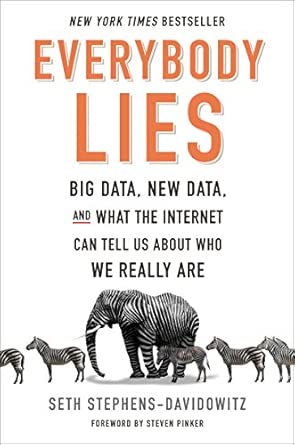
  • Everybody Lies: Big Data, New Data, and What the Internet Can Tell Us About Who We Really Are
  • Everybody Lies: Big Data, New Data, and What the Internet Can Tell Us About Who We Really AreMerchant Video
  • VIDEO

Follow the author

Get new release updates & improved recommendations
Something went wrong. Please try your request again later.

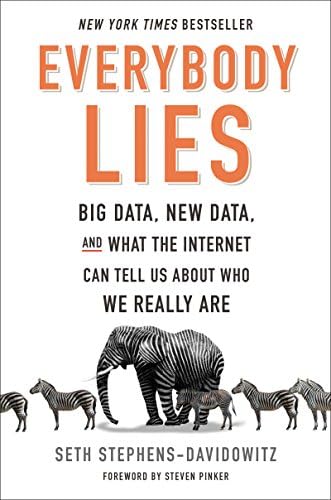
Everybody Lies: Big Data, New Data, and What the Internet Can Tell Us About Who We Really Are Hardcover – Illustrated, May 9, 2017

4.4 out of 5 stars (6,221)

Purchase options and add-ons

An Economist Best Book of the Year

A PBS NewsHour Book of the Year

An Entrepeneur Top Business Book

An Amazon Best Book of the Year in Business and Leadership

New York Times Bestseller

Foreword by Steven Pinker, author of The Better Angels of our Nature

Blending the informed analysis of The Signal and the Noise with the instructive iconoclasm of Think Like a Freak, a fascinating, illuminating, and witty look at what the vast amounts of information from Big Data now instantly available to us reveals about ourselves and our world―provided we ask the right questions.

By the end of an average day in the early twenty-first century, human beings searching the internet will amass eight trillion gigabytes of data. This staggering amount of information―unprecedented in history―can tell us a great deal about who we are―the fears, desires, and behaviors that drive us, and the conscious and unconscious decisions we make. From the profound to the mundane, this new approach to social science allows us to gain astonishing knowledge about the human psyche that less than twenty years ago, seemed unfathomable.

Everybody Lies offers fascinating, surprising, and sometimes laugh-out-loud insights into everything from economics to ethics to sports to race to sex, gender and more, all drawn from the world of big data. What percentage of white voters didn’t vote for Barack Obama because he’s black? Does where you go to school effect how successful you are in life? Do parents secretly favor boy children over girls? Do violent films affect the crime rate? Can you beat the stock market? How regularly do we lie about our sex lives and who’s more self-conscious about sex, men or women?

Investigating these questions and a host of others using surprising sources like internet search data, Seth Stephens-Davidowitz offers revelations that can help us understand ourselves and our lives better. Drawing on studies and experiments on how we really live and think, he demonstrates in fascinating and often funny ways the extent to which all the world is indeed a lab. With conclusions ranging from strange-but-true to thought-provoking to disturbing, he explores the power of this digital truth serum and its deeper potential―revealing biases deeply embedded within the human psyche, information we can use to change our culture, and the questions we’re afraid to ask that might be essential to our health―both emotional and physical. All of us are touched by big data everyday, and its influence is multiplying. Everybody Lies challenges us to think differently about how we see it and the world.

What secrets are hidden in our internet searches?

  • Digital Truth Serum: Discover what people confess to a search engine that they would never admit to a pollster, from secret political biases to surprising sexual anxieties.
  • Human Behavior, Unfiltered: Explore surprising truths about everything from the real effects of violent movies to whether parents secretly favor sons over daughters.
  • Behavioral Economics in the Wild: Go beyond theory to see what trillions of data points reveal about our conscious and unconscious decisions in economics, sports, ethics, and more.
  • The Science of Google Trends: Learn how the simple act of searching for information becomes the most important dataset ever collected on the human psyche, revealing the world as it truly is.

Books with Buzz
Discover the latest buzz-worthy books, from mysteries and romance to humor and nonfiction. Explore more

Great on Kindle
Great Experience. Great Value.

iphone with kindle app
Putting our best book forward
Each Great on Kindle book offers a great reading experience, at a better value than print to keep your wallet happy.

Explore your book, then jump right back to where you left off with Page Flip.

View high quality images that let you zoom in to take a closer look.

Enjoy features only possible in digital – start reading right away, carry your library with you, adjust the font, create shareable notes and highlights, and more.

Discover additional details about the events, people, and places in your book, with Wikipedia integration.

Get the free Kindle app: Link to the kindle app page Link to the kindle app page
Enjoy a great reading experience when you buy the Kindle edition of this book. Learn more about Great on Kindle, available in select categories.

Frequently bought together
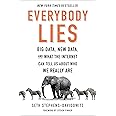
This item: Everybody Lies: Big Data, New Data, and What the Internet Can Tell Us About Who We Really Are
$16.62
Get it as soon as Tuesday, Jun 16
Sold by Cevherbooks and ships from Amazon Fulfillment.
+
$9.99
Get it as soon as Wednesday, Jun 10
In Stock
Sold by OTTNOT and ships from Amazon Fulfillment.
Total price: $00
To see our price, add these items to your cart.
Details
Added to Cart
Some of these items ship sooner than the others.
Choose items to buy together.

Customers also bought or read

Loading...

Editorial Reviews

Review

“Move over Freakonomics. Move over Moneyball. This brilliant book is the best demonstration yet of how big data plus cleverness can illuminate and then move the world. Read it and you’ll see life in a new way.” - Lawrence Summers, President Emeritus and Charles W. Eliot University Professor of Harvard University

“Everybody Lies relies on big data to rip the veneer of what we like to think of as our civilized selves. A book that is fascinating, shocking, sometimes horrifying, but above all, revealing.” - Tim Wu, author of The Attention Merchants

“Brimming with intriguing anecdotes and counterintuitive facts, Stephens-Davidowitz does his level best to help usher in a new age of human understanding, one digital data point at a time.” - Fortune, Best New Business Books

Freakonomics on steroids―this book shows how big data can give us surprising new answers to important and interesting questions. Seth Stephens-Davidowitz brings data analysis alive in a crisp, witty manner, providing a terrific introduction to how big data is shaping social science.” - Raj Chetty, Professor of Economics at Stanford University

“This book is about a whole new way of studying the mind . . . an unprecedented peek into people’s psyches . . . Time and again my preconceptions about my country and my species were turned upside-down by Stephens-Davidowitz’s discoveries . . . endlessly fascinating.” - Steven Pinker, author of The Better Angels of Our Nature

Everybody Lies is a spirited and enthralling examination of the data of our lives. Drawing on a wide variety of revelatory sources, Seth Stephens-Davidowitz will make you cringe, chuckle, and wince at the people you thought we were.” - Christian Rudder, author of Dataclysm

“A whirlwind tour of the modern human psyche using search data as its guide. . . . The empirical findings in Everybody Lies are so intriguing that the book would be a page-turner even if it were structured as a mere laundry list.” - The Economist

“Pivotal . . . A book for those who are intensely curious about human nature, informational analysis, and amusing anecdotes to the tune of Steven Levitt and Stephen Dubner’s Freakanomics.” - Library Journal

Everybody Lies is a tour de force―a well-written and entertaining journey through big data that, along the way, happens to put forward an important new perspective on human behavior itself. If you want to understand what’s going on in the world, or even with your friends, this is one book you should read cover to cover.” - Peter Orszag, Managing Director, Lazard and former Director of the Office of Management and Budget

“A tour de force―a well-written and entertaining journey through big data that, along the way, happens to put forward an important new perspective on human behavior itself. If you want to understand what’s going on in the world, or even with your friends, this is one book you should read cover to cover.” - Peter Orszag, Managing Director, Lazard and former Director of the Office of Management and Budget

“Stephens-Davidowitz, a former data scientist at Google, has spent the last four years poring over Internet search data . . . What he found is that Internet search data might be the Holy Grail when it comes to understanding the true nature of humanity.” - New York Post

Everybody Lies is an astoundingly clever and mischievous exploration of what big data tells us about everyday life.  Seth Stephens-Davidowitz is as good a data storyteller as I have ever met.” - Steven Levitt, co-author, Freakonomics

From the Back Cover

How much sex are people really having? 
How many Americans are actually racist?
Is America experiencing a hidden back-alley abortion crisis?
Can you game the stock market?
Does violent entertainment increase the rate of violent crime?
Do parents treat sons differently from daughters?  
How many people actually read the books they buy?

In this groundbreaking work, Seth Stephens-Davidowitz, a Harvard-trained economist, former Google data scientist, and New York Times writer, argues that much of what we thought about people has been dead wrong. The reason?  People lie, to friends, lovers, doctors, surveys—and themselves.

However, we no longer need to rely on what people tell us. New data from the internet—the traces of information that billions of people leave on Google, social media, dating, and even pornography sites—finally reveals the truth. By analyzing this digital goldmine, we can now learn what people really think, what they really want, and what they really do. Sometimes the new data will make you laugh out loud. Sometimes the new data will shock you.  Sometimes the new data will deeply disturb you.  But, always, this new data will make you think.

Everybody Lies combines the informed analysis of Nate Silver’s The Signal and the Noise, the storytelling of Malcolm Gladwell’s Outliers, and the wit and fun of Steven Levitt and Stephen Dubner’s Freakonomics in a book that will change the way you view the world. There is almost no limit to what can be learned about human nature from Big Data—provided, that is, you ask the right questions.

Product details

  • Publisher ‏ : ‎ Dey Street Books
  • Publication date ‏ : ‎ May 9, 2017
  • Edition ‏ : ‎ Illustrated
  • Language ‏ : ‎ English
  • Print length ‏ : ‎ 352 pages
  • ISBN-10 ‏ : ‎ 0062390856
  • ISBN-13 ‏ : ‎ 978-0062390851
  • Item Weight ‏ : ‎ 2.31 pounds
  • Dimensions ‏ : ‎ 1.3 x 5.7 x 8.3 inches
  • Best Sellers Rank: #318,918 in Books (See Top 100 in Books)
  • Customer Reviews:
    4.4 out of 5 stars (6,221)

About the author

Follow authors to get new release updates, plus improved recommendations.
Seth Stephens-Davidowitz
Brief content visible, double tap to read full content.
Full content visible, double tap to read brief content.

Seth is a data scientist, economist, and author. He has worked as a data scientist at Google, a contributing op-ed writer for the New York Times, and a visiting lecturer at The Wharton School. He is the author of 3 books, including Everybody Lies, which was a New York Times bestseller and an Economist Book of the Year. He has a BA in philosophy from Stanford and a PhD in economics from Harvard. He lives in Brooklyn and is a passionate fan of the Mets, Knicks, Jets, and Leonard Cohen.

Customer reviews

4.4 out of 5 stars
6,221 global ratings

Customers say

Customers find this book to be a super interesting read with great insights and amazing amount of research. The writing style is conversational, making it easy to understand, and customers appreciate its humor and meaningful examples. They describe it as highly engaging, with one customer noting how it makes data fun, while another mentions how it explains technology in a non-technical way.
AI Generated from the text of customer reviews

Select to learn more

361 customers mention content, 336 positive, 25 negative
Customers find the content of the book super interesting and wonderful, describing it as a must-read that is pleasant to read.
Great book and incredibly interesting. Didn't give it five stars because a few times it felt a bit repetitive in the discussions....Read more
This is the most eye-opening, interesting, thought-provoking book I've read in years. Just bought a copy for my son and recommended it on Facebook.Read more
A great, great read offering numerous applications of the revolutionary approach that Seth's pioneered for estimating public opinion...Read more
I read it in two days. It is an easy and fun read even for the general reader. “...Read more
233 customers mention informative, 205 positive, 28 negative
Customers find the book informative, praising its great insights and amazing amount of research, with one customer noting it serves as a good introduction to the topic.
Funny, insightful, intelligent. Everybody Lies is a great way to think through just what Big Data can tell us about society and human life.Read more
...But if you just read it for some humor and fun facts you will not be disappointed....Read more
Informative, quirky, and readable. It tells us plenty about ourselves, and portends the coming big data information age....Read more
Very interesting topics, well researched and well argued....Read more
51 customers mention engaging, 51 positive, 0 negative
Customers find the book highly engaging and entertaining, making data fun to read.
Fun, Interesting, funny, new ideas. This book has it all. The ideas in this book will allow humans to understand human behaviour better....Read more
...read, and surprising findings make this book thought-provoking and entertaining. Highly recommend it. Well done, Seth!...Read more
...book's style was guided first by a desire to keep it fast-flowing and engaging. It succeeds at that, hence the four stars....Read more
...shares several entertaining data science use cases that keep the reader engaged and illuminated....Read more
49 customers mention writing style, 42 positive, 7 negative
Customers appreciate the writing style of the book, finding it well-crafted and conversational, with one customer noting its brilliant treatment of Big Data.
Well written and researched examination of "what the shadow knows" and worth reading for anyone who suspects that many things that people say out...Read more
I found this understandable , concise and engaging....Read more
My title said enough. This is extremely well written, somewhat technical at times but explained, and understandable....Read more
...Writing style is easy to follow, but at times a bit too casual.Read more
48 customers mention readability, 43 positive, 5 negative
Customers find the book easy to read and understand, with one customer mentioning they read parts out loud to friends, while another describes it as a highly readable dive into data.
...not particularly difficult to follow as it is a relatively quick and easy read. But although a t is rather brief, it is dense....Read more
Interesting topics, easy to read, and surprising findings make this book thought-provoking and entertaining. Highly recommend it. Well done, Seth!...Read more
Excellent book. Clear and nicely organized. Full of interesting beginning studies....Read more
The book is an easy read, written in mostly conversational style. Yes, I did finish the book, though I agree with the data that most do not....Read more
35 customers mention humor, 34 positive, 1 negative
Customers find the book humorous, with many appreciating its insights delivered with a sense of humor.
Fun, Interesting, funny, new ideas. This book has it all. The ideas in this book will allow humans to understand human behaviour better....Read more
...are a bit strong, but has some very insightful information, written with humor and intellect.Read more
...of moral superiority ruined an entire book that was supposed to be witty, fun, thoughtful, and provoking.Read more
...This was a quick read with funny bits and interesting information. And yes, I finished the book.Read more
32 customers mention complexity, 26 positive, 6 negative
Customers appreciate how the book explains complex topics in a simple manner, with one customer noting that it avoids technical jargon and formulas.
Easy, fun, interesting but mostly just really exciting. It reads like an excitable humanist describing his high hopes for humanity.Read more
...Great intro into big data. Not too technical but enough to make you want to learn more....Read more
...It’s important to understand, and tells us a lot of things about ourselves as humans that I’m not sure I’m happier knowing....Read more
...on big data in a variety of meanings, very cool examples and easy to follow structure....Read more
23 customers mention examples, 22 positive, 1 negative
Customers appreciate the book's examples, which are meaningful and practical, with one customer noting how they can be used in presentations.
This book was entertaining, with real life examples. It makes you think deeper about everything instead of taking things at face value....Read more
Very well written and structured book that has good examples that explain the uses and possibilities of big data....Read more
...That is what I got from reading this book. That, alone, excites and inspires me to explore and learn more....Read more
...Using many examples, ranging from enlightening (racism pervasive in the country), to quirky (people’s preferences on porn websites), the author...Read more
funny and informative
5 out of 5 stars
funny and informative
This is the funniest book I've read in general in a long time. I'm a data scientist but I've read Seth SD's NY Times pieces and they were great. So I ordered this book. I read it in about two nights since I got it. He's got stories that you wouldn't believe. I'm kinda afraid of what I put into google now. It's really eye opening how much data there is and that anyone can access aggregate data like this book does to find out interesting things. The best and most serious stories are about racism, but Seth does a great job of being neutral and sticking to the facts. Just like in his Times articles. I honestly haven't read such a good book since the first Freakonomics. It's that good!! Five stars all the way!
Thank you for your feedback
Sorry, there was an error
Sorry we couldn't load the review

Top reviews from the United States

  • 5 out of 5 stars
    A vagina is a vagina
    Reviewed in the United States on December 14, 2017
    Brief content visible, double tap to read full content.
    Full content visible, double tap to read brief content.

    The author Seth is smart, poignant and funny. It was a fun book and I read it in two days. This book is really great for so many people who really do not see the lies they tell themselves. I talk on this subject often, so the book was no surprise. But there were a few subjects I found fun and/or surprising. There are lots of fun subjects to keep just about anyone interested. I doubt that this book will make the masses look into the lies they tell themselves and change...but I hope so. I pride myself on not being a liar, but if a stranger asked me my favorite porn or how often I pick my nose, I might not be so honest. We all tell white lies on occasion, but we should never lie to ourselves, that is ridiculous and yet is more common than not. I hope this book opens many eyes and helps individuals be more comfortable with themselves. But if you just read it for some humor and fun facts you will not be disappointed. On a side note to woman from a woman in her 40's: Your vagina should not smell like roses and soap. It should smell like a vagina. A vagina is a vagina, it has the potent smell of a vagina. Stop hating the smell of your vagina, its perfect just the way it is.

    One person found this helpful
    Sending feedback...
    Thank you for your feedback.
    Sending feedback...
    Thanks, we'll investigate in the next few days.
  • 4 out of 5 stars
    Smart, fun and fast-paced read, but overstates its case
    Reviewed in the United States on May 10, 2017
    Brief content visible, double tap to read full content.
    Full content visible, double tap to read brief content.

    The basic thesis of "Everybody Lies" is that online data on human behavior, including Google searches and data from Facebook, shopping and pornographic sites, can reveal much about what we really think than data from surveys in which people might be too embarrassed to tell the truth. In our unguarded moments, when we are alone and searching Google in the privacy of our homes, we are much more likely to divulge our innermost desires. The premise is that truly understanding human behavior by way of psychology or neuroscience is too complicated right now, so it's much better to simply bypass that kind of understanding and look at what the numbers are telling us in terms of what people's online behavior. In doing this the author looks at a remarkable variety of online sources and studies by leading researchers, and one must congratulate him for the diversity and depth of material he has plumbed.

    What has allowed us to access this pool of unguarded opinions and truckloads of data concerning human behavior is the Internet and the tools of "big" data. As the author puts it, this data is not just "big" but also "new", which means that the kind of data we can access is also quite different from what we are used to; in his words, we live in a world where every sneeze, cough, internet purchase, political opinion, and evening run can be considered "data". This makes it possible to test hypotheses that we could not have tested before. For instance, the author gives the example of testing Freud's Oedipus Complex through accessing pornographic data which indicates a measurable interest in incest. Generally speaking there is quite an emphasis on exploring human sexuality in the book, partly because sexuality is one of those aspects of our life that we wish to hide the most and are also pruriently interested in, and partly because investigating this data through Google searches and pornographic sites reveals some rather bizarre sexual preference that are also sometimes specific to one country or another. This is a somewhat fun use of data mining.

    Data exploration can both reveal the obvious as well as throw up unexpected observations. A more serious use of data tools concerns political opinions. Based on Google searches in particular states, the author shows how racism (as indicated by racist Google searches) was a primary indicator of which states voted for Obama in the 2008 election and Trump in the 2016 election. That's possibly an obvious conclusion, at least in retrospect. A more counterintuitive conclusion is that the racism divide does not seem to map neatly on the urban-rural divide or the North-South divide, but rather on the East-West divide; people seem to be searching much more for explicitly racist things in the East compared to the West. There is also an interesting survey of gay people in more and less tolerant states which concludes that you are as likely to find gay people in both parts of the country. Another interesting section of the book talked about how calls for peace by politicians after terrorist attacks actually lead to more rather than less xenophobic Google searches; this is accompanied by a section that hints at how the trends can be potentially reversed if different words are used in political speeches. There is also an interesting discussion of how the belief that newspaper political leanings drive customer political preferences gets it exactly backward; the data shows that customer political preferences shape what newspapers print, so effectively they are doing nothing different from any other customer-focused, profit making organization.

    The primary tool for doing all this data analysis is correlation or regression analysis, where you look at online searches and try to find correlations between certain terms and factors like geographic location, gender, ethnicity. One hopes that one has separated the most important correlated variable and has eliminated other potentially important ones.

    There are tons of other amusing and informative studies - sometimes the author's own but more often other people's - that reveal human desires and behavior across a wide swathe of fields, including politics, dating, sports, education, shopping and sexuality. There's plenty of potentially useful material in these studies. For instance, some of the data that indicates gaps in educational or social attainment in different parts of the country are immediately actionable in principle. Google searches have also been used to keep track of flu and other disease epidemics. Sometimes finding correlations is financially lucrative; there is a story about how a horse expert found that success in horse races seems to correlate with one factor more than any other: the size of the left ventricle. Another study isolated the impact of the early growing season on the quality of wines. There is no doubt that financial firms, supermarkets, newspapers, hospitals and online purveyors of everything from pornography to peanuts are going to keep a close eye on this data to maximize their reach and profits.

    Generally speaking I enjoyed "Everybody Lies"; for the scope of the material, the easy-going style and some of the counterintuitive observations it reveals. My main reservation about the book is that I think the author overstates his case and sometimes sounds a little too breathless about the great changes these tools are going to bring. More than once he uses the term "revolutionary" in describing these data tools, but I am much more suspicious of their ultimate utility. Firstly, data does not equal knowledge; rather, it is the raw material for knowledge. As the author himself acknowledges, understanding correlation is not the same as understanding causation, and it's in very few cases that a true causal relationship between people's Google searches and their true nature can be established. Part of the reason I think this way is because I don't believe that a person's Google search is as reflective of their innermost desires as the book seems to think, so what a person truly believes may go way beyond their online behavior. Consider the studies revealing people's sexual preferences for instance; how many of them point to trivial idiosyncrasies and how many are indicative of some deeper truth about human brains? The tools alone cannot draw this distinction. At the end of the day you could thus end up with a lot of data (including a lot of noise), but teasing apart the useful data points from the red herrings is a completely different matter. In this sense, looking at Google searches and other information can be a reductionist and simplistic approach.

    Secondly, it's usually quite hard to control for all possible variables that may reflect a Google search; for instance in concluding that racism contributes the most to a particular political behavior, it's very hard to tease out all other factors that also may do so, especially when you are talking about a heterogeneous collection of human beings. How can you know that you have corrected for every possible factor? Thirdly and finally, the "science" part of "data science" still lacks rigor in my opinion. For instance, a lot of the conclusions the book talks about are based on single studies which don't seem to be repeated. In some cases the sample sizes are large, but in other cases they are small. Plus, people's opinions can change over time, so it's important to pick the right time window in which to do the study. All this points to great responsibility on the part of data scientists to make sure that their results are rigorous and not too simplistic, before they are taken up by both politicians and the general public as blunt instruments to change social policies. This responsibility increases especially as these approaches become more widespread and cheaper to use, especially in the hands of non-specialists. When you are in possession of a hammer, everything starts looking like a nail.

    Considering all these caveats, I thus find tools like those described in this volume to be the starting points for understanding human behavior, rather than direct determinants of human behavior. The tools themselves can tell you what they can be used for, not necessarily what problems would benefit the most from their application. The many interesting studies in this book certainly answer the "what" quite well, but most of them are still quite far from answering the "how" and especially the "why". They point out the path to the door, but don't necessarily tell us which door to open. And they can be especially impoverished in illuminating what lies beyond; for that only a true understanding of the human mind will pave the way.

    625 people found this helpful
    Sending feedback...
    Thank you for your feedback.
    Sending feedback...
    Thanks, we'll investigate in the next few days.
  • 5 out of 5 stars
    Fascinating and Timely Analysis
    Reviewed in the United States on November 5, 2017
    Brief content visible, double tap to read full content.
    Full content visible, double tap to read brief content.

    I became interested in this book after hearing an interview with the author on the radio, and it certainly lived up to expectations. “Everybody Lies” is a truly timely and fascinating book that primarily explores how using Google data can deliver more reliable results that underscore people’s true thinking and predicts their behavior. The author’s hypothesis, which is backed by data, is that people typically lie even when taking anonymous surveys, but they effectively can’t lie to themselves when they’re conducting searches on Google.

    Some of my favorite parts of the book were the various studies the author conducted using Google search data, particularly regarding sexual orientation, voting behavior, and racial biases. That said, I also really enjoyed earlier parts of his book that had nothing to do with Google and talked about big data generally, particularly when he talked about studies involving horse racing and the socioeconomic backgrounds of NBA players. There was also a section of the book that talked about students who did and didn’t attend highly competitive public schools in New York and measured the impact on their future, which I thought was very interesting. Generally, as interesting as the individual studies were, I think the underlying implications behind them were even more compelling, whether in the business, political, or academic realms.

    If the book has flaws, I would say that the author could be overtly preachy at times, to a degree to which I could see skeptics using his clearly stated opinions as reasons to wrongfully discard his analysis. For example, his analysis on why people voted for Donald Trump is simultaneously interesting and disturbing when he ties it to underlying feelings regarding race. But the author makes so many off-handed comments about Trump throughout the book that I could see anyone “on the fence” being completely turned off regardless of what the data says, for right or wrong. Likewise, I think his conclusions about Big Data are a bit bombastic. The key value in this book are the insights about Google data, however the author tries positioning his work as being on the cutting edge of a big data “revolution” that in reality is almost a decade old.

    Still, the book was fantastic overall and certainly gives you a lot to think about. I really do think the implications of using Google data are pretty incredible and the author does a great job presenting his findings and its potential uses and/or pitfalls. I would highly recommend this book to anyone mildly curious about big data or human psychology.

    9 people found this helpful
    Sending feedback...
    Thank you for your feedback.
    Sending feedback...
    Thanks, we'll investigate in the next few days.
  • 5 out of 5 stars
    A wonderful read.
    Reviewed in the United States on June 6, 2017
    Brief content visible, double tap to read full content.
    Full content visible, double tap to read brief content.

    This is an important book.

    Books that tend to make big proclamations about social-science research either overshoot their marks or make for mind-numbing reads. (Or often, both.) Chapters are slogs to get through, and the authors just can’t help themselves and get overexcited about their work. And their everything-will change, nothing-will-be-the-same-after-this conclusions are, almost always, too grand and too impossible to come true. It makes the whole project feel kind of hollow.

    This book does neither. It’s clear that big-data research will change a lot of things. And it’s equally clear already that big-data research (with a particular tip of the hat to pornography) has shown us that we’re very, very wrong about a lot of basic, fundamental stuff. Yet given this backdrop, the book still manages to remain cautiously optimistic and modest about whatever overarching implications it might have for the years ahead. And that’s a nice, refreshing change.

    And Seth’s book isn’t just an important read—it’s a pleasant one to boot. Although the research is interesting enough on its own, it’s evident that he took great time and care with the writing in each chapter. My wife has gracefully stiff-armed every nonfiction book I’ve ever suggested to her; she devoured this book in a week. While reading through these chapters on my daily commute, I’d have new factoids for my friends and coworkers about just how wrong they were about everything, and they looked forward to hearing all about it.

    It’s fun. You’ll have fun. Give it a shot.

    6 people found this helpful
    Sending feedback...
    Thank you for your feedback.
    Sending feedback...
    Thanks, we'll investigate in the next few days.
  • 3 out of 5 stars
    A fresh insight into Big Data, but personal views distorts some of the impact.
    Reviewed in the United States on May 23, 2017
    Brief content visible, double tap to read full content.
    Full content visible, double tap to read brief content.

    An interesting read. For me it was sort of an eye opener into a new way of looking at and thinking of using available data to reach new and better understandings. Problem is that the author has a completely different axe to grind and do so throughout the entire book.

    There is something the author repeatedly focuses on which for me just seems forced and illogical. He's focus on how bad islamophobia is. Why is this mentioned time and time again? The author gives no background for why such a view is unquestionably bad. Why is islamophobia so bad? He mentions antisemitism and racism. These are believes/views we -know- have caused unimaginable pains and suffering. However a fear of or an unfavorable view upon Islam seems to me to be quite healthy. If you wholeheartedly disagree with me you choose(?) to not consider any facts. At least if you disagree with me, like what the author does, at least explain your point of view. Just for a paragraph or two.

    In his book the author view any area of interest from different angles. He tries different perspectives to reach a conclusion. On islamophobia there is no different angles. No alternating views. No diving into the depth of data to see if there is a reason for people to have or to form such an opinion. Shouldn't that be an obvious thing to start with? How/where did fear of islam become unquestionable bad? Should the author's personal view just be taken as a fact?

    The apex of this peculiar recurring viewpoint is at the end of the book where the author starts talking about usage of Big Data in preventing crime. He then does research on for example "kill muslim" seemingly taking it for granted that islamophobia is the path to this. This he relates to a number of 12 killed muslims. (Not) surprisingly the ratio of searches compared to deaths are extremely high. So high there seems to really be no correlation at all. The author also also seem to fail to mention that these deaths could be unrelated to any "islamophobic crime". It's just such a weird area of focus. Why this obsessions with fear of islam?

    It is an obsession. The natural thing to do after doing the research on "kill muslim" and that would also be following the research done for the other subjects in this book, would be to research the opposite. See if there is a rationality behind people actually looking unfavorable upon Islam as a belief and an ideology. Where is the research on "jihad", "do jihad", "commit jihad" and etc.? While writing this, 23rd of May 2017, I'm right now getting a newsfeed from a terrorist attack in Manchester, England. At least 20 people including children killed in a bomb attack. Could Big Data have prevented this? Probably not by looking at searches made for "kill muslim"...

    Dates related to this subject from Europa, but not motivated by islamophobia:

    * Manchester, 23. May: 20+ people killed

    * Stockholm, 7. April 2017: Fem people killed

    * St. Petersburg, 3. April 2017: 14 people killed

    * London 22. March 2017: 5 people killed

    * Istanbul, 31. December 2016: 39 people killed

    * Berlin, 19. December 2016: 12 people killed

    * Nice, 14. July 2016: 86 people killed

    * Istanbul, 28. June 2016: 36 people killed

    * Brussel, 22. March 2016: 32 people killed

    * Istanbul, 12. January 2016: 13 people killed

    * Paris, 13. November 2015: 130 people killed

    * Paris, 7. January 2015: 12 people killed

    * Paris, 9. January fire people killed

    * Istanbul, 10. October 2015: 102 people killed

    * Istanbul, 20. July 2015: 33 people killed

    Then we have the number of people killed in all the ongoing conflicts between jihadists and society in the middle east. Probably hundres of thousands. Millions of refugees. Then we have the number of people killed because of islam and islamic rule.

    Another list:

    1. Afghanistan

    2. Iran

    3. Malaysia

    4. Maldives

    5. Mauritania

    6. Nigeria

    7. Pakistan

    8. Qatar

    9. Saudi Arabia

    10. Somalia

    11. Sudan

    12. United Arab Emirates

    13. Yemen

    These are countries where non-believers can be sentenced to death. For being non-believers! But have no fear. We'll focus on the world altering problem of islamophobia. Big Data will help us in this fight. Fear of Islam as a religion and ideology is totally and utterly unfounded. Where could anyone anywhere have gotten such a notion? The author of this book has spoken!

    Although this is a very serious and grave are there is a funny side to this book, related to the author's focus on fear of Islam. He spend a lot of time talking about president Obama's speech after the shooting in San Bernardino, California, 2015. Obama wanted to address the country and hopefully try convey the notion that the government could both stop terrorism and lessen islamophobia. Or as written by the author, "government could both stop terrorism and, perhaps more important, quiet this dangerous Islamophobia". The author probably and hopefully does not mean this, but what he writes almost reads like the fear of Islam is worse than (muslim) terrorist killing people(?)... The author then does a research on the result of Obama's speech and if it did in fact result in a better understanding between different views, and if it did induce tolerance and inclusion. It did not (according to the author). The funny thing is that this book does the same regarding this (important) subject for the author. His focus on the fallacy of thinking Islam is something to be feared does in fact in no way lessen my increased sceptical view on Islam. The author does nothing to explain his viewpoint. Just state a "fact" that Islamophobia is bad. So bad that the obvious thing relating to Islamophobia is searches for "kill muslims". In fact this fear is so bad that there does not seem necessary at all to actually dive into the data and see if there is something more to this. We should just take his view as a fact.

    30 people found this helpful
    Sending feedback...
    Thank you for your feedback.
    Sending feedback...
    Thanks, we'll investigate in the next few days.
  • 4 out of 5 stars
    In like manner, the quality of a wine can be ...
    Reviewed in the United States on November 29, 2017
    Brief content visible, double tap to read full content.
    Full content visible, double tap to read brief content.

    Author Stephens-Davidowitz is a data scientist, someone employed to analyse and interpret complex digital data. He has worked at Google, who hired him after learning about the strength and accuracy of his data research into racism.

    His exploration of data has led to fascinating revelations about mental illness, human sexuality, child abuse, abortion, advertising, religion and health. The datasets enabled by the digital explosion, offered new perspectives on all manner of issues that didn’t exist a couple of decades ago.

    The microscope made it possible to see that there is more to a drop of pond water than we thought, and the telescope showed us there is so much more to the night sky than we imagined. Digital data similarly reveals that there is more to human behaviour and society than we thought, and often very different to what we thought.

    “One of the primary goals of this book… is to provide the missing evidence of what can be done with Big Data—how we can find the needles, if you will, in those larger and larger haystacks,” the author explains.

    In the past we might have suspected something, now using Big Data, we can prove it, or show that the world works in precisely the opposite manner.

    The author’s grandmother frequently emphasized the importance of couples having common friends as a key factor for their marital success, as it was in hers. Is this sound advice?

    A team of computer scientists recently analysed the biggest dataset ever assembled on human relationships—Facebook, to answer this question. What the data showed was that having a common core group of friends, is a strong predictor that a relationship will not last. Having separate social circles may actually make relationships stronger.

    So why did grandmother believe just the opposite of what is true? People tend to exaggerate the relevance of their own experience. We give far too much to weight to certain data points – ourselves. Similarly, we tend to overestimate the prevalence of anything that makes for a memorable story. Consider, for example, whether more people in the OECD countries die from terrorist attacks, or from drowning in bath tubs? (The answer is bath tubs!)

    The author claims four unique powers of Big Data.

    The first power of Big Data is, obviously, new data – data that could not be understood in small quantities.

    The second power is being able to provide honest data. In the digital age, people still hide their thoughts, prejudices and desires from themselves and from other people. This is the origin of the book’s title, “Everybody Lies”. However, through people’s searches on the internet for example, even with their anonymity protected, people’s aggregated views are accurate and honest reflections of their thoughts.

    We can also zoom in on small subsets of people - the third power of Big Data. For example, are people sick with the flu more likely to make flu-related searches? Which searches most closely track housing prices? If for example, searches for schools in a district increase, we can expect housing price changes.

    We can also do many causal experiments with Big Data. What types of crucial information will make the stock market move? In the U.S. one answer is the monthly unemployment rate. Financial institutions do whatever they can to maximize the speed with which they receive, analyse, and act on this information, and make buy or sell decisions. Today, once the labour statistics are released, the market will move in less time than it takes you to blink your eyes.

    By analysing Big Data, we are also able to identify information of real value even if it is not explained. The size of a horse’s heart, and particularly the size of the left ventricle, is the single most important predictor of a horse’s success. In the same vein, horses with small spleens earned virtually nothing. And the horse’s pedigree is a far less reliable predictor of success that we used to believe. This realization will eventually affect the price of pedigreed horses.

    Based on their Big Data analysis, Walmart identified a strong positive correlation between the sale of strawberry Pop-Tarts, and impending hurricanes. In like manner, the quality of a wine can be explained simply by the weather during the growing season, and less by a host of other factors we have become used to considering.

    If your goal is to predict which wine will excel, what products will sell, which horses will win, you don’t need to be concerned with why your model works. “Just get the numbers right,” Stephens-Davidowitz recommends

    Big Data comes in many forms – not only numbers, but text and even images. Traditionally, when academics or businesspeople want data, they conduct surveys.

    Do newspapers influence readers’ left or right political leanings, or do readers’ leanings influence the newspaper? Using Big Data researchers can prove that just as supermarkets identify what ice cream people want, and then fill their shelves with it, newspapers identify the viewpoints people want to read, and fill their pages with it. The influence relationship is in the opposite direction to what many thought. But the two big data sets, how people vote in a district, and which papers they read, don’t lie.

    Pictures are also data, as we see from the changing ways people have posed. Researchers studied 949 scanned yearbooks from American high schools from 1905–2013. From these they were able to create an “average” face out of the pictures from every decade. The image data showed how Americans, particularly women, started smiling in photos.

    People originally thought of photographs as paintings for which you posed for hours. Holding a smile would have been impossible. When Kodak began associating photos with happiness, being photographed smiling was how people want to show others what a good time they were having.

    This is the stuff of science, not pseudoscience. In the past, the world’s most famous linguists analysed individual texts – today they can reveal patterns across billions of books. The methodologies taught to graduate students in psychology, political science, and sociology and business, have been virtually untouched by the digital revolution.

    This book demonstrates how much they have missed.

    Readability Light --+-- Serious

    Insights High -+--- Low

    Practical High --+-- Low

    *Ian Mann of Gateways consults internationally on leadership and strategy, and is the author of the recently released ‘Executive Update.

    8 people found this helpful
    Sending feedback...
    Thank you for your feedback.
    Sending feedback...
    Thanks, we'll investigate in the next few days.
  • 5 out of 5 stars
    Between seminal and simply thought-provoking.
    Reviewed in the United States on July 20, 2017
    Brief content visible, double tap to read full content.
    Full content visible, double tap to read brief content.

    You may have heard this is the book about the data from Google and PornHub searches. There is a chapter or two and many factoids along those lines. But the author's contention is much more than what you read in the reviews.

    This book is about Big Data. Big Data which includes those searches, but also a lot more. Already years and years of books, newspapers and magazines have been digitized and made searchable. Now we can determine when the United States went from an "are" to an "is." (About 1880.) Now we can determine to a few decimal points how valuable a case of wine is based on the weather in the vineyard. If WalMart opened its treasure trove to us I suppose we could know when fungal infections peak in Texas. Just if we really needed to know.

    Big Data is all those searches, all those newspapers, all the books, all the inventory data, all the telephone traffic data, all the FaceBook posts, all the sales information for everything. All of it is stored somewhere in and someday it will all be available.

    Some data is Important. (We know the census is Important.) Some data is Unimportant. (Sales of steak sauce is Unimportant.) But all of it can be combined, compared and examined in ways that will be important beyond all our imaginings. This is a case of "Quantity had a Quality all its own."

    The digitization of past data will change how we view our history. The oceans of data we are compiling now will allow our chroniclers to know us better than we know ourselves.

    The book is somewhere between seminal and simply thought-provoking. I think you ought to read it.

    4 people found this helpful
    Sending feedback...
    Thank you for your feedback.
    Sending feedback...
    Thanks, we'll investigate in the next few days.
  • 5 out of 5 stars
    rollicking exploration into how big data helps us better understand ourselves
    Reviewed in the United States on May 30, 2017
    Brief content visible, double tap to read full content.
    Full content visible, double tap to read brief content.

    Everybody Lies is a fast-paced, rollicking exploration into how big data helps us better understand ourselves, our predilections, and our prejudices. There is much to like here. Topically, it fits in the genre of other creative and well-researched books like Freakeconomics and Outliers. The author has a clear objective and ample skill, but to say that he is singularly devoted to showing ways big data can unearth hidden truths understates his dexterity, pluckiness, and enthusiasm. Stephens-Davidowitz hunts for truths like a pig hunts for truffles. And he’s really really good at it.

    I admired the author's eagerness to take on touchy topics in part because he does so with an abundance of wit, insight, and disarming sincerity. Whether diving into dating patterns, pornhub data, exploring tax fraud contagion, or recounting an awkward meeting with Larry Summers, Stephens-Davidowitz has a knack for exceptionally vivid and engaging story-telling. Stylistically, I could see comparisons to Malcolm Gladwell and Jordan Ellenberg, but I actually found him to be more like a mathematically-minded Jonathan Ames. I lost track of how many times I burst out laughing. And, despite the author’s Klein-bottle-of-a-conclusion that it is unlikely you will ever read his conclusion (a view support by… big data), I made it to the end with a smile, and am already looking forward to his next book.

    Sending feedback...
    Thank you for your feedback.
    Sending feedback...
    Thanks, we'll investigate in the next few days.

Top reviews from other countries

    Translated by Amazon
    See original
  • 5 out of 5 stars
    Quienes somos cuando internet es nuestro asesor?
    Reviewed in Mexico on October 28, 2024
    Brief content visible, double tap to read full content.
    Full content visible, double tap to read brief content.

    La llegada de internet y la super conectividad, el mundo cambia y las sociedades y al final, el ser humano. Siendo un mundo despersonalizado, las personas, preguntan, buscan y se identifican con grupos e información que antes no tenían, no necesariamente para ser mejores seres humanos, pero más para confirmar sus visiones de vida (sesgados) que eventualmente les hacen estar más convencidos de sus propias convicciones. La era de la información -hasta ahora- ha funcionado para confirmar formas de pensar (incluso radicalizarlas). Ante una mayor oleada de información, el ser humano se defiende fortaleciendo sus valores no abriéndose a otras posturas pues para cuestionarse, lo cual es necesario. Nadie nos preparó para la era de la información. El acceso a la información no hace al ser humano mejor (no por ahora) porque procesar esa información lleva tiempo y preparación sistemática que aun no existe. En Everybody Lies, Davidowitz, demuestra que el ser humano actúa -impresionantemente igual a otros seres humanos con sus mismas características y por otro lado de acuerdo con sus impulsos animales. Mentimos ante encuestas personales, pero no frente al internet. Los buscadores de internet evidencian la forma de pensar del ser humano, sus preocupaciones, sus culpas y sus deseos (algunos terribles). Parece que el internet es un puente que moverá a la humanidad a entenderse así misma, para eso pasará mucho tiempo.

    Sending feedback...
    Thanks, we'll investigate in the next few days.
    Translated from Spanish by Amazon
    See original
  • 5 out of 5 stars
    Un livre à lire
    Reviewed in France on January 15, 2018
    Brief content visible, double tap to read full content.
    Full content visible, double tap to read brief content.

    J'ai beaucoup aimé ce livre, plus profond qu'il y paraît, très intéressant pour les personnes qui s'intéressent au big data et aussi éclairant sur certains aspects de la société dans laquelle on vit et les perspectives qu'ouvre le Big Data pour les étudier. Je recommande. Le petit bémol comme certains l'ont dit est sa grande taille, il ne rentrait pas dans mon sac... Pour les français qui n'auraient pas confiance en leur anglais, ce livre est écrit dans un anglais assez simple, n'ayez pas peur.

    Sending feedback...
    Thanks, we'll investigate in the next few days.
    Translated from French by Amazon
    See original
  • 5 out of 5 stars
    Sugerente
    Reviewed in Spain on October 31, 2024
    Brief content visible, double tap to read full content.
    Full content visible, double tap to read brief content.

    A book with very Interesting ideas

    Sending feedback...
    Thanks, we'll investigate in the next few days.
  • 5 out of 5 stars
    Não acredite no que as pessoas dizem, mas no que elas fazem
    Reviewed in Brazil on March 23, 2018
    Brief content visible, double tap to read full content.
    Full content visible, double tap to read brief content.

    Fantástico!

    Cheguei neste livro através de um tuíte do Steven Pinker.

    O autor é um ex-cientista de dados do Google e colunista do NY Times, e traz um olhar surpreendente para o comportamento humano através do Big Data utilizando google trends e redes sociais.

    As descobertas e as reflexões são, no mínimo, inquietantes e muitas vezes assustadoras em alguns casos (homens buscando como fazer sexo oral em si mesmo e se preocupam muito mais com o tamanho do órgão genital próprio do que as mulheres; jogadores de basquete oriundos de regiões mais pobres e ambientes familiares adversos não são mais propensos a se tornarem astros da NBA por terem de esforçarem mais; esquerdistas e direitistas se informam no mesmo lugar, etc).

    O propósito do livro é mostrar como mentimos quando nos relacionamos pessoalmente, e nos comportamos diferente na internet (o gancho inicial do livro são as eleições presidenciais americanas de 2016, onde as pesquisas tradicionais apontavam para um lado e os dados na internet para o lado oposto). "Não acredite no que as pessoas dizem, mas no que elas fazem".

    O autor também faz questão de dizer, assim como Nate Silver no brilhante "O sinal e o ruído", que o Big Data não é a solução para tudo. Em muitos casos há a necessidade da interpretação e ação humana para as decisões e ações, e que a área exige cuidado e atenção pois ao mesmo tempo que resolve e melhora diversos campos, ameaça e prejudica muitos outros.

    No fim o autor diz que deseja que esta obra seja um novo Freakonomics, e ao meu ver ele conseguiu.

    Recomendo para curiosos, para quem quer entender o que é e o que não é Big Data de uma maneira leve. Para os que gostam de obter visões e versões diferentes do usual.

    Certamente um dos melhores livros que li.

    Sending feedback...
    Thanks, we'll investigate in the next few days.
    Translated from Portuguese by Amazon
    See original
  • 5 out of 5 stars
    Eine hervorragende Einordnung des Potentials von Big Data
    Reviewed in Germany on June 20, 2017
    Brief content visible, double tap to read full content.
    Full content visible, double tap to read brief content.

    Seth Stephens-Davidowitz vermittelt dem Leser auf eine eindrückliche Art und Weise das grosse Potential von Big Data und dessen Auswirkungen auf die unterschiedlichsten Disziplinen (z.B. Sozialwissenschaften oder Medizin). Er unterlässt es dabei nicht, auch die Limitierungen und Gefahren von Big Data zu thematisieren. Das Buch ist nicht im akademischen Stil verfasst, sehr flüssig geschrieben und mit vielen, zum Teil verblüffenden Beispielen, angereichert. Ich kann das Buch als sehr lesenswert empfehlen.

    Sending feedback...
    Thanks, we'll investigate in the next few days.
    Translated from German by Amazon
    See original