


Discover Yoshi and the Mysterious Book
Buy New
To see product details, add this item to your cart.
Ships from: Amazon.com
Sold by: Amazon.com
To see product details, add this item to your cart. You can always remove it later.
Shipper / Seller
Amazon.com
Amazon.com
Shipper / Seller
Amazon.com
Returns
30-day refund / replacement
This item can be returned in its original condition for a full refund or replacement within 30 days of receipt.
Read full return policy
Payment
Secure transaction
Your transaction is secure
We work hard to protect your security and privacy. Our payment security system encrypts your information during transmission. We don’t share your credit card details with third-party sellers, and we don’t sell your information to others. Learn more
Gift options
Available at checkout
Available at checkout This item is a gift. Change
At checkout, you can add a custom message, a gift receipt for easy returns and have the item gift-wrapped
To see product details, add this item to your cart. You can always remove it later.
Fast Free Shipping – Excellent condition book with clean cover and pages. Barely handled, with minimal wear. An outstanding copy, close to enjoy! Fast Free Shipping – Excellent condition book with clean cover and pages. Barely handled, with minimal wear. An outstanding copy, close to enjoy! See less
Access codes and supplements are not guaranteed with used items.
Ships from and sold by GREENWORLD BOOKS.
Added to

Sorry, there was a problem.

There was an error retrieving your Wish Lists. Please try again.

Sorry, there was a problem.

List unavailable.
Kindle app logo image

Download the free Kindle app and start reading Kindle books instantly on your smartphone, tablet, or computer - no Kindle device required.

Read instantly on your browser with Kindle for Web.

Using your mobile phone camera - scan the code below and download the Kindle app.

QR code to download the Kindle App

  • How Children Succeed: Grit, Curiosity, and the Hidden Power of Character

Follow the author

Get new release updates & improved recommendations
Something went wrong. Please try your request again later.

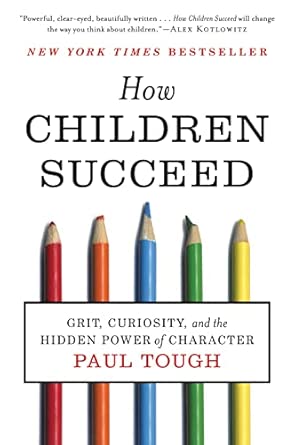
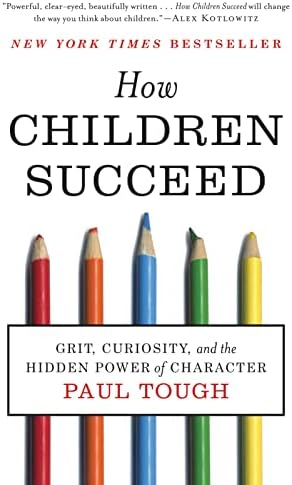
How Children Succeed: Grit, Curiosity, and the Hidden Power of Character

4.4 out of 5 stars (2,688)

Purchase options and add-ons

"A persuasive wake-up call."—People

A
NEW YORK TIMES BESTSELLER

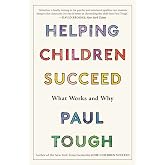
From the award-winning journalist Paul Tough, a provocative and profound examination of child development, success, and character—an insightful study that reveals the power to transform young people’s lives.

Why do some children succeed while others fail? The story we usually tell about childhood and success is the one about intelligence: success comes to those who score highest on tests, from preschool admissions to SATs. In How Children Succeed, Paul Tough argues that success has more to do with character—a set of noncognitive skills that includes perseverance, curiosity, optimism, and self-control. In this groundbreaking study grounded in psychology and neuroscience, Tough introduces us to key researchers and educators, who, for the first time, are using the tools of science to peel back the mysteries of character. Through their stories—and the stories of the children they are trying to help—Tough reveals how developing character strengths like grit has the power to transform young people’s lives. This provocative and profoundly hopeful book will not only inspire and engage readers—it will also change our understanding of childhood itself.

Why is our modern focus on test scores and IQ failing so many children—and what does the science of child development say we should be focusing on instead?

  • The Character Hypothesis: An exploration of why qualities like perseverance, curiosity, and self-control are more predictive of long-term success than IQ scores from preschool to the SATs.
  • The Science of Stress: A look at the groundbreaking neuroscience revealing how childhood adversity shapes the developing brain, and how nurturing relationships can reverse the damage.
  • How Character is Built: From the classrooms of innovative schools to the labs of leading psychologists, discover how traits like grit and self-discipline are not born, but made.
  • Rethinking Education: A new roadmap for parents and educators that moves beyond the achievement gap and focuses on creating environments where all children can thrive.
The%20Amazon%20Book%20Review
The Amazon Book Review
Book recommendations, author interviews, editors' picks, and more. Read it now.

Frequently bought together

This item: How Children Succeed: Grit, Curiosity, and the Hidden Power of Character
$8.11
Get it as soon as Friday, Jun 12
Sold by Frog Champ and ships from Amazon Fulfillment.
+
$9.87
Get it as soon as Friday, Jun 19
Sold by London on the track and ships from Amazon Fulfillment.
+
$10.12
Get it as soon as Thursday, Jun 11
In Stock
Ships from and sold by Amazon.com.
Total price: $00
To see our price, add these items to your cart.
Details
Added to Cart
Some of these items ship sooner than the others.
Choose items to buy together.

Customers also bought or read

Loading...

Editorial Reviews

Review

"Drop the flashcards - grit, character, and curiosity matter even more than cognitive skills. A persuasive wake-up call."
People Magazine "In this absorbing and important book, Tough explains why American children from both ends of the socioeconomic spectrum are missing out on these essential experiences. … The book illuminates the extremes of American childhood: for rich kids, a safety net drawn so tight it’s a harness; for poor kids, almost nothing to break their fall."
—Annie Murphy Paul, 
The New York Times Book Review "An engaging book that casts the school reform debate in a provocative new light. … [Tough] introduces us to a wide-ranging cast of characters — economists, psychologists, and neuroscientists among them — whose work yields a compelling new picture of the intersection of poverty and education."
—Thomas Toch, 
The Washington Monthly "Mr. Tough’s new book, How Children Succeed: Grit, Curiosity and the Hidden Power of Character, combines compelling findings in brain research with his own first-hand observations on the front lines of school reform. He argues that the qualities that matter most to children’s success have more to do with character – and that parents and schools can play a powerful role in nurturing the character traits that foster success. His book is an inspiration. It has made me less of a determinist, and more of an optimist."
—Margaret Wente, 
The Globe and Mail "How Children Succeed is a must-read for all educators. It’s a fascinating book that makes it very clear that the conventional wisdom about child development is flat-out wrong."
—School Leadership Briefing "I loved this book and the stories it told about children who succeed against big odds and the people who help them. … It is well-researched, wonderfully written and thought-provoking."
—Siobhan Curious, Classroom as Microcosm "
How to Succeed takes readers on a high-speed tour of experimental schools and new research, all peppered with anecdotes about disadvantaged youths overcoming the odds, and affluent students meeting enough resistance to develop character strengths."
—James Sweeney, 
Cleveland Plain Dealer "[This] wonderfully written new book reveals a school improvement measure in its infancy that has the potential to transform our schools, particularly in low-income neighborhoods."
—Jay Mathews, 
Washington Post "Nurturing successful kids doesn’t have to be a game of chance. There are powerful new ideas out there on how best to equip children to thrive, innovations that have transformed schools, homes, and lives. Paul Tough has scoured the science and met the people who are challenging what we thought we knew about childhood and success. And now he has written the instruction manual. Every parent should read this book – and every policymaker, too."
— Charles Duhigg, author of
The Power of Habit "I wish I could take this compact, powerful, clear-eyed, beautifully written book and put it in the hands of every parent, teacher and politician. At its core is a notion that is electrifying in its originality and its optimism: that character — not cognition — is central to success, and that character can be taught. How Children Succeed will change the way you think about children. But more than that: it will fill you with a sense of what could be."
—Alex Kotlowitz, author of
There Are No Children Here "Turning the conventional wisdom about child development on its head, New York Times Magazine editor Tough argues that non-cognitive skills (persistence, self-control, curiosity, conscientiousness, grit and self-confidence) are the most critical to success in school and life....Well-written and bursting with ideas, this will be essential reading for anyone who cares about childhood in America. "
— STARRED
Kirkus Reviews “This American Life contributor Tough (Whatever It Takes: Geoffrey Canada’s Quest to Change Harlem and America) tackles new theories on childhood education with a compelling style that weaves in personal details about his own child and childhood. Personal narratives of administrators, teachers, students, single mothers, and scientists lend support to the extensive scientific studies Tough uses to discuss a new, character-based learning approach."
Publishers Weekly

From the Back Cover

“Drop the flashcards—grit, character, and curiosity matter even more than cognitive skills. A persuasive wake-up call.”—People

Why do some children succeed while others fail? The story we usually tell about childhood and success is the one about intelligence: success comes to those who score highest on tests, from preschool admissions to SATs. But in
How Children Succeed, Paul Tough argues that the qualities that matter more have to do with character: skills like perseverance, curiosity, optimism, and self-control.

How Children Succeed introduces us to a new generation of researchers and educators, who, for the first time, are using the tools of science to peel back the mysteries of character. Through their stories—and the stories of the children they are trying to help—Tough reveals how this new knowledge can transform young people’s lives. He uncovers the surprising ways in which parents do—and do not—prepare their children for adulthood. And he provides us with new insights into how to improve the lives of children growing up in poverty. This provocative and profoundly hopeful book will not only inspire and engage readers, it will also change our understanding of childhood itself.

“Illuminates the extremes of American childhood: for rich kids, a safety net drawn so tight it’s a harness; for poor kids, almost nothing to break their fall.”—
New York Times

“I learned so much reading this book and I came away full of hope about how we can make life better for all kinds of kids.”—
Slate

PAUL TOUGH is the author of
Whatever It Takes: Geoffrey Canada’s Quest to Change Harlem and America. He has written about education, child development, and poverty in The New Yorker and in cover stories for the New York Times Magazine, where he is a contributing writer. His journalism has also appeared in Slate, GQ, and Esquire, and on This American Life. Learn more at www.paultough.com or follow him on Twitter: @PaulTough.

Product details

  • ASIN ‏ : ‎ 0544104404
  • Publisher ‏ : ‎ Mariner Books
  • Publication date ‏ : ‎ July 2, 2013
  • Edition ‏ : ‎ Reprint
  • Language ‏ : ‎ English
  • Print length ‏ : ‎ 256 pages
  • ISBN-10 ‏ : ‎ 9780544104402
  • ISBN-13 ‏ : ‎ 978-0544104402
  • Item Weight ‏ : ‎ 2.31 pounds
  • Dimensions ‏ : ‎ 5.31 x 0.68 x 8 inches
  • Best Sellers Rank: #78,574 in Books (See Top 100 in Books)
  • Customer Reviews:
    4.4 out of 5 stars (2,688)

About the author

Follow authors to get new release updates, plus improved recommendations.
Paul Tough
Brief content visible, double tap to read full content.
Full content visible, double tap to read brief content.

Paul Tough is the author, most recently, of "The Inequality Machine: How College Divides Us." His three previous books include "How Children Succeed: Grit, Curiosity, and the Hidden Power of Character," which was translated into 27 languages and spent more than a year on the New York Times hardcover and paperback best-seller lists. Paul is a contributing writer to the New York Times Magazine; his writing has also appeared in the New Yorker, the Atlantic, and GQ and on the op-ed page of the New York Times. He is a speaker on topics including education, parenting, equity, and student success. He has worked as an editor at the New York Times Magazine and Harper’s Magazine and as a reporter and producer for "This American Life." He was the founding editor of Open Letters, an online magazine. He lives with his wife and two sons in Austin, Texas.

Customer reviews

4.4 out of 5 stars
2,688 global ratings

Customers say

Customers find this book essential for educators, packed with relevant research from top thinkers, and well-written with easy-to-read case studies. Moreover, they appreciate how the author identifies 24 key character skills and how parents and educators can shape them. Additionally, the book features rich real stories, with one customer noting how it presents tough material in a story format.
AI Generated from the text of customer reviews

Select to learn more

467 customers mention content, 435 positive, 32 negative
Customers find the book thought-provoking and essential for educators, with one customer noting it's the best book they've read about cognitive development.
I'm still reading this book. I think it is great book because the author give us specific samples with a lot information how our children succeed....Read more
Great read-very timely all educators and parents should read this book, particularly in light of the proposed revisions of the SAT testsRead more
Excellent book. I highly recommend this for any personal library of those who work with children.Read more
...A good read and great for any teacher!Read more
258 customers mention informative, 244 positive, 14 negative
Customers find the book informative and well-researched, using empirical research from top thinkers to provide a great overview of the subject.
A well researched and informative read. Gets bogged down a little in the middle with chess, but overall well worth spending time with.Read more
...Excellent reading, very informative and insightful, presenting a broad exploration of the reasons for student failure and success from brain...Read more
...this, I still found this book to be extremely interesting and informative. I have already recommended it to a large number of my colleagues....Read more
Very insightful and well documented book....Read more
133 customers mention interesting, 126 positive, 7 negative
Customers find the book engaging and entertaining, with one mentioning it introduces readers to many interesting people.
An interesting, balanced look at education that argues that cognitive skills aren't the only, or even the most important predictor of success in...Read more
Very interesting and thought provoking book. Refreshingly it was full of lots of different information for me....Read more
...there was more science involved in the narrative but overall am interesting read.Read more
Very interesting book about how to help children prepare for life. Well researched and easy to read. Highly recommended.Read more
99 customers mention educational, 98 positive, 1 negative
Customers find the book educational, particularly praising it as an excellent read for educators and parents, with several mentioning it was assigned reading for graduate courses.
...I have not yet finished the book but I would say it is a must read for educators, parents and those to-be and all others involved in the education...Read more
This will be required reading for my kids' teachers. Must read for parents and anyone who will be involved in raising a child.Read more
Must read for all educators.Read more
Great read for educators and parentsRead more
78 customers mention readability, 67 positive, 11 negative
Customers find the book easy to read, with clear explanations that don't talk down to the reader, and one customer notes it reads like a pop psychology nonfiction book.
...with conclusive hard data driven (rat) research, this book is easy to read and put into practice....Read more
...It is an easy read and fun! As a teacher it has been useful in helping me think of how to design lesson plans that will help build character....Read more
Clear, concise and important information that anyone, parents, grandparents, educators, or lawmakers, who says they care about children needs to...Read more
...Otherwise, it is a quick read, if not a completely easy read....Read more
62 customers mention character, 58 positive, 4 negative
Customers appreciate the book's focus on character development, noting that parents and educators can shape these traits, with the book identifying 24 key skills.
How Children Succeed: Grit, Curiosity, and the Hidden Power of Character by Paul ToughRead more
...well-researched and informative regarding the interaction of grit, character, and intelligence....Read more
...Also argues that evidence supports notion that character is malleable well into later teen years and so interventions to shape character can...Read more
...studies, expert findings, as well as anecdotal evidence that strong character really does impact a person's success dramatically.Read more
61 customers mention story, 53 positive, 8 negative
Customers appreciate the book's narrative approach, which is rich in real stories and includes interesting case studies of students' achievements.
Nice read, insightful and rich real stories....Read more
...He is also a great storyteller, which makes the book all that much more readable. Highly recommended.Read more
...Tough included great stories and examples to prove his ideas.Read more
The premise is interesting, but gets a bit repetitive in the latter chapters....Read more
54 customers mention writing style, 50 positive, 4 negative
Customers appreciate the writing style of the book, finding it well and easy to understand, with one customer noting it is based on extensive case studies.
Well written, based on citations and literature, this book helps me to think of how I can be a more effective parent and maybe about how I can be a...Read more
...It is well-written but not too academic or complex.Read more
Well written book. Makes the point that these traits predict success better than intelligence alone....Read more
Extremely well written. Clear concise argument an d outline of education/poverty debate in America....Read more
Forget High Grades- Other Factors Might Matter Even More
4 out of 5 stars
Forget High Grades- Other Factors Might Matter Even More
Much has been written and debated about the American education system and why some kids seem to do better than others. There are several positions taken on such important issues, often with personal or political preferences getting in the way of sound reasoning and research. How Children Succeed draws conclusions of a different sort, showing how academic achievement is influenced by factors other than mastery of the three R’s and other traditional measurements. I have been a teacher myself, on the university level, so I have a definite interest in education. I have never taught young people, but I have two junior high aged kids of my own and I am always looking for ways to improve the way they learn and ways to improve the way others learn, for the betterment of the community. This book’s author draws on his own experience and official research to challenge the common beliefs about learning. Rather than focus on basic skills, the book stresses motivation, self- control, and overall character development as better determinants of who will succeed and who will not. This contrasts with what many others have said was the key to education success and I like that the book takes a fresh angle on a hotly debated subject. The author of this book derives most of his conclusions from experiences he had dealing with kids in low income neighborhoods. These kids are often the ones regarded high risk to drop out, have a child while in school, and otherwise fail to achieve much in the way of educational attainment. I like that the author focused on these individuals and some of his conclusions are surprising, while others are not. For example, there does, indeed, appear to be a strong correlation between low educational attainment and distractions at home caused by an unstable environment. This isn’t too shocking- many people have drawn the same conclusion. But the idea that grit and determination are stronger determinants of educational success than getting high grades is something different. I liked reading these parts of the book because they help explain something that has always puzzled me about the achievement gap. The author backs up his claims with official research, too, so this is not just some guy pushing his own personal opinion with nothing to back it up. Education is lagging in the United States and while there is no definitive answer to our problems, How Children Succeed does its best to resolve these issues from a fresh perspective. Other developed nations are ahead of us in the race for educational excellence and this book is good at identifying some possible solutions that could improve education and, ultimately, economic well- being for the disadvantaged.
Thank you for your feedback
Sorry, there was an error
Sorry we couldn't load the review

Top reviews from the United States

  • 5 out of 5 stars
    Good read for educators and parents
    Reviewed in the United States on August 5, 2017
    Brief content visible, double tap to read full content.
    Full content visible, double tap to read brief content.

    How do children succeed? Is there one thing that boils down to? Is there one magic formula to ensure success for children? This is what Paul Tough explores in his book, How Children Succeed. In particular, he closely examines the aspects of character, including grit, curiosity, self-control, and more. The book is set up in a narrative format, with Tough introducing us to a variety of researchers, administrators, and students, and telling us their story.

    Reading Tough’s book really helped me to do a self-analysis of what I considered to be “character”. There is a lot of discussion throughout the text about character and what exactly that boils down to, and what indicators of character could be. Tough described several professionals and they had various lists of traits that together formed character. I found this interesting and was intrigued by that which I had never really considered. I have used the term of character before, but I had not done enough self-reflection to determine what, exactly, I was referring to when I said that. After reading, I have more ideas but I think I need more time for self-reflection to be able to determine my own personal idea of character, and how that definition and those traits are impacting my teaching and my students.

    Character was the big theme of the text, but there was more to the book than just that. I really liked how each chapter in this book had it’s own feel but still built upon the previous chapters. Chapter one is entitled “How to Fail (and How Not To)”. This part of the book explores a school, Fenger, and the students and administrator of the school. Using this, Tough gives us an introduction to trauma scale (ACE), stress systems, and executive functioning skills, among other things. He also introduces us to students who have shown that they can overcome circumstances. Brain research is a heavy theme in this opening chapter.

    Chapter two is entitled “How to Build Character”. Here is where Tough spends a lot of time introducing us to professionals and their ideas and research on character. He introduces us to David Levin, who came up with the idea of a character report card, and goes through the process of this becoming reality. It is in this chapter, too, that Tough examines affluence. Typically, affluent students are thought to have less troubles than students who are in poverty situations, but Tough shows that although they do not have the same troubles, there are other obstacles they face and that has a different impact on character development. For example, these students might experience a greater pressure to be successful, which an create a feeling of distress.

    Next the narrative switches to an examination of chess and character in chapter three, “How to Think”. This chapter I found to be the easiest to read. The focus is on chess and how a teacher in Brooklyn uses chess with her intermediate students and takes it beyond the game itself. She ingrains in her students a way of thinking via her chess education.

    Chapter four, “How to Succeed”, examines college and the path from high school to college. It turns out the greatest indicator of college graduation is a high school GPA, and not because it reflects a student’s mastery of content; rather, a GPA is more a reflection of character skills. In this chapter as well, we are introduced to the organization OneGoal, which is based in Chicago and the goal is to help students find, apply, and be accepted to appropriately matched colleges. Tough goes over this program and also takes us through one student’s journey in this chapter.

    The book ends with chapter five, “A Better Path”. The chapter begins with a bomb-drop moment of Tough revealing to the reader that he himself was a college drop out. Here he goes into a self-analysis with you, the reader. Then he turns the narrative to his son that the introduced you to in the book’s introduction, and the way that his parenting choices can impact his child’s character. Here, Tough makes a lot of personal connections back to the research he shared with us in chapter one. Finally, Tough spends time here looking at poverty and education.

    As a teacher, I felt this book was a good read for me. I teach kindergarten at a Title One school, and while reading Tough’s book, I was able to make connections to situations and students I have had. In particular, the overall theme of character I think is important and influential to teachers. After my reading, I believe I have a better understanding of character and what I can do in my time with students to help them build this. Not only do I think I have a better grasp on the concept of character for my students, but I also think I can examine my own character more closely, such as Tough did in the final chapter. While reading, I had an idea of things I was good at and other traits came up that I knew I was not so good at. These character traits I am not exactly strong are areas I can be cognizant of and be proactive about. Self-control is an example of a character trait that I am strong in but I am lacking in grit, which I would attribute to a lack of challenge in childhood. I would definitely recommend this book to teachers, and I would also recommend the book to parents as it has a lot of information that parents can use as well.

    How Children Succeed: Grit, Curiosity, and the Hidden Power of Character by Paul Tough is $15.95, 231 pages long, and published by Mariner Books: Houghton Mifflin Harcourt.

    10 people found this helpful
    Sending feedback...
    Thank you for your feedback.
    Sending feedback...
    Thanks, we'll investigate in the next few days.
  • 4 out of 5 stars
    Great help for parents willing to ask deep questions
    Reviewed in the United States on September 27, 2012
    Brief content visible, double tap to read full content.
    Full content visible, double tap to read brief content.

    I really like this book.

    Tough dug into real issues, talked to experts and explored their research, asking deep questions.

    Some of his conclusions were more feel good than fully explored, but that was rare! I learned so much about success and raising children. While I don't agree with everything realize that his research and sources are innovating in a developing field thus are still learning themselves. And his sources are both super smart and very committed thus even when they haven't fully come up with a final answer they lead you to follow the direction their research is going.

    One profound conclusion Tough makes (because I believe it myself) is that parents in the better schools are often setting their kids on a safe path but one that doesn't encourage innovation or risk. Yes! And so few writers are willing to point that out...and it limits the options long term for these "safe" kids who are facing a more rapidly evolving and more competitive world.

    Why four star and not five? I didn't always agree with the conclusions Tough makes from his research. But you should still buy the book and read every page! I'm just pointing out that it isn't all fact and readers should question his conclusions. A lot of the research is too new or limited, but is heavily valuable as it's so important and ground breaking. Readers just need to do an analysis as well, and judge for their own child or circumstances. So, for example, I've read the Charles Murray book he references, and disagree with how he characterizes Murray's point (to support his thesis). Murray does not claim that children who score poorly on standardized tests should not go to college. Rather he points out our high college drop out rate, especially for children who enter college unprepared, and suggests being realistic about what our child can accomplish. Not all will graduate (they don't). He then points out the best plumber will earn more and be happier than a mid range or less manager. So ,know your child and push them in their best direction; they will feel like failures if you set them up for goals they can't accomplish. Tough uses this Murray line in reference to a very determined young lady who does well her first year in college, despite her poor test score and scattered history...but only after she'd completed one year of college and didn't graduate! So, yes, I totally agree that kids like her should be given all support and opportunities; she's working and fighting hard to succeed. But, i think Murray would also agree and Tough mis-quotes him. One person's opinion.

    Great book, even if not perfect.

    2 people found this helpful
    Sending feedback...
    Thank you for your feedback.
    Sending feedback...
    Thanks, we'll investigate in the next few days.
  • 5 out of 5 stars
    Grit and Character
    Reviewed in the United States on December 31, 2012
    Brief content visible, double tap to read full content.
    Full content visible, double tap to read brief content.

    GRIT AND CHARACTER: CHILDREN SUCCEED WHO HAVE IT; THOSE WHO DON'T WON'T

    I. GED DEGREES ARE WORTHLESS. IQ or intelligence, by itself, has little to do with a child's ultimate success. America once believed the contrary: that what schools develop, and what a high school degree certifies, is cognitive skill. Thus, if a teenager has proven this skill through passing the GED exam, then she doesn't have to waste her time actually finishing high school. We now know this is false. In terms of all kinds of important future outcomes - annual income, unemployment rate, divorce rate, use of illegal drugs and college accomplishments - GED holders look exactly like every other high school drop-out. Yes, the GED measures intelligence. But it signifies nothing more.

    II. THE ACQUISITION OF NON-COGNITIVE SKILLS SUCH AS GRIT, CURIOSITY AND CONSCIENTIOUSNESS. These are what economists refer to as noncognitive skills, that psychologists call personality traits and that the rest of us sometimes think of as character. Developing many other kinds of skill - such as in vocabulary and math - is a simple matter of starting earlier and practicing more. If you want to perfect your foul shot, shooting 200 free throws every afternoon is going to be more helpful than shooting 20. If you're in fourth grade, reading 40 books over the summer is going to improve your reading ability more than 4. But we can't get better at overcoming disappointment by working harder at it; children don't lag behind in curiosity simply because they didn't start doing curiosity drills at an early enough age.

    III. PERRY PRESCHOOL PROJECT. In this 1960s war on poverty experiment, children 4 years of age were selected from low-income, low IQ, inner-city black parents and then immersed in a high quality two-year pre-school program. The Perry Project for a long time was considered something of a failure because by the time the children were in the third grade, their IQ scores had deflated and were no better than a control group's. However, years later, an economist looking at the Perry data discovered that there had been very positive effects. Compared to the control group, the Perry children were more likely to have graduated from high school, more likely to be employed at age 27 , and less likely ever to have been arrested or spent time on welfare.

    IV. ADVERSE CHILDHOOD EXPERIENCES STUDY. (Commonly called ACE) From a mostly middle class Kaiser HMO data base, researchers conducted surveys on thousands of adults to determine whether they, as children, had experienced any of 10 different categories of adverse childhood experience: physical and sexual abuse, physical and emotional neglect, divorced or separated parents, parents incarcerated/ addicted, etc. A child who had suffered one of these conditions got an ACE score of "1", two conditions, "2" etc. The correlations between adverse childhood experiences and negative adult outcomes were so powerful that they "stunned" the researchers. People with ACE scores of 4 or higher were twice as likely to smoke, 7X more likely to be alcoholics, and 7X more likely to have had sex before age fifteen. They were twice as likely to have been diagnosed with cancer, twice as likely to have heart disease, twice as likely to have liver disease, four times as likely to suffer from emphysema or chronic bronchitis. On some charts, the slopes were especially steep: adults with an ACE score above 6 were 30X more likely to have attempted suicide than those with an ACE score of 0. And men with an ACE score above 5 were 46 more likely to have injected drugs. Even when researchers discounted for self-destructive behaviors like smoking and heavy drinking, the negative health effects on things such as heart disease were still pronounced. The key channel causing the damage: the body's hormonal reaction to the stress, precipitated by the childhood adversity. The effects were "written" on the child's body ... deep under their skin where they remained for the rest of its life.

    V. EXECUTIVE FUNCTION (the ability to deal with confusing and unpredictable situations) Researchers long have known that poverty correlates strongly with executive function, but they didn't know why. When researchers used statistical techniques to factor out child adversity influences, the apparent poverty effect disappeared completely. It wasn't poverty itself that was messing with the executive-function abilities of poor kids. It was the stress that usually goes along with poverty.

    VI. HIGH-LICKING AND GROOMED LAB RATS. A researcher (Meaney) while handling baby rat pups, inadvertently noticed a difference between pups after they were put back in the litter: some were licked and groomed by their mothers while other mothers ignored their pups. Tests determined that human handling of pups always produced anxiety and a flood of stress hormones. Researchers divided the pups into two categories: high lick and groomed (LG) pups vs. low (LG) pups. Factoring out genetics (by putting pups with foster mothers) the differences in "character" between the two groups was striking. Over the full course of their lives, the high-LG pups excelled: They were better at mazes. They were more social. They were more curious. They were less aggressive. They had more self-control. They were healthier. They lived longer.

    VII. HUMAN CHILD DEVELOPMENT RESEARCH. Into the 1960s, research in this field was dominated by the "behaviorists." Non-behaviorist researchers created the "Strange Situation" experiment: 12 month old human babies with their mothers were put into a lab set up as a playground. Then the mothers were asked to leave the lab, sometimes leaving the baby alone and sometimes with strangers. When the mother returned, researchers observed two different categories of baby reaction: 60% ("securely attached") greeted the returning mother happily, sometimes tearfully, sometimes with joy; 40% ("anxiously attached") did not have a happy reunion, lashing out, pretending to ignore the mother, etc. Not surprisingly in retrospect- since this was exactly the opposite of what the behaviorists had expected - the parents of the anxious babies had parenting styles that were detached or conflicted or hostile. This difference in early parental care had long-term consequences; the researchers discovered that this single measure of baby attachment could predict with 77% accuracy which children would never graduate from high school. A more accurate predictor than IQ or test scores or the natural abilities of the child! Bottom line: improving a child's attachment is the most powerful lever for improving later academic outcomes, far more important than infant nutrition, housing, the vocabulary richness of the home, etc.

    VIII. KIPP CHARTER SCHOOLS (Knowledge is Power Program) These charter schools were started in New York City for inner city kids and involved a new, immersive style of schooling, combining long days of high-energy, high-intensity classroom instruction with an elaborate program of attitude adjustment and behavior modification. Initially, the formula seemed to have worked: in 1999 the KIPP students earned the highest scores of any school in the Bronx and the fifth-highest in all of New York City. Unheard of. But longer term, the results of PIPP were not so clear-cut. Six years after their high-school graduation, just 21 percent of the KIPP initial class-- eight students-- had completed a four-year college degree. The problem: KIPP set up graduating students very well academically, but it didn't prepare them emotionally or psychologically. "We went from having that close-knit family, where everyone knew what you were doing, to high school, where there's no one on you." What the founder of KIPP (Levin) learned was that what his students needed, in addition to academic skills, what he called "character strengths"... like optimism and resilience. The trouble was that at that time in America, there was not an established curriculum or method for teaching character.... or even talking about it! Today, Levin's teachers use chants, songs and drills and the students wear T-shirts with the slogan "One School. One Mission. Two Skills. Academics and Character." Upshot: Levin has learned that character traits such as optimism are learnable skills and that these character skills are even more necessary for the under-privileged.

    IX. CHARACTER NEEDED EQUALLY BY CHILDREN OF THE WEALTHY. John F Kennedy and Robert F Kennedy once attended Riverdale School in New York City. Tuition in this school, just for prekindergarten, starts at $38,500 per year. It is the kind of school members of the establishment send their kids so they can learn to be members of the establishment. Yet the new headmaster at Riverdale believes the emphasis on tests and IQ "is missing out on some serious parts of what it means to be a successful human." That missing thing is character. "People who have an easy time of things, who get eight hundreds on their SATs, I worry that those people get feedback that everything they're doing is great. And I think as a result, we are actually setting them up for long-term failure." For underprivileged KIPP kids, the notion that character can help them get through college is a powerful lure, but for kids at schools like Riverdale, not so much. No Riverdale student ever doubts that he/she is going on to college and inevitable graduation. (`Every generation in my family did it'). So it's harder to get rich kids invested in this idea of character. Riverdale see a lot of "helicopter parents," always hovering around, ready to swoop in to rescue, but not necessarily, to bond.

    X. AFFLUENT TEENAGERS OFTEN HAVE MORE PROBLEMS WITH ALCOHOL, DRUGS AND DEPRESSION THAN LOW-INCOME TEENS. Studies show that children of affluent parents exhibit "unexpectedly high rates of emotional problems beginning in junior high school. And this is no accident of demographics. Wealthy parents today are more likely than others to be emotionally distant from their children while at the same time insisting on high levels of achievement, a potentially toxic blend of influences that can create "intense feelings of shame and hopelessness." Some studies have found that affluent teenagers use alcohol, cigarettes, marijuana, and harder illegal drugs more than the low-income teens. And because of emotional disconnection, affluent parents tend to be unusually indulgent of their children's bad behavior. Children of affluent parents don't have to put up with a lot of suffering. They don't have a threshold for it and, thus, inadvertently they are shielded from exactly the kind of experiences that can lead to character growth. What kids need more than anything is a little hardship: some challenge, some deprivation that they can overcome, even if just to prove to themselves that they can.

    XI. CONSCIENTIOUSNESS. Human personality can be explored along 5 dimensions: agreeableness, extraversion, neuroticism, openness to experience, and conscientiousness. The most important of these from the standpoint of academic success is conscientiousness, the ability to respond well even in the absence of material incentives. Conscientiousness predicts many outcomes that go far beyond the workplace. People high in conscientiousness get better grades in high school and college; they commit fewer crimes; and they stay married longer. They live longer-- and not just because they smoke and drink less. They have fewer strokes, lower blood pressure, and a lower incidence of Alzheimer's disease. The people in society who value conscientiousness are not intellectuals, and they're not academics, and they're not liberals. They tend to be religious-right conservatives. Until very recently, academic researchers shunned conscientiousness; they preferred to study "openness to experience" because it's "cool" and it's about creativity. Most of the research on conscientiousness was done by consultants to resource managers in large corporations who found that IT was the trait that best predicted workplace success. But though it has no downsides, conscientiousness is not the only measure of human potentiality, nor the only word to encompass the concept.

    XII. "GRIT" AND THE 6 OTHER STRENGTHS OF HUMAN PERSONALITY. Grit is roughly defined as "a passionate commitment to a single mission and unswerving dedication to achieve that mission. A simple test (involving self-evaluation) has been developed and it is highly predictive of academic success. Grit is only faintly related to IQ; there are smart gritty people and some dumb gritty people. The educational authorities upon whom the author relies believe grit is the most important for education of the 7 dimensions of human character they have focused upon. Self-control, zest, social intelligence, gratitude, optimism and curiosity are the others.

    XIII. THE CRUCIAL DIFFERENCE BETWEEN `WANTING' SOMETHING AND `CHOOSING' IT. When it comes to ambition, there is a crucial difference between volition and motivation. Between wanting to lose weight and choosing to be fit. Decide that you want to become world chess champion, and you will probably fail to put in the necessary hard work. If, however, you choose to become world champion, then you will reveal your choice through your behavior and your determination. Every action says, `This is who I am.' The author spent several years monitoring a woman public school chess coach who has had amazing success teaching NYC underprivileged black kids to become (often) nationally ranked chess players. One such kid gave up everything for more than a year to achieve his goal: no parties, no Facebook, no TV or ESPN. Talking about it later, this young man looked back on those months with not just pride in the result, but also pleasant memories of that monastic process. He contrasted this period of dedication with his previous feeling of being unchallenged, "Wasting his brain." Why not, he was asked, spend the same energy on something worthwhile like becoming a brain surgeon? Or something that will bring one material advantage? He answered in terms of aesthetics. The game of chess "is a celebration of existential freedom, in the sense that we are blessed with the opportunity to create ourselves through our actions. In choosing to play chess, we are celebrating freedom above utility. The same can be said of football, competitive swimming, etc..

    XIV. RULES, WILLPOWER, HABIT AND CHARACTER. Rules are not the same as willpower. They are a metacognitive substitute for willpower. By making yourself a rule ("I never eat fried dumplings"), you can sidestep the painful internal conflict between your desire and your willful determination to resist. Rules provide structure, preparing us for encounters with tempting stimuli and redirecting our attention elsewhere. Before long, the rules have become as automatic as the appetites they are deflecting. William James, the American philosopher and psychologist, wrote that the traits we call virtues are no more and no less than simple habits. Habit and character are essentially the same thing. Some kids have good habits and some bad; the trick for schools is to inculcate - in most of them - the good.

    XV. GROUP IDENTITY AND "STEREOTYPE THREAT." The human psyche is incredibly complex. Psychologists have demonstrated that group identity can have a powerful effect on achievement-- both a positive and a negative one. For example, poor disadvantaged kids going to KIPP charter schools are encouraged to play on the in-group/ out-group thing: `We know what SLANTing is and you don't know what SLANTing is, because you don't go to KIPP.' When white students at Princeton were told before trying a ten-hole mini golf course that it was a test of natural ability in sports (which they feared they didn't possess), they scored four strokes worse than a similar group of white students who were told it was a test of their ability to think strategically. For black students, the effect was the opposite: when they were told the mini golf course was a test of their strategic intelligence, their scores were four strokes worse. Before a challenging math test, female college students need only be reminded that they are female for them to do worse on the test than female students who don't receive that identity cue. The good news about stereotype threat is that, just as it can be triggered by subtle cues, it can be defused by subtle interventions.

    XVI. YOUNG ADULTS WITHOUT CHARACTER SKILLS DON'T HAVE MUCH ....BECAUSE CHARACTER IS WHAT KEEPS PEOPLE HAPPY AND SUCCESSFUL AND FULFILLED. Chess or athletics or an "A" in calculus, anything that one choses to accomplish, it doesn't matter. Per the author: "I think the worst thing is you look back on your childhood and it's one blur of sitting in class and being bored and coming home and watching TV." This is the all too common result for too many American children. In positive psychology "optimal experiences" are those rare moments in human existence when a person feels free of mundane distractions, in control of his fate, totally engaged by the moment. A word to describe this is flow. Flow moments occur "when a person's body or mind is stretched to its limits in a voluntary effort to accomplish something difficult or worthwhile." "There's joyousness to it. That's when you're happiest or that's when you're most you or that's when you feel your best. It's easy for naysayers - looking from the outside in - to deride your accomplishment; but for the child who has achieved, there's nothing else they'd rather do.

    XVII. CONCLUSION: WE NEED TO IMPROVE POOR CHILDREN'S ACADEMIC SKILLS AND OUTCOMES. Academic grades in school are very good predictors of all kinds of outcomes in life: not just how far you'll go in school and how much you'll earn when you get out, but also whether you'll commit crimes, whether you'll take drugs, whether you'll get married, and whether you'll get divorced. What The Bell Curve showed was that kids who do well in school tend to do well in life, whether or not they come from poverty. If we can help poor children improve their academic skills and academic outcomes, they can escape the cycle of poverty by virtue of their own abilities and without additional handouts or set-asides. But....according to a consensus of reform advocates, the challenge is that there are far too many underperforming teachers, especially in high-poverty schools.

    .

    10 people found this helpful
    Sending feedback...
    Thank you for your feedback.
    Sending feedback...
    Thanks, we'll investigate in the next few days.
  • 5 out of 5 stars
    Masterfully written AND scientifically accurate, will move you and make you rethink some "common sense" assumptions
    Reviewed in the United States on December 3, 2012
    Brief content visible, double tap to read full content.
    Full content visible, double tap to read brief content.

    Paul Tough's conclusions can be summed up very briefly:

    - the biggest obstacle to academic & life success is a home & a community that create high levels of stress, and the absence of a secure relationship with a caregiver that would allow a child to manage stress;

    - non-cognitive skills, like conscientiousness, grit, resilience, perseverance and optimism are more important than cognitive skills for young people to succeed in life;

    - character matters; as the author points out, conservatives are right about this. But character is molded by the environment and as a society we can do a lot to influence its development in children; as the author points out, liberals are right about this. "We now know a great deal about what kind of interventions will help children develop those strengths and skills, starting at birth and going all the way through college." (p. 196).

    To get to those conclusions the author takes the reader on a very interesting journey, and that is what makes the book superb. It is well written and a treasure throve of scientific insights and cutting edge research, with moving stories about students, teachers and schools that make the science alive. Mr. Tough introduces the reader to innovative interventions for children and adolescents while painting insightful portraits of the people at the forefront in the quest to develop (or at least not squander) the human capital of this nation.

    I felt the author's position was very balanced. While looking for successes in his reporting, he does not shy away from highlighting the difficulties and the unknown: e.g., he puts the early successful KIPP's results into perspective, with the good, the bad and what can be done differently; you got a sense this topic is still a work in progress; he makes it very clear that "No one [author's emphasis] has found a reliable way to help deeply disadvantaged children, in fact."(p. 193).

    But overall there is a sense that, in the end, we will figure it out. A sense of possibility.

    For passion and for work I read a lot of books about psychology, neuroscience & leadership / personal development. I always learn a lot.

    But this book is different. Not only did I learn a lot. I was also moved.

    I was totally absorbed and emotionally involved in the stories of the kids the author features in his narrative.

    Mr Tough says that when he spent time with these young people he felt "a sense of anger for what they've already missed."

    I felt the same way - and that goes to his credit. I almost feel as if I personally know little James Black or Kewauna. I did get mad on their behalf.

    Mr. Tough also says he had a second reaction: "a feeling of admiration and hope when I watch young people making the difficult and often painful choice to follow a better path, to turn away from what might have seemed like their inevitable destiny." (p. 197).

    That is what I felt as well - again, to Mr. Tough's credit.

    I am already doing some volunteer work with Big Brothers, Big Sisters.

    But you get sucked in the local situation and your horizons get narrower.

    Reading this book widened my perspective and made me fully appreciate the depth of the problem but also the promise of better days to come if we embrace a new way to tackle it.

    So I made the resolution to get more involved next year.

    Here is my recommendation: read the book.

    You will learn a lot - about neuroscience, about parenting, about teaching and about what makes people successful.

    You will meet some young people who deserve all of our respect and admiration.

    Hopefully, you will be moved as well to do something, even a little tiny bit, to make a difference.

    28 people found this helpful
    Sending feedback...
    Thank you for your feedback.
    Sending feedback...
    Thanks, we'll investigate in the next few days.
  • 3 out of 5 stars
    He focuses his research on how best to help children in three categories of grit
    Reviewed in the United States on July 31, 2017
    Brief content visible, double tap to read full content.
    Full content visible, double tap to read brief content.

    How Children Succeed (Paul Tough, 2012) sparked an interest within me as a teacher and new mom. The title made me question myself in both of my roles; am I doing enough to help both my students and my son succeed? I knew this book was a must read for me. However, I must admit I am truly left feeling unsatisfied and still as curious as I was before reading How Children Succeed.

    Tough writes using a journalist style approach. He focuses his research on how best to help children in three categories of grit, curiosity, and character. The main focus of the book is that knowledge is not going to be the be all end all that gets poverty stricken children to what he determines as success. Tough’s classification for success is graduating college, marriage, and income levels. I questioned this though, who is to say that that is what makes someone successful? Not every child has to attend higher education. That is why we have, in so many high schools career tech classes that allow them to be completed and into the job force after high school graduation. More so, Tough focuses on the fact that these children need to be taught grit and how to stick it out when the going gets tough. He also focuses on the fact that teachers should be teaching grit along with different character strengths. The strengths of kindness and resilience. If a student can have those strengths they are on a path towards success.

    I found his arguments to be two-fold though. He often mentioned the results of the home life and how the support at home is the most importance. His research did not have hard evidence that grit taught at school is truly working or successful. As a parent, I feel like I am setting my son up to succeed as I am teaching him love, patient, hard work and determination. However, as a teacher, I almost feel like Tough’s arguments that teaching grit, character, and curiosity outweigh the academic portion of school and that his emphasis was solely focused on character skills to help children. I personally believe that just character skills and strengths are not going to be enough to push a student on to higher education, we saw this in his own research with a few students. Kewauna really struggled to get into college with a low ACT score and James Black did not get into a particular high school because his knowledge was not high enough. I liked that Tough did question whether or not if Black had spent as much time daily on knowledge that he did on chess would he have been accepted into the high school he wanted? This is what I wanted more so, what can we do academically to continue pushing our students.

    I do believe that character skills are important though and they are something that I focus on with my own students. I teach them daily skills that will help them in life no matter what they do post high school (I teach elementary level). I enjoyed reading the different personal stories of the children that Tough used as his examples throughout his research. Kewauna’s story was one that resonated with me in showing that the program worked for her, in the long run. She really needed to be taught how to never give up and to believe in herself. Had she not been taught those things she would have never even made it on to college. I also enjoyed reading how not only did she learn the meaning of grit and hard work she learned exactly what to do once she got to college when the going got hard again. I feel like far too often even in middle class high schools the counselors and teachers get the students enrolled in college and universities, but they never prepare them for the difficulties they will face.

    My main take away from Tough’s research is to keep teaching what we call the “hidden curriculum” because far too often students are not learning it at home. Make the time to get to know your students deeper than just on an academic level and show them that someone really cares about them and believes in them. For some students, having this mentor will be the change they need to find success. That way when the going does get tough they know they have someone in their court, that will support them and help them through the adversities they are bound to face, even if that person is not at home with them.

    11 people found this helpful
    Sending feedback...
    Thank you for your feedback.
    Sending feedback...
    Thanks, we'll investigate in the next few days.
  • 5 out of 5 stars
    Love this book!
    Reviewed in the United States on July 2, 2020
    Brief content visible, double tap to read full content.
    Full content visible, double tap to read brief content.

    A large amount of the success of children is placed on the shoulders of teachers. Teachers are responsible for the academic achievement of their students and it was previously believed that academic success translated into success in life. Paul Tough did an extensive amount of research in various school environments to determine if that was true. Through the research he concluded that although academic success is a positive for young students, it does not necessarily equal life success. He found that social emotional responsiveness, grit, and excellent character traits are better predictors of success in life.

    I recently read How Children Succeed: Grit, Curiosity, and the Hidden Power of Character written by Paul Tough. This book was fairly inexpensive when purchased through Amazon coming in at around $10. Tough published the book with Houghton Mifflin in 2012. The book is approximately 200 pages long, with additions of the Introduction and citations. Tough went on to write additional books examining why children succeed after this book was published.

    I thoroughly enjoyed this read and would highly recommend it to any teachers or others looking to expand their knowledge of childhood development. This book was packed with research and information about the science behind child success and how that success translates to their adult lives. There were some parts of the book that were extremely difficult to read and were slow, for back of a better way to describe it. Despite this, I still found this book to be extremely interesting and informative. I have already recommended it to a large number of my colleagues.

    The guiding question featured in How Children Succeed: Grit, Curiosity, and the Hidden Power of Character is “Why do some children fail while others succeed?” This question is asked and answered many times throughout the duration of the book. Tough has determined that success in adulthood has a lot to do with the items listed in the title of the book; grit, curiosity, and character. He interviews and observes successful individuals and individuals that might be struggling to determine the correlation. According to Tough, the lack of those skills is directly linked to childhood poverty and childhood trauma. Individuals that have a higher ACE score tend to show that later in life with their successes and failures. Although childhood trauma can be a predictor of success in adulthood, with the presence of certain character traits, children and adults can overcome those adverse childhood experiences.

    This book examined the character traits necessary for success. It looked at successful people and determined what they all had in common. Tough examined schools that historically produce successful adults and the schools that historically do not. The practices of the schools were examined to determine what was taking place to produce successful adults. This success primarily centered around effective character education. The schools that had effective and reflective character education produced more successful adults. The students produced by these schools had more social emotional awareness which lead to more grit, curiosity, and overall character.

    Overall, I would highly recommend this book to all individuals in the education profession or any individuals that work directly with children. I learned a lot from this book that I will be able to take into my classroom to better serve my students in the future. This book altered my perspective on what it means to be successful and how to acquire that success. It has changed my view on teaching significantly. It is not enough to simply focus on academic subjects and gains in the classroom. It is crucial to also focus on the emotional well-being of students and push them to develop certain skills that will translate into success later in life.

    Sending feedback...
    Thank you for your feedback.
    Sending feedback...
    Thanks, we'll investigate in the next few days.
  • 4 out of 5 stars
    Who else thinks Character, passion & Grist are the answers?
    Reviewed in the United States on October 29, 2013
    Brief content visible, double tap to read full content.
    Full content visible, double tap to read brief content.

    Earlier this month, I was recommend a book from my in-laws called How to Build Up Your Child Instead of Repairing Your Teenager by Brian Tracy, a short and concise book on parenting techniques that seem to be working for many parents today. After purchasing it, I saw this book as one of the suggestions at the bottom of the page and after reading the reviews, I decided to give it a try. I have 2 boys and always thought our children's character makes a huge impact on their lives but as parents, how are we supposed to develop character? Isn't that something that's built-in genetically? Well, that's what you'll find out.

    The general consensus of this book is this: If we want our children to succeed, we're probably teaching them the wrong things and not giving them the optimal tools to succeed based on conventional wisdom.

    The author talks about a concept called Cognitive Hypothesis, our misconception that if there is one thing that could matter the most in a child's success is his/her IQ . But when you take a closer look at education and the science of what seems to be working most effectively, it's things like grit (mental toughness & stick-to-it-iveness), passion, curiosity, optimism and self-control. Those appear to be making a much bigger impact than IQ by itself.

    Paul provides proof from a particular study stating this fact: even though High school grads and GED holders were generally the same IQ level, high school grads had a much higher probability of success than GED holders because in order to graduate from high school, they needed to have persistence and perseverance to accomplish all that was part of being a high school student/graduate.

    Author also talks about teaching non-cognitive skills such as character and the debate whether or not that's really teachable. He explains we're aware that many of these character strengths matter, they're shaped by the child's environment, how a child grows up, by their parents behavior and skillset. But we're mostly unaware of how educators and parents could actually TEACH them to our children.

    In the end however, Paul does talk about some programs and initiatives that could be quite helpful in accomplishing this task but there still are no proven ways to teach these techniques as of yet, and for them to become policy in schools. The book takes many turns and twists on our conventional wisdom for both parents and educators. I would say the book was very useful and unlike any type of parenting book I'd ever read. I found the 1st half much more useful than the 2nd half though.

    10 people found this helpful
    Sending feedback...
    Thank you for your feedback.
    Sending feedback...
    Thanks, we'll investigate in the next few days.
  • 5 out of 5 stars
    "Why do some children thrive while others lose their way?"
    Reviewed in the United States on October 4, 2012
    Brief content visible, double tap to read full content.
    Full content visible, double tap to read brief content.

    The question I selected as a title for this review is one of several to which Paul Tough responds in this book. The titles of the first four chapters suggest others: How to Fail (and How Not to), How to Build Character, How to Think, and finally, How to Succeed. According to an ancient Africa an aphorism, it takes a village to raise a child. In the Introduction, Tough briefly discusses several research studies whose findings have had a great impact on child development in the U.S. (especially in public schools), for better or worse. He asserts that "conventional wisdom about child development over the past two decades has been misguided. We have been focusing on the wrong skills and abilities in our children, and we have been using the wrong strategies to help nurture and teach those skills." If it will take a society to develop a child, what specifically does Tough recommend? Where to begin? What specifically must "villagers" do?

    No brief commentary such as mine can possibly do full justice to the scope and depth of material that Tough provides, supplemented by 19 pages of extensively annotated notes. Also, those who have already reviewed the book have identified what they found most important, most valuable to them. Briefly, here are five of the several dozen passages that caught my eye:

    "There is something undeniably compelling about the cognitive hypothesis [i.e. the number of words a child hears from parents early in life determines academic success later]. The world it describes is so neat, so reassuringly linear, such a clear case of inputs [begin italics] here [end italics] to outputs [begin italics] there [end italics]." However, in recent years, research conducted by individuals and teams raises questions about many of the assumptions behind the cognitive hypothesis. "What matters, instead [of stuffing information in a child's head], is whether we can help that develop a very different set of qualities, a list that includes persistence, self-control, curiosity, conscientiousness, grit, and self-confidence." These are all non-cognitive skills. (Pages xiv-xv)

    "Overloading the HPA axis, especially in infancy and childhood, produces all kinds of serious and long-lasting negative effects -- physical, psychological, and neurological." What's tricky about this process is that "it's not actually the stress itself that messes us up. It's the body's [begin italics] reaction [end italics] to the stress...Although the human stress-response system is highly complex in design, in practice it has all the subtlety of a croquet mallet...Your HPA axis, sensing danger, is conserving fluids, preparing to ward off an attack. And you're standing there looking for a glass of water and swallowing hard." The sense of threat is even more terrifying for a child. (Page 13)

    For infants to develop qualities like perseverance and focus, "they need a high level of warmth and nurturance from their caregivers (e.g. parents, other family members, teachers, coaches, and clergy]...when children reach early adolescence, what motivates them most effectively isn't licking and grooming-style care but a very different kind of attention. Perhaps what pushes middle school students to practice as maniacally as [Elizabeth] Spiegel's chess players do is the unexpected experience of someone taking them seriously, believing in their abilities, and challenging them to improve themselves." (120-121)

    Neuroscientists have discovered that "the most reliable way to produce an adult who is brave and curious and kind and prudent is to ensure that when he is an infant, his hypothalamic-pituitary-adrenal [HPA] axis functions well. And how do you do that? It's not magic. First, as much as possible, you protect him from serious trauma and chronic stress; then, even more important, you provide him with a secure, nurturing relationship with at least one parent and ideally two. That's not the whole secret of success, but it is a big, big part of it." (182)

    Tough explains that, rather than making a case for the economic value of better-educated students who will add greater value to society, "the argument that resonates more with me is a purely personal one. When I spend time with children growing up in adversity, I can't help but feel two things. First, a sense of anger for what they've already missed...Which leads to my second reaction: a feeling of admiration and hope when I watch young people making the difficult and often painful choice to follow a better path, to turn away from what might have seemed like their inevitable destiny...And every day they pull themselves up one more rung on the ladder to a more successful future...They did not get onto that ladder alone. They are there only because someone helped them to take the first step."

    I share Paul Tough's hope that those who read his book will follow Elizabeth Siegel's example and seize every opportunity to provide children with "the unexpected experience of someone taking them seriously, believing in their abilities, and challenging them to improve themselves." Help them to locate a "ladder" and then take the first step up. Thus begins what is certain to be a difficult climb for them but one made somewhat easier by knowing they are not alone. In years to come, many of the young ladder climbers will then help other children to achieve success. That is a compelling vision, one that simply must become a reality.

    3 people found this helpful
    Sending feedback...
    Thank you for your feedback.
    Sending feedback...
    Thanks, we'll investigate in the next few days.

Top reviews from other countries

    Translated by Amazon
    See original
  • 5 out of 5 stars
    Well worth a read for those interested in child development or education.
    Reviewed in the United Kingdom on February 4, 2015
    Brief content visible, double tap to read full content.
    Full content visible, double tap to read brief content.

    Review courtesy of www.subtleillumination.com

    How Children Succeed follows on from the classic Mischel work on self control and examines the importance of character (things like self-control, optimism, and grit), not just intelligence, in adult outcomes. Tough points out that measures of character are as good at predicting success in later life as measures of intelligence, and that measures of intelligence can be disturbingly flawed: one study found that offering M&Ms for each correct answer increased IQ scores by 12 points for kids at the bottom of the distribution.

    One of the most fascinating chapters, though, is on stress. On the savannah, when we see a lion every possible system activates in order to get us out of trouble: we breathe faster, we have more white blood cells, our muscles tense, etc. This response is essential for survival, but wears our body out over time. He argues the same happens today when people have stressful childhoods: their systems become overloaded and wear out, and they find it difficult to regulate thoughts and emotions later in life. If we measure stress levels as children and control for them, the effect of poverty on adult outcomes almost disappears.

    The evidence is clear that character is extremely important to outcomes, and it’s not clear our modern society accounts for that. Policy interventions are therefore critical. Stress reduction among children can contribute to measures meant to tackle poverty, and ensuring that students rate themselves on non-cognitive measures can go a long way to encouraging the right behaviour, as some charter schools that offer a character report card have discovered. Intelligence is not enough, as many an intelligent adult can tell you.

    Sending feedback...
    Thanks, we'll investigate in the next few days.
  • 5 out of 5 stars
    Tolles Buch - Sehr empfehlenswert
    Reviewed in Germany on May 4, 2014
    Brief content visible, double tap to read full content.
    Full content visible, double tap to read brief content.

    Paul Tough geht der Frage nach, inwiefern Charaktereigenschaften wie Ausdauer, Optimismus, Neugier, Mut und Gewissenhaftigkeit wichtig für ein erfolgreiches Leben sind und ob der IQ nicht vielleicht eine untergeordnete Rolle spielt.

    Tatsächlich bezieht er sich auf Studien aus den USA, bei denen besonders leistungsschwache Schüler aus sozial vernachlässigten Elternhäusern ausgewählt wurden, um nachzuweisen, dass diese Schüler bei gezielter Förderung eine gute Chance auf einen guten Schulabschluss und später einen guten Universitätsabschluss haben und somit eine Grundlage für ein erfolgreiches Leben geschaffen wird.

    Das Werk zeigt eindrucksvoll, dass der IQ einer Person durch günstige Lebensbedingungen auch noch im Jugendalter gefördert werden kann. Er zeigt aber auch, dass Kinder aus vernachlässigten Elternhäusern nur dann eine faire Chance auf einen guten Start ins Leben haben, wenn es spezielle Förderprogramme für sie gibt. Diese Förderprogramme dürfen aber nicht nur Wissen vermitteln, sondern müssen besonderen Wert auf die Charaktereigenschaften legen, da diese wichtiger zu sein scheinen, als der "bloße" IQ eines Menschen.

    Sending feedback...
    Thanks, we'll investigate in the next few days.
    Translated from German by Amazon
    See original
  • 5 out of 5 stars
    Finally!
    Reviewed in Canada on May 12, 2013
    Brief content visible, double tap to read full content.
    Full content visible, double tap to read brief content.

    Finally someone who bothered to look at the simplest reason why kids are successful. As a teacher I am tired of reading the latest and greatest and newest and ending up rolling my eyes because any experienced teacher could debunk the new fashionable theories without effort. This is a Father's experience, well written, thought out, substantiated.

    Sending feedback...
    Thanks, we'll investigate in the next few days.
  • 5 out of 5 stars
    Five Stars
    Reviewed in Australia on February 27, 2018
    Brief content visible, double tap to read full content.
    Full content visible, double tap to read brief content.
    Sending feedback...
    Thanks, we'll investigate in the next few days.
  • 5 out of 5 stars
    Excellent read
    Reviewed in Spain on December 2, 2016
    Brief content visible, double tap to read full content.
    Full content visible, double tap to read brief content.

    I discovered through this book some outstanding researches on how stress in early childhood can influence later their character and learning skills. A great book full of good references and very easy to read.

    Sending feedback...
    Thanks, we'll investigate in the next few days.