


Shop Viral Tech & Accessories
Buy New
To see product details, add this item to your cart.
Ships from: Amazon.com
Sold by: Amazon.com
To see product details, add this item to your cart. You can always remove it later.
As an alternative, the Kindle eBook is included with a Kindle Unlimited membership. Learn more. Want to listen? Try Audible.
Shipper / Seller
Amazon.com
Amazon.com
Shipper / Seller
Amazon.com
Returns
30-day refund / replacement
This item can be returned in its original condition for a full refund or replacement within 30 days of receipt.
Read full return policy
Payment
Secure transaction
Your transaction is secure
We work hard to protect your security and privacy. Our payment security system encrypts your information during transmission. We don’t share your credit card details with third-party sellers, and we don’t sell your information to others. Learn more
Gift options
Available at checkout
Available at checkout This item is a gift. Change
At checkout, you can add a custom message, a gift receipt for easy returns and have the item gift-wrapped
To see product details, add this item to your cart. You can always remove it later.
Access codes and supplements are not guaranteed with used items.
Ships from and sold by Seattlegoodwill.
Added to

Sorry, there was a problem.

There was an error retrieving your Wish Lists. Please try again.

Sorry, there was a problem.

List unavailable.
Kindle app logo image

Download the free Kindle app and start reading Kindle books instantly on your smartphone, tablet, or computer - no Kindle device required.

Read instantly on your browser with Kindle for Web.

Using your mobile phone camera - scan the code below and download the Kindle app.

QR code to download the Kindle App

  • The Great Crash 1929

Follow the authors

Get new release updates & improved recommendations
See all
Something went wrong. Please try your request again later.

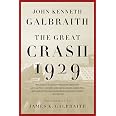
The Great Crash 1929 Paperback – September 10, 2009

4.4 out of 5 stars (1,478)

Purchase options and add-ons

John Kenneth Galbraith's classic examination of the 1929 financial collapse.

Arguing that the 1929 stock market crash was precipitated by rampant speculation in the stock market, Galbraith notes that the common denominator of all speculative episodes is the belief of participants that they can become rich without work. It was Galbraith's belief that a good knowledge of what happened in 1929 was the best safeguard against its recurrence.

Atlantic Monthly wrote, "Economic writings are seldom notable for their entertainment value, but this book is. Galbraith's prose has grace and wit, and he distills a good deal of sardonic fun from the whopping errors of the nation's oracles and the wondrous antics of the financial community."
Books with Buzz
Discover the latest buzz-worthy books, from mysteries and romance to humor and nonfiction. Explore more

Frequently bought together
This item: The Great Crash 1929
$12.39
Get it as soon as Wednesday, Jun 10
In Stock
Ships from and sold by Amazon.com.
+
$20.03
Get it as soon as Wednesday, Jun 10
In Stock
Ships from and sold by Amazon.com.
+
$12.99
Get it as soon as Wednesday, Jun 10
In Stock
Ships from and sold by Amazon.com.
Total price: $00
To see our price, add these items to your cart.
Details
Added to Cart
Choose items to buy together.

Customers also bought or read

Loading...

Editorial Reviews

About the Author

John Kenneth Galbraith (1908-2006) was a critically acclaimed author and one of America's foremost economists. His most famous works include The Affluent Society, The Good Society, and The Great Crash. Galbraith was the recipient of the Order of Canada and the Robert F. Kennedy Book Award for Lifetime Achievement, and he was twice awarded the Presidential Medal of Freedom.

Product details

  • Publisher ‏ : ‎ Harper Business
  • Publication date ‏ : ‎ September 10, 2009
  • Edition ‏ : ‎ Reprint
  • Language ‏ : ‎ English
  • Print length ‏ : ‎ 224 pages
  • ISBN-10 ‏ : ‎ 0547248164
  • ISBN-13 ‏ : ‎ 978-0547248165
  • Item Weight ‏ : ‎ 2.31 pounds
  • Dimensions ‏ : ‎ 5.5 x 0.55 x 8.25 inches
  • Best Sellers Rank: #42,247 in Books (See Top 100 in Books)
  • Customer Reviews:
    4.4 out of 5 stars (1,478)

About the authors

Follow authors to get new release updates, plus improved recommendations.

Customer reviews

4.4 out of 5 stars
1,478 global ratings

Customers say

Customers find this book to be a required read for anyone in the stock market, with brilliant analysis and a compelling narrative centered around the 1929 crash. Moreover, the writing style receives positive feedback, with one customer noting it's clearly written for laymen. Additionally, customers appreciate the book's informative content, with one review highlighting its heavily researched approach, and its humor, with customers noting its great wit. However, opinions about the book's entertainment value are mixed, with some finding it entertaining while others describe it as boring.
AI Generated from the text of customer reviews

Select to learn more

72 customers mention readability, 61 positive, 11 negative
Customers find the book readable and enjoyable, with some noting it's required reading for those in the stock market. One customer mentions it reads like a thriller.
An excellent read and caution on what can happen with people's greed and ignorance. It is good as a nonfiction read and a reference for the future!Read more
Short and to the point. Good read if you just want a quick layout of what happened in 1929. Would recommendRead more
...Very straightforward and an easy read. I like the summary of how this was so different from other recessions.Read more
Interesting and easy read.Read more
58 customers mention informative, 46 positive, 12 negative
Customers find the book informative and well-researched, with one customer noting its brilliant analysis and another highlighting its depth from an academic perspective.
...History repeats itself!! Need to stay Informed!! Very informative & easy read....Read more
Terrific writing. Insightful, serious, edifying and entertaining. So many of the players have not changed, it's a great read for these times.Read more
...The book is witty and wry, delightful and informative, proving that Galbraith was capable of producing clear prose when he wanted to.Read more
...It does not go into detail about the following years from 1930 to late thirties, so-called the Great Depression....Read more
53 customers mention content, 50 positive, 3 negative
Customers praise the book's content, describing it as brilliant and a great classic, with several noting it is the best book to understand the Great Depression.
Great book that really chronicles the history of the great crash of 1929 in such a way that I never really thought about before. Highly reccomend!!!Read more
good bookRead more
A Classic! Gives the best explanation of the the causes of the Great Depression and so of the Crash of 2008....Read more
Brilliant. I will probably read it twiceRead more
29 customers mention relevance, 27 positive, 2 negative
Customers find the book relevant and astute, with one customer noting it remains interesting throughout and provides good insight into the events.
As great a book as I had heard it was. Fascinating history.Read more
Terrific writing. Insightful, serious, edifying and entertaining. So many of the players have not changed, it's a great read for these times.Read more
...Easy reading, lot of datas, interesting points of view... Strongly recommended for all economicsts.Read more
...Galbraith's caustic humor remains clever and topical and enjoyable. The clarity of his insights remains stunning.Read more
28 customers mention writing style, 27 positive, 1 negative
Customers praise the writing style of the book, with one customer noting it is clearly written for laymen, while another describes it as beautifully written history.
Good insight into what happened. Well written and also entertaining. Those interested in historical events might find this well worthwhile.Read more
I disagree with the author politically, but he is an excellent writer, and his presentation of some of the facts are very revealing; especially the...Read more
Wonderful read. JKG is a great writer, and keeps the story going through what could be labor-some or dry economic topics....Read more
Terrific writing. Insightful, serious, edifying and entertaining. So many of the players have not changed, it's a great read for these times.Read more
15 customers mention narrative, 11 positive, 4 negative
Customers appreciate the narrative of the book, describing it as a classic account of the 1929 crash that is gripping and centered around a compelling story.
...The book does a great job telling the story of the stock market crash of 1929....Read more
Wonderful read. JKG is a great writer, and keeps the story going through what could be labor-some or dry economic topics....Read more
...She was right, and history is repeating itself, enabled by active forgetting of what we knew.Read more
Quite good summary of actual events, a lot of anecdotes, and thankfully not too m uch on cause More economics than Frederick Allen, , but not too...Read more
14 customers mention humor, 13 positive, 1 negative
Customers appreciate the book's humor, noting its great wit and dry sense of humor that tempers the tragedy.
...Galbraith. Galbraith, I remember, was arrogant, intelligent, and witty, and all three of these attributes permeate his contribution to the...Read more
...Funny, great wit, well writte. A lot of fun to read. I thoroughly enjoyed this book, so glad I bought it.Read more
...Galbraith's account is a pleasure to read, not least because of his very dry wit....Read more
...you then this is a good place to start not a bad book at all, kind of funny too.Read more
19 customers mention enjoyment, 11 positive, 8 negative
Customers have mixed opinions about the book's entertainment value, with some finding it entertaining while others describe it as boring.
Terrific writing. Insightful, serious, edifying and entertaining. So many of the players have not changed, it's a great read for these times.Read more
I hated this book, its boring and written in oldy time text and I got very little out of the book in the end....Read more
...Also, it is the opposite of dry reading. Enjoyable, understandable, and enlightening. You won't regret reading it.Read more
Put it down after 7 pages. My eyes hurt so bad from the monotonous and tedious prose.Read more

Top reviews from the United States

  • 5 out of 5 stars
    Astute history which reads like a thriller
    Reviewed in the United States on January 3, 2011
    Brief content visible, double tap to read full content.
    Full content visible, double tap to read brief content.

    Galbraith's account of the 1929 crash is gripping, and reads more like the work of a slightly-removed journalist than an economic historian. Discussions about discount rates and public pronouncements are interwoven with samples of other news of the day-- Lindbergh's flight across the Atlantic, the skylarking of stock clerks in Central Park, etc. The effect is to place the reader inside the world of 1929 just as the rug was being pulled out from under him.

    No one who has been paying attention to the events of the past three years can fail to see disturbing similarities between the market crash of 2008 and 1929. Why, therefore, was the same dynamic allowed to play out? Galbraith explains from 1954 with an eerie prescience:

    "The market will not go on a speculative rampage without some rationalization. But during any future boom some newly rediscovered virtuosity of the free enterprise system will be cited. It will be pointed out that people are justified in paying the present prices-- indeed, almost any price-- to have an equity position in the system. Among the first to accept these rationalizations will be some of those responsible for invoking the controls. They will say firmly that controls are not needed. The newspapers, some of them, will agree and speak harshly of those who think action might be in order. They will be called men of little faith."

    The sheer succession of parallels between 1929 and 2008 are mind-numbing:

    * a dangerous amount of financial leverage propping up asset prices

    * A pyramid effect in which each actor along the economic chain benefited by cooperating in the fraudulent scheme

    * Endless 'preventive incantations' from public officials and bankers that the worse was over, when the worse was still to come

    * The unearthing of shocking frauds like Bernie Madoff and Allen Stanford-- the modern descendants of Richard Whitney and Charles E. Mitchell

    * A barely-concealed hostility for Washington by Wall Street, the latter taking the former to task for its apparent idiocy in not being able to follow the subtle machinations of the high finance

    * The destructive knee-jerk tendency of politicians to rush to exactly the wrong solution: espousing the immediate need for a balanced budget, despite the fact that taking this to its logical conclusion would prevent government from doing the very things necessary to get the economy moving again (ie. cutting taxes and increasing spending)

    * The merciless chain-reaction of margin calls and stop-loss orders which, together, greatly accelerated the downward plunging of stock prices

    * The role of academics in providing a veneer of legitimacy to various ill-conceived schemes (one immediately calls Long-Term Capital Management to mind)

    * The seduction of traditional watchdogs, mentioned in Galbraith's words above. While today we look to credit ratings agencies like Moody's, Fitch's, and Standard and Poor, in 1929, the public looked to the banks, which abandoned their role as financial gatekeepers and worked around the clock to convince ordinary Americans why they should place all of their money in the stock market

    * The haughty dismissal by the financial press-- especially The Wall Street Journal-- of anyone who would challenge its rosy financial outlook ("Why is it that any ignoramus can talk about Wall Street?", it opined in response to market naysayers in pre-crash 1929)

    One is justified in asking how Alan Greenspan's Federal Reserve Bank and George W. Bush's White House could proceed along so destructive a path with so rich history before them.

    Galbraith offers at least this hope for the future, however: the unlikelihood of another asset bubble in the immediate future:

    "...a speculative outbreak has a greater or less immunizing effect. The ensuing collapse automatically destroys the very mood speculation requires. It follows that an outbreak of speculation provides a reasonable assurance that another outbreak will not immediately occur. With time and the dimming of memory, the immunity wears off. A recurrence becomes possible."

    One must wonder, however, whether this pronouncement remains valid in an age of compressed historical timelines in which the lessons of one generation are only partially-learned before being inadequately passed down to the next.

    "The Great Crash 1929" is an immensely engaging book which will cause the reader to shake his head in disbelief as passage after passage finds resonance with the events of recent years.

    19 people found this helpful
    Sending feedback...
    Thank you for your feedback.
    Sending feedback...
    Thanks, we'll investigate in the next few days.
  • 4 out of 5 stars
    Good book
    Reviewed in the United States on February 5, 2026
    Brief content visible, double tap to read full content.
    Full content visible, double tap to read brief content.

    Quite good summary of actual events, a lot of anecdotes, and thankfully not too m uch on cause More economics than Frederick Allen, , but not too much. ,

    Sending feedback...
    Thank you for your feedback.
    Sending feedback...
    Thanks, we'll investigate in the next few days.
  • 5 out of 5 stars
    interesting and informative
    Reviewed in the United States on January 11, 2026
    Brief content visible, double tap to read full content.
    Full content visible, double tap to read brief content.

    I recently read two books on the 1929 crash by Andrew Sorkin and Galbraith, both are written from different perspectives, but both add to the understanding of what happened and who were the main contributors to the crash and ensuing depression of the 1930s. Both note that overt detachment from reality, by so many people, contributed to the crash. A lesson of caution for everyone in current American.

    5 people found this helpful
    Sending feedback...
    Thank you for your feedback.
    Sending feedback...
    Thanks, we'll investigate in the next few days.
  • 3 out of 5 stars
    A great book, poorly printed
    Reviewed in the United States on January 6, 2026
    Brief content visible, double tap to read full content.
    Full content visible, double tap to read brief content.

    I had previously read the e-book version of The Great Crash 1929 and was greatly impressed by Galbraith's brilliant analysis and witty writing style. In fact, I liked it so much that I wanted a printed copy as well. This turned out to be a mistake. Although this book is published by a major publisher (Harper Business) it's poorly printed. The type is dark and fuzzy, and as you try to read each page, the page behind it shows through.

    This great book deserves better.

    One person found this helpful
    Sending feedback...
    Thank you for your feedback.
    Sending feedback...
    Thanks, we'll investigate in the next few days.
  • 5 out of 5 stars
    Economics at its best
    Reviewed in the United States on March 2, 2008
    Brief content visible, double tap to read full content.
    Full content visible, double tap to read brief content.

    When I was an undergraduate, the church around which the campus was centered hosted informal luncheons twice a month. These affairs were held in the church's large and comfortable basement, and usually had nothing to do with religion. The enticement for students to attend the luncheons (aside from a free box lunch) was the reputation or position of a fellow diner the church had managed to ensnare, and to be included at a gathering, a student had only to sign up while space was still available. Sometimes this personage would be as humble as the Dean of Student Affairs. On one occasion, it was John Kenneth Galbraith.

    Galbraith, I remember, was arrogant, intelligent, and witty, and all three of these attributes permeate his contribution to the literature on the crash. Galbraith himself remarks in the introduction that he "never enjoyed writing a book more," and I can well imagine that he laughed out loud as he penned the hilarious passages that make this book so enjoyable. His explanation of the increase in embezzlement during the late twenties, which he euphemistically calls "informal financial arrangements," and the fall of various illustrious personages associated with the Wall Street crash make for some of the funniest reading I have ever encountered.

    There is a serious side to the book, however, wherein Galbraith succinctly analyzes the causes of the crash (in his humble opinion). For those looking for parallels in today's market, there is one striking similarity between 1929 and today: the impact that the collapse in securities prices had on the well-to-do. Because the well-to-do, then as now, "disposed of a large proportion of consumer income," and "were a source of a lion's share of personal saving and investment," the losses suffered by this group of investor's "had broad effects on expenditure and income in the economy at large." This, perhaps, is Galbraith's indictment of the capitalist system, and the fact that he offers no remedy for this situation is tacit acceptance of the inherent flaw of capitalism. Galbraith, though, is no socialist or economic radical. As he casually claimed during the luncheon I attended, he ran the US economy during World War II, and I've never heard of any extreme economic policies that were instituted during the war. On the other hand, I'm not now, nor have I ever been, an economist.

    Galbraith does a brilliant job of tracing the fluctuations in the market from 1927 to 1932, demonstrating in the process that the crash was not confined to a single day, nor even to a single month. He explodes a few myths about the crash (it was caused by a lack of available securities; suicides after the crash skyrocketed) and explains the impact of the growth of investment trusts and the lack of involvement by regulatory bodies (such as they were). It is unlikely a better short course on the crash of 1929 exists, and it is a certainty that no more entertaining book on the subject exists. Galbraith's little tome is convincing evidence that the dismal science need not be.

    12 people found this helpful
    Sending feedback...
    Thank you for your feedback.
    Sending feedback...
    Thanks, we'll investigate in the next few days.
  • 5 out of 5 stars
    A MOST ENJOYABLE AND READABLE CLASSIC ON THE STOCK MARKET CRASH AND DEPRESSION
    Reviewed in the United States on January 11, 2026
    Brief content visible, double tap to read full content.
    Full content visible, double tap to read brief content.

    I recently read Andrew Ross Sorkin's marvelous new book on the stock market crash, entitled "1929." I enjoyed it immensely but it inspired me to read again John Kenneth Galbraith's classic little book (about 200 pages) from 1955 on the same subject. They complement each other nicely! But only Professor Galbraith spends a lot of time pointing out how the crash triggered the great depression but certainly did not cause it, what could have been done differently to minimize the suffering, and what erroneous ideas made things worse. We have, I hope, learned a lot since then!

    One person found this helpful
    Sending feedback...
    Thank you for your feedback.
    Sending feedback...
    Thanks, we'll investigate in the next few days.
  • 4 out of 5 stars
    Interesting facts on 1929
    Reviewed in the United States on August 25, 2025
    Brief content visible, double tap to read full content.
    Full content visible, double tap to read brief content.

    Interesting read but does need update or additional information since it ends in 2006 and missed commentary on the financial crisis of 08-09 and the post covid recovery.

    3 people found this helpful
    Sending feedback...
    Thank you for your feedback.
    Sending feedback...
    Thanks, we'll investigate in the next few days.
  • 5 out of 5 stars
    A Must-Read for Anyone Wanting to Understand How Markets Really Break
    Reviewed in the United States on June 30, 2025
    Brief content visible, double tap to read full content.
    Full content visible, double tap to read brief content.

    The Great Crash 1929 gave me a much clearer understanding of how financial markets can unravel and why they often do. Galbraith does an excellent job showing how a small number of over-leveraged individuals and companies helped stretch the market too far, and how the Federal Reserve’s failure to act early made everything worse.

    What really stuck with me was how familiar it all felt. Reading this after the 2008 real estate crash, I saw so many parallels and honestly, I see the same kinds of risks today in AI and crypto. It makes you wonder if we’re stuck in a cycle of repeating the same mistakes decade after decade.

    If you’re interested in how financial bubbles form, burst, and what we can learn from the past, this is a great book to pick up. It’s accessible, insightful, and still incredibly relevant.

    11 people found this helpful
    Sending feedback...
    Thank you for your feedback.
    Sending feedback...
    Thanks, we'll investigate in the next few days.

Top reviews from other countries

    Translated by Amazon
    See original
  • 5 out of 5 stars
    Good book
    Reviewed in India on June 28, 2020
    Brief content visible, double tap to read full content.
    Full content visible, double tap to read brief content.
    Sending feedback...
    Thanks, we'll investigate in the next few days.
  • 4 out of 5 stars
    History will teach us nothing
    Reviewed in Italy on October 7, 2013
    Brief content visible, double tap to read full content.
    Full content visible, double tap to read brief content.

    1929. The worst crisis to hit the financial world.

    The world is plunged in a crisis that will lead to WWII.

    A fine analysis of the underling causes of the '29 crash and a stern warning for the future.

    Just compare it to 1998, and you'll see the value of studying history; it tends to repeat itself.

    But once again, sad to say, history will teach us nothing.

    Sending feedback...
    Thanks, we'll investigate in the next few days.
  • 5 out of 5 stars
    Lessons for financial crisis management in the 21st century
    Reviewed in Germany on November 1, 2014
    Brief content visible, double tap to read full content.
    Full content visible, double tap to read brief content.

    John Kenneth Galbraith, a famous 20th century economist serving in the administrations of Franklin D. Roosevelt, Harry S. Truman, John F. Kennedy, and Lyndon B. Johnson, studied "The Great Crash, 1929, and published his book in 1955. It has been continuously in print ever since.

    The financial crisis 2007/2008 is one of many reasons to read Galbraith's book, edition 1997, with a new introduction by the author, to identify differences between and communalities of these two crises; it could also induce to compare the findings in this book with those of Liaquat Ahamed in his book "Lords of Finance - 1929, the great depression, and the bankers who broke the world, edition 2010".

    The following excerpts from Galbraith's book could motivate to read this very interesting book:

    "One thing in the twenties should have been visible even to Coolidge [30th U.S. President 1923-1929]: the great Florida real estate boom 1925. It contained all of the elements of the classic speculative bubble. (Page 3)

    Hoover was elected [1928] in a landslide [31st U.S. President 1929-1933]. (16)

    Over the whole year of 1928 the Times industrial average gained 86 points, or from 245 to 331. (17)

    But there was still another and even more significant index of what was happening in the market. That was the phenomenal increase in trading on margin. (18)

    In principle, New York banks could borrow money from the Federal Reserve Bank for 5 per cent and re-lend it in the call market for 12. This was, possibly, the most profitable arbitrage operation of all time.

    Never had there been a better time to get rich, and people knew it. (22)

    As Walter Bagehot once observed: `All people are most credulous when they are most happy.' Footnote: Lombard Street, 1922 ed. P. 151. [Bagehot wrote his excellent book in 1873 and it is still today considered the bible of central banking - see Timothy Geithner's outstanding book "Stress Test", edition 2014, Page 118) (23)

    No one, wise or unwise, knew or now knows when depressions are due or overdue.

    One of the oldest puzzles of politics is who is to regulate the regulators. But an equally baffling problem, which has never received the attention it deserves, is who is to make wise those who are required to have wisdom. (24)

    The Federal Reserve Board in those times was a body of startling incompetence. (27)

    By early 1929, loans from these non-banking sources were approximately equal to those from the banks. (31)

    The Federal Reserve authorities took for granted that they had no influence whatever over this supply of funds. ... In fact, the Federal Reserve was helpless only because it wanted to be. (32)

    In the early months of 1929, there was worry that the country might running out of common stocks. (42)

    It was a golden age for professors. (55)

    That autumn [1929] Professor Irving Fisher of Yale made his immortal estimate: `Stock prices have reached what looks like a permanently high plateau.' Irving Fisher was the most original of American economists. (70)

    The Harvard Economic Society remained persuaded that no serious depression was in prospect. In November it said firmly that `a severe depression like that of 1920-21 is outside the range of probability. We are not facing protracted liquidation.' This view the Society reiterated until it was liquidated. (71)

    However, there were exceptions. One was Paul M. Warburg of the International Acceptance Bank, whose predictions must be accorded the same prominence as the forecasts of Irving Fisher. They were remarkably prescient. In March of 1929, he called for a stronger Federal Reserve policy and argued that if the present orgy of `unrestrained speculation' were not brought promptly to a halt there would ultimately be a disastrous collapse. It would `bring about a general depression involving the entire country.' (72)

    On September 3, by common consent, the great bull market of the nineteen-twenties came to an end.

    On September 4, the tone of the market was still good, and then on September 5 came a break.

    The immediate cause of the break was clear - and interesting. Speaking before his Annual National Business Conference on September 5, Roger Babson observed, `Sooner or later a crash is coming, and it may be terrific.'(84)

    The end had come, but it was not yet in sight. (87)

    From the foregoing it follows that the crash did not come - as some have suggested - because the market suddenly became aware that a serious depression was in the offing. A depression, serious or otherwise, could not be foreseen when the market fell. (90)

    In England on September 20, 1929, the enterprises of Clarence Hatry suddenly collapsed. (91)

    On October 15, 1929, Professor Irving Fisher made his historic announcement about the permanently high plateau and added, `I expect to see the stock market a good deal higher than it is today within a few months.' Indeed, the only disturbing thing, in these October days, was the fairly downward drift in the market. (94)

    Monday, October 21, was a very poor day. There was no way of telling what was happening. (96)

    Professor Fisher said that the decline had represented only a `shaking out of the lunatic fringe.' (97)

    Thursday, October 24, is the first of the days which history - such as it is on the subject - identifies with the panic of 1929. (98) The panic did not last all day. It was a phenomenon of the morning hours. (99)

    Representatives of thirty-five of the largest wire houses assembled at the offices of Hornblower and Weeks and told the press on departing that the market was `fundamentally sound' and `technically in better condition that is has been in months.' (104)

    On Monday, October 28, 1929, the real disaster began. (107)

    The singular feature of the great crash of 1929 was that the worst continued to worsen. What looked one day like the end proved on the next day to have been only the beginning. (108)

    On the evening of the 28th no one any longer could feel "secure in the knowledge that the most powerful banks stood ready to prevent a recurrence' of panic.

    Tuesday, October 29, was the most devastating day in the history of the New York stock market, and it may have been the most devastating day in the history of markets. Selling began as soon as the market opened and in huge volume. (111)

    On the evening of the 29th, Dr. Julius Klein, Assistant Secretary of Commerce, friend of President Hoover, and the senior apostle of the official economic view, took to the radio to remind the country that President Hoover had said that the `fundamental business of the country' was sound. (118)

    In these three days, November 11, 12, and 13, the Times industrials lost another 50 points. Of all the days of the crash, these without doubt were the dreariest.

    Clerks in downtown hotels were said to be asking guests whether they wished the room for sleeping or jumping. Two men jumped hand-in-hand from a high window in the Ritz. (126)

    In mid-November 1929, at long, long last, the market stopped falling - at least, for a while. The low was on Wednesday, November 13. On that day the Times industrials closed at 224 down from 452, or by almost exactly one half since September 3. (135)

    On July 8, 1932, they were 58. (141)

    Things were far worse with the investment trusts.

    The fears of November 1929 that the investment trusts might go to nothing had been largely realized.

    No one any longer suggested that business was sound. (142)

    November 15, 1930: `We are now near the end of the declining phase of the depression.'

    A year later, on October 31, 1931: `Stabilization at [present] depression levels is clearly possible.' Even these last forecasts were wildly optimistic. Somewhat later, its reputation for infallibility rather dimmed, the Harvard Economic Society was dissolved. (145)

    Professor Irving Fisher tried hard to explain why he had been wrong. (146)

    With the advent of the New Deal the sins of Wall Street became the sins of the political enemy. What was bad for Wall Street was bad for the Republican Party. (155)

    After the Great Crash came the Great Depression which lasted, with varying severity, for ten years.

    In 1933, Gross National Product was nearly a third less than in 1929. Not until 1937 did the physical volume of production recover to the levels of 1929, and then it promptly slipped back again.

    Until 1941 the dollar value of production remained below 1929.

    In 1933 nearly thirteen million were out of work, or about one in every four in the labor force.

    In 1938 one person in five was still out of work.

    On the whole, the great stock market crash can be much more readily explained than the depression that followed it. (168)

    The causes of the Great Depression are still far from certain.

    When people are least sure they are often most dogmatic. (171)

    There seems little question that in 1929, modifying a famous cliché, the economy was fundamentally unsound. This is a circumstance of first-rate importance. Many things were wrong, but five weaknesses seem to have had an especially intimate bearing on the ensuing disaster. They are:

    1) The bad distribution of income. In 1929 the rich were indubitably rich.

    2) The bad corporate structure. The most important corporate weakness was inherent in the vast

    new structure of holding companies and investment trusts.

    3) The bad banking structure.

    However, although the bankers were not unusually foolish in 1929, the banking structure was inherently

    weak.

    4) The dubious state of the foreign balance. This is a familiar story. During the First World War, the United

    States became a creditor on international account.

    5) The poor state of economic intelligence. Mass employment in particular had altered the rules.

    Events had played a very bad trick on people, but almost no one tried to think out the problem anew.

    The balanced budget was not the only strait jacket on policy. There was also the bogey of "going off"

    the gold standard and, most surprisingly, of risking inflation. The fear of inflation reinforced the demand

    for the balanced budget. (177ff)

    The avoidance of depression and the prevention of unemployment have become for the politician the most critical of all questions of public policy. Action to break up a boom must always be weighed against the chance that it will cause unemployment at a politically inopportune moment. (190)

    My conclusion which I want to share with you: policy makers, bankers, investors, entrepreneurs, business managers, employees, workers, students etc. should make themselves familiar with the phenomena, intricacies and effects of financial crises.

    Sending feedback...
    Thanks, we'll investigate in the next few days.
  • 5 out of 5 stars
    I Will happen again
    Reviewed in Brazil on March 31, 2016
    Brief content visible, double tap to read full content.
    Full content visible, double tap to read brief content.

    Great analysis of the 1929 and depression... And show we have to be attended... There is no free lunch

    It should be necessary for all economic studies

    Sending feedback...
    Thanks, we'll investigate in the next few days.
  • 5 out of 5 stars
    Parfait !
    Reviewed in France on May 26, 2015
    Brief content visible, double tap to read full content.
    Full content visible, double tap to read brief content.

    la forme: livre en état impeccable, livré rapidement

    le fond: tour de force réalisé par Galbraith: faire comprendre par l'humour et l'ironie la Crise de 29 !!

    Sending feedback...
    Thanks, we'll investigate in the next few days.
    Translated from French by Amazon
    See original