


Discover Yoshi and the Mysterious Book
Kindle Unlimited
Unlimited reading. Over 5 million titles. Learn more
OR
You've subscribed to ! We will preorder your items within 24 hours of when they become available. When new books are released, we'll charge your default payment method for the lowest price available during the pre-order period.
Update your device or payment method, cancel individual pre-orders or your subscription at
Your Memberships & Subscriptions
Added to

Sorry, there was a problem.

There was an error retrieving your Wish Lists. Please try again.

Sorry, there was a problem.

List unavailable.
Kindle app logo image

Download the free Kindle app and start reading Kindle books instantly on your smartphone, tablet, or computer - no Kindle device required.

Read instantly on your browser with Kindle for Web.

Using your mobile phone camera - scan the code below and download the Kindle app.

QR code to download the Kindle App

  • The Intelligent Investor, Rev. Ed: The Definitive Book on Value Investing – A Timeless Investment Strategy for Navigating the Stock Market and Mastering Finance
  • The Intelligent Investor, Rev. Ed: The Definitive Book on Value InvestingAmazon Videos
  • 6 VIDEOS

Follow the authors

Get new release updates & improved recommendations
See all
Something went wrong. Please try your request again later.

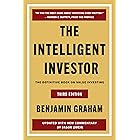
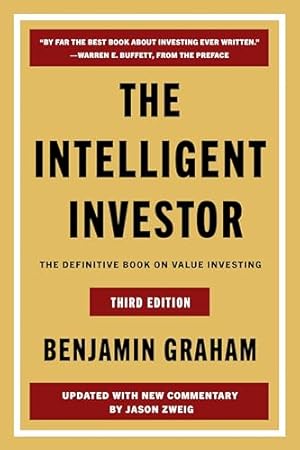
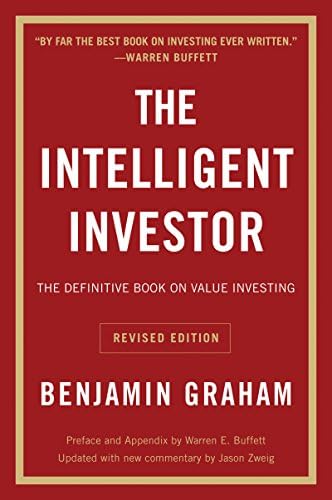
The Intelligent Investor, Rev. Ed: The Definitive Book on Value Investing – A Timeless Investment Strategy for Navigating the Stock Market and Mastering Finance

4.6 out of 5 stars (52,155)

“By far the best book on investing ever written.” — Warren Buffett

The classic text of Benjamin Graham’s seminal The Intelligent Investor has now been revised and annotated to update the timeless wisdom for today’s market conditions.

The greatest investment advisor of the twentieth century, Benjamin Graham, taught and inspired people worldwide. Graham's philosophy of "value investing"—which shields investors from substantial error and teaches them to develop long-term strategies—has made The Intelligent Investor the stock market bible ever since its original publication in 1949.

Over the years, market developments have proven the wisdom of Graham's strategies. While preserving the integrity of Graham's original text, this revised edition includes updated commentary by noted financial journalist Jason Zweig, whose perspective incorporates the realities of today's market, draws parallels between Graham's examples and today's financial headlines, and gives readers a more thorough understanding of how to apply Graham's principles.

Vital and indispensable, this revised edition of The Intelligent Investor is the most important book you will ever read on how to reach your financial goals.

Due to its large file size, this book may take longer to download

Customers also bought or read

Loading...

Editorial Reviews

Amazon.com Review

Among the library of investment books promising no-fail strategies for riches, Benjamin Graham's classic, The Intelligent Investor, offers no guarantees or gimmicks but overflows with the wisdom at the core of all good portfolio management.

The hallmark of Graham's philosophy is not profit maximization but loss minimization. In this respect, The Intelligent Investor is a book for true investors, not speculators or day traders. He provides, "in a form suitable for the laymen, guidance in adoption and execution of an investment policy" (1). This policy is inherently for the longer term and requires a commitment of effort. Where the speculator follows market trends, the investor uses discipline, research, and his analytical ability to make unpopular but sound investments in bargains relative to current asset value. Graham coaches the investor to develop a rational plan for buying stocks and bonds, and he argues that this plan must be a bulwark against emotional behavior that will always be tempting during abrupt bull and bear markets.

Since it was first published in 1949, Graham's investment guide has sold over a million copies and has been praised by such luminaries as Warren E. Buffet as "the best book on investing ever written." These accolades are well deserved. In its new form--with commentary on each chapter and extensive footnotes prepared by senior Money editor, Jason Zweig--the classic is now updated in light of changes in investment vehicles and market activities since 1972. What remains is a better book. Graham's sage advice, analytical guides, and cautionary tales are still valid for the contemporary investor, and Zweig's commentaries demonstrate the relevance of Graham's principles in light of 1990s and early twenty-first century market trends. --Patrick O'Kelley

Review

“The wider Mr. Graham’s gospel spreads, the more fairly the market will deal with its public.” - Barron's

“By far the best book on investing ever written.” - Warren Buffett

“If you read just one book on investing during your lifetime, make it this one” - Fortune

Product details

  • ASIN ‏ : ‎ B000FC12C8
  • Publisher ‏ : ‎ Harper Business
  • Accessibility ‏ : ‎ Learn more
  • Publication date ‏ : ‎ March 17, 2009
  • Edition ‏ : ‎ Revised ed.
  • Language ‏ : ‎ English
  • File size ‏ : ‎ 46.2 MB
  • Screen Reader ‏ : ‎ Supported
  • Enhanced typesetting ‏ : ‎ Enabled
  • X-Ray ‏ : ‎ Enabled
  • Word Wise ‏ : ‎ Enabled
  • Print length ‏ : ‎ 640 pages
  • ISBN-13 ‏ : ‎ 978-0061745171
  • Page Flip ‏ : ‎ Enabled
  • Best Sellers Rank: #10,491 in Kindle Store (See Top 100 in Kindle Store)
  • Customer Reviews:
    4.6 out of 5 stars (52,155)

About the authors

Follow authors to get new release updates, plus improved recommendations.

Customer reviews

4.6 out of 5 stars
52,155 global ratings

Customers say

Customers consider this book the definitive work on value investing, praising its comprehensive content and helpful hints. Moreover, the book serves as a great starting for both beginners and experienced investors, providing practical examples that make it a valuable resource. However, the readability receives mixed feedback - while some find it easy to understand, others find it tedious to read. Additionally, the book's timelessness is debated, with some calling it a timeless classic while others note outdated examples.
AI Generated from the text of customer reviews

Select to learn more

1309 customers mention content, 1230 positive, 79 negative
Customers praise the book's content, describing it as the definitive guide to value investing and a must-read, with solid and sound advice throughout.
That`s a great book, but I recommend you all reading the original version of Ben Graham of "The Intelligent Investor" instead of it.Read more
...market and plan on making some sort of investment plan, this is a good book since it comes with a ton of examples and advice....Read more
It's really technical but i think it's a great read for anyone who wants to really learn about finances and investing.Read more
This is an excellent book for anyone who invests in the stock market. It provides the keys to successful longer term portfolio management.Read more
312 customers mention informative, 289 positive, 23 negative
Customers find the book informative, with comprehensive content and helpful hints throughout.
A friend recomended me this book its very informative i would definately recomend it for anyone looking to invest or to anyone who is already...Read more
...However, there is a lot of good information still on how to find the right stocks and about investing in general, but keep in mind the world we live...Read more
This book is informative and helpful. I recommend this book for whomsoever interested in the money markets for investing and money management.Read more
It was written awhile ago but has useful information that lasts across any market. It also has input from a modern perspective.Read more
202 customers mention investment advice, 196 positive, 6 negative
Customers praise this book's investment philosophy and consider it a goldmine of information, helping them shape their investment habits and understand different forms of investment.
...why Warren Buffet boasts about Benjamin Graham, as this is the bible of investing. This book is enlightening on so many levels....Read more
B.O. Graham's book is some of the best investment advice you will ever read or obtain....Read more
After reading this book it completely changes your outlook on investing....Read more
Invaluable advice for the investor with character. Great investing philosophy that will increase your portfolio even in this modern age.Read more
115 customers mention educational, 94 positive, 21 negative
Customers find the book educational, describing it as a must-read for both individual and beginner investors, with one customer noting how it simplifies investing down to a few basics.
This book is great for beginners. It lays out all the need to know details and much more....Read more
...to loss mitigation than anything else...which will be perfect for the novice investor.Read more
It is a very interesting and educational book. It is taking me some time to finish reading it.Read more
Great condition upon arrival! And a great book to learn!...Read more
88 customers mention usefulness, 85 positive, 3 negative
Customers find the book very useful and appreciate that it provides many practical examples, making it a great resource to have at hand.
Very helpful and insightful read. As a matter of fact this is one of the first books...Read more
This book is informative and helpful. I recommend this book for whomsoever interested in the money markets for investing and money management.Read more
I got this as a gift and they love it and find it very useful, 10/10Read more
Such a great resource, I will keep this book forever!Read more
248 customers mention readability, 130 positive, 118 negative
Customers have mixed opinions about the book's readability, with some finding it simple and easy to follow, while others describe it as tedious and textbook-like.
If you are thinking of investing or invest this book is easy to read and walks you through some important points to think about and keep in mind as...Read more
...anymore and it can be outdated, but like I said, earlier, it is a hard read, but it will increase your intelligence and ability to make investment...Read more
This is the most important book for value investing. It is easy to understand but I would suggest that you read "The Little Book of Value Investing...Read more
Difficult read and all the tables were orientated incorrectly.Read more
117 customers mention timeless, 59 positive, 58 negative
Customers have mixed opinions about the book's timelessness, with some praising it as a timeless classic while others find it slightly outdated and note that the examples are rather dated.
The Intelligent Investor by Benjamin Graham is a classic and by far the best book ever written on value investing....Read more
...many things, don't change and the fundamentals are often boring yet timeless. If you want excitement you have no business being an investor....Read more
...It's a timeless classic that is a must have for anyone interested in investing.Read more
I gave this to my son and he quickly returned it to me - outdated and not appropriate for today’s market.Read more
75 customers mention interestingness, 44 positive, 31 negative
Customers have mixed opinions about the book's interestingness, with some finding it an extremely interesting read and looking forward to reading it, while others describe it as very repetitious, boring, and not engaging.
...Very good book and interesting.Read more
...In short, it's boring, dry, outdated with examples, overhyped, and a difficult read without 100 hours of spare time....Read more
Interesting book recommended to me by an individual that has really been fortunate with his portfolio using the information gained in this book....Read more
Not real exciting but it has lots of content that is just as relevant today as when it was first published.Read more
Buy stocks as groceries, not as jewelry.
5 out of 5 stars
Buy stocks as groceries, not as jewelry.
Edition: I found commentary very useful (though often distracting). If you are not a professional - you'll appreciate the commentaries and epilogue - read it first? It's very inspiring. Book: "You either get the idea in the first five minutes, or you don't get it at all", commented Warren Buffet in the epilogue. I would add - you don't necessarily need to read all 550 pages, but you must read through the idea of value investing - and it will change your way of looking at the world. I always felt confused and amazed by listening to all the ridiculous fuzz that comes from the Wall Street through TV and the internet. The book explains why. Several rules of thumbs I noted into my keep: - Investor buys the business [based on its price/value], speculator buys the stock [based on an absurd believe that he can foresee where the stock price will go]. - The best way to earn adequate return without any trouble whatsoever is to invest into cheap (low maintenance cost) indexes; use dollar averaging (buy every month instead of once at a random point of time) for smoothing the luck involved. - For enterprising investor (willing to spend much more time), look for a diversified list of bargain issues (at least 30 issues, business values (i.e. net current asset and other related metrics) is below market cap) - During the bubble, hot industries and companies are getting overpriced. That could only be financed from somewhere. Partially that money are coming from well established old economy companies that lose the appeal. Thus, invest in such old economy companies while bubble grows, as soon as the bubble burst - undervalued companies would rise back. - Don't ever buy IPOs! (See chapter for compelling arguments) - Don't consider companies that do not pay dividends. Dividends - money firm pays you for providing capital, they belong to you. They cut a piece for reinvestment - payout ratio. If firm doesn't pay dividends - invest all into growth so you could profit later - that's a speculation. Moreover stock price would be more volatile because it should now rely on future rather than current prospects. - When gambling - bet on a single chip to maximize the payoff (roulette $1 to $35 payoff at 1/37 chance). When investing - diversify: each investment must have a margin of safety, the more diversified portfolio - the less likely that all will fail. You are a roulette house now who earns with each turn of the wheel.
Thank you for your feedback
Sorry, there was an error
Sorry we couldn't load the review

Top reviews from the United States

  • 5 out of 5 stars
    Review of Intellignet of Investor
    Reviewed in the United States on November 21, 2012
    Brief content visible, double tap to read full content.
    Full content visible, double tap to read brief content.

    How to become an intelligent Investor?

    Benjamin Graham is famous with the fact that one of the most famous investor, Warren Buffett was taught by him in Columbia business school. So I choose this book to read since I was curious of the figure, Benjamin Graham. The book `Intelligent Investor' deals with the financial concepts such as stock investment, the inflation relates to bond investments and interest rates. Hence, this book was very helpful to understand at not only the investment, but also the sense of finance. I believe that this book indicates that these two concepts are very considerable; `Margin of Safety', and `Uncertainty'. These two concepts were Graham's fundamental concepts.

    Benjamin Graham sees the principle of investment of common stock as follow. 1. It's good have diversified investment, minimum 10, maximum 30. 2. Selected stock type should be large-cap stock, have high prospects at performances, and should be a risk based capital. 3. Selected stock type should have a consistency over distributed performances. 4. Should restrict on purchase price over the company's annual average net income per share for past 7 years.

    And then, after comparing 4 listed company, above principles' detailed numerical value was shown in follows; 1. Moderate company scale. 2. Strong financial position. 3. At least 20 years of consistently distributed performances. 4. At least for 10 years, more than one-third growth of EPS. 5. Stock prices per share do not go over than 1.5 times of net asset value. 6. Stock prices do not go over more than 15 times of average EPS in recent 3 years.

    I read this book throughout the weekend again. I read this book couple of weeks ago one time, and I started re-read this book again. It was kinda hard to understand this book at the first time, however as I read them over, I started to understand a bit better. Honestly, I just do not prefer the individual stock investment, thus I thought how Benjamin Graham's way of selecting stock was very interesting, however I never really thought that I need to change the index investment strategy for that. Instead, the definition of initial investment and speculation, and concept of margin of safety were the part that could be able to apply in anyways of stock investment, hence it was very good chance to refresh the investing mind. Especially, I love to read the chapter 20. It was the description of margin of safety, which explains that to earn profits in stock market; we need to approach with long-term mind while securing the minimum safety margin.

    When I read this book through, what I felt first was that I have to put my assets into cash, stock, and real estate while evenly distribute. Every type of assets have their own pros and cons, hence it is always good to have evenly distributed on the different type of assets. In this way, even if the certain market has failed to perform high valuation, the others may not. The second thought about the diversification was I would invest in high, middle, and low risk investment.

    In Wall-street, with all that passions, researches, and talents there are a lot of cases losing money. It is actually common to lose. Thus, our goal of investment should be not to earn more than the average, but to earn money that will satisfy my needs. That is, not to win markets, nor to pass the goal faster than some other figure. It is just to reach the goal and pass that finish line though. It doesn't matter how fast nor how slow it may take. To accomplish this important goal, we need to make realistic estimation for the future, and to purchase the stock with the price that can secure enough safety margins. Also through the long-term investment and diversified investment, we need to endeavor to manage the risk of the investment. Additionally, I believe that we can finally become a intelligent investors when we trust and take pluck on our own analysis and investment.

    At last, Benjamin Graham mentioned in his book that `If a person sets out to make profits from security purchases and sales, he is embarking on a business venture of his own, which must be run in accordance with accepted business principles if it is to have a chance of success.'

    With the four principles that he explained in this book, he explains that `To achieve satisfactory investment result is easier than most people realize; to achieve superior results is harder than it looks.'

    Especially in these days, everything change so fast and the trend of yesterday is different with that of today. However, the book `Intelligent Investor' that was written by Benjamin Graham and published in 1949. It is actually very amazing that how the principle of investment that was written in 1949 is still considered as the best investment book in nowadays. It is still a steady seller from the Amazon as well. One of reasons this book is so popular and grabs investors' attention is how this book has focused on the upright investing principles and the attitudes that investors should have, instead saying the methods of stock analysis, nor trading techniques.

    I definitely recommend this book to the individual investors. There is another famous book of Benjamin Graham called, `Security Analysis', however this book may be difficult to read for individual investors. I heard this book is more targeted towards the professional analyst. However, this book that I read, `Intelligent Investor' is more likely towards the individual investors. Hence, again I strongly recommend this book to anyone who is hesitating to start reading this book. It may hard to read for the beginners of investment however it should be the must-read book before even starting investment. At the same time, for who is actively performing investors, it is good way to remind the basic principle that must not to be forgotten.

    For me, it was great way to refresh the investing mind, and I would love to suggest this book towards my friends as well.

    11 people found this helpful
    Sending feedback...
    Thank you for your feedback.
    Sending feedback...
    Thanks, we'll investigate in the next few days.
  • 5 out of 5 stars
    5 Stars for Graham, 3 Stars for Zweig, and 5 Stars for Buffett
    Reviewed in the United States on October 30, 2012
    Brief content visible, double tap to read full content.
    Full content visible, double tap to read brief content.

    GRAHAM REVIEW

    Graham's original work itself is fantastic, if you take the time to absorb it and understand it. It took me two reads before I really felt like I grasped it well. I don't need to write an elaborate review discussing this book for people to know it is obviously an investment classic; it has Warren Buffett's full endorsement which is the reason a lot of people opt to read it in the first place. The practical advice offered is timeless. In particular I found Chapter 1 (the difference between speculation and investing), Chapter 8 (managing your emotions), Chapter 10 (discerning the advice from others) and Chapter 20 (having a margin of safety) to be enlightening, as those four chapters were probably the most useful to me personally. The advice in the very first chapter regarding the difference between investing and speculating gets lost on a lot of people today, as anything and everything that involves stocks, bonds, options, or futures seems to be categorized as investing. The portion of Chapter 8 that discusses managing your emotions is arguably the most difficult for people to actually implement in the real world, despite being a very important concept. Graham truly makes a compelling case in favor of a value approach, which as I will discuss later in this review, is inherently reliant on the belief that investments can and do become undervalued. Buffett notes that the most significant chapters for him were 8 and 20. I agree, but also add chapters 1 and 10 to that shortened list. For others that might be different.

    A unique thing that I appreciated about Graham is that he discusses two different ways of investing, depending on how much time you have to put into the matter. For those who have too many other things going on to put the time into it, he advocates "defensive investing," which basically focuses on safer, larger companies and is a little more bond-heavy. And for those who want to put a lot more work into it, he advocates "enterprise investing," where he lays out a more rigorous approach to value investing. While the enterprising method does indeed yield greater returns over the long run, there is nothing wrong with taking the defensive approach, particularly for those who aren't able to commit enough time in order to make the enterprising method effective.

    There are a few minor areas that are no longer relevant as they were in Graham's day, such as his suggestion that one should use a local bank to handle transfers of stock certificates... when it is basically all online these days. But if one reads it and remains aware that it was written in the early 1970s, then these little quirks will not bother them. I will also add that Graham places an emphasis on dividend maintenance that is probably less relevant today. In his day, strong companies actually paid out about 1/3 to 2/3 of their surpluses, whereas these days that is far less common. Graham's followers, including Buffett and Klarman, do not emphasize this so heavily (Klarman has gone as far as saying that looking at dividend policy is almost useless in today's era), although it is still probably relevant to look at the continuity of dividends especially for "defensive" investors. It should be added that while Graham has an almost aloof/academic air about him, he is equally humble and sincere, never underestimating the intelligence of his readers. And for those occasional uppity words that he uses, there is always a dictionary nearby. It may take more than a cursory read, but if you are patient, then this book is a gold mine. As a result, I give Graham 5 stars.

    ZWEIG REVIEW

    Jason Zweig's commentary really deserves its own separate review, as this is basically two different books. Throughout MUCH (not all) of the book, I would have given Zweig 4 or 5 stars, as his commentary adds to the discussion and thought process of Graham. However, Zweig departs from Graham in a very fundamental way in three portions of the book, causing me to believe that Zweig either truly disagrees with or otherwise does not fully understand what Graham's argument is. Zweig essentially subscribes to the "Random Walker" camp of those supporting a Semi-Strong version of Efficient Market Hypothesis (EMH) and believes that one is simply speculating when choosing individual stocks instead of index funds. Zweig lets his own views seep into the book slowly, chapter by chapter, until it becomes more obvious that he is not a value investor. Graham did not subscribe to this relatively recent view (only existing since the 1960s) in his approach to VALUE investing. The entire premise of value investing is that securities sometimes do become undervalued, which is rare/impossible according to proponents such as Zweig. Though to my knowledge Graham never wrote a piece articulating his stance, his actions were to the contrary of what Zweig seems to believe his position was. It's also notable that his contemporaries/students blatantly countered the EMH viewpoint (see Buffett and "Superinvestors" below; see also Phil Fisher in "Developing an Investment Philosophy" chapter 4, entitled "Is the Market Efficient?").

    (1) In the first and most notable departure for Zweig, there is a portion of the book where Graham says "[i]t would be rather strange if - with all the brains at work professionally in the stock market - there could be approaches which are both sound and relatively unpopular. Yet our own career and reputation have been based on this unlikely fact." (Graham, p. 380). If one reads the version in its proper context, then they will realize rather quickly that Graham is arguing that this unlikely fact of the markets actually being inefficient much of the time is actually TRUE, and is thus a compelling reason to study value investing. However... Zweig goes on in the commentary to say that Graham is pointing out that the market is efficient, and discusses the definition of the Efficient Market Hypothesis (EMH). This is clearly NOT what Graham was saying... rather the opposite.

    (2) In the second notable departure, there is a commentary chapter of Zweig's where he discusses how to effectively manage your portfolio. In the chapter itself, Graham discussed stock selection. Zweig, however, goes on to say that people should not actually pick stocks with more than 10% of their money, as doing so is akin to speculating, and should instead place all or nearly all of their funds into index funds that can come close to tying the market because of the EMH. Even though this advice MIGHT (arguably) be relevant for the "defensive" investor that Graham discusses (those who do not have the time or want to put the time into managing their own portfolio), this advice is a blatant misrepresentation of what Graham advises for "enterprising" investors (those who want to actively practice value investing) in such a fundamental way as to make me want to give Zweig 1 star instead of 5. But due to my holistic review, Zweig gets more than 1.

    (3) Zweig places an emphasis on diversification that I don't think Graham fully intended. Graham discusses the value of diversification throughout the book by taking multiple positions. Note though that Graham does NOT advocate buying everything...simply holding a few varied positions. But Zweig interprets this concept in such a way as to, in my humble opinion, advocate over-diversification... which is effectively nothing more than buying so many things that you should have just purchased an index fund to begin with.

    Collectively, Zweig's most significant contribution to the book was simply putting some of Graham's now-dated statements into context. I'm not saying there's anything wrong with believing in EMH in the markets the way that Zweig does, per se. But I am harsh on Zweig because advocating EMH and claiming that any stock is "speculative" is a blatant misrepresentation of Graham's views and stance. Despite departing from Graham quite fundamentally in two or three areas, Zweig mostly added a beneficial/informative conversation. Thus I hesitantly give him 3 stars.

    BUFFETT REVIEW

    Warren Buffett has a brief introduction towards the beginning of the book that tells what readers can expect from reading his mentor, Graham. As already mentioned, he places additional emphasis on chapters 8 and 20. But more importantly, there is a compelling essay/speech by Buffett in the back of the book that is called "The Superinvestors of Graham and Doddsville" that was given at Columbia University in 1984. You don't have to buy the book to read this essay, as it is free on the internet in a few different places. But it is arguably the best rebuttal to the Efficient Market Hypothesis that anyone has ever put out, and I don't know of any EMH proponents that have ever addressed Buffett's argument. In essence, Buffett points out that many different versions of investing that have little in common with each other beyond a decidedly long-term value-driven approach have all yielded positive results over time that have had decidedly superior returns to the market. There is unfortunately little written on this topic by actual practitioners, but Buffett's argument is worth a read. It's a definite 5 stars.

    CONCLUSION

    As a result, I give this whole book collectively 5 stars. You can just ignore the areas where Zweig errs, sometimes rather substantially. You could safely ignore his additional chapters/commentary altogether, although I think it is useful to read for putting certain portions of Graham's writing into perspective. Entire book is recommended; but if you don't read the whole thing, at least read Chapters 1, 8, 10, and 20, as well as Buffett's essay. It's a great addition to any investment library. I know that adding those up rounds to 4, but it is Graham's book after all (much as Zweig might wish it was his)... so it's 5 stars.

    291 people found this helpful
    Sending feedback...
    Thank you for your feedback.
    Sending feedback...
    Thanks, we'll investigate in the next few days.
  • 5 out of 5 stars
    Shakespeare for the Investing Crowd
    Reviewed in the United States on July 28, 2006
    Brief content visible, double tap to read full content.
    Full content visible, double tap to read brief content.

    This book is light reading compared to Ben Graham's seminal tome, Security Analysis. It's easier to read, and shorter. It's also more up to date. Highly recommended for investors of any stripe, value or growth. The appendix, from Warren Buffett's speech at Columbia University is particularly entertaining, as he debunks academia's love affair with efficient market theory. Jason Zweig, an obvious Graham disciple, does a fantastic job bringing the book's principles to life through modern examples. The only grating thing is his constant derision of brokers or anyone that actually gets paid to manage money. (full disclosure: I'm an analyst now and was a broker for 10 years).

    Ben Graham clearly invested in the stock market during a period of hustlers, crooks, crashes, and frauds. Brokers, investment bankers and analysts back then were not much more than fast-talking salesmen. Wait a minute, that sounds just like the way things are today on Wall Street! Things may not have changed as much as we would like to think. Due to his travails as an investor in difficult markets, Ben Graham's investment style evolved into a systematic, logical approach which became the basis for value investing. In "The Intelligent Investor", Graham lays out the foundation of value investing by three introducing key principles: the idea of "Mr. Market", a value-oriented disciplined approach to investing, and the "margin of safety" concept.

    "Mr. Market."

    The stock market on a daily basis resembles a casino, only without the comfort of free cocktails. Watching the stock ticker is like having a business partner that is totally schizophrenic; Graham calls him "Mr. Market." One day he loves the business and wants to pay a ridiculous price to buy out your half. The next day, all hope is lost, and he wants to sell you his portion for pennies on the dollar. Graham argues that this daily liquidity is an advantage that most investors turn against themselves: (p. 203) "But note this important fact: The true investor scarcely ever is forced to sell his shares, and at all other times he is free to disregard the current price quotation. He need pay attention to it and act upon it only to the extent that it suits his book, and no more. Thus the investor who permits himself to be stampeded or unduly worried by unjustified market declines in his holdings is perversely transforming his basic advantage into a basic disadvantage. That man would be better off if his stocks had no market quotation at all; for he would then be spared the mental anguish caused him by other persons' mistakes of judgment." This is profound. It's not a question of whether our stocks will drop; they will: the trick is how we respond to that eventuality.

    Ben Graham's Stock selection for the defensive investor.

    Graham lays out some important characteristics of "value" stocks. (p. 348). Some of the metrics are dated, but the principles are still valid. Even deep value investing today would seem like GARP investing to Ben Graham. Investors are now more focused on future earnings than they were in his day, and valuations reflect that. Graham recommends:

    a. Adequate size of the enterprise (>$100M revenue, old figure)

    b. Sufficiently strong financial condition (2:1 current ratio)

    c. Earnings stability (some earnings every year last 10 years)

    d. Dividend record (uninterrupted payments for at least 20 years)

    e. Earnings growth (1/3 increase in per share EPS past 10 years)

    f. Moderate price/earnings ratio (P/E < 15x average last 3 years EPS)

    g. Moderate ratio of price to assets (price/book < 1 1/2 times)

    h. Overall stock portfolio, when acquired, should have an overall earnings /price ratio- the reverse of the P/E ratio - at least as high as the current high-grade bond rate. A P/E no higher than 13.3 against an AA bond yield of 7.5%

    Margin of Safety as the central concept of value investing.

    This is an investment rule that was written by a man who had been deeply bruised by bear markets. I believe he came up with this by learning from his losses. When the market turns into a storm of feces, like it inevitably will, if the stock has no earnings to rely on, you have nothing to grab onto. You can't make yourself stay in the stock when the price is down. Graham says: (p. 515) "The margin of safety is the difference between the percentage rate of the earnings on the stock at the price you pay for it and the rate of interest on bonds, and that is to absorb unsatisfactory developments". Furthermore he writes: (p. 518) "The buyer of bargain issues places particular emphasis on the ability of the investment to withstand adverse developments. " You can and will still lose money in the market with value-oriented investing, but according to Graham: (p. 518) "The margin guarantees only that he has a better chance of profit than for loss-not that loss is impossible."

    Conclusion

    So that's it, those are the three basic points of the book, but you should still buy it and read it, it's a very enjoyable experience, Shakespeare for the investing crowd. Despite being a realist, Ben Graham wasn't a total pessimist. Late in the book Graham makes a point that is one of my favorites: (p. 524) "A fourth business rule is more positive: "Have the courage of your knowledge and experience. If you have formed a conclusion from the facts and if you know your judgment is sound, act on it- even though others may hesitate or differ. You are neither right nor wrong because the crowd disagrees with you. You are right because your data and reasoning are right. Similarly, in the world of securities, courage becomes the supreme virtue after adequate knowledge and a tested judgment are at hand. "

    586 people found this helpful
    Sending feedback...
    Thank you for your feedback.
    Sending feedback...
    Thanks, we'll investigate in the next few days.
  • 4 out of 5 stars
    Two books in one - and that's not necessarily a good thing.
    Reviewed in the United States on June 24, 2007
    Brief content visible, double tap to read full content.
    Full content visible, double tap to read brief content.

    This is the 4th edition of Benjamin Graham's landmark book for the investing public, called "The Intelligent Investor." However, it's been "updated" for 2003 by Jason Zweig, a senior editor and writer at CNN/Money, and overall I think this detracts from, rather than improves, the book. I rate Graham's book 5 stars and Zweig's contributions get 3 stars: overall, 4 stars.

    First off, there are 3 contributors to this book: Buffett, Graham and Zweig. Warren Buffett, the superinvestor who heads Berkshire Hathaway, is frequently pointed out as one of the world's great investors/stock pickers and also as Ben Graham's star student. Buffett's preface to this book consists of 2 pages: a biographical essay he wrote about Graham in 1976, saying nice things about Graham's personal qualities; and a recommendation to pay particular attention to Chapters 8 and 20. (Buffett, incidentally, cannot be honestly said to have been influenced by this book; his bible was Graham's landmark 1940 textbook for the professional security analyst, called "Security Analysis.") So Buffettologists should know that there will be little to interest them here.

    Graham's text is level-headed and sane, and makes for wonderful reading. His distinction between speculators and investors, his way of viewing the markets, and his methodical approach to considering the inherent value of investments is required reading. In my opinion, any non-professional who's interested in investing money could benefit from reading it. Enough said about that.

    However, Graham's book makes up only about 1/3 of the present volume. The format is the following: Graham writes a 6 page chapter; Zweig pads that chapter out to 8 pages with giant footnotes; and then Zweig appends a 10-15 page "commentary" to each chapter. Now who exactly is Jason Zweig? I'd never heard of him. His qualifications are very different from Graham's and Buffett's; he is a writer for CNN/Money magazine. I don't consider him to be an investment professional.

    Unfortunately, this shows in his writing. Whereas Graham's text is even-handed, methodical, and rational, Zweig comes across as hysterical, emotional, and shrill. His annoying habit of flinging superlatives around (he frequently mentions Buffett as "the greatest investor of all time", and calls Graham the "greatest practical investment thinker of all time") is annoying and adds little to understanding. But much worse is his incessant habit of putting words into Graham's mouth. About 3 or 4 chapters in I began to chafe at this. "Who is this Jason Zweig exactly," I thought, "and how exactly does he claim to know how Graham would have analyzed the tech bubble of 1999-2000?"

    As I started paying closer attention, I began to feel that Zweig was making comments - under the guise of "updating" Graham's ideas - that Graham himself would never have endorsed. This bothered me. I feel that, in a way, I was baited with Graham's name into buying a book by Jason Zweig, and it's not the book I thought I was buying.

    To be fair, Zweig's commentary is often interesting. His commentary on Chapter 12 has nothing to do with Graham's chapter (on analyzing per-share earnings) at all; rather, it is a scathing, well-presented, easily understood, and fairly detailed analysis of certain examples of accounting irregularities that contributed to the tech blowup and led to Sarbanes-Oxley. (I wouldn't be surprised to learn Zweig had written a book of his own about this topic; if so, I may buy it.) But this only further strengthens the feeling, present always, that Zweig is less interested in explaining Graham's text and more interested in pushing his own agenda and ways of investment thinking. Now for the casual reader who enjoys CNN/Money's style and format as their principal source of investment advice, they may truly enjoy and benefit from this. But I wanted to read Graham's historical text as a whole and interpret it myself; Zweig's constant, harping interpolations severely detracted from my ability to do this.

    Finally, there is little in the first 10 chapters of this book that has not become near-dogma for the conservative, value-oriented small investor, repeated ad nauseam in the pages of Money, Forbes, the Motley Fool, and elsewhere. The meat of the book is in the last half, where Graham touches - lightly - on issues that the conservative investor may be interested in valuing, and how to do it right. Frankly I was expecting him to go into more depth on these topics, and I will probably be picking up a copy of either The Interpretation of Financial Statements or Security Analysis (the 1940 edition seems to be the consensus pick) to learn more about his thoughts on these matters.

    102 people found this helpful
    Sending feedback...
    Thank you for your feedback.
    Sending feedback...
    Thanks, we'll investigate in the next few days.
  • 5 out of 5 stars
    Look in the Mirror First!
    Reviewed in the United States on January 13, 2007
    Brief content visible, double tap to read full content.
    Full content visible, double tap to read brief content.

    Since I am retired and trying to manage my own portfolio, I figured this would be the book to read. I know how to pick 4 or 5 star funds and diversify well enough, but I don't have enough theory or any formal financial background at all. I was looking for a classic book on the subject, one that a financial novice could understand, and decided to read this one.

    Benjamin Graham is known as the Father of Value Investing and was the mentor of Warren Buffett, the most successful investor of all time. Warren Buffett called the Intelligent Investor `the best book about investing ever written.' He believed in defensive, value investing, and famously summarized his philosphy as follows: "An investment operation is one which, upon thorough analysis, promises safety of principal and a satisfactory return. Operations not meeting these requirements are speculative."

    I found that `value investing' means that you buy only something that is being sold below its actual value, like buying dollar bills for 40 cents each, he said. One should take the quantitative (statistical) instead of the qualitative (predictive) approach, since no one can forecast the future anyway. Look at what a security is really worth in a business-like way, just like you would do for any purchase, ignoring what others might think. Do your homework is what he is saying!

    According to Graham, almost everybody, me included, does investing wrong. You are supposed to buy low and sell high, but most folks buy when the price is going up and sell when it is coming down. `Mr. Market' is very emotional and encourages stampedes toward whatever looks good at the moment, and away from investments that seem spent. This very act of buying and selling creates updrafts and downdrafts in the market which causes disparity between what the price is and what the price should be for a given investment. Eventually the true value of an investment comes to fore when things settle down. The maxim he uses for this is: the market is a voting machine in the short run and a weighing machine in the long run. The investors `vote' for an investment which drives the price up; later, the investors find out what the investment is really worth, and the price settles into it's real value. He cited convincing examples in the tech-bubble era of the late 90's where stock prices ascended to ridiculously high levels and then came crashing down to almost nothing, and their stock shares became like Confederate money, worth only slightly more than the paper they were printed on.

    In general, his theory runs counter to the speculative, get-richer-quick investing that seems standard for most of us. Stay away from gimmicks like market-timing and formula investing (chasing after perceived patterns in the market). Be boring, he says, and go for something steady and sure. Don't try to beat the market; just try to keep up with it. If you don't want to do the necessary homework, buy index funds. He touts ignored `secondary' or `unsexy' companies, the ones that don't have big names, or ones that produce boring products. It was interesting that when Graham was asked why he was unafraid of losing his edge by proclaiming value investing, he joked that his books are' the most over-read and under-used books on finances ever written'. If, indeed, everyone did value investing, there would be no bargains left out there. We are talking about something that works, but that no one wants to use!

    A cornerstone of the defensive investing philosophy involves building in a good margin of safety by buying investments at as far below actual worth as possible. He also talks a lot about managing risk by patience and self-control; he says: `Don't just do something, stand there!' In some sense, this book is more about the person making the investments than the investments themselves. In essence, if you want to know what risk is, look in the mirror! In other words, it's not about how much risk you can tolerate; it is about how much investigation you are willing to do. He mentioned Pascal's Wager as a graphic example of how to think of the consequences when taking on risk - - - if one wagers as to whether God exists or not, he is better off betting He does; otherwise, though the rewards could be a little better, the consequences could be eternally worse! (This was, to me, a fairly heavy-handed but instructive parallel.)

    Watch out for the shenanigans of the accountants when you read the financial reports. Words and phrases like pro-forma, nonrecurring charges, special charges, and good will could be euphemisms for a smoke screen. I also learned the phrase `kitchen sink accounting', which puts all possible losses into one year, which distorts the picture but gives good tax results for the company. The lesson is to not ignore the footnotes and to read the statements to the end.

    Consistent with his philosophy, Graham does not believe in the prevalent Efficient Market Theory (or EMH), which says that investments have the correct prices because there is so much, widespread information readily available on every investment. He basically believes, and gives many good examples, that the public is not interested in digging into the nuts-and-bolts financial information, but is only interested in what is popular. In a word, an investor needs to make sure he understands what he is investing in, and make business decisions instead of emotional decisions about it. He says that the finances are really not very complicated, and it's more about character than brain.

    The first edition of this book, written in 1950 and was revised several times before Graham died in 1976. Since it was a little dated as far as market history is concerned, Jason Zweig wrote commentaries on each chapter to bring it into the 21st century. Graham, as a product of his day, talked mostly about stocks and bonds, and less about funds, and he over-emphasized, in my opinion, the importance of dividends. Zweig says that diversity has replaced value today. Also, dividends are no big deal today for most investors since the total return (NAV + dividends) is what really matters. Another thing is that Graham lived through the Depression and saw that it took 25 years (to 1954) for the market to reach the levels of pre-Crash 1929; this might have made him defensive.

    I'm glad I read the book. It gave me perspective on how the market works, though I'll still stick with diversity over value, especially since I invest almost entirely in funds. He did not have to scare me off on individual stocks, but he did convince me to do more homework and to try to be more business-like in my financial decisions, and - - - to look in the mirror first.

    260 people found this helpful
    Sending feedback...
    Thank you for your feedback.
    Sending feedback...
    Thanks, we'll investigate in the next few days.
  • 5 out of 5 stars
    Good read
    Reviewed in the United States on May 19, 2026
    Brief content visible, double tap to read full content.
    Full content visible, double tap to read brief content.

    Lots of info to take in

    Sending feedback...
    Thank you for your feedback.
    Sending feedback...
    Thanks, we'll investigate in the next few days.
  • 5 out of 5 stars
    A Meditation on Reason and Patience
    Reviewed in the United States on December 13, 2025
    Brief content visible, double tap to read full content.
    Full content visible, double tap to read brief content.

    The Intelligent Investor by Benjamin Graham, with insights from Jason Zweig and the commentary of Warren E. Buffett, is a tome that stands as both guide and philosophical companion in the often chaotic landscape of finance. Its pages, dense with principle yet lucid in expression, demand reflection and careful attention, offering lessons that extend beyond numbers into the temperament of thought itself. Graham’s wisdom, grounded in patience and rationality, resonates as a quiet counterpoint to the clamor of speculation, while Zweig’s commentary illuminates these truths for the contemporary reader without diminishing their subtlety.

    The work is rigorous, requiring patience and disciplined reading, yet its rewards are profound: a framework not only for investment, but for judgment and composure in the face of uncertainty. I award five stars, for it is more than a manual; it is a study in reason, a call to measured thought, and a reminder that enduring success arises not from haste, but from contemplation, diligence, and the quiet courage to follow principle over whim.

    2 people found this helpful
    Sending feedback...
    Thank you for your feedback.
    Sending feedback...
    Thanks, we'll investigate in the next few days.
  • 5 out of 5 stars
    Awesome book!
    Reviewed in the United States on May 11, 2026
    Brief content visible, double tap to read full content.
    Full content visible, double tap to read brief content.

    Greatest investment book I’ve ever read!

    Sending feedback...
    Thank you for your feedback.
    Sending feedback...
    Thanks, we'll investigate in the next few days.

Top reviews from other countries

    Translated by Amazon
    See original
  • 3 out of 5 stars
    Damaged item
    Reviewed in Poland on March 11, 2022
    Brief content visible, double tap to read full content.
    Full content visible, double tap to read brief content.

    When I received the book, the package was not damaged but the book was already bent (as shown in the photo). I am pretty disappointed with this delivery :(

    Damaged item
    3 out of 5 stars
    Damaged item
    Reviewed in Poland on March 11, 2022

    When I received the book, the package was not damaged but the book was already bent (as shown in the photo). I am pretty disappointed with this delivery :(

    Sending feedback...
    Thanks, we'll investigate in the next few days.
  • 5 out of 5 stars
    Gran libro
    Reviewed in Mexico on June 8, 2020
    Brief content visible, double tap to read full content.
    Full content visible, double tap to read brief content.

    Habia leido muy buenas reseñas de este libro ya que estaba interesado en aprender un poco más sobre todo lo relacionado a inversiones a través de bolsa. Es una lectura pesada ya que tiene muchos tecnicismos, pero me ha sido de mucha utilidad. Si estás buscando guía en estos temas, este libro te ayudara a orientarte.

    Sending feedback...
    Thanks, we'll investigate in the next few days.
    Translated from Spanish by Amazon
    See original
  • 1 out of 5 stars
    Terrible quality and outdated information
    Reviewed in Ireland on April 8, 2026
    Brief content visible, double tap to read full content.
    Full content visible, double tap to read brief content.

    Binding on the book was horrendous couldn't flip between pages because they were all different sizes and came damaged

    Sending feedback...
    Thanks, we'll investigate in the next few days.
  • 5 out of 5 stars
    Un ouvrage de référence que tout investisseur doit avoir lu.
    Reviewed in France on March 6, 2016
    Brief content visible, double tap to read full content.
    Full content visible, double tap to read brief content.

    Le livre de Benjamin Graham est une pièce de référence qui a permis à de nombreux investisseurs de débuter dans la gestion de fond d'investissement en évitant les erreurs commises par le passé. Ce livre se lit un peu comme on déguste une friandise et chaque chapitre aborde un principe ou une stratégie appliquée en finance. Le livre datant du début des années 70 chaque chapitre est suivi d'un commentaire par Jason Zweig qui replace le chapitre dans le contexte actuel en montrant les développements qui sont survenus au cour des 40 dernières années. Un ouvrage très complet qui défend les principes de la gestion passive et de l'investissement par opposition à la spéculation. Si l'on ne lit qu'un ouvrage avant de débuter dans la gestion d'actifs financiers c'est celui ci qu'il faut choisir car finalement de nombreux autres ouvrages s'en inspirent.

    Sending feedback...
    Thanks, we'll investigate in the next few days.
    Translated from French by Amazon
    See original
  • 5 out of 5 stars
    It’s a comprehensive and informative book about investing.
    Reviewed in Australia on December 29, 2022
    Brief content visible, double tap to read full content.
    Full content visible, double tap to read brief content.

    It’s an excellent and comprehensive book about investing, written in an easy readable style and understandable by most people. It outlasts many other texts because in the many oscillations of markets it explains the reasons for the many market variations. In particular I like the explanation of an intelligent investor on page 13, a concept that is carried throughout the book - all 600 pages of it.

    Sending feedback...
    Thanks, we'll investigate in the next few days.

Report an issue


Does this item contain inappropriate content?
Do you believe that this item violates a copyright?
Does this item contain quality or formatting issues?