


Discover Yoshi and the Mysterious Book
You've subscribed to ! We will preorder your items within 24 hours of when they become available. When new books are released, we'll charge your default payment method for the lowest price available during the pre-order period.
Update your device or payment method, cancel individual pre-orders or your subscription at
Your Memberships & Subscriptions
Added to

Sorry, there was a problem.

There was an error retrieving your Wish Lists. Please try again.

Sorry, there was a problem.

List unavailable.
Kindle app logo image

Download the free Kindle app and start reading Kindle books instantly on your smartphone, tablet, or computer - no Kindle device required.

Read instantly on your browser with Kindle for Web.

Using your mobile phone camera - scan the code below and download the Kindle app.

QR code to download the Kindle App

  • Misbehaving: The Making of Behavioral Economics

Follow the authors

Get new release updates & improved recommendations
Something went wrong. Please try your request again later.

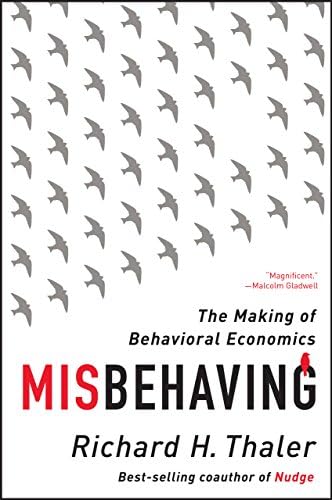
Misbehaving: The Making of Behavioral Economics

4.5 out of 5 stars (4,831)

Winner of the Nobel Prize in Economics


Get ready to change the way you think about economics.


Nobel laureate Richard H. Thaler has spent his career studying the radical notion that the central agents in the economy are humans—predictable, error-prone individuals. Misbehaving is his arresting, frequently hilarious account of the struggle to bring an academic discipline back down to earth—and change the way we think about economics, ourselves, and our world.


Traditional economics assumes rational actors. Early in his research, Thaler realized these Spock-like automatons were nothing like real people. Whether buying a clock radio, selling basketball tickets, or applying for a mortgage, we all succumb to biases and make decisions that deviate from the standards of rationality assumed by economists. In other words, we misbehave. More importantly, our misbehavior has serious consequences. Dismissed at first by economists as an amusing sideshow, the study of human miscalculations and their effects on markets now drives efforts to make better decisions in our lives, our businesses, and our governments.


Coupling recent discoveries in human psychology with a practical understanding of incentives and market behavior, Thaler enlightens readers about how to make smarter decisions in an increasingly mystifying world. He reveals how behavioral economic analysis opens up new ways to look at everything from household finance to assigning faculty offices in a new building, to TV game shows, the NFL draft, and businesses like Uber.


Laced with antic stories of Thaler’s spirited battles with the bastions of traditional economic thinking, Misbehaving is a singular look into profound human foibles. When economics meets psychology, the implications for individuals, managers, and policy makers are both profound and entertaining.


Shortlisted for the Financial Times & McKinsey Business Book of the Year Award

This title is only available on select devices and the latest version of the Kindle app. Please refer to the supported device list before purchase. Available on these devices

See all supported devices

Kindle E-Readers

  • Kindle Paperwhite (6th Generation)
  • Kindle (11th Generation, 2022 Release)
  • Kindle (7th Generation)
  • Kindle Oasis (9th Generation)
  • Kindle Paperwhite (11th Generation)
  • Kindle (11th Generation, 2024 Release)
  • Kindle (10th Generation)
  • Kindle Scribe (1st Generation, 2022 Release)
  • Kindle Oasis (10th Generation)
  • Kindle (8th Generation)
  • Kindle Colorsoft (1st Generation)
  • Kindle Paperwhite (10th Generation)
  • Kindle Scribe (3rd Generation)
  • Kindle Scribe (2024 Release)
  • Kindle Scribe Colorsoft (1st Generation)
  • Kindle Paperwhite (12th Generation)
  • Kindle Oasis (8th Generation)
  • Kindle Voyage (7th Generation)
  • Kindle Paperwhite (7th Generation)

Fire Tablets

  • Fire HD 8 (10th Generation)
  • Fire Max 11 (13th Generation)
  • Fire HD 10 (11th Generation)
  • Fire 10 HD (13th Gen)
  • Fire HD 8 (8th Generation)
  • Fire HD 8 (12th Generation)
  • Fire HD 10 Plus
  • Fire HD 8 (12th Generation)
  • Fire 7 (12th Generation)
  • Fire HD 10 (9th Generation)
  • Fire 7 (9th Generation)
  • Fire HD 8 (12th Generation)

Free Kindle Reading Apps

  • Kindle for Android Tablets
  • Kindle for iPhone
  • Kindle for PC
  • Kindle for Mac
  • Kindle for iPad
  • Kindle for Android Phones
  • Kindle for Web

Customers also bought or read

Loading...

Editorial Reviews

Review

“A sly and somewhat subversive history of [the economics] profession… Engrossing and highly relevant.” —Jonathan A. Knee, New York Times

“Highly enjoyable… Dense with fascinating examples…. It is long past time to replace Econs with Humans, both in theory and in the practice of prediction.” —Carol Tavris, Wall Street Journal

“A dryly humorous history of the revolution [Thaler] helped ignite, as well as a useful (if sometimes challenging) primer on its key concepts.” —Julia M. Klein, Chicago Tribune

“[A] masterful, readable account of behavioral economics. Very well done.” —David Wessel, Pulitzer Prize-winning journalist, author of Red Ink and Ben Bernanke’s War on the Great Panic

“Bound to become a classic. Now established as one of the great figures in the history of economic thought, Thaler has no predecessors. A rebel with a cause…[w]here he wins Olympic gold is in keen observation; his greatest insights come from actually looking.” —Cass Sunstein, New Rambler

“Entertaining…. An excellent read on the shortcomings of classical economic and finance theory.” —Ronald L. Moy, CFA Institute

“The creative genius who invented the field of behavioral economics is also a master storyteller and a very funny man. All these talents are on display in this wonderful book.” —Daniel Kahneman, winner of the Nobel Prize in Economics and author of Thinking, Fast and Slow

“The story behind some of the most important insights in modern economics. If I had to be trapped in an elevator with any contemporary intellectual, I’d pick Richard Thaler.” —Malcolm Gladwell

“Richard Thaler has been at the center of the most important revolution to happen in economics in the last thirty years. In this captivating book, he lays out the evidence for behavioral economics and explains why there was so much resistance to it. Read Misbehaving. There is no better guide to this new and exciting economics.” —Robert J. Shiller, winner of the Nobel Prize in Economics and author of Finance and the Good Society

About the Author

Richard H. Thaler is the coauthor of the bestselling book Nudge with Cass R. Sunstein, and the author of Quasi Rational Economics and The Winner’s Curse. He is a professor of behavioral science and economics at the University of Chicago Booth School of Business and, in 2015, the president of the American Economic Association.

Product details

  • ASIN ‏ : ‎ B00NUB4GFQ
  • Publisher ‏ : ‎ W. W. Norton & Company
  • Accessibility ‏ : ‎ Learn more
  • Publication date ‏ : ‎ May 11, 2015
  • Edition ‏ : ‎ Reprint
  • Language ‏ : ‎ English
  • File size ‏ : ‎ 5.0 MB
  • Screen Reader ‏ : ‎ Supported
  • Enhanced typesetting ‏ : ‎ Enabled
  • X-Ray ‏ : ‎ Not Enabled
  • Word Wise ‏ : ‎ Enabled
  • Print length ‏ : ‎ 434 pages
  • ISBN-10 ‏ : ‎ 9780393246773
  • ISBN-13 ‏ : ‎ 978-0393246773
  • Page Flip ‏ : ‎ Enabled
  • Best Sellers Rank: #157,056 in Kindle Store (See Top 100 in Kindle Store)
  • Customer Reviews:
    4.5 out of 5 stars (4,831)

About the authors

Follow authors to get new release updates, plus improved recommendations.

Customer reviews

4.5 out of 5 stars
4,831 global ratings

Customers say

Customers find this book engaging and easy to read, providing valuable insights into behavioral economics. The writing style is well-crafted, with the author's earnest humor making it entertaining, and customers appreciate the historical context and real-life examples that make it useful in both business and everyday life. They consider it a must-read for economists and find it worth the price.
AI Generated from the text of customer reviews

Select to learn more

212 customers mention content, 199 positive, 13 negative
Customers find the book engaging with delightful storytelling, describing it as a very interesting and fun read.
I thought "Nudge" was a great read so I was interested to get more of the story on the creation and development of behavioral economics....Read more
Great book. Very insightful about the surprising "blind spots" in the conventional wisdom of economics....Read more
Well written, insightful, and entertaining.Read more
...All in all, a good read about a sometimes tough topic to assimilate. Highly recommended.Read more
157 customers mention informative, 146 positive, 11 negative
Customers find the book informative, providing great insights and historical perspective on behavioral economics.
...potential pitfalls and be aware of our cognitive biases though his insightful yet delightful storytelling....Read more
Witty, informative and very entertaining. I would highly recommend this for anyone interested in a light introduction to behavioral economics.Read more
Great book. Very insightful about the surprising "blind spots" in the conventional wisdom of economics....Read more
I found this book to be incredibly facinating and enlightening. So much so that I am looking into making this a course of study....Read more
58 customers mention readability, 51 positive, 7 negative
Customers find the book easy to read and understand, describing it as an accessible overview of behavioral economics that reads quickly like a narrative.
A very interesting and well written book. An easy read with things explained well. Is a bit autobiographical but does not go overboard on it.Read more
...The prose is conversational and easy to read. Plus the anecdotes are insightful and amusing.Read more
This book was very readable and the stories and examples make it fun. It's relevance for many fields of endeavor is intriguing.Read more
...Easy to understand even if you have never taken an economic course in your life....Read more
34 customers mention writing style, 31 positive, 3 negative
Customers appreciate the writing style of the book, describing it as well-written and engaging, with one customer noting how the author's understanding of reader behavior is evident throughout.
...This book plows little new territory but it is so well written and convincing it is sure to encourage more and better work. Ken Davidson UC '63Read more
A very interesting and well written book. An easy read with things explained well. Is a bit autobiographical but does not go overboard on it.Read more
Written very well, but you don't have to be an academic to understand his theses or concepts....Read more
I really liked this book. I think most people would. It is well-written (and an interesting topic, of course)Read more
31 customers mention humor, 31 positive, 0 negative
Customers enjoy the book's humor, particularly its earnest wit and personal stories, with one customer noting the amusing debates with other academics.
...the course of what appears an effortless coffee conversation, which is funny and witty at the same time. Yet, these insights are anything but simple!Read more
Witty, informative and very entertaining. I would highly recommend this for anyone interested in a light introduction to behavioral economics.Read more
...Highly recommend, and Thaler writes with earnest humor and process.Read more
...It is a very good, eminently readable and at times funny book with great insight into this emerging field....Read more
30 customers mention examples, 29 positive, 1 negative
Customers appreciate the examples in the book, finding them valuable and useful in both business and everyday life.
Simultaneously fun and educational. Thaler is witty in chronicling the disruption that he brought to an irrationally rational field of economics....Read more
...book, and it is full of useful information and guidance for my real estate career.Read more
...This book is a great reminder that true rational actions are actually less common than otherwise believed. And above all, it's fun to read!Read more
...Good examples on why the markets and financial environment do not behave the way classic economic theories predict....Read more
25 customers mention interesting topics, 24 positive, 1 negative
Customers find the book's topics engaging, particularly appreciating its historical context and relevance to various fields of endeavor.
Certainly an interesting topic and one that anyone can relate to....Read more
This is a great history and fun journey through the development of a field that is vitally important to us all whether or not we realize not, not...Read more
...Never thought that an economics book can be so exciting. Very interesting ideas and the examples are really clear and explains them very nicely....Read more
...for the layperson, but if you can tough it out - it has some interesting parts....Read more
14 customers mention value for money, 13 positive, 1 negative
Customers find the book well worth the time and money invested, with many considering it a must-read for economists.
...Easily accessible to all, and a must read for all economists.Read more
...All in all, I found this book well worth the read, and I highly recommend it to those interested in the psychology of economic decision making.Read more
This book is challenging to understand and read but well worth the time invested....Read more
...ingredients that go into the recipe of behavior econ and it's well worth your time.Read more
A must read for every layman wanting to understand human economic behavior.
5 out of 5 stars
A must read for every layman wanting to understand human economic behavior.
I had to read this book for a class, but it ended up feeling like a breeze and really enjoying it. Richard Thaler is funny and communicates in a simple, yet effective style.
Thank you for your feedback
Sorry, there was an error
Sorry we couldn't load the review

Top reviews from the United States

  • 5 out of 5 stars
    Paradigm Shift - The Evolution of Behavioral Economics
    Reviewed in the United States on May 26, 2015
    Brief content visible, double tap to read full content.
    Full content visible, double tap to read brief content.

    "The foundation of political economy and, in general of every social science, is evidently psychology. A day may come when we shall be able to deduce the laws of social science from the principles of psychology." Vilfredo Pareto, 1906

    Misbehaving is a thoroughly enjoyable read, both comprehensive and replete with historical context, but "neither a treatise nor a polemic" as prefaced by Thaler. Instead, it is a memoir and a chronological history on the rise of behavioral economics as a legitimate discipline, making it an excellent introduction to the field. The book is lengthy, an un-lazy 358 pages, but an easy read because of Thaler's self-deprecating style and numerous examples that are both funny and informative (like oenophile mental accounting). My favorite illustrative anecdote, however, was the kerfuffle that ensued among the "efficient market" professors at the University of Chicago when it came time to hold a lottery on allocating offices in their new academic building - hilarious.

    I got hooked on behavioral economics almost 20 years ago at a conference held on the topic at Harvard's Kennedy School, featuring Richard Thaler, Richard Zeckhauser, Arnie Wood and others. The seeds planted from that fascinating seminar led me to be a lifelong student of this emerging, multi-disciplinary field and the importance of metacognition - quite literally, thinking about thinking. For an alcoholic, admitting you have a problem is the first step towards recovery. Analogously, it is impossible to temper evolutionarily prewired heuristics and biases unless you have studied them - and even then, it is too easy to 'fall off the wagon.' Anchoring, myopic loss aversion, overconfidence and hyperbolic discounting are all pervasive, but you have to understand the nature of these inherent biases to have any chance of counteracting them in your own behavior, both personally and professionally. As an institutional money manager overseeing billions of dollars in client assets, the lessons learned from behavioral finance have - unequivocally - been a key source of competitive advantage for me in an otherwise fairly efficient market.

    From a personal standpoint, the useful lessons are also manifold and overlap with research on happiness and the value of rich experiences over accumulating more 'stuff.' Specifically, understanding the siren song of transaction utility (i.e. bargains) vs. acquisition utility (the 'consumer surplus') offers great insight on how to spend money. As Thaler notes: "For those who are at least living comfortably, negative transaction utility can prevent our consuming special experiences that will provide a lifetime of happy memories, and the amount by which the item was overpriced will long be forgotten. Good deals, on the other hand, can lure all of us into making purchases of objects of little value." Learn this lesson and you will be more likely to scalp an expensive ticket to the 'last' Rolling Stones tour than buy a fancy new jacket that is enticingly on sale, but will eventually gather dust in the back of your closet (Note: this also dovetails nicely with Buddhist philosophy around impermanence and craving - see "Hooked! Buddhist Writings on Greed, Desire, and the Urge to Consume" by Shambhala).

    An excellent complementary read to Misbehaving, for those interested in the evolutionary drivers of behavioral biases, is "Kluge: The Haphazard Construction of the Human Mind" by Gary Marcus. Likewise, Nassim Taleb's brilliant "Fooled by Randomness: The Hidden Role of Chance in Life and in the Markets" is also a highly relevant read. Finally, for anyone with an interest in the applied behavioral field of 'choice architecture,' Thaler's earlier book with Cass Sunstein, "Nudge: Improving Decisions About Health, Wealth, and Happiness" is also thought-provoking. As a registered libertarian, I can honestly say that I have no problem with Thaler's view towards 'nudging' people to better outcomes through choice architecture, despite predictable criticisms of 'libertarian paternalism' as Orwellian (see Robert Williams' letter in WSJ - 5/23/15). Thaler clarifies the nudge objective as trying to "influence choices in a way that will make the choosers better off, as judged by themselves."

    This is a very intimate book - reading Misbehaving, one is left with the wonderful feeling they've spent a long weekend with Thaler hearing about the history and rise of behavioral finance, over multiple bottles of wine, and all while being peppered with entertaining personal references and anecdotes.

    65 people found this helpful
    Sending feedback...
    Thank you for your feedback.
    Sending feedback...
    Thanks, we'll investigate in the next few days.
  • 4 out of 5 stars
    Interesting looking into the history of Behavioral Economics
    Reviewed in the United States on August 2, 2017
    Brief content visible, double tap to read full content.
    Full content visible, double tap to read brief content.

    My Rating: Put it on your list

    Level: Moderate to difficult, depending on your base knowledge of Economics and Psychology. Moderate in length, but reads quickly

    Summary

    Part Thaler autobiography, part time line of the development of the field, with plenty of humorous anecdotes and academic ‘anomalies’, this book does not read like a history of an academic discipline. The book is broken into eight broad chapter based around years in which Thaler worked through differing parts of the development of the field. The chronology starts with him as a graduate student, where he is just starting to look into ideas that would become the discipline, and proceeds up to the present, where he seems poised to hand over the reins to the next generation. Along the way are his stories of getting the discipline recognized by academic journals, struggles with the establishment, and gaining allies (across other disciplines, as well) and students that will become the next generation.

    My Thoughts

    This book, like the somewhat related book (Thinking, Fast & Slow) by his fellow collaborator, Daniel Kahneman, kind of annoyed me in how well it is written. Thaler has had a nearly five decade career as researcher and writer, so he should write well, but that is not what I mean. His book is funny and reads quickly like a narrative. As I said above, it it part autobiography, and lends itself tremendously to humorous narrative that leaves you interested in reading more. As a pretend internet researcher and writer, I am envious that someone with actual credentials writes so well.

    All that being said, I think I missed the subtitle of this book when I first heard about it a few years ago. I heard Thaler on a interview, and knew he was related to behavioral economics, but didn’t quite realize this was book he was promoting. I must have searched his name on amazon and bought the first book I saw, without noticing the reference to ‘Nudge’ on the cover. Nudge was really the book I was looking for, which is more about the research out of Behavioral Economics as it relates to topics like money and health. ‘The Making of Behavioral Economics’ should have clued me in to this book being more of a history. Luckily, I enjoy history and biographies, and as I said above, he is a very talented writer.

    One of the first things that stuck out to me was how long he as been in the field. His book starts in 1970, with him as a grad student. I wouldn’t be born for another decade and a half, and I don’t consider myself very young. I’ve heard that Millennials will have between seven and 17 careers over their lifetimes, so it amazes me to read of someone’s history in a field that is longer than my lifetime.

    Reading history is always fascinating, because you, with the addition of hindsight, can read and say, ‘how did these people miss this?’ I couldn’t believe some of the resistance he and others would face as the argued against the efficient market hypothesis. I was in high school during pets.com (look it up kids) and the tech bubble and finished grad school a few months before the housing bubble popped, so I struggle to believe in any way the the market is efficient and that people are well informed. Thinking back to my undergrad economics courses, I believe I was taught the distinction between theory of economics (people who Thaler calls Econs) and actual behavior (called Humans). In grad school, the distinction was called that of theory and practice. So, it is interesting to see that a few decades before, saying things like this, which to me are clearly true, would get you laughed out of conferences and barred from academic journals.

    This history was interesting, and the debates with other academics were amusing and insightful, but the book really shines with the anecdotes. I won’t go through all of them here, but the include an economist who refuses to sell his wine (for a gain) at the market price while also stating he would never buy it at the price and companies whose stock prices are lower than their subsidiaries (even when purchasing the larger company stock means getting the smaller companies stock included; this means the larger company is valued in negative dollars relative to market cap).

    These types of stories are what I enjoy reading. They are amusing on their own, but also challenge your assumptions about certain areas, but even more, make you really question whether you actually know what you are doing. You may think you do everything rationally, but you probably don’t, and that is illustrated time and again in this book. If you are looking for just stories and research results, you are probably better off with Nudge or Thinking, Fast and Slow. However, if you are interesting in Behavioral Economics in general, this is definitely a book to put on your list.

    More reviews at MondayMorningTheology.com

    10 people found this helpful
    Sending feedback...
    Thank you for your feedback.
    Sending feedback...
    Thanks, we'll investigate in the next few days.
  • 5 out of 5 stars
    Great overview of the field of behavioural economics and its own evolution within economics over the last 40 years.
    Reviewed in the United States on July 22, 2015
    Brief content visible, double tap to read full content.
    Full content visible, double tap to read brief content.

    Behavioral economics has gone from a backwater discipline to the forefront of economic research over the last four decades and Richard Thaler has been one of the pioneers to take the field forward. Misbehaving: the making of behavioral economics is both the personal story of Richard Thaler as well as a strong overview of many of the experimental findings that have propelled the field forward and highlighted the relevance of experimental economics. With the financial crisis leading to much soul-searching among macro-economists behavioral finance has seen much renewed interest and representative agent models have been questioned more thoroughly. Misbehaving gives the reader a comprehensive overview of the value of psychology within economics and how our irrational behavioral failings don't get averaged out by the law of large numbers.

    Misbehaving is developed chronologically and is split into 8 sections. The author starts with his beginnings as a graduate student and early professor in the 70s. He starts by describing how when he first was constructing his exams he had a series of questions of increasing difficulty that would be a good measure of the depth of understanding of the student and how the average of his test was in the low 70s. Despite the grade curve being a normal one, the student's disdain for such a low mean led to an outcry and so he changed the denominator to a much larger number such that the numerator mean was much closer to 100. The proportion of correct answers was the same but the psychology of the results was totally different to the students. With this irrationality the author got caught in the growing interest in what economists consider supposedly irrelevant factors. The author starts to describe how early studies noticed endowment effects where people valued objects more as soon as they became their possessions which imply large transactional frictions. The author also highlights the work of Tversky and Khaneman on prospect theory and how declining marginal utility was insufficient to describe our economic decisions. The author gets into how people frame bargains and ripoffs and how the mental accounting that people have for acquisitions is based on transactional utility as well as consumption utility. In particular the value of getting a deal in and of itself leads people to buy unnecessary goods. This doesn't make sense if we were only focused on utility from the use of a good. The author discusses how people anchor on sunk costs and overuse goods for which they don't want to waste due to historic cost. The author also discusses how in peoples mental accounting they budget for categories and don't let those budgets spillover from one another leading to inefficient usage of capita. The author notes for example that when the price of gas collapsed people bought premium gas rather than other goods or services which should have been their preference. The author also highlights how people treat their winnings with different level of care than their initial endowments as they consider themselves playing with 'house money'. The author then tackles how people recognize they don't have self control and as a consequence sometimes remove temptation. Such a strategy would be irrational if people were trying to maximize their welfare but its obvious to people that we are often of more than one mind. Given results from brain science and split brain research results, for economists to actually belief people are of one mind and can optimize their behavior would be remarkable.

    The author then moves on to his work with Khaneman in the mid 80s. He documents the results of the ultimatum and dictator games. These are basic game theory games in which there is a game with first mover advantage that should result in heavily skewed outcomes in favor of the first mover. With no repetitions the outcomes should be that the winner takes all but people don't act like the rational actors of game theory calculating their Nash equilibrium and use rules of thumb based on perceptions of fairness. The results of these experiments have let to similar results on how to divide a pie across varying cultures reinforcing that fairness is a property people care about deeply. The author discusses fairness and market clearing mechanisms discussing concepts like outcomes that people think are repugnant - like hiking prices during a crisis. The author also highlights how in real business losing your customer base is far more detrimental than securing higher short term profits are beneficial.

    The author moves from experimental results to the academic debates around their relevance which picked up in the mid 80s and continued to the mid 90s. The author describes some of the early debates that occurred with Arrow on the behaviorist side against Chicago School with Merton Miller a staunch opponent. One of the debated points was the Modigliani-Miller theorem in which the capital structure should be irrelevant to the value of equities but is clearly not in practice. The author discusses the growth of journals which started to focus on behavioral economics and some of the puzzles posted. He includes a great puzzle which highlights confirmation bias for the reader. The author gets into the mission of building an economics team as well as discusses how people can get caught in the trap of forecasting time horizons with very narrow frames of reference instead of trying to step outside the project and reflect on past experiences. The author highlights how completing a book takes much longer than the author usually assumes it will take and repeating that time miscalculation time and time again despite realizing the result when advising others.

    The author then starts to cover finance which is where a lot of focus is for behavioral finance these days. The author gives some simple puzzles to note how investing requires thinking in the shoes of other people and how it resembles a beauty contest in which you are trying to pick the choices you believe others will make- a reference to Keynes. The author discusses episodes like the 87 crash and how volatility of dividends is a fraction of that of markets implying that noise is potentially a large component of volatility. The author brings up examples of irrational behavior like closed end fund premiums and discounts and highlights the mispricing of the stub investment of 3M vs pal during the internet bubble.

    The author then moves in to some interesting case studies he worked on where he discusses the NFL draft and the time inconsistency of people's decisions as well as their over emphasis of trying to pick superstars. He goes into the humorous example of office assignment for economics and business school professors- an area in which homo economicus should reign supreme; unsurprisingly he did not. He also discussed some of the risk taking behavior of people on game shows in which playing with house money led to risk loving behavior that would be totally contrary to behavior based on gambling with one's own capital. The author then moves into how this field can be useful and discusses his book Nudge and some policy reform in which better guiding policies can lead to more self enhancing outcomes for the population. The decisions by people to opt in to a program vs opt out are quite different and framing and laziness can have large impacts on how people make decisions.

    Misbehaving gives an informative overview of behavioral economics as it evolved. One learns about the field itself and the intertwining of disciplines with psychology as well as the internal conflicts faced by the economics profession. It presents a readable overview of the author's personal and professional life and is highly educational as well. Definitely worth reading.

    17 people found this helpful
    Sending feedback...
    Thank you for your feedback.
    Sending feedback...
    Thanks, we'll investigate in the next few days.
  • 5 out of 5 stars
    Essential read for traders striving to better understand and improve their psychology
    Reviewed in the United States on December 18, 2023
    Brief content visible, double tap to read full content.
    Full content visible, double tap to read brief content.

    I'm glad that I first read Daniel Kahneman's "Thinking, Fast and Slow" before delving into Richard Thaler's work. The foundational logic of Thaler's behavioral economics theory is much easier to grasp after understanding Kahneman's concepts. Many examples are shared across both books, and Thaler's journey is laid out chronologically, providing a clear view of how his thinking evolved as he gained recognition in his field. It's important to note that Kahneman was awarded the Nobel Prize in 2002, a full 15 years before Thaler received the same honor in 2017 for his contribution to behavioral economics. By the time Thaler completed this book in 2015, he was yet to join the ranks of Nobel Laureates. He mentions contemporaries of the big names such as Kahneman, Fama, and Shiller with deep respect and admiration.

    One of the most valuable aspects of Thaler's book is that it allowed me to draw connections between major figures in economics and their respective theories. I could immerse myself in the historical context, picturing the scene in 1985 when a conference filled with leading economists heatedly debated and the Nobel Prize winner was announced to be Modigliani.

    Thaler's understanding of reader behavior is evident in his writing. The book is devoid of mathematical equations that might deter readers from engaging with complex economic issues. The autobiographical style makes the absorption of economic knowledge effortless as readers navigate through Thaler's intriguing anecdotes.

    As a stock market trader, I was particularly struck by the story of Samuelson's correction regarding the misuse of the law of large numbers (LLN). Samuelson argued that if a person rejects a bet once, they should not accept it multiple times, because the possibility of losing a hundred times in a row is real and something they are not mentally prepared for.

    In summary, both Kahneman's "Thinking, Fast and Slow" and Thaler's "Misbehaving" are essential reads for traders striving to better understand and improve their psychology. For instance, compare your emotional response to a loss turning from $0 to $10 with a loss escalating from $1300 to $1310 in the stock market. If your reactions differ, you are likely susceptible to revenge trading and stand to lose in the stock market. Only by fully understanding our human tendencies can we harness this knowledge to outwit those who have not done so.

    Sending feedback...
    Thank you for your feedback.
    Sending feedback...
    Thanks, we'll investigate in the next few days.
  • 5 out of 5 stars
    I enjoyed Richard Thaler’s Misbehaving very much because (1) it’s a ...
    Reviewed in the United States on July 24, 2017
    Brief content visible, double tap to read full content.
    Full content visible, double tap to read brief content.

    I enjoyed Richard Thaler’s Misbehaving very much because (1) it’s a fun read, (2) it’s an interesting account of the development of economics, and (3) it includes deep investment insights.

    A fun read

    The book is full of anecdotes and funny stories. The author advised readers early on to stop reading the book when it is no longer fun (that would be misbehaving). I didn’t stop.

    To illustrate the tone of the book, here is how Thaler explains the difference between the “sophisticated” rational models used by classical economists like Harvard’s Robert Barro, and his own “simple” models. “When Robert Barro and I where at a conference together years ago, I said that the difference between our models was that he assumed that the agents in his model were as smart as he was, and I assumed they were as dumb as I am. Barro agreed.”

    Another one on the late Amos Tversky (the research partner of Daniel Kahneman), “who made possible a one-item IQ test: the sooner you realized Amos was smarter than you, the smarter you were.”

    And on the “no trade theorem” or Groucho Marx theorem: “If everyone believes that every stock was correctly priced already – and always would be correctly priced – there would not be very much point in trading.”

    Economics evolution

    Thaler clearly explains the evolution in economic thinking, for instance with respect to the consumption function. Keynes used the marginal propensity to consume, Friedman proposed the permanent income hypothesis, Modigliani developed the life-cycle hypothesis, Barro established the Ricardian equivalence. Economists prefer “clever” models and hence adopted the most “sophisticated” versions, which assume that economic agents are extremely smart and fully conversant in economic theory and fiscal policy.

    Through a variety of ingenious experiments and research, Thaler and other behavioral economists convincingly showed that Humans are not Econs (home economicus), that markets are not always efficient, and that nudging can be effective in public policy and elsewhere.

    Investment insights

    When behind, investors are more likely to gamble in an effort to break even.

    The closed-end fund puzzle is perplexing, and creates interesting investment opportunities. See here for a paper Thaler co-authored on this anomaly.

    Stockmarkets tend to overreact, as documented in a well-known paper by Thaler and De Bondt.

    Arbitrage opportunities sometimes arise. In “Can the Market Add and Subtract” Lamont and Thaler document cases of equity carve-outs where the implied price of the “stub” is a large negative number (e.g., 3COM/Palm).

    3 people found this helpful
    Sending feedback...
    Thank you for your feedback.
    Sending feedback...
    Thanks, we'll investigate in the next few days.
  • 4 out of 5 stars
    Thaler and his predecessors mark a regime change in economic theory
    Reviewed in the United States on February 21, 2018
    Brief content visible, double tap to read full content.
    Full content visible, double tap to read brief content.

    Misbehaving is one of several stand-out books on behavioral theory in the past decade or so. Richard Thaler succeeds at both providing a conceptual understanding of behavioral biases and explaining how these biases are present in everything from going to the store to economic research.

    He starts with his crown jewel, the endowment bias, which is strongly demonstrated using the wine example, wherein an owner of a fine wine worth $100 would not consider selling the wine because they want to drink it, but would not actually buy the same wine for $100 to drink if they didn’t already own it. This inconsistent logic extends beyond wine drinking. Consider also a person who would be willing to make a minimal payment to eliminate an already low risk of death, but would require significantly more if asked to accept that risk when it were not already present is also demonstrating this bias. There is a clear nonlinearity in subjective value that can be found frequently in consumer decision-making.

    Thereafter, Thaler continues to cover a series of interesting behavioral concepts.

    Hindsight bias, where individuals reviewing past performance believe that outcomes were predictable, causes mid-level managers to receive too much blame for project failures. Individual projects with sizeable payoff and sizeable risk of loss may not be favored by project managers individually due to capped upside and potential termination on the downside, even though from an aggregate perspective doing all projects may be the best choice for the company.

    Bounded rationality, a decision-making framework that incorporates behavioral biases, when applied to the theory of the firm, leads firms to maximize size (revenue) instead of value/profits (with minimal profit constraints). CEO pay seems to increase with both size and profits. Managers try to increase sales and match their workforce to meet sales, as opposed to performing marginal analysis for hiring decisions.

    The Weber Fechner law (also referred to as range-effects) describes a relationship between magnitude and intensity. Going from 2 headlights to 1 in a lit city is not a noticeable difference, but 1 to 0 is. Similarly, losing $1,300 instead of $1,290 is less noticeable than losing $20 instead of $10. In the latter example there is a diminishing marginal utility impact, so people are loss averse for the same reason they’re risk averse for gains…the loss of the second hundred hurts less than the first hundred. However, loss aversion (risk seeking when faced with losses) may only apply if the risk can generate enough gains to break even. If simply minimizing losses, loss aversion may not be exhibited. Accordingly, loss aversion could explain rogue trader issues and outsized losses/risk.

    Thaler goes on to explain the house money fallacy, wherein gamblers or investors will take more risk when playing with gains/investing with profits. He suggests this is a subsidiary behavior of mental accounting, implying that individuals should treat all gains the same as money initially invested. This concept has received appropriate challenge by opponents like Nassim Taleb, who highlight the importance of time probability and the use of thresholds to manage path-dependent financial decisions. While average returns over long-periods of time may be positive, intermediate volatility causing positions to be wiped out could prevent participation in recoveries, making thresholds important.

    An extension of this discussion includes myopic loss aversion, where people will turn down a single bet with a favorable payoff because the small loss would hurt more than the large gain, but would be willing to accept the same bet if run 100 times (because of the law of large numbers). Samuelson used backward induction to say this is irrational because there’s still a risk (albeit lower) of larger loss over 100 trials. Thaler disagrees, saying it’s actually the refusal to take the first bet that is irrational. Thaler then applies this to markets, saying investors over-invest in bonds because of similar short-term concern for potential losses (volatility). This may explain why the equity risk premium is so high, people are just looking at their portfolio too often!

    There is also dissent regarding how individuals respond to potential gains. In an experiment, Thaler notes that higher fares resulted in some inexperienced cab drivers hitting a target income and going home early, while staying out longer when fares are low. This is due to viewing income day by day instead of as a whole (though more experienced drivers didn’t make this mistake). This has far-reaching implications, as standard practice assumes that higher gains encourage individuals to intensify competition for those gains. To the extent investors operate with income targets in mind, higher rates of return may not induce investment.

    Thaler then introduces the first common argument against the relevance of behavioral biases: when stakes are high, individuals will make the right choice. However, research suggests individuals make irrational decisions whether stakes are high or low. In fact, high stakes purchases (i.e. a house) are less frequent than low stakes purchases, so consumers should really be better at making rational low stakes decisions as opposed to high stakes decisions.

    Another common argument against the relevance of behavioral biases: markets correct for behavioral irrationality. Thaler calls this the invisible hand wave, since its proponents often speak vociferously with their hands when explaining. However, if market participants are too unsophisticated to make rational decisions, how can they rationally select an expert? Also, experts likely have a conflict of interest. Both of these are reasonable objections, but not sufficient. It may not be about whether markets can make agents fully rational, but about how many layers of rational encouragement there are. For example, if sick, you could dance around a fire, but marketing and education help one reject this option in favor of medicine. You could just take any medicine, but you see a doctors to indicate which medicine or treatment is best. You could just see any doctor, or you could see those that have signaled competence via accreditation. At some point, the consumer has no choice but to use experience and judgment when making repeat purchases, even if more layers of assurance are added. Competition of private quality assurance adds checks to the process via liability and alternative options when dissatisfied. Overall, I don’t think Thaler is right to completely reject the invisible hand wave, though he does point out clear limitations.

    The last noteworthy general argument against the relevance of behavioral biases is from Gary Becker, who states that in competitive labor markets it doesn’t matter if most people suffer from behavioral biases, as the people who don’t will “win” the positions that require strong rational thinking. This argument is never really theoretically addressed, instead empirically challenged looking at football draft strategies (Thaler shows that team management tends to exhibit present bias and overpay for early picks).

    Thaler then moves on to explain the difference between transaction utility (the difference between price paid and usual price) and acquisition utility (general happiness attained via consumption). Homo economicus (the rational individual assumed in many economic theories) is never fooled by transaction utility, though normal people may be. Research suggests that poor individuals tend to assign more emphasis to opportunity costs, making them closest to homo economicus. Along similar lines, he explains the sunk cost fallacy, wherein individuals make decisions based on money already spent, potentially leading them to do something they would rather not just because of the money spent (going to a concert you bought tickets for when you’d rather just watch a movie when the night of the concert comes). This has both micro and macro effects, as Thaler argues it may cause governments to extent wars when they shouldn’t (there’s evidence this was the case during the Vietnam War). Fortunately, there is evidence that sunk cost inertia tends to be strong shortly after expenditure but wear off over time.

    Another popular bias, the self-control bias, has been a cornerstone of Thaler’s career. The self-control bias is exhibited when individuals admit that they’d be happier if the cashew bowl at a dinner party is taken away as to prevent them from getting full before dinner. The implication is that consumers may actually be better off when consumption options are limited instead of expanded, which directly opposes older economic frameworks that assume an increased possible consumption bundle is always better. This bias is ultimately a time preference issue. A one day difference matters more if it’s today versus tomorrow than if it’s one year from now versus one day before a year from now. Irving fisher argued that poor individuals have a more short-term preference because their desires apply to more urgent necessities. Samuelson pointed out that time preference is comparable to discounting future consumption. An exponential function is present if the year-over-year discount rate is constant. As conditions change over time and utility discount rates are adjusted, people may not act consistently (i.e. they may choose satisfaction in 2 years now, but prefer immediate satisfaction in a year). In other words, people may discount back from 1 year at 30% and back from 2 years at only 10%. This is called quasi-hyperbolic discounting when an individual starts high then declines, also known as present bias.

    This leads into an important discussion on consumption functions: how much will people spend after a tax cut? Keynes attempted to answer this question by noting that the marginal propensity to consumer is higher for poor people than for rich. Friedman argued that people will smooth the windfall over the short-run, but would spend more if they thought the income was permanent. Modigliani argued that it’s not income, but lifetime wealth that determines people’s marginal propensity to consume (the life cycle hypothesis). Barro took it even farther, extending the wealth time horizon to infinity to consider continued bequests (so Ricardian equivalence would exist). Thaler ultimately states that the marginal propensity to consume is higher or lower depending on the mental bucket new income is placed in, calling this the behavioral life cycle theory. He notes that lump sum tax breaks are more likely to be saved or used to pay off debt, while spreading tax breaks out will increase spending.

    Thaler then looks to other theories through a behavioral lens, particularly the Modigliani and Miller Irrelevance theorem, which states that if there are no taxes or transaction costs, companies should be indifferent whether money is paid in dividends, to repay debt, or in what bucket it is stored. Thaler says that mental accounting may cause investors to prefer dividends despite unfavorable taxes. Miller disagreed, saying Lintner’s explanation that firms only raise dividends when earnings are such that the firm will not have to lower dividends in the future is likely correct, although Thaler points out that this is itself a behavioral explanation similar to loss aversion.

    Thaler also delves into theories of market returns. He starts by introducing Keynes’ beauty contest and the guess the number game. The guess the number game dictates that everyone pick a number between 0 and 100, with the winner the individual who picks the number closest to two-thirds of the average number everyone else picks. Depending on the number of degrees of thought, the expected guess should keep getting lower until reaching 0, which is the Nash Equilibrium solution. These games demonstrate a different way of viewing secondary markets, with a focus on the actions of others instead of fundamentals.

    The first psychological explanation of market inefficiencies (value versus growth) was over-extrapolation of past performance onto future (so if growth stocks are too high and value stocks too low, outperformance of value is just reversion to mean). Fama argued it’s a risk difference, not a mispricing. In other words, higher returns may simply be due to value firms being more risky. Note, however, that this is not consistent with early users of the CAPM, which assumed these risks could be eliminated in diversified portfolios. Thaler notes that beta alone cannot explain these return differences.

    Thaler further argues that closed-end fund discounts from NAV refute the law of one price, though he seems to miss a large argument against such a claim. Closed-end funds are publicly traded holding companies that typically invest in portfolios of publicly traded securities. Unlike conventional mutual funds, closed-end funds do not redeem shares once they are issued; therefore, investors must buy and sell shares in the open market. Closed-end funds tend to trade at a discount relative to the value of their underlying assets in the open market, while conventional mutual funds trade at NAV (because conventional mutual funds will redeem shares from any shareholder at NAV). Although there are many possible explanations for the discount associated with closed-end funds (i.e. shareholders have no control over distribution policies of the fund, they cannot effect the level of management fees, they cannot control the timing of capital gain tax liabilities, they cannot control the issuance of new dilutive shares, etc.), most principally relate to a shareholder’s lack of control of the underlying assets of the fund. Thaler notes that closed-end funds are initially sold by brokers along with an approximate 7% commission. The fees don’t change but the discounts do, so the fees alone can’t be a sole explanation. Thus, Thaler blames investor sentiment and small firm effect (discount rises as difference between small and large stock returns increases) for the closed-end fund discount, without any reference to control issues. Control discounts at this level are further supported by control premium studies of acquisitions of publicly traded companies (which are admittedly influenced by synergies, not just control).

    Nonetheless, Thaler goes on to describe Fisher Black’s explanation of noise traders as simply “stupid” traders who ignore the law of one price, allowing for arbitrage-like opportunities. For example, when one public company owns another and the stub + subsidiary value doesn’t equal current value. He states that restrictions on shorts, a shortage of share inventory for shorts, and redemption requests from investors may prevent smart money from closing these anomalies.

    Thaler then takes on the Coase theorem, which states that if transaction costs are low and if dealing with small amounts of wealth, judges won’t be able to impact what kind of activity ends up occurring, they will only rule on who owns what or has what rights. The parties will end up negotiating according to their own preferences thereafter, so resources will still flow to the best use. Thaler argues that the endowment effect, sunk cost fallacy, and fairness consideration (preference to harm other side even at cost to self) will prevent the Coase theorem from working out. This is surprisingly reminiscent of Murray Rothbard’s criticism of the Coase theorem, which focuses on fairness and non-monetary (subjective) costs. Thaler then uses this reasoning to attack the perfection of consumer sovereignty, though he acknowledges bureaucratic behavioral limitations as well.

    Thaler then introduces asymmetric paternalism, where regulation benefits those who make errors without harming those who do not. This is the basis of the “nudge” solution. The role of government within such a framework is to enact laws that encourage individuals to make rational decisions without taking away their ability to make irrational (or just different) decisions if desired. A nudge does not involve reducing possible consumption or action bundles, instead simply selecting starting default decisions that can be changed if desired.

    Overall, while the ability of behavioral theory to explain certain identified phenomena is still up for debate, Thaler’s work is likely to be the core of macro-economic policy discussion for years to come. Great read.

    24 people found this helpful
    Sending feedback...
    Thank you for your feedback.
    Sending feedback...
    Thanks, we'll investigate in the next few days.
  • 5 out of 5 stars
    Be-Having: In Defense of Behavioral Economics
    Reviewed in the United States on May 26, 2015
    Brief content visible, double tap to read full content.
    Full content visible, double tap to read brief content.

    In this book, Richard Thaler, who doesn’t even have a Nobel Prize yet, talks about his role in the development of behavioral economics.

    It is a fun book to read. If you have read “Nudge,” his best seller with Cass Sunstein, you know that he has some verve as a storyteller. If you’ve read any of Sunstein’s books where his is the sole credited author, you know that that the verve in “Nudge” is from Thaler.

    There is some chronological structure to the book, but it is a little looser than a more rigorous introduction to the subject like Kahneman's “Thinking, Fast and Slow”. Thaler is a little more focused on the anecdotal to illustrate some of the general things behind behavioral economics. Namely, people are not necessarily economic actors. In the book he makes the divide between irrational “Humans” and more rational “Econs”. People don’t seem to like Thaler’s division. Many of his critics say that they know human beings aren’t entirely rational actors but they model as if they are. (I think these are some of the same people whose models of the economy didn’t include banks, so I’m not sure if their simplifications are useful).

    But here’s the thing. Behavioral econ is fun at the anecdotal level. After some people talking about Macro, the behavioral people are some of the most well known by the general public. That’s if you even accept the premise that they are even economists. Maybe they’re just psychologist trying to horn in on whatever halo effect you get by calling yourself an economist.

    The problem is that being fun at the anecdotal level doesn’t mean that you can build strong theories on it. In fact, it might disrupt your theories. Say you think there’s deadweight loss in giving gifts -- but people still give gifts when the most rational economic act would be to give no gift. If you had to give something, then cash is the best gift. It doesn’t have the graphic simplicity of criss-crossing demand and supply curves.

    What it can do is allow people to make the best choices. If you are in a situation where people have to make choices, you can make the decision easy for them so that they will make the one that is the best for them in the long run. This is where some other people bristle against the findings of Thaler and his school. The don't like the idea of making the default one thing or another, being afraid of paternalism by people who themselves are irrational actors. The most commonly cited “nudge” is making 401 (k) enrollment automatic. People are slackers, and instead of the default being “no,” you change it it “yes.” That way people are saving their money in a tax-favored retirement fund, when people need to have money for retirement. The point is here that a default has to be chosen and it makes sense to look at the research to determine what choices will be made with what defaults, ands what is the best default.

    I don’t just give it lip service. I recently got a raise and I immediately increased my withholding. My take-home increased, but so did the amount I put away. I wouldn’t have thought to do it had I not read books like Thaler’s. It might not save the world, but it will help my retirement.

    7 people found this helpful
    Sending feedback...
    Thank you for your feedback.
    Sending feedback...
    Thanks, we'll investigate in the next few days.
  • 3 out of 5 stars
    Average...
    Reviewed in the United States on October 15, 2024
    Brief content visible, double tap to read full content.
    Full content visible, double tap to read brief content.

    Behavioral economics is a very fascinating field. I have read several books on the subject even though I have no interest in working in economics whatsoever I have read Daniel Kahneman, Amos Tversky, Dan Ariely, Cass Sunstein, and of course Richard Thaler.

    It is fascinating seeing these people break down human behavior. It’s frustrating when I act more Human than Econ.

    The history of behavioral economics is fascinating too. Not long ago, it was a radical idea. Now it infiltrates every aspect of our economy and culture.

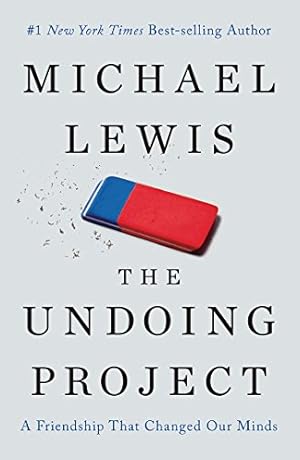
    If you want a good book on the history of behavioral economics I suggest “The Undoing Project” by Michael Lewis. This book is fine, but I was bored a lot of the time. Understanding the dynamics of choosing offices for professors was not exciting.

    So, it’s an average book for those behavioral economic nerds.

    One person found this helpful
    Sending feedback...
    Thank you for your feedback.
    Sending feedback...
    Thanks, we'll investigate in the next few days.

Top reviews from other countries

    Translated by Amazon
    See original
  • 1 out of 5 stars
    Horrible print quality and book is damaged. Doesn't look authentic.
    Reviewed in Singapore on September 1, 2022
    Brief content visible, double tap to read full content.
    Full content visible, double tap to read brief content.
    Horrible print quality and book is damaged. Doesn't look authentic.
    1 out of 5 stars
    Horrible print quality and book is damaged. Doesn't look authentic.
    Reviewed in Singapore on September 1, 2022

    Sending feedback...
    Thanks, we'll investigate in the next few days.
  • 5 out of 5 stars
    Superb storytelling
    Reviewed in Australia on March 3, 2019
    Brief content visible, double tap to read full content.
    Full content visible, double tap to read brief content.

    A wonderful biography of an academic theory, written with love by its founder. Just as Mr Thaler has made this science more Human, so he also writes for Humans, making something so complex and sophisticated seem simple, relevant, and easy to understand - even for beginners like me. Thank you!

    Sending feedback...
    Thanks, we'll investigate in the next few days.
  • 5 out of 5 stars
    Capolavoro
    Reviewed in Italy on April 23, 2019
    Brief content visible, double tap to read full content.
    Full content visible, double tap to read brief content.

    Davvero splendido libro, Thaler riesce a spiegare concetti complessi con metafore semplicissime! Ottima lettura per chiunque, non eccessivamente matematico ma allo stesso tempo approfondito nei punti giusti. Splendida lettura, dovrebbe essere inserito in qualsiasi corso universitario di economia.

    Sending feedback...
    Thanks, we'll investigate in the next few days.
    Translated from Italian by Amazon
    See original
  • 5 out of 5 stars
    Great read
    Reviewed in Germany on December 30, 2024
    Brief content visible, double tap to read full content.
    Full content visible, double tap to read brief content.

    Great summary of the field. Slowly bringing one into the whole idea of putting Humans back where they belong in the field of economics : the centre.

    Sending feedback...
    Thanks, we'll investigate in the next few days.
  • 5 out of 5 stars
    Complete, Compact, Hilarious and Horse's Mouth
    Reviewed in the United Kingdom on May 25, 2015
    Brief content visible, double tap to read full content.
    Full content visible, double tap to read brief content.

    He's taken his time and he's waited his turn, but Richard Thaler has delivered the definitive book on Behavioral Economics, the one you can't afford to miss. It's a summary of the main findings, a history of how they came about and a preview of coming attractions, with due care taken to pay tribute to those who came before Thaler and apportion credit to those who worked with him.

    The field is not as new as Thaler would have you think. There's bias in this account and it is a bias against those among his predecessors who tried to explain human behavior in a way that was consistent with mainstream economic theory. I'm thinking Gary Becker here (who tried to explain long lines outside empty clubs and packed cheap restaurants alike using an "upward sloping demand curve" and famously sat down to write a paper on suicide when his wife took her own life); I'm thinking the very same Robert Barro that Thaler makes fun of when he describes him as the smartest man ever, but who nonetheless made me understand in his book "Getting it Right" why superstars could get paid so much in a zero-sum game and got confirmation to his theory when Maradona was paid more than the rest of his team, Napoli, put together, and justifiably so because he not only took them to the Campionato, but also thwarted much more fancied teams from winning it.

    Thaler's predecessors operated in a world where most Economics books had to start with a chapter explaining why Economics is a science. Of course they had to stick to the utility-maximizing / profit-maximizing orthodoxy! Besides, orthodox economic theory was not all that shabby when it came to predicting human behavior.

    By the time Thaler was entering his prime, Economics no longer had to apologize to anybody and was much more open to heresy, of course. It was in a position to withstand additional questioning. Armed with a nice piece of math invented by Tversky and Kahneman it was ready to be taken to the next level.

    Thaler takes you through the whole thing in the space of the shortest 358 pages you will ever read. As he promises at the start, he tells it through a bunch of stories, mostly the stories of his collaborations and his epic fights with Economic Orthodoxy.

    The book is worth reading for the humor alone. The jokes range from pure slapstick (example p. 128: "we were trying to learn what ordinary citizens, albeit Canadians, think is fair") to the esoteric inside joke, like when he mentions Vishny is a common co-author of Shleifer (to the best of my knowledge he's never written a paper without Shleifer). If you're not laughing the whole time, basically, there are squadrons of jokes flying over your head. My favorite type of humor, relentless repetition, is also very well represented. I lost count of the number of times I read the expression "invisible handwave." The man is irrepressible, basically. You can't keep him down.

    There's a sadness that goes with this too, and it's that this is a bit of a category killer. "Misbehaving" Pareto-dominates all behavioral economics books that precede it in terms of readability, context, scope, you name it. I don't know what I would do with myself if I was Dan Ariely or if I was Steven Levitt (Roe v. Wade findings notwithstanding), to say nothing of Tim Hartford. They now have to accept that there's a book out there that beats their entire life's work on all fronts.

    The long problem set masquerading as a re-interpretation of behavioral economics that is Kahneman's "Thinking Fast and Slow" is the only true exception to the rule, it continues to stand alone, but relative to "Misbehaving" it's a cop-out. As he told Michael Lewis in the interview that preceded that book, Kahnemann did not want to write the history of the field, he did not want the book to have the feel of one's last book. So the door was left wide open to Kahneman's self-admittedly "lazy" student to jump into the breach.

    This he has done with gusto.

    Prospect Theory (how we are risk averse when we're winning and risk loving when we're losing) is taught straight from Tversky and Kahneman's 1976 graph and is used to explain: (i) transaction utility, including Costco's business model (ii) sunk costs (i.e. why you will carry on wearing an uncomfortable pair of shoes you paid 300 dollars for) (iii) the endowment effect (including later in the book how it undermines the Coase theorem) and (iv) "gambling with the house's money" at the casino, versus the fact that outsiders get overpriced toward the end of the day at the racetrack. Bucketing of budgets gets thrown in for free.

    Next comes a tutorial on Self-Control. Thaler explains that many humans discount future pleasure (or pain) on a scale that is totally unrelated to how we present-value bond cashflows and mainly operates on three levels: Now (intense), Later (much less intense) and Much Later (only slightly less intense than Later). This leads to preferences that are intertemporally inconsistent, a nightmare to Economic Orthodoxy, but very often true in real life. Heady stuff, and I promise, he makes it clear. He does not use graphs or charts or math. He explains it all with one picture: the famous cover of New Yorker magazine where everything this side of the Hudson is rendered in great detail, New Jersey through to California takes up as much space as West Manhattan and Asia is visible behind. You get that chart, you get how we humans really think about delayed gratification. Genius.

    A chapter follows which is a summary of "Thinking Fast and Slow" but without trying to shoehorn the rest of Behavioral Economics into that model.

    The next couple chapters deal with Fairness (the Ultimatum Game, the Dictator Game, the Punishment Game, cooperation games such as the Prisoner's Dilemma) and a revisit of the Endowment Effect as exemplified by the trading of Mugs with capital M. Then Thaler attacks Finance and the Efficient Market Hypothesis in Particular.

    Not that anybody sane thinks markets are efficient, but you could tear out the rest of the book and keep pages 203 to 253 as a quick guide to why markets are inefficient. Thaler starts with Keynes' "beauty contest" analogy for stock picking (we pick the girl we think most other people will like, not the one we really fancy). Next he explains why a stock ought to be worth the net present value of its dividends and takes the reader through Shiller's discovery that stocks move around tons more than dividends do (or can be reasonably expected to do), which proves they wander around tons relative to what they will ever pay out. He offers additional proof by going through closed-end funds' variation from their NPV and gets some serious kicks from pointing out that stocks on occasion sell for less than the market value of their listed subsidiaries. He's a bit of a showman, Thaler, he calls this "negative stock prices."

    From there he goes for the kill and notes that Royal Dutch Shell shares have a different price in New York versus Europe, and never more so than they did during the blow-up of LTCM, providing a real-life example of Shleifer and Vishny's mathematical formalization of Keynes' old aphorism that "the market can stay irrational for longer than you can stay solvent."

    At some point, Chicago had to follow Al Pacino's view that "you keep your friends close and your enemies closer" and put him on the faculty. From his angle, it was time to storm the citadel, and this is what Thaler chronicles next.

    He had been ready for them from day one. The book actually starts with "The Gauntlet," which is the series of challenges orthodox economists lay out for the behavioral crowd:

    1. The "As If" challenge states that even if nobody is an expert in everything, society operates as if we all were, because through division of labor we all end up doing things we understand.

    2. The "Incentives" challenge states that people respond to incentives once the stakes are large enough. All the wishy washy behavioral stuff washes away once we're talking real money.

    3. The "Learning" challenge states that even if we get it wrong in "one-shot" games, in real life most games are "repeated" and behavior thus converges to what Orthodox Economics would suggest.

    4. The "Invisible Hand" argument states that if we all go about doing what's best for us we nevertheless end up doing what's right for everyone else as well.

    Won't spoil it for you and take you through Thaler's answers to the above. It's after all what the book is really all about. But forgive me one indulgence, I've GOT to tell you about the bit where he demolishes Robert Barro:

    The Rational Expectations Hypothesis has a number of implications, chief amongst them the prediction that fiscal stimulus does not work. If the government writes you a check, the story goes, you know you'll be taxed for it in the future, so you save it rather than spend it. And the stimulus ends up being a damp squib. Thaler proves the circularity of this argument by suggesting a similarly circular counter-argument: what if the rational agents that compose this economy believed in Keynes' multiplier? What if they thought the stimulus will work and the economy will fly and their taxes will actually go down? Should they spend TWICE the check they were sent?

    From Chicago he goes on to a couple (well-earned) victory laps. He applies Behavioral Economics to Americal Football, where he advised three separate teams on how to conduct their affairs during the annual draft, to game shows he was allowed to set up with Endemol, where he proved that his theories can withstand some pretty high stakes and from there onto "nudging" people to contribute more to their pension and pay their taxes on time.

    He ends the book with a wish that one day there will be one Economics again, with the Orthodox Economics of utility maximization and profit maximization as a quaint special case. We're probably already there.

    Sending feedback...
    Thanks, we'll investigate in the next few days.

Report an issue


Does this item contain inappropriate content?
Do you believe that this item violates a copyright?
Does this item contain quality or formatting issues?