Reader Questions: Cash and Bond Holdings Details

I’ve gotten a few reader questions about my personal cash and bond holdings, so I thought I’d combine them here. You may be surprised that I don’t chase the top rates that much myself anymore, although I still do attractive deposit bonuses (most recently CIT Bank and Marcus). I’ve found that I can get pretty darn close to the top rates without being spread across as many bank accounts as in the past. My specific situation is that I have state income taxes of ~10%, so the fact that US Treasury obligations are exempt from state income tax makes a significant difference to me.

Big picture, I am roughly 70% stocks and 30% bonds and I let it float between 65%/35% or 75%/25% without worrying about. I mostly rebalance with both new cash inflows and internal flows of interest/dividends.

30% in bonds is broken down into 20% US “Regular” Treasury Bonds and/or FDIC-insured deposits and 10% US Treasury Inflation-Protected Bonds. For the US Treasury bonds, I hold mostly Vanguard Short-Term Treasury ETF (VGSH). The current 30-day SEC yield is 3.83%. Again, this converts to a tax-equivalent yield of ~4.25 APY due to the state-tax exemption for my situation.

VGSH is essentially a basket of US Treasury bonds held at a rock-bottom expense ratio of 0.03% with an average effective maturity and average duration of about 2 years. I converted to the ETF because the equivalent mutual fund has an expense ratio of 0.06%. If you think about it, a ladder of 1-year, 2-year, 3-year, 4-year, and 5-year bank certificates of deposit (CDs) with an added rung of “0-year” cash has an average duration of 2 to 2.5 years depending on how close they are to maturity. I used to spend a lot of time creating a 5-year CD ladder with top rates spread across multiple different credit unions, but right now I doubt you’ll beat a weighted average rate of 4.25% (again due to my 10% state tax rate).

What about more interest rate risk? The Vanguard Intermediate-Term Treasury ETF (VGIT) has an average duration of 5 years. The current 30-day SEC yield is 4.02% (roughly 0.20% higher). The steepness of the yield curve changes, but for the most part it is pretty flat right now, such that I haven’t felt that the slight increase in yield is worth the added interest rate risk. If interest rates go up, then that little bit of extra yield can be offset completely. Overall it’s a minor difference, VGIT would be fine really, but I do make sure to avoid long-term bonds. I used to own both short-term and intermediate-term funds, but now it’s just short-term for simplicity and lower stress. I choose to take my risk in the stock portion of the portfolio.

What about more credit risk? I can compare with Vanguard Total US Bond ETF (BND), which contains corporate bonds and mortgage-backed securities and such, with a current 30-day SEC yield of 4.34%. While BND also holds some Treasuries, it doesn’t meet the 50% threshold requirements for California, Connecticut, and New York, so residents don’t get any tax break in those states. That makes the difference only about 0.10%. For me, the extra risk doesn’t seem worth the extra yield.

Municipal bonds are also not competitive right now if you compare them directly (AAA-rated short-term munis to short-term Treasuries). I have held Vanguard muni bond funds in the past when their tax-equivalent yield was a full 1% higher than the same term US Treasury.

(* I know that there is discussion about the credit quality of the United States, which is fine and fair, but I still think they are the relative safest and don’t feel the need to diversify into corporate bonds or debt from other countries. The Treasury literally creates the money. Inflation is more of a concern to me.)

As part of my bond allocation, I include at least a year’s worth of expenses in “cash”. Let’s say my rough withdrawal rate is 3%, so I keep about 3% of my portfolio in cash. This is mostly held in a combination of the following three accounts and whatever deposit bonuses I am currently pursuing.

  • Vanguard Treasury Money Market Fund (VUSXX) has a currently APY equivalent of ~3.68%, which converts to a tax-equivalent yield of ~4.08% APY due to the state-tax exemption. Vanguard is a traditional brokerage and doesn’t provide things like Bill Pay or checking account features, but it is also where I hold the rest of my bonds and where most of my dividends land every quarter.
  • Fidelity® Treasury Only Money Market Fund (FDLXX) has a currently APY equivalent of ~3.3%, which converts to a tax-equivalent yield of ~3.67% APY due to the state-tax exemption. This is not as good as Vanguard or the top online savings accounts, but I like that it usually stays relatively competitive without having to move any funds. I also use Fidelity for its brokerage/IRA/Solo 401k already. Direct deposit (and some dividends) goes in, and Bill Payments go out. Fidelity “pushes” these payments out. I don’t use Fidelity for anything else requiring their routing numbers, checkwriting, or debit card (anything “pulled” from Fidelity). Many of their banking services are farmed out through UMB Bank and if there is any kind of issue, then dealing with them can be a pain as they can blame each other for the problem.
  • Ally Savings, SoFi Savings, and CIT Bank. I’ve used each of these for a while and I like that they are reliable especially when dealing with lots of smaller transactions (ACH pulls, check deposits, Venmo, etc) and interbank ACH transfers. They have competitive interest rates, if not the highest every month. They each also have invested in their own user interface for interbank transfers. Honestly, I’d stick with just Ally if I could as I like their system the best, but they’ve been lagging in the interest rate department recently.

MMB Portfolio Dividend & Interest Income – 2026 1st Quarter Update

Here’s my 2026 1st Quarter income update as a companion post to my 2026 1st Quarter asset allocation & performance update. Even though I don’t focus on high-dividend stocks or covered-call strategies, I still track the income from my portfolio as an alternative metric to price performance. The total income goes up much more gradually and consistently than the number shown on brokerage statements, which helps encourage consistent investing. Here’s a quote from Jack Bogle (source):

The true investor will do better if he forgets about the stock market and pays attention to his dividend returns and to the operating results of his companies. – Jack Bogle

Stock dividends are a portion of profits that businesses have decided to distribute directly to shareholders, as opposed to reinvesting into their business, paying back debt, or buying back shares. They have explicitly decided that they don’t need this money to improve their business, and that it would be better to distribute it to shareholders. The dividends may suffer some short-term drops, but over the long run they have grown faster than inflation.

Here is the historical growth of the S&P 500 total dividend, which tracks roughly the largest 500 stocks in the US, updated as of 2026 Q1 (via Yardeni Research):

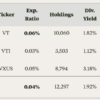
Tracking the income from my portfolio. Three of the primary “trees” that produce “fruit” in my portfolio are Vanguard Total US Stock ETF (VTI), Vanguard Total International Stock ETF (VXUS), and Vanguard Real Estate Index ETF (VNQ).

In the US, the dividend culture is somewhat conservative in that shareholders expect dividends to be stable and only go up. Thus the starting yield is lower, but grows more steadily with smaller cuts during hard times. Companies do buybacks as well, often because they are easier to discontinue. Here is an updated chart of the trailing 12-month (ttm) dividend per share over the last 15 years paid by the Vanguard Total US Stock ETF (VTI) via WallStNumbers.com.

European corporate culture tends to encourage paying out a higher (sometimes even fixed) percentage of earnings as dividends, but that also means the dividends move up and down with earnings. The starting yield is currently higher but may not grow as reliably. Here is an updated chart of the trailing 12-month (ttm) dividend per share over the last 15 years paid by the Vanguard Total International Stock ETF (VXUS).

In the case of Real Estate Investment Trusts (REITs), they are legally required to distribute at least 90 percent of their taxable income to shareholders as dividends. Historically, about half of the total return from REITs is from this dividend income. Here is an updated chart of the trailing 12-month (ttm) dividend per share over the last 15 years paid by the Vanguard Real Estate Index ETF (VNQ).

The dividend yield (dividends divided by price) also serve as a rough valuation metric. When stock prices drop, this percentage metric usually goes up – which makes me feel better in a bear market. When stock prices go up, this percentage metric usually goes down, which keeps me from getting too euphoric during a bull market.

Finally, the last income component of my portfolio comes from interest from bonds and cash. Vanguard Short-Term Treasury ETF (VGSH) and Schwab US TIPS ETF (SCHP) are example holdings, with the actual amount varying with the prevailing interest rates, the real rates on TIPS, and the current rate of inflation.

Dividend and interest income yield. To estimate the income from my portfolio, I use the weighted “TTM” or “12-Month Yield” from Morningstar (checked 4/8/26), which is the sum of the trailing 12 months of interest and dividend payments divided by the last month’s ending share price (NAV) plus any capital gains distributed (usually zero for index funds) over the same period. My TTM portfolio yield is now roughly 2.61%.

In dividend investing circles, there is a metric called yield on cost, which is calculated by dividing the current dividend by the original purchase price. In other words, while my portfolio yield today is may be lower than say a target withdrawal rate of 3%, that is because the current market price is also a lot higher. Due to increasing dividends on average over time, my yield-on-cost based on my portfolio value from 10 years ago is over 5%.

What about the 4% rule? For big-picture purposes, I support the simple 4% or 3% rule of thumb, which equates to a target of accumulating roughly 25 to 33 times your annual expenses. I would lean towards a 3% withdrawal rate if you want to retire young (closer to age 50) and a 4% withdrawal rate if retiring at a more traditional age (closer to 65). It’s just a quick and dirty target to get you started, not a number sent down from the heavens!

During the accumulation stage, your time is better spent focusing on earning potential via better career moves, improving your skillset, networking, and/or looking for asymmetrical (unlimited upside, limited downside) entrepreneurial opportunities where you have an ownership interest.

Our dividends and interest income are not automatically reinvested. They are simply another “paycheck”. As with our other variable paychecks, we can choose to either spend it or invest it again to compound things more quickly. You could use this money to cut back working hours, pursue a different career path, start a new business, take a sabbatical, perform charity or volunteer work, and so on. You don’t have to wait until you hit a magic number. Our life path has been very different because of this philosophy. FIRE is Life!

Spruce Money Fintech App: $100 Referral Bonus w/ Direct Deposit (H&R Block)

Spruce is a new fintech app from H&R Block with banking services provided by Pathward NA, member FDIC. They are currently offering a $100 referral bonus if you activate their debit card and complete a qualifying direct deposit of at least $200 … [Read the rest]

Best Interest Rates Survey: Bank Accounts, Treasury Bills, Money Markets, ETFs – April 2026

Here's my monthly survey of the best interest rates on cash as of April 2026, roughly sorted from shortest to longest maturities. Banks and brokerages love taking advantage of idle cash, and you can often earn more interest while keeping the same … [Read the rest]

CIT Bank Platinum Savings APY Boost Promo: 6-Months at 4.10% APY (New and Existing Customers)

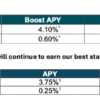
(Update: The end date for this offer has been extended to 5/31/26.) CIT Bank has a new limited-time Platinum Savings APY Boost Promotion, offering a boosted interest rate of 4.10% APY for 6 months on their Platinum Saving account that is 0.35% APY … [Read the rest]

Chase Bank $900 Checking + Savings Bonus w/ Coupon Code (Updated 2026)

Back again, new expiration date 7/15/2026. Here's another megabank bonus to pick up if you haven't already. Chase Bank has a Total Checking + Savings account promotion offering up to $900 total for new customers that open both a checking and … [Read the rest]

3 Reasons Why Vanguard Investors Made $5 Trillion Over Last 10 Years

A new Morningstar article points out that between December 2016 and December 2025, Vanguard investors contributed about $2 trillion in net investment flows, while also gaining $5 trillion in market appreciation (income and gains). They listed two … [Read the rest]

MMB Portfolio Asset Allocation & Performance – 2026 1st Quarter Update

Here is my 2026 1st Quarter portfolio update that includes all our combined 401k/403b/IRAs and taxable brokerage accounts but excludes our house and small side portfolio of self-directed investments. Following the concept of skin in the game, the … [Read the rest]

5% Cash Back Cards: Restaurants, Home Improvement, Amazon – April through June 2026

Activation reminder for 2026 2nd Quarter. The credit cards below offer 5% cash back and up on specific categories, some fixed and some that rotate each quarter. It takes a little extra attention to which card you're using, but it can add up to … [Read the rest]

Marriott Bonvoy Brilliant American Express Review: 200,000 Points Limited-Time Offer

New limited-time 200k offer. The Marriott Bonvoy Brilliant American Express is the premium co-branded rewards card for Marriott hotels. This card has a hefty annual fee, but a closer look reveals it's not as bad as it looks initially due to perks … [Read the rest]

Marriott Bonvoy Bevy American Express Review: 175,000 Points Limited-Time Offer

New limited-time 175k offer. The Marriott Bonvoy Bevy American Express is the mid-tier co-branded rewards card for Marriott hotels. Right now, there is a limited-time offer boost, making it worth a look. Here are the highlights: 175,000 … [Read the rest]

Marriott Bonvoy Boundless Card Review: 4 Free Night Awards + $100 in Airline Credits

The Marriott Bonvoy Boundless credit card is one of the co-branded rewards card for Marriott hotels (which includes The Ritz-Carlton, St. Regis, JW Marriott, W Hotels, Sheraton, Westin, Marriott, Renaissance, Courtyard, Residence Inn, and Fairfield … [Read the rest]