MMB Portfolio Dividend & Interest Income – 2025 Year End Update

Here’s my 2025 Year-End income update as a companion post to my 2025 Year-End asset allocation & performance update. Even though I don’t focus on high-dividend stocks or covered-call strategies – I still track the income from my portfolio as an alternative metric to price performance. The total income goes up much more gradually and consistently than the number shown on brokerage statements, which helps encourage consistent investing. Here’s a related quote from Jack Bogle (source):

The true investor will do better if he forgets about the stock market and pays attention to his dividend returns and to the operating results of his companies. – Jack Bogle

Stock dividends are a portion of profits that businesses have decided to distribute directly to shareholders, as opposed to reinvesting into their business, paying back debt, or buying back shares. They have explicitly decided that they don’t need this money to improve their business, and that it would be better to distribute it to shareholders. The dividends may suffer some short-term drops, but over the long run they have grown faster than inflation.

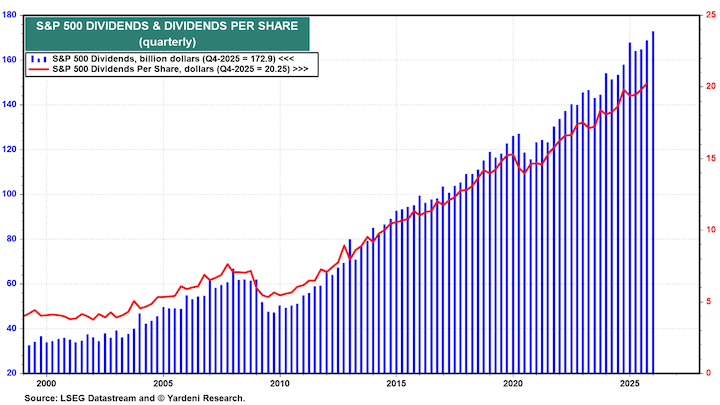
Here is the historical growth of the S&P 500 total dividend, which tracks roughly the largest 500 stocks in the US, updated as of 2025 Q4 (via Yardeni Research):

Tracking the income from my portfolio. Three of the primary income “trees” that produce income “fruit” in my portfolio are Vanguard Total US Stock ETF (VTI), Vanguard Total International Stock ETF (VXUS), and Vanguard Real Estate Index ETF (VNQ).

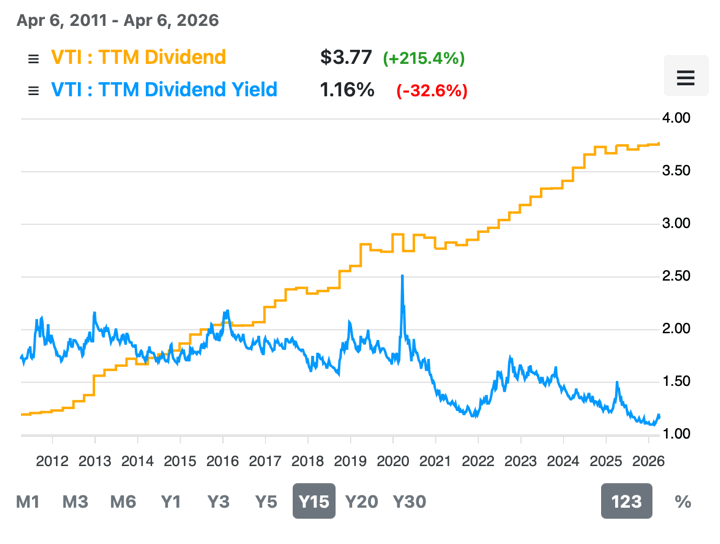
In the US, the dividend culture is somewhat conservative in that shareholders expect dividends to be stable and only go up. Thus the starting yield is lower, but grows more steadily with smaller cuts during hard times. Companies do buybacks as well, often because they are easier to discontinue. Here is an updated chart of the trailing 12-month (ttm) dividend per share over the last 15 years paid by the Vanguard Total US Stock ETF (VTI) via WallStNumbers.com.

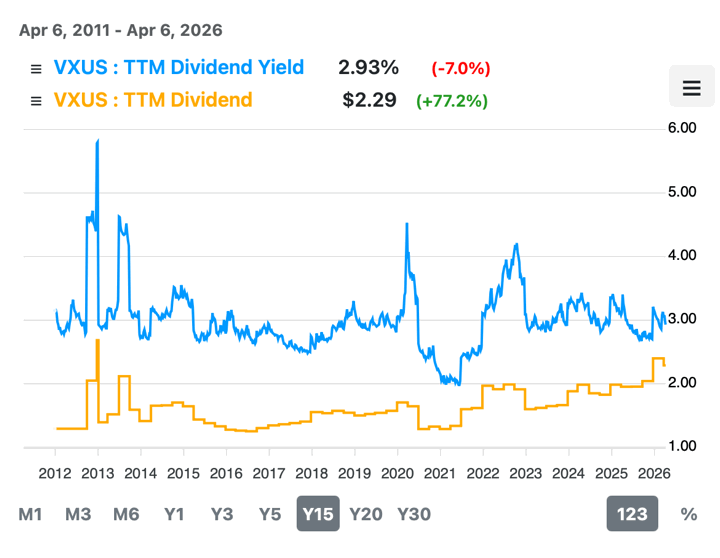
European corporate culture tends to encourage paying out a higher (sometimes even fixed) percentage of earnings as dividends, but that also means the dividends move up and down with earnings. The starting yield is currently higher but may not grow as reliably. Here is an updated chart of the trailing 12-month (ttm) dividend per share over the last 15 years paid by the Vanguard Total International Stock ETF (VXUS).

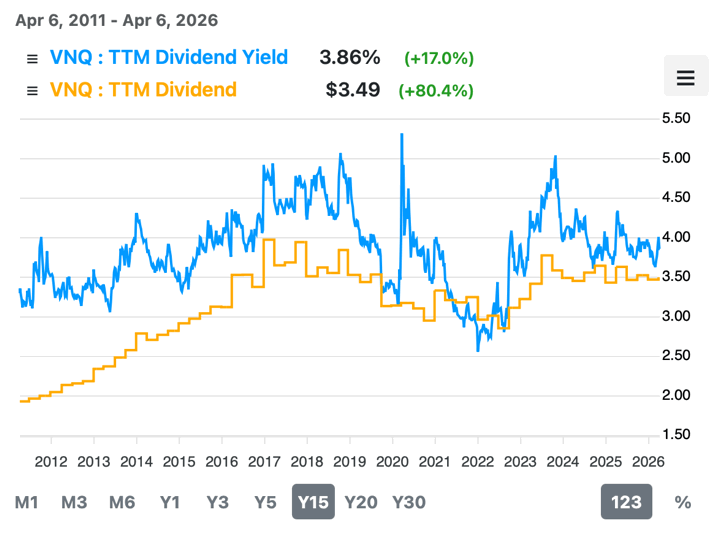
In the case of Real Estate Investment Trusts (REITs), they are legally required to distribute at least 90 percent of their taxable income to shareholders as dividends. Historically, about half of the total return from REITs is from this dividend income. Here is an updated chart of the trailing 12-month (ttm) dividend per share over the last 15 years paid by the Vanguard Real Estate Index ETF (VNQ).

The dividend yield (dividends divided by price) also serve as a rough valuation metric. When stock prices drop, this percentage metric usually goes up – which makes me feel better in a bear market. When stock prices go up, this percentage metric usually goes down, which keeps me from getting too euphoric during a bull market.

Finally, the last income component of my portfolio comes from interest from bonds and cash. Vanguard Short-Term Treasury ETF (VGSH) and Schwab US TIPS ETF (SCHP) are example holdings, with the actual amount varying with the prevailing interest rates, the real rates on TIPS, and the current rate of inflation.

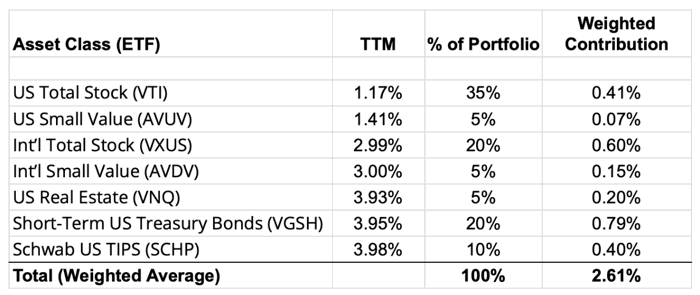
Dividend and interest income yield. To estimate the income from my portfolio, I use the weighted “TTM” or “12-Month Yield” from Morningstar (checked 1/4/26), which is the sum of the trailing 12 months of interest and dividend payments divided by the last month’s ending share price (NAV) plus any capital gains distributed (usually zero for index funds) over the same period. My TTM portfolio yield is now roughly 2.66%.

In dividend investing circles, there is a metric called yield on cost, which is calculated by dividing the current dividend by the original purchase price. In other words, while my portfolio yield today is 2.53%, that is because the current market price is also a lot higher. Due to increasing dividends on average over time, my yield-on-cost based on my portfolio value from 10 years ago is over 5%.

What about the 4% rule? For big-picture purposes, I support the simple 4% or 3% rule of thumb, which equates to a target of accumulating roughly 25 to 33 times your annual expenses. I would lean towards a 3% withdrawal rate if you want to retire young (closer to age 50) and a 4% withdrawal rate if retiring at a more traditional age (closer to 65). It’s just a quick and dirty target to get you started, not a number sent down from the heavens!

During the accumulation stage, your time is better spent focusing on earning potential via better career moves, improving your skillset, networking, and/or looking for asymmetrical (unlimited upside, limited downside) entrepreneurial opportunities where you have an ownership interest.

Our dividends and interest income are not automatically reinvested. They are simply another “paycheck”. As with our other variable paychecks, we can choose to either spend it or invest it again to compound things more quickly. You could use this money to cut back working hours, pursue a different career path, start a new business, take a sabbatical, perform charity or volunteer work, and so on. You don’t have to wait until you hit a magic number. Our life path has been very different because of this philosophy. FIRE is Life!

Best Interest Rates Survey: Bank Accounts, Treasury Bills, Money Markets, ETFs – January 2026

Here’s my monthly survey of the best interest rates on cash as of January 2026, roughly sorted from shortest to longest maturities. Banks and brokerages love taking advantage of idle cash, and you can often earn more money while keeping the same level of safety by moving to another FDIC-insured bank or NCUA-insured credit union. Check out my Ultimate Rate-Chaser Calculator to see how much extra interest you could earn from switching. Rates listed are available to everyone nationwide. Rates checked as of 1/11/26.

TL;DR: Savings account interest rates have dropped slightly overall, moving with the Fed rate cut. You can still get 4.6% if you accept some hoops/restrictions, but most are under 4% now. Short-term T-Bill rates have fallen, now ~3.6%. Top 5-year CD rates are ~4% APY, while 5-year Treasury rate is ~3.7%.

High-yield savings accounts*
Since the huge megabanks still pay essentially zero interest, everyone should at least have a separate, no-fee online savings account to piggy-back onto your existing checking account. The interest rates on savings accounts can drop at any time, so I list the top rates as well as competitive rates from banks with a history of competitive rates and solid user experience. Some banks will bait you with a temporary top rate and then lower the rates in the hopes that you are too lazy to leave.

  • The top saving rate at the moment: Pibank at 4.60% APY (no min), but they have some weird restrictions; like you can only use wire/Plaid to deposit and wire transfers to withdraw funds?! OnPath FCU is at 4.40% APY with $25,000 minimum balance. CIT Platinum Savings is now at 3.75% APY with $5,000+ balance and is offering an up to $300 deposit bonus which increases your effective APY for a while. There are many banks in between.
  • SoFi Bank is at 3.30% APY + up to 4.00% APY for 6 months + $325 new account bonus with qualifying direct deposit. You must maintain a direct deposit of any amount (even $1) each month for the higher ongoing APY. SoFi has historically competitive rates and full banking features.
  • Here is a limited survey of high-yield savings accounts. They aren’t the top rates, but a group that have historically kept it relatively competitive such that I like to track their history. This month they start at 3.30% APY on up.

Short-term guaranteed rates (1 year and under)
A common question is what to do with a big pile of cash that you’re waiting to deploy shortly (plan to buy a house soon, just sold your house, just sold your business, legal settlement, inheritance). My usual advice is to keep things simple and take your time. If not a savings account, then put it in a flexible short-term CD under the FDIC limits until you have a plan.

  • No Penalty CDs offer a fixed interest rate that can never go down, but you can still take out your money (once) without any fees if you want to use it elsewhere. Marcus has a 13-month No Penalty CD at 3.95% APY ($500 minimum deposit). Farmer’s Insurance FCU has a 9-month No Penalty CD at 4.00% APY ($1,000 minimum deposit). USALLIANCE Financial CU has a 11-month No Penalty CD at 3.90% APY ($500 minimum deposit). CIT Bank has a 11-month No Penalty CD at 3.75% APY ($1,000 minimum deposit).
  • Genisys CU has a 13-month certificate at 4.16% APY ($500 min). Early withdrawal penalty is a clearly-disclosed 90 days of interest (many places hide this info now). Anyone can join this credit union via partner organization Arthritis Foundation or Paint Creek Center for the Arts (one-time $5 fee).

Money market mutual funds
Many brokerage firms that pay out very little interest on their default cash sweep funds (and keep the difference for themselves). Note: Money market mutual funds are highly-regulated, but ultimately not FDIC-insured, so I would still stick with highly reputable firms.

  • Vanguard Federal Money Market Fund (VMFXX) is the default sweep option for Vanguard brokerage accounts, which has a 7-day SEC yield of 3.64% (changes daily, but also works out to a compound yield of 3.70%, which is better for comparing against APY). Odds are this is much higher than your own broker’s default cash sweep interest rate.
  • Vanguard Treasury Money Market Fund (VUSXX) is an alternative money market fund which you must manually purchase, but the interest will be mostly (100% for 2024 tax year) exempt from state and local income taxes because it comes from qualifying US government obligations. Current 7-day SEC yield of 3.66% (compound yield of 3.72%).

Treasury Bills and Ultra-short Treasury ETFs
Another option is to buy individual Treasury bills which come in a variety of maturities from 4-weeks to 52-weeks and are fully backed by the US government. You can also invest in ETFs that hold a rotating basket of short-term Treasury Bills for you, while charging a small management fee for doing so. T-bill interest is exempt from state and local income taxes, which can make a significant difference in your effective yield.

  • You can build your own T-Bill ladder at TreasuryDirect.gov or via a brokerage account with a bond desk like Vanguard and Fidelity. Here are the current Treasury Bill rates. As of 1/9/26, a new 4-week T-Bill had the equivalent of 3.62% annualized interest and a 52-week T-Bill had the equivalent of 3.51% annualized interest.
  • The iShares 0-3 Month Treasury Bond ETF (SGOV) has a 3.70% 30-day SEC yield (0.09% expense ratio) and effective duration of 0.10 years. SPDR Bloomberg Barclays 1-3 Month T-Bill ETF (BIL) has a 3.59% 30-day SEC yield (0.136% expense ratio) and effective duration of 0.15 years. The new Vanguard 0-3 Month Treasury Bill ETF (VBIL) has a 3.72% 30-day SEC yield (0.07% expense ratio) and effective duration of 0.10 years.

US Savings Bonds
Series I Savings Bonds offer rates that are linked to inflation and backed by the US government. You must hold them for at least a year. If you redeem them within 5 years there is a penalty of the last 3 months of interest. The annual purchase limit for electronic I bonds is $10,000 per Social Security Number, available online at TreasuryDirect.gov.

  • “I Bonds” bought between November 2025 and April 2026 will earn a 4.03% rate for the first six months. The rate of the subsequent 6-month period will be based on inflation again. More on Savings Bonds here.
  • In mid-April 2026, the CPI will be announced and you will have a short period where you will have a very close estimate of the rate for the next 12 months. I will post another update at that time.

Rewards checking accounts
These unique checking accounts pay above-average interest rates, but with unique risks. You have to jump through certain hoops which usually involve 10+ debit card purchases each cycle, a certain number of ACH/direct deposits, and/or a certain number of logins per month. If you make a mistake (or they judge that you did) you risk earning zero interest for that month. Some folks don’t mind the extra work and attention required, while others would rather not bother. Rates can also drop suddenly, leaving a “bait-and-switch” feeling.

  • La Capitol Federal Credit Union pays 6.50% APY (increased) on up to $10,000 if you make 15 debit card purchases of at least $5 each per statement cycle. Anyone can join this credit union via partner organization, Louisiana Association for Personal Financial Achievement ($20).
  • OnPath Federal Credit Union (my review) pays 6.00% APY on up to $10,000 if you make 15 debit card purchases, opt into online statements, and login to online or mobile banking once per statement cycle. Anyone can join this credit union via $5 membership fee to join partner organization. You can also get a $150 Visa Reward card when you open a new account and make qualifying transactions.
  • Genisys Credit Union pays 6.75% APY on up to $7,500 if you make 10 debit card purchases of $5+ each per statement cycle, and opt into online statements. Anyone can join this credit union via $5 membership fee to join partner organization.
  • Oklahoma Central Credit Union pays 6.00% APY on up to $10,000 if you make 15 debit card purchases (non-ATM) per statement cycle. Anyone can join this credit union if they are “affiliated with another credit union”.
  • First Southern Bank pays 5.50% APY on up to $25,000 if you make at least 15 debit card purchases, 1 ACH credit or payment transaction, and enroll in online statements.
  • Credit Union of New Jersey pays 6.00% APY on up to $25,000 if you make 12 debit card purchases, opt into online statements, and make at least 1 direct deposit, online bill payment, or automatic payment (ACH) per statement cycle. Anyone can join this credit union via $5 membership fee to join partner organization.
  • Andrews Federal Credit Union pays 5.25% APY (decreased) on up to $25,000 if you make 15 debit card purchases, opt into online statements, and make at least 1 direct deposit or ACH transaction per statement cycle. Anyone can join this credit union via partner organization.
  • Capitol Credit Union pays 6.00% APY on up to $15,000 if you make 12 debit card purchases, opt into online statements, and make at least 1 direct deposit or ACH transaction per statement cycle. Anyone can join this credit union via partner organization ($5 to Wild Basin Wilderness).
  • Find a locally-restricted rewards checking account at DepositAccounts.

Certificates of deposit (greater than 1 year)
CDs offer higher rates, but come with an early withdrawal penalty. By finding a bank CD with a reasonable early withdrawal penalty, you can enjoy higher rates but maintain access in a true emergency. Alternatively, consider building a CD ladder of different maturity lengths (ex. 1/2/3/4/5-years) such that you have access to part of the ladder each year, but your blended interest rate is higher than a savings account. When one CD matures, use that money to buy another 5-year CD to keep the ladder going. Some CDs also offer “add-ons” where you can deposit more funds if rates drop.

  • ClearPath FCU has a limited-time 5-year “Flex” certificate at 4.25% APY ($5,000 minimum of new money), which has a unique feature of having no penalty after 12 months (must withdraw it all; partial withdrawals are subject to penalties). Available as regular or IRA. Anyone can join this credit union via partner organization ($5.00 donation to Clear Giving Charitable Association). Hat tip to Deposit Quest.
  • United Fidelity Bank has a 5-year certificate at 4.15% APY ($1,000 minimum), 4-year at 4.10% APY, 3-year at 4.10% APY, 2-year at 4.15% APY, and 1.5-year at 4.05% APY. Early withdrawal penalties are not disclosed clearly online.
  • Mountain America Credit Union (MACU) has a 5-year certificate at 4.00% APY ($500 minimum), 4-year at 4.00% APY, 3-year at 4.05% APY, 2-year at 4.20% APY, and 1-year at 3.80% APY. Early withdrawal penalty for the 4-year and 5-year is 365 days of interest. Anyone can join this credit union via partner organization American Consumer Council (use promo code “consumer” when joining).
  • You can buy certificates of deposit via the bond desks of Vanguard and Fidelity. You may need an account to see the rates. These “brokered CDs” offer FDIC insurance and easy laddering, but they don’t come with predictable early withdrawal penalties. Right now, I see a 5-year non-callable brokered CD at 3.75% APY (callable: no, call protection: yes). Be warned that both Vanguard and Fidelity will list higher rates from callable CDs, which importantly means they can (and will!) call back your CD if rates drop significantly later.

Longer-term Instruments
I’d use these with caution due to increased interest rate risk (tbh, I don’t use them at all), but I still track them to see the rest of the current yield curve.

  • Willing to lock up your money for 10 years? You can buy long-term certificates of deposit via the bond desks of Vanguard and Fidelity. These “brokered CDs” offer FDIC insurance, but they don’t come with predictable early withdrawal penalties. You might find something that pays more than your other brokerage cash and Treasury options. Right now, I see a 10-year CDs at 3.65% (non-callable) vs. 4.15% for a 10-year Treasury. Watch out for higher rates from callable CDs where they can call your CD back if interest rates drop.

All rates were checked as of 1/11/26.

* I no longer recommend fintech companies due to the possibility of significant loss due to poor recordkeeping and the lack of government protection in such scenarios. The point of cash is absolute safety of principal.

Photo by Giorgio Trovato on Unsplash

MMB Portfolio Asset Allocation & Performance – 2025 Year End Update

Here is my 2025 Year-End portfolio update that includes all our combined 401k/403b/IRAs and taxable brokerage accounts but excludes our house and small side portfolio of self-directed investments. Following the concept of skin in the game, the following is not a recommendation, but a sharing of our actual, imperfect DIY portfolio.

“Never ask anyone for their opinion, forecast, or recommendation. Just ask them what they have in their portfolio.” – Nassim Taleb

How I Track My Portfolio
Here’s how I track my portfolio across multiple brokers and account types:

  • The Empower Personal Dashboard real-time portfolio tracking tools (free) automatically logs into my different accounts, adds up my various balances, tracks my performance, and calculates my overall asset allocation daily. Formerly known as Personal Capital.
  • Once a quarter, I also update my manual Google Spreadsheet (free to copy, instructions) because it helps me calculate how much I need in each asset class to rebalance back towards my target asset allocation. I also create a new sheet each quarter, so I have a personal archive of my portfolio dating back many years.

2025 Year-End Asset Allocation and YTD Performance
Here are updated performance and asset allocation charts, per the “Holdings” and “Allocation” tabs of my Empower Personal Dashboard.

The major components of my portfolio are broad index ETFs. I do mix it up a bit around the edges, but not very much. Here is a model version of my target asset allocation with sample ETF holdings for each asset class.

  • 35% US Total Market (VTI)
  • 5% US Small-Cap Value (AVUV)
  • 20% International Total Market (VXUS)
  • 5% International Small-Cap Value (AVDV)
  • 5% US Real Estate (REIT) (VNQ)
  • 20% US “Regular” Treasury Bonds and/or FDIC-insured deposits (VGSH)
  • 10% US Treasury Inflation-Protected Bonds (SCHP)

Big picture, it is 70% businesses and 30% very safe bonds/cash:

By paying minimal costs including management fees, transaction spreads, and tax drag, I am trying to essentially guarantee myself above-average net performance over time.

I do not spend a lot of time backtesting various model portfolios. You’ll usually find that whatever model portfolio is popular at the moment just happens to hold the asset class that has been the hottest recently.

The portfolio that you can hold onto through the tough times is the best one for you. I’ve been pretty much holding this same portfolio for 20 years. Check out these ancient posts from 2004 and 2005. Every asset class will eventually have a low period, and you must have strong faith during these periods to earn those historically high returns. You have to keep owning and buying more stocks through the stock market crashes. You have to maintain and even buy more rental properties during a housing crunch, etc. A good sign is that if prices drop, you’ll want to buy more of that asset instead of less. I don’t have strong faith in the long-term results of commodities, gold, or bitcoin – so I don’t own them.

Performance details. Here’s an updated YTD Growth of $10,000 chart courtesy of Testfolio for some of the major ETFs that shows the difference in performance in the broad indexes:

Nearly everything went up in 2025. I doubt 2026 will be boring. I’ll share about more about the income aspect in a separate post.

Webull ACAT Transfer Bonus: 3% to 4% of Assets ($2k/100k Minimum)

Updated with new offer. The Webull brokerage app is offering an updated ACAT Transfer bonus of up to 4% of assets transferred plus up to $100 in outgoing fee reimbursements on your first transfer of at least $2,000. This specific offer ends March 31, 2026. This is for individual taxable brokerage accounts. Joint, Crypto, and IRA accounts are excluded.

You must transfer at least $100,000 in assets to get a 4% match, with a minimum hold of 5 years to get the full payout (they break it up into installments with the last one being paid March 2031). Max funding is $2,000,000. You must transfer at least $2,000 in assets to get a 3% match, also with a minimum hold of 5 years. 4% is a very high bonus, but it is a long hold period. Be sure to read all the terms and conditions.

2025 Year-End Review: Asset Class & Target Date Fund Returns

2025 saw positive returns for every broad asset class that I track. Per Morningstar, here are the total annual returns (includes price appreciation and dividends/interest) for select asset classes as benchmarked by popular ETFs after market close 12/31/25.

I didn’t include Bitcoin or any other crypto because I don’t track them as a long-term asset, only own small amounts temporarily, and would not advise my family to own it. However, I do acknowledge that it went down slightly this year.

Meanwhile, Gold went up by a lot this year, which indicates to me that Gold and Bitcoin have some very different characteristics. Very few developed countries are buying large amounts of Bitcoin to store in their central bank vaults.

The “set and forget” Vanguard Target Retirement 2055 fund (VFFVX), currently consisting of roughly 90% diversified stocks and 10% bonds, was up 21.4% in 2025.

Commentary. 2024 yet again shows that you want to stay in the game. There are always going to be reasons to be afraid: because US stocks continue to have historically high valuations, because you’re worried about an AI bubble, or worried that AI will instead take your job…

Here are your cumulative returns through the end of 2025 if you had been a steady investor in the Vanguard Target Retirement 2055 for many years despite the many, many problems of the world:

(These work great inside 401ks and IRAs. I’d avoid buying Target Retirement mutual funds in a taxable account.)

I feel the need to promote slow compounding over all the short-term madness around us. Sports gambling. Risky options trading. Crypto joke coins. Buy Now Pay Later. I tell my kids that it’s perfectly okay to avoid some stuff completely. You don’t need to try it to know it’s a bad idea.

The Central Struggle of Investing: Repeatedly Choosing Easy but Boring

Michael Burry, of “Big Short” fame, recently shut down his hedge fund and started a Substack with an educational goal. I enjoy following his musings because he’s not afraid to say what he thinks, even if I often don’t agree (or have any idea what he’s obliquely referring to). He recently posted a “foundational” article that is supposed to show his thinking process, with a familiar beginning:

For those that do not trust anything analog, since 1990, there have been over 750 replacements in the S&P 500 Index. Google’s Gemini 3 Pro swears by it. Claude Max agrees.

Gemini 3 Pro and Claude Max further propose that 45% of the top 20 names in the 1999 NASDAQ 100 ended up bankrupt or acquired after a >75% loss. This checks out, my conference room says.

Capital is always fighting to be recycled.

Thusly, you now carry the knowledge that most investors are best off in an index – and have no need to invest in individual stocks.

If one is rather young and has 50-70 years left, then one absolutely should be almost entirely invested in common stock indices, preferably the S&P 500 or the Nasdaq 100 or both. Live life, touch grass, achieve real things, automatically reinvest dividends, and let the compounding of the Index Gods do the work. Maybe not this very day, but over time, this is the way for most.

Of course, some of us just do…not…want…easy.

For them, well, their God gave them GameStop.

He then goes very deep into how he analyzed GameStop and through skill and smarts, of course made some nice returns on the trade.

This is the central humblebrag of professional investors. *You* should index, but here’s what *I* do instead.

This also relates to the central struggle for all individual investors. If you are a motivated person who studies investing with an honest and open mind, you realize that you probably shouldn’t really be actively trading. But if you are a motivated person who studies investing, you probably think you are in the tiny minority that can make money reliably with actively trading. Smart enough to turn off “easy” mode.

The other problem with “easy” is that it is usuually boring and often slow. Meanwhile, your Robinhood app or equivalent will happily sell you:

  • Crypto, including memecoins that have zero utility.
  • Gambling, err “Prediction markets” on this weekend’s NFL game.
  • “Dividend” ETFs with a crazy 12% yield that some think will last forever.
  • Aggressive options that can lose all your money within days.
  • “Boomer candy” ETFs that promise stock-like upside with zero downside.
  • Index “Plus”. Index with extra ketchup. Index minus the ketchup. Just 25 basis points extra!

I spend a lot of my own time doing just this – reading such interesting ideas across various corners of the investing world but repeatedly convincing myself to pick “easy”. Doing nothing, over and over again.

Fidelity Tax-Loss Harvesting Tool: Help Identify Capital Loss Opportunities

Fidelity has a number of useful Tools & Calculators, most of which are open to everyone to use. However, their Tax-Loss Harvesting Tool (login required) is meant for Fidelity taxable brokerage customers, as it is based on your personal data and shows the size of your expected capital gains this year, while also helping you identify capital losses that you can “harvest” if you wanted.

You’ll need to provide your marginal tax rates (make an estimate with current brackets here). The tool can even help you place the (market) order to sell those shares with just a couple clicks.

This Fidelity article How to reduce investment taxes contains a lot of details on the practice of tax-loss harvesting:

An investment loss can be used for 2 different things:

– The losses can be used to offset investment gains.
– Remaining losses can offset $3,000 of income on a tax return in one year. (For married individuals filing separately, the deduction is $1,500.)

[…] There are 2 types of gains and losses: short-term and long-term.

– Short-term capital gains and losses are those realized from the sale of investments that you have owned for one year or less.
– Long-term capital gains and losses are realized after selling investments held longer than one year.
The key difference between short- and long-term gains is the rate at which they are taxed.

Short-term capital gains are taxed at your marginal tax rate as ordinary income. The top marginal federal tax rate on ordinary income is 37%.

Wash sale warning: The tool can’t cross-reference all your other non-Fidelity trades, and also doesn’t even account for your Fidelity trades within tax-deferred accounts. If a wash sale occurs, your loss will be disallowed. Here’s the warning provided:

Wash sale warning: Estimated savings based on tax-loss harvesting assumes that you will not have a wash sale that would defer your tax loss.

If you sell shares at a loss and you purchase additional shares of the same or a substantially identical security (in the same or a different account) within the 61-day period that begins 30 days before and ends 30 days after the trade date of the sale, the purchase may result in a wash sale. If a wash sale occurs, the loss from the transaction will be “disallowed” for tax purposes, and the amount of the loss will be added to the cost basis of your shares in the same security. Fidelity adjusts cost basis information related to shares in the same security when a wash sale occurs within an account as the result of an identical security purchase.

You must check your own records across all of your Fidelity and non-Fidelity accounts to ensure that you are correctly accounting for losses related to any wash sales.

ETFs are often the easiest way to harvest a tax loss. Even if you buy-and-hold ETFs, consider ETF tax-loss harvesting (my post from 2008?!) as you can harvest the loss from the sale of an ETF, and then immediately buy a similar but not “substantially identical” ETF without triggering a wash sale. This has become common industry practice. There’s a Fidelity article on this too.

When evaluating your ETFs against the wash-sale rule, compare the issuer, index, and underlying holdings between the two ETFs being swapped. The more dissimilar these are, the more likely it is that you won’t trigger a wash sale.

Even Vanguard does ETF tax-loss harvesting in their advisory services using “surrogate ETFs”.

Surrogate funds are the ETFs (exchange?traded funds) Vanguard Personal Advisor uses toreplace investments sold to harvest losses. They are Vanguard ETFs® with similar asset and sub?asset allocations to the funds we’re replacing.

There may not be as many opportunities to harvest a tax loss this year since most things are up (a good thing!), but something to keep in mind down the road.

The usual disclaimer: I do not provide legal or tax advice. The information herein is general and educational in nature and should not be considered legal or tax advice.

LifeX TIPS ETFs: Monthly Inflation-Adjusted Income

Sometimes it seems like everyone just wants risk these days. Crypto. Sports gambling. Options trading, ETFs that magically yield 10% or more. However, if you’re in the opposite camp and you want the absolute least amount of risk, you’d want to retire off an investment that has a return that is fully-guaranteed, pays out a monthly income like clockwork, is even guaranteed to grow with inflation. Inflation was relatively mild for a long time until recently, but historically it has been a significant risk factor.

If that interests you, check out 3 Ways to Build an Inflation-Adjusted Pension by Allan Roth – which first reminds you that Social Security is exactly this! – but also introduces a new series of LifeX Inflation-Protected Longevity Income ETFs.

At current rates as of 12/11/25, the LifeX 2055 Inflation-Protected Longevity Income ETF (LIAM) contains a managed portfolio of United States Treasury Inflation Indexed Bonds (TIPS) that can provide you with a 4.26% guaranteed real withdrawal rate for 30 years. That means a $1,000,000 portfolio would distribute roughly $42,600 in annual income this year, but that number would increase with CPI inflation each year for 30 years (through the year 2055). At 3% average inflation, your 30th year’s income would have grown to over $100,000 a year. Of course, inflation could be a lot higher, which is why no private insurance company will sell you inflation protection over such a long period of time.

After those 30 years, you will be left with nothing. Your initial principal will be gone. Therefore, your income taken each year is partially a return of principal.

The expense ratio is 0.25%, which isn’t Vanguard-level but not horrible. I like that it does all of the work for you in a tidy ETF package, as building a TIPS ladder yourself can be a bit tricky (and do you want to keep doing it at age 80, 90?). Of course, I also worry about what happens if you bought a 30-year ladder at 65 and happen to live past 95. It could happen, and remember, this product is meant for the risk-averse folks that like to cover all the bases.

In general, I feel a TIPS ladder or equivalent that adjusts with inflation would work well in combination with a traditional annuity like an SPIA or a deferred longevity annuity that starts at a later age, which doesn’t adjust with inflation but does provide an higher initial fixed income that can last as long as you live. This is what I have set up for my parents – Social Security that rises with inflation, plus a joint income annuity that pays out as long as one is living.

SoFi Offers: SoFi Plus Changes, New 5% Grocery Card, $325/4.20% APY Checking Bonus, $300-$1000 Loan Bonuses

Update December 2025: SoFi announced some changes to their available features and what is only available with their SoFi Plus “Premium” membership program. I feel that they are trying to build something like “Robinhood Gold”, but hopefully better promos are coming because I don’t feel the perks are worth the cost right now. First, there are now three different ways to earn their higher APY tier (any single ONE of these is enough):

  • Eligible Direct Deposit of any amount (even $1). Many people can split their paycheck multiple ways.
  • $5,000+ in combined balances across SoFi Checking and Savings accounts
  • SoFi Plus members that pay $10/month fee.

You can see this on their rate sheet (as of 11/12/25):

Second, SoFi Plus is now paid-only at $10/month. You no longer get it for free with a direct deposit, although they are extending complimentary access to all SoFi Plus benefits through March 30, 2026 with eligible deposits. You can see a list of SoFi Plus benefits here.

For the most part, the SoFi Plus benefits are the same as before. A notable new addition is the SoFi Smart Card which is a charge card linked to your SoFI Bank accounts that offers unlimited 5% cash back at grocery stores.

Otherwise, I would say the most valuable SoFi Plus perks that existing Direct Deposit folks lost with this change are:

  • 10% rewards boost on the SoFi Unlimited 2% Credit Card, which turns the 2% cash back into 2.2% cash back.
  • 2% match on recurring IRA contributions, plus a 1% match on recurring deposits made through SoFi Invest taxable brokerage accounts.
  • Possibly the ability to “schedule an unlimited number of appointments with a financial planner”, although I’m not sure of the quality of this advice. There is no indication you’re guaranteed at least a CFP. I’ve never used this feature, but it might be nice if you wanted to get some general advice.

Update April 2024: SoFi made a few notable changes recently, both positive and negative:

  • The SoFi Unlimited 2% Credit Card added 10% boost on their rewards with direct deposit into SoFi Checking or Savings. This would work out to 2.2% cash back rewards points on everyday purchases. (As of December 2025, this is now restricted to SoFi Plus members paying $10 a month.)
  • There is a new inactivity fee of $25 per account for every 6 months of login inactivity.
  • The outgoing ACAT transfer fee was increased to $100. Previously $75.

Original post:

SoFi (“Social Finance”) is an all-in-one finance app that expanded from students loans into banking, stocks, crypto, credit cards, and more. Here are their current promotional offers; New users can receive a separate opening bonus for each separate part of SoFi (Money, Invest, Loans, etc).

  • SoFi Checking Referral Offer: Up to $325 new user bonus. Open a new SoFi Money account and add at least $10 to your account within 5 days, and get $25. Then get up to $300 additional bonus with qualifying direct deposit. Plus up to 4.30% APY.
  • SoFi Credit Score Tracking Offer: $10 in rewards bonus points. You’ll earn $10 in rewards points when you activate free credit score monitoring
  • SoFi Invest Referral Offer: $25 new user bonus. Taxable brokerage account. Open an Active Investing account with $10 or more, and you’ll get $25 in stock.
  • SoFi 401(k) Rollover Offer: Up to $10,000 Bonus. Get a 1% match when you roll over your 401(k) into a SoFi IRA. Partnered with Capitalize to make the transition easier.
  • SoFi Student Loan Refi: $300 bonus. Warning: Do your research before refinancing your Federal student loans to a private lender.
  • SoFi Doctors and Dentists Student Loan Refi: $1,000 bonus. Special low rates just for doctors and dentists.
  • SoFi Private Student Loan: $300 bonus.
  • SoFi Personal Loans Referral Offer: Fixed $300 bonus. Fixed $300 bonus, 90 days after successful funding. The loan has no fees and you can pay it back in full after 90 days (you can pay it down to $50 before then to accrue minimal interest, thus making a new profit after the bonus).

Valuation Gap Chart: US vs. International Developed vs. Emerging Markets

As 2025 winds down, you will probably read a lot of articles remarking how international stock indexes have outperformed US stock indexes like the S&P 500 by a significant amount this year. This hasn’t happened in a while! Yet, the following chart shows that the gap in valuations is still very wide.

PE10 stands for the ratio of price to 10-year average trailing earnings (AKA CAPE ratio, or cyclically-adjusted P/E ratio) which attempts to smooth out earnings spikes. Image via TopDownCharts.

Best Interest Rates Survey: Bank Accounts, Treasury Bills, Money Markets, ETFs – December 2025

Here’s my monthly survey of the best interest rates on cash as of December 2025, roughly sorted from shortest to longest maturities. Banks and brokerages love taking advantage of idle cash, and you can often earning more money while keeping the same level of safety by moving to another FDIC-insured bank or NCUA-insured credit union. Check out my Ultimate Rate-Chaser Calculator to see how much extra interest you could earn from switching. Rates listed are available to everyone nationwide. Rates checked as of 12/5/2025.

TL;DR: Savings account interest rates have dropped slightly overall, moving with Fed rates. You can still get 4.6% and 4.5% APY if you accept some hoops/restrictions, but most are a little under 4% now. Short-term T-Bill rates have fallen, now ~3.7%. Top 5-year CD rates are ~4.25% APY, while 5-year Treasury rate is ~3.7%.

High-yield savings accounts*
Since the huge megabanks still pay essentially no interest, everyone should at least have a separate, no-fee online savings account to piggy-back onto your existing checking account. The interest rates on savings accounts can drop at any time, so I list the top rates as well as competitive rates from banks with a history of competitive rates and solid user experience. Some banks will bait you with a temporary top rate and then lower the rates in the hopes that you are too lazy to leave.

  • The top saving rate at the moment: Pibank at 4.60% APY (no min), but they have some weird restrictions; like you can only use wire/Plaid to deposit and wire transfers to withdraw funds?! Hyperion Bank has a 4.50% APY money market account ($10,000 minimum, new money) with a 6-month rate guarantee. CIT Platinum Savings is now at 3.75% APY with $5,000+ balance and is offering an up to $300 deposit bonus which increases your effective APY for a while. There are many banks in between.
  • SoFi Bank is at 3.60% APY + up to 4.30% APY for 6 months + $325 new account bonus with qualifying direct deposit. You must maintain a direct deposit of any amount (even $1) each month for the higher APY. SoFi has historically competitive rates and full banking features.
  • Here is a limited survey of high-yield savings accounts. They aren’t the top rates, but a group that have historically kept it relatively competitive such that I like to track their history. This month they start at 3.30% APY on up.

Short-term guaranteed rates (1 year and under)
A common question is what to do with a big pile of cash that you’re waiting to deploy shortly (plan to buy a house soon, just sold your house, just sold your business, legal settlement, inheritance). My usual advice is to keep things simple and take your time. If not a savings account, then put it in a flexible short-term CD under the FDIC limits until you have a plan.

  • No Penalty CDs offer a fixed interest rate that can never go down, but you can still take out your money (once) without any fees if you want to use it elsewhere. Marcus has a 13-month No Penalty CD at 3.95% APY ($500 minimum deposit). Farmer’s Insurance FCU has a 9-month No Penalty CD at 4.00% APY ($1,000 minimum deposit). USALLIANCE Financial CU has a 11-month No Penalty CD at 3.90% APY ($500 minimum deposit).
  • USALLIANCE Financial CU has a 12-month certificate at 4.18% APY ($500 min). Early withdrawal penalty is 180 days of interest. Anyone can join this credit union via partner organization American Consumer Council (try promo codes “consumer”, “abnb”, or “USFFCU” to join for free).

Money market mutual funds
Many brokerage firms that pay out very little interest on their default cash sweep funds (and keep the difference for themselves). Note: Money market mutual funds are highly-regulated, but ultimately not FDIC-insured, so I would still stick with highly reputable firms.

  • Vanguard Federal Money Market Fund (VMFXX) is the default sweep option for Vanguard brokerage accounts, which has a 7-day SEC yield of 3.89% (changes daily, but also works out to a compound yield of 3.96%, which is better for comparing against APY). Odds are this is much higher than your own broker’s default cash sweep interest rate.
  • Vanguard Treasury Money Market Fund (VUSXX) is an alternative money market fund which you must manually purchase, but the interest will be mostly (100% for 2024 tax year) exempt from state and local income taxes because it comes from qualifying US government obligations. Current 7-day SEC yield of 3.88% (compound yield of 3.95%).

Treasury Bills and Ultra-short Treasury ETFs
Another option is to buy individual Treasury bills which come in a variety of maturities from 4-weeks to 52-weeks and are fully backed by the US government. You can also invest in ETFs that hold a rotating basket of short-term Treasury Bills for you, while charging a small management fee for doing so. T-bill interest is exempt from state and local income taxes, which can make a significant difference in your effective yield.

  • You can build your own T-Bill ladder at TreasuryDirect.gov or via a brokerage account with a bond desk like Vanguard and Fidelity. Here are the current Treasury Bill rates. As of 12/5/25, a new 4-week T-Bill had the equivalent of 3.72% annualized interest and a 52-week T-Bill had the equivalent of 3.61% annualized interest.
  • The iShares 0-3 Month Treasury Bond ETF (SGOV) has a 3.85% 30-day SEC yield (0.09% expense ratio) and effective duration of 0.10 years. SPDR Bloomberg Barclays 1-3 Month T-Bill ETF (BIL) has a 3.71% 30-day SEC yield (0.136% expense ratio) and effective duration of 0.15 years. The new Vanguard 0-3 Month Treasury Bill ETF (VBIL) has a 3.89% 30-day SEC yield (0.07% expense ratio) and effective duration of 0.10 years.

US Savings Bonds
Series I Savings Bonds offer rates that are linked to inflation and backed by the US government. You must hold them for at least a year. If you redeem them within 5 years there is a penalty of the last 3 months of interest. The annual purchase limit for electronic I bonds is $10,000 per Social Security Number, available online at TreasuryDirect.gov.

  • “I Bonds” bought between November 2025 and April 2026 will earn a 4.03% rate for the first six months. The rate of the subsequent 6-month period will be based on inflation again. More on Savings Bonds here.
  • In mid-April 2026, the CPI will be announced and you will have a short period where you will have a very close estimate of the rate for the next 12 months. I will post another update at that time.

Rewards checking accounts
These unique checking accounts pay above-average interest rates, but with unique risks. You have to jump through certain hoops which usually involve 10+ debit card purchases each cycle, a certain number of ACH/direct deposits, and/or a certain number of logins per month. If you make a mistake (or they judge that you did) you risk earning zero interest for that month. Some folks don’t mind the extra work and attention required, while others would rather not bother. Rates can also drop suddenly, leaving a “bait-and-switch” feeling.

  • OnPath Federal Credit Union (my review) pays 6.00% APY on up to $10,000 if you make 15 debit card purchases, opt into online statements, and login to online or mobile banking once per statement cycle. Anyone can join this credit union via $5 membership fee to join partner organization. You can also get a $150 Visa Reward card when you open a new account and make qualifying transactions.
  • Genisys Credit Union pays 6.75% APY on up to $7,500 if you make 10 debit card purchases of $5+ each per statement cycle, and opt into online statements. Anyone can join this credit union via $5 membership fee to join partner organization.
  • Oklahoma Central Credit Union pays 6.00% APY on up to $10,000 if you make 15 debit card purchases (non-ATM) per statement cycle. Anyone can join this credit union if they are “affiliated with another credit union”.
  • La Capitol Federal Credit Union pays 5.75% APY on up to $10,000 if you make 15 debit card purchases of at least $5 each per statement cycle. Anyone can join this credit union via partner organization, Louisiana Association for Personal Financial Achievement ($20).
  • First Southern Bank pays 5.50% APY on up to $25,000 if you make at least 15 debit card purchases, 1 ACH credit or payment transaction, and enroll in online statements.
  • Credit Union of New Jersey pays 6.00% APY on up to $25,000 if you make 12 debit card purchases, opt into online statements, and make at least 1 direct deposit, online bill payment, or automatic payment (ACH) per statement cycle. Anyone can join this credit union via $5 membership fee to join partner organization.
  • Andrews Federal Credit Union pays 5.50% APY (down from 6%) on up to $25,000 if you make 15 debit card purchases, opt into online statements, and make at least 1 direct deposit or ACH transaction per statement cycle. Anyone can join this credit union via partner organization.
  • Find a locally-restricted rewards checking account at DepositAccounts.

Certificates of deposit (greater than 1 year)
CDs offer higher rates, but come with an early withdrawal penalty. By finding a bank CD with a reasonable early withdrawal penalty, you can enjoy higher rates but maintain access in a true emergency. Alternatively, consider building a CD ladder of different maturity lengths (ex. 1/2/3/4/5-years) such that you have access to part of the ladder each year, but your blended interest rate is higher than a savings account. When one CD matures, use that money to buy another 5-year CD to keep the ladder going. Some CDs also offer “add-ons” where you can deposit more funds if rates drop.

  • United Fidelity Bank has a 5-year certificate at 4.25% APY ($1,000 minimum), 4-year at 4.20% APY, 3-year at 4.20% APY, 2-year at 4.25% APY, and 1.5-year at 4.15% APY. Early withdrawal penalties are not disclosed clearly online.
  • Mountain America Credit Union (MACU) has a 5-year certificate at 4.00% APY ($500 minimum), 4-year at 4.00% APY, 3-year at 4.05% APY, 2-year at 4.20% APY, and 1-year at 3.85% APY. Early withdrawal penalty for the 4-year and 5-year is 365 days of interest. Anyone can join this credit union via partner organization American Consumer Council (use promo code “consumer” when joining).
  • You can buy certificates of deposit via the bond desks of Vanguard and Fidelity. You may need an account to see the rates. These “brokered CDs” offer FDIC insurance and easy laddering, but they don’t come with predictable early withdrawal penalties. Right now, I see a 5-year non-callable brokered CD at 3.90% APY (callable: no, call protection: yes). Be warned that both Vanguard and Fidelity will list higher rates from callable CDs, which importantly means they can (and will!) call back your CD if rates drop significantly later.

Longer-term Instruments
I’d use these with caution due to increased interest rate risk (tbh, I don’t use them at all), but I still track them to see the rest of the current yield curve.

  • Willing to lock up your money for 10 years? You can buy long-term certificates of deposit via the bond desks of Vanguard and Fidelity. These “brokered CDs” offer FDIC insurance, but they don’t come with predictable early withdrawal penalties. You might find something that pays more than your other brokerage cash and Treasury options. Right now, I see a 10-year CDs at 4.00% (non-callable) vs. 4.13% for a 10-year Treasury. Watch out for higher rates from callable CDs where they can call your CD back if interest rates drop.

All rates were checked as of 12/5/25.

* I no longer recommend fintech companies due to the possibility of significant loss due to poor recordkeeping and the lack of government protection in such scenarios. The point of cash is absolute safety of principal.

Photo by Giorgio Trovato on Unsplash

Lennar / Millrose Properties Odd Lot Tender (Sold My Shares)

Update 12/4/25 (by me). Shares sold; final profit of $890.54. My limit order was triggered yesterday and my shares were sold, closing out my position and finishing this deal. Here are my personal results, you may have done better or worse:

  • Bought 99 shares of LEN @$122.29 (11/14) for $12,107.
  • Tendered all 99 shares, exchanged for 409.53 shares of MRP (11/20 deadline).
  • Received 409 MRP shares and $15.88 cash for the partial share (12/1).
  • Sold 409 shares of MRP @$31.74 for $12,981.66 (12/3).

Net profit was $890.54. Total time between purchase and sale was 19 calendar days, working out to an internal rate of return (IRR) of 290.98%. (At 5% APY, my interest over 23 days on $12,107 would have been about $32.) I usually try to buy within a week of the tender deadline, and sell within a week of receiving the final shares, and it takes roughly a week to exchange so the total time is usually less than three weeks. The absolute ROI is 891/12107 = 7.4%.

Update 11/29/25 (by me). Check for exchanged shares. The final results have been released. My new MRP shares showed up after market close of Friday 11/28 in my Fidelity account, and probably in other brokerage accounts around this time as well. See original post below for past details, although the opportunity has passed.

The final exchange ratio was 1 share LEN to 4.1367 shares of MRP. The deal was oversubscribed, with a final proration factor of ~8.6% of shares tendered. However, those with “odd lots” of 99 shares or less were not subject to proration.

If treated as a short-term workout, your profit will depend on both your entry and exit price. This tender was drawn out due to the government shutdown, so your entry price could have varied widely, as low as around $115 per share. Mine wasn’t all that great at $122.29 x 99 shares = $12,107.

You would have gotten 409.53 shares of MRP, so 409 shares of MRP and a bit of cash later. At the Friday 11/28 close price of $30.46, 409 shares would be worth ~$12,458 for a rough profit of about ~$350 plus any fractional share payout later.

However, the actual price at which I will sell MRP is unknown. I don’t know how the market will open on Monday. I will note that 778,625 shares of LEN were tendered by odd-lot holders, which would now be about 3.2 million shares of MRP. Now, the 90-day average daily trading volume for MRP stock is only ~2 million shares. So if you think that all the odd-lot holders will want to sell, that might put some pressure on the stock for a while. I expect to watch things for a bit, but sell within a couple of weeks. Might put in a limit order.

If you did not hedge this bet (and thus losing some of the edge), then it is/was just a bet with a positive edge that you can still lose money on. Imagine you had to be “in the market” for a couple of weeks, but with a 6% buffer. If the market goes down worse than 6% during that time, you lose some money. Otherwise, you are ahead. For some, that is still too much risk. For others, it’s a gamble with an edge and they’ll take it using a appropriately sized portion of their bankroll. Personally, I would take that bet repeatedly. There’s a lot to be learned about investing with this little experiment. Again, please consider all the risks outlined in the original guest post below.

Update 11/14/25 (by me). Things moving forward. Things appear to have settled down, as this exchange offer had to be extended a few times due to the government shutdown (which includes the SEC). As it stands now, the expiration date is 12:00 midnight ET on November 21, 2025. Each broker will have their own cutoff time to participate in the offer, my Fidelity account shows a cutoff date of 11/20/2025 7:00 PM ET (although I’d call in before market close that day). I had to call in to tender my shares this time.

Lennar’s motivation to complete this exchange appears to remain strong, so my expectation is that it will go through. I make this update now because it means you still have time to do your own research (see risks explained in the guest post below), decide whether to buy 99 shares, and tender those shares. The site Envisionreports.com/lennarexchange remains a good place to see the updated live stats on this offer.

Original post 10/17/25:

From time to time, I participate in certain stock exchange offers which include a special provision for smaller investors, called “odd lot tenders”. You can find more background information on these short-term “arbitrage” plays in the last two offers that I joined: Cummins/Atmus Filtration and Johnson & Johnson/Kenvue.

Recently, Lennar (primarily a homebuilder) announced such an exchange offer as they try to complete their spinoff of Millrose Properties (an REIT, primarily a land bank). This time, Rich Howe of StockSpinoffInvesting.com – who has a lot more experience with these deals than me – has generously agreed to share his summary and analysis of the deal. Please enjoy the following guest post:

Buy Lennar – Exchange Offer – Special Situation

October 15, 2025
LEN: $122.21
Market Cap: $30BN
Recommendation: Buy 99 shares of LEN, Exchange for shares of MRP
Expected Profit: $772 / 6.4%

Summary

Lennar (LEN) announced an exchange offer on October 10, 2025 whereby investors can exchange their LEN shares for shares of Millrose Properties (MRP), Lennar’s land bank spin-off. To incentivize the exchange, LEN investors will receive $106.43 of value in MRP shares for every $100 of value in LEN shares. I expect the exchange offer to be oversubscribed. However, there is an odd lot provision such that any LEN shareholders with 99 shares or less (odd lot provision) will not be prorated. Thus, there is an opportunity to buy 99 shares of LEN and exchange them for shares of MRP. This should result in a profit of ~6.4% / ~$757 (at current prices) in less than a month. The profit is not guaranteed (of course!) but is low risk, in my opinion. To participate in this exchange offer, you must contact your broker (you may be able to participate in the exchange offer online). It will not happen automatically.

Deadline: The exchange offer will expire on November 7, 2025. So this is time sensitive. Brokers typically require investors to give them notice about the exchange well before the official deadline. Schwab’s deadline will likely be November 5, 2025, but it would be prudent to buy on November 3, 2025 at the latest as it takes two days for shares to settle. I’m planning to buy 99 shares of LEN shares on or before November 3rd and then immediately call Schwab and ask to participate in the exchange offer. Other brokers (Fidelity, Interactive Brokers, etc.) have their own internal deadlines which are typically after the Schwab deadline.

Additional Details

Lennar (LEN) spun-off ~80% of Millrose Properties (MRP), its land bank, in February 2025.

It retained ~20% of the business.

On October 10, 2025, Lennar formally announced that it would spin off its remaining ~20% stake in Millrose Properties via an exchange offer.

I’ve highlighted key terms but you can visit the transaction’s live website with additional details.

For every $100 shares of LEN that you own, you will receive $106.38 of MRP shares.

Since this exchange represents an attractive return in a short period of time, I expect the offering to be oversubscribed (similar to previous exchange offers that I’ve covered).

However, there is an odd lot provision such that if you own fewer than 100 shares, you will not prorated.

Here is the exchange offer filing and a website which tracks the exchange offer indicative exchange ratio.

This offering is very similar to the many other split off/exchange offers that we’ve participated in.

Examples:

How to Execute the Trade

LEN is currently trading at $122.21 per share.
MRP is currently trading at $31.96.
Here’s how the math works at current price levels.

Step 1
Buy 99 shares of LEN for $122.21 per share. Total cost of $12,099.

Step 2
Per the exchange offer, shareholders who elect to exchange their LEN shares will receive MRP shares at a 6% discount or at a price of $30.04 ($31.96 x (1-6%)). The MRP price hasn’t been finalized yet. But I’m using the current price plus the discount as I think that’s the best way to approximate what the actual price will be. The actual price will be determined by a formula laid out here.

$12,099 / $30.04 = 402.72 shares of MRP

402.72 shares of LEN / 99 shares of MRP = 4.07. 4.07 is lower than the max exchange ratio of 4.1367. If the ratio were higher than 4.1367, the number of MRP shares would be maxed out at 409 (4.1367 * 99).

Step 3
Sell MRP shares that are received once the exchange goes through. It usually takes Schwab about a week to process the exchange offer. I expect to receive my MRP shares by November 14, 2025 or shortly thereafter.

At current prices, the trade is expected to generate a profit of $772.

In terms of timing, the exchange offer expires on November 7, 2025 (unless LEN changes it), and so I recommend that you buy LEN shares no later than November 3rd to ensure you make the deadline (it takes two trading days for your purchase to settle and brokers internal deadlines are usually 2 days prior to the official company deadline). After you purchase shares, call your broker and ask them to tender your shares. This is important. Your participation in the exchange isn’t automatic.

I created a spreadsheet to track the profitability of this trade. Here is a screenshot of it:

You can access the spreadsheet here: LEN / MRP Exchange Offer Spreadsheet
(to edit, make a copy of the spreadsheet and plug in your own assumptions)

Thoughts on Millrose Properties?

Millrose was created when Lennar contributed ~$5.5 billion in undeveloped, partially developed, and some fully developed land assets, along with up to $1 billion in cash, to Millrose. Millrose operates as an independent entity, acquiring and developing land to deliver finished homesites under land option contracts. At the time of the spin-off, it only served Lennar but it plans to engage with other homebuilders as well.
Lennar pays Millrose option fees for the right to buy land on Millrose’s balance sheet.

This strategic move is part of Lennar’s ongoing shift toward an asset-light operating model, aiming to reduce financial risk and enhance returns by minimizing direct land ownership.

I’m happy to own Millrose Properties at a 6% discount, but don’t want to own the stock for the long term as I believe its ability to grow and generate upside is limited given Lennar’s right to purchase its land.

What are the risks?

LEN Sells Off
If you buy LEN, and it sells off prior to the exchange, you could lose money. I’m not particularly worried about this risk, as investors will likely continue to bid LEN shares up to take advantage of the share exchange.

A major sell off could happen if some random negative news hits LEN (for instance negative news in a lawsuit). This is unlikely but did happen during the MMM/NEOG exchange offer. JNJ also had a negative court ruling during its exchange offer, but the exchange was still profitable.

If LEN does sell off, it would have to sell off by ~6.4% for you to lose money. To minimize risk, you could also short out the MRP exposure.

I looked back at the performance of the parent during similar transactions and found that it usually performs well (average: +2.2%; median: +3.8%)

The Exchange Is Canceled or the Odd Lot Provision is Removed
Lennar wants to distribute its ~20% stake in Millrose Properties and this is an efficient way to do so. I don’t expect it to be canceled, but it’s possible.
The odd lot provision could be removed, however, this has never happened for split off transactions (that I’m aware of). Nonetheless, it could happen!

Millrose Properties (MRP) Stock is Weak After the Share Exchange Closes
If the share exchange closes and investors who’ve exchanged their LEN shares for MRP shares make 6.4%, but then MRP shares immediately depreciate by more than 6.4%, this trade will lose money. In other words, this trade can lose money even though the initial math looks favorable.

While this risk is valid, I’m comfortable participating in this trade and believe it represents an attractive risk/reward.

Disclosure
Rich Howe, owner of Stock Spin-off Investing (“SSOI”), doesn’t own LEN shares but plans to buy them. All expressions of opinion are subject to change without notice. This article is provided for informational purposes. We do not warrant the completeness or accuracy of this content. Please do your own due diligence and consult with an investment adviser before buying or selling any stock mentioned on www.stockspinoffinvesting.com.