Long Cycles and Hot Asset Classes: Large Cap Growth vs. Value Stocks

As this decade comes to an end, I find it noteworthy that Large-Cap Growth stocks have outperformed Large-Cap Value stocks during most of the the 2010s. When I first started learning about investing in the previous decade of the 2000s, much was made of how Large-Cap Value stocks historically outperformed Growth. You can see this cyclical behavior below, taken from this Morningstar article:

Similar to economic cycles, growth and value stocks have alternated leadership roles based on past performance, as shown here over the rolling three-year periods starting 1973. While value beat growth during the 2000s, the trend reversed in the 2010s as growth outperformed value and continues to post large gains year-to-date 2019. Nonetheless, it’s challenging to predict whether the growth’s premium over value will persist, given the irregularity of the cycles.

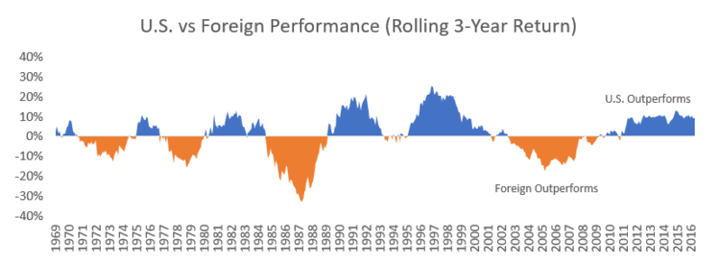
Nowadays, when I read about some factor that provides a superior long-term average return, I often wonder if its simply that a hot streak of recent outperformance has tilted it towards one side over another. What if it’s just part of a long cycle that eventually goes the other way? It was only after 2009 that long-term bonds and gold came back as desirable asset classes. Before that, it was commodities. Of course, there are all the ways that stocks are split up – US/International, Large/Small, Value/Growth, Momentum, Volatility, and so on.

From a previous post US vs. International Stocks: Historical Cycles of Outperformance:
us_intl_cycle

Bottom line. Large Value stocks did great during the 2000s, but Large Growth stocks dominated the 2010s. Have some healthy skepticism regarding “hot” asset classes, as the trend may not last and indeed may turn around just as you make the switch.

Stocks, Bonds, and Gold: Historical Charts Since 1800

StarCapital Research has shared a series of interesting long-term charts comparing the long-term returns, drawdowns, and volatility of stocks, bonds, and gold over the last 220 years. There are also some stats on relative market valuations and forward return expectation for different countries and regions. You must accept some terms before viewing, but it is available to US individual investors.

Here is a sample chart of the return distributions of stocks, bonds, and gold since 1800, depending on holding period, along with their takeaway, via Norbert Keimling @CAPE_invest:

Conclusion: For periods of 10 years or more, stocks are safer than bonds or gold!

This is because for a 10-year holding, the worst inflation-adjusted performance of stocks (-5.9% annually) was better than the worst performance for bonds (-6.4%) and gold (-10.1%). The problem is that during a specific 10-year timeframe where stocks did that poorly, it’s quite likely that bonds or gold did great! Which means that it would still be quite difficult to keep holding stocks through such a period of poor performance. In a fearful environment, “sell stocks and wait things out” will start sounding like much wiser advice than “buy and hold”.

Of course, stocks can recover quite quickly and you might miss it while you’re waiting:

(There is also an ongoing debate about the validity of “time diversification”. Do stocks really become “safer” the longer you hold them? They can still go down 50% at any given time, so if you need to sell in the near future, they are never really safe.)

After doing this for a while, I don’t know if someone can simply read a book and “learn” how to keep the faith during the scary bits. It takes some time and making some mistakes to develop a portfolio where you understand its limitations and how long and how badly it can act in the short-term. I’m still learning.

Best Interest Rates on Cash – December 2019

Here’s my monthly roundup of the best interest rates on cash for December 2019, roughly sorted from shortest to longest maturities. I track these rates because I keep a full 12 months of expenses as a cash cushion and also invest in longer-term CDs (often at lesser-known credit unions) when they yield more than bonds. Check out my Ultimate Rate-Chaser Calculator to see how much extra interest you’d earn by moving money between accounts. Rates listed are available to everyone nationwide. Rates checked as of 12/9/19.

High-yield savings accounts
While the huge megabanks like to get away with 0.01% APY, it’s easy to open a new “piggy-back” savings account and simply move some funds over from your existing checking account. The interest rates on savings accounts can drop at any time, so I list the top rates as well as competitive rates from banks with a history of competitive rates. Some banks will bait you with a temporary top rate and then lower the rates in the hopes that you are too lazy to leave.

Short-term guaranteed rates (1 year and under)
A common question is what to do with a big pile of cash that you’re waiting to deploy shortly (just sold your house, just sold your business, legal settlement, inheritance). My usual advice is to keep things simple and take your time. If not a savings account, then put it in a flexible short-term CD under the FDIC limits until you have a plan.

  • No Penalty CDs offer a fixed interest rate that can never go down, but you can still take out your money (once) without any fees if you want to use it elsewhere. My eBanc has a 11-month No Penalty CD at 2.00% APY with a $100,000 minimum deposit. Marcus Bank has a 7-month No Penalty CD at 1.90% APY with a $500 minimum deposit. Ally Bank has a 11-month No Penalty CD at 1.90% APY with a $25,000 minimum deposit. CIT Bank has a 11-month No Penalty CD at 1.85% APY with a $1,000 minimum deposit. You may wish to open multiple CDs in smaller increments for more flexibility.
  • Quontic Bank has a 12-month CD at 2.25% APY ($1,000 minimum).

Money market mutual funds + Ultra-short bond ETFs
If you like to keep cash in a brokerage account, beware that many brokers pay out very little interest on their default cash sweep funds (and keep the difference for themselves). The following money market and ultra-short bond funds are not FDIC-insured, but may be a good option if you have idle cash and cheap/free commissions.

  • Vanguard Prime Money Market Fund currently pays an 1.72% SEC yield. The default sweep option is the Vanguard Federal Money Market Fund, which has an SEC yield of 1.60%. You can manually move the money over to Prime if you meet the $3,000 minimum investment.
  • Vanguard Ultra-Short-Term Bond Fund currently pays 2.06% SEC yield ($3,000 min) and 2.16% SEC Yield ($50,000 min). The average duration is ~1 year, so there is more interest rate risk.
  • The PIMCO Enhanced Short Maturity Active Bond ETF (MINT) has a 2.05% SEC yield and the iShares Short Maturity Bond ETF (NEAR) has a 2.15% SEC yield while holding a portfolio of investment-grade bonds with an average duration of ~6 months.

Treasury Bills and Ultra-short Treasury ETFs
Another option is to buy individual Treasury bills which come in a variety of maturities from 4-weeks to 52-weeks. You can also invest in ETFs that hold a rotating basket of short-term Treasury Bills for you, while charging a small management fee for doing so. T-bill interest is exempt from state and local income taxes.

  • You can build your own T-Bill ladder at TreasuryDirect.gov or via a brokerage account with a bond desk like Vanguard and Fidelity. Here are the current Treasury Bill rates. As of 12/6/19, a 4-week T-Bill had the equivalent of 1.52% annualized interest and a 52-week T-Bill had the equivalent of 1.57% annualized interest.
  • The Goldman Sachs Access Treasury 0-1 Year ETF (GBIL) has a 1.83% SEC yield and the SPDR Bloomberg Barclays 1-3 Month T-Bill ETF (BIL) has a 1.44% SEC yield. GBIL appears to have a slightly longer average maturity than BIL.

US Savings Bonds
Series I Savings Bonds offer rates that are linked to inflation and backed by the US government. You must hold them for at least a year. There are annual purchase limits. If you redeem them within 5 years there is a penalty of the last 3 months of interest.

  • “I Bonds” bought between November 2019 and April 2020 will earn a 2.22% rate for the first six months. The rate of the subsequent 6-month period will be based on inflation again. More info here.
  • In mid-April 2020, the CPI will be announced and you will have a short period where you will have a very close estimate of the rate for the next 12 months. I will have another post up at that time.

Prepaid Cards with Attached Savings Accounts
A small subset of prepaid debit cards have an “attached” FDIC-insured savings account with exceptionally high interest rates. The negatives are that balances are capped, and there are many fees that you must be careful to avoid (lest they eat up your interest). Some folks don’t mind the extra work and attention required, while others do. There is a long list of previous offers that have already disappeared with little notice. I don’t personally recommend nor use any of these anymore.

  • The only notable card left in this category is Mango Money at 6% APY on up to $2,500, but there are many hoops to jump through. Requirements include $1,500+ in “signature” purchases and a minimum balance of $25.00 at the end of the month.

Rewards checking accounts
These unique checking accounts pay above-average interest rates, but with unique risks. You have to jump through certain hoops, and if you make a mistake you won’t earn any interest for that month. Some folks don’t mind the extra work and attention required, while others do. Rates can also drop to near-zero quickly, leaving a “bait-and-switch” feeling. I don’t use any of these anymore, but the Orion offer is worth consideration.

  • Consumers Credit Union Free Rewards Checking (my review) has up to 5.09% APY on balances up to $10,000 if you meet make $500+ in ACH deposits, 12 debit card “signature” purchases, and spend $1,000 on their credit card each month. Orion FCU Premium Checking (my review) has 3.00% APY on balances up to $15,000 if you meet make $500+ in direct deposits and 8 debit card “signature” purchases each month. Find a locally-restricted rewards checking account at DepositAccounts.
  • If you’re looking for a high-interest checking account without debit card transaction requirements, the rate won’t be nearly as high, but take a look at MemoryBank at 0.90% APY.

Certificates of deposit (greater than 1 year)
CDs offer higher rates, but come with an early withdrawal penalty. By finding a bank CD with a reasonable early withdrawal penalty, you can enjoy higher rates but maintain access in a true emergency. Alternatively, consider building a CD ladder of different maturity lengths (ex. 1/2/3/4/5-years) such that you have access to part of the ladder each year, but your blended interest rate is higher than a savings account. When one CD matures, use that money to buy another 5-year CD to keep the ladder going. Some CDs also offer “add-ons” where you can deposit more funds if rates drop.

  • You could build a CD ladder at Lafayette Federal Credit Union (LFCU) at 3.03% APY for 5-years, 2.78% APY for 4-year, 2.52% APY for 3-year, 2.27% APY for 2-year, and 2.02% APY for 1-year. As with many credit union deals, this likely won’t last long. Anyone can join this credit union via partner organization ($10 one-time fee).
  • Andrews FCU still had their special 7-year certificate at 3.05% APY. Anyone can join this credit union via partner organization.
  • You can buy certificates of deposit via the bond desks of Vanguard and Fidelity. You may need an account to see the rates. These “brokered CDs” offer FDIC insurance and easy laddering, but they don’t come with predictable early withdrawal penalties. The rates are not competitive right now. Watch out for higher rates from callable CDs listed by Fidelity.

Longer-term Instruments
I’d use these with caution due to increased interest rate risk, but I still track them to see the rest of the current yield curve.

  • Willing to lock up your money for 10+ years? You can buy long-term certificates of deposit via the bond desks of Vanguard and Fidelity. These “brokered CDs” offer FDIC insurance, but they don’t come with predictable early withdrawal penalties. I don’t see anything noteworthy. Watch out for higher rates from callable CDs from Fidelity.
  • How about two decades? Series EE Savings Bonds are not indexed to inflation, but they have a unique guarantee that the value will double in value in 20 years, which equals a guaranteed return of 3.5% a year. However, if you don’t hold for that long, you’ll be stuck with the normal rate which is quite low (currently a sad 0.10% rate). I view this as a huge early withdrawal penalty. You could also view it as a hedge against prolonged deflation, but only if you can hold on for 20 years. As of 12/9/19, the 20-year Treasury Bond rate was 2.13%.

All rates were checked as of 12/9/19.

Fidelity Charitable Donor-Advised Fund (DAF) Opening Process Review

It took me an extra year to get around to it, but it only took me about 15 minutes to actually open and fund my new Fidelity Charitable Donor-Advised Fund (DAF). I even donated stocks instead of just cash, but the donating appreciated securities were from an existing Fidelity taxable brokerage account. Here’s a brief review of the process.

Step 1: Create Fidelity account. Provide personal details, including name, address, and Social Security Number. Similar to opening a new bank or brokerage account. They need this information for tax purposes. If, for example, you make 20 donations of $100 all to different charities, you will only have one $2,000 tax receipt at the end of the year. If you already have a Fidelity account log-in, it links easily.

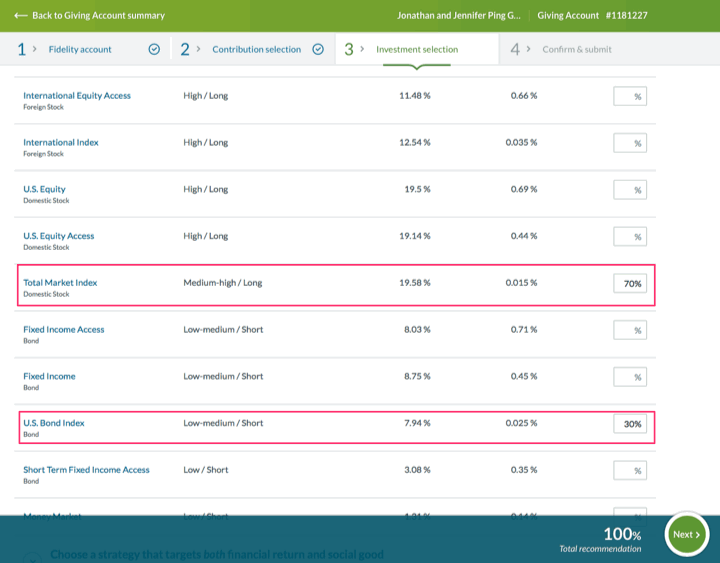
Step 2: Contribution selection. If donating from a Fidelity brokerage account, they have a special tool that searches for tax lots with the largest unrealized gains. This maximizes the tax advantage of your donation. This ability to find specific lots is neat and overrides your usual default setting for tax lots (ex. First-in, First-out). You can also enter you desired donation amount and it will tell you how many shares you should donate to approximate that amount (final number will depend on market price). For now, I chose to donate enough to satisfy the minimum opening amount of $5,000. Here’s a screenshot:

Step 3: Investment selection. Pre-packaged or customized allocation. One of the benefits of a DAF is that you can invest your money in between the time of initial contribution and eventual distribution. I did not spend a lot of time agonizing over this choice, as I don’t plan on keep a large amount of funds in there. We are not talking about an obscene amount of money here, so I feel better about distributing it sooner and helping out now. I am mainly using the DAF for the bonus tax savings and thus making my effective contribution larger.

Still, I was happy to see that I could create a custom allocation using low-cost index fund choices, including a Total US Stock Market Index at 0.015% annual expense ratio and US Bond Index at 0.025% annual expense ratio. Keep in mind there is also a 0.60% annual administrative fee (minimum $100). I mostly hope that the market gains will more than offset the maintenance fees.

Step 4. Confirm and Submit. The overall user experience was smooth and my choices were summarized in a clear and concise manner. The actual sale of my shares will take a few business days. It is made clear that this is an irrevocable charitable contribution. This means I am eligible to take an itemized deduction for this contribution immediately.

You can also choose to donate stocks from an outside brokerage account, but that process will take more time (and possibly more work). I plan on trying this out later, to test out that experience.

The Double Tax Advantage of Donating Appreciated Stocks Directly

If you own stocks in a taxable brokerage account and make charitable donations, consider donating your stocks this year instead of just writing a check. Why? Given the all-time market highs, your stocks, mutual funds, and/or ETFs probably have unrealized capital gains. When you donate an appreciated security that you’ve held for at least a year, you’ll both avoid paying long-term capital gains tax AND get a tax deduction for the full current market value.

This HCR Wealth Advisors graphic shows the benefit using the example of donating $50,000 of stock to charity with an original cost basis of $30,000. It assumes the highest long-term capital gains tax rate of 23.8% (20% plus the 3.8% Medicare surtax for high-income earners).

Here is a similar graphic from Fidelity using the example of donating $50,000 of stock to charity with an original cost basis of $20,000.

The size of your benefit is your unrealized gain times your tax rate. This basic idea still applies if you’re only donating a smaller amount of stock at the lower long-term capital gains rate of 15%. If you bought a stock for $1,000 and it’s now worth $2,000, donating it directly will save you $150 to $238 in taxes ($1,000 x 15% or 20% or 23.8%). If someone didn’t know and simply changed the order (sell stock, then immediately donate the cash proceeds), that tax savings would disappear.

The problem is that not all individual charities are equipped to accept such stock donations. That’s where donor-advised funds (DAFs) come in handy. Fidelity, Vanguard, and Schwab all have donor-advised funds that can accept such donations, get you that tax deduction upfront, and allow you to make a cash grant to your individual charities. DAFs do charge for their services – an administration fee of about 0.60% of assets annually on top of investment expense ratios. There is also a minimum initial donation of between $5,000 and $25,000. You can then weigh the options of investing your donations for growth, or distributing it immediately to charities for immediate impact.

I am fortunate to have some appreciated stocks, so this year I plan to open an account with Fidelity Charitable. I chose them because they seem to have been in the game the longest and are also the most flexible with a $5,000 minimum initial donation, no minimum requirement for future donations, and a low $50 minimum grant size. Their administrative fees are also comparable with Schwab and Vanguard. I hope that I can finish the process by year-end.

This Vanguard Chart Is Why Schwab Bought TD Ameritrade

The big news while I was on vacation was that Schwab bought TD Ameritrade for $26 billion in an all-stock transaction (press release). Well, first Schwab shaved off 17% of TD Ameritrade’s value by cutting their trade commissions to zero, and then they bought AMTD at a multi-billion dollar discount to what it would have cost just a month earlier. Nice move.

Now that trade costs have gone to zero, and index fund expense ratios are also pretty much zero, what’s left? Vanguard funds now have a greater market share of all funds and ETFs than that of its next three biggest competitors combined, per this Marketwatch article:

That doesn’t include Schwab funds, which aren’t even on the chart.

Vanguard dominates because it has a long record of passing on virtually all of the benefits of scale to their clients. As they gathered more assets, they lowered their expense ratios, which helped them to better returns, which helped them gather more assets, and so on. Index funds may be a commodity now, but more people buy them from Vanguard than any else by far.

Vanguard is now moving into the portfolio advising turf formerly dominated by Schwab, Fidelity, and TD Ameritrade. The only way Schwab and TD Ameritrade can compete is through scale and creating a better total package for both advisors and retail customers. Can customer service and technology make enough difference that people will hold their funds and ETFs at Schwab?

Peerstreet Case Study #2: NJ Commercial Property Foreclosure Recovery

I’ve invested over $50,000 of my “alternative” money into PeerStreet real estate notes because of the ability to diversify into 50+ different high-interest loans backed by physical real estate. Here is a case study of a commercial property loan where Peerstreet negotiated an exit when it was already very deep into the foreclosure process. You can find additional case study links and the most recent update to my overall portfolio performance in my Peerstreet review.

Initial investment details.

  • Property: Commercial property in New Jersey.
  • Target Net Investor Rate/Term: 9.25% APR for 17 months.
  • Amount invested: $1,133 out of $1,700,000 loan.
  • Appraised at $4M = 43% LTV.
  • Loan secured by the property in first position.
  • Bridge loan to redevelop into a 179-unit apartment building.

Timeline.

  • May 2018. Loaned out $1,133, my share of $1,700,000 total.
  • June 2018. One single interest payment was made.
  • August 2018. No more payments.
  • September 2018. Legal notices sent.
  • November 2018. PeerStreet and the borrower agree to a forbearance agreement. The terms of the forbearance include, the borrower paying $8,500 and in return, PeerStreet will not file the foreclosure complaint until the end of November. The borrower states that they are in the process of refinancing the loan.
  • December 2018. The forbearance agreement has expired and the borrower has not cured or paid off their loan. The loan file has been sent to a local law firm to initiate legal proceedings against the borrower. Foreclosure counsel filed the foreclosure complaint on December 13, 2018. The complaint has been sent out for service.
  • February 2019. All parties have been Served. Once the time to answer expires, we will move for defaults.
  • June 2019. Foreclosure counsel filed the final judgment package and are waiting on the court to enter the same. Judgment should be entered in the next 3 to 6 weeks
  • July 2019. The foreclosure process continues and PeerStreet is in negotiations to sell the note back to the lender. On 7/31/2019, PeerStreet provided the originating lender with an updated payoff statement as repurchase discussions continue. PeerStreet continues to wait for the Court’s ruling on its Motion for Final Judgment in the foreclosure.
  • September 2019. The Escrow Agent advised that it has received the bulk of the funds for the repurchase of the loan at $1,850,000.00.
  • October 2019. PeerStreet has completed its sale of the note, and final proceeds have been distributed to investors. Proceeds from the sale were $1,815,227, net of costs and fees associated with the foreclosure. The cash-on-cash return on this investment, after taking into account interest and fees paid to investors, was positive at 107.7%.

Final numbers. I invested $1,113 in May 2018 and got paid $87.52 of interest and $1,113 of principal for a total of $1,265.27 as of October 2019. (This was an automated reinvestment which included whatever cash was in my account, thus the odd numbers.) This works out to a 7.86% total return over 17 months, which is roughly a 5.5% annualized return. My overall annualized return across my entire portfolio is 7.3%. These numbers are net of all PeerStreet fees.

My commentary. This loan is an example of Peerstreet negotiating a settlement, in this case getting my principal back and even a a small positive return. This loan was initially concerning because the lender made a single payment and then stopped. While you have collateral, if the loan goes into default, it takes a very, very long time to seize and sell that collateral. This is why you need to diversify your notes and never invest money you need anytime soon.

I can only assume that Peerstreet negotiated with the lender here because they just didn’t want it to drag out any further. They might have gotten more money if they foreclosed, but they would also have had to finish the foreclosure, prep it for sale, market it, and then wait for a sale of the property. The lender still took advantage of the situation, as they basically didn’t have to pay any interest for 17 months and then they ended up paying less interest than they initially promised. The borrower also likely had a bad mark on their credit report, which should hurt their ability to get future loans.

I’ve read many reviews of real estate crowdfunding sites done by new investors who haven’t had the chance to experience how it all works out. Some are overly positive because they haven’t had any late payments yet, while others are too negative because they have some really late loans and assume the worst. With Peerstreet, both of my loans that went “bad” took over a year to sort out, but in the end they had positive returns. Of course, that is not always the case and I have lost some principal on a single note from another now-defunct real estate site.

Bottom line. Out of the $50,000+ I’ve now invested into 51 loans at PeerStreet over 3+ years, 48 were paid back in full in a timely manner, while three have reached various stages of the foreclosure process. This is one example where we went pretty deep into the foreclosure process, but PeerStreet negotiated directly with the borrower to settle the debt and thus avoided another several months of waiting and selling the property. The annualized return for this loan was 5.5%, while my overall annualized return across my entire portfolio is 7.3%.

If you are interested, you can sign up and browse investments at PeerStreet for free before depositing any funds or making any investments. You must qualify as an accredited investor (either via income or net worth) to invest. If you already invest with them, they now sync with Mint.com.

Morningstar Top 529 College Savings Plan Rankings 2019

Investment research firm Morningstar has released their annual 529 College Savings Plans analyst ratings for 2019. While the full ratings and plan analysis for every individual plan are restricted to paid premium members, the vast majority are mediocre and can be ignored. You choices are pretty much (1) your in-state plan for the tax benefits or (2) the best overall plan if you don’t have good in-state perks.

Here are the Gold-rated plans for 2019 (no particular order). Morningstar uses a Gold, Silver, or Bronze rating scale for the top plans and Neutral or Negative for the rest.

The top 3 were Gold last year as well. California Scholarshare is a new addition, upgraded from Silver. The Vanguard 529 Plan from Nevada was removed, downgraded to Silver. The reason stated was because their expenses were low, but not as low as the rest of the Gold-rated plans above.

Here are the consistently top-rated plans from 2011-2019. This means they were rated either Gold or Silver (or equivalent) for every year the rankings were done from 2011 through 2018. These were also the same as last year. No particular order.

  • T. Rowe Price College Savings Plan, Alaska
  • Maryland College Investment Plan
  • Vanguard 529 College Savings Plan, Nevada
  • CollegeAdvantage 529 Savings Plan, Ohio
  • CollegeAmerica Plan, Virginia (Advisor-sold)
  • My529, formerly the Utah Educational Savings Plan

The “Five P” criteria.

  • People. Who’s behind the plans? Who are the investment consultants picking the underlying investments? Who are the mutual fund managers?
  • Process. Are the asset-allocation glide paths and funds chosen for the age-based options based on solid research? Whether active or passive, how is it implemented?
  • Parent. How is the quality of the program manager (often an asset-management company or board of trustees which has a main role in the investment choices and pricing)? Also refers to state officials and their policies.
  • Performance. Has the plan delivered strong risk-adjusted performance, both during the recent volatility and in the long-term?
  • Price. Includes factors like asset-weighted expense ratios and in-state tax benefits.

State-specific tax benefits. Remember to first consider your state-specific tax benefits via the tools from Morningstar, SavingForCollege, or Vanguard. Morningstar estimates that an upfront tax break of at least 5% can make it worth investing in your in-state plan even if it is not a top plan (assuming that is required to get the tax benefit).

If you don’t have anything compelling available, anyone can open a 529 plan from any state. I would pick from the ones listed above. Also, if you have money in an in-state plan now but your situation changes, you can roll over your funds into another 529 from any state. (Watch out for tax-benefit recapture if you got a tax break initially.)

My picks. Overall, the plans are getting better and most Gold/Silver picks are solid. If your state doesn’t offer a significant tax break, I have recommended these two plans to my friends and family:

  • Nevada 529 Plan has low costs, solid automated glide paths, a variety of Vanguard investment options, and long-term commitment to consistently lowering costs as their assets grow. (It is not the rock-bottom cheapest, but this is often because other plans don’t offer much international exposure, which usually costs more.) This is only plan that Vanguard puts their name on, and you can manage it within your Vanguard.com account. This is the keep-it-simple option.
  • Utah 529 plan has low costs, investments from Vanguard and DFA, and has highly-customizable glide paths. Over the last few years, the Utah plan has also shown a consistent effort towards passing on future cost savings to clients. This is the option for folks that enjoy DIY asset allocation. Since I like to DIY, the vast majority of my family’s college savings is in this plan.

I feel that a consistent history of consumer-first practices is important. Sure, you can move your funds if needed, but wouldn’t you rather watch your current plan just keep getting better every year?

Best Interest Rates on Cash – November 2019

Here’s my monthly roundup of the best interest rates on cash for November 2019, roughly sorted from shortest to longest maturities. There was another Fed rate cut last week. I track these rates because I keep a full 12 months of expenses as a cash cushion and also invest in longer-term CDs (often at lesser-known credit unions) when they yield more than bonds. Check out my Ultimate Rate-Chaser Calculator to get an idea of how much extra interest you’d earn if you are moving money between accounts. Rates listed are available to everyone nationwide. Rates checked as of 11/5/19.

High-yield savings accounts
While the huge megabanks like to get away with 0.01% APY, it’s easy to open a new “piggy-back” savings account and simply move some funds over from your existing checking account. The interest rates on savings accounts can drop at any time, so I include banks with a history of competitive rates. Some banks will bait you with a temporary top rate and then lower the rates in the hopes that you are too lazy to leave.

Short-term guaranteed rates (1 year and under)
A common question is what to do with a big pile of cash that you’re waiting to deploy shortly (just sold your house, just sold your business, legal settlement, inheritance). My usual advice is to keep things simple and take your time. If not a savings account, then put it in a flexible short-term CD under the FDIC limits until you have a plan.

  • No Penalty CDs offer a fixed interest rate that can never go down, but you can still take out your money (once) without any fees if you want to use it elsewhere. My eBanc has a 11-month No Penalty CD at 2.15% APY with a $10,000 minimum deposit. Marcus Bank has a 7-month No Penalty CD at 2.00% APY with a $500 minimum deposit. Ally Bank has a 11-month No Penalty CD at 1.90% APY with a $25,000 minimum deposit. CIT Bank has a 11-month No Penalty CD at 1.85% APY with a $1,000 minimum deposit. You may wish to open multiple CDs in smaller increments for more flexibility.
  • Total Direct Bank has a 12-month CD at 2.36% APY ($25,000 minimum) with an early withdrawal penalty of 3 months of interest.

Money market mutual funds + Ultra-short bond ETFs
If you like to keep cash in a brokerage account, beware that many brokers pay out very little interest on their default cash sweep funds (and keep the difference for themselves). The following money market and ultra-short bond funds are not FDIC-insured, but may be a good option if you have idle cash and cheap/free commissions.

  • Vanguard Prime Money Market Fund currently pays an 1.85% SEC yield. The default sweep option is the Vanguard Federal Money Market Fund, which has an SEC yield of 1.76%. You can manually move the money over to Prime if you meet the $3,000 minimum investment.
  • Vanguard Ultra-Short-Term Bond Fund currently pays 2.09% SEC yield ($3,000 min) and 2.19% SEC Yield ($50,000 min). The average duration is ~1 year, so there is more interest rate risk.
  • The PIMCO Enhanced Short Maturity Active Bond ETF (MINT) has a 2.19% SEC yield and the iShares Short Maturity Bond ETF (NEAR) has a 2.30% SEC yield while holding a portfolio of investment-grade bonds with an average duration of ~6 months.

Treasury Bills and Ultra-short Treasury ETFs
Another option is to buy individual Treasury bills which come in a variety of maturities from 4-weeks to 52-weeks. You can also invest in ETFs that hold a rotating basket of short-term Treasury Bills for you, while charging a small management fee for doing so. T-bill interest is exempt from state and local income taxes.

  • You can build your own T-Bill ladder at TreasuryDirect.gov or via a brokerage account with a bond desk like Vanguard and Fidelity. Here are the current Treasury Bill rates. As of 11/5/19, a 4-week T-Bill had the equivalent of 1.56% annualized interest and a 52-week T-Bill had the equivalent of 1.62% annualized interest.
  • The Goldman Sachs Access Treasury 0-1 Year ETF (GBIL) has a 1.83% SEC yield and the SPDR Bloomberg Barclays 1-3 Month T-Bill ETF (BIL) has a 1.66% SEC yield. GBIL appears to have a slightly longer average maturity than BIL.

US Savings Bonds
Series I Savings Bonds offer rates that are linked to inflation and backed by the US government. You must hold them for at least a year. There are annual purchase limits. If you redeem them within 5 years there is a penalty of the last 3 months of interest.

  • “I Bonds” bought between November 2019 and April 2020 will earn a 2.22% rate for the first six months. The rate of the subsequent 6-month period will be based on inflation again. More info here.
  • In mid-April 2020, the CPI will be announced and you will have a short period where you will have a very close estimate of the rate for the next 12 months. I will have another post up at that time.

Prepaid Cards with Attached Savings Accounts
A small subset of prepaid debit cards have an “attached” FDIC-insured savings account with exceptionally high interest rates. The negatives are that balances are capped, and there are many fees that you must be careful to avoid (lest they eat up your interest). Some folks don’t mind the extra work and attention required, while others do. There is a long list of previous offers that have already disappeared with little notice. I don’t personally recommend nor use any of these anymore.

  • The only notable card left in this category is Mango Money at 6% APY on up to $2,500, but there are many hoops to jump through. Requirements include $1,500+ in “signature” purchases and a minimum balance of $25.00 at the end of the month.

Rewards checking accounts
These unique checking accounts pay above-average interest rates, but with unique risks. You have to jump through certain hoops, and if you make a mistake you won’t earn any interest for that month. Some folks don’t mind the extra work and attention required, while others do. Rates can also drop to near-zero quickly, leaving a “bait-and-switch” feeling. I don’t use any of these anymore, but the Orion offer is worth consideration.

  • Consumers Credit Union Free Rewards Checking (my review) has up to 5.09% APY on balances up to $10,000 if you meet make $500+ in ACH deposits, 12 debit card “signature” purchases, and spend $1,000 on their credit card each month. Orion FCU Premium Checking (my review)has 4.00% APY on balances up to $30,000 if you meet make $500+ in direct deposits and 8 debit card “signature” purchases each month. Find a locally-restricted rewards checking account at DepositAccounts.
  • If you’re looking for a high-interest checking account without debit card transaction requirements, the rate won’t nearly as high, but take a look at MemoryBank at 0.90% APY.

Certificates of deposit (greater than 1 year)
CDs offer higher rates, but come with an early withdrawal penalty. By finding a bank CD with a reasonable early withdrawal penalty, you can enjoy higher rates but maintain access in a true emergency. Alternatively, consider building a CD ladder of different maturity lengths (ex. 1/2/3/4/5-years) such that you have access to part of the ladder each year, but your blended interest rate is higher than a savings account. When one CD matures, use that money to buy another 5-year CD to keep the ladder going. Some CDs also offer “add-ons” where you can deposit more funds if rates drop.

  • You could build a CD ladder at Pennsylvania State Employees Credit Union (PSECU) at 3.00% APY for 5-year, 2.75% APY for 4-year, 3.25% APY for 3-year, 3.00% APY for 2-year, and 1.95% APY for 1-year. Early withdrawal penalty: Up to 2-year CD is 90 days of interest. 3 to 5 year CD is 180 days of interest. Some of these are limited-time specials. Anyone can join this credit union via partner organization ($10 one-time fee).
  • You could also build a CD ladder at current rates of First National Bank of America at 2.55% APY for 5-year, 2.50% APY for 4-year, 2.40% APY for 3-year, 2.37% APY for 2-year, and 2.35% APY for 1-year.
  • You can buy certificates of deposit via the bond desks of Vanguard and Fidelity. You may need an account to see the rates. These “brokered CDs” offer FDIC insurance and easy laddering, but they don’t come with predictable early withdrawal penalties. The rates are not competitive right now. Watch out for higher rates from callable CDs listed by Fidelity.

Longer-term Instruments
I’d use these with caution due to increased interest rate risk, but I still track them to see the rest of the current yield curve.

  • Willing to lock up your money for 10+ years? You can buy long-term certificates of deposit via the bond desks of Vanguard and Fidelity. These “brokered CDs” offer FDIC insurance, but they don’t come with predictable early withdrawal penalties. As of this writing, I am seeing no inventory on 7-year and 10-year CDs. Watch out for higher rates from callable CDs from Fidelity.
  • How about two decades? Series EE Savings Bonds are not indexed to inflation, but they have a unique guarantee that the value will double in value in 20 years, which equals a guaranteed return of 3.5% a year. However, if you don’t hold for that long, you’ll be stuck with the normal rate which is quite low (currently a sad 0.10% rate). I view this as a huge early withdrawal penalty. You could also view it as a hedge against prolonged deflation, but only if you can hold on for 20 years. As of 10/2/19, the 20-year Treasury Bond rate was 1.90%.

All rates were checked as of 11/5/19.

Savings I Bonds November 2019 Interest Rate: 2.02% Inflation + 0.20% Fixed Rate

sb_poster

Updated November 2019. The fixed rate will be 0.20% for I bonds issued from November 1, 2019 through April 30th, 2020. This is a drop from the previous fixed rate of 0.50%. The variable inflation-indexed rate for this 6-month period will be 2.02% (as was predicted). The total rate on any specific bond is the sum of the fixed and variable rates, changing every 6 months. If you buy a new bond in between November 2019 and April 2020, you’ll get 2.22% for the first 6 months. This isn’t that bad given the recent rate cuts. See you again in mid-April for the next early prediction for May 2020.

Original post 10/14/19:

Savings I Bonds are a unique, low-risk investment backed by the US Treasury that pay out a variable interest rate linked to inflation. You could own them as an alternative to bank certificates of deposit (they are liquid after 12 months) or bonds in your portfolio.

New inflation numbers were just announced at BLS.gov, which allows us to make an early prediction of the November 2019 savings bond rates a couple of weeks before the official announcement on the 1st. This also allows the opportunity to predict what an October 2019 savings bond purchase will yield over the next 12 months, instead of just 6 months.

New inflation rate prediction. March 2019 CPI-U was 254.202. September 2019 CPI-U was 256.759, for a semi-annual increase of 1.01%. Using the official formula, the variable component of interest rate for the next 6 month cycle will be 2.02%. You add the fixed and variable rates to get the total interest rate. If you have an older savings bond, your fixed rate may be very different than one from recent years.

Tips on purchase and redemption. You can’t redeem until 12 months have gone by, and any redemptions within 5 years incur an interest penalty of the last 3 months of interest. A known “trick” with I-Bonds is that if you buy at the end of the month, you’ll still get all the interest for the entire month as if you bought it in the beginning of the month. It’s best to give yourself a few business days of buffer time. If you miss the cutoff, your effective purchase date will be bumped into the next month.

Buying in October 2019. If you buy before the end of October, the fixed rate portion of I-Bonds will be 0.50%. You will be guaranteed a total interest rate of 1.90% for the next 6 months (0.50 + 1.40). For the 6 months after that, the total rate will be 0.50 + 2.02 = 2.52%.

Let’s look at a worst-case scenario, where you hold for the minimum of one year and pay the 3-month interest penalty. If you theoretically buy on October 31st, 2019 and sell on October 1, 2020, you’ll earn a ~1.72% annualized return for an 11-month holding period, for which the interest is also exempt from state income taxes. If you held for three months longer, you’d be looking at a ~1.89% annualized return for a 14-month holding period (assuming my math is correct). Compare with the best interest rates as of October 2019.

Buying in November 2019. If you buy in November 2019, you will get 2.02% plus a newly-set fixed rate for the first 6 months. The new fixed rate is unknown, but is loosely linked to the real yield of short-term TIPS. In the past 6 months, the 5-year TIPS yield has dropped to about 0.20% and has been close to zero. My best guess is that it will be 0.10%. Every six months, your rate will adjust to your fixed rate (set at purchase) plus a variable rate based on inflation.

If you have an existing I-Bond, the rates reset every 6 months depending on your purchase month. Your bond rate = your specific fixed rate (set at purchase) + variable rate (minimum floor of 0%).

Buy now or wait? In the short-term, these I bond rates will probably not beat a top CD. If you intend to be a long-term holder, a factor to consider is that the October fixed rate is 0.5% and that it will likely drop at least a little in November in my opinion. You may want to lock in that higher fixed rate now.

Unique features. I have a separate post on reasons to own Series I Savings Bonds, including inflation protection, tax deferral, exemption from state income taxes, and educational tax benefits.

Over the years, I have accumulated a nice pile of I-Bonds and now consider it part of the inflation-linked bond allocation inside my long-term investment portfolio.

Annual purchase limits. The annual purchase limit is now $10,000 in online I-bonds per Social Security Number. For a couple, that’s $20,000 per year. Buy online at TreasuryDirect.gov, after making sure you’re okay with their security protocols and user-friendliness. You can also buy an additional $5,000 in paper bonds using your tax refund with IRS Form 8888. If you have children, you may be able to buy additional savings bonds by using a minor’s Social Security Number.

For more background, see the rest of my posts on savings bonds.

[Image: 1946 Savings Bond poster from US Treasury – source]

S&P 500 vs. International Stock Funds: Revenue Breakdown By World Region

One of the common reasons given for only investing the S&P 500 or only US-based companies is that the businesses operate globally. “McDonald’s and Coca-Cola sell burgers and soda everywhere. Disney is everywhere. ExxonMobil sells energy around the world.” I understand the sentiment, but how about some real numbers? The Morningstar article Investing Close to Home Is Overrated breaks down the revenue by region for some popular ETFs that track broad US and International stock indexes.

A few quick takeaways:

  • Companies in the S&P 500 or Total US index get about 65% of their revenue from the United States and 35% from the rest of the world.
  • Companies in a Total World ex-US index only get about 15% of their revenue from the United States and 85% from the rest of the world.

The S&P 500 does derive a decent chunk of its profits from international sources. However, you’re still missing a lot of exposure from the rest of the world.

Now, I happen to agree that you don’t “need” to own an international index fund. The Dow Jones index has taught us that even a poorly-constructed funky index that tracks 30 human-picked companies based on the numerical price of a single share (not total market value) can work out over the long run. By extension, if you only own the S&P 500 and hold on for 30 years, you’ll probably turn out fine as well.

However, I still choose to add international stocks to my portfolio. Why? The holding on part. I expect international stocks again outperform US stocks for years in a row. From a previous post US vs. International Stocks: Historical Cycles of Outperformance:

us_intl_cycle

Nobody knows the future, and so there is no single “right” answer. From No Consensus on International Stocks: Make Any Decision, Just Stick With It:

international3

Bottom line. Owning just US stocks might work out just fine, but it’s still not the same as owning international stocks. The world will change in many unexpected ways during next 50 years and my investing life is easier when I own the entire haystack.

Mental Model For Expenses: Past, Present, and Future (With Animated GIFs!)

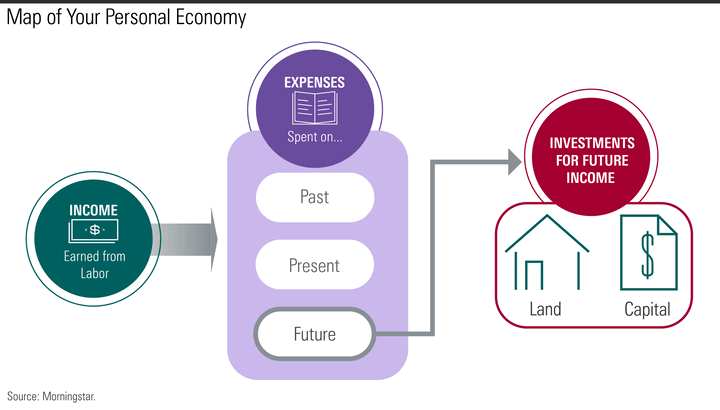
The theory behind financial independence is simple. Spend less, save more, invest it into income-producing assets. The reality is complex, full of daily decisions about balancing income and spending. The Morningstar article (yes, M* is writing about early retirement too now) A Simple Plan for Financial Independence presents this simplified graphic of your “personal economy”.

Income can come from labor, capital, or land. Expenses can be put toward your past (debt), present, or future (investing in capital or land).

I’ve been thinking about this “past, present, and future” mental model for expenses, it meshes will with the simple rules that I want to teach my children: Avoid debt whenever possible, and seek out income-producing assets.

Present. There is countless advice to save money on current expenses. Call it prioritizing, call it frugality, call it whatever. These are important, but I’d rather focus on the added ideas of past and future.

Past. While debt is an important part of the economy, I hate that going into debt for non-essentials is so readily accepted in today’s society. Using home equity lines of credit for a kitchen remodels. Credit cards for vacations. The entire microloans trend where you buy a $100 pair of jeans for $10 a month times 12 months ($120) is a dangerous mind game. Debt is having compound interest work against you, and thus making someone else rich. Debt should not be normalized. Debt is an emergency!

via GIPHY

Future. If you look at people who have really achieved financial freedom, where they truly spend the day doing whatever they want and without money worries, they have all have collected a big pile of income-producing assets. It could be rental property, commercial real estate, a laundromat/car wash/business, dividend-paying stocks, municipal bonds, a pension, Social Security or even just bank CDs if you have enough. In most cases, they collected them with purpose. They didn’t just put the minimum into their 401(k) and call it a day. They would shovel whatever extra money they had into their favorite money-making machine. When I buy more stocks, I see a future income stream:

via GIPHY

When you buy one of these income-producing assets, it should get you excited!

via GIPHY

I’m still not sure exactly how to create this distaste for debt and this desire for money factories, but I’m working on it. If you have these two in place, that should help with everything else – earning more income with labor, spending less on the present.

Oh, and here’s a funny-but-sad representation of the paycheck-to-paycheck lifestyle.

via GIPHY