Vanguard Interactive Ad: $1 Million Is Closer Than You Think

vg_1mil

Vanguard has a new full-page interactive ad in the NY Times online with the heading $1 Million Is Closer Than You Think. This is one of those expensive ads that I feel ambivalent about as a investor-owner of Vanguard. I’d rather they rely on word-of-mouth (like from yours truly) and focus more on the customer experience. Will the slick design attract new money and lower expense ratios? At least it promotes the types of things that I support:

  • Save more. Increase your regular contributions. Track your overall saving rate.
  • Keep costs low. Watch your management fees and other costs affecting your portfolio.
  • Stay the course. Don’t react to the market and chase what’s hot.

Which Index Fund Companies Are Most Aligned With Individual Investors?

mstarlogoYou’ve decided that low-cost index funds are the way to go. Which index fund company do you pick? Morningstar has a new research paper titled Partnering With Passive Fund Sponsors That Have Your Back:

Successful investing hinges on putting yourself in the best position to maximize favorable outcomes. Beyond selecting a fund that tracks a well-constructed index and charges a low fee, choosing a fund sponsor that aligns its interests with its fundholders’ increases the odds of a positive investor outcome. Our research found that purveyors of passive funds that align their incentives with those of their fundholders have generated better category-relative risk-adjusted performance on average than funds from firms that seem to prioritize their own interests over investors’.

Here are the characteristics that they felt showed “alignment”:

  • Charging low expense ratios
  • Sharing a greater portion of generated securities-lending revenue
  • Maintaining a disciplined approach to product development
  • Investing in portfolio management infrastructure

After finishing the entire paper, my primary takeaway is that most of the big companies are doing a pretty good job. Vanguard, Fidelity, and Schwab are probably the most aligned. DFA is good in many areas but they do charge higher expense ratios for their factor-tilted passive funds (though past performance has also been higher). Blackrock has some good characteristics but also does a few questionable things like creating a cheap version of a successful ETF, which still charging as much as they can on the old ETF.

Index tracking quality. Here’s a chart of how well each firm tracked their underlying indexes over the past 5 years. Tracking errors are now very low across the board.

mstar_track

For the most part, competition is working and industry practices are converging. The paper notes that State Street has historically been the worst at lowering expense ratios over the last 10 years. The next thing I see? State Street announces their new suite of low-cost SPDR Portfolio ETFs.

TIAA is NOT a non-profit. The Morningstar paper states that TIAA is a nonprofit. However, according to this recent NY Times article, TIAA stopped being a non-profit in 1997 and has been accused of touting its “nonprofit heritage” while pushing higher-cost investment products:

Even though TIAA stopped being a nonprofit organization in 1997, many of its customers might think it remains one. The company’s website ends in a .org rather than a .com and TIAA repeatedly refers to its “nonprofit heritage.”

Most of TIAA is for-profit. Teachers Advisors, for example, is an investment advisory firm that receives compensation from each in-house mutual fund it manages. Nuveen, a mutual fund company purchased by TIAA in 2014, is also run on a for-profit basis. So is EverBank, a Florida banking institution TIAA acquired in June.

Bottom line. Morningstar did not provide final rankings, but my interpretation of Morningstar data is that these firms show the most investor-aligned practices: Vanguard, Fidelity, and Schwab. Based on my own observations, I would be most comfortable having my money held with these firms as well. DFA and Blackrock are not that far behind.

Morningstar Top 529 College Savings Plan Rankings 2017

mstarlogoInvestment research firm Morningstar has released their annual 529 College Savings Plans Research Paper and Industry Survey. While the full survey appears restricted to paid premium members, they did release their top-rated plans for 2017. This is still useful as while there are currently over 60 different 529 plan options nationwide, the majority are mediocre and can quickly be dismissed.

Here are the Gold-rated plans for 2017 (no particular order). Morningstar uses a Gold, Silver, or Bronze rating scale for the top plans and Neutral or Negative for the rest.

The Bright Start College Savings Plan from Illinois was upgraded to Gold this year due to a manager change and thus an entire new set of investment options and age-based tracks. The new plan is cheaper and removed a $10 maintenance fee. The other 3 plans were Gold last year as well.

Here are the consistently top-rated plans from 2011-2017. This means they were rated either Gold or Silver (or equivalent) for every year the rankings were done from 2011 through 2017. No particular order.

  • T. Rowe Price College Savings Plan, Alaska
  • Maryland College Investment Plan
  • Vanguard 529 College Savings Plan, Nevada
  • CollegeAdvantage 529 Savings Plan, Ohio
  • CollegeAmerica Plan, Virginia (Advisor-sold)
  • Utah Educational Savings Plan

The “Five P” criteria.

  • People. Who’s behind the plans? Who are the investment consultants picking the underlying investments? Who are the mutual fund managers?
  • Process. Are the asset-allocation glide paths and funds chosen for the age-based options based on solid research? Whether active or passive, how is it implemented?
  • Parent. How is the quality of the program manager (often an asset-management company or board of trustees which has a main role in the investment choices and pricing)? Also refers to state officials and their policies.
  • Performance. Has the plan delivered strong risk-adjusted performance, both during the recent volatility and in the long-term? Is it judged likely to continue?
  • Price. Includes factors like asset-weighted expense ratios and in-state tax benefits.

State-specific tax benefits. Remember to first consider your state-specific tax benefits that may outweigh other factors. If you don’t have anything compelling available, you can open a 529 plan from any state (I would pick from the ones listed above). Also, if you like an in-state plan now but your situation changes, you can roll over your funds into another 529 from any state.

My picks. Overall, the plans are getting better and most Gold/Silver picks are solid. If your state doesn’t offer an significant local perks, I narrow things down and recommend these two plans to my friends and family:

  • Nevada 529 Plan has low costs, solid automated glide paths, a variety of Vanguard investment options, and long-term commitment to consistently lowering costs as their assets grow. This is only plan that Vanguard puts their name on, and you can manage it within your Vanguard.com account. This is the keep-it-simple option.
  • Utah 529 plan has low costs, investments from Vanguard and DFA, and has highly-customizable glide paths. Over the last few years, the Utah plan has also shown a history of passing on future cost savings to clients. This is the option for folks that enjoy DIY asset allocation.

I feel that a consistent history of consumer-first practices is most important. Sure, you can move your funds if needed, but wouldn’t you rather watch your current plan just keep getting better every year?

Tulip Fever Movie: Love and Economic Bubbles

tulipIf you’ve read enough investing books, you know about the “Dutch Tulip Mania” of the 1600s (Wikipedia) and how it was considered one of the first documented economic bubbles. At one point, 12 acres of land were exchanged for a single tulip bulb.
I was catching up on my Bloomberg magazines and saw this: Finance Geeks Will Love This New Movie About the Tulip Bubble. The official trailer would indicate it’s mostly a romantic drama, but the article suggests that it weaves in the tulip mania, the “nature of money”, and what “love and money have in common”:

The critic reviews weren’t that great, so perhaps it will end up on Amazon Prime Video or Netflix soon enough.

I believe I first read about tulip mania in the Burton Malkiel classic A Random Walk down Wall Street as an example of the Greater Fool Theory, where you buy something for a high price not due to its intrinsic value, but solely because you think someone else will buy it from you for an even higher price. (Does this apply to iPhone X pre-orders?)

Best Interest Rates on Cash – November 2017

percentage2

Interest rates are slowly inching upwards. Don’t let a megabank pay you 0.01% APY or less for your idle cash. Here is my monthly roundup of the best safe rates available, roughly sorted from shortest to longest maturities. I focus on rates that are nationally available to everyone (not restricted to certain geographic areas or specific groups). Rates checked as of 11/1/17.

High-yield savings accounts
While the huge brick-and-mortar banks rarely offer good yields, there are many online savings accounts offering competitive rates clustered around 1.1%-1.3% APY. Remember that with savings accounts, the interest rates can change at any time.

  • Top rates: DollarSavingsDirect at 1.50% APY. SalemFiveDirect at 1.50% APY. Redneck Bank and All America Bank (they are affiliated) having Mega Money Market accounts paying 1.50% APY on balances up to $35,000.
  • More rates from banks with solid history of competitive rates: CIT Bank at 1.35% APY up to $250k, Synchrony Bank at 1.30% APY, GS Bank at 1.30% APY, and UFB Direct at 1.41% APY ($5k min).
  • I’ve experienced the “bait-and-switch” of moving to a new bank only to have the rate lowered quickly afterward. Until the rate difference is huge, I’m sticking with a Ally Bank Savings + Checking combo due to their history of competitive rates (including CDs), 1-day interbank transfers, and overall user experience. I also like the free overdraft transfers from savings that let’s me keep my checking balance at a minimum. Ally Savings is at 1.25% APY.

Money market mutual funds + Ultra-short bond ETFs
If you like to keep cash in a brokerage account, you should know that money market and short-term Treasury rates have inched upwards. It may be worth the effort to move your money into a higher-yielding money market fund or ultrashort-term bond ETF. The following bond funds are not FDIC-insured, but if you want to keep “standby money” in your brokerage account and have cheap/free commissions, it may be worth a look.

  • Vanguard Prime Money Market Fund currently pays an 1.13% SEC yield. The default sweep option is the Vanguard Federal Money Market Fund, which has an SEC yield of 0.99%. You can manually move the money over to Prime if you meet the $3,000 minimum investment.
  • Vanguard Ultra-Short-Term Bond Fund currently pays 1.57% SEC Yield ($3,000 min) and 1.68% SEC Yield ($50,000 min). The current average effective duration is 1 year.
  • The PIMCO Enhanced Short Maturity Active Bond ETF (MINT) has a 1.54% SEC yield and the iShares Short Maturity Bond ETF (NEAR) has a 1.62% SEC yield while holding a portfolio of investment-grade bonds with an average duration of ~6 months. More info here.

Short-term guaranteed rates (1 year and under)
I am often asked what to do with a big wad of cash that you’re waiting to deploy shortly (just sold your house, just sold your business, legal settlement, inheritance). My standard advice is to keep things simple. If not a savings account, then put it in a short-term CD under the FDIC limits until you have a plan.

  • Ally Bank No-Penalty 11-Month CD is paying 1.50% APY for $25,000+ balances and 1.25% APY for $5,000+ balances. The CIT Bank 11-Month No-Penalty CD is at 1.45% APY with a lower $1,000 minimum deposit and no withdrawal penalty seven days or later after funds have been received. The lack of early withdrawal penalty means that your interest rate can never go down for 11 months, but you can always jump ship if rates rise.
  • GS Bank’s 12-month CD is at 1.65% APY with $500 minimum. For sizeable balances, Advancial Federal Credit Union has a 6-month CD at 1.72% APY ($50k min) and a 12-month CD at 1.87% APY ($50k min). If you don’t otherwise qualify, you can join with a $5 fee to Connex Professional Network and maintaining $5 in a Share savings account. Via DepositAccounts.

US Savings Bonds
Series I Savings Bonds offer rates that are linked to inflation and backed by the US government. You must hold them for at least a year. There are annual purchase limits. If you redeem them within 5 years there is a penalty of the last 3 months of interest.

  • “I Bonds” bought between November 2017 and April 2018 will earn a 2.58% rate for the first six months. The rate of the subsequent 6-month period will be based on inflation again. At the very minimum, the total yield after 12 months will be 1.29% with additional upside potential. More info here.
  • In mid-April 2018, the CPI will be announced and you will have a short period where you will have a very close estimate of the rate for the next 12 months. I will have another post up at that time.

Prepaid Cards with Attached Savings Accounts
A small subset of prepaid debit cards have an “attached” FDIC-insured savings account with high interest rates. The negatives are that balances are capped, and there are many fees that you must be careful to avoid (lest they eat up your interest). The other catch is that these good features may be killed off without much notice. My NetSpend card now only has an eligible balance up to $1,000.

  • Insight Card is one of the best remaining cards with 5% APY on up to $5,000 as of this writing. Fees to avoid include the $1 per purchase fee, $2.50 for each ATM withdrawal, and the $3.95 inactivity fee if there is no activity within 90 days. If you can navigate it carefully (basically only use ACH transfers and keep up your activity regularly) you can still end up with more interest than other options. Earning 4% extra interest on $5,000 is $200 a year.

Rewards checking accounts
These unique checking accounts pay above-average interest rates, but with some risk. You have to jump through certain hoops, and if you make a mistake you won’t earn any interest for that month. Rates can also drop quickly, leaving a “bait-and-switch” feeling. But the rates can be high while they last.

  • Northpointe Bank has Rewards Checking at 5% APY on up to $10k. The requirements are (1) 15 debit card purchases per month (in-person or online), (2) enrolling in e-statements, and (3) a monthly direct deposit or automatic withdrawal of $100 or more. ATM fees are rebated up to $10 per month.

Certificates of deposit (greater than 1 year)
You might have larger balances, either because you are using CDs instead of bonds or you simply want a large cash cushion. Buying finding a bank CD with a reasonable early withdrawal penalty, you can enjoy higher rates but maintain access in a true emergency. Alternatively, consider a custom CD ladder of different maturity lengths such that you have access to part of the ladder each year, but your blended interest rate is higher than a savings account.

  • Advancial Federal Credit Union (see above) has their 18-month CD at 1.96% APY ($50k min) and a 24-month CD at 2.04% APY ($50k min). The early withdrawal penalty is 180 days of interest.
  • Ally Bank also has a 5-year CD at 2.25% APY (no minimum) with a relatively short 150-day early withdrawal penalty and no credit union membership hoops. For example, if you closed this CD after 18-months you’d still get an 1.64% effective APY even after accounting for the penalty.
  • Hanscom Federal Credit Union is offering a 4-year Share Certificate at 2.50% APY (180-day early withdrawal penalty) if you also have Premier Checking (no monthly fee if you keep $6,000 in total balances or $2,000 in checking). HFCU also offers a 3% APY CU Thrive “starter” savings account with balance caps. HFCU membership is open to active/retired military or anyone who makes a one-time $35 donation to the Nashua River Watershed Association.
  • Mountain America Credit Union has a 5-year Share Certificate rate at 2.60% APY ($5 minimum) with a 365-day early withdrawal penalty. Anyone can join this credit union via partner organization American Consumer Council for a one-time $5 fee.

Longer-term Instruments
I’d use these with caution, but I still track them to see the rest of the current yield curve.

  • Willing to lock up your money for 10+ years? You can buy certificates of deposit via the bond desks of Vanguard and Fidelity. These “brokered CDs” offer the same FDIC-insurance. As of this writing, Vanguard is showing a 10-year non-callable CD at 2.65% APY (Watch out for higher rates from callable CDs from Fidelity.) Unfortunately, current long-term CD rates do not rise much higher even as you extend beyond a 5-year maturity.
  • How about two decades!? Series EE Savings Bonds are not indexed to inflation, but they have a guarantee that the value will double in value in 20 years, which equals a guaranteed return of 3.5% a year. However, if you don’t hold for that long, you’ll be stuck with the normal rate which is quite low (currently a sad 0.10% rate). You could view as a huge early withdrawal penalty. You could also view it as long-term bond and thus a hedge against deflation, but only if you can hold on for 20 years. Too long for me.

All rates were checked as of 11/1/17.

Savings I Bonds November 2017 Update: 0.1% Fixed, 2.48% Variable Interest Rate

sb_poster

Update 11/1/17. The fixed rate will be 0.1% for I bonds issued from November 1, 2017 through April 30, 2018. The variable inflation-indexed rate for this 6-month period will be 2.48% (as was predicted 😉 ). The total rate on any specific bond is the sum of the fixed and variable rates. See you again in mid-April 2018 for the next early prediction.

Original post 10/15/17:

Savings I Bonds are a unique, low-risk investment backed by the US Treasury that pay out a variable interest rate linked to inflation. You could own them as a replacement for cash reserves (they are liquid after 12 months) or bonds in your portfolio.

New inflation numbers were just announced at BLS.gov, which allows us to make an early prediction of the November 2017 savings bond rates a couple of weeks before the official announcement on the 1st. This also allows the opportunity to know exactly what a October 2017 savings bond purchase will yield over the next 12 months, instead of just 6 months.

New Inflation Rate Component
March 2017 CPI-U was 243.801. September 2017 CPI-U was 246.819, for a semi-annual increase of 1.24%. Using the official formula, the variable component of interest rate for the next 6 month cycle will be 2.48%. You add the fixed and variable rates to get the total interest rate. If you have an older savings bond, your fixed rate may be very different than one from recent years.

Purchase and Redemption Timing Reminders
You can’t redeem until 12 months have gone by, and any redemptions within 5 years incur an interest penalty of the last 3 months of interest. A known “trick” with I-Bonds is that if you buy at the end of the month, you’ll still get all the interest for the entire month as if you bought it in the beginning of the month. It’s best to give yourself a few business days of buffer time. If you miss the cutoff, your effective purchase date will be bumped into the next month.

Buying in October 2017
If you buy before the end of October, the fixed rate portion of I-Bonds will be 0.0%. You will be guaranteed the current variable interest rate of 1.96% for the next 6 months, for a total 0.00 + 1.96 = 1.96%. For the 6 months after that, the total rate will be 0.00 + 2.48 = 2.48%.

Let’s say we hold for the minimum of one year and pay the 3-month interest penalty. If you theoretically buy on October 31st, 2017 and sell on October 1, 2018, you’ll earn a ~1.76% annualized return for an 11-month holding period, for which the interest is also exempt from state income taxes. If you held for three months longer, you’d be looking at a ~1.91% annualized return for a 14-month holding period (assuming my math is correct). Compare with the current best bank interest rates.

Buying in November 2017
If you buy in November, you will get 2.48% plus an unknown fixed rate for the first 6 months. The fixed rate is likely to be zero or 0.1%. (Current real yield of 5-year TIPS is ~0.20%.) Every six months, your rate will adjust to the fixed rate plus a variable rate based on inflation. If inflation picks up, you’ll get a hiked rate earlier than versus buying in October.

If haven’t bought your limit for 2017 yet, I don’t feel strongly one way or the other. If you like the idea of locking in a rate of return for the next 12 months that is a bit better than current CD rates, buy in October. If you think inflation will go up soon, buy in November. Your November fixed rate might be also be bumped up a tiny bit to 0.1%.

Existing I-Bonds and Unique Features
If you have an existing I-Bond, the rates reset every 6 months depending on your purchase month. Your bond rate = your specific fixed rate + variable rate (minimum floor of 0%). Due to their annual purchase limits, you should still consider their unique advantages before redeeming them. These include ongoing tax deferral, exemption from state income taxes, and being a hedge against inflation (and even a bit of a hedge against deflation).

Over the years, I have accumulated a portfolio of I-Bonds with fixed rates varying from 0% to over 1%, and I consider it part of my inflation-linked bond allocation inside my long-term investment portfolio.

Annual Purchase Limits
The annual purchase limit is now $10,000 in online I-bonds per Social Security Number. For a couple, that’s $20,000 per year. Buy online at TreasuryDirect.gov, after making sure you’re okay with their security protocols and user-friendliness. You can also buy an additional $5,000 in paper bonds using your tax refund (see IRS Form 8888). If you have children, you may be able to buy additional savings bonds by using a minor’s Social Security Number.

For more background, see the rest of my posts on savings bonds.

[Image: 1946 Savings Bond poster from US Treasury – source]

Scare-Testing Your Risk Tolerance on Halloween

jackoIt’s Halloween as I finishing writing this, and soon little ghosts and ghouls will be lining up to score treats from my great-aunt. She’s lived through some amazing times. It’s really hard to predict how you will handle a scary situation until you are actually faced with it. The fear, the uncertainly, the doubt. Sometimes the best you can do is try to scare yourself and imagine your response.
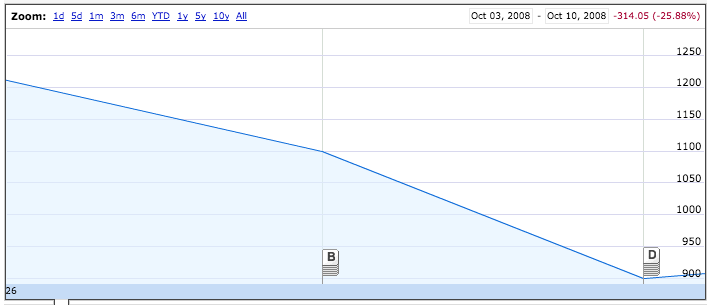
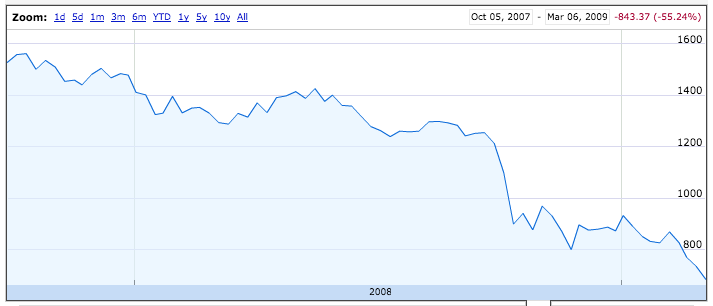
Scary stories. Instead of a horror flick, I read all 240+ posts from an October 2008 Bogleheads thread where a 75-year-old retiree discussed whether or not to cash out some of his portfolio. What happened October 1st to October 8, 2008? The S&P 500 went down 25%. In a week.

sp500_0810

Even if you managed to keep it together then, March 2009 rolled around and you found yourself down over 55% from a little more than a year ago.

sp500_0903b

Scary news articles. On Google Finance, if you look back at historical quotes, they will adjust the “News” box to include articles from that time period. Here’s a few I picked out:

Scary numbers. Here are historical S&P 500 drawdowns from user BlueEars.

1973 down 38% in 21 months (understated because of inflation)
1980 down 27% in 13 months
1990 down 19% in 3 months
2000 down 49% in 31 months (growth bubble, SP500 loaded with it)
2007 down 42% in 12 months to date

Lessons?

  • Know your own tendencies. We did live through 2008/2009, but it felt like a different time. We were barely 30 years old and both employed. We “lost” a six-figure balance but we didn’t need it immediately. We did not sell any stocks and kept up all our automated 401k and IRA contributions. The hardest part was rebalancing, because that required action. Lesson: I tend to freeze and do nothing.
  • Everyone is different. One poster had 33% cash, 33% bonds, 33% stocks and was still in a panic. Others wanted to increase their stock holdings to 90% or higher. Some bought in after the first major drop but then got nervous when it kept dropping.
  • Stocks can drop 50% very quickly. Whatever you have in stocks, imagine it cut in half. Are you okay with that? Are you sure? I think I would be more nervous today given our much larger portfolio size. Therefore, our current asset allocation is more conservative (66% stocks/34% bonds).
  • Cash helps keep you calm. If you don’t need the money for a long time, it’s easier to be detached. However, retirees tend to view investment loses in terms of “years of expenses”. If you usually take out $50,000 a year to cover spending, and then your portfolio drops by $500,000, that’s an entire decade of spending “lost”. Knowing that you already have at least 3-5 years of withdrawals in a safe money bucket can help.

If you are willing to read something longer, I recommend The Great Depression: A Diary. 2008/2009 was bad, but things could have been much worse. It’s easy to not appreciate safe assets when things are going well.

Book Review: A History of Gold in the United States

onenationgold

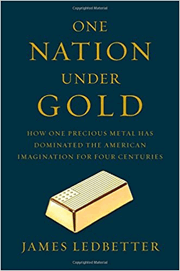
Having been born after 1971, I have never lived in a time when the dollar was backed by gold. In an effort to learn more about the gold standard, I recently finished One Nation Under Gold: How One Precious Metal Has Dominated the American Imagination for Four Centuries by James Ledbetter. In other words, this is a history of gold in America. Here are my overall takeaways:

I always thought that the pre-1971 gold standard meant that for every dollar printed, there was a certain amount of gold set aside in a vault. This turns out to be false. A long time ago, gold coins actually circulated as currency. But the more modern version of a gold standard simply means the government agrees to sell gold bullion on demand at a fixed dollar price (ex. $35 for an ounce of gold).

Under the gold standard, countries rarely had enough gold in their vaults to cover if everyone decided to redeem their currency. As a result, countries including the United States were constantly worried about running out of gold and used various political tricks to prevent too many redemptions. If the fixed ratio was $35 an ounce and people could get the equivalent of $36 an ounce somewhere else, there would be a big spike in demand and the US would have to ship out tons of gold. If the vaults went empty, that could cause a financial crisis. The system was constantly under stress.

Every major currency has ended up being forced off the gold standard, usually in times of severe stress. Wars. International trade deficits. Economic depressions. In 1933, the US government was again running low on gold and so they devalued from $20.67/oz. to $35/oz (a devaluation of over 40%). In addition, they banned domestic individuals from owning gold from 1933-1974. (Hmmm… a gold standard where you couldn’t actually get gold…) In 1971, with both the Vietnam War and ongoing trade deficits, Nixon ended international convertibility of the US dollar to gold.

I’ve read that every fiat currency in history has eventually failed. Well, it’s also true that every gold standard in history has eventually failed. Just a thought that kept running through my head while reading this book. Gold-backed currency has its own set of problems.

Harry Browne: Wise investment mind or paid salesman for gold industry? You may have heard of Harry Browne as the creator the Permanent Portfolio: 25% stocks/25% cash/25% long-term bonds/25% gold. Well, this book mostly mentions Browne as a shady doomsday salesman for the gold industry. He wrote books that promoted a specific gold company (Pacific Coast Coin Exchange) and then got paid $100,000 (~$600,000 in 2017 dollars) by that company. That’s not all… The SEC shut down PCCE for having no actual gold in vaults and instead buying things like private jets with the money. Here is a 1974 NY Times article about the company.

The chance that the US goes back on a gold standard is very, very, very small. The gold standard did restrict governmental power, and some people like the sound of that. However, governments like having the ability to expand and contract the money supply to overcome stressful events like war and economic recessions. Will they wield that power wisely and effectively? Mistakes will be made, but I don’t see how they will voluntarily give up that flexibility. The question is not whether fiat currency is perfect, it is about which is better amongst imperfect options.

In the end, perhaps it is better that there is an open market for gold. Today, individuals can exchange gold for dollars and dollars for gold whenever they want. Gold ETFs let you buy gold with few clicks and lower transactional costs than physical gold. If you like market-cap weighting, consider a 1% gold portfolio.

I’m not a history buff in general, and perhaps that is why I found this book rather dry and hard to finish. There is no flowing narrative like a Michael Lewis book. However, I felt like I did learn some useful lessons and I’m glad I finished it.

Morningstar Star Ratings, Still Less Useful Than Expense Ratios

jeapordy_shadeFor investment nerds, the recent Wall Street Journal article The Morningstar Mirage was high drama. The subtitle got straight to the point:
Investors everywhere think a 5-star rating from Morningstar means a mutual fund will be a top performer—it doesn’t.

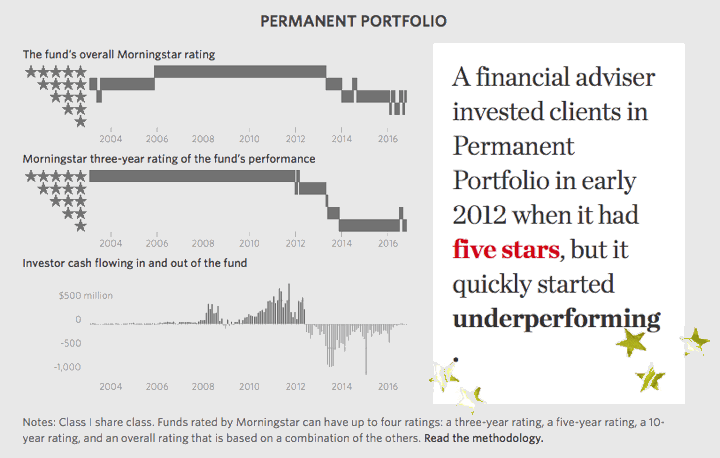
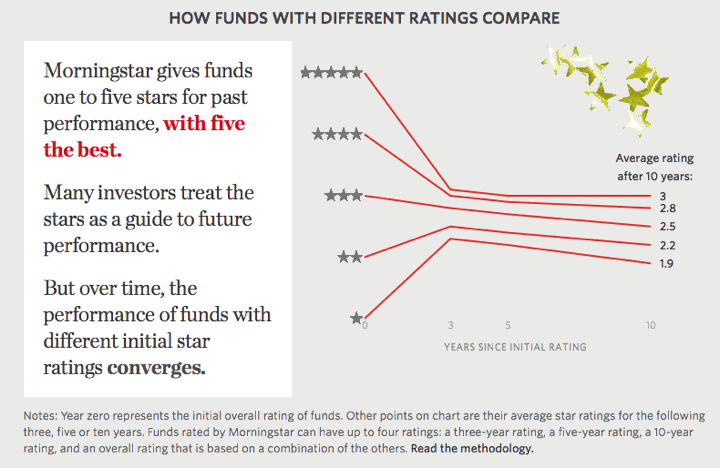
Morningstar ratings mainly reflect past performance. However, something called “mean reversion” usually happens. If a fund has done well recently, it will have a high rating. But it usually doesn’t stick. The WSJ has a good visual:

wsj_mstar1

This quote is spot on: “Morningstar’s star ratings for funds are clearly used in the industry to imply that funds that performed well in the past will do so in the future.” Check out the fund flows into the Permanent Portfolio Fund when they were 5-star. Just a couple years later, chheck out the fund flows out when they drop to 1-star.

wsj_mstar2

Morningstar responded with Setting the Record Straight on Our Fund Ratings, which in my opinion just repeated the top graphic above. People think the left part will hold. Reality is the right part.

The Journal’s analysis found that most five-star funds perform somewhat better than lower-rated ones, yet on the average, five-star funds eventually turn into merely ordinary performers.

More importantly, something was conspicuously missing from this rebuttal…

Expense ratios are a more dependable predictor of performance. Source: Morningstar. Back in 2010, Russell Kinnell of M* had what the NY Times called “an act of radical and admirable transparency” in his article How Expense Ratios and Star Ratings Predict Success. Here’s my 2010 post about it.

If there’s anything in the whole world of mutual funds that you can take to the bank, it’s that expense ratios help you make a better decision. In every single time period and data point tested, low-cost funds beat high-cost funds. […] Investors should make expense ratios a primary test in fund selection. They are still the most dependable predictor of performance.

Smart investors know about this article. Morningstar executives choose not to mention it. Why would they? They charge fund companies $10,000 a pop to brag about their 5-star ratings in ads.

This is where my pragmatic side kicks in. I like Morningstar overall. I’m glad they exist. You just have to pick what you consume carefully.

  • Morningstar creates a lot of high-quality, free stuff for DIY investors. They have great free data, some nice tools, and many helpful articles from knowledgable authors. I link to them regularly. I talk about star ratings never.
  • People love star ratings systems. There’s a reason why you see stars on every Amazon product page. Most people don’t want to filter out everything themselves. They want the feeling that some fancy algorithm has hand-picked the best funds for them. They want easy.
  • Financial advisors love star ratings systems. If the financial advisor makes a pick and it goes bad, then whose fault is it? Not mine, I followed the rating system and followed the experts! Financial advisors are incentivized to stay close to the pack, as if they stick out in the wrong way, they will get fired. This is known as minimizing career risk.
  • This is not a perfect analogy, but Morningstar is kind of like Whole Foods. You could make some great food at decent prices using their raw ingredients and 365 product line. But 1/3rd of the store is prepared foods, and the most popular are stuff like pizza, sushi, mac & cheese, chicken nuggets, and chicken wings. Why do they sell these things? It is what the customer wants, and they are a for-profit corporation.

10 years from now, I predict that the system will be exactly the same. Morningstar wants to keep it, most clients want to keep it, and the financial advisors want to keep it. Morningstar stock plunged when the WSJ story broke, but recently bounced back up. I suspect people came to the same conclusion as I did.

Bottom line. The WSJ article reminds us of an important lesson. Morningstar “5-star ratings” are simply markers of past performance. Reversion to the mean usually happens. Consider long-term past performance as one factor amongst many, but don’t chase 5-star funds. Expense ratios are a better predictor of future returns than M* star ratings. If anything, simply avoid 1-star funds.

Early Retirement Income Update 2017 Q3: Do I Have Enough Yet?

dividendmono225

How do you know when you portfolio is enough to retire on? You have to figure out a withdrawal strategy first. This is a tricky question and full of worries about running out of money. You could take out a fixed amount (i.e. $50,000 a year). You could take out a fixed percentage (i.e. 4% a year). You can adjust for inflation. You can implement upper or lower guardrails.

Personally, I appreciate the behavioral reasons why living off income while keeping your ownership stake is desirable. The analogy I fall back on is owning a rental property. If you are reliably getting rent checks that increase with inflation, you can sit back calmly and ignore what the house might sell for on the open market.

I’ve also come to feel that dividend yield can be a quick-and-dirty way to adjust your withdrawal rate for valuation. For example, if the price of S&P 500 index goes up while the dividend payout stays the same, then wouldn’t it be prudent to simply spend the same amount? Check out the historical S&P 500 dividend yield via Multpl. Focus the last 20 years – the yield was highest in the 2008 crash and lowest in the 2000 tech bubble.

sp500dy_1710

Now check out the absolute dividend amount (inflation-adjusted), also via Multpl:

sp500d_1710

Note that if you only buy “high-yield” stocks and “high-yield” bonds, that actually increases the chance that those yields will drop sooner or later. I am trying to reach some sort of balance where I spend the income on a “total return” portfolio.

Even the venerable Jack Bogle advocated something similar in his early books in investing. He suggested owning the Vanguard Value Index fund and spending only the dividends as way to fund retirement.

One simple way to see how much income (dividends and interest) your portfolio is generating is to take the “TTM Yield” or “12 Mo. Yield” from Morningstar (linked below). Trailing 12 Month Yield is the sum of a fund’s total trailing 12-month interest and dividend payments divided by the last month’s ending share price (NAV) plus any capital gains distributed over the same period. SEC yield is another alternative, but I like TTM because it is based on actual distributions (SEC vs. TTM yield article).

Below is a very close approximation of my most recent portfolio update. My current target asset allocation is 66% stocks and 34% bonds, and intend that to be my permanent allocation upon early retirement.

Asset Class / Fund % of Portfolio Trailing 12-Month Yield (Taken 10/23/17) Yield Contribution
US Total Stock
Vanguard Total Stock Market Fund (VTI, VTSAX)
25% 1.85% 0.46%
US Small Value
Vanguard Small-Cap Value ETF (VBR)
5% 1.81% 0.09%
International Total Stock
Vanguard Total International Stock Market Fund (VXUS, VTIAX)
25% 2.57% 0.64%
Emerging Markets
Vanguard Emerging Markets ETF (VWO)
5% 2.34% 0.12%
US Real Estate
Vanguard REIT Index Fund (VNQ, VGSLX)
6% 3.90% 0.23%
Intermediate-Term High Quality Bonds
Vanguard Intermediate-Term Tax-Exempt Fund (VWIUX)
17% 2.81% 0.48%
Inflation-Linked Treasury Bonds
Vanguard Inflation-Protected Securities Fund (VAIPX)
17% 2.99% 0.51%
Totals 100% 2.53%


If I had a $1,000,000 portfolio balance today, a 2.5% yield means that it would have generated $25,000 in interest and dividends over the last 12 months. (The muni bond interest in my portfolio is exempt from federal income taxes.) Some comparison numbers (taken 10/23/2017):

  • Vanguard LifeStrategy Moderate Growth Fund (VSMGX) is a low-cost, passive 60/40 fund that has a trailing 12-month yield of 2.06%.
  • Vanguard Wellington Fund is a low-cost active 65/35 fund that has a trailing 12-month yield of 2.48%.

These income yield numbers are significantly lower than the 4% withdrawal rate often quoted for 65-year-old retirees with 30-year spending horizons, and is even lower than the 3% withdrawal rate that I usually use as a rough benchmark. If I use 3%, my theoretical income would cover my projected annual expenses. If I used the actual numbers above, I am close but still short. Most people won’t want to use this number because it is a very small number. However, I like it for the following reasons:

  • Tracking dividends and interest income is less volatile and stressful than tracking market prices.
  • Dividend yields adjust roughly for stock market valuations (if prices are high, dividend yield is probably down).
  • Bond yields adjust roughly for interest rates (low interest rates now, probably low bond returns in future).
  • With 2/3rds of my portfolio in stocks, I have confidence that over time the income will increase with inflation.

I will admit that planning on spending only 2% is most likely too conservative. Consider that if all your portfolio did was keep up with inflation each year (0% real returns), you could still spend 2% a year for 50 years. But as an aspiring early retiree with hopefully 40+ years ahead of me, I like that this method adapts to the volatility of stock returns and the associated sequence of returns risk.

Early Retirement Portfolio Asset Allocation, 2017 Third Quarter Update

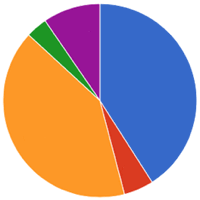
portpie_blank200

Here is an update on my investment portfolio holdings after the third quarter 2017. This includes tax-deferred 401k/403b/IRAs and taxable brokerage holdings, but excludes things like our primary home, cash reserves, and a few other side investments. The purpose of this portfolio is to create enough income to cover our regular household expenses.

Target Asset Allocation. The overall goal is to include asset classes that will provide long-term returns above inflation, distribute income via dividends and interest, and finally offer some historical tendencies to balance each other out. I don’t hold commodities futures or gold as they don’t provide any income and I don’t believe they’ll outpace inflation significantly. I also try to imagine each asset class doing poorly for a long time, and only hold the ones where I think I can maintain faith.

Stocks Breakdown

  • 38% US Total Market
  • 7% US Small-Cap Value
  • 38% International Total Market
  • 7% Emerging Markets
  • 10% US Real Estate (REIT)

Bonds Breakdown

  • 50% High-quality, Intermediate-Term Bonds
  • 50% US Treasury Inflation-Protected Bonds

I have settled into a long-term target ratio is 67% stocks and 33% bonds (2:1 ratio) within our investment strategy of buy, hold, and rebalance. With a self-managed, simple portfolio of low-cost funds, we minimize management fees, commissions, and income taxes.

Actual Asset Allocation and Holdings

aa_portpie_1710

Stock Holdings
Vanguard Total Stock Market Fund (VTI, VTSMX, VTSAX)
Vanguard Total International Stock Market Fund (VXUS, VGTSX, VTIAX)
WisdomTree SmallCap Dividend ETF (DES)
WisdomTree Emerging Markets SmallCap Dividend ETF (DGS)
Vanguard Small Value ETF (VBR)
Vanguard Emerging Markets ETF (VWO)
Vanguard REIT Index Fund (VNQ, VGSIX, VGSLX)

Bond Holdings
Vanguard Limited-Term Tax-Exempt Fund (VMLTX, VMLUX)
Vanguard Intermediate-Term Tax-Exempt Fund (VWITX, VWIUX)
Vanguard High-Yield Tax-Exempt Fund (VWAHX, VWALX)
Vanguard Inflation-Protected Securities Fund (VIPSX, VAIPX)
iShares Barclays TIPS Bond ETF (TIP)
Individual TIPS securities
U.S. Savings Bonds (Series I)

Performance and commentary. According to Personal Capital, which aggregates all of my investment holdings across different accounts, my portfolio has gained 7.41% over the last 6 months since my last update. In the same time period, the S&P 500 has gained 9.21% (excluding dividends) and the US Aggregate bond index has gained 1.34%.

pcport_1710

Things are currently at 69% stocks/31% bonds. For the most part, I continue to invest new money on a monthly basis in order to try and maintain the target ratios. Once a quarter, I also reinvest any accumulated dividends and interest. I don’t use automatic dividend reinvestment. This way, I can usually avoid creating any taxable transactions unless markets are really volatile.

For both simplicity and cost reasons, I am no longer buying DES/DGS and will be phasing them out whenever there are tax-loss harvesting opportunities. New money is going into the more “vanilla” Vanguard versions: Vanguard Small Value ETF (VBR) and Vanguard Emerging Markets ETF (VWO).

I’m still somewhat underweight in TIPS and REITs mostly due to limited tax-deferred space as I don’t want to hold them in a taxable account. My taxable muni bonds are split roughly evenly between the three Vanguard muni funds with an average duration of 4.5 years. I may start switching back to US Treasuries if my income tax rate changes signficantly.

In a separate post, I will track dividend and interest income.

Housing Has Higher Long-Term Returns Than Stocks?

housemoneyI finally got around to reading an academic paper that looked a bit dry but had a great title: The Rate of Return on Everything, 1870–2015 [pdf] by Jorda, Knoll, Kuvshinov, Schularick, and Taylor. I wonder which of the authors came up with that.

One of the major findings that was residential housing – when you add up the returns from both price change and imputed rent – had a higher overall average return than stocks (equities). Not only did housing have higher returns, but it also had lower volatility (standard deviation). Here’s a chart that compares housing and equities:

jorda1b

When the paper was released, places like the Financial Times discussed the paper’s conclusions but none of them addressed my two immediate questions.

Did they account for the maintenance and management costs of rental real estate? If you own a rental property, you may still have to pay for lawn maintenance, replacing roofs, HVAC units, interior and exterior painting, replacing carpets, and various other issues. To be fairly compared with equities, you should also account for property management costs. Here’s are excerpts that deal with maintenance and repairs:

To the best of the authors’ knowledge, this study is the first to present long-run returns on residential real estate. We combine the long-run house price series presented by Knoll, Schularick, and Steger (2016) with a novel dataset on rents from Knoll (2016). For most countries, the rent series rely on the rent components of the cost of living of consumer price indices as constructed by national statistical offices and combines them with information from other sources to create long-run series reaching back to the late 19th century.

A number of additional issues have to be considered when constructing returns on housing. First, any homeowner incurs costs for maintenance and repairs which lower the rental yield and thus the effective return on housing. We deal with this issue by the choice of the benchmark rent-price ratios. Specifically, in the Investment Property Database (IPD) the rental yields reflect net income (i.e., net of property management costs, ground rent, and other irrecoverable expenditure) received for residential real estate as percentage of the capital employed.

Did they account for the annual property taxes required on residential real estate? In many US states, the annual property tax bill can exceed 1% of the value of the house. Some are closer to 2% annually, and these are owner-occupied numbers. Rental properties may be higher. That’s on top of any potential capital gains you’d owe upon sale of the house, and any taxes you’d owe on rent received. Here’s are excerpts that deal with taxes:

Although the extent of real estate taxation varies widely across countries, real estate is taxed nearly everywhere in the developed world. International comparisons of housing taxation levels are, however, difficult since tax laws, tax rates, assessment rules vary over time and within countries. Typically, real estate is subject to four different kinds of taxes. First, in most countries, transfer taxes or stamp duties are levied when real estate is purchased. Second, in some cases capital gains from property sales are taxed. Often, the tax rates depend on the holding period. Third, income taxes typically also apply to rental income. Fourth, owners’ of real estate may be subject to property taxes and/or wealth taxes where the tax is based upon the (assessed) value of the property.
This section briefly describes the current property tax regimes by country and provides estimates of the tax impact on real estate returns.

With few exceptions, the tax impact on real estate returns can be considered to be less than 1 percentage point per annum.

This is an interesting paper that tries to cover a huge amount of stuff. Estimating the return of all businesses from all countries for the last 150 years? Estimating the return of all residential real estate from all countries for the last 150 years? They mix together a bunch of different datasets, so it’s hard to know exactly the quality level of each and how well they accounted for things like taxes and maintenance.

I’m not sure why they prefer to use arithmetic averages instead of geometric averages, but even if you shave off 1% for additional property taxes and another 1% because you don’t think they account for maintenance costs adequately, housing returns are still at least comparable to equity returns.

Here is the most recent update of the Case/Shiller home price index from Multpl, which tracks US housing prices on an inflation-adjusted basis:

shiller1890

Some people use this to argue that housing returns only keep up with inflation, but home prices ignore the value of rent. The fact that most housing purchases involve a mortgage loan does complicate things a bit.

Bottom line. An interesting paper that compares the long-term returns (last 150 years!) of residential housing and equities. In the long run, some may be surprised that residential housing returns at least matched equity returns, and housing returns had lower volatility. This is a reminder that you can also build wealth via residential real estate, taking into account that rent makes up half of the total return. Stocks are not the only game in town. (Just like with stocks, can is not the same as will.) New services like AirBNB provide an alternate path to monetize residential real estate.