
While I understand the arguments for a “total return” approach, I also appreciate the behavioral reasons why living off income while keeping your ownership stake is desirable. The analogy I fall back on is owning an investment property that produces rental income. If you are reliably getting rent checks that increase with inflation, you can sit back calmly and let the market value fluctuate. The problem is that buy only things with the highest yields only increases the chance that those yields will drop. Therefore, I am trying to reach some sort of balance between the two approaches.
A quick and dirty way to see how much income (dividends and interest) your portfolio is generating is to take the “TTM Yield” or “12 Mo. Yield” from Morningstar (linked below). Trailing 12 Month Yield is the sum of a fund’s total trailing 12-month interest and dividend payments divided by the last month’s ending share price (NAV) plus any capital gains distributed over the same period. SEC yield is another alternative, but I like TTM because it is based on actual distributions (SEC vs. TTM yield article).
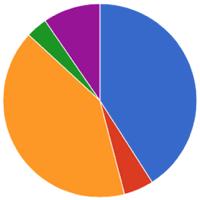
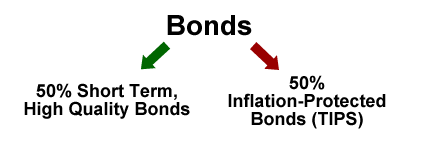
Below is a close approximation of my most recent portfolio update. I have changed my asset allocation slightly to 65% stocks and 35% bonds because I believe that will be my permanent allocation upon early retirement.
| Asset Class / Fund | % of Portfolio | Trailing 12-Month Yield (Taken 4/19/17) | Yield Contribution |
| US Total Stock Vanguard Total Stock Market Fund (VTI, VTSAX) |
25% | 1.88% | 0.47% |
| US Small Value Vanguard Small-Cap Value ETF (VBR) |
5% | 1.83% | 0.09% |
| International Total Stock Vanguard Total International Stock Market Fund (VXUS, VTIAX) |
25% | 2.75% | 0.69% |
| Emerging Markets Vanguard Emerging Markets ETF (VWO) |
5% | 2.31% | 0.12% |
| US Real Estate Vanguard REIT Index Fund (VNQ, VGSLX) |
6% | 4.42% | 0.27% |
| Intermediate-Term High Quality Bonds Vanguard Intermediate-Term Tax-Exempt Fund (VWIUX) |
17% | 2.87% | 0.49% |
| Inflation-Linked Treasury Bonds Vanguard Inflation-Protected Securities Fund (VAIPX) |
17% | 2.20% | 0.37% |
| Totals | 100% | 2.50% |
The total weighted 12-month yield on this portfolio has historically varied between 2% and 2.5%. This time, it was on the higher end of 2.50% mostly because inflation has picked up and thus the TIPS fund started to yield more. If I had a $1,000,000 portfolio balance today, a 2.5% yield means that it would have generated $25,000 in interest and dividends over the last 12 months. (The muni bond interest in my portfolio is exempt from federal income taxes.)
For comparison, the Vanguard LifeStrategy Moderate Growth Fund (VSMGX) is a low-cost, passive 60/40 fund that has a trailing 12-month yield of 2.12%. The Vanguard Wellington Fund is a low-cost active 65/35 fund that has a trailing 12-month yield of 2.55%. Numbers taken 4/19/2017.
These income yield numbers are significantly lower than the 4% withdrawal rate often quoted for 65-year-old retirees with 30-year spending horizons, and is even lower than the 3% withdrawal rate that I usually use as a rough benchmark. If I use 3%, my theoretical income would cover my projected annual expenses. If I used the actual numbers above, I am close but still short. Most people won’t want to use this number because it is a very small number. However, I like it for the following reasons:
- Tracking dividends and interest income is less stressful than tracking market price movements.
- Dividend yields adjust roughly for stock market valuations (if prices are high, dividend yield is probably down).
- Bond yields adjust roughly for interest rates (low interest rates now, probably low bond returns in future).
- With 2/3rds of my portfolio in stocks, I have confidence that over time the income will increase with inflation.
I will admit that planning on spending only 2% is most likely too conservative. Consider that if all your portfolio did was keep up with inflation each year (0% real returns), you could still spend 2% a year for 50 years. But as an aspiring early retiree with hopefully 40+ years ahead of me, I like having safe numbers given the volatility of stock returns and the associated sequence of returns risk.

 Updated. Automated portfolio management services like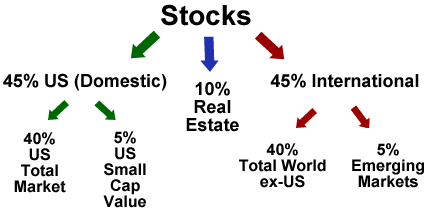
 As we stand today in early 2017, the performance of the US stock market since 2009 has been pretty impressive with only a few minor hiccups. I am not calling a market drop, but the best time to prepare is before an emergency or crisis occurs. Humans have a well-documented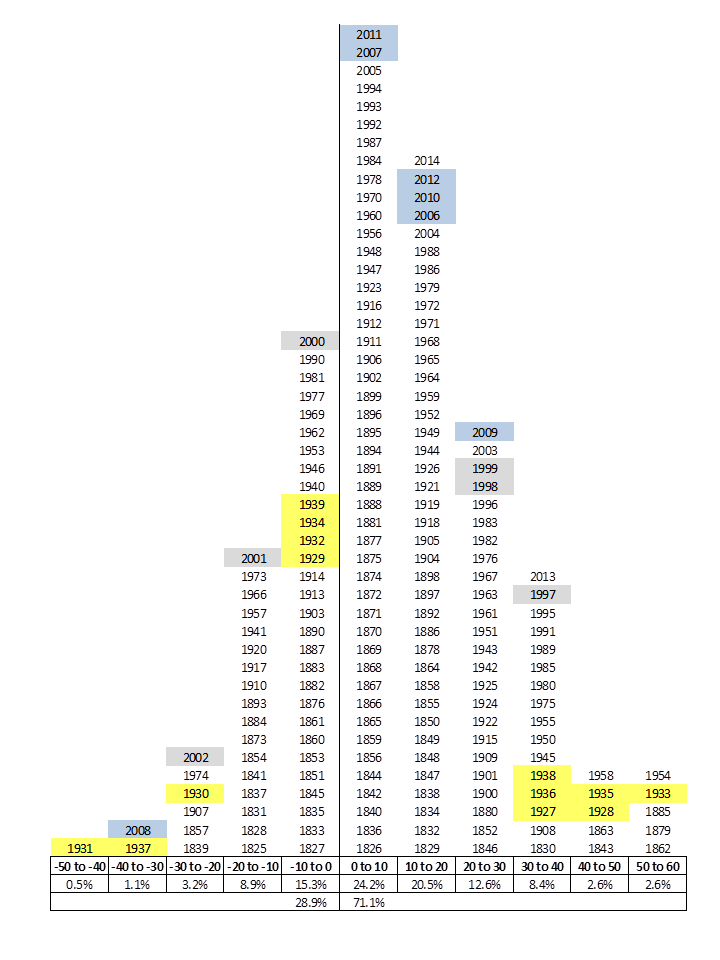

 Do you recommend


 Fidelity Investments has a few different bonuses if you transfer a certain levels of new assets over to them. These are handy if you want to move money out of an old 401(k) plan or are looking to try out a new broker. Besides a cash deposit, you can also do an in-kind transfer and move over your existing investments without incurring any capital gains. Please note that for some you must register soon by March 31st, 2017. You can register now and still have 60 days to move over assets.


 Allan Roth has a new ETF.com article called
  Institutional Investor has an
  The Best Credit Card Bonus Offers – 2026
 Big List of Free Stocks from Brokerage Apps
 Best Interest Rates on Cash - 2026
 Free Credit Scores x 3 + Free Credit Monitoring
 Best No Fee 0% APR Balance Transfer Offers
 Little-Known Cellular Data Plans That Can Save Big Money
 How To Haggle Your Cable or Direct TV Bill
 Big List of Free Consumer Data Reports (Credit, Rent, Work)