The Vanguard Blog for Advisors has a recent post about how we’re now in the 3rd biggest bull market since 1929, which followed the 2008 financial crisis, also known as the 3rd biggest bear market since 1929. The takeaway is that none of us know the future, so advisors need to convince their clients to rebalance their portfolios both in good times and bad.
Remember, rebalancing is not about maximizing returns, reversion to the mean, or market forecasts—it is about maintaining the risk-and-return characteristics of the portfolio an investor selected based on his or her unique time horizon, risk tolerance, and financial goals. In contrast to market predictions, rebalancing is within your clients’ control.
That’s all well and good, but included was this curious chart with the title “Rebalancing: Asset allocations show trend following”:

This chart confuses me. I assume it is supposed to show that when stocks go up, people buy more stocks and when stocks go down, people sell off their stock allocations. But if for every trade there is both a buyer and a seller, then who is taking the other side of all these trades? For instance, if everyone is buying stocks now, who are they buying it from? Is this only retail investors and the other buyers are institutional investors? Or is this chart mostly just showing changes in overall market-cap?


 I’m not sure exactly what details of this investment I am allowed to share, so I’ll save that part for later. It will be good for you guys to pick apart, but it doesn’t really matter for other investors as the project is already 100% funded. I’m just waiting on my first interest payment in May, and hope to be done by October. At the end of the year I will get a 1099-INT.

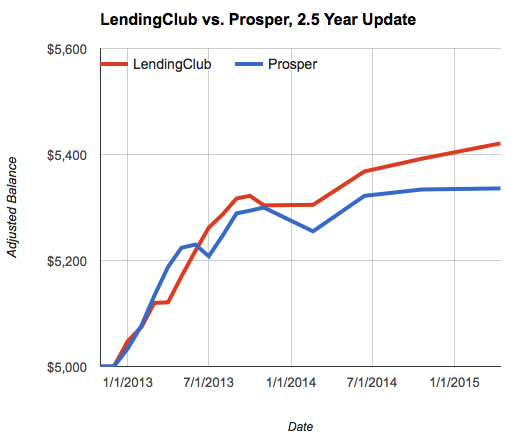
 In November 2012, I invested $10,000 into person-to-person loans split evenly between


 Automated portfolio managers like Betterment will set you up with a diversified mix of index funds and manage it for you for a small fee. I’m an investing geek, so I always lean towards keeping the small fee and manage things myself. But an important variable to this equation is tax-loss harvesting (TLH). Tax-loss harvesting tries to improve your returns by minimizing your tax bill, but it is also tedious work that is ideally suited to handing over to a computer.
 Here’s a reader question that arrived this week:
 Many people feel more comfortable with someone else helping them with their finances. A common piece of advice these days is to find a fee-only advisor that doesn’t work on commission. Many times this leads to a recommendation of the National Association of Personal Financial Advisors (NAPFA), whose members must promise to be fee-only and act in a fiduciary manner (putting your interests first). They are regularly mentioned in Kiplinger’s magazine, and I’ve even referred a few readers to their website myself. You’d think that putting your money with the president of NAPFA would be a sound idea, right?
 Here’s another data point on the debate on how often to rebalance your portfolio to your target asset allocation.

 Quick question – What was the highest value ever for your investment portfolio? Now, what was the value exactly a year before that? You probably know the answer to the first question, but not the second, even though both have little to do with your final portfolio value.
 The Best Credit Card Bonus Offers – 2026
 Big List of Free Stocks from Brokerage Apps
 Best Interest Rates on Cash - 2026
 Free Credit Scores x 3 + Free Credit Monitoring
 Best No Fee 0% APR Balance Transfer Offers
 Little-Known Cellular Data Plans That Can Save Big Money
 How To Haggle Your Cable or Direct TV Bill
 Big List of Free Consumer Data Reports (Credit, Rent, Work)