Monthly Financial Status / Net Worth Update (June 2009)

Net Worth Chart 2009

Credit Card Debt
In the past, I have taken money from credit cards at 0% APR and placed it into online savings accounts or similar safe investments that earn 4-5% interest or more, and keeping the difference as profit. I even put together a series of step-by-step posts on how to make money off of credit cards in this way. However, given the current lack of great no fee 0% APR balance transfer offers, I am have not been as active in this “game” recently. My credit score remains high enough that I haven’t seen any negative actions.

Retirement and Brokerage accounts
Markets went up, although as usual I don’t know why. I’ve been swearing off CNBC so I’m especially detached from all the buzz. Most of our retirement accounts rose about 10% the last month, which was over a $10,000 gain. I actually wish it stayed down so I could start investing some of my new cashflow at lower prices. However, waiting for it to drop again is not logical behavior, or so I keep reminding myself…

Cash Savings and Emergency Funds
We did still save a good deal of cash from our income this month, but I shifted about $10,000 of it into my brokerage account so that I can start investing in taxable accounts, which skewed the values above a bit. We still have a year’s worth of expenses in our emergency fund, which always gives me the warm fuzzies.

Home Equity
Using four different internet valuation tools – Zillow, Cyberhomes, Coldwell Banker, and Bank of America (old version) – I took the average and took off 5% to be conservative and 6% for real estate agent commissions. These sites are really wonky. Last month I was actually up, but this month my home’s estimated value dropped over $32,000 in a month. Shrug. I’m lucky that our work situation is doing well and we have no plans on moving.

According to my quick and dirty plan for financial freedom I should start paying extra towards my mortgage, but I’m having a hard time pulling the trigger on this one as well. I feel inflation coming. Should I just invest in stocks, and keep my 5% mortgage as long as possible?

Personal Finance Ratios: Savings-to-Income, Debt-to-Income, and Savings Rate-to-Income

There was a recent post on how much savings one should have at age 30 over at the Bogleheads forum. Being 30 myself, I was intrigued, but I am in the camp that believes that there is no right answer at 30. You’re still so young that you could just be out of school for a few years, and at that time it’s mostly up to how much student loan debt you racked up. Most important might be your ability to live under your means, and that you’re learning a valuable skill of some sort.

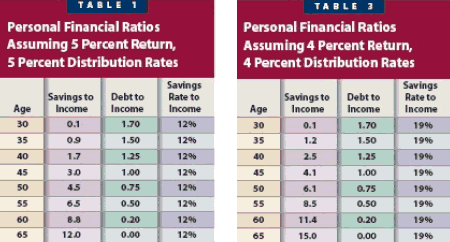
However, there was mention of a paper the the FPA Journal called Personal Financial Ratios: An Elegant Road Map to Financial Health and Retirement, where the author presents a variety of ratios as a rough benchmark to help clients determine whether they are on track to retire by age 65. These include Savings-to-Income, Debt-to-Income, and Savings Rate-to-Income.

The actual numbers depend on how you believe your investments will perform annually after inflation. (5% on the left table, 4% on the right.) Definitions below.

Savings include the current value of one’s investments, such as a 401(k), IRAs, brokerage accounts, investment real estate, and the value of any private business interests. The home is excluded as an investment. Debt comprises all debt, including mortgage, student loans, car, and consumer debt. Savings rate refers to the percentage of pre-tax income an investor is saving each year out of their total income.

A Hypothetical Example
Let’s take a look at a hypothetical 45-year-old individual to see how he might use the ratios to assess his financial circumstances. This person has the following financial statistics:

Salary $110,000
Mortgage $125,000
Auto Loan $25,000
Investments $260,000
Annual Savings $10,000
Employer 401(k) Match $3,000

Based on these statistics, the hypothetical individual ratios are as follows:

Savings to Earnings: $260,000 / $110,000 = 2.36
Debt to Earnings: ($125,000 + $25,000) / $110,000 = 1.36
Savings Rate to Earnings: ($10,000 + $3,000) / $110,000 = 11.8 %

As for us, we’re doing okay according to the table for age 30 regarding the savings-to-income ratios (0.5) and savings rate-to-income ratios (50%+). Our debt-to-income ratio is a bit high though, at around 2. Of course, this is highly dependent on our income number, which might change if we downshift with kids. I guess that’s another reason to wait until we’re a bit older to really start benchmarking like this.

One thing I don’t like about the ratios is that home equity is never included, because the author says that it’s hard to extract home equity. Okay, I agree on that point, but there is no mention of compensating for renters in the analysis. If I have no debt at age 65 + a paid-off house, that’s a lot different than no debt at 65 + still paying rent forever. My largest expense by far is housing (greater than all other expenses combined), and having that taken care of changes my retirement outlook drastically.

So… should we be using these ratios as a benchmark?

Monthly Financial Status / Net Worth Update (May 2009)

Net Worth Chart 2009

Credit Card Debt
In the past, I have taken money from credit cards at 0% APR and placed it into high-yield savings accounts or similar safe investments that earn 4-5% interest or more, and keeping the difference as profit. I even put together a series of step-by-step posts on how to make money off of credit cards in this way. However, given the current lack of great no fee 0% APR balance transfer offers, I am have not been as active in this “game” recently. My credit score remains high enough that I haven’t seen any negative actions.

Retirement and Brokerage accounts
The market rally was sustained during April, so our predominantly passive investment portfolio increased a bit. We contributed another $2,312 in 401(k) salary deferrals this month including company match. See my investment portfolio page for more details.

I get attracted to various different ideas as time passes, but I really haven’t changed my investment portfolio in about two years now. I always need to remind myself to stick to the basics.

Cash Savings and Emergency Funds
Our cash savings rose again, and although I want to keep one year of expenses for our emergency cash reserves, I need to start putting more money to work in the stock market and other investments. It’s just hard to let go of the security of cash right now. We are contemplating whether we want to save up for a rental property.

Home Equity
I used the same internet valuation tools as before – Zillow, Cyberhomes, Coldwell Banker, and Bank of America (old version).

I have zero personal input here, I just average out what the sites say. They say up. The number shown is after an additional 11% reduction to be more conservative. Not that it really matters, as I am primarily focused on paying off the mortgage, as outlined in my quick and dirty plan for financial freedom!

Quick Review of ESPlannerBasic, Free Version of ESPlanner Retirement Planning Calculator

Background
There are an increasing number of sleek but simplistic retirement calculators out there, and most of them are basically the same. You put in your savings rate and overall asset allocation, and it crunches some numbers based on historical market returns to see if you can replace 80-100% of your current income in retirement.

Then there’s ESPlanner, which represents “Economic Security Planner”. It is based on consumption smoothing, an economic theory where the primary goal of financial planning is instead to avoid abrupt changes in one’s standard of living. Here is one graphical explanation:

This method has gotten some extra publicity because it often tells you that you need to save less money as compared to other calculators. However, since the software cost $149, I never really got to try it out. But now, they have released ESPlannerBasic, which is a slightly stripped-down but free version that everyone can tinker with. For example, it assumes that everyone will live to 100 in its computations.

You input various financial information like income and assets, and the calculator will give you a “spending and saving plan” for each of the rest of your life. I think the most important column is savings:

Saving is the recommended increase (reduction) each year in your regular financial assets. This saving is over and above your specified contributions to retirement accounts.

Sample Run of ESPlannerBasic
Let’s take a look at some of our results, using very rough numbers and a retirement goal at age 50. (Sound familiar?) Our “standard of living” has us spending $60,000 per year as a couple forever. During the next few years, we are supposed to save about $75k per year. (I specified zero future retirement contributions for simplicity, it’s all included in the $75k.)

Then at my chosen retirement age of 50, things change fast, with us starting to take large withdrawals from savings:

That’s be scary! Then, at age 65, the calculator assumes that Social Security will kick in, which almost has us at a zero savings rate.

Criticisms and Compliments
My thoughts on this calculator are pretty much in line with my thoughts on consumption smoothing in general.

For starters, I don’t like the idea of a calculator telling me what I should be spending in retirement. I like the idea of constructing this on my own, based on conscious decision making. However, the fact that the calculator chose $60,000 per year is creepy. Beforehand, I had already estimated my non-housing expenses in retirement at $24,000 per year. My housing costs are current about $36,000 per year. Add them up, and you get.. $60,000! Of course, at that rate the mortgage should be paid off after 29 years. Still, just an interesting coincidence?

In addition, the calculator gives very specific results based on what are essentially wild guesses. I have no idea if my income will stay the same, increase, or decrease. I have no idea if Social Security will change the full retirement age to 75, or if benefits will be means-tested. I have no idea what tax rates will be 30 or 40 years from now. So I’d take the results with a big grain of salt.

However, since the calculator is free, I can play with many different scenarios and see how different inputs change the given results, and this may help in my retirement planning. What are the most sensitive factors? I hope to try exploring this next.

Via Bogleheads and WSJ Wallet.

A Quick & Dirty Plan To Reach Financial Freedom

Despite the current financial funk, I still desire financial freedom. The general idea is simple; I need to generate enough income from my assets to pay for my expenses. Here is how I’ve been framing the problem in my mind recently. I’m 30 now, let’s say I want to be “retired” by age 50.

Part 1: Accumulate 30 times annual (non-housing) expenses

There are numerous studies about the “safe withdrawal rate” from a portfolio, and they usually end up at around 3% to 4%. This usually means that with $1,000,000 dollars, you have a high (say 99%) chance of being able to produce $30,000 to $40,000 of income each year plus inflation adjustments for a long period of time (30+ years).

This is the same as saying you need to save 25 to 33 times your annual expenses.. If you’re conservative (or young), I’d go with a higher number, so I picked 30. Multiply your annual expenses by 30. You need that much money to retire. All of these are based on historical numbers, so this is only an estimate.

Right now I’d estimate our annual non-housing expenses at about $24,000 per year ($2,000 per month). Previously I’ve found that we spend about $18,000 per year, but that neglects a few things like health insurance and car deprecation. (Again, health insurance for those that retirement very early and are not healthy might be a bogey.)

$24,000 x 30 = $720,000.

At about $200,000 in non-housing assets right now, that leave me $520k left. Divided by 20 years and assuming no investment return, that would require $25k per year (not inflation-adjusted). At a 3% annual real return, I’d still need to save nearly $20k per year.

Remarks
With this part, you can see the power of frugal living, or the damage done by lifestyle inflation. $500 a month is $6k per year. $6k x 30 = $180,000.

So if I could cut $500 a month in my expenses, I’d need to save $180,000 less. On the other hand, if I grow some bad habits and start spending $500 more a month, I’d need to save $180,000 more. Either way, that’s a big number! This is why I still need to complete my line-by-line examination of expenses.

Part 2: Own my house / Pay off mortgage

I currently have 29 years left on a 30-year fixed mortgage. For us, that would mean another ~$470,000 in mortgage principal, but more when you count in all that interest.

According to this mortgage calculator, if we make one extra monthly payment per year (simulating a bi-weekly acceleration plan), that’d give us about 24 years before we’re done. If I made two extra monthly payments per year, it’d be shaved down to 20 years, which has the house paid off at age 50. Lots of other considerations, but I’m strongly leaning towards it.

Remarks
I know that you could easily roll up “housing” costs into Part 1 above, but I didn’t for a few reasons. For one, housing is one of the few expense areas where you can essentially “buy” all future costs. For example, you can’t pay a lump sum in exchange for all the electricity you’ll consume in your lifetime. Same thing for your grocery bill, or even a car since you’ll have to replace it. But if you own your house, you’ve basically cut out rent forever (just left with maintenance and property taxes). It also reduces the danger of inflation eating up your spending power.

The second reason is lower taxes. Owning your own house not only saves you from have to pay a housing payment, but also keeps you from having to earn the gross income needed to generate that after-tax amount. Ignoring house, I saw above that I only need to generate $24,000 of income per year total. The income taxes on that amount is very, very small. Using current numbers it might be less than 5% overall, with my marginal tax bracket at a mere 10% after taking out the personal exemptions and standard deductions.

But if I need to generate another $24,000 of income to cover housing ($2k per month in rent), then that additional $24k would be taxed at much higher rate of 15%. With state tax, the difference might be another 5%.

Try out this method with your own numbers, and see what happens. When I run the numbers like this, I know that I could retire much earlier if I moved to a cheaper place upon retirement. But is it worth it? It’s all about priorities…

April 2009 Financial Status / Net Worth Update

Net Worth Chart 2009

Finally a bit of green!

Credit Card Debt
For newer readers, don’t worry. In the past, I have been taking money from credit cards at 0% APR and immediately placing it into high-yield savings accounts or similar safe investments that earn 5% interest or more, and keeping the difference as profit. I even put together a series of step-by-step posts on how to make money off of credit cards this way. However, given the current lack of good no fee 0% APR balance transfer offers, I am just waiting to pay off my existing balances.

Retirement and Brokerage accounts
March was a rebound month for the stock market, and our balances went up accordingly. We contributed $10,000 into IRAs, and $12,969 in 401(k) salary deferral and company match. A chunk of that was a true-up contribution from 2008. Score! See my 2009 Q1 portfolio update for more details.

Cash Savings and Emergency Funds
Our cash savings did drop due to the IRA contributions, but we still have over a years worth of expenses set aside. I want to keep one year of expenses for our emergency fund, and start looking for places to invest the rest.

Home Equity
I used the same internet valuation tools as before – Zillow, Cyberhomes, Coldwell Banker, and Bank of America (old version). The magical elves have decided that my home is worth a tiny bit more this month. The number shown is after another 11% reduction to be more conservative.

It’s been about a year that I’ve had this mortgage, and I am wondering if I should commit some cash towards paying down the mortgage principal too. If I make an extra mortgage payment each year, I replicate a biweekly accelerated payment plan, and can shave around 5 years off my 30-year mortgage.

2009 Q1 Investment Portfolio Update – April 6th, 2009

2009 Q1 Portfolio Breakdown
 
Retirement Portfolio Actual Target
Asset Class / Fund % %
Broad US Stock Market 32.2% 34%
VTSMX – Vanguard Total Stock Market Index Fund
DISFX – Diversified Stock Index Institutional Fund*
FSEMX – Fidelity Spartan Extended Market Index Fund*
US Small-Cap Value 8.7% 8.9%
VISVX – Vanguard Small Cap Value Index Fund
Real Estate (REITs) 8.7% 8.5%
VGSIX – Vanguard REIT Index Fund
Broad International Developed 23.8% 25.5%
FSIIX – Fidelity Spartan International Index Fund*
International Emerging Markets 12.1% 8.5%
VEIEX – Vanguard Emerging Markets Stock Index Fund
Bonds – Short-Term 3.7% 3.8%
VFISX – Vanguard Short-Term Treasury Fund
Bonds – Inflation-Indexed 10.8% 11.3%
VIPSX – Vanguard Inflation-Protected Securities Fund
Total Portfolio Value $120,016
* denotes 401(k) holding given limited investment options.

2009 is already over one-fourth over, so I think it’s a good time to check on the ole’ battered portfolio.

Contribution Details
In early 2009, we each made a $5,000 contribution towards our non-deductible IRAs for the 2008 tax year, for a total of $10,000. We have also contributed $12,969 so far into our 401ks through regular salary deferrals and the company match. We haven’t made any after-tax investments in our portfolio yet.

YTD Performance
According to my spreadsheet, the 2009 year-to-date time-weighted performance of our personal portfolio is -15.5% YTD.

For reference, the Vanguard S&P 500 Fund has returned -6% YTD, their FTSE All World Ex-US fund has returned –6.36% YTD, and their Total Bond Index fund is -0.13% YTD as of 12/8/08. The Vanguard Target 2045 Fund has returned -4.70% YTD. Part of the poor relative performance is probably due to the timing of my large lump-sum investments.

Investment Changes
We have used our new contributions to bring us closer to our asset allocation target, with a 85% stocks/15% bonds split.

You can view all my previous portfolio snapshots here.

Brightscope: How Does Your Company’s 401k Plan Compare?

Even though most people I know are too scared to even look at their 401(k) statements right now, have you ever thought about how well your company’s plan stacks up to other similar companies? The problem is that 401(k) plans lack transparency. What if every company had to publish their company match, fees, revenue sharing (*cough* kickbacks), investment choices, and vesting schedules? That would certainly produce competition and peer pressure to make better plans.

This is what the website Brightscope is trying to change. Just type in your company name and see an overall rating based on the components I listed above, also some other interesting details like average account balance. As they point out, a poorly designed plan could be costing you hundreds of thousands of dollars over time – or put another way the equivalent of an extra decade of work!

According to their site, BrightScope is the only 401k analytics firm that is truly independent and does not accept compensation in the form of revenue sharing from mutual fund companies or plan providers. This should make them objective. Found via Capital Ideas.

A related site is 401khelp.com, which covers less companies but does offer more insights and opinions on the plans it does cover. Not sure how often it is updated, though.

March 2009 Financial Status / Net Worth Update

Net Worth Chart 2009

Time for another super-happy-fun net worth update…

Credit Card Debt
For newer readers, don’t worry. In the past, I have been taking money from credit cards at 0% APR and immediately placing it into high-yield savings accounts or similar safe investments that earn 5% interest or more, and keeping the difference as profit. I even put together a series of step-by-step posts on how to make money off of credit cards this way. However, given the current lack of good no fee 0% APR balance transfer offers, I am just waiting to pay off my existing balances.

Retirement and Brokerage accounts
Unless you’ve been completely devoid of human contact for the last few weeks, you know the market is in the dumps. I really don’t have much market commentary to make, besides the fact that I still intend to keep investing. I’ve been trying to cut back on the CNN/CNBC-types of financial news actually and focus more on things I can change, which as a result has helped keep me a bit more optimistic.

Cash Savings and Emergency Funds
Our emergency fund has increased a bit, but this snapshot was taken before we each put $5,000 into our 2008 IRA contribution. So really it remains at about a year of our current expenses.

Home Equity
This is where most of this month’s drop comes from. I used the same internet valuation tools as before – Zillow, Cyberhomes, Coldwell Banker, and Bank of America (old version) – but while most of them continued their gradual decline, the Coldwell Banker estimate dropped by over $140,000 in one month! After taking off 5% to be conservative and 6% for expected real estate agent commissions (11% total), the overall average estimate dropped by $34k. Well look at that, I am nearly “underwater” on my house despite putting 20% down a year ago. Oops.

2008/2009 NonDeductible IRA Contribution Decisions

With the market in another funk this week, I was reminded that I had until April 15th to make my IRA contributions for 2008. It could get worse before then, or it might bounce up again, I have no predictive powers either way. I don’t like to be wishy-washy, so we went ahead and each invested $5,000 to a non-deductible IRA today.

Background
A nondeductible IRA is the same as a Traditional IRA, except that your income is too high so you can’t deduct the contribution. If you haven’t maxed out all your other options like a deductible Traditional IRA, Roth IRA, 401(k), or 403(b) plan, you should put your money towards those first. This option is mostly for those with no other better options.

Why?
So if you don’t get the tax deduction, what’s the point? The most appealing is that in 2010, unless the law is changed, you can start rolling over your non-deductible IRA into a Roth IRA with no income restrictions. I am starting to like my chances, since we are only ten months away from 2010 (I plan to convert right away) and I’m sure with the current deficit the government would like to collect all the tax revenue it can now instead of later. If it looks good, I’ll probably make my 2009 contribution in December (after making sure we don’t otherwise qualify) and convert that to a Roth too.

The second reason is that the after-tax returns might be higher if you invested in tax-inefficient products like bonds, commodities, or REITs.

Contribution Limits
The contribution limits are $5,000 for both 2008 and 2009. If you are age 50 or older, you can contribute another $1,000 that year.

What Did I Buy?
My portfolio is getting out of whack right now, so I bought what I need to bring it back into my desired asset allocation. I purchased $3,000 of an REIT fund (VGSIX), $2,000 of a US Small Value fund (VISVX), and $5,000 of an Emerging Market fund (VEIEX). We’re still making regular contributions to our 401ks, which contain our US and International “Total Market” funds.

401(k) Failures: Over Last 20 Years, The Average Investor Did Worse Than Cash

These days, not too many people are singing the praises of their 401(k) plans. They have been called failures, with many having hidden fees and poor investment choices. But I was reading a Scott Burns article that had an different take on things: 401(k) plans are a miserable failure because most of us make bad choices.

Here the evidence: For the 20-year period from 1988-2007, the S&P 500 had annualized returns of 11.81%, while investment-grade bonds returned 7.56%. But what did the average mutual fund investor return? Only 4.48 percent. That’s worse than super-safe Treasury bills, which managed 4.53% annually!

This data is actually pulled from the “DALBAR study”, which I have seen referenced before. DALBAR is a research firm that provides research for financial professionals about investor behavior. Each year, they publish a report called the Quantitative Analysis of Investor Behavior where it compares the returns from average individual investors to various benchmarks. The news is not encouraging…

For years, mutual fund companies have been marketing their products using the long-term results of a lump-sum investment. The results typically show that the funds’ annualized returns have outpaced their designated benchmarks and inflation, implying that if investors purchase fund shares and hold them for similar time periods, they may achieve similar results.

Reality, however, is quite different from this scenario – and it’s not the fault of the fund companies. In this year’s Quantitative Analysis of Investor Behavior, DALBAR illustrates how investors are often their own worst enemies. By examining actual fund inflows and outflows during the 20-year period ended December 31, 2007, the analysis finds that investors often buy and sell at the worst possible times – and achieve commensurate returns.

As Burns quips, investors as a whole do seem have a great skill for “methodically buying equities when they were up and selling when they were down.” 🙁 This sentence summarizes it best:

Investment return is far more dependent on investor behavior than on fund performance. Mutual fund investors who hold their investments typically earn higher returns over time than those who time the market.

Added: I’m not really trying to bag on 401ks, I’m trying to focus on the fact that tying to time the market has been very destructive for investors. For a related parable, read their story of Quincy and Caroline.

February 2009 Financial Status / Net Worth Update

Net Worth Chart 2008

I pretty much have a general feeling of malaise right now. Hiring freeze at one job, big group meeting about how “we don’t have to worry about layoffs… right now” at the other. And now it’s time to look at my incredibly shrinking net worth… I know I have it really good in general, but let’s just make this quick. 😉

Credit Card Debt
I do not carry consumer debt. In the past, I have been taking money from credit cards at 0% APR and immediately placing it into high-yield savings accounts or similar safe investments that earn 5% interest or more, and keeping the difference as profit. I even put together a series of step-by-step posts on how I make money off of credit cards this way. However, given the current lack of good no fee 0% APR credit card offers, I am just waiting to pay off my existing balances.

Retirement and Brokerage accounts
The media has pronounced last month as the “Worst January Ever” for the Dow (-8.8%) and the S&P (-8.6%). The value of our passively-managed portfolio shrank accordingly. Our 401(k) contributions for the month and new company match got swallowed up instantly by losses. Same old, same old.

Cash Savings and Emergency Funds
Our net cash balance (aka emergency fund) increased a bit, and remains more than 12 months of our total monthly expenses. Let’s hope we don’t need it.

I intend to contribute again to a non-deductible Traditional IRA for 2008. My reasons are basically the same as last year: Should I contribute to a non-deductible IRA? The limits for Roth conversions are removed in 2010, which is just around the corner.

Home Equity
I continue to estimate our home value using internet tools, starting with the average estimates provided by Zillow, Cyberhomes, Coldwell Banker, and Bank of America. After taking off 5% to be conservative and 6% for expected real estate agent commissions (11% total), I am left with $515,257.

I need to work out the last few kinks in my new long-term goals, in order to regain some focus. You can see our previous net worth updates here.