One of the most popular ways to build out the stock portion of a simple index fund portfolio is to own the following two Vanguard ETFs:
- Vanguard Total US Stock Market ETF (VTI), which tracks the CRSP US Total Market Index representing ~100% of the investable U.S. stock market and includes large-, mid-, small-, and micro-cap stocks.
- Vanguard Total International Stock ETF (VXUS), which tracks the FTSE Global All Cap ex US Index representing equity market performance in developed and emerging markets, including 48 countries and excluding the United States.
However, a lesser-known option is to own a single Vanguard ETFs that attempts to track all the investable stocks in the entire world:
- Vanguard Total World Stock ETF (VT), which tracks the FTSE Global All Cap Index, a free-float-adjusted, market-capitalization-weighted index designed to measure the market performance of large-, mid-, and small-capitalization stocks of companies located around the world.
You may already have noticed that VTI/VXUS together have a lower blended expense ratio than VT, at least partially due to how big they are and their economies of scale. This Elm Wealth article goes into detail about one of the major benefits of owning them separately in a taxable brokerage account: the ability to obtain the Foreign Tax Credit. VT is ~60% US stocks and thus does not qualify for the Foreign Tax Credit.
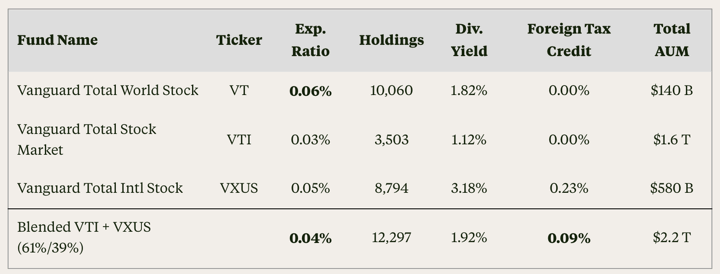
The net result of this is that VXUS effectively earns you an extra 0.23%, which when added to the expense ratio difference in a blended 60% VTI/40% VXUS portfolio ends up being worth 0.13% annually. The effect of an extra ~0.13% in essentially guaranteed extra performance every year (in a taxable account) is pretty significant and can really compound over time. I’m happy to see a number placed on this benefit.
The article includes other good points, with the overall takeaway being that owning both VTI and VXUS has a lot of notable advantages and only minor disadvantages. VTI and VXUS are my largest holdings by far, and I agree that it’s hardly any extra work to add the tiny bit of complexity of owning two ETFs (that mostly already rebalance automatically with price changes).
 The Best Credit Card Bonus Offers – 2026
 Big List of Free Stocks from Brokerage Apps
 Best Interest Rates on Cash - 2026
 Free Credit Scores x 3 + Free Credit Monitoring
 Best No Fee 0% APR Balance Transfer Offers
 Little-Known Cellular Data Plans That Can Save Big Money
 How To Haggle Your Cable or Direct TV Bill
 Big List of Free Consumer Data Reports (Credit, Rent, Work)
I also like owning VTI and VXUS (vs VT) because it allowed me to overweight my international position for the last couple of years (to about 50% VTI and 50% VXUS). I’ll likely go back to about 60% VTI / 40% VXUS once the US valuations come down to historical levels.
Interesting, I started moving to an all VT portfolio for the simplicity but stopped for various reasons. Most of my portfolio is in VTI and VXUS. I guess I’ll just stick with that.
My thesis: Warsh and Bessent as has come forward at Warsh’s confirmation hearings plan to create a new fed-treasury accord. To keep debt interest payments managable for the federal government and to re-privitize the market (move the risk of bad debt from the fed to the market). To accomplish this they have agreed to change banking regulations to force banks to buy more government debt. and hold interest rates low to allow inflation to rise to 3.5-4.5%. This will force returns on long bonds to be effectively negative, where the bonds yeild less than the rate of inflation. This is called fincial repression and it is a near certainty repression will be used as the most politically viable tool to manage the debt and continued deficit spending. Other central banks know this and are already repatriating their captial out of the US back to their home countries. Japan the largest forieng bond holder is already a net seller according to market records from the last few months. My opinion based on this informattion is everyone should examine their bond holdings and move to short-term inflation protected securities for their “safe” asset and sell any long duration bond funds as this plays out over the coming years. Keep in mind the fiscal cliff for social security.. They should also consider weighting more heavily on Japan, UK, and China as those countries economies will benifit by their repatration of captial out of the US back to their home countries. So I would argue one should consider FLJP or other similar un-hedged Japanese and pacific investments. With Japan repatrating its captial from the US it will cause a rise in Japanese asset prices and they will go on a buying spree for resources throughout the world. This will allow you to foucs on the economies that will benifit vs poorly performing Euriope. It will also mean their export driven companies will encounter challengs in countries repatrating their capital. So invest in services.. Also consider the eurzone countries are further along in their fincial repression debt spiral. Japan is different in that it has real wealth to bring back.