Vanguard Money Market & Target Retirement Funds: Claim Your State Income Tax Exemption (Updated 2026)

Updated for 2026. Tax time is here again, and if you earned interest from a money market fund, a significant portion of this interest may have come from “US Government Obligations” like Treasury bills and bonds, which are generally exempt from state and local income taxes. However, in order to claim this exemption, you’ll likely have to manually enter it on your tax return after digging up a few extra details.

(Note: California, Connecticut, and New York exempt dividend income only when the mutual fund has met certain minimum investments in U.S. government securities. They require that 50% of a mutual fund’s assets at each quarter-end within the tax year consist of U.S. government obligations.)

Vanguard has recently released the U.S. government obligations income information for Tax Year 2025 [pdf] for all their funds, which states:

This tax update provides information to help clients properly report state and local tax liability on ordinary income distributions received from mutual fund investments in 2025.

On the next page, you’ll find a list of Vanguard funds that earned a portion of their ordinary dividends from
obligations of the U.S. government. Direct U.S. government obligations and certain U.S. government agency
obligations are generally exempt from taxation in most states.1

To find the portion of Vanguard dividends that may be exempt from your state income tax, multiply the amount of “ordinary dividends” reported in Box 1a of your Form 1099-DIV by the percentage listed in the PDF. Note that on the IRS Form 1099-INT, there is a special Line 3 that includes “Interest on US Savings Bonds & Treasury obligations”. However, for the Vanguard funds, they report on 1099-DIV and not 1099-INT. My Vanguard 1099-INT was all zeros.

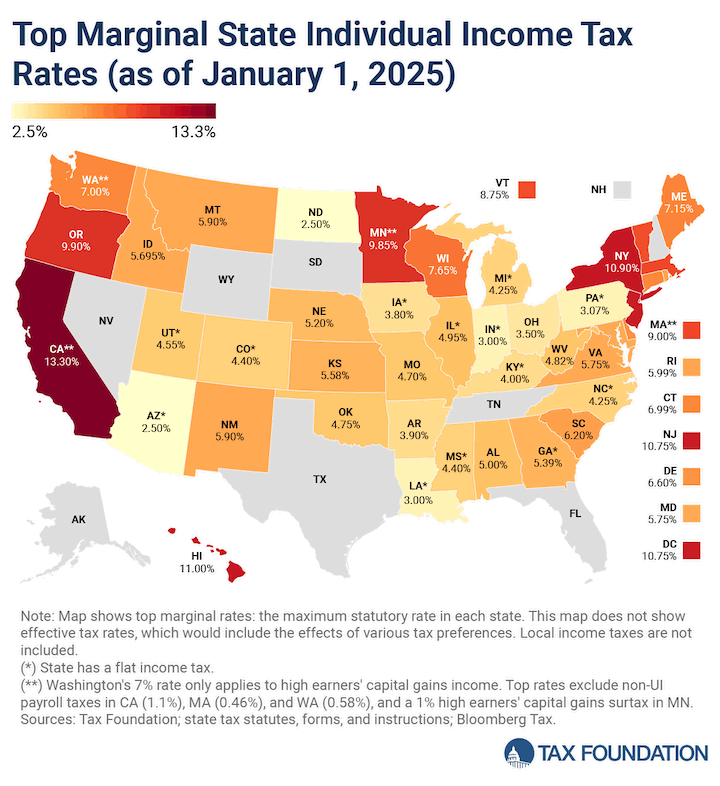
For the default cash sweep Vanguard Federal Money Market Fund (VMFXX), this percentage was 66.61% in 2025. (For reference, it was 59.87% in 2024 and 49.37% in 2023.) Therefore, if you earned $1,000 in total interest from VMFXX in 2025, then $666.10 could possibly be exempt from state and local income taxes. If your marginal state income tax rate was 10% that would be a ~$67 tax savings for every $1,000 in total interest earned. For 2025, this fund DID meet the threshold requirements for California, Connecticut, and New York, which require that 50% of the fund’s assets at each quarter-end within the tax year consist of U.S. government obligations.

In comparison, the Vanguard Treasury Money Market Fund (VUSXX) had a GOI percentage of 100% in 2025. (For reference, it was 100% on 2024 and 80.06% in 2023.) If your marginal state income tax rate was 10% that would be a $100 tax savings for every $1,000 in total interest earned.

The total income return for Vanguard Federal Money Market Fund (VMFXX) was 4.22% and Vanguard Treasury Money Market Fund (VUSXX) was 4.23% over the 12-month period of 2025, meaning the pre-tax return was basically the same. This is why many people chose to manually buy VUSXX instead of the default settlement fund as it can earn you a higher after-tax interest rate.

(Why doesn’t Vanguard let you use VUSXX as your cash sweep? Most likely due to the many inflow and outflows of a cash sweep, those liquidity concerns make it hard to hold everything in Treasury bonds. I’m guessing that repurchase agreements are more liquid.)

The following Vanguard funds and ETF equivalents have 100% of their interest from US government obligations:

  • 0-3 Month Treasury Bill ETF (VBIL)
  • Ultra-Short Treasury ETF (VGUS)
  • Short-Term Treasury Index Fund (VGSH, VSBSX)
  • Intermediate-Term Treasury Index Fund (VGIT, VSIGX)
  • Long-Term Treasury Index Fund (VGLT, VLGSX)
  • Extended Duration Treasury Index Fund (EDV)
  • Short-Term Inflation-Protected Securities
    Index Fund (VTIP, VTAPX)
  • Inflation-Protected Securities Fund (VIPSX, VAIPX)

Note that several other Vanguard funds have a lower but nonzero percentage of dividends from US government obligations, including the popular Vanguard Target Retirement 20XX funds (up to 33-34% for Target Retirement 2020 and Target Retirement Income!). Definitely worth a closer look for residents with high state/local income tax rates, especially those closer to retirement (holds more bonds).

To obtain these tax savings, you’ll have to manually adjust your state/local income tax return. I don’t believe that TurboTax, H&R Block, and other tax software will do this automatically for you, as they won’t have the required information on their own. (I’m also not sure if they ask about it in their interview process. You may need to click on certain spot.) If you use an accountant, you should also double-check to make sure they use this information. Here is some information on how to enter this into TurboTax:

  • When you are entering the 1099-DIV Box 1a, 1b, and 2a – click the “My form has info in other boxes (this is uncommon)” checkbox.
  • Next, click on the option “A portion of these dividends is U.S. Government interest.”
  • On the next screen enter the Government interest amount. This will be subtracted from your state return.

Standard disclosure: Check with your state or local tax office or with your tax advisor to determine whether your state allows you to exclude some or all of the income you earn from mutual funds that invest in U.S. government obligations.

[Image credit – Tax Foundation]

Fidelity Money Market Funds: Claim Your State Income Tax Exemption (Updated 2026)

Updated for 2026. As the brokerage 1099 forms for the 2025 Tax Year are coming out, here is a quick reminder for those subject to state and/or local income taxes. If you earned interest from a money market fund, a significant portion of this interest may have come from “US Government Obligations” like Treasury bills and bonds, which are generally exempt from state and local income taxes. However, in order to claim this exemption, you’ll likely have to manually enter it on your tax return after digging up a few extra details.

(Note: California, Connecticut, and New York exempt dividend income only when the mutual fund has met certain minimum investments in U.S. government securities. They require that 50% of a mutual fund’s assets at each quarter-end within the tax year consist of U.S. government obligations.)

Fidelity has released 2025 Percentage of Income from U.S. Government Securities [pdf]. Here are the results for the most popular core Fidelity money market funds:

  • Fidelity® Treasury Only Money Market Fund (FDLXX, CUSIP 31617H300) – 98.67%.
  • Fidelity® Government Money Market Fund (SPAXX, CUSIP 31617H102) – 50.90%. *Did not meet the minimum investment in U.S. Government securities required to exempt the distribution from tax in California, Connecticut, and New York.
  • Fidelity® Government Cash Reserves (FDRXX, CUSIP 316067107) – 52.17%. *Did not meet the minimum investment in U.S. Government securities required to exempt the distribution from tax in California, Connecticut, and New York.
  • Fidelity® Treasury Money Market Fund* (FZFXX, CUSIP 316341304) – 61.52%. *Did not meet the minimum investment in U.S. Government securities required to exempt the distribution from tax in California, Connecticut, and New York.

It is disappointing that SPAXX as a default cash sweep did not meet the requirements to exempt any of their interest from state income tax in California, Connecticut, and New York. They must have missed the 50% minimum cut-off in one of the four quarters of 2025.

This is why I mostly own FDLXX as my “pseudo-core” money market fund via automated recurring purchases. For more information on this “hack”, see my post Fidelity Treasury Only Money Market (FDLXX) as Fidelity Core Position Workaround.

To find the portion of Fidelity dividends that may be exempt from your state income tax, multiply the amount of “ordinary dividends” reported in Box 1a of your Form 1099-DIV by the percentage listed in the PDF. For example, if you earned $1,000 in total interest from Fidelity Treasury Only Money Market Fund (FDLXX) in 2025, then $986.70 could possibly be exempt from state and local income taxes. If your marginal state income tax rate was 10% that would be a ~$99 tax savings for every $1,000 in total interest earned.

On a net after-tax basis, folks with a ~10% state income tax rate will likely find that FDLXX earns more interest than the default core holdings of SPAXX/FZFXX, even though the gross yield of SPAXX/FZFXX is higher than that of FDLXX.

To obtain these tax savings, you’ll have to manually adjust your state/local income tax return. I don’t believe that TurboTax, H&R Block, and other tax software will do this automatically for you, as they won’t have the required information on their own. (I’m also not sure if they ask about it in their interview process.) If you use an accountant, you should also double-check to make sure they use this information. Here is some information on how to enter this into a previous version of TurboTax:

  • When you are entering the 1099-DIV Box 1a, 1b, and 2a – click the “My form has info in other boxes (this is uncommon)” checkbox.
  • Next, click on the option “A portion of these dividends is U.S. Government interest.”
  • On the next screen enter the Government interest amount. This will be subtracted from your state return.

Standard disclosure: Check with your state or local tax office or with your tax advisor to determine whether your state allows you to exclude some or all of the income you earn from mutual funds that invest in U.S. government obligations.

[Image credit – Tax Foundation]

Marcus Bank: $100 to $1,500 Deposit Bonus (New and Existing Customers)

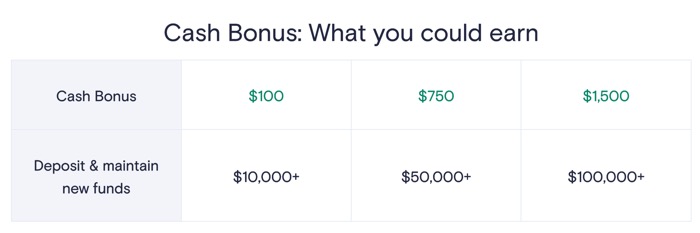
Updated offer for 2026. May sure you enroll first! Marcus by Goldman Sachs is offering a up to a $1,500 deposit bonus (starting at $100 bonus on $10,000 in new funds) into their online savings account within 10 calendar days of enrollment at this special offer page. Valid for both new and existing customers. You must enroll first by 3/11/26 and maintain the new funds for 90 days (after the end of the 10-day funding period, so possibly up to 100 days total). You then get the bonus after another 14 days. No offer or promo code required. They have done a similar promotion in past years (and it’s nice that you can keep doing it). Here are the tiers:

After enrolling, you must deposit $10,000 or more in new funds from an external account into your Account within 10 calendar days of enrollment (the “Funding Period”). The Account balance plus a minimum of $10,000 in new funds (the “Required Dollar Amount”) must be maintained in your Account for 90 consecutive days from the end of the Funding Period. The Account balance is based on the starting current balance reflected on your account at 12 am ET the day you enroll. Once the Funding Period has ended, your Account balance may not drop below the Required Dollar Amount at any point until after the 90 consecutive days have passed. You may make multiple deposits within the Funding Period to reach the Required Dollar Amount. Internal transfers do not count for purposes of this Offer.

Important disclosures: Enroll your Online Savings Account in the Offer, then deposit (within 10 calendar days of enrollment) and maintain at least $10,000 (for $100 bonus), $50,000 (for $750 bonus), or $100,000 (for $1,500 bonus) of New Funds, plus your balances in your enrolled account and across all Marcus accounts as of 6:00 pm ET on 1/27/26, for 90 days after the 10-day Funding Period. Withdrawals made by you or a joint owner while enrolled, including CD maturities to non-Marcus accounts or CD early withdrawals, may result in a lower bonus or losing eligibility, depending on your balances.

New customer referral offer. If you don’t have a Marcus account yet, if you open with a Marcus referral link from an existing customer, you will a small 0.25% bonus (it keeps shrinking!). That’s my referral link, thanks if you use it! I’d open and get the referral offer first, and then later enroll in this $100 offer as an existing customer.
Bonus math. Here’s how it works out for each tier:

  • $100 is a 1% bonus on $10,000 if you keep it there for 90 days, which makes it the equivalent of ~4% APY annualized.
  • $750 is a 1.5% bonus on $50,000 if you keep it there for 90 days, which makes it the equivalent of ~6% APY annualized.
  • $1,500 is a 1.5% bonus on $100,000 if you keep it there for 90 days, which makes it the equivalent of ~6% APY annualized.

The bonus is on top of the standard interest rate, currently 3.65% APY as of 1/29/2026. Compare with my latest update of best interest rates. I have gotten a similar Marcus bonus in the past with no issues. Make sure you enroll at the link above first before transferring in your new funds.

American Express Rewards Checking: $250 Bonus w/ Direct Deposit

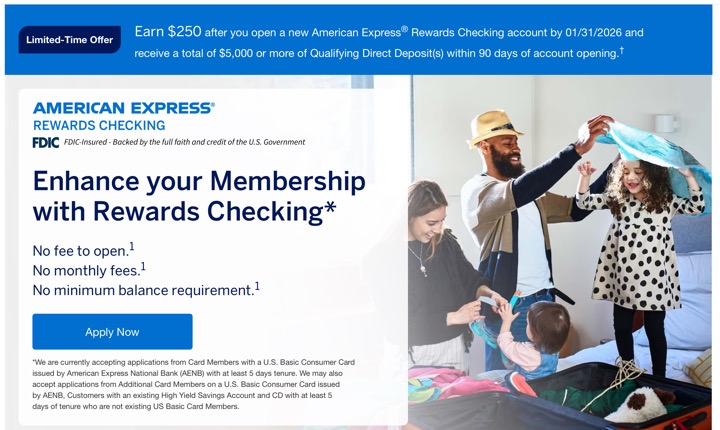
Offer is back, updated details, expires soon. American Express is again promoting their Rewards Checking Account with a new $250 direct deposit bonus. The bonus requirements are pretty straightforward:

  • Open your first American Express Rewards Checking Account in your name by 1/31/2026,
  • Receive a total of $5,000 or more of Qualifying Direct Deposit(s) within 90 days of account opening.
  • After you have completed the above qualifying criteria, American Express will deposit the Welcome Bonus into your Rewards Checking Account within 8-12 weeks.

This bonus is targeted for existing consumer credit cardholders, and possibly savings accountholders:

Who is eligible to apply for an American Express® Rewards Checking account?

Applying for an American Express Rewards Checking account can be completed in minutes. We are currently accepting applications from Card Members with a U.S. Basic Consumer Card issued by American Express National Bank (AENB) with at least 5 days tenure. We may also accept applications from Additional Card Members on a U.S. Basic Consumer Card issued by AENB, Customers with an existing High Yield Savings Account and CD with at least 5 days of tenure who are not existing US Basic Card Members.

Submitted applications will be reviewed promptly with decisions that can be provided within minutes.

If you log into your personal credit card account, the application is mostly auto-filled and just takes a few clicks. There is no hard credit check.

Here are some quick highlights about the Rewards Checking account:

  • No monthly fees, and no minimum balance requirements.
  • 1.00% APY (as of 1/29/26)
  • Earn 1 Membership Rewards® point for every $2 of eligible Debit Card purchases. You can combine these points for redemption using your other AmEx cards.
  • Unlimited fee-free ATM withdrawals at over 37,000 MoneyPass® ATM locations nationwide.
  • Mobile check deposit is available.
  • Free paper checks are not included, but you can purchase them at additional cost.

From the full terms and conditions:

A Qualifying Direct Deposit is a single ACH transfer from an employer or the government for a paycheck, pension, government benefit (such as Social Security), or tax refund. Qualifying Direct Deposit(s) totaling at least $5,000 or more are required to qualify for this offer. The following are not Qualifying Direct Deposits: person to person transfers (P2P) such as money transfer apps, deposit account to deposit account transfers (for example, from a checking account to another checking account or from a savings account to a checking account), deposits or ACH transfers not from an employer or the government (for example, online transfers or bank transfers), internal transfers from your American Express® Savings account, deposits made via check, and Membership Rewards® points redemption for deposits.

Big List of Free Consumer Data Reports 2026: Check Your Credit, Banking, Rental History, Insurance, and Employment Data

magChecked and updated for 2026. Since these are available every 12 months, it is a good idea to check these near or around the same time each year. A lot of companies make their money by collecting and selling data – your personal data. It can be critical to know what they are telling prospective lenders, landlords, even employers about you. Under the FCRA and/or FACT Act, many consumer reporting agencies (CRAs) are now legally required to send you a free copy of your report every 12 months, as well as provide a way to dispute incorrect information.

Some have an online request form, but some are purposefully making it harder to check your reports by removing the online option. Don’t be afraid to call them if needed. You probably won’t want to bother checking all of them anyhow, but if you’ve experienced any sort of rejection or adverse action in these areas the cause might be found inside one of these databases. Keep in mind that you may not have a file with all of these places. Requesting a copy of your own consumer reports does not hurt your credit score.

The Consumer Financial Protection Bureau has been doing a better job maintaining their own comprehensive list of CRAs (PDF version) recently, so I am editing down this list to include direct links to the overall categories along with the larger and more widely-used consumer reporting agencies.

Credit-Related

Experian, Equifax, and TransUnion. The three major credit bureaus track your credit accounts, payment history, and other related information like bankrupts and liens. Free online credit reports now available weekly (the frequency was increased from annual to weekly during the COVID pandemic, but that change has been made permanent).

(Note: As part of a class action settlement, you may also request up to six additional free copies of your Equifax credit report directly from myEquifax during any 12-month period through December 2026.)

You can also now freeze your credit reports for free, but you must contact each bureau separately. For the contact info, please see Big List of Ways To Protect Your Identity: Free Credit Monitoring, Free Credit Locks, and Free Credit Freezes

LexisNexis. One of the largest personal information databases that includes public records, real estate transaction and ownership data, lien, judgment, and bankruptcy records, professional license information, and historical addresses on file. Free copy, must mail in form.

Innovis. Innovis is a lesser-known but still large nationwide CRA, providing credit reports to places including payday lenders, utilities, landlords, employment screening, and insurance companies.

Banking-Related

Chexsystems. A consumer information database used by an estimated 80-90% of all banks to help determine the risk of opening new accounts. Think of it as the banks’ version of a credit bureau. If a person commits check fraud or overdraws their account, it will be listed here. In addition, the simple act of opening or closing a bank account may be recorded in their database. Having a negative ChexSystems record can leave you blacklisted from opening bank accounts at most major banks. Free copy once every 12 months. You can now request your report online.

Early Warning Services (EWS). Provides deposit account data to lenders. Early Warning is co-owned by seven of the largest banks in the US (Bank of America, Capital One, JPMorgan Chase, PNC Bank, Truist, U.S. Bank and Wells Fargo.)

Subprime-Related (Payday Lending)

Microbilt and subsidiary Payment Reporting Builds Credit (PRBC). Microbilt is a provider of credit data for the “approximately 110 million underserved and underbanked consumers in the United States.” Free copy once every 12 months.

Rental History

Realpage (LeasingDesk) Consumer Report. Provides tenant screening through their LeasingDesk product, including “the industry’s largest rental payment history database.”

CoreLogic SafeRent. SafeRent provides both tenant and employment screening data, including information regarding landlord tenant and criminal public court records. One free report every 12 months.

Experian RentBureau Rental History Report. “Every 24 hours, Experian RentBureau receives updated rental payment history data from property owners/managers, electronic rent payment services and collection companies and makes that information available immediately to the multifamily industry through our resident screening partners.”

TransUnion Rental Screening Solutions. SmartMove provides tenant credit, eviction, and background checks.

  • MySmartMove.com FAQ page
  • SmartMove will disclose the contents of a criminal and/or credit report retained by SmartMove to an individual who requests a copy of their report. To verify your identity and obtain a copy of your report(s) or dispute any information within that report, please contact customer service at 866-775-0961.

Auto and Property Insurance

C.L.U.E. Personal Property Report. A division of LexisNexis, CLUE stands for Comprehensive Loss Underwriting Exchange, which collects information that is used to calculate your insurance premiums. This report provides a seven year history of losses associated with an individual and his/her personal property. Includes date of loss, loss type, and amount paid along with general information such as policy number, claim number and insurance company name. This also means you can find out about previous claims on the house you are currently renting or recently bought, even if they weren’t made by you.

C.L.U.E. Auto Report. This report provides a seven year history of automobile insurance losses associated with an individual. Includes date of loss, loss type, and amount paid along with general information such as policy number, claim number and insurance company name.

A-PLUS Loss History Reports, subsidiary of Verisk. ISO stands for Insurance Services Office, A-PLUS stands for Automated Property Loss Underwriting System. Auto and property loss claim history.

Utilities

National Consumer Telecom and Utilities Exchange. NCTUE tracks when people don’t pay their phone, cable, or utility bills. One free report every 12 months.

Retail

The Retail Equation. Tracks product return and exchange abuse at retail merchants.

Medical History

MIB (previously known as Medical Information Bureau). Run by 470 insurance companies with a “primary mission of detecting and deterring fraud that may occur in the course of obtaining life, health, disability income, critical illness, and long-term care insurance.” They record information of “underwriting significance” like medical conditions or hazardous activities. If you have not applied for individually underwritten life, health, or disability income insurance during the preceding seven year period, then you probably don’t have a record.

Milliman IntelliScript. Tracks your prescription drug purchase history. “Milliman IntelliScript will have prescription information about you only if you authorized the release of your medical records to an insurance company and that company requested that we gather a report on you.”

Employment History / Background Checks

The following companies all offer background screening services for employers. Most will not have any information about you unless you authorized a potential employer to run a background check on you (probably during the application process). Some will not provide you information unless there was adverse action. Otherwise, you can get one free copy every 12 months. There are a LOT more of these companies in the full list linked above.

The main point here is that if you do apply for a job and someone runs a background check on you, you can get a free copy for yourself if you formally request it. This is important to be able to quickly dispute any incorrect or negative information on those reports.

The Work Number (division of Equifax). They also keep historical income records.

Backgroundchecks.com

Checkr

Accurate

ADP Screening and Selection Services

IRS Identity Protection PIN Reminder: Prevent Tax Return Scams

Reminder for new tax season. Identity Protection PINs (IP PIN) have been updated for 2026 (they are updated every January).

An important “hardening” tactic against identity theft is to obtain an Identity Protection PIN (IP PIN) from the IRS. The common scam here is that someone with your name, address, and Social Security Number will file a tax return before you do, and then steal the resulting tax refund for themselves. In 2022, over 228,000 taxpayers filed IRS Form 14039, Identity Theft Affidavit, which asserts “I know or suspect that someone used my information to fraudulently file a federal tax return”.

Once you opt-in to the IP PIN program, the IRS will not accept any tax return filed during the current calendar year (even for prior years) without this unique six-digit number. Every calendar year in January, you’ll get assigned a new IP PIN. Getting one at any time will still prevent anyone from filing a fraudulent return during the rest of that calendar year.

To do it completely online, you’ll need an ID.me account, which is a third-party provider that the IRS trusts to verify your identity. From their page:

You can use either a self-service process that requires a photo of a government ID and selfie, or a live call with an ID.me video chat agent that doesn’t require biometric data.

I had already set up an ID.me account for another purpose years ago, but I do remember that the selfie method worked eventually for me but my wife had to go for the live video chat method. I’ve also had to deal with problems with rejected ID photos, too much glare, software crashes, etc.

If you forget your PIN, you can always sign back into your IRS.gov account and view it again under your Profile. This is another reason to take extra care with your ID.me/IRS.gov passwords and MFA methods. ID.me lets you set up a TOTP Authenticator app for MFA. Also set a reminder to use it when you eventually file taxes, so your return doesn’t get rejected.

More information at the IRS IP PIN FAQ page (that’s a lot of acronyms!).

Navy Federal CU Specials: 13-Month CD at 4.00% APY w/ Add-On Feature

Updated January 2026. Navy Federal Credit Union is the nation’s largest credit union, with a long history of serving active military members. More recently, they have expanded their field of membership to include veterans and family members of veterans. Here are some current noteworthy offers:

  • 13-month Special Certificate at 4.00% APY. Open with as little as $50, but make additional deposits any time up to the maximum of $250,000. Valid for taxable, IRAs, ESAs.
  • Credit card $250 bonus: Open a new cashRewards or cashRewards Plus credit card and get $250 when you spend $2,500 within 90 days of account opening. Unlimited 2% cash back on all purchases with cashRewards Plus. No annual fee. 1.99% intro APR for 12 months from account opening on balance transfers made in your first 60 days, with no balance transfer fees.
  • Auto loan $200 bonus if your auto refinance loan is at least $5,000. Their rates are usually competitive as well, starting at under 4%.

NavyFed likes to offer these special add-on CDs regularly, and I usually always open one with the minimum $50 because I like the optionality. If rates drop drastically somehow, I’ll have the ability to add unlimited additional funds at 4.00% APY. If nothing big happens (most likely scenario), I’ll only have committed $50, which I can later roll over into the next special CD. Once you have joined NavyFed, it just takes a few clicks.

Best Interest Rates Survey: Bank Accounts, Treasury Bills, Money Markets, ETFs – January 2026

Here’s my monthly survey of the best interest rates on cash as of January 2026, roughly sorted from shortest to longest maturities. Banks and brokerages love taking advantage of idle cash, and you can often earn more money while keeping the same level of safety by moving to another FDIC-insured bank or NCUA-insured credit union. Check out my Ultimate Rate-Chaser Calculator to see how much extra interest you could earn from switching. Rates listed are available to everyone nationwide. Rates checked as of 1/11/26.

TL;DR: Savings account interest rates have dropped slightly overall, moving with the Fed rate cut. You can still get 4.6% if you accept some hoops/restrictions, but most are under 4% now. Short-term T-Bill rates have fallen, now ~3.6%. Top 5-year CD rates are ~4% APY, while 5-year Treasury rate is ~3.7%.

High-yield savings accounts*
Since the huge megabanks still pay essentially zero interest, everyone should at least have a separate, no-fee online savings account to piggy-back onto your existing checking account. The interest rates on savings accounts can drop at any time, so I list the top rates as well as competitive rates from banks with a history of competitive rates and solid user experience. Some banks will bait you with a temporary top rate and then lower the rates in the hopes that you are too lazy to leave.

  • The top saving rate at the moment: Pibank at 4.60% APY (no min), but they have some weird restrictions; like you can only use wire/Plaid to deposit and wire transfers to withdraw funds?! OnPath FCU is at 4.40% APY with $25,000 minimum balance. CIT Platinum Savings is now at 3.75% APY with $5,000+ balance and is offering an up to $300 deposit bonus which increases your effective APY for a while. There are many banks in between.
  • SoFi Bank is at 3.30% APY + up to 4.00% APY for 6 months + $325 new account bonus with qualifying direct deposit. You must maintain a direct deposit of any amount (even $1) each month for the higher ongoing APY. SoFi has historically competitive rates and full banking features.
  • Here is a limited survey of high-yield savings accounts. They aren’t the top rates, but a group that have historically kept it relatively competitive such that I like to track their history. This month they start at 3.30% APY on up.

Short-term guaranteed rates (1 year and under)
A common question is what to do with a big pile of cash that you’re waiting to deploy shortly (plan to buy a house soon, just sold your house, just sold your business, legal settlement, inheritance). My usual advice is to keep things simple and take your time. If not a savings account, then put it in a flexible short-term CD under the FDIC limits until you have a plan.

  • No Penalty CDs offer a fixed interest rate that can never go down, but you can still take out your money (once) without any fees if you want to use it elsewhere. Marcus has a 13-month No Penalty CD at 3.95% APY ($500 minimum deposit). Farmer’s Insurance FCU has a 9-month No Penalty CD at 4.00% APY ($1,000 minimum deposit). USALLIANCE Financial CU has a 11-month No Penalty CD at 3.90% APY ($500 minimum deposit). CIT Bank has a 11-month No Penalty CD at 3.75% APY ($1,000 minimum deposit).
  • Genisys CU has a 13-month certificate at 4.16% APY ($500 min). Early withdrawal penalty is a clearly-disclosed 90 days of interest (many places hide this info now). Anyone can join this credit union via partner organization Arthritis Foundation or Paint Creek Center for the Arts (one-time $5 fee).

Money market mutual funds
Many brokerage firms that pay out very little interest on their default cash sweep funds (and keep the difference for themselves). Note: Money market mutual funds are highly-regulated, but ultimately not FDIC-insured, so I would still stick with highly reputable firms.

  • Vanguard Federal Money Market Fund (VMFXX) is the default sweep option for Vanguard brokerage accounts, which has a 7-day SEC yield of 3.64% (changes daily, but also works out to a compound yield of 3.70%, which is better for comparing against APY). Odds are this is much higher than your own broker’s default cash sweep interest rate.
  • Vanguard Treasury Money Market Fund (VUSXX) is an alternative money market fund which you must manually purchase, but the interest will be mostly (100% for 2024 tax year) exempt from state and local income taxes because it comes from qualifying US government obligations. Current 7-day SEC yield of 3.66% (compound yield of 3.72%).

Treasury Bills and Ultra-short Treasury ETFs
Another option is to buy individual Treasury bills which come in a variety of maturities from 4-weeks to 52-weeks and are fully backed by the US government. You can also invest in ETFs that hold a rotating basket of short-term Treasury Bills for you, while charging a small management fee for doing so. T-bill interest is exempt from state and local income taxes, which can make a significant difference in your effective yield.

  • You can build your own T-Bill ladder at TreasuryDirect.gov or via a brokerage account with a bond desk like Vanguard and Fidelity. Here are the current Treasury Bill rates. As of 1/9/26, a new 4-week T-Bill had the equivalent of 3.62% annualized interest and a 52-week T-Bill had the equivalent of 3.51% annualized interest.
  • The iShares 0-3 Month Treasury Bond ETF (SGOV) has a 3.70% 30-day SEC yield (0.09% expense ratio) and effective duration of 0.10 years. SPDR Bloomberg Barclays 1-3 Month T-Bill ETF (BIL) has a 3.59% 30-day SEC yield (0.136% expense ratio) and effective duration of 0.15 years. The new Vanguard 0-3 Month Treasury Bill ETF (VBIL) has a 3.72% 30-day SEC yield (0.07% expense ratio) and effective duration of 0.10 years.

US Savings Bonds
Series I Savings Bonds offer rates that are linked to inflation and backed by the US government. You must hold them for at least a year. If you redeem them within 5 years there is a penalty of the last 3 months of interest. The annual purchase limit for electronic I bonds is $10,000 per Social Security Number, available online at TreasuryDirect.gov.

  • “I Bonds” bought between November 2025 and April 2026 will earn a 4.03% rate for the first six months. The rate of the subsequent 6-month period will be based on inflation again. More on Savings Bonds here.
  • In mid-April 2026, the CPI will be announced and you will have a short period where you will have a very close estimate of the rate for the next 12 months. I will post another update at that time.

Rewards checking accounts
These unique checking accounts pay above-average interest rates, but with unique risks. You have to jump through certain hoops which usually involve 10+ debit card purchases each cycle, a certain number of ACH/direct deposits, and/or a certain number of logins per month. If you make a mistake (or they judge that you did) you risk earning zero interest for that month. Some folks don’t mind the extra work and attention required, while others would rather not bother. Rates can also drop suddenly, leaving a “bait-and-switch” feeling.

  • La Capitol Federal Credit Union pays 6.50% APY (increased) on up to $10,000 if you make 15 debit card purchases of at least $5 each per statement cycle. Anyone can join this credit union via partner organization, Louisiana Association for Personal Financial Achievement ($20).
  • OnPath Federal Credit Union (my review) pays 6.00% APY on up to $10,000 if you make 15 debit card purchases, opt into online statements, and login to online or mobile banking once per statement cycle. Anyone can join this credit union via $5 membership fee to join partner organization. You can also get a $150 Visa Reward card when you open a new account and make qualifying transactions.
  • Genisys Credit Union pays 6.75% APY on up to $7,500 if you make 10 debit card purchases of $5+ each per statement cycle, and opt into online statements. Anyone can join this credit union via $5 membership fee to join partner organization.
  • Oklahoma Central Credit Union pays 6.00% APY on up to $10,000 if you make 15 debit card purchases (non-ATM) per statement cycle. Anyone can join this credit union if they are “affiliated with another credit union”.
  • First Southern Bank pays 5.50% APY on up to $25,000 if you make at least 15 debit card purchases, 1 ACH credit or payment transaction, and enroll in online statements.
  • Credit Union of New Jersey pays 6.00% APY on up to $25,000 if you make 12 debit card purchases, opt into online statements, and make at least 1 direct deposit, online bill payment, or automatic payment (ACH) per statement cycle. Anyone can join this credit union via $5 membership fee to join partner organization.
  • Andrews Federal Credit Union pays 5.25% APY (decreased) on up to $25,000 if you make 15 debit card purchases, opt into online statements, and make at least 1 direct deposit or ACH transaction per statement cycle. Anyone can join this credit union via partner organization.
  • Capitol Credit Union pays 6.00% APY on up to $15,000 if you make 12 debit card purchases, opt into online statements, and make at least 1 direct deposit or ACH transaction per statement cycle. Anyone can join this credit union via partner organization ($5 to Wild Basin Wilderness).
  • Find a locally-restricted rewards checking account at DepositAccounts.

Certificates of deposit (greater than 1 year)
CDs offer higher rates, but come with an early withdrawal penalty. By finding a bank CD with a reasonable early withdrawal penalty, you can enjoy higher rates but maintain access in a true emergency. Alternatively, consider building a CD ladder of different maturity lengths (ex. 1/2/3/4/5-years) such that you have access to part of the ladder each year, but your blended interest rate is higher than a savings account. When one CD matures, use that money to buy another 5-year CD to keep the ladder going. Some CDs also offer “add-ons” where you can deposit more funds if rates drop.

  • ClearPath FCU has a limited-time 5-year “Flex” certificate at 4.25% APY ($5,000 minimum of new money), which has a unique feature of having no penalty after 12 months (must withdraw it all; partial withdrawals are subject to penalties). Available as regular or IRA. Anyone can join this credit union via partner organization ($5.00 donation to Clear Giving Charitable Association). Hat tip to Deposit Quest.
  • United Fidelity Bank has a 5-year certificate at 4.15% APY ($1,000 minimum), 4-year at 4.10% APY, 3-year at 4.10% APY, 2-year at 4.15% APY, and 1.5-year at 4.05% APY. Early withdrawal penalties are not disclosed clearly online.
  • Mountain America Credit Union (MACU) has a 5-year certificate at 4.00% APY ($500 minimum), 4-year at 4.00% APY, 3-year at 4.05% APY, 2-year at 4.20% APY, and 1-year at 3.80% APY. Early withdrawal penalty for the 4-year and 5-year is 365 days of interest. Anyone can join this credit union via partner organization American Consumer Council (use promo code “consumer” when joining).
  • You can buy certificates of deposit via the bond desks of Vanguard and Fidelity. You may need an account to see the rates. These “brokered CDs” offer FDIC insurance and easy laddering, but they don’t come with predictable early withdrawal penalties. Right now, I see a 5-year non-callable brokered CD at 3.75% APY (callable: no, call protection: yes). Be warned that both Vanguard and Fidelity will list higher rates from callable CDs, which importantly means they can (and will!) call back your CD if rates drop significantly later.

Longer-term Instruments
I’d use these with caution due to increased interest rate risk (tbh, I don’t use them at all), but I still track them to see the rest of the current yield curve.

  • Willing to lock up your money for 10 years? You can buy long-term certificates of deposit via the bond desks of Vanguard and Fidelity. These “brokered CDs” offer FDIC insurance, but they don’t come with predictable early withdrawal penalties. You might find something that pays more than your other brokerage cash and Treasury options. Right now, I see a 10-year CDs at 3.65% (non-callable) vs. 4.15% for a 10-year Treasury. Watch out for higher rates from callable CDs where they can call your CD back if interest rates drop.

All rates were checked as of 1/11/26.

* I no longer recommend fintech companies due to the possibility of significant loss due to poor recordkeeping and the lack of government protection in such scenarios. The point of cash is absolute safety of principal.

Photo by Giorgio Trovato on Unsplash

Live Oak Bank: $200 Bonus on $20,000 Deposit (New and Existing Customers)

(Update: Offer is back. Again available to existing customers depositing new funds. Hat tip to reader David.)

Live Oak Bank is an FDIC-insured internet bank that is focused on lending to small businesses. Their personal savings account has a limited-time offer of a $200 bonus if you deposit $20,000+ in new funds into their online savings account by 1/30/26 via this special offer page and keep it there for 60 days. The current interest rate is 3.80% APY. Direct deposit is not required. Valid for both new and existing customers, as long as you are adding new money (lookback date is 1/4/26).

Selected fine print:

New and Existing Customers:

The promotion begins on January 5, 2026.
Only one bonus is available per Tax Identification Number per promotional period.
Only personal savings accounts are eligible for the bonus offer. Checking accounts, certificates of deposit (CD) accounts, and fiduciary accounts (e.g., trusts) are not eligible for this offer.
Opening of a new account will be subject to approval by Live Oak Banking Company in its sole discretion.
A new account must be opened between January 5, 2026 and January 30, 2026 to be eligible.
A new Live Oak Bank personal savings account must be fully funded with at least $20,000 by 11:59 p.m. Eastern Time on January 30, 2026 to be eligible. If the account is not fully funded by January 30, then it is not eligible for the bonus offer.

All funding of the new personal savings account must consist of funds originating from an external financial institution to qualify; deposits or transfers originating from an existing Live Oak Bank account (personal or business) via internal transfer, CD redemption, check, ACH transfer, wire, or loan proceeds do not qualify for the bonus offer.

Beginning on the date in January 2026 that the new account attains a balance of at least $20,000, if the balance remains equal to or exceeding $20,000 for 60 consecutive days, then the account will be eligible for the bonus if all other conditions are met. If all eligibility criteria are met, the $200 cash bonus will be deposited to your open, eligible account within 45 days following the expiration of the 60-day period.

Your new account must not be closed or restricted at the time of payout in order to receive the bonus. Live Oak Bank reserves the right to withdraw or withhold the bonus offer from any customer, with or without notice, if fraud or other suspicious activity is suspected.

Any promotional amounts received may be subject to taxation.

Existing Customers:
In addition to the other requirements for the bonus offer, existing Live Oak Bank customers must maintain their existing account balances (not including interest accrued but not credited to the account) at or above the end-of-day balance as of January 4, 2026 at 11:59:59 p.m. ET across their existing personal savings in order to be eligible for the bonus offer.

Bonus math. This is a 1% bonus on $20,000 if you keep it there for 60 days, which makes it the equivalent of 6% APY annualized. Bonus will be paid around Day 105 and the account must be open at that time, but you only need to maintain full balance through Day 60. The bonus is on top of the standard interest rate, currently a competitive 3.80% APY as of 1/6/26.

This equivalent of roughly 9.80% total APY over 60 days makes it a solid offer for those with compatible balances looking for short-term place to hold their cash for a few months. Live Oak Bank seems to come and go with the competitiveness of their rates, but it’s nice that this is available to existing customers.

E-Trade from Morgan Stanley: Savings and Checking Account Bonuses

Savings offer improved. E*Trade (Morgan Stanley Private Bank) is running promotions for new customers on both their savings and checking accounts:

Hat tip to reader Greg on this one.

Up to $2,000 Savings promo details (deposit bonus).

  • Open a new Premium Savings Account on etrade.com by February 28, 2026 using promo code SAVE26.
  • Deposit qualifying new money (see tiers below) within the first 30 days after account opening.
  • Maintain your balance for 45 additional days after the 30-day funding period ends to earn your bonus.

If your deposit meets the minimum of a tier exactly then it works out to up a 1.5% bonus. Note that on some tiers it might be as low as 1%. If let’s say you hold for 60 days for some wiggle room, 1.5% for 60 days works out to a 9% bonus on an annualized basis. Add on the current 3.50% APY on the Premium Savings account for a total of 12.50% APY.

Even on the 1% bonus for 60 days, that works out to a 6% bonus on an annualized basis. Add on the current 3.50% APY on the Premium Savings account for a total of 9.50% APY. Not bad.

$300 Checking promo details (direct deposit required).

    CHECKING25. You are not eligible if you have or had owned or co-owned (joint) a Checking or Max-Rate Checking Account within the last 12 months from when you enroll in this offer.
  • Make at least 2 direct deposits, each of $1,500 or more, within 90 days of opening your new account.
  • Your bonus should arrive around 120 days from account opening.

As of 1/5/26, Max-Rate Checking Account pays 2.00% APY. You must maintain a $5,000 average monthly balance, otherwise there is a $15 monthly fee. The basic Checking Account only pays 0.05% APY (basically nothing), but has no minimum balance. This is notable since you’ll need to maintain an open account for at least a few extra months to get the bonus, so the basic Checking might be better.

Capital One 360 Checking Bonuses: $250 w/o Direct Deposit, $300 w/ Direct Deposit

Updated with new offers. Capital One has two different checking bonuses for new customers right now, one that requires direct deposit and another that requires debit card activity. You’ll have to pick one.

$250 bonus w/o Direct Deposit requirement:

  • Open a 360 Checking account using promotional code DEBIT250.
  • Use your 360 Checking debit card for qualifying transactions at least 20 of $10 or more within 75 days of account opening.

What is “new”? If you have or had an open 360 Checking, Simply Checking, or Total Control Checking account as a primary or secondary account holder with Capital One on or after January 1, 2024, you will be ineligible for the bonus. Hat tip to DoC.

$300 bonus w/ Direct Deposit requirement:

  • Open a 360 Checking account using promotional code OFFER300.
  • Set up and receive at least 2 Qualifying Direct Deposits each of $500 or more to your 360 Checking account within 75 days of account opening.

For this one, if you have or had an open 360 Checking, Simply Checking, or Total Control Checking account as a primary or secondary account holder with Capital One on or after January 1, 2023, you will be ineligible for the bonus.

The 360 Checking account offers a rather disappointing 0.10% APY interest rate, and nothing exceptional other than the ability to link easily with 360 Savings. Highlights:

  • No monthly fees, no minimum balance required.
  • 0.10% APY on all balance tiers.
  • Remote check deposit via app.
  • Paper checks will cost you $20 for 50 checks, or $25 for 100 checks.
  • In addition to their own ATMs, Capital One uses the Allpoint ATM network for fee-free ATM access.
  • You can use your 360 Savings as the overdraft backup source of funds.

A pretty generous checking bonus if you are eligible, but not that attractive long-term unless you already prefer using CapOne 360 Savings. Capital One does seem to keep offering these bonuses regularly each year, making it a good idea to close any idle Capital One 360 accounts.

2025 Year-End Review: Asset Class & Target Date Fund Returns

2025 saw positive returns for every broad asset class that I track. Per Morningstar, here are the total annual returns (includes price appreciation and dividends/interest) for select asset classes as benchmarked by popular ETFs after market close 12/31/25.

I didn’t include Bitcoin or any other crypto because I don’t track them as a long-term asset, only own small amounts temporarily, and would not advise my family to own it. However, I do acknowledge that it went down slightly this year.

Meanwhile, Gold went up by a lot this year, which indicates to me that Gold and Bitcoin have some very different characteristics. Very few developed countries are buying large amounts of Bitcoin to store in their central bank vaults.

The “set and forget” Vanguard Target Retirement 2055 fund (VFFVX), currently consisting of roughly 90% diversified stocks and 10% bonds, was up 21.4% in 2025.

Commentary. 2024 yet again shows that you want to stay in the game. There are always going to be reasons to be afraid: because US stocks continue to have historically high valuations, because you’re worried about an AI bubble, or worried that AI will instead take your job…

Here are your cumulative returns through the end of 2025 if you had been a steady investor in the Vanguard Target Retirement 2055 for many years despite the many, many problems of the world:

(These work great inside 401ks and IRAs. I’d avoid buying Target Retirement mutual funds in a taxable account.)

I feel the need to promote slow compounding over all the short-term madness around us. Sports gambling. Risky options trading. Crypto joke coins. Buy Now Pay Later. I tell my kids that it’s perfectly okay to avoid some stuff completely. You don’t need to try it to know it’s a bad idea.