Instacart Express: Free Two-Month Trial Membership with Mastercard

Mastercard has partnered with Instacart to offer a free 2-month membership to Instacart Express when you join with a Mastercard, but after the 2 months you will automatically renew at the $99 annual rate.

Join today with Mastercard® to enjoy Instacart Express member benefits for 2 months at no charge. After 2 months, your Instacart Express membership will automatically renew to an annual plan and $99 will be automatically charged to your default, active and registered Mastercard® on file with your Instacart account at the time of renewal. Starting a membership with your Mastercard® updates your default payment method. See your Instacart Express account page to make changes or cancel your plan.

Instacart Express usually costs $9.99 a month and includes free delivery on $35+ orders and reduced service fees. They claim the average savings is $7 per order. Be sure to set a calendar reminder to cancel.

Best Interest Rates on Cash – October 2020

Here’s my monthly roundup of the best interest rates on cash for October 2020, roughly sorted from shortest to longest maturities. I track these rates because I keep 12 months of expenses as a cash cushion and also invest in longer-term CDs (often at lesser-known credit unions) when they yield more than bonds. Check out my Ultimate Rate-Chaser Calculator to see how much extra interest you’d earn by moving money between accounts. Rates listed are available to everyone nationwide. Rates checked as of 10/4/2020.

High-yield savings accounts
While the huge megabanks pay essentially no interest, it’s easy to open a new “piggy-back” savings account and simply move some funds over from your existing checking account. The interest rates on savings accounts can drop at any time, so I list the top rates as well as competitive rates from banks with a history of competitive rates. Some banks will bait you with a temporary top rate and then lower the rates in the hopes that you are too lazy to leave.

  • Affirm has the top rate at the moment at 1.00% APY with no minimum balance requirements. I wonder how long this will last, as the rate is high but Affirm also charges really high interest to let folks buy jeans on a payment plan. There are several other established high-yield savings accounts at a little below 1% APY for now.
  • As noted in my past two monthly updates, I took a gamble and opened an HM Bradley last quarter, shifted over my direct deposit, didn’t withdraw it, and am now earning 3% APY on up to $100,000 of my liquid savings from October through December 2020. My long-term concerns still linger, but I am impressed that they kept their rates high for this quarter. You can still earn 1% for this quarter (and hopefully qualify for the higher tiers next quarter) if you can move over a direct deposit.

Short-term guaranteed rates (1 year and under)
A common question is what to do with a big pile of cash that you’re waiting to deploy shortly (just sold your house, just sold your business, legal settlement, inheritance). My usual advice is to keep things simple and take your time. If not a savings account, then put it in a flexible short-term CD under the FDIC limits until you have a plan.

  • No Penalty CDs offer a fixed interest rate that can never go down, but you can still take out your money (once) without any fees if you want to use it elsewhere. Marcus has a 7-month No Penalty CD at 0.75% APY with a $500 minimum deposit. AARP members can get an 8-month CD at 0.85% APY. Ally Bank has a 11-month No Penalty CD at 0.60% APY for all balance tiers. CIT Bank has a 11-month No Penalty CD at 0.35% APY with a $1,000 minimum deposit. You may wish to open multiple CDs in smaller increments for more flexibility.
  • CommunityWide Federal Credit Union has a 12-month CD at 0.95% APY ($1,000 min). Early withdrawal penalty depends on how early you withdraw. Anyone can join this credit union via partner organization ($5 one-time fee).

Money market mutual funds + Ultra-short bond ETFs
If you like to keep cash in a brokerage account, beware that many brokers pay out very little interest on their default cash sweep funds (and keep the difference for themselves). The following money market and ultra-short bond funds are NOT FDIC-insured and thus come with a possibility of principal loss, but may be a good option if you have idle cash and cheap/free commissions.

  • The default sweep option is the Vanguard Federal Money Market Fund which has an SEC yield of 0.05%. Vanguard Cash Reserves Federal Money Market Fund (formerly Prime Money Market) currently pays an 0.04% SEC yield.
  • Vanguard Ultra-Short-Term Bond Fund currently pays 0.70% SEC yield ($3,000 min) and 0.80% SEC Yield ($50,000 min). The average duration is ~1 year, so there is more interest rate risk.
  • The PIMCO Enhanced Short Maturity Active Bond ETF (MINT) has a 0.47% SEC yield and the iShares Short Maturity Bond ETF (NEAR) has a 0.64% SEC yield while holding a portfolio of investment-grade bonds with an average duration of ~6 months. Note that there was a sudden, temporary drop in net asset value during the March 2020 market stress.

Treasury Bills and Ultra-short Treasury ETFs
Another option is to buy individual Treasury bills which come in a variety of maturities from 4-weeks to 52-weeks. You can also invest in ETFs that hold a rotating basket of short-term Treasury Bills for you, while charging a small management fee for doing so. T-bill interest is exempt from state and local income taxes. Right now, this section isn’t very interesting as T-Bills are yielding close to zero!

  • You can build your own T-Bill ladder at TreasuryDirect.gov or via a brokerage account with a bond desk like Vanguard and Fidelity. Here are the current Treasury Bill rates. As of 10/2/2020, a new 4-week T-Bill had the equivalent of 0.10% annualized interest and a 52-week T-Bill had the equivalent of 0.12% annualized interest.
  • The Goldman Sachs Access Treasury 0-1 Year ETF (GBIL) has a 0.00% SEC yield and the SPDR Bloomberg Barclays 1-3 Month T-Bill ETF (BIL) has a -0.04% (!) SEC yield. GBIL appears to have a slightly longer average maturity than BIL.

US Savings Bonds
Series I Savings Bonds offer rates that are linked to inflation and backed by the US government. You must hold them for at least a year. There are annual purchase limits. If you redeem them within 5 years there is a penalty of the last 3 months of interest. The annual purchase limit is $10,000 per Social Security Number, available online at TreasuryDirect.gov. You can also buy an additional $5,000 in paper I bonds using your tax refund with IRS Form 8888.

  • “I Bonds” bought between May 2020 and October 2020 will earn a 1.06% rate for the first six months. The rate of the subsequent 6-month period will be based on inflation again. More info here.
  • In mid-October 2020, the CPI will be announced and you will have a short period where you will have a very close estimate of the rate for the next 12 months. I will have another post up at that time.
  • See note about EE Bonds as a potential long-term bond alternative.

Prepaid Cards with Attached Savings Accounts
A small subset of prepaid debit cards have an “attached” FDIC-insured savings account with exceptionally high interest rates. The negatives are that balances are capped, and there are many fees that you must be careful to avoid (lest they eat up your interest). Some folks don’t mind the extra work and attention required, while others do. There is a long list of previous offers that have already disappeared with little notice. I don’t personally recommend nor use any of these anymore.

  • One of the few notable cards left in this category is Mango Money at 6% APY on up to $2,500, along with several hoops to jump through. Requirements include $1,500+ in “signature” purchases and a minimum balance of $25.00 at the end of the month.

Rewards checking accounts
These unique checking accounts pay above-average interest rates, but with unique risks. You have to jump through certain hoops, and if you make a mistake you won’t earn any interest for that month. Some folks don’t mind the extra work and attention required, while others do. Rates can also drop to near-zero quickly, leaving a “bait-and-switch” feeling. If you want rates above 2% APY, this is close to the only game in town.

  • Consumers Credit Union Free Rewards Checking (my review) still offers up to 4.09% APY on balances up to $10,000 if you make $500+ in ACH deposits, 12 debit card “signature” purchases, and spend $1,000 on their credit card each month. The Bank of Denver has a Free Kasasa Cash Checking offering 2.50% APY on balances up to $25,000 if you make 12 debit card purchases and at least 1 ACH credit or debit transaction per statement cycle. If you meet those qualifications, you can also link a savings account that pays 1.50% APY on up to $50k. Thanks to reader Bill for the updated info. Find a locally-restricted rewards checking account at DepositAccounts.

Certificates of deposit (greater than 1 year)
CDs offer higher rates, but come with an early withdrawal penalty. By finding a bank CD with a reasonable early withdrawal penalty, you can enjoy higher rates but maintain access in a true emergency. Alternatively, consider building a CD ladder of different maturity lengths (ex. 1/2/3/4/5-years) such that you have access to part of the ladder each year, but your blended interest rate is higher than a savings account. When one CD matures, use that money to buy another 5-year CD to keep the ladder going. Some CDs also offer “add-ons” where you can deposit more funds if rates drop.

  • The Federal Savings Bank has a 5-year promo certificate at 1.50% APY ($10,000 min), 3-year at 1.20% APY, and 18-month at 1.10% APY. The early withdrawal penalty for the 5-year is 12 months of interest.
  • You can buy certificates of deposit via the bond desks of Vanguard and Fidelity. You may need an account to see the rates. These “brokered CDs” offer FDIC insurance and easy laddering, but they don’t come with predictable early withdrawal penalties. Vanguard has nothing special right now, I see a 5-year at 0.45% APY right now. Be wary of higher rates from callable CDs listed by Fidelity.

Longer-term Instruments
I’d use these with caution due to increased interest rate risk, but I still track them to see the rest of the current yield curve.

  • Willing to lock up your money for 10 years? You can buy long-term certificates of deposit via the bond desks of Vanguard and Fidelity. These “brokered CDs” offer FDIC insurance, but they don’t come with predictable early withdrawal penalties. At this writing, Vanguard has a 10-year at 0.65% APY. Watch out for higher rates from callable CDs from Fidelity.
  • How about two decades? Series EE Savings Bonds are not indexed to inflation, but they have a unique guarantee that the value will double in value in 20 years, which equals a guaranteed return of 3.5% a year. However, if you don’t hold for that long, you’ll be stuck with the normal rate which is quite low (currently 0.10%). I view this as a huge early withdrawal penalty. But if holding for 20 years isn’t an issue, it can also serve as a hedge against prolonged deflation during that time. Purchase limit is $10,000 each calendar year for each Social Security Number. As of 10/2/2020, the 20-year Treasury Bond rate was 1.25%.

All rates were checked as of 10/4/2020.

Southwest Companion Pass: Free 2-Month Pass With Paid Flight

Southwest has a new companion pass promotion where can get a companion pass free for nearly two months at the beginning of 2021. Here are the requirements (you must make your ticket purchase soon):

  • Register at the promo link, and then purchase a flight by 9/24.
  • Travel by 11/15.
  • Companion flies free with you from 1/6/2021 to 2/28/2021.

The qualifying flight only need to be one person with a paid flight. Remember to register your Rapid Rewards (RR) number at the promo link first, then buy your ticket using that same RR number. Changes made to the itinerary after purchase may eliminate qualification for promotion.

I have written more about the Companion Pass here, including how the requirements are loosened for 2020. Obviously this promo won’t be of interest to everyone, but if you needed to fly anyway, it can be a good opportunity to try out the companion pass. Thanks to reader Mark for the tip.

Coinstar Promo: Redeem $30 of Coins Into Amazon Gift Card, Get $5 Bonus Credit

Here’s a way to both help keep physical coins in circulation and get a little bonus for yourself. If you redeem $30+ worth of coins into Amazon gift cards at your local Coinstar kiosk, they will add a $5 Amazon promotional credit code (valid on products sold by Amazon). Promotion expires November 30, 2020 and the promotional Amazon credit expires December 21, 2020.

You also don’t have to pay any fees using the Amazon gift card option, whereas the cash option hits you with a big 11.9% fee (the last time I checked it was under 10%!). I would have a hard time paying that fee… I’d rather pay the money directly to my kids for rolling up those coins! There are still some banks and credit unions that offer free coin counting services for customers.

Total Wireless 25% Off Coupon For Phone + Plan Purchase (Verizon MVNO)

Total Wireless is an Verizon MVNO that while not the overall cheapest, can be the best value to remain the Verizon network if you don’t require unlimited data. $25/month gets you unlimited talk, text, and 1GB data. $35/month gets you 5 GB. Right now, if you visit their website and look at the bottom right, you should see a form to submit your email for a unique 25% off coupon code (max discount of $100) when you buy both a phone and a plan card. This can result in some very cheap prices on select new and used phones including the iPhone SE, iPhone 8+, and other Android phones.

New iPhone SE 64GB and $25 plan card for $287.49 total:

New iPhone 8+ 128GB and $25 plan card for $250 total:

I personally would lean toward the iPhone SE 2020 with fast internals, or maybe the iPhone 8+ if you want the bigger screen. Shipping should be free as well.

Alternatively, you can try the promo code FALL15 for 15% off a phone + plan purchase.

Visible is another Verizon MVNO where if you are willing to do some legwork and maintain a “Party”, you can get unlimited data for $25 a month. If you need that much data yet, one option would be to use these discounted phone prices and stay on Total for 12 months, at which point they will allow you to unlock your phone to use on any carrier, and then you can move to Visible.

Amazon Audible: Two Free Audiobooks with Prime & Free 30-Day Trial

If you are an Amazon Prime member, check if you are targeted for a free 30-day trial to Audible Premium Plus which will include 2 free audiobook credits. This promotion appears to work even if you are a past Audible member (trial or otherwise), but not if you are an existing active member. If you don’t have Amazon Prime, you could start a 30-day free trial. Here is a screenshot:

My favorite feature of these Audible trials is that once you get a book, it remains available permanently. You can go back an listen whenever you want, even if your membership is not active. Additional features include the ability to swap out audiobooks if you don’t like it after listening for a bit, and discounts off the list price of additional audiobooks. You can even have Alexa read your audiobook to you.

If you don’t want to continue your membership at $14.95/month after the 30-day trial ends, you will want to redeem the audiobooks credit first, and then cancel your membership before the trial ends. Canceling is easily done online, although they will try to offer you some discounts to stay.

I’ve listened to over 10 books by utilizing every free trial offer that comes up. Here are a few of my past purchases:

My two new picks will likely be The Psychology of Money by Morgan Housel and Atomic Habits by James Clear. I am also gradually collecting the Harry Potter series.

Amazon Prime Video: Watch Select TV, Get $5 Cheez-It Credit + $5 Prime Video Credit

Promo reset for September. Get compensated to watch TV through Amazon Prime Video with Cheez-it and Prime Video Credit. The time commitment of has increased to 8 hours this month.

Best Interest Rates on Cash – September 2020

Here’s my monthly roundup of the best interest rates on cash for September 2020, roughly sorted from shortest to longest maturities. I track these rates because I keep 12 months of expenses as a cash cushion and also invest in longer-term CDs (often at lesser-known credit unions) when they yield more than bonds. Check out my Ultimate Rate-Chaser Calculator to see how much extra interest you’d earn by moving money between accounts. Rates listed are available to everyone nationwide. Rates checked as of 9/9/2020.

High-yield savings accounts
While the huge megabanks still pay nearly zero, it’s easy to open a new “piggy-back” savings account and simply move some funds over from your existing checking account. The interest rates on savings accounts can drop at any time, so I list the top rates as well as competitive rates from banks with a history of competitive rates. Some banks will bait you with a temporary top rate and then lower the rates in the hopes that you are too lazy to leave.

  • Affirm has the top rate at the moment at 1.00% APY with no minimum balance requirements. I wonder how long this will last, as the rate is high but Affirm also charges really high interest to let folks buy jeans on a payment plan. There are several other established high-yield savings accounts at a little below 1% APY for now.
  • If you want some upside potential, HM Bradley is still advertising a 3% APY top rate for those that spent the previous quarter saving at least 20% of your direct deposit. It’s likely to drop next quarter starting 10/1, but if you can make a real direct deposit by 10/1 (and not withdrawal more than 80% of it) you’ll earn at least 1% APY in September and gain the possibility of a rate greater than 1% after 10/1.

Short-term guaranteed rates (1 year and under)
A common question is what to do with a big pile of cash that you’re waiting to deploy shortly (just sold your house, just sold your business, legal settlement, inheritance). My usual advice is to keep things simple and take your time. If not a savings account, then put it in a flexible short-term CD under the FDIC limits until you have a plan.

  • No Penalty CDs offer a fixed interest rate that can never go down, but you can still take out your money (once) without any fees if you want to use it elsewhere. Marcus has a 7-month No Penalty CD at 0.75% APY with a $500 minimum deposit. AARP members can get an 8-month CD at 0.85% APY. Ally Bank has a 11-month No Penalty CD at 0.75% APY for all balance tiers. CIT Bank has a 11-month No Penalty CD at 0.35% APY with a $1,000 minimum deposit. You may wish to open multiple CDs in smaller increments for more flexibility.
  • CommunityWide Federal Credit Union has a 12-month CD at 1.00% APY ($1,000 min). Early withdrawal penalty depends on how early you withdraw. Anyone can join this credit union via partner organization ($5 one-time fee).

Money market mutual funds + Ultra-short bond ETFs
If you like to keep cash in a brokerage account, beware that many brokers pay out very little interest on their default cash sweep funds (and keep the difference for themselves). The following money market and ultra-short bond funds are NOT FDIC-insured and thus come with a possibility of principal loss, but may be a good option if you have idle cash and cheap/free commissions.

  • Vanguard Prime Money Market Fund (note the upcoming changes) currently pays an 0.03% SEC yield. The default sweep option is the Vanguard Federal Money Market Fund which has an SEC yield of 0.08%.
  • Vanguard Ultra-Short-Term Bond Fund currently pays 0.82% SEC yield ($3,000 min) and 0.92% SEC Yield ($50,000 min). The average duration is ~1 year, so there is more interest rate risk.
  • The PIMCO Enhanced Short Maturity Active Bond ETF (MINT) has a 0.51% SEC yield and the iShares Short Maturity Bond ETF (NEAR) has a 0.64% SEC yield while holding a portfolio of investment-grade bonds with an average duration of ~6 months. Note that there was a sudden, temporary drop in net asset value during the March 2020 market stress.

Treasury Bills and Ultra-short Treasury ETFs
Another option is to buy individual Treasury bills which come in a variety of maturities from 4-weeks to 52-weeks. You can also invest in ETFs that hold a rotating basket of short-term Treasury Bills for you, while charging a small management fee for doing so. T-bill interest is exempt from state and local income taxes. Right now, this section probably isn’t very interesting as T-Bills are yielding close to zero!

  • You can build your own T-Bill ladder at TreasuryDirect.gov or via a brokerage account with a bond desk like Vanguard and Fidelity. Here are the current Treasury Bill rates. As of 9/8/2020, a new 4-week T-Bill had the equivalent of 0.10% annualized interest and a 52-week T-Bill had the equivalent of 0.15% annualized interest.
  • The Goldman Sachs Access Treasury 0-1 Year ETF (GBIL) has a 0.08% SEC yield and the SPDR Bloomberg Barclays 1-3 Month T-Bill ETF (BIL) has a -0.04% (!) SEC yield. GBIL appears to have a slightly longer average maturity than BIL.

US Savings Bonds
Series I Savings Bonds offer rates that are linked to inflation and backed by the US government. You must hold them for at least a year. There are annual purchase limits. If you redeem them within 5 years there is a penalty of the last 3 months of interest.

  • “I Bonds” bought between May 2020 and October 2020 will earn a 1.06% rate for the first six months. The rate of the subsequent 6-month period will be based on inflation again. More info here.
  • In mid-October 2020, the CPI will be announced and you will have a short period where you will have a very close estimate of the rate for the next 12 months. I will have another post up at that time.

Prepaid Cards with Attached Savings Accounts
A small subset of prepaid debit cards have an “attached” FDIC-insured savings account with exceptionally high interest rates. The negatives are that balances are capped, and there are many fees that you must be careful to avoid (lest they eat up your interest). Some folks don’t mind the extra work and attention required, while others do. There is a long list of previous offers that have already disappeared with little notice. I don’t personally recommend nor use any of these anymore.

  • One of the few notable cards left in this category is Mango Money at 6% APY on up to $2,500, along with several hoops to jump through. Requirements include $1,500+ in “signature” purchases and a minimum balance of $25.00 at the end of the month.

Rewards checking accounts
These unique checking accounts pay above-average interest rates, but with unique risks. You have to jump through certain hoops, and if you make a mistake you won’t earn any interest for that month. Some folks don’t mind the extra work and attention required, while others do. Rates can also drop to near-zero quickly, leaving a “bait-and-switch” feeling. If you want rates above 2% APY, this is close to the only game in town.

  • Consumers Credit Union Free Rewards Checking (my review) still offers up to 4.09% APY on balances up to $10,000 if you make $500+ in ACH deposits, 12 debit card “signature” purchases, and spend $1,000 on their credit card each month. The Bank of Denver has a Free Kasasa Cash Checking offering 2.50% APY on balances up to $25,000 if you make 12 debit card purchases and at least 1 ACH credit or debit transaction per statement cycle. If you meet those qualifications, you can also link a savings account that pays 1.50% APY on up to $50k. Thanks to reader Bill for the updated info. Find a locally-restricted rewards checking account at DepositAccounts.

Certificates of deposit (greater than 1 year)
CDs offer higher rates, but come with an early withdrawal penalty. By finding a bank CD with a reasonable early withdrawal penalty, you can enjoy higher rates but maintain access in a true emergency. Alternatively, consider building a CD ladder of different maturity lengths (ex. 1/2/3/4/5-years) such that you have access to part of the ladder each year, but your blended interest rate is higher than a savings account. When one CD matures, use that money to buy another 5-year CD to keep the ladder going. Some CDs also offer “add-ons” where you can deposit more funds if rates drop.

  • Greenwood Credit Union has a 5-year certificate at 1.50% APY ($5,000 min), 4-year at 1.00% APY, 3-year at 1.20% APY, and 2-year at 0.90% APY. The early withdrawal penalty for the 5-year is 6 month of interest. Anyone can join this credit union by maintaining $5 in a share savings account.
  • You can buy certificates of deposit via the bond desks of Vanguard and Fidelity. You may need an account to see the rates. These “brokered CDs” offer FDIC insurance and easy laddering, but they don’t come with predictable early withdrawal penalties. Vanguard has a 5-year at 0.50% APY right now. Be wary of higher rates from callable CDs listed by Fidelity.

Longer-term Instruments
I’d use these with caution due to increased interest rate risk, but I still track them to see the rest of the current yield curve.

  • Willing to lock up your money for 10 years? You can buy long-term certificates of deposit via the bond desks of Vanguard and Fidelity. These “brokered CDs” offer FDIC insurance, but they don’t come with predictable early withdrawal penalties. At this writing, Vanguard has a 10-year at 0.85% APY. Watch out for higher rates from callable CDs from Fidelity.
  • How about two decades? Series EE Savings Bonds are not indexed to inflation, but they have a unique guarantee that the value will double in value in 20 years, which equals a guaranteed return of 3.5% a year. However, if you don’t hold for that long, you’ll be stuck with the normal rate which is quite low (currently a sad 0.10% rate). I view this as a huge early withdrawal penalty. But if holding for 20 years isn’t an issue, it can also serve as a hedge against prolonged deflation during that time. As of 9/9/2020, the 20-year Treasury Bond rate was 1.22%.

All rates were checked as of 9/9/2020.

Refinance Window? 30-Year Fixed at 3%, But New Refinance Fee Added Soon

Mortgage rates have hit another all-time low, with some 30-year fixed rate mortgages below 3% and 15-year fixed below 2.5%. I know that many folks have already refinanced successfully, but these lower rates may offer even more homeowners the ability to lower their payments and/or pay off their home sooner. Importantly, Fannie Mae and Freddie Mac announced an additional 0.5% fee on refinances that was supposed to start on 9/1, but that was just delayed to 12/1. This could add thousands to your upfront cost. The fact that they ultimately buy 2/3rd of all refi loans and called this an “adverse market refinance fee” also suggests that they feel rates are so low that they don’t properly compensate for the risk involved.
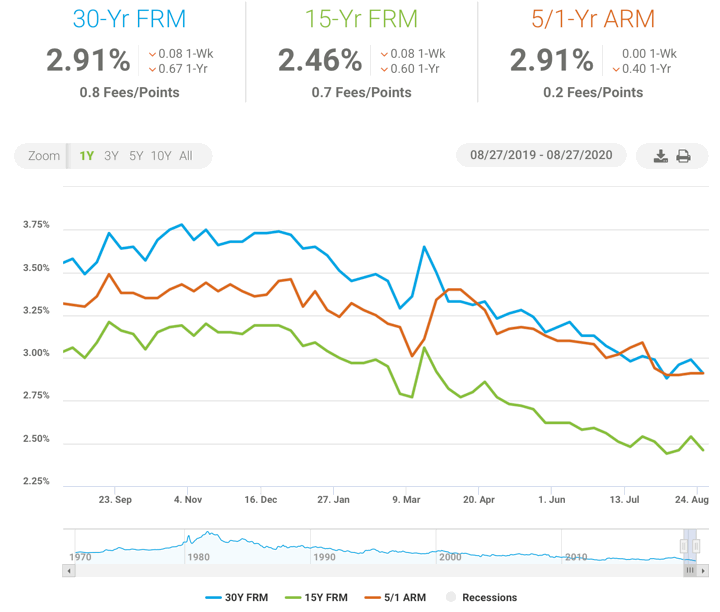
Here is how mortgage rates have changed in just the last 12 months, per Freddie Mac. Would anyone who lived through the 2009 boom-and-bust have expected a 30-year fixed mortgage to cost the same as a 5/1 ARM?

You may not get these rates as they do assume some points, and it may actually work out better for your situation to pay less in upfront closing costs in exchange for a higher interest rate than 2.91%. You can calculate a breakeven point upon which your saved monthly payments completely offset your upfront costs, and also how far you are “ahead” at certain time periods like 3 or 5 years down the road.

Bottom line. Mortgage rates are even lower and many new homeowners will now able to lower their mortgage rates via a refinance. In addition, a new refinance fee that can add thousands to your upfront cost will be added on 12/1. From what I understand, it’s rather hectic right now and refi’s can take over a month, so you will need to start soon and “pack your patience”.

If you are serious, get an accurate full quote with all the costs involved with a reputable mortgage comparison site like LendingTree (tip: they will likely call whatever phone number you choose to enter) or go local and call up your neighborhood broker. You don’t have to provide your Social Security number to get a quote. If you like what you see, lock in the rate as they can change quickly.


Walmart Plus Membership Program w/ Free Delivery

Walmart is rolling out a membership program called Walmart+ that includes unlimited free delivery with no minimum order size. The cost is $98 a year or $12.95 a month, with a 15-day free trial period. Sign-ups start September 15, 2020. Here are the primary features at launch:

  • Free delivery, unlimited with $35 minimum. In-store prices as fast as same-day on more than 160,000 items from electronics to groceries.
  • Scan & Go in-store. Use the Walmart app to scan barcodes as you shop in-store and skip the cashier line.
  • Fuel discount. Save up to 5 cents a gallon at nearly 2,000 Walmart, Murphy USA and Murphy Express fuel stations. Sam’s Club fuel stations will eventually be added as well.

This should be interesting, as it includes “cold” grocery items. I’m just not sure how the economics of this would work while paying a fair wage to the delivery workers. I feel that Instacart relies on customer tips to bridge this gap. Instead, I wish that Walmart would create a speedy “drive thru pickup” service that leverages their big box store footprint. If they offered the same in-store prices with free drive-thru pickup (perhaps within an hour after being ordered via app), they would save the delivery costs and customers wouldn’t have to pay extra for membership fees or gratuities.

Schwab Plan Review: Free DIY Financial Planning Software

Schwab has rolled out a new digital financial planning tool called Schwab Plan. They claim it to be a simplified version of the same financial planning software used by many human financial advisors. From their press release:

Schwab Plan is a digital self-guided financial plan available through Schwab.com that helps investors build a personalized plan that includes a range of factors such as desired retirement age, retirement goals, social security expectations, portfolio risk profile and asset allocation, and various income sources.

[…] they are able to generate a retirement plan that shows retirement goals and probability of funding those goals, a comparison of an individual’s current asset allocation to a recommended allocation based on plan inputs, and suggested next steps to get and stay on track.

Access to this tool is free to anyone with any type of Schwab account. (Eventually, this should include TD Ameritrade clients as well.) There is no minimum asset requirement and you don’t need to sign up for a new service. For example, I was able to access it with only a Schwab PCRA brokerage window account. Here are a few initial impressions and screenshots after testing it out.

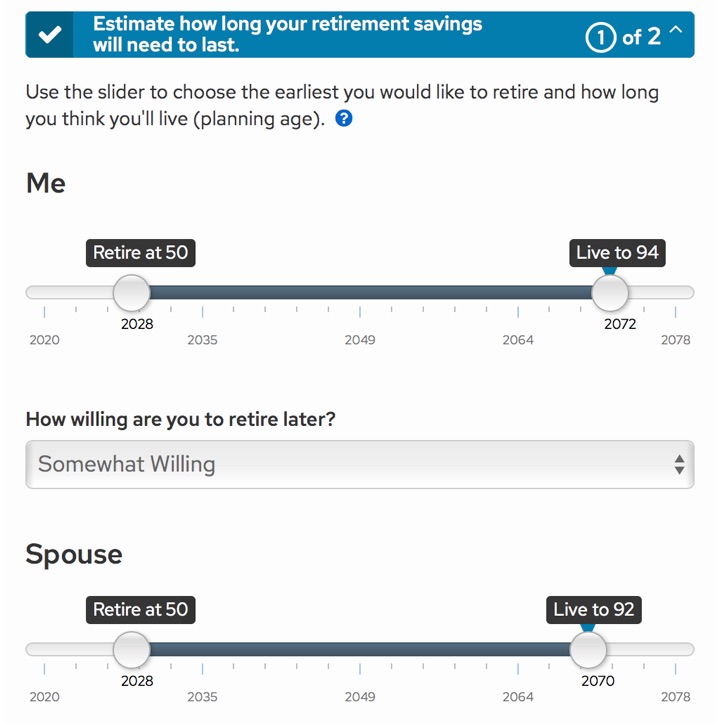
First, you enter some basic personal information like current age, gender, retirement age, and life expectancy:

Next, you estimate your income needs in retirement. They offer additional assistance in estimated your health insurance costs in retirement. You then enter your assets and income sources. Your Schwab accounts are automatically imported, and you can manually add the raw balances of additional external accounts (no account aggregation). They use your information to estimate your Social Security income, and also ask about stock options and restricted stock units.

(They don’t ask about children, college savings, term life insurance, disability insurance, or any of those smaller details that a full-service advisor would ask about. There is also very little customization available in terms of recognizing your external asset allocations.)

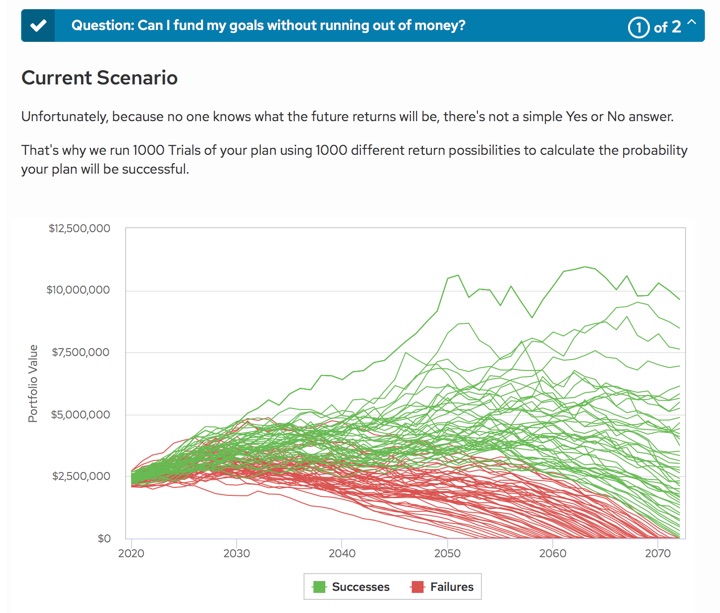
Once everything is entered, they run a Monte Carlo simulation to estimate your probability of success.

You can then adjust the variables, such your retirement age and future spending, in order to see how it affects your success rate. I found the analysis to be reasonably consistent with my other research, and I liked that the results changed significantly for an early retirement (45 year period) as opposed to a traditional retirement (30 year period). They use a “confidence zone” system:

(The Monte Carlo simulations above does not equate to an 86% confidence level. This was after making some tweaks to improve the results.)

Bottom line. Schwab has added a free financial planning tool for all of their customers (no minimum asset requirement). After testing it out, it is not quite “professional-grade”, but I did find it to be slightly more advanced than most other free options. I would recommend trying it out if you have any type of Schwab account. Of course, it also provides a pathway to upgrade to their other portfolio management services, and I still have concerns about their Intelligent Portfolios product.

HSBC Bank Promo: 3% Cash Bonus on New Deposits, Up to $600 Total

Interest rates on liquid savings accounts keep dropping, making bank bonuses more attractive on a relative basis. Opening new accounts are more hassle, so I usually want at least double the interest rates I could get by doing nothing. This $240/$600 HSBC bank bonus satisfies that requirement at over 12% APY. This bonus is not as simple as I’d like, so let’s unpack the details a bit.

Premier Checking (up to $600) bonus details.

  • Open by 9/30/2020. Customers who held an HSBC consumer deposit or investment account from June 29, 2017 through and including June 29, 2020 are not eligible for this offer.
  • 3% cash bonus on qualifying direct deposits, up to $100 per calendar months for 6 months ($600 total). The 6 calendar months begin with the first full calendar month after account opening.
  • Qualifying Direct Deposits are electronic deposits of regular periodic payments (such as salary, pension, Government Benefits or other monthly income) made into your HSBC Premier checking account from third parties at least once per calendar month.
  • Bonus arrives 8 weeks after qualifying activity. To be eligible for the offer, your HSBC Premier checking account must be open without being changed to a product with lower balance requirements, and in good standing at the time of fulfillment.
  • Limit one 3% Promotional Offer or New Consumer Deposit Offer per customer, including all individual and joint accounts — the first line name on the joint account is considered the customer for gift purposes.

HSBC Premier checking has a $50 monthly maintenance fee, unless you have one of the following:

  • Balances of $75,000 in combined U.S. consumer and qualifying commercial U.S. Dollar deposit and investment* accounts; OR
  • Monthly recurring direct deposits totaling at least $5,000 from a third party to an HSBC Premier checking account(s); OR
  • HSBC U.S. residential mortgage loan with an original loan amount of at least $500,000, not an aggregate of multiple mortgages. Home Equity products are not included.

This is not official, but to me the wording suggests that a regularly scheduled monthly ACH transfer pushed from an external bank can count as a direct deposit. The comments under this Doctor of Credit post support this. Obviously, you may want to switch over a payroll if that is an option for you. HSBC doesn’t have any high-interest bank accounts where it would be beneficial to park $75,000 (even if you had this large amount available), so this leaves the best move as making an ACH transfer of $5,000 per month into the account during those 6 months (wait to start until the next new month after opening). This triggers the full bonus and you can then withdraw the funds as you wish, as you have already done the deposits and waived the monthly fee. Limit one per customer, so you and a spouse/partner can each get a bonus, but as usual I would make two individual accounts instead of joint accounts.

The fact that you don’t keep those $5,000 monthly deposits in the account is what I missed initially, and what makes this bonus worth a second look. You can just cycle it: deposit $5k, spend/transfer out $5k, and then deposit $5k again. Now you’re earning a $600 bonus on $5,000 instead of $30,000 or $75,000 in committed cash. Even if you were loose with the math and assumed you had to keep $5,000 in the account for 12 months, a $600 bonus would be 12% annualized. Don’t downgrade your account until get the bonus!

Advance Checking (up to $240) bonus details.

  • Open by 9/30/2020. Customers who held an HSBC consumer deposit or investment account from June 29, 2017 through and including June 29, 2020 are not eligible for this offer.
  • 3% cash bonus on qualifying direct deposits, up to $40 per calendar months for 6 months ($240 total). The 6 calendar months begin with the first full calendar month after account opening.
  • Qualifying Direct Deposits are electronic deposits of regular periodic payments (such as salary, pension, Government Benefits or other monthly income) made into your HSBC Advance checking account from third parties at least once per calendar month.
  • Bonus arrives 8 weeks after qualifying activity. To be eligible for the offer, your HSBC Advance checking account must be open without being changed to a product with lower balance requirements, and in good standing at the time of fulfillment.
  • Limit one 3% Promotional Offer or New Consumer Deposit Offer per customer, including all individual and joint accounts — the first line name on the joint account is considered the customer for gift purposes.

HSBC Advance checking has a $25 monthly maintenance fee, unless you have one of the following:

  • Balances of $5,000 in combined U.S. consumer and qualifying commercial U.S. Dollar deposit and investment* accounts; OR
  • Monthly recurring direct deposits (of any amount) from a third party to an HSBC Advance checking account(s); OR
  • HSBC U.S. residential mortgage loan (of any amount). Home Equity products are not included.

You can either park $5,000 there for about 8 months, or you can make a small direct deposit of any amount each month to waive the monthly fee. However, you will need to deposit at least $1,334 each month to max out the bonus at $40 per month. Even if you were loose with the math and assumed you had to keep $1,500 in the account for 12 months, a $240 bonus would be 16% annualized. Don’t downgrade your account until get the bonus!

Which one? If you have $5,000 that you can cycle, then the $600 Premier bonus is a better use of your time as this bonus will require you to set up multiple transfers and take 8-9 months to complete. If you only have $1,500 to cycle, getting a $240 bonus is still pretty good. Bank bonuses require attention to detail, a tracking/reminder system, and patience. It helps to have that quirk where getting the equivalent of guaranteed 12% annual return on your money is “fun”. 🙂

Thanks to reader Brian M for the tip.