National Emergency Library: Free Digitized Book Access During Pandemic

It is estimated that 1 in 5 students across the world are currently unable to attend school. In response, the Internet Archive opened the National Emergency Library, which suspends the normal lending waitlists on its 1.4 million digitized books. Your local library also has an eBook section, but only has a finite number of copies that it can lend out at one time. (I’m still waiting patiently to read Ali Wong’s Dear Girls…) The National Emergency Library is essentially lending out unlimited copies through June 30, 2020, or the end of the US national emergency, whichever is later.

Announcing the National Emergency Library, a collection of books that supports emergency remote teaching, research activities, independent scholarship, and intellectual stimulation while universities, schools, training centers, and libraries are closed.

Here are their Frequently Asked Questions.

This may be is another helpful resource for those that can’t utilize their normal libraries.You won’t necessarily find the current bestsellers, but there are a number of classic books and good options for children. I randomly checked a few investing geek books that are relatively rare and expensive to buy, and they even have scans of Poor Charlie’s almanack : the wit and wisdom of Charles T. Munger and Margin of Safety by Seth Klarman.

CARES Act: Stimulus Checks, Unemployment, Student Loan, IRA/401k, HSA/FSA Changes

In response to the coronavirus outbreak, the federal government approved a third round of economic relief. There is plenty of media coverage, but after reading multiple articles I noticed that nearly all of them miss at least one thing that another covered. Here’s my own mixtape of highlights so that you can research further if it applies to your situation.
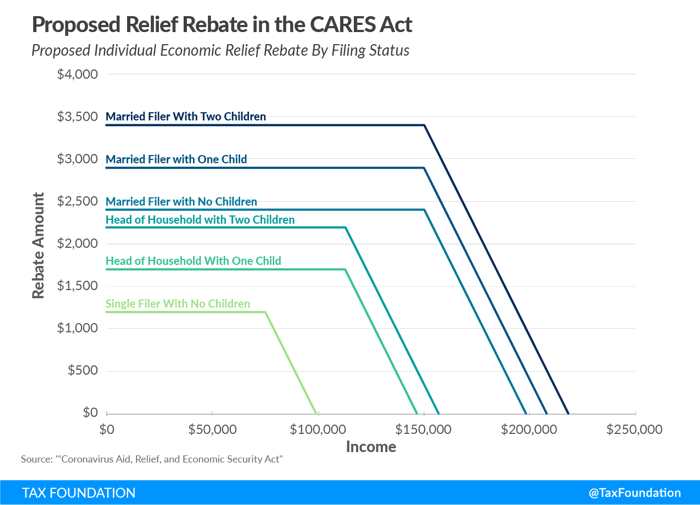

$1,200 for each adult + $500 per child 16 or under. You may want to wait to file. Individuals under $75,000 adjusted gross income get the full amount, and married filing joint under $150,000 get the full amount. Fully phased out at $99,000/$198,000. You can find AGI on Line 8b on 2019 Form 1040 2019, Line 7 on 2018 Form 1040. Based on 2018 tax filing if you haven’t filed for 2019, and 2019 tax filing if you did file. So if got a big raise in 2019, you should delay filing. If your income went down in 2019 or you didn’t file before, you should file now. Finally, if you made a lot in 2019 and expect to make less in 2020, you may still be able to get the money eventually when filing your 2020 taxes.

There is no clawback provision on overpayments, so it doesn’t matter if you end up making more than the income limits in 2020. If you listed a bank account for direct deposit of tax refund, they will try to send your money that way (and then send you a snail mail confirmation). The target date is April 17th. Otherwise, you will likely have to wait longer for a physical check. The money is not taxable.

Unemployment benefits expanded again. The bill has expanded eligibility for unemployment benefits to self-employed and part-time workers. Eligibility also expanded to cover those unable to work due to the coronavirus outbreak. The eligible period is also extended by 13 weeks. There will also be an increased benefit amount (up to $600 per week) on top of your state benefits for up to 4 months.

401(k) and IRA early withdrawal penalties waived up to $100,000. You can now take up to $100,000 out of your IRAs and you have 3 years to put it back into your IRA again without penalty or tax. It’s kind of like a really long rollover window. However, you will owe income tax on whatever partial amount is not put back within 3 years. This is called a coronavirus-related distribution (CRD) and is limited to those affected by the coronavirus.

Instead of a hardship withdrawal, you may wish to take a 401k loan instead. The retirement plan loan limit is also raised to the smaller of $100,000 or up to the full amount vested. Anything that can permanently damage your retirement savings should all be avoided if possible, of course.

Required minimum distributions are waived for 2020. This applies to everyone, even if not affected by the coronavirus. If you don’t need to make the distribution, this can save you on taxes.

Extended student loan relief. Loan and interest payments will be deferred through September 30th without penalty for all federally owned student loans.

Expanded use of Health Savings Accounts (HSAs) and Flexible Spending Accounts (FSAs). Tele-medicine services can now be used before meeting the plan deductible. You can again buy over-the-counter drugs without a prescription. Certain menstrual care products, such as tampons and pads, are also now eligible medical expenses.

Sources: NYT, Tax Foundation, NPR, Accounting Today, SHRM, SGR Law

Amazon & Target Buy 2 Get 1 Free Board & Video Games, Targeted $5 eBook Credit

Amazon and Target have a few sales on video games and board games to help with that cabin fever.

Sprint Unlimited Kickstart: Unlimited Talk, Text, Data For $35/Month

Sprint has an Unlimited Kickstart plan with unlimited talk/text/data for $35 per month, per line. No annual contracts. You can bring over your own compatible phone, or buy one from them. Online orders only. New customers only. Requires port-in of your existing number.

Pros of Kickstart Unlimited:

  • Unlimited talk, text, and data for $35 a month, per line.
  • You can bring over any compatible phone, or buy one from Sprint. Use their phone IMEI/MEID checker.
  • You can come over from ANY outside provider, Verizon/AT&T/T-Mobile or even another cheap MVNO.
  • No expiration date. Price will not go up after a year.
  • No annual contracts.
  • No family plan or minimum number of lines required.

Cons of Kickstart Unlimited:

  • New customers only.
  • Online orders only. You won’t see this offer in stores.
  • No mobile hotspot.
  • Unlimited video in standard definition. Video streams up to 480p, music up to 500 Kbps, gaming up to 2 Mbps.
  • Data deprioritization during congestion.
  • Autopay required.

Sprint Unlimited Kickstart is best for those that want to lock in unlimited data direct from a major provider at a low $35/month price. Verizon, AT&T, and T-Mobile Unlimited may have slightly better networks but they are also significantly more expensive.

I am not a huge data user, but it was still nice when I was on Sprint Unlimited. I could stream videos without worry and switched all my settings to “use cellular data whenever the heck you want!” instead of having to wait to sync or download things like podcasts over WiFi. There is also (slightly) better customer service at a major provider as compared to an MVNO. However, I would also consider the these MVNO alternatives as they can offer some significant savings.

Mint Mobile is another low-cost competitor with data caps. This is what I use. They are an MVNO that runs on the T-Mobile GSM network. You can get:

(Disclosure: I am a Mint affiliate and if you purchase a Mint plan through one of the links above, I may earn a commission. I am also a paying Mint customer. Thanks for supporting this individually-owned site.)

The thing about Mint Mobile is that you have to “buy in bulk”. Initially you have to buy at least 3 months upfront, and then after that you have to buy 12 months at a time to get their lowest price. After your LTE data runs out, you still get data included at slower 2G data speeds until your month resets. They do offer a 7-Day Money Back Guarantee (starts upon SIM activation) so you can test them out before making any commitment.

Special Coronavirus Relief: Paid Leave, Mortgage Payments, Student Loans, Credit Cards, and Unemployment

Wow. I thought that I was prepared, but I must admit that I was still shaken by last week. For those facing severe financial emergencies right now, so I have tried to collect information and links to where you can hopefully find some help. Be prepared advocate for yourself; many of these will only be given to those who ask and are persistent. Everything is in flux as well, so if you don’t find success try again later. There will be more government stimulus coming.

Paid leave for small/mid-sized business employees, including part-time workers and self-employed. Eligible employees can receive up to 80 hours of paid sick leave and expanded paid child care leave for 12 weeks when employees’ children’s schools are closed or child care providers are unavailable. Business must have less than 500 employees (52% of workforce). This is done via refundable payroll tax credits. DOL press release. NYT article.

The act provided paid sick leave and expanded family and medical leave for COVID-19 related reasons and created the refundable paid sick leave credit and the paid child-care leave credit for eligible employers. Eligible employers are businesses and tax-exempt organizations with fewer than 500 employees that are required to provide emergency paid sick leave and emergency paid family and medical leave under the act. Eligible employers will be able to claim these credits based on qualifying leave they provide between the effective date and Dec. 31, 2020. Equivalent credits are available to self-employed individuals based on similar circumstances.

Unemployment insurance. Many states are expanding their eligibility rules for unemployment benefits. You might be eligible if you have to stay at home to care for children. You may not have to officially quit your current job (i.e. your employer temporarily shuts down). You might be eligible if you are under quarantine or have to take care of someone under quarantine or infected. Please visit the Department of Labor for your specific state. CNBC article. DOL.gov/coronavirus.

Mortgage payments. Contact your mortgage or home-equity loan servicer directly to ask about mortgage payment deferral options. Fannie and Freddie Mac have instructed their loan servicers to suspend mortgage payments for up to 12 months if borrowers suffer hardship. In New York, the impacted can defer mortgage payments from any servicer for 90 days. Bank of America is allowing deferrals on a case-by-case basis, with the waived payments being added to the end of their loan term. CNBC article.

Student loans. President Trump announced that federally-held student loans would be set to 0% interest for at least 60 days in addition to being able to request forbearance for 60 days, but there has been a lot of difficulty in actually making the requests with loan servicers as they have cut back on call center hours. There will also be an automatic suspension of payments for any borrower more than 31 days delinquent as of March 13, 2020, or who becomes more than 31 days delinquent. Press release. ED.gov. Studentaid.gov.

Credit cards and auto loans. Chase, Citibank, American Express, US Bank, Discover, Ally Bank, and Apple have all announced some sort of accommodation for coronavirus. The offers are often vague, but it can’t hurt to call and ask for details. For example, Discover says it won’t report late payment to credit bureaus, but what about late fees and penalty APRs? Chase says they might waive fees or extend payment due dates, but only on a case-by-case basis. Apple (if approved) will allow you to skip your March credit card payment without incurring interest charges. Ally Bank will allow deferral of auto loan payments for 120 days, but finance charges will still accrue. Some of these are rather lame, like offering up credit line increases that were always available anyway.

Federal and State Tax Payment Deadline Extensions Due to Coronavirus

Updated March 20th. The US Treasury has announced taxpayer relief for federal tax in response to COVID-19. Here is the Treasury press release, official IRS notice, and a CNBC article. On March 20th, the filing deadline was also changed. Below is my brief summary for most taxpayers.

  • The standard deadline for filing your individual federal income tax returns is now July 15, 2020. This is a change as of 3/20.
  • If you’re getting a tax refund, you should try to file right away. Might as well get your money sooner, as this relief won’t help you if you don’t owe money.
  • The deadline for tax payments if you owe money has been postponed by 90 days. If you owe money on your return, instead of April 15, 2020, you now have until July 15th, 2020. Penalties and interest that you would otherwise have accrued will be waived. This applies on up to $1 million in tax owed.
  • Filing a tax extension can still help. If you can’t make the filing deadline of 4/15, you should file for a free automatic online extension by 4/15. This extends your tax filing deadline all the way to October 15th. Late filing penalties are quite significant.
  • 2020 1st quarter estimated tax payments due April 15th are also now due July 15th. This can be confusing as the 2nd quarter deadline is still currently June 15th. This may help many self-employed workers whose income is hard to predict right now.

Check your state tax situation as well. The American Institute of CPAs has a handy list of state-specific coronavirus taxpayer relief.

List of Free Educational Resources (and Free High-Speed Data)

Here is a list of newly-available resources to help folks manage having their kids home all day long for weeks at a time! From getting free data to free lesson plans and materials.

Free Data Access

  • All four major US carriers — AT&T, Sprint, T-Mobile, and Verizon agreed to waive late fees and will not disconnect anyone due to missed payments. In addition, their WiFi hotspots will be opened to all. Everyone can also connect to xFinity WiFi hotspots and other broadband WiFi hotspots for free.
  • AT&T, Sprint, and T-Mobile (including Metro by T-Mobile) customers will get unlimited data for the next 60 days, even if that is not part of their plan. This should be automatic. They also promise an extra 20 GB of free hotspot data “soon”.
  • Mint Mobile is also offering free unlimited data. See site for details, you can manually purchase unlimited “add-on data” for free through April 12th.
  • Comcast is increasing the speed of their Internet Essentials package for free. In addition, new customers of their $10/month service will receive two months of free service.

Free Educational Materials

The trickier part is finding engaging non-screen activities. Our next project is to make homemade giant bubbles (with honey instead of having to find glycerine?).

Ally Bank New Deposit Promo 2020: Up to $250 Cash Bonus

Ally Bank has a new cash deposit bonus that is offering a 1% cash bonus (up to $250) on new deposits on top of their existing interest rates. Valid for both new and existing customers. Given the holding period, this roughly equates to the same total interest paid as a 3-month bank CD at 5%+ APY. Here’s how it works:

  • Enroll by 3/20/20. You must enroll or you won’t get the bonus. Existing customers must enroll with the same e-mail as linked to their Ally bank account.
  • Fund account by 3/31/20. This means your account has to be approved, opened and funded by this date. Move at least $1,000 from another financial institution to a new or existing eligible Ally Bank account. Remember, transfers can take up to 3 business days.
  • Maintain funds through 6/30/20. Your funds need to remain in an eligible Ally Bank account through 6/30/20. Any withdrawals made during this time may reduce your bonus.
  • Get cash bonus on 7/30/20. Get a 1% cash bonus back on the money you moved, up to $250. That means $25,000 would max out this bonus.

Ally had a similar bonus in 2018, but with higher deposit limits. Note the following regarding which are eligible Ally accounts:

What accounts are eligible?
New or existing Ally Bank Online Savings Accounts, Money Market Accounts, and CDs are eligible for the cash bonus. If you have more than one of these accounts, we’ll consider all of them when calculating your bonus. Remember, the total maximum bonus you can receive is $250.

What accounts are not eligible?
Interest Checking accounts, Individual Retirement Accounts (IRAs), accounts owned by a trust, custodial accounts, Uniform Gift to Minors Act (UGMA) accounts, and Uniform Transfers to Minors Act (UTMA) accounts aren’t eligible for the cash bonus. New money you add to these accounts, or money you move from these accounts to your eligible accounts, won’t qualify for the bonus.

Rough math. The current rate on the Ally Online Savings account is 1.50% APY, and the 11-month No Penalty CD is 1.75% APY on $25k+ balances (as of 3/15/20). Given that you can an additional 1% bonus in 3 months, the bonus itself works out to the equivalent of a 4% annualized yield. 1.5% plus 4% = 5.5%, but given the recent market volatility, the savings rate may be cut down to 1% in the coming months. However, the No Penalty CD at 1.75% would be locked in. So you’re looking at the equivalent of a 3-month CD at roughly 5% – 5.75% APY for new money deposits between $1,000 and $25,000.

Should I move money out of Ally and back in to qualify? No, it won’t make any difference as Ally has already thought of that. All new funds added after 3/13/20 will count as new money for this promotion. They’ve already set the start date in the past, so you gain nothing by delaying your enrollment.

Existing customers. As a longtime Ally accountholder, I’m happy again to see that this offer includes existing customers, even if it has to be new money.

Bottom line. Ally Bank has a new promotion to attract new money (or bring back old money). You get a 1% cash bonus (up to $250) on new deposits on top of their existing interest rates. For their savings account, this works out to a 3-month holding period paying roughly 5% annualized interest. You must enroll soon by 3/20/20 and your account must be opened and fully funded by 3/31/20 at the very latest.

Best Interest Rates on Cash – March 2020

The Federal Reserve just cut their target Fed Funds Rate by 0.50% in response to the market volatility brought on by the coronavirus. This will likely result in many rates drops this month for savings accounts and certificates across the board. (Lower rates may also make it a good time to refinance your mortgage with rates at all-time lows.)

Here’s my monthly roundup of the best interest rates on cash for March 2020, roughly sorted from shortest to longest maturities. I track these rates because I keep 12 months of expenses as a cash cushion and also invest in longer-term CDs (often at lesser-known credit unions) when they yield more than bonds. Check out my Ultimate Rate-Chaser Calculator to see how much extra interest you’d earn by moving money between accounts. Rates listed are available to everyone nationwide. Rates checked as of 3/4/2020.

High-yield savings accounts
While the huge megabanks make huge profits while paying you 0.01% APY, it’s easy to open a new “piggy-back” savings account and simply move some funds over from your existing checking account. The interest rates on savings accounts can drop at any time, so I list the top rates as well as competitive rates from banks with a history of competitive rates. Some banks will bait you with a temporary top rate and then lower the rates in the hopes that you are too lazy to leave.

Short-term guaranteed rates (1 year and under)
A common question is what to do with a big pile of cash that you’re waiting to deploy shortly (just sold your house, just sold your business, legal settlement, inheritance). My usual advice is to keep things simple and take your time. If not a savings account, then put it in a flexible short-term CD under the FDIC limits until you have a plan.

  • No Penalty CDs offer a fixed interest rate that can never go down, but you can still take out your money (once) without any fees if you want to use it elsewhere. Marcus has a 11-month No Penalty CD at 1.90% APY with a $500 minimum deposit. My eBanc has a 11-month No Penalty CD at 2.00% APY with a $100,000 minimum deposit. Ally Bank has a 11-month No Penalty CD at 1.90% APY with a $25,000 minimum deposit. CIT Bank has a 11-month No Penalty CD at 1.70% APY with a $1,000 minimum deposit. You may wish to open multiple CDs in smaller increments for more flexibility.
  • Andrews FCU has a special 13-month certificate at 2.15% APY. Anyone can join this credit union via partner organization. Ally Bank has a special 13-month certificate at 2.10% APY. CIT Bank has a 12-month CD at 2.06% APY ($1,000 min).

Money market mutual funds + Ultra-short bond ETFs
If you like to keep cash in a brokerage account, beware that many brokers pay out very little interest on their default cash sweep funds (and keep the difference for themselves). The following money market and ultra-short bond funds are not FDIC-insured, but may be a good option if you have idle cash and cheap/free commissions.

  • Vanguard Prime Money Market Fund currently pays an 1.60% SEC yield. The default sweep option is the Vanguard Federal Money Market Fund which has an SEC yield of 1.49%. You can manually move the money over to Prime if you meet the $3,000 minimum investment.
  • Vanguard Ultra-Short-Term Bond Fund currently pays 1.89% SEC yield ($3,000 min) and 1.99% SEC Yield ($50,000 min). The average duration is ~1 year, so there is more interest rate risk.
  • The PIMCO Enhanced Short Maturity Active Bond ETF (MINT) has a 1.77% SEC yield and the iShares Short Maturity Bond ETF (NEAR) has a 2.00% SEC yield while holding a portfolio of investment-grade bonds with an average duration of ~6 months.

Treasury Bills and Ultra-short Treasury ETFs
Another option is to buy individual Treasury bills which come in a variety of maturities from 4-weeks to 52-weeks. You can also invest in ETFs that hold a rotating basket of short-term Treasury Bills for you, while charging a small management fee for doing so. T-bill interest is exempt from state and local income taxes.

  • You can build your own T-Bill ladder at TreasuryDirect.gov or via a brokerage account with a bond desk like Vanguard and Fidelity. Here are the current Treasury Bill rates. As of 3/3/2020, a 4-week T-Bill had the equivalent of 1.12% annualized interest and a 52-week T-Bill had the equivalent of 0.73% annualized interest.
  • The Goldman Sachs Access Treasury 0-1 Year ETF (GBIL) has a 1.46% SEC yield and the SPDR Bloomberg Barclays 1-3 Month T-Bill ETF (BIL) has a 1.38% SEC yield. GBIL appears to have a slightly longer average maturity than BIL.

US Savings Bonds
Series I Savings Bonds offer rates that are linked to inflation and backed by the US government. You must hold them for at least a year. There are annual purchase limits. If you redeem them within 5 years there is a penalty of the last 3 months of interest.

  • “I Bonds” bought between November 2019 and April 2020 will earn a 2.22% rate for the first six months. The rate of the subsequent 6-month period will be based on inflation again. More info here.
  • In mid-April 2020, the CPI will be announced and you will have a short period where you will have a very close estimate of the rate for the next 12 months. I will have another post up at that time.

Prepaid Cards with Attached Savings Accounts
A small subset of prepaid debit cards have an “attached” FDIC-insured savings account with exceptionally high interest rates. The negatives are that balances are capped, and there are many fees that you must be careful to avoid (lest they eat up your interest). Some folks don’t mind the extra work and attention required, while others do. There is a long list of previous offers that have already disappeared with little notice. I don’t personally recommend nor use any of these anymore.

  • The only notable card left in this category is Mango Money at 6% APY on up to $2,500, but there are many hoops to jump through. Requirements include $1,500+ in “signature” purchases and a minimum balance of $25.00 at the end of the month.

Rewards checking accounts
These unique checking accounts pay above-average interest rates, but with unique risks. You have to jump through certain hoops, and if you make a mistake you won’t earn any interest for that month. Some folks don’t mind the extra work and attention required, while others do. Rates can also drop to near-zero quickly, leaving a “bait-and-switch” feeling. I don’t use any of these anymore.

  • Consumers Credit Union Free Rewards Checking (my review) has up to 5.09% APY on balances up to $10,000 if you make $500+ in ACH deposits, 12 debit card “signature” purchases, and spend $1,000 on their credit card each month. Elements Financial has 3% APY on balances up to $20,000 if you make 15 debit card “signature” purchases or other qualifying transactions per statement cycle. Find a locally-restricted rewards checking account at DepositAccounts.

Certificates of deposit (greater than 1 year)
CDs offer higher rates, but come with an early withdrawal penalty. By finding a bank CD with a reasonable early withdrawal penalty, you can enjoy higher rates but maintain access in a true emergency. Alternatively, consider building a CD ladder of different maturity lengths (ex. 1/2/3/4/5-years) such that you have access to part of the ladder each year, but your blended interest rate is higher than a savings account. When one CD matures, use that money to buy another 5-year CD to keep the ladder going. Some CDs also offer “add-ons” where you can deposit more funds if rates drop.

  • Hiway Federal Credit Union has a 5-year certificate at 2.61% APY ($25k minimum) and 2.50% APY with a $10,000 minimum. Early withdrawal penalty is 1 year of interest. Anyone can join this credit union via partner organization ($10 one-time fee).
  • Navy Federal Credit Union has a special 17-month CD at 2.25% APY ($50 minimum + add-on feature up to $75k), but you must have a military affiliation to join (includes being a relative of a veteran).
  • Andrews FCU still has their special 84-month certificate at 3.05% APY. They also have a 55-month at 2.60% APY. $1,000 minimum to open. Anyone can join this credit union via partner organization.
  • You can buy certificates of deposit via the bond desks of Vanguard and Fidelity. You may need an account to see the rates. These “brokered CDs” offer FDIC insurance and easy laddering, but they don’t come with predictable early withdrawal penalties. The rates are not competitive right now. Be wary of higher rates from callable CDs listed by Fidelity.

Longer-term Instruments
I’d use these with caution due to increased interest rate risk, but I still track them to see the rest of the current yield curve.

  • Willing to lock up your money for 10+ years? You can buy long-term certificates of deposit via the bond desks of Vanguard and Fidelity. These “brokered CDs” offer FDIC insurance, but they don’t come with predictable early withdrawal penalties. I don’t see anything noteworthy. Watch out for higher rates from callable CDs from Fidelity.
  • How about two decades? Series EE Savings Bonds are not indexed to inflation, but they have a unique guarantee that the value will double in value in 20 years, which equals a guaranteed return of 3.5% a year. However, if you don’t hold for that long, you’ll be stuck with the normal rate which is quite low (currently a sad 0.10% rate). I view this as a huge early withdrawal penalty. You could also view it as a hedge against prolonged deflation, but only if you can hold on for 20 years. As of 3/3/2020, the 20-year Treasury Bond rate was 1.44%.

All rates were checked as of 3/4/2020.

Simple Bank Bonus: $400 Bonus + 1.75% APY for $20,000 New Deposit

Bonus back again 3/3/20. Simple is one of many fintech startups adding fancy tech and smartphone app sprinkles to your vanilla checking account. They were acquired by the big European-based bank BBVA in 2014. They just updated their $200 and $400 new customer bonuses with new expiration dates.
$200 Bonus Details ($10,000+)

  • Open a new Simple Account by 3/15/2020 at 4:59 PM PT.
  • Deposit(s) totaling $10,000 or more must post to the new account by 4:59PM PT within 15 calendar days after the account is opened.
  • Maintain a balance of at least $10,000 through 5/31/20 4:59 PM PT.
  • The combined balance between your Simple Account and Protected Goals Account counts towards this bonus. The Protected Goals account currently pays 1.75% APY while the primary checking only pays 0.01% APY, so I would recommend opening one of those as well. Note that balances in *Shared* Accounts and *Shared* Protected Goals Accounts do not toward this bonus.
  • Qualifying customers will receive the bonus credit into the eligible Simple account by 6/15/2020 at 4:59pm PT.

$400 Bonus Details ($20,000+)

  • Same as above, except you’ll need to deposit $20,000+ within 15 calendar days of opening, and you’ll get a bigger $400 bonus.

This works out to a 2% bonus after 60 days, which makes it roughly 12% APY annualized. The bonus is on top of the variable interest rate of their Protected Goals account, currently 1.75% APY (as of 3/3/20). That is a pretty good return on FDIC-insured cash in this current rate environment.

Note that this offer is for new accounts only. They’ve been running this on and off since July 2019 (thus the old comments below) so many of us are no longer eligible. Here is their full fee schedule.

Note that for some reason Simple limits ACH transfers to/from an external account to $5,000 cumulative during the first 30 days, when initiated on the Simple website. However, you can simply initiate a transfer from another bank (Ally Bank, Marcus, CIT, etc.) and there are no transfer limits.

Bottom line. Simple is offering a $200/$400 bonus on $10,000/$20,000 of new money into a new account. This works out to a very high APY for a 60 day holding period. Currently, there are also new deposit bonuses from CIT Bank and CIBC Bank. Compare with my most recent roundup of best interest rates.

Orion FCU Premium Checking Review: 1% APY (Up to $10k) w/ New Activity Requirements

(Update April 2019. The interest rate on this account has dropped to 1% APY. In addition, instead of 8 debit transactions per month, you must now spend at least $500 on your Orion debit or credit card each month. All signature and PIN based purchases count. They seem to have given up the idea of being a top rate. I have not updated the review below yet.)

Orion Federal Credit Union (FCU) has a Premium Checking account that offers 1% APY on balances up to $10,000 if you meet certain direct deposit and debit card transaction requirements. However, if you don’t meet the requirements, you’ll get basically no interest and be charged a monthly fee. Their membership is now open nationally. Details below.

Membership eligibility. Orion FCU is based in Memphis, Tennessee and has a field of membership open to nearby residents and employers of local companies. However, you can also join as a “volunteer” for one of their affiliated nonprofit organizations:

Volunteers for Orion Gives Back organizations are eligible for membership in Orion. You can qualify as a volunteer fundraiser simply by choosing an organization and asking us to make a $10 donation.

Yes, you read that right – they will even make the donation for you! Choose from Habitat for Humanity Greater Memphis, Hope House, Porter-Leath, Ronald McDonald House, and Wolf River Conservancy.

You will need your Social Security number and Driver’s License number. In addition, reader Bill reports that they will perform both a ChexSystems inquiry and a hard credit check through Equifax.

Premium Checking requirements. To qualify for the 3% APY on balances up to $15,000 and up to $10 in ATM fee rebates per month, you must have the following:

  • Electronic deposits totaling at least $500 per month. Electronic deposits include: direct deposit, mobile deposit, and electronic transfers from another financial institution.
  • Spend at least $500 on your Orion debit or credit card per month. All signature and PIN based purchases will count toward the $500 minimum.

Note that amounts in excess of $25,000 but under $100,000 will earn 2.01%. If you meet these requirements, there is no monthly fee. If you don’t, then there is a $5 monthly fee and your rate goes down to 0.05% APY.

It is nice that the deposit requirement is not restricted to “payroll direct deposits”. You can set up an automated monthly transfer from another bank account.

Worth it? Like many other such “rewards checking” accounts, you have to be ready for continuous changes. These financial institutions are constantly tinkering to see how they can get you to make this your main checking account, but not lose too much money on the perks.

Previously, you just had to make any 8 debit-card purchases per month. You might just make a bunch of $2 purchases at the convenience store. Some people who were making many small purchases will balk at the new $500 total requirement, but others might like the simplicity of the new terms.

Let’s make some rough calculations. An online savings account earning 2% would earn $300 of interest on a $15,000 balance. At 3% APY, you would earn $450 instead. That’s a difference of $150 per year in extra interest ($12.50 per month). Missing out on 2% cash back on credit card purchases of $500 per month works out to $10 per month. But the bank interest is taxable, while the credit card rewards are not. If you keep significantly less than $15,000, you might even come out behind with Orion.

Note: Some grocery stores allow you to get up to $200 cash back when making a purchase with a debit card with a PIN. However, this would depend on your cash needs as you’d still be missing out on credit card rewards if you are spending cash instead. You could technically deposit this cash back into a bank somewhere, but that also takes time and effort.

Bottom line. Orion FCU has a Premium Rewards checking account available to anyone nationwide that pays 3% APY on balances up to $15,000 if you meet certain direct deposit and debit/credit card transaction requirements. However, if you don’t meet those requirements, you will earn virtually no interest and be subject to a $5 monthly fee. The latest change replaces the 8 debit card transactions with a least $500 in monthly spending on an Orion debit/credit card.

Coronavirus + Mortgage Rates at 8-Year Lows = Refinance Boom

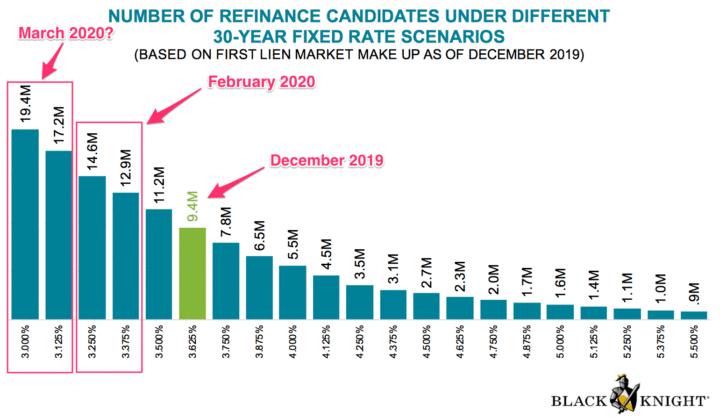
Update March 2020: 30-year fixed rates on 3/4 were at 3.0%-3.25%. If you’re looking for some good news to distract you right now, check out refinancing your mortgage. In November 2018, the average 30-year mortgage rate was nearly 5%. Right now, you can find 30-year rates at around 3.25% and lower with zero points. Mortgage rates are at all-time lows again, with the previous lows back in 2016 and 2012 (source):

At these lower rates, millions more homeowners can save money by refinancing rates, even after taking into account the loan fees (source). This is based on industry data on the rates of existing mortgages.

If you are refinancing, try to see if you can lower your rate, how much your lower monthly payment will be, and how long it will take to break even with the refinancing costs. Here is an example scenario from the WSJ:

WHEN IT IS WORTH REFINANCING
– Home buyer puts 20% down on a home worth $266,300, the median home price in January.
– No plans to move soon.
– Pays a 4% rate, resulting in a monthly payment excluding taxes, fees and insurance of $1,017.09, according to LendingTree.
– Dropping to a 3.25% rate would decrease the payment from $1,017.09 to $927.16. The homeowner would save around $90 a month, with exclusions.
– Assuming refinancing costs of $2,000, this homeowner would need to stay in the home for a little less than two years to make it worth the money.

If you are willing to take a slightly higher rate (negative points), you can even get a “no cost” refinance where the negative points cover your refinance costs. This way, your monthly costs go down with no upfront cost at all.

Bottom line. Due to coronavirus fears, interest rates are now at or nearing all-time lows. This also means that millions more homeowners may be able to lower their mortgage rate via a refinance. If you are serious, get an accurate full quote with all the costs involved with a reputable comparison site like LendingTree (tip: they will likely call whatever phone number you choose to enter) or go local and call up your neighborhood broker. If you are just curious, try an “instant quote” that doesn’t require any upfront information. If you do like what you see, lock in the rate as they can pop back up quickly.