Free Phone Calls From Google Voice and Gmail Extended Until 2013

Free calling within the US and Canada through 2012 has also been confirmed on the Official Google Voice blog.

It has been reported that Google Voice and Gmail will continue to offer free calls to anywhere in the U.S. and Canada for all of 2012. Previously, Google had only committed to free calls until the end of 2011.

This should make the owners of the Obi110 VoIP Telephone Adapter very happy, as it allows you plug in any standard telephone system and use Google Voice to make free phone calls. The current regular price is $49.99, for which you will at least get a full year of free phone service including long distance, with no computer required (broadband internet access is required). It costs $20 to port your existing number over to Google Voice. The sound quality is reportedly good per reviews.

I replaced traditional telephone service with VoIP over 6 years ago (except for a brief stint with a cheap DSL plan), and I’m quite happy with the technology. Voice quality is great; I’d much rather talk for extended periods on VoIP rather than cell phone.

Practical Gift Guide: A Few Of My Favorite Things

Not done shopping yet? December 16th (today) is Free Shipping Day for many merchants who are offering free delivery by Christmas Eve. Also, the last day for things bought with Amazon’s Free Super Saver Shipping to arrive before Christmas is Monday the 19th. I’ve noticed they spring for 2-day air more often this time of year.
In that spirit, I’ve seen a lot of silly gift guides floating around, so here’s a few things in different price ranges that I actually own and found to be good value:

Quality Jackets With Lifetime Warranty ($50-$200)
Given how long good outerwear can last, I don’t see why you wouldn’t spend a little more for the good stuff. I have a mix of different jackets that have all lasted over 10 years and also have lifetime warranties in case they don’t last another 10. First, I had a soft fleece jacket from REI that went 10 years before the zipper broke. I took it into the store and they fixed it for me free of charge. I have an outer jacket from L.L. Bean that is now 15 years old and hasn’t given me any cause to return it. (I’m actually more proud that it still fits since it’s a graduation present from high school, but still.) Finally, I have a Gore-Tex jacket from North Face that has gone 10 years and still repels snow and water. Even their own fabric instructions say you can just wash them like anything else.

Sales are everywhere, but I noticed that REI currently has 30% off any REI-branded item with promo code REISAVE. Also don’t forget your favorite cashback shopping portal.

Enamel Dutch Oven ($45)
We got a Le Creuset dutch oven as a gift, and we think it’s a great product even though they retail for $200+. You get all the benefits of cast-iron (great heat retention, works on stove, works in oven) but with a nice, durable enamel coating (easier cooking, easier cleanup, looks nice). Did I mention it lasts forever? However, you should know that the respected magazine Cook’s Illustrated did careful testing of various competing products and found the $45 Tramontina dutch oven to be of comparable quality at a fraction of the price. Seems like a great value. If anything, replace the plastic knob with a metal one for high-temperature baking.

Travel Underwear & Socks ($10-$20)
Didn’t see that one coming, did ya? Frequent travelers always talk about packing light. When packing for a longer trip, I found it hard to fit everything in a carry-on if you’re packing 7 pairs of socks and 7 pairs of boxers. The trick is to buy quick-drying underwear and socks, so you really just need a minimum of two pairs – one to wear while the other is trying. (Or theoretically even just one pair if you like sleeping commando…) I like the ExOfficio Men’s Give-N-Go Boxer Brief and these J.B. Expedition Adventure Travel Quick Dry Socks. (Ladies’ versions available as well.) I actually pack 3 pairs as they are also lighter and thinner than my regular clothes.

Drying tip: Wash them in the sink with your soap of choice. Wring dry by hand. Now place a dry towel flat on a bed, and then place the damp clothing onto the towel. Roll the towel up with the clothes inside, and then wring the towel again tightly. You should have removed enough of the water to finish hang-drying overnight.

What practical gifts do you recommend?

Connect to Compete: $10/Month Broadband Internet For Lower Income Families With Children

I just wanted to spread the word about a new program Connect to Compete which is a “private and nonprofit sector partnership to promote broadband adoption and improve outcomes in disadvantaged communities” that offers broadband internet access for $9.95 a month as well as discounted computers and digital literacy classes. Partners include Cox, Time Warner Cable, Charter, Cablevision, and more.

The discounts are available to households with at least one child eligible for the free National School Lunch Program (offering millions of lunches and growing). According to the income guidelines, a family of 4 within the lower 48 states can’t make more than $29,055 a year to qualify. Also, you must not have outstanding balances with the service provider. The program will not go nationwide until September 2012, but there is a sign-up form on the website to be notified when is arrives in your area.

If you are served by Comcast, this is very similar to Comcast Internet Essentials, which appears to be live already.

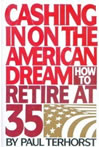
Cashing in on the American Dream: How To Retire at 35 by Paul Terhorst (Book Review)

One of classic books on many early-retirement reading lists is Cashing in on the American Dream: How To Retire at 35 by Paul Terhorst. However, this book was published in 1988 and has been out-of-print for a while. Luckily, I noticed that there were several used copies available on Amazon for $0.01 + 3.99 shipping (or $4 with free shipping) and grabbed one.

Author Background
Terhorst earned his money as an accountant, making partner at a major accounting firm in his early 30s. He retired in 1984 at age 35 with a nest egg of around $400,000. He and his wife Vicki (no children) refer to themselves now as “perpetual travelers”. He wrote this book in a era before the internet became popular – imagine how hard it would be to gather information on this topic back then, limited to early BBS chat boards or snail-mail newsletters. Sometimes I take for granted how easily we can share and discuss information today.

Paul and Vicki used to have a Geocities page that is now defunct, but they still occasionally write travel articles and it looks they have a small internet presence here.

Implementation: Managing Expenses
The basic retirement plan in the book is to spend no more than $50 a day = $18,000 a year (1988). Adjusting with the Consumer Price Index, this would be around $33,000 a year in 2010 dollars. However, personal inflation does not necessarily match the CPI, and they reportedly still manage on $50 a day as recently as 2003.

A major part of lowering your expenses is to avoid living somewhere expensive. Realize that the most expensive cities in the US are up there with the most expensive cities in the entire world! When you’re retired, you can live anywhere. The book includes several example of smaller cities in the southern US with temperate climates, lots of things to do, and a proximity to a major city and airport. They also support living close to the center of these smaller cities, using public transportation, and not owning a car – another big source of savings.

In addition, the author is a strong proponent of spending a good chunk of your time in foreign countries where a dollar goes a lot further. Latin America (Argentina) and Southeast Asia (Thailand) are places where they have lived. The key is to “live like a native, not like a tourist”. Don’t stay in hotels or live in gated communities made for expats. If the natives live on $10,000 a year, you should be very comfortable at $20,000 a year.

They pay for health care with cash in the same foreign countries, which offer quality care at much lower prices than in the US. The rest of the frugal-living advice is pretty standard. Prioritize your spending, cut out the excess consumerism, etc.

Implementation: Creating Investment Income
Investment advice is often referred to as the weakest part of this book. You have to realize that the 1980s were a completely different financial environment. With high inflation, you could buy FDIC-insured CDs paying 8% interest annually. Thus, he recommended liquidating all your assets to cash, including selling your home, and then build a CD ladder creating 8% income. Obviously, this is not an option today. But if you take a step back, you’ll see that the basic premise is that you should never take on any more risk than you need.

It’s hard to find any updated investment advice from Terhorst, but it appears like they are still happily retired and don’t worry about money much. If they needed money, you’d think they’d republish their book. 🙂 I did find this 2003 Kiplinger’s Personal Finance article which provided some insight:

…they began to move their money into stocks – mostly low-cost index funds – when interest rates declined in 1992. Now they have 40% of their portfolio in large- and small-cap stocks, 40% in natural resources companies (oil, gold, platinum), and the rest in money market accounts. […] Their assets now total more than $1 million

These days, I pose that a more realistic early retirement portfolio might be 50% dividend stocks and 50% investment-grade bonds paying out a 3% yield that will keep up with inflation overall. However, creating $33,000 a year would require $1,100,000. Creating $18,000 a year ($50/day) would require $600,000.

Implementation: Saving Up That Nest Egg
I think this area is actually the weakest part of the book. The advice is essentially work hard at your career and be a good company man. Do all the right things to get promotions and work your way up the ranks to management and upper management… until the day you bail out. This is what Terhorst did, and he doesn’t really explore any other options like starting your own business. I suppose the truth is that this method will work for many, but it’s not very satisfying.

Takeaways
The main lesson that I got from reading this book is that the concept of “early retirement” for everyday middle-class folks has been around and available for decades. However, most people today don’t seem to even know it’s an option. I guess it takes a special disposition to be unsatisfied enough with the normal 9-5 grind to do what it takes to get out of it. I’ve also realized that many people – good people! – are quite happy with working 40+ hours a week for 40+ weeks a year for 40+ years of their life. There are so many different ways to balance work, investment income, and spending to retire partially or retire early.. but first you just have realize that you have that option!

Hundreds of Free Kindle eBooks Download Links

I already mentioned checking out library books on the Kindle eReader, but here are also some handy bookmarks to check regularly to find free content on the Amazon.com website:

  • Top 100 Free – Quick and easy, this just lists the popular free eBooks being downloaded at the moment. However, for business and finance books you may have to dig a bit.
  • Limited Time Free eBooks – List of books that are free for a limited time, and then often go back up in price. Grab ’em right away if they look interesting now, and decide whether or not to read them later.
  • Free Classics – List of books that are permanently free due to being old enough to be out-of-copyright, including several well-known classics

Want some suggestions? Here are my recent free downloads.

Reminder: You can read Kindle eBooks in almost any web browser, plus apps for PC, Mac, iPad, iPod Touch, and all major smartphones.

Borrowing Library e-Books On Kindle Using Overdrive

I’m a pretty regular user of my local library, usually with 3-4 books out each month (with only 1-2 completely read + a few bucks in late fees). I bought a Kindle a few months ago* and was happy to hear that I can now borrow e-books from my library onto it. Overdrive runs the digital media portion of my local library system, and also runs it for many others. Previously, the DRM software restrictions made it impossible to get onto a Kindle. You can run a search for a branch close to you on Overdrive.com.

Unfortunately, so far I haven’t been impressed. The titles are very limited, and usually my city only has one copy of each. I’m still hopeful that a lower cost for distribution means it will this system more popular. Maybe libraries can even get a cut by offering a link to the book for sale. Here are a few stats:

  • Lending period: 21 days for me, which is the same as physical books. You can electronically return the book earlier if you like.
  • No late fees. The book is automatically removed from your Kindle device when time is up. You’ll get an e-mail warning, but this also means you can’t just keep it an extra day or two to finish up for $.50 in late fees. Poof!
  • Maximum checkouts allowed at one time: For me, this is 10. Plenty.

I do like not having to drive to the library, of course. Finally, for more free reading material, I now use Instapaper to transfer all long web articles (like Boomerang) to read on Kindle. Much less eye strain. My most recent clipping? The famous 1979 Businessweek article The Death of Equities.

* By the way, I would definitely go for the $30 savings for “special offers” Kindle version. I would honestly have paid the same price as without ads (but don’t tell Jeff Bezos that). The ads are not intrusive to the reading experience at all, and and the coupons offered regularly save me money. You can view a list of all previously offered discounts here. It seems like every month I either get a Kindle book for $1 or something like $5 off any $10 Amazon purchase.

Spending and Saving Money Is All About Trade Offs

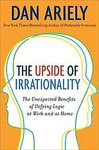
Author and professor Dan Ariely has gained fame from being able to make his behavioral economics research accessible to the general public. We all want to understand better why we do what we do. His newest book is The Upside of Irrationality. You can read sample chapters from his books for free via the eBook Taste of Irrationality.

One of the problems he’s trying to address is saving for retirement. Why do so many people save less than they need to? Here’s what Ariely says, via a recent interview on the Betterment blog:

The world around us (wants) us to spend money now. The incentives (to spend) are always very high. It’s hard to resist that, and sadly, after being tempted towards spending, spending, spending, what we have left for savings is not enough.

Investing is between now and later. It’s about the trade off, and because people are not making these trade offs correctly, we’re basically in the (bad economic) situation that we’re in.

Money is fungible. Any time you spend money on anything, it could be spent on something else. The $10 lunch, the $1,000 TV, the $20,000 car. We all know this is true, but in practice we tend to weigh things differently. Here is a thought experiment taken from a recent talking engagement (paraphrased):

Imagine being presented with the decision to either by a $700 Sony speaker set or a $1000 Pioneer speaker set. Most people go for the better and more expensive Pioneer speakers.

Now, what if the same people were instead presented with the decision between the $700 Sony set + $300 in CDs and DVDs or a $1000 Pioneer speaker set? Ariely found that now most people go for the Sony set and music package.

Why? It’s easier to imagine the value of $300 of CDs as opposed to the diluted value of $300 spread across all the possible things in the world to buy.

Perhaps it would help us to remember a list of things at different price points that are really important to us, so that we can better judge our daily spending. For example, if I really enjoy my daily $3 coffee, then I could think of other small purchases in terms of giving up that coffee. Now, getting everyone to agree to delayed gratification is something for which I don’t think there is a simple solution.

Thermostat + iPod = The $249 Nest Energy-Saving Appliance?

What happens when a former Apple executive and other top geeks focus their energy on a… thermostat? The Nest Learning Thermostat. I just finished a neat Wired magazine article about this new gadget, which hopes to make saving energy both trendy and hassle-free.

First, it looks like something Apple would make. When the heat is on, it’s red. When the A/C is one, it turns blue. You use it like any other thermostat, turning it up and down whenever, and it’ll even show you how long until you get there. What’s wrong with existing programmable thermostats? For one, they are often so hard to use that half of them aren’t programmed at all. A study actually showed that programmable thermostats used more energy than non-programmable thermostats, which led to the EnergyStar label being pulled for all of them.

How is it better? If you’re being efficient, you get rewarded with a little green leaf icon, nudging you towards more savings. It learns your habits, and uses that to minimize your energy use. If you forget to turn it down on a weekend getaway, it will fix that for you. Or, you can jump online and set it yourself, since it connects via WiFi and stores your energy consumption patterns online. It even has motion detectors built in so it knows if people are around, and it lights up when you approach it. All with just the trickle of power that a normal thermostat gets.

It also costs $249, much more than competing beige thermostats. It’s supposed to pay for itself in two years, so that’s a savings of $10 a month. If it reduces your usage by 20%, that means your current bill should average at least $50 a month.

Needs vs. Wants, Scaling Your Luxuries, and Conscious Priorities

There was a thought-provoking NYT article about luxuries last week that pointed to a 2006 report by the Pew Research center that surveyed Americans on what they considered “necessities” versus “luxuries”. Some things have become more accepted as a necessity over time:

Other things have stayed “needed” on a constant level, like having a car, TV, or clothes washer. I stewed on this over the weekend, because right now I have all 7 of those things listed above. But as recently as 10 years ago, I only had a computer, broadband internet, and a microwave. No car, no washer/dryer, no air conditioning, no dishwasher.

Are any of these really a need? Even if you live somewhere hot, somewhere in the world there are people living in the same conditions without air conditioning. My wife’s grandmother still used a washboard to clean her clothes up until recently. On top of that, each of our needs or wants can be scaled up or down. You may “need” a car for work, but that car can cost $200,000 or $20,000 or $2,000. A house can cost $1,000,000 or $100,000 or less. Even a TV can cost $2,000 or free (you can’t even give away a tube TV these days). You could run your A/C all day long, or set the thermostat to 83 like my dad does.

It would seem that the real decision is more about priorities. Somewhere in those spending priorities is saving for a rainy day, or saving for retirement. Some people are effectively making the decision that they want to live in a 3,000 sf house instead of a 1,500 sf house than, rather than stop working period 5 years early (or work part-time instead of full-time for 10 years). Is that wrong? I don’t necessarily think so, if that’s their choice. In the end I couldn’t think of any easy answers, but hopefully we start making our choices more consciously rather than just going along with others.

Cheapest iPhone 4S Plan = $69.99 Sprint Everything Plus Referral Program (EPRP) with Unlimited Data and Text

If you’re looking for the cheapest plan that offers the iPhone 4S (or iPhone 4), with unlimited data and text included, then check out the Sprint Everything Plus Referral Program. This is meant for friends of employees, but a Sprint executive has offered to refer us:
Sprint employee e-mail address: Russ.S.McGuire@Sprint.com
Last 3 digits of employee ID (CID): 383

Monthly plans start at $59.99 for individuals with 500 anytime minutes with unlimited text and data, which is $10 cheaper than their regular plans. Family shared plans start at $109.99 for two lines sharing 1600 minutes with unlimited text and data, which is $20 less than their regular price. You also get unlimited nights and weekends starting at 7pm.

However, Sprint adds on a “Premium data charge” of $10 a month for iPhones and other select smartphones. This brings the total to $69.99 a month for the 500 minutes individual plan. I don’t know of any carrier that offers all that for a lower price, but let me know in the comments if you do. In fact, only Sprint has unlimited data right now, and most others charge for texting separately.

Already in a contract? Check if you are eligible for a student or employee corporate discount, or 10-15% savings for being a credit union member. Finally, if you are an AAA member, Sprint should offer you a 10% discount on their regular retail plans if you call them and ask. You can apply these for a discount on your current plan, even in the middle of a contract.

Sprint SERO Premium + iPhone 4S = $50 a month

This post is an update for fellow stubborn folks still clinging to the Sprint SERO plan. This grandfathered plan gave us individual plans with 500 minutes, nights starting at 7pm, unlimited text, and unlimited data for $30 a month. However, this was with severe restrictions on available phones. In 2010, Sprint announced SERO Premium which allowed us to upgrade to Android or Blackberry phones for $10 a month, and another $10 a month for “high data use” smartphones like the ones capable of 4G data.

Yes, the new iPhone 4S (and iPhone 4) is available on the SERO Premium plan for $50 a month. The 500 minute plan will cost $30 + $10 +$10 = $50 a month, because it is also “high data use” even though it’s not 4G-capable. For a while, the swamped Sprint CSRs were not well-trained in this area and were giving conflicting information. But customer-friendly Sprint executive Russ McGuire has confirmed the $50 price on his personal blog, and it has been ordered successfully in various cell phone forums. Looks like it’s time for an upgrade. 🙂

Never heard of SERO? You can still get the cheapest iPhone 4S plan available to the public at for $69.99 a month, including unlimited data and text messages, through the Sprint Employee referral program.

What If Time Was Currency? Don’t Waste Your Time

In Time is a new sci-fi movie about a future where science has figured out how to stop the aging process. To prevent overpopulation, the solution was to allow everyone to live to age 25, and then give them one year to live. Time has replaced money as currency. If you don’t earn more time, then you die. The rich effectively live forever. A cup of coffee costs 4 minutes. The trailer is below:

This storyline made me think of the almost frugal-cult-classic book Your Money or Your Life (get it used for $3 shipped). One of the concepts inside is that working is the same as exchanging your life energy for money. Let’s say you earn a solid living, $25 an hour after taxes. But then there is all the stuff attached – the commute, the clothes, the lunches, the stress (need for vacations and drinks after work). You might really be earning $20 a hour.

If your rent is $1,000, you’re spending 50 hours each month just to pay for that. An iPad costs $500, 25 hours of work. If you spend $100 a month on wasteful things that you really don’t enjoy, that’s another 5 hours of your life every month. In a way, we are sacrificing our lives for money. Sure, you may not die any sooner, but you’ll be spending that much less time on what you really want to do. It just happens so gradually and indirectly, we don’t notice. Try pricing everything out in terms of your real hourly wage. (A cup of coffee might actually cost more than 4 minutes.) Try adding up all the money you’ve ever made, and calculate your net worth to see how much you actually kept.

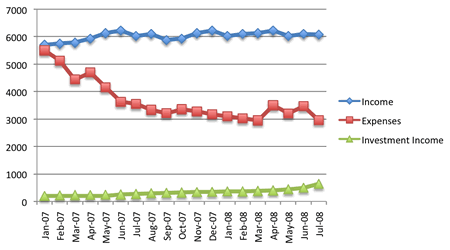
If you concentrate on maximizing the gap between expenses and income, one day your income from your investments will match your expenses. That’s financial independence.

Steve Jobs said in a great commencement speech that we should find work that we love. Most of us don’t love our work in the way that if we didn’t get paid, we would still go out and do it. Amazingly, he did. If you’re like me and are still having trouble with that, then at least we can reach for the day when we can simply do what we love because we don’t need more money.

Either way, don’t waste your time.