Make Money Bidding on Self Storage Auctions?

Self-storage unit auctions have been getting increased attention to two new reality TV shows, Storage Wars and Auction Hunters. The premise is simple. If someone pays to have their stuff stored there, but stops paying the rent, the storage company won’t let you pick up your stuff until you pay up. If you still don’t pay your bills, they’ll auction off all your stuff in order to make the unit available again. I’ve always tried to avoid such places because I figured that just meant I had too much stuff!

The auction itself is quite a gamble. Bidders usually only get to see what is visible while standing outside the unit, and that’s it. So you could end up with valuable antiques, or a carefully-folded collection of used underwear. Want to participate in a live auction to see what it’s all about? Traditionally, you would be looking for the legally-required notices in your local newspaper. These days, the best site I could find for looking up self storage listings in your area is Sparefoot.com, a start-up that primarily does self-storage price comparisons. Bring cash, and verify the time and place by phone on the day of the auction.

A few added warnings. First, the new popularity means winning bids have doubled in some areas. Second, some shady places now actually scam people by making the unit look artificially valuable with things like (empty) brand-name boxes. Almost sounds like a Freakonomics topic.

Buying Discounted Gift Cards Just Before Purchase

Now that there is a secondary market for gift cards, you can also buy gift cards at a discount to face value and use them at your preferred retailer. Better yet, you can combine them with whatever coupon or sale is already going on. A good use is for larger purchases at stores like Home Depot or Lowe’s, where an additional 7% off means $35 savings on a $500 appliance. These guys often also have 10% off coupons floating around, for example in US Postal Service moving kits or in exchange for signing up for 0% financing.

The downside to this is that for physical gift cards and brick-and-mortar stores, this takes advance planning. You have to buy it, wait for it to come in the mail, and then use it in a store on a future purchase while hoping the sale/promotion is still going on and the item is still in stock. It would be great if you could simply go a store, pick up your items, and then buy some discounted gift cards right before reaching the cash register. This turns out to be possible, but it was a bit clunky. This will only work with retailers that accept online gift certificates in their physical stores.

  1. Find it. You need to find a website that sells discounted Home Depot “eCodes”, which are electronic gift certificates. I used Plastic Jungle (PJ), which currently offers a good selection of Home Depot codes at 7% off. Now, the PJ site says that these codes are for online-use only, but but both the HomeDepot.com website and my actual conversation with an HD employee confirm that you can use them in-store.

    Where can I use my eGift Card? You can use your eGift Card at any The Home Depot store in the United States, its territories or possessions, and in Canada. You may also redeem your eGift Card online at homedepot.com.

  2. Buy it. Browse the website on your mobile device, and purchase the required amount. You’ll have to decide whether to buy a little less than you need, or a little more and use the rest later. I prefer just buying a little less if I can, like $100 worth for $110 of stuff. PJ uses Paypal, but you can still use a rewards credit card to get extra savings.
  3. Hope it comes instantly, and use it. Now, the extra-clunky part is that most websites don’t promise instant delivery. For example, at Plastic Jungle this was in their purchase confirmation e-mail:

    The PayPal payment you authorized is pending, your order will be processed within 1 business day. You will receive a notification when your payment has been approved. Please note eCODEs purchased after 1PM PST will be delivered via email the next business day.

    However, my gift code did indeed come immediately, literally 30 seconds after the purchase confirmation. Perhaps this is how it goes with Home Depot cards, as I even bought after 1pm PST. I checked the balance and it was legit. You may get a cashier that doesn’t know how to enter the code, in that case ask for a supervisor.

So here is my suggestion for gift card reseller websites. Create an iPhone/Android app or mobile website that allows quick and easy purchases of gift certificate codes that can be delivered and used immediately. Let me save “favorite stores” and secure payment information to make things even faster. As consumers, we should encourage stores to allow online codes to work both online and in-store.

Book Review: Early Retirement Extreme

Earn more, or spend less. That’s what you have to do in achieve financially independence. My own philosophy has been to try and earn more than average, perhaps look about average to casual observers, and spend below average. Now, what if instead you earned about average, but spent way, way below average?

Various studies have shown that with a portfolio of about 60% stocks/40% bonds, you can withdraw 3-4% of your portfolio value each year (inflation-adjusted) and have a 95%+ chance that your money will last a lifetime. Using a 4% rate, that means to retire, you’ll need to save up 25 times your expenses. So if you spend $40,000 a year, you need $1,000,000. By that same math, if you only spend $8,000 a year, you only need $200,000 to retire.

Impossible, you say? Not to Jacob Lund Fisker, author of the book Early Retirement Extreme, who says he lives on about $10k a year and retired by 33. Extreme is a good word for it, though. In the US, the poverty line for a single person is $10,890; for a family of four is $22,350. But that’s how he can make the following claim about his book:

It’s possible to retire and live on invested savings after just five years of full-time work.

Five years?! No, I don’t think he’s crazy. I think it’s awesome that he presents such a different perspective, even if few others can achieve it. He observes that as humans we are more productive than ever, yet we work just as hard or harder than before. The opportunity for early retirement is definitely within grasp in this country.

So how do you manage to lower your expenses to such a level? You’ll likely need to alter your entire philosophy. Living a low-cost, self-sufficient lifestyle must be the end goal, not just a means to an end. If being financially free means driving fancy cars and eating at a new restaurant every night, this will not work for you.

Being Fisker’s ideal “Renaissance man” means going back to when people were mostly generalists (proficient at many things) instead of specialists (exceptional at one thing and outsourcing everything else). It means buying stuff that last forever (high-quality shoes), and learning to fix stuff that doesn’t (darning your own socks). It means not using air conditioning and accepting that sweating also cools you off. It means being willing to bike/run/walk 5 miles to the store instead of jumping in a car. It means living in smaller, more efficient housing that should cost no more than $200-$350 per month per person. It means not paying $100,000 for a college education, but going to a trade school or apprenticeship instead.

Going back to the 4% withdrawal rate. Let’s say your cable bill is $40 a month. That means you would need to save up $12,000 solely to pay for your ongoing cable bill. Is cable TV worth $12,000? Maybe, maybe not. Now do this for all your expenses.

Investing philosophy. Fisker does not like “Buy and Hold” or even low-cost index funds as an investment strategy. However, he does not offer up a satisfying alternative. There are some vague references about how if you devote some time to learning about investments, you’ll be able to earn much better returns. After gathering up clues from the book and his blog, I can only guess that he focuses high dividend stocks that have a very small market cap and thus avoid Wall Street analyst attention (a less efficient market). He doesn’t share actual holdings, so we are unable to follow along or track returns.

Conclusion

Jacob is a Physics PhD and this book is written like a scientific paper or textbook. The text is small, the information is densely packed in, there are lots of footnotes, and it was even written with LaTeX. Much of the same material is available from Jacob’s blog at EarlyRetirementExtreme.com. I recommend reading the archives chronologically from the beginning, especially now because there are few new articles (most are simply randomized re-posts of his old ones and it can get confusing).

In the end, I enjoyed reading this book primarily because it is so “extreme” and thus different from any other book on my nightstand. Even if you don’t adopt his philosophy entirely, it will hopefully make you question some of your current choices. I feel that we need more insight on this side of the spectrum, as opposed to all the attention on the “I sold my company to Google and made a bajillion dollars that’s how I retired early” folks.

Health Insurance Now Required To Provide Free Vaccinations

There are many changes to health care that have come and are coming from the Affordable Care Act. For example, if you are a young adult looking for health insurance, you can now be covered under your parent’s plan (if it covers children) until you turn 26 years old. (See here for more info.)
Another change that I was reminded about from this CNN Money article is that plans must cover “recommended preventive services” without charging a deductible, copayment, or coinsurance. In other words, it’s free as long as you visit an in-network provider. Something to consider if you’ve been putting them off due to cost.

The list of included preventive services is long and covers a variety of screenings, and also includes the cost of 10 vaccines recommended by the Centers for Disease Control and Prevention. Here is the list from CDC.gov. For adults, the CNN article highlighted the Influenza, Pneumococcal, Tetanus/Diphtheria/Pertussis, and Zoster (shingles) vaccines, but I see other familiar ones like Hepatitis A, so talk to your doctor. The required frequency varies from annually for the flu to once total for the shingles vaccine. A family member got shingles recently and it was not a pleasant experience.

There are some exemptions for existing plans, but as time progresses almost all plans should participate. From Healthcare.gov:

Unless noted otherwise below, the recommended services must be provided without cost-sharing when delivered by an in-network provider in the plan years (in the individual market, policy years) that begin on or after September 23, 2010. For recommendations that have been in effect for less than one year, plans and issuers will have one year from the effective date to comply.

Virgin Mobile $25 a Month Plan w/ Data : Price Increase on July 20th

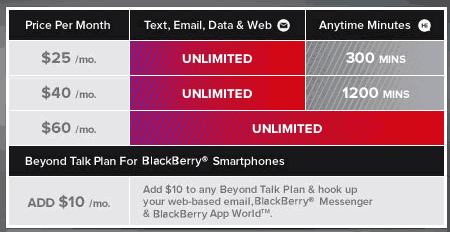
Virgin Mobile has a set of no-contract Beyond Talk plans that include minutes and unlimited data. Their lowest plan currently offers 300 minutes and unlimited data for only $25 a month. Previous post with more details here, but now you can buy an LG Optimus V with Android OS for $150.

However, starting July 20th, the price will increase to $35 a month for new customers. However, if you are an existing customer or activate by July 19th, you will be grandfathered in on the $25/mo plan. Edit: The 1200 Beyond Talk plans will increase $5 a month, while the unlimited will actually decrease $5 a month. So if you’ve been meaning to switch, you can save $60 to $120 a year by doing so before 7/19. I’m not sure how long shipping takes, so you might need to act quickly and find a phone in a store like Target or Walmart.

$25 including taxes is a great deal for light talkers who still want a full-featured Android phone with apps and all that. My mother uses Virgin Mobile prepaid and the coverage seems to be adequate in most areas. Virgin Mobile uses the Sprint network, but you aren’t allowed to roam on other networks like you are if you actually are a Sprint-branded customer. Any readers use this plan?

Netflix User Poll: How to Handle The New Pricing Changes?

Netflix users around the country are abuzz about Netflix’s new pricing plans. Previously, all DVD plans included unlimited internet streaming. Late last year the prices were upped slightly to $10 a month for 1 DVD out at a time, $15 for 2 DVDs, and $20 for 3 DVDs. (I’m rounding because I think .99 pricing is annoying.) Coming September 1st, 2011, Netflix has separated the DVD and Streaming options completely. Streaming is $8 a month, and there is no discount if you add it to a DVD plan. 1 DVD at a time is $8, making the total now $16 month – a 60% price hike. 2 DVDs at a time is $12, making the new total $20 a month, a 33% price hike.

Now, that’s one way to look at it. However, I really only used Netflix streaming very lightly. Instead, I can now get my 1 DVD a month for only $8. Or, I can upgrade to 2 DVDs for month for $12. I think that streaming video is the key to Netflix avoiding becoming the next buggy-whip manufacturer, and that making things a la carte was something that had to be done sooner or later. I just think the move came too early. Their streaming quality and selection is simply not good enough for me to pay $8 a month for it.

According to a reader poll last month, 63% of you subscribe to Netflix. So think about it for a minute… what are you going to do?

Netflix Subscribers: How Will You Respond To The New Pricing Plan Changes?

View Results

Loading ... Loading ...

Some people say that they are going to switch to Redbox or Blockbuster Express, but I’m actually probably going to go with the 2 DVDs for $12 plan, since I don’t like having to remember to return movies at the grocery store. If anything, this will push me to explore other online streaming options for the occasional “I’m bored and there’s nothing to watch” moments. I know that with a paid Amazon Prime membership ($79 annually) you can get free access to Amazon Instant Video as well as that handy 2-day shipping. Not sure how good their selection is, though. Alternatively, I could rent movies a month from iTunes at $1-$4 each, and they’d be new releases.

Wow, I Actually Found Some Unclaimed Money

Over the years, I’ve read numerous articles about “missing money” that the government may be holding for me. I would always enter my name, but there was never any unclaimed property for me… until today!

I was reading an Businessweek article about how California and many other states were using the interest from all their unclaimed money from things like dormant savings accounts to bridge their budget gaps. Even Warren Buffett is owed $20 from an old escrow account.

I visited the California Unclaimed Property page and found that I was owed $75 from an unclaimed check from “DSL SERVICES LITIGATION ACCOUNT”, which I can only assume is the result of being part of some class action settlement. I’ll have to send in a copy of my driver’s license and Social Security card for identity verification.

You can find your state-specific unclaimed property page via Unclaimed.org. You should search in any state where you have lived. MissingMoney.com is a related site that will search several participating databases all at once, but not all of them (like California, for instance). Finally, also check out TreasuryHunt.gov to locate any Treasury bonds and savings bonds using your Social Security Number.

While looking around, I saw several other official-sounding websites offering to locate missing money for a fee. Not surprisingly, one of them always “found” $156.16 in my name, whether it was James Smith or Iam Notsosmarten. What a scam, so watch out.

Are Cheap Calories The Reason We’re Unhealthy?

Unhealthy food is a lot cheaper than healthy food, on a price-per-calorie basis. This is illustrated in this chart about how many calories you can buy for a dollar from the Lapham’s Quarterly magazine, which corresponds to my own research ranking how much 200 calories of different foods cost:

Cost of 200 Calories: Less than 50 cents
image credit: wisegeek.com
Glazed Donut
$0.23
image credit: wisegeek.com
Potato Chips
$0.33
image credit: wisegeek.com
Snickers
$0.40
image credit: wisegeek.com
Gummy Bears
$0.40

.

Cost of 200 Calories: Over $1.00
image credit: wisegeek.com
Dried Apricots
$2.19
image credit: wisegeek.com
Baby Carrots
$2.50
image credit: wisegeek.com
Grapes
$2.55
image credit: wisegeek.com
Red Onions
$1.35

Recently the NYT Economix blog charted the historical change in price for different food categories relative to overall CPI inflation since 1978. This shows that the price gap is growing. For example, the the price of soda has dropped more than 30%, while the price of fresh fruits and vegetables has gone up more than 30% (both relative to other prices in general).


Source: NYT, BLS

It is pointed out that it costs about $5 to buy 2,000 calories at McDonald’s, $19 to buy 2,000 calories worth of canned tuna and $60 to buy 2,000 calories worth of lettuce.

But I’m not sure this means what we think it means. Do people really buy junk food because they need cheap calories? I think most unhealthy people get plenty of calories. Also, if you simply ate mostly rice and beans, you’d get plenty of calories for even less than McDonald’s. If all foods were the same price, would we really eat that much better? Perhaps it would help, but I don’t think lower prices would solve obesity.

I think the problem is people just eat what they want, and what they want happens to have way too many calories. If more health problems are caused by being overweight than malnutrition, then unhealthy people need less calories more than they need “better nutritional quality” calories. There are many studies that show that the less calories you eat, the longer you’ll live. Even severe calorie restriction (near-starvation) is believed to result in longer lives in a variety of animals including mice and monkeys.

What do people in countries where starvation is a real concern eat? Mostly rice with a little fish for flavor. Mostly beans and lentils with spices for flavor. Mostly cassava with a little meat and vegetables for flavor. They don’t eat a huge variety of things, and they eat mostly carbs. But they eat a lot less. If we can’t lower the prices of healthy unprocessed food, maybe we just need to eat less in general. But that takes self-control, which can also be hard to come by.

Frugal Gardening Tips for a Small Backyard

The following is a guest post from my wife, aka Mrs. MMB. I was whining like a spoiled child about how I needed to write up extra posts for when we’re traveling this week, so she kindly offered up her own tips.

Jonathan and I love eating fresh foods, and it tastes even better when we harvest it straight from our yard. We don’t actually have much space – just a 9 foot wide strip of land next to our house – but our garden is now so plentiful, that we are able to incorporate fresh veggies and herbs into almost every meal that we cook at home. Although the initial start up costs added up (a new garden and soaker hose, soil, and seeds), here are some frugal gardening tips that I learned:

Buy seeds. Seeds take a little longer to grow, but are much cheaper than seedlings at Home Depot. For example, one packet of thirty bell pepper seeds cost $1.99, where as one seedling costs $.99 to $3.99, depending on the size of your seedling.

Trade seeds with your friends: I always have an excess of seeds (I don’t really need 30 bell pepper plants!), so I bring my seed packets and extra seedlings to work and trade them with friends and co-workers. I also like to trade cuttings with co-workers; mint and sweet potato are especially easy to grow from cuttings. That way, I always have a variety of seeds and plants on hand, all for a very reasonable price of free.

Make your own compost. Like any gardener, I have a daily battle with pests and clay soil, but I try to do everything organically with things like Neem oil and self-made compost. Compost enriches our soil, and it decreases the quantity of kitchen scraps that go into our trash. Coffee grounds are especially rich in nitrogen and something that I would have otherwise thrown out. I really dig the fancy commercial compost bins, but they can easily cost more than $100 for the bin. Instead, I made my own compost bin from extra pieces of plywood and chicken wire. There are a lot of DIY compost bin instructions on the internet. I’ll be upgrading to a bigger bin soon, but for now, my little bin produces nice earthy compost.

Recycle! I love the idea of reusing household trash, and I use take-out chopsticks to label plants, an old milk carton to collect kitchen scraps, a plastic orange juice container as my “watering can”, and as an alternative to expensive jiffy pots, I like to use egg cartons to plant seedlings. Recycling, can also provide excellent alternative to expensive bell jars: I recently had a problem with especially voracious pill bugs, and I now use old water and soda bottles as cloches and bell jars to protect the seedlings from the bugs.

I also wanted pretty trellises, but a fancy manufactured trellis, though very pretty, can be expensive. Instead, I made trellises with inexpensive PVC pipes and a recycled old plastic fence that we would have otherwise thrown out. I simply screwed the PVC pipe onto the fence and bought a couple of two-foot rebar poles ($2.99 each) to anchor the “new” trellis into the ground. Voila! A vertical space for cucumbers, peas, and morning glories for less than $10!

Overall, I spend a few hours every weekend weeding, sowing, transplanting, and tilling, and 15 minutes everyday watering and harvesting goodies for our dinner. While I agree that gardening is not for everyone, I find gardening a very relaxing and rewarding hobby.

Reader Poll: Do You Buy Entertainment Coupon Books?

You may have heard of a huge annual coupon book that is known simply as The Entertainment Book. Compiled specifically for your local area, it includes discounts for restaurants, movie tickets, movie attractions, and services like car repair or nail salons. The most common are 2-for-1 or 50% off. If you enter your zip code online, you’ll be able to see the coupons inside ahead of time. (Some people also buy books from tourist places like Orlando or Hawaii.)

The retail price varies by area, but is usually around $35 to $50, although you can usually find an addition discount on the site (they know their target demographic of bargain hunters). Currently, you can buy the 2011 book for about $5 + free shipping if you agree to pre-order the 2012 book at $5 off retail + free shipping. In addition, you can go through the shopping portal Mr. Rebates ($5 bonus) and get an additional 30% cash back.

I have never bought one myself, mostly because of my love/hate relationship with coupons. I love discounts but never seem to remember to bring coupons along, and that makes it even worse than not having it at all! However, I was recently given an Entertainment Book as a present. This thing is thick! It was a thoughtful gift, and now I can actually see if this thing will save me money.

So far, flipping through it, I’m happy to see that they do cover a lot of nearby vendors. The deals are very localized, so my preliminary advice would be to look through the deals online, and add up which ones you know you can use without changing your existing shopping habits. Then, cut your expected saving by 50% for a margin of error. If you can still save money after that, then consider purchasing.

Have you bought an Entertainment Book before? If so, did you find it worth the purchase price?

View Results

Loading ... Loading ...

Book Review: Keep The Change – A Book About Tipping

If you want to start a lively conversation online, just bring up the topic of tipping. Keep The Change is basically a book that interviews the actual workers in the service industry to find how they view gratuities. The author is Steve Dublanica, which you may know from the Waiter Rant blog, and the tagline is “A Clueless Tipper’s Quest to Become the Guru of the Gratuity”.

The book starts with the history and origins of tipping. Why do we tip at all? To Insure Prompt Service? If you give the tips beforehand or regularly it can help, but that’s most likely not where the term comes from. Is it to reward good service after the fact? Again, probably not.

It turns out that the quality of service by the waitperson has almost no effect on what size tip s/he receives. Good service, awful service, whatever. In fact, researchers found the statistical correlation between service quality and tip to be merely 0.2. That’s about the same correlation as between service quality and how sunny it is outside. The author explores the many real reasons why people tip, and many of them have to do with psychological issues of avoiding shame, providing generosity, seeking approval, or showing off. Sometimes it’s plain bribery.

The rest of the book is organized into the different service industries. Waiters and waitresses. Bartenders. Coffee shop baristas. Beauty salons. Strip clubs. Casinos. Hotels (doormen, maids, bellhops, concierge). Cars (parking, mechanics, car wash). I love these kind of behind-the-scenes books that reveal their hidden attitudes and experiences.

I won’t divulge all the details, but my one-line takeaway from this book was “Everyone wants at least 15%”. We all know waiters. But a bartender wants 15-20% of the drink price total as well. Baristas from Starbucks to the super-fancy foam art places also want 15-20% of the drink price. Masseuses and haircuts? 15-20%. Note that this is what they deem appropriate, not what everyone actually gives.

Surprised? I’m betting this book will contain at least one new discovery for everyone. Hotel maids would like 2-3 dollars each day separately (a different person cleans the room each day). I used to just tip when I checked out because otherwise they may think I’m just leaving cash around. To avoid confusion, use a marked envelope. Tricky!

Another underlying theme seems to be how greedy business owners are simply shifting the role of paying their employees onto the customers. In fact, that’s quite possibly how tipping got started on sleeper train porters in 1894! And the customers pay up, promoting more “tip creep”. For most of the people interviewed, tips now end up making up 10-40% of their total income.

I’d rather everyone be paid a fair wage and everything to be rolled into the upfront price, but I appreciate this book because if I know the expected gratuity then I can include that in my own mental pricing. If I do use the service, I want to tip properly. But if the tip makes things too expensive, then I simply won’t use the service. For example, I might be okay with paying for a $100 massage but not a $120 one. If you hate not knowing expected customs as much as I do, I recommend this book.

Reader Poll: Do You Subscribe to NetFlix?

I’ll be honest, I did not see the success of Netflix coming. I thought it was a nice, cute DVD rental business that would probably be bought out by Blockbuster eventually, leaving their founders stupendously rich. But look around today: Blockbuster is bankrupt, and Netflix now has more subscribers than any U.S. cable or satellite provider, including Comcast.

That’s more than 24 million customers and growing (9 million added last year). Since the start of 2009, shares of NFLX stock are up 828% to $260 a share. Online streaming of Netflix videos now takes up 30% of all downstream bandwidth during peak hours. All those DVDs flying back and forth make up more than $600 million a year of the US Postal Service’s revenue.

I’ve been a customer of Netflix on and off during the last few years. I don’t watch very many movies in theaters, so when I feel like I’m falling behind popular culture references, I subscribe for a few months and catch up. The good thing is that Netflix makes it incredibly easy to stop, pause, and restart subscriptions. My “wanted” queue is stored. (You can only do the free month trial once per account.) I don’t own a Wii/PS3/Xbox and rarely stream video from my laptop, but I have noticed improvement in the selection available. How about you?

Do you use Netflix?

View Results

Loading ... Loading ...

Sources: BusinessInsider, Guardian