Bing Offers Free Turn-By-Turn Navigation on Windows Mobile Phones

This only helps a few people so far, but I know there are a lot of Sprint SERO users like myself who are still using Windows Mobile phones. Microsoft’s Bing Mobile application now offers free turn-by-turn navigation on WinMo 6.x OS, similar to Google Maps on Android OS. If you don’t have GPS, it uses cell phone triangulation. Sprint, AT&T, and T-mobile look to be covered, but on Verizon phones it is disabled due to VZ Navigator. See the full list of compatible phones here.

The second feature is turn-by-turn navigation for Windows 6.x phones, powered by Bing Maps. We took advantage of the Microsoft Tellme team’s expertise in voice applications to deliver an amazingly lifelike voice experience for the turn-by-turn navigation. If you have a Windows phones on Sprint, T-Mobile, or AT&T you can use the voice guided navigation.

I took it for a test run today on my Sprint Touch Pro2, and it worked well overall. The phone tells you to turn shortly before reaching an intersection. Bing did seem to have more trouble locating my position initially than Google Maps. Also, I have a screensaver-like app that shuts off the navigation sounds after 30 seconds of inactivity, which I need to figure out how to disable.

Still, can’t complain about free! It appears to only be a matter of time before similar navigation is free to anyone with a data plan.

Anyone Use CarBargains.com Price Negotiation Service?

The car buying strategy that I hear recommended most often is to

  1. decide on which car you want, down to all the options
  2. e-mail (or previously fax) the fleet managers of 3-5 local dealers, and ask for their best deal
  3. pit each of them against each other until you have the “best” best deal
  4. go in, sign paperwork, drive away happy

Sounds easy, but in practice seems like it might be tedious and time-consuming, not to mention uncomfortable for those that don’t like to haggle. However, I keep hearing mentions of CarBargains, run by a non-profit, will do all the negotiating for you if you pay them $200 ($175 if you are a subscriber to Consumer CHECKBOOK magazine).

Seems like it might just be worth it, but I haven’t heard any in-depth testimonials that aren’t on their site. Their press section includes several positive reviews from such magazines as Money and Kiplinger’s Personal Finance. They also offer a money-back guarantee if you can beat their price “without using their information”, although that would be hard to prove…

Has a reader out there actually used CarBargains recently? If you’d be willing to share your experience in detail, please contact me directly. I’d like to write a post with detailed price quotes and model information. If you participate and agree to having me interview you, I have some ideas for compensation. 🙂

Surviving the Great Baseball Card Bubble

From the 1630s tulip mania to the Roaring 1920s to the Dot-com Bust to Real Estate, I thought I had read about all the bubbles. But it seems that I forgot that I was right in the middle another one – the baseball card craze of the late 1980s and early 1990s.


I was about 10-14 during these years, in which I had just the right combination of a little bit of spending money, a love of sports, and greed. All my friends collected cards, and we traded them daily. Baseball cards were our form of currency. You could buy homework answers, protection from bullies, or even temporary popularity. I would secretly only spend half of my lunch money and go hungry for a few hours before running home to buy another pack of cards.

In the new book Mint Condition: How Baseball Cards Became an American Obsession, James Davieson tells the story of how this bubble formed and subsequently popped. This Slate article The Great Baseball Card Bubble includes a few excerpts. This one hit especially close to home:

American boys growing up in the 1980s approached Beckett Baseball Card Monthly with something like religious reverence. For many of us, it was the first magazine we bought and the only one we leafed through regularly. The magazine’s circulation eventually reached about 1 million, with many of those issues no doubt destined for the book bags of young boys. We walked the school hallways in the ’80s with our Becketts sandwiched between our textbooks, and we followed the price fluctuations of our favorite players with slavish devotion. Beckett’s valuations served as the foundation for all card trades.

To this day, I have about 3 years of worn out Becketts stacked up in my parent’s house. Looking back it was basically the stock market for kids, except instead of real-time quotes we only had monthly updates. Quality downgrades, riding momentum, pure speculation, it was all there. And just like mortgage-backed securities, when the mass media starts calling something a legitimate investment, a crash is soon to follow.

By the ’80s, baseball card values were rising beyond the average hobbyist’s means. As prices continued to climb, baseball cards were touted as a legitimate investment alternative to stocks, with the Wall Street Journal referring to them as sound “inflation hedges” and “nostalgia futures.” Newspapers started running feature stories with headlines such as “Turning Cardboard Into Cash” (the Washington Post), “A Grand Slam Profit May Be in the Cards” (the New York Times), and “Cards Put Gold, Stocks to Shame as Investment” (the Orange County Register). A hobby bulletin called the Ball Street Journal, claiming entrée to a network of scouts and coaches, promised collectors “insider scouting information” that would help them invest in the cards of rising big-league prospects. Collectors bought bundles of rookie cards as a way to gamble legally on a player’s future.

Of course I had to idea what inflation hedges were back then, but I did view them as an investment. Baseball cards were a store of value, and were sure to only increase as time went on, right? Even now, I still have a few unopened packs of 1989 Upper Deck, the first “premium” baseball card. I used to fight the urge to open them, balancing the curiosity of whether I had a Ken Griffey, Jr. rookie card, or whether it was better to keep it an unopened mystery.

I suppose I did learn a few things about personal finance in those days. But after reading all this, I figure I can complete my Nolan Ryan 1968-1993 Topps collection on the cheap. 🙂

Cell Phone Carriers: Money Back Guarantee Comparison

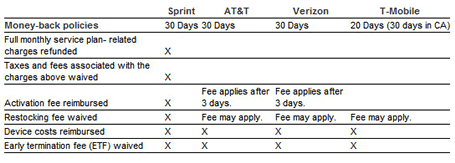
Sprint recently announced an improved 30 day ‘money back guarantee’ on new activations. You basically get virtually all fees associated with your phone returned to you, if you return your new phone within 30 days. You don’t pay activation fees, taxes, restocking fees, etc. Via Engadget.

If a customer isn’t completely satisfied, they can get reimbursed for the device purchase and activation fee, get the early termination fee waived, get a full refund for service plan monthly recurring charges incurred and get all associated taxes and Sprint surcharges associated with these charges waived. In addition, Sprint will waive the restocking fee for new customer exchanges as part of this policy.

They also provided a chart comparison the money back guarantees of the major cell carriers, which is informational even if it is obviously skewed in Sprint’s favor.

If you are thinking of adding a new line, don’t forget to see if you qualify for a corporate or student discount, often just using an e-mail address. Read the comments for more reader-submitted tips as well.

Sprint Cellular Discounts for Credit Union Members

I was browsing my local credit union’s website when I saw a banner for discounts on Sprint discount service at CUsaver.com. It advertises:

  • 10-15% off wireless plans
  • Waived activation and upgrade fees

You can view the discounted plans and phones on the site, which appear to be available to members of any credit union. It would be worth a try so see if the discount may be stackable with other discounts. To get the discounts, you must either call them or enter your phone number and they’ll call you back.

This seems like a great alternative if you can’t get in on a student or employee discount from a major cell carrier.

SellBackYourBook.com Review: TextBook SellBack Scam?

The other site I used when selling back my old textbooks online was and SellBackYourBook.com. All the websites I used did indeed eventually pay me for my books.

Reviews on the Web
I did not spend more than couple minutes on this, but a quick search did not find any claims of non-payment or scam reports on SellBackYourBook.com.

I found two Better Business Bureau listings for this site. One gave No Rating and the other gave an A- rating. SellBackYourBook.com does advertise that it is an BBB Accredited Business, so if you do have issues I would file a complaint.

My Personal Experience
After typing in my ISBN numbers into BigWords.com, SellBackYourBook was the highest bidder for certain textbooks. Although I found their site lacking polish, I went ahead and agreed to their price and terms, and they provided me with a printable packing slip and prepaid shipping label. Here’s part of the email sent to me:

This confirms that your order has been placed with Sell Back Your Book. Please print a copy of your packing slip and include a copy of it in the box with your books. A link to print your packing slip can be found at the bottom of this email. Please mark your order number on the outside of your box so that we can quickly check in your books and pay you (order number is listed below).

It took me a couple of days to get around to going to the post office, and mail it out via USPS Media Mail (formerly known as Book Rate). 20 days later, I received a confirmation email, partial text below. There was no 2nd email confirming payment was sent.

Thank you for your order. We have received your books and payment will be processed with in three business days.

A check was made the same day, and three days later it was in my mailbox for the exact amount the promised me for my books. It was from “Ez Book Recycle Inc.”, for which SellBackYourBook.com is the sourcing arm. In total, 23 days went by from mailing out to receiving the check.

Summary Timeline

Day 1 – Sent out book via USPS Media Mail

Day 20 – Email confirmation of arrival

Day 20 – Check printed and mailed out

Day 23 – Check received successfully

Valore Books Review: TextBook SellBack Experience

It’s been about a month since I wrote about selling back my old textbooks online. I ended up selling books to two websites, ValoreBooks.com and SellBackYourBook.com. I figured I’d do a quick review of each one, starting with ValoreBooks.

Reviews on the Web
There were some online accusations at RipOffReport and ComplaintsBoard from people who said that ValoreBooks was a scam because they mailed off their books and never received any payment at all. It’s hard to prove anything because ValoreBooks only covers your Media Mail postage to their warehouse, and it is your option to buy Delivery Confirmation or other sort of tracking. But if I’m only selling $15 worth of books, it’s hard to just paying another $1-2 in my opinion. Perhaps for a larger order.

The Better Business Bureau gives them a rating of A+, although I don’t really think it’s that hard to achieve such a rating. It does indicate that the company is willing to try and resolve issues, if you file a complaint with the BBB.

BBB processed a total of 21 complaint(s) about this business in the last 36 months, our standard reporting period. Of the total 21 complaint(s) closed in the last 36 months, 21 were closed in the last 12 months.

My Personal Experience
After typing in my ISBN numbers into BigWords.com, ValoreBooks was the highest bidder for certain textbooks. I agreed to their price and terms, and they provided me with a printable packing slip and prepaid shipping label. Here’s part of the email sent to me:

Please follow the steps below to complete your order:

1. Include your packaging slip with your shipment.
2. Package your books tightly in a cardboard box or padded envelope.
3. Cut out your prepaid shipping label and affix it to your sealed package.
4. Drop off your package at your local Postal Office.

It took me two days to get around to going to the post office, as you have to drop off the package in person for items weighing more than a pound. “No, this is not an explosive.” Would I really tell you if it was?

Then came the waiting game. Media Mail is notoriously inconsistent, so I almost forgot about the book when 15 days later I received the following confirmation in my email:

ValoreBooks Ship to Us Order: 1026XXX Arrived
Your sell back order has arrived at our warehouse and will be processed within 48 business hours.

I’ll never know if it really took 15 days to get there, or if they just sat on it for a while. In any case, one hour later I received another e-mail:

ValoreBooks Ship to Us Order: #1026XXX Confirmed
Thank you for choosing to sell your book(s) with ValoreBooks.com. […] Your order has successfully been checked in and you can expect payment within 10 business days to the following address: […]

Six calendar days later, a check was in my mailbox from “Bucks4Books” of San Diego, CA. I did get the exact amount the promised me for my book and reported condition. In total, 22 days went by from mailing out to receiving the check.

Summary Timeline

Day 1 – Sent out book via USPS Media Mail

Day 16 – Email confirmation of arrival

Day 16 – 2nd Email confirmation of payment approved

Day 19 – Check printed and mailed out from ValoreBooks

Day 22 – Check received successfully

Grocery Prices: Name Brand vs. Store Brand vs. Organic

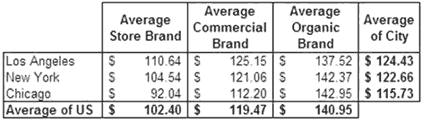
Here are the results of a recent study by industry research firm IBISWorld that compared the price of an average grocery cart in Los Angeles, New York City, and Chicago.

In general, organic products cost about 20% more than simply name brand items. However, the organic grocery cart is nearly 40% more expensive than a cart filled with store-branded products whenever possible. I wish there was more information on what makes up an “average” grocery cart, but I’m guessing it contains a wide variety of items.

Which reminds me of a previous post on which fruits and vegetables you should buy organic. If you value organic but are still on a budget, certain conventionally-grown vegetables retain much higher amounts of pesticides than others. Prioritize your spending with this updated list from Foodnews.org (you can even download an iPhone app with the chart):

Cheap Airfare Links & Bookmarks

This week, the New York Times offered up two helpful articles about the current best sites for finding cheap airfares: Booking a Flight the Frugal Way by the Frugal Traveler and Sites That Do Your Fare Digging by the Practical Traveler. I guess nobody wants to hear from the Disturbingly Rich and Wasteful Traveler.

Instead of having to read through these long articles again every time I need to book a flight, I found myself just making a list of all the handy links that were thrown out.

  • Kayak.com
  • Bing Travel (also bought FareCast)
  • Momondo.com
  • ITASoftware.com (doesn’t sell tickets)
  • cFares.com ($50 annual fee, but pays rebates)
  • Yapta.com – Tracks flight prices
  • Vayama.com – International flights
  • Airfare.com – International flights

American Express Extended Warranty Review

Roomba VaccumIf you’re like me, you’re vaguely aware that you can get some sort of additional warranty coverage from your credit card, but not interested enough to carefully read those little brochures with the tiny print that come in the mail. Today a fellow named Joe sent me a story about his broken Roomba which describes his experience with American Express when his beloved vacuum broke after 18 months, which was 6 months past the manufacturer’s 1-year warranty. It’s a bit long-winded, but in the end AmEx did refund his original $300 purchase price. After reading it and doing some other hunting around, here’s a summary of the American Express Extended Warrant feature:

The Basics

All American Express (AMEX) cards (as well many versions of Visa and MasterCard) offer an automatic warranty extension if you buy the product using their card. Specifically for American Express, here is the fine print from the their FAQ page:

1. How does the Extended Warranty work?
When you charge the cost of a covered product with your American Express® Card, the Extended Warranty will extend the terms of the original manufacturer’s warranty for a period of time equal to the duration of the original manufacturer’s warranty, up to one additional year on warranties of five years or less that are eligible in the U.S.

In other words, in general they will double the original manufacturer’s warranty, but only up to one year. This is unless your product has a warranty of over 5 years as default. If you are still covered by the original warranty, you must go through the manufacturer. You do not need to sign-up or perform any kind of activation process to get this extended warranty.

Things You Need To Keep

American Express seems to advertise this service the most, and anecdotally is one of the best at actually coming through with their promise. However, you’ll still need to keep several pieces of information to support your claim. For all your big purchases, use an AmEx and keep these papers somewhere organized!

  • The original purchase receipt, which notes which product you bought, the date of purchase, and that it was bought entirely with an American Express card.
  • The product warranty card, which outlines the details of the original manufacturers warranty.
  • Your old AmEx credit card statement, which lists and matches the purchase receipt above.
  • The broken product. AmEx may choose to replace your item, repair it, or refund the purchase price. They choose, so keep what you have until they say so. If they replace it, they may ask you to send the broken item back to them.

Filing a Claim

To start a claim, the Extended Warranty department’s phone number is 1-800-225-3750. You can check the status of your claim online at www.americanexpress.com/onlineclaim. Be prepared to wait two weeks for the claim to process after submitting support materials.


Starwood Preferred Guest Credit Card from American Express

My Swiss army knife of travel rewards cards. You get 1 point per $1 spent, and 20,000 Starwood points = 25,000 airline miles (free ticket). Essentially up to 1.25 miles per dollar spent, and you can convert to a variety of airlines or free hotel rooms. Top off an account, or convert a big lump sum.

Currently, the sign-up bonus is 10,000 points after first purchase. On top of that, you can also get an additional 15,000 points by spending $5,000 on the card within the first 6 months. Annual fee is waived for the first year, and is $65 the second year if you keep it.

American Express Disclaimer: This content is not provided or commissioned by American Express. Opinions expressed here are author’s alone, not those of American Express, and have not been reviewed, approved or otherwise endorsed by American Express. This site may be compensated through American Express Affiliate Program.

Ooma Landline Phone Number Porting Timeline & Review

oomahub

You may recall that I recently bought an Ooma VoIP Telephone system since it offers me unlimited phone service for an upfront price of about $200. Porting your landline phone number over to Ooma costs $40, but can be worth it for some folks. (It’s also free with a 1-year $99 subscription to Ooma Premier service, which includes a second phone number.)

Although Ooma warns that it can take up to 4-6 weeks, the results are highly dependent on your local telephone company. I thought I would share the timeline of a friend’s successful port which took 19 days.

Day 1 – Filled out port request online.

Day 3 – Faxed/e-mailed in required paperwork, which required some signatures and a copy of recent phone bill.

Day 9 – Received the following e-mail from Ooma. Emphasis is mine.

You’ve recently requested your phone number to be ported to ooma. We have submitted all of the information you provided to your current Carrier and are still awaiting confirmation. We will notify you via email once we have confirmation of the actual completion date.

Please keep in mind that if you have DSL on the same number that you requested to port, you will lose your internet connection when your number is ported. ooma will not work without a broadband connection, so this is a friendly reminder to insure you do not experience down time.

Day 12 – Another e-mail from Ooma.

You’ve recently requested your phone number to be ported to Ooma. The expected completion date of your request is scheduled for 12/29/09 [Day 19].

Day 19 – Final e-mail from Ooma.

Thank you for placing your order with ooma, your porting request has been completed. Please reboot your ooma hub so your account will be updated with this number. You may also contact your local carrier to cancel your account with them.

As promised, on Day 19, the regular landline phone went dead. If you called it, it said “This number is no longer in service.” But after rebooting the Ooma unit, all calls were immediately picked up by the new Ooma line. After calling the telephone company to cancel, they said that everything was already terminated and that the final bill would come in shortly. I guess since the number was already gone, they had no reason to try and convince me to stay.

In general, I think Ooma did a very good job of providing regular updates during the process. The overall process was as smooth as could be expected, with the worst part being that it still took 3 weeks total.

15-Minute Resolution #2: Start Spending Consciously

Alright, now for a 15-minute 2010 Resolution that doesn’t make you spend less, just better. Huh? Achieving financial success doesn’t mean pinching every single penny all day long and watching your net worth ticker inch upwards. It means spending money on what you enjoy, and not wasting it on things that you don’t (like credit card interest).

An interesting exercise to help you focus is to list ALL your voluntary expenses, and then organize them by priority. When I say voluntary expense I mean that you should generally ignore bare expenses like rent for a single room and basic food. This is not a rigid exercise, but mostly to get you to think more about spending consciously. Again, don’t spend more than 15-minutes on this.

What is your most important expense?

What is your LEAST important expense?

For example, your list might look something like this, from most important to least important:

  • Mortgage on my dream house
  • Yearly travel
  • Monthly iPhone Bill
  • Dining Out
  • Daily Starbucks
  • Rounds of golf
  • Cable TV
  • Beer & Alcohol

You might think, well everyone is going to put housing first. No, in fact it may be at the bottom. Maybe you live in a luxury downtown urban condo right now, and would rather save $1,000 per month and share a 4-bedroom house with a bunch of friends and spend that money on private French lessons and wine. Only you know!

Now write down your list and place it somewhere visible. Make it your computer desktop background if possible. Next time you spend any money, you’ll think twice about whether you’d rather allocate it to something more important to you. You can now finish the rest of the 2010 with a better frame of mind.

In addition, the next time you run into a money hiccup, you’ll know what to cut first before dipping into savings or *gasp* stopping your 401k contributions.

See all the 2010 Instant New Year’s Resolutions here.