Restaurant.com: $25 Certificates for $1

Restaurant.com is offering a whopping 90% off with the coupon code NINETY, resulting in a $25 “certificate” for $1. Starts midnight 9/9/09 and expires in 90 hours.

I have never bought one of these certificates, due to all their restrictions and fine print. Here are just a few:

  • The “retail” price of these things is $10, and they still have to discount, so that should tell you something about the true value.
  • Participating restaurants are limited, and usually offer either bad food with okay prices, or good food with really high prices. I have never seen a restaurant on their list that I have been a regular diner at already.
  • Virtually all restaurants require a minimum purchase of $35+, making these more coupons than gift certificates. Also, they can often only be used on Fridays or weekends.
  • You have to triple-check that any specific place still takes the certificate, because the website may be outdated and turnover is high. Showing up with friends, only to be turned away, is annoying.
  • You have to announce that you’re paying with a certificate before you order, which for some has affected food quality and/or service. Be sure to tip on pre-coupon amount. Some restaurants will mandate a 18% tip on the pre-discount bill.

Still at $1 a piece, it might be worth a shot if you can find one decent participating restaurant. For those that have used these before, how did it work out?

Price Targeting, Coffee Shops, and Supermarket Secrets

I recently started reading The Undercover Economist by Tim Harford. So far, it’s a little like Freakonomics but a bit more economics and with slightly less controversial topics.

One interesting concept explained was price-targeting. Let’s say a coffee shop has to spend 50 cents to make a cup of coffee, including labor and materials but not rent. Now, each person walking by has a certain trigger price. If the coffee is cheaper than their personal trigger price, they buy, and if the coffee is more expensive, they don’t buy.

In a perfectly efficient market, a person would be honest about their trigger price, and a business could sell their coffee to anyone whose trigger price is above 50 cents. A frugal person might walk up and pay 75 cents, while a spendthrift coffee addict in a rush would pay $4 for the same cup. Obviously, this wouldn’t work in the real world, so stores have to find a way around this. Getting people to pay as close to their trigger price as possible is called price-targeting.

Instead, you have the current Starbucks menu = an entire wall of caffeinated options differing slightly by roast, size, flavoring, and preparation. When I need to get out of the house, I usually go in and get an iced coffee for about $2. They will add milk, or I can add it myself and you can get their syrup sweetener for free since sugar packets are hard to dissolve in cold drinks. Alternatively, a frappaccino is basically the same time but blended with some whipped cream for $3.50. So the “frugal” version is for the people looking to spend $2 on coffee, and the “premium” frapp is for those willing to spend over $3. The frapp probably cost around 10 cents more to make, while Starbucks made an additional $1 in profit.

A similar thing takes place in supermarkets, and is summarized well in this CFP Board newsletter article Taking Aim at Price Targeting:

Imagine you’re at the supermarket and want to buy a bag of chips. If you tend to be an impulse shopper, grabbing the first thing you see, you’ll likely end up with the most expensive chips available, conveniently placed at eye level by the supermarket’s thoughtful management. If you’re bargain conscious, however, a brief scan of the shelves will reveal cheaper chips tucked away closer to floor level. By offering similar products at different prices, the supermarket can make everybody happy: the impulse shopper gets her chips, the bargain hunter gets his bargain, and the supermarket maximizes profits from both types of customer. “In price targeting, customers pay what they are willing to pay,” Harford says. “It doesn’t depend on being a sucker. It’s even a good thing because if companies weren’t able to target, then nobody would get the lower prices.”

This is also why supermarkets have sales on a rotating range of products, instead of the same products or just lowering prices in general. The price-sensitive frugal folks will pretty much only buy what is on sale, and they’ll be drawn in and the store will make a little profit with slimmer margins. The people who never check what is on sale or are just buying ingredients required for a specific recipe will end up buying a lot of non-sale items which are marked up at a higher profit margin. Again, the store tries to get as close to a “perfect” market as possible.

The lesson? Be aware of price-targeting, be aware of your own tendencies, and look around to make sure you’re getting the best price when presented with a variety of options.

Budget Long-Term Travel: Explore Longer For Less

The following is a guest post from Matt from NomadicMatt, who as you might guess has a passion for travel and doesn’t like to stay in one place for too long. He wrote this while running around Spain! If you like what you see, I encourage you to check out his site for his travel blog and other travel tips.

One thing that always irks me about my fellow countrymen is the huge perception that travel is expensive. With only two weeks away a year, I can see why a lot of people would want to splash out on an expensive holiday. There’s nothing wrong with that. But a lot of people spend more money and get less value. They spend money on things the travel industry tells them they need but could find much cheaper. I’ve been traveling around the world for three years and whenever, I have friends come visit me in places, they are amazed at how little they spend compared to what they thought they would. I don’t penny pinch but I don’t spend money stupidly.
Take for example my trip to Thailand with a co-worker. Flights to Thailand can run anywhere between 800 and 1200 dollars for an economy class ticket. You can only hope to get on the lower end and sites like Momondo and Mobissimo are good at that. Additionally, you can check out my page on how to find cheap flights. My friend asked me how it would cost her for the two and half weeks we were going to be there. Should she bring 1,000 dollars? 1,500? Thinking about what I had planned for us, I told her $700 should be enough, unless she wanted to shop – then she should bring a few hundred more. She didn’t believe me but I was right. Here’s the break down:

  • Accommodation – Typical double bed room with shower, fan, or a/c. Nothing fancy but not super dirt, “I see a cockroach” cheap either. It cost us 20 dollars a night, which was split by two people.
  • Transportation – We took the local buses and trains around the country. They are very cheap with a train costing only a few hundred baht. (It’s 35 baht to one dollar). Overall, we spent $50 dollars on transport.
  • Food – Having lived in Thailand, I know the best food there is on the streets, which is also the cheapest food. A meal is about 30 baht. We also ate a lot of seafood on the islands which is about 300 baht a meal. Throw in a few sushi and Italian dinners at about 800 baht each and in total for 2 1/2 weeks we spent about 3,500 baht on food, which is $100 dollars.
  • Alcohol – We like to party so this was a bit of a budget buster. We easily spent $100 USD on going to clubs and beach parties.
  • Tours – We took one tour through the national park that cost us 1,500 baht for two days. The guides spoke perfect English and new things about the area that amazing. When we went to the beach, we did a snorkel tour for 500 baht.
  • Other sights – We spent about $10 dollars on the palace and temples in Bangkok.

So for 18 days we spent about $560 dollars per person, or about $31 a day, without skimping on anything, eating the local food, taking a few tours, and doing nothing really cheap. For 18 days, that is not a lot of money.

Thailand is a cheap country so I’m always amazed when people walk away spending lots of money. A typical two week tour to Thailand runs about $1,000 dollars from Gap Adventures, which actually specializes in inexpensive tours. We spent less in longer. (Editor’s note: Or you could stay an entire month for the same price of $1,000.)

Moreover, when most people travel to Thailand they stay at the big international hotels like the Marriott or the Sheraton, fly everywhere, and stay at luxury beach bungalows for 2,000 baht a night. When they eat, they eat out at fancy places. Relative to their home country, whether the U.S. or Europe, this may seem like a bargain (Wow! I just got a beach bungalow for 70 dollars a night!) but compared to how living locally is a third of the price, you aren’t getting good value for your money.

If luxury is what you want, go for it but if you want more value for your money, live more like a local, take the local transportation, and stay in middle of the road places. You’ll save a lot of money but also get to know the pulse of the location more. There’s nothing wrong with spending money but I find not getting the most out of the money you spend a waste.

(Photo credit: NomadicMatt)

Personal Finance Education, Delayed Gratification, and Marshmallows

Many people agree that there should be more personal finance education in school. This is supposed to be one of the keys to making the average person save more money, have less credit card debt, and invest wisely. You know, teach a high schooler the wonder of compound interest and the related trap of credit card minimum payments.

But I’ve perhaps the problem is even more basic than that. I recently ran across something called the Marshmallow Experiment by Walter Mischel. Check out this video (hat tip to Rob Garcia of LendingClub):

Here’s a quick summary of the original 1960s study. A group of four-year olds were put in a room with just a chair and a table. The kids could pick either a marshmallow, a cookie, or a pretzel stick. The child was then given an option. They could either eat one marshmallow right away, or if they waited until the researcher left and came back, they could have two marshmallows. How long could they wait? The researchers continued tracking them and found that those with the ability to wait were better adjusted, had less behavioral problems, and scored an average of 210 points higher on the Scholastic Aptitude Test.

Teaching Delayed Gratification
Along the same lines, I think a core requirement of good personal finance “education” is teaching people delayed gratification. Imagine how many adults wouldn’t be able to wait a year to get $500 versus getting $250 today. If you can exercise such self-control, then you won’t buy things on credit cards because you “gotta have it now”. You’ll be able to save money towards a retirement that may be decades away. It will be easy to spend less than you earn.

How do you teach delayed gratification? Since it would require years of practice, you’d want to start early and the responsibility would fall heavily on the parents. From an interview with Mischel in a related New Yorker article:

“This is where your parents are important,” Mischel says. “Have they established rituals that force you to delay on a daily basis? Do they encourage you to wait? And do they make waiting worthwhile?” According to Mischel, even the most mundane routines of childhood—such as not snacking before dinner, or saving up your allowance, or holding out until Christmas morning—are really sly exercises in cognitive training: we’re teaching ourselves how to think so that we can outsmart our desires.

But of course, not all parents will do that. So the problem is then how do we systematically teach children this skill in school, which is what researchers are working on now. In my opinion, that would be the ultimate in personal finance education. Because if you don’t have the ability to defer gratification, then learning about index funds isn’t going to help very much.

Finding The Actual Hotel Name On Hotwire.com Before Purchase

This is a follow-up to my 5-Step Guide to Finding The Lowest Rate For Hotel Rooms, which includes tips on using “opaque” sites like Hotwire.com and Priceline.com to save on hotel rooms.

Specifically, I’ll show you how to greatly improve your guess as to which hotel you’re actually bidding on Hotwire.com before pulling out your credit card. This was initially inspired by a helpful comment by reader Nasty N8, but I expanded and altered his advice a bit.

Finding The Hidden Hotel

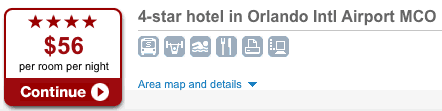
When you run a search for hotels on Hotwire, you only get the price, star rating, and the general neighborhood. For example, here’s a search result for hotels near the Orlando airport (MCO) on 12/20/09.

Hotwire Participating Hotels
I see that I can get a 4-star hotel near MCO for $56+taxes. But which one? How do I know if it is any good? Using the Hotwire Hotel List for Florida at BetterBidding.com, I scroll down to the Orlando MCO section and see two listings: Hyatt Regency Orlando Airport and Renaissance Orlando Hotel Airport (Marriott). Again, this list is not 100% accurate, but it does provide a shortcut possibility and also another data point for later (see scenic route).

TripAdvisor Clues
I click on the red box “Continue” to see the total with taxes per night ($69.45), and also learn more details about the actual hotel. If I scroll down I see some information from TripAdvisor.com:

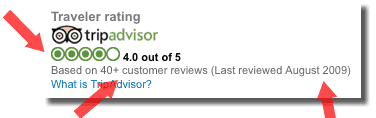
With this information, I can usually reverse engineer the specific hotel from the TripAdvisor (TA) site. There are three points of interest here:

  1. Tripadvisor Traveler Rating (Out of 5). Based on customer reviews, this is an average rating of quality. Sometimes they won’t match up perfectly (i.e. TA will show 3.5, but Hotwire will round up to 4), but most of the time they will.
  2. Number of reviews. This will not be exact, but instead be rounded off to the nearest 20. So if TA has 35 reviews, then Hotwire will say 20+. If TA has 41, then Hotwire will show 40+.
  3. Date of last review. Simply look at the date of the first review you see on TA, and compare with this date.

Mix-n-Match
Let’s go back to the initial hotel list. Here are the Tripadvisor pages for the Hyatt Regency (4.5 dots, 163 reviews, last on Aug 2009) and the Renaissance Hotel (4 dots, 57 reviews, last on Aug 2009). Remember, 57 is the same as 40+.

We see here that the most likely hotel is the Renaissance Orlando Hotel, with all factors matching. At Expedia.com, this hotel would have cost $112 per night with taxes on the exact same day. By doing a little legwork, you could secure a savings of over $42 per night (38%).

The Scenic Route
If you did not find a match, then the hotel may not be updated on the list yet. Here, you’ll have to run a search on Tripadvisor. Use the “Hotels” tab and act as if you want to book a hotel, using your travel dates and everything. Do not just use the search box. Now, the left sidebar will have a ton of options to narrow down your search results. Again, use your region, your Tripadvisor rating, and also the star class rating. (Note: The hotel class “star” rating by Tripadvisor will sometimes vary from the ratings from Hotwire, so you might allow one star difference either way.)

Here is a nice screenshot that shows how I narrowed it down to 6 hotels. As you can see, the only hotel left that matches the Tripadvisor stats is… again the Renaissance Orlando Hotel!

You can also do this down the line with all the different Hotwire search results. Now that you can figure out the actual hotels, you might feel that $50 a night at a 3-star Holiday Inn is better than $100 at at 4-star Hyatt. Happy hotel hunting!

How The Average U.S. Consumer Spends Their Paycheck

Here’s an interesting graphic of the spending breakdown for the average U.S. consumer. It’s based a theoretical household “unit” consisting of 2.5 people, not individuals. Looks like such a household unit spends approximately $50,000 per year. Click on image for larger version.

I guess taxes are not considered an expense by the government. 🙂 I’m not sure where leisure travel or vacation spending falls under, perhaps split as transportation and housing?

The image was created by Visual Economics, using information taken from the Consumer Expenditure Survey by the U.S. Department of Labor.

Historical Net Worth & Goal Chart Updates

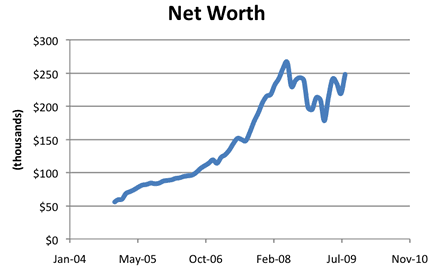
I finally got around to updating all my net worth charts and graphics. Here is my net worth since I started tracking it on this blog in December 2004:

You can also view my net worth since graduating from college in my Net Worth page. You can download my tracking template here.

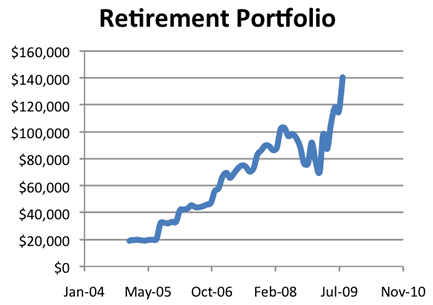
Since I had all the data handy, I also put together a chart of the value of my retirement portfolio. This is simply the sum of all the money in our 401k/IRA/403b’s over the years, including any gains/losses and contributions. Since I did a Traditional-to-Roth IRA conversion a while back, I normalized all the values by taking 30% off of any pre-tax account values. Therefore, the chart is of (estimated) after-tax balances.

As you can see, my portfolio is small enough that regular contributions have been able to counter the rather mediocre returns over the last 5 years so. The swings in our property value is also contributing to making our overall net worth very volatile recently.

Goal Tracker Chart
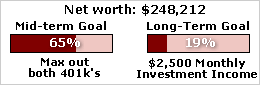
I also wanted to update my little goal meter on the top-right of every page. I updated our 401k contribution progress; we are on track to max them out for 2009. My first long-term goal is pay off my home mortgage, so I won’t have a house payment anymore. My second is to build a $750,000 investment portfolio. More details here.

At a 4% inflation-adjusted withdrawal rate, a very rough rule-of-thumb, $750k would create an annual income of $30,000 per year ($2,500 monthly). This should cover all our non-housing expenses. At the current $140,000 value, I’d theoretically be able to produce about $467 of “passive” income per month.

I’d like to come up with a better graphic to track these things, but for now I’ll stick with the progress bar. Any creative ideas out there?

Costco Membership Certificates w/ $50 in Free Costco Coupons

Update: Costco is no longer allowing me to sell these certificates. Sorry!

See Is Costco Executive Membership worth it?

Goldstar: Half-Off Local Events In 8 Major Cities

Feeling the recession, but still want to get out of the house? You might consider signing up for Goldstar, which helps you to “Go out more”. They offer half-price tickets on plays, concerts, sporting events, and museum exhibits.

So far, it includes events in these areas: Los Angeles, San Francisco, Chicago, D.C. Metro, New York, Boston, San Diego, and Las Vegas. Events are summarized into weekly e-mails, and there is also a social networking component where they collect a lot of individual reviews of each event.

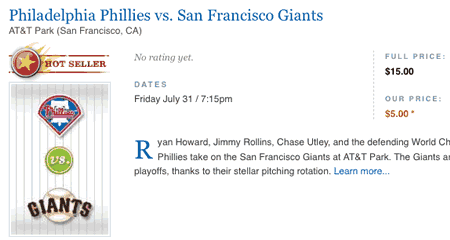
For example, if you live in the SF Bay Area, you could ride an all-day Golden Gate Bay Cruise this weekend for $11, see the Giants play baseball tonight for just $5, watch professional beach volleyball for $5, or even watch bassist Charlie Haden at Yoshi’s Jazz Club for free.

They do tack on a service fee for each ticket, which varies but is at least disclosed relatively early. I saw from $2 to $6 per ticket. Also, for each new friend you refer that joins Goldstar, you get $1 credit towards service fees.

The Hawthorne Effect and Better Money Management

I was reading an article in Wired Magazine about improving one’s health with new personal metrics devices such as the Nike+iPod kit, which is a neat device that helps you easily track and records details about your running. Did you know that all it measures is the amount of time your foot is on the ground? (That time is inversely proportional to your speed.)

The Hawthorne Effect
In the 1920s, the management at the Hawthorne Works factory decided to try some things to improve productivity. When they improved the lighting, workers assembled parts faster. When they were given more breaks, workers assembled faster. But then, the reduced the lighting back to normal, and productivity was still increased. After months of tinkering, when all the work conditions were set back to the original state, productivity remained higher. The fact that they were being watched was the primary reason things changed.

The idea that the act of observing itself will change the phenomenon being observed became known as the Hawthorne Effect (also known as the “observer effect”), and has since been confirmed by many other follow-up studies.

Application to Personal Finances
While this seems like common sense, it is actually quite powerful to know that simply noting down what you spend every day or month in itself may improve your finances. You could set a budget or analyze trends later, but don’t worry about that for now. Don’t judge your expenses. Don’t try to change them. Just track them.

On that front, online aggregation sites like Quicken Online, Yodlee, Mint, and Geezeo make the data collection easier, just like the Nike gadget takes away the stopwatch and logbook. They all pull up your transactions automatically (if you trust them with your passwords and data). Otherwise, I still see nothing wrong with using simple pen and paper and/or a spreadsheet.

Making a Habit
Nike also found that once a Nike+iPod user uploads five runs to the software, the user is much, much more likely to keep running and uploading data. Maybe it would be good to set a goal of tracking expenses for… 5 weeks? 5 months? We need time to get addicted to the stats!

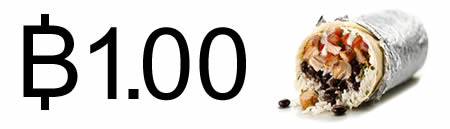
What Is Your Motivational Burrito Currency?


(image credit: chipotlebreakfast.com)

Sometimes people wonder why a guy who makes a six figure salary will still bother to fill out a form for a free razor, or sign up for a credit card for the $100+ bonus. Well, for one thing it’s a habit leftover from making $15,000 per year. Back then, adding anywhere from $2,000-$5,000 a year to my annual income from various shenanigans was a huge benefit. It allowed me to enjoy niceties like not eating spaghetti three times a week and booking flights to visit my girlfriend (while still paying down student loans).

In this way, I started to correlate little savings with specific things. $5 meant a plate at the Indian food cart or a loaded burrito. So $100 wasn’t just an amorphous $100 to be deposited into a bank and forgotten, it was 20 meals. I’ll do XX for a month of naan & curry!

By extension, creating additional freelance income of $1,000 to me meant a flight + hotel to a new and strange spot in the world I hadn’t been before. For another person, they might think in terms of Lucky jeans, automotive gear, or ski lift tickets. I know this is a consumeristic form of thinking, but you don’t have to spend all the money you make, nor do you have to save all the money you make.

Do you have a form of motivational currency? Or is cash king?

My Dog’s Favorite Chew Toy Is Now Free

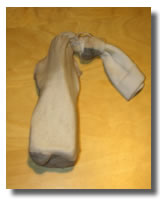
This might be completely obvious to others, and I’m probably opening myself to ridicule, but I only recently discovered it and find it awesome. If you have dog that like to chew things, many of those fancy plush squeak toys last about a day. But if you take an empty plastic water bottle, slip in inside an old sock, and tie off the end, you now have an endless supply of free dog toys!

I did this after finding $10 “bottle buddies” at a dog store, and have already gone through three of these things in a little over a week. Removing the cap and ring helps avoid a choking hazard.