Reminder: Why Do We Bother Investing In The Stock Market?

These days, a lot of people are asking themselves this very question. For most, including myself, I have a unsatisfying answer:

We don’t save enough money.

Think about it. If I had a billion dollars and my current lifestyle, I could simply build myself a Scrooge McDuck vault and just spend it gradually. No banks, no stocks, no bonds.

But I don’t. I have to try and fund both our ongoing and future expenses with our income. In order to make this more likely, I need higher returns. Unfortunately, this sometimes means investing in things that are riskier. Things that can drop 45% in less than a year!

What kind of after-inflation returns can I expect from stocks?
I explored the sources of long-term stock returns here. But as correctly pointed out they are nominal (before-inflation) returns . What about real (after-inflation) returns? Isn’t that what really matters?

Here is the adjusted equation:

Expected Real Return = Real Earnings Growth + Dividend Yield

Historically, the real earnings growth has been estimated at around 2%. At current depressed prices, the dividend yield of the US Stock Market as a whole is about 3%. Thus, this suggests that we can expect 5% real returns before expenses.

But don’t take my word for it, take it straight from Warren Buffett, in this semi-famous 1999 Fortune magazine article:

Let me summarize what I’ve been saying about the stock market: I think it’s very hard to come up with a persuasive case that equities will over the next 17 years perform anything like–anything like–they’ve performed in the past 17. If I had to pick the most probable return, from appreciation and dividends combined, that investors in aggregate–repeat, aggregate–would earn in a world of constant interest rates, 2% inflation, and those ever hurtful frictional costs, it would be 6%. If you strip out the inflation component from this nominal return (which you would need to do however inflation fluctuates), that’s 4% in real terms. And if 4% is wrong, I believe that the percentage is just as likely to be less as more.

4% real return, which was after taking out 1% in assumed management fees and commissions, again brings us back to 5% after-inflation returns from stocks. In exchange, we get a lot of volatility – big dips and peaks, and the dips can last a long time.

What if we wanted to take minimal risk?
I am nearly done with reading a book by economist Laurence Kotlikoff and financial advisor/columnist Scott Burns called Spend ‘Til the End: The Revolutionary Guide to Raising Your Living Standard–Today and When You Retire. In it, instead of recommending a portfolio of mostly stocks and adjusting from there, they start from the other direction. They believe you should start with a portfolio consisting entirely of inflation-protected bonds and see if you need more return from there.

Treasury Inflation-Protected Securities (TIPS) are bonds issued and backed by the U.S. government that promises you a total return that adjusts with inflation. Very generally, it works like this: if the stated real yield is 2% and inflation ends up at 4%, your interest payment would be 6%.

Coincidentally, the last few weeks have given us a huge surge in the real yield offered by TIPS, around 3%. This is the highest it has been in many years:
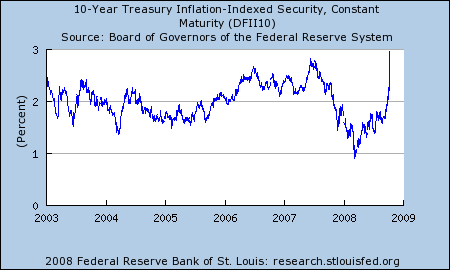
If you had enough money, such that a fixed 3% after-inflation return is adequate for your needs, then you wouldn’t have to take on very much risk. You wouldn’t have to own any stocks at all. Of course the market value of these bonds will still vary along the way, but if you hold until maturity you will get the real yield. And it is guaranteed by the government, just as much as “regular” Treasury bonds.

More thoughts…
If you invested $5,000 inflation-adjusted dollars every year for 30 years, with a 3% return you would end up with $257,000 in today’s dollars. If you invested the same amount at 5% you would have $370,000 – 44% more.

Of course, 100% stocks or 100% TIPS are at two extremes. But as you can see, either saving more (or living on less in retirement) allows us the luxury of needing to take less risk. Which means in times like these you’d be much less stressed. The question is, can we save enough money to pull this off? I don’t know, but I think I may try harder now. 🙂

Your Own Financial Rescue Plan, Part 1: Adequate Cash Reserves

Well, the big boys are getting their rescue/bailout plan, but I guess ours got lost in the mail… So what should we do? I think that everyone should take a second look at their cash reserves. Do you have enough?

What Job Security?
These days, I don’t see any job as safe. My company went from interviewing people to hiring… nobody. Even local and state governments are facing major budget deficits. At a minimum, I would want a few months of living expenses to tide me over until I find another job. I still remember the dot-com bust days when former tech workers ended up living in their cars.

A Reason Not To Invest In Stocks
Hey, if you’re looking for an excuse not to buy any more stocks for a while, beefing up your emergency fund is not a bad one. Any money you may need within 5 years should be in cash or short-term investments anyway.

A Reason *To* Invest In Stocks
Ironically, after you build up a nice cushion, it may actually make you feel better about investing in the stock market. I definitely helps me to keep short-term money separate from long-term money. As such, I’m still applying my upcoming income towards maxing out my 401(k) for 2008. But after that, I will probably start to save another three months of living expenses, for a total of 9 months in cash.

Less Credit Available
A lot of people used to simply assume that their home equity line of credit (HELoC) could serve as their emergency fund. But these days, it just takes one letter in the mail that says your HELOC is frozen or greatly reduced. You don’t want to be forced into taking an early withdrawal from your 401(k) or IRA, or paying exorbitant credit card interest.

If anything, apply for a credit card with a low fixed interest rate now while it is still offered. Here is a list of no fee 0% APR balance transfer credit cards. Just buy goods as you regularly would, and pay the minimum while saving the difference in an interest-bearing account. (Don’t go buying more stuff, obviously!)

Looking Ahead
For me, an alternative reason for increasing my cash reserves is that I can also use it later for investing in real estate. I still don’t see many opportunities with good cashflow right now, and may not see them for another couple of years. But I want to be ready, as the no-money-down days may never come back.

Where do you keep it?
As long as it is safe and liquid, I just go by rate. Use the new FDIC insurance estimator if you have lots of money. Both Vanguard and Fidelity are participating the money market fund insurance program, so they are super-duper safe now. . Well, your old money is safe. Still, I consider money market funds with Fidelity and Vanguard as safe as FDIC-insured, although this is only my opinion. However, my cash is currently split between:

  1. Series I US Savings Bonds – Bought in April with 1.2% fixed rate, now only 0% fixed rate available. Note that they are illiquid for the first 12 months. Rates adjust semi-annually. I earn 4.38% for 1st six months, 6.06% for 2nd six months. With recent inflation, my 3rd six months should also be pretty good. Exempt from state income tax as well.
  2. 12-Month 5% APY CD at WaMu/Chase – Sadly, no longer available.
  3. Low or no-minimum banks with high liquidity – A big chunk currently in transit to Everbank at 1.10% for first 6 months.

How We Tried To Save Money On A Trip To Spain

The tickets are booked and hotel reservations are made for our trip to Spain. Of course, all this economic turmoil makes me a bit nervous, but the fact that we finally finished saving up for our 6-month Emergency Fund makes me much more comfortable. Not that we feel our jobs are in trouble, but you never know.

We did try several things to minimize costs for our 7-night stay in Spain:

Airfare: Save 50% By Combining Trips
We already committed going to a friend’s wedding on the East Coast, and so as is our habit we looked to see we could “add on” a trip somewhere interesting in that direction. For example, the ticket from West Coast to East Coast was around $350, while tacking on the trip to Spain made the flight cost $750. Effectively, we only had to pay $400 each to fly to Spain – not a bad deal! (Other European countries were $200-$400 more for some reason.)

In addition, we managed to book an open-jaw trip into Madrid and out of Barcelona for the same price. This allows us to spend more time in both cities, and we don’t have to pay to travel back to Madrid for the return flight.

We still have to decide whether to take train or plane from Madrid to Barcelona. The train is more expensive, but might be more fun? Airplane looks to be both slightly faster and cheaper, though.

The Westin Hotel Madrid

Hotels: Cashing in Rewards Points
A hostel in Madrid would starts at about $25 per bed per night, for a total of $50 per couple. But after getting married, I had to put the hosteling days behind me. 🙂 It’s okay, I get a better night’s sleep in a hotel. A basic hotel in a decent location with a double/queen bed starts at around €80 = $120 per night. It goes up really quickly from there.

However, I have collected a fair number of the ever-useful Starpoints, mostly from my Starwood Preferred Guest Credit Card from American Express, so I decided to look at what was available. I found the Westin Palace Hotel, first built in 1912 by King Alfonso XIII as a place for his wedding guests to stay (naturally). Rated Spain’s #1 Hotel by Condé Naste magazine, it runs €305 = $450 per night!

However, I could book a room for only 12,000 Starpoints. On top of that, if I booked 4 nights, I got the 5th free. So now I had 5 nights for only 48,000 points total. At the $450 rate, that made each Starpoint worth 4.7 cents. Put another way, my Starwood card was earning me 4.7% cash back. Even at the budget hotel rate of $120 a night, I still was getting 1.25%. Except now I’m sleeping on a Heavenly Bed and staying in a palace!

Barcelona was even more expensive, but we found a simple hotel for €85 = $125 per night.

Pre-Planning
We both hate guided tours, so we usually just plan things out by ourselves with guidebooks and the internet. We like Rick Steves, Rough Guides, and Lonely Planet the best. We usually buy one guidebook that we can highlight and mark up, and also bring along three other ones + a language phrasebook from the library. Of course, we risk losing the books in which case we’d have to replace them, but I think it is worthwhile. This time around, I even checked out some Spanish language CDs. Dos cerveza por fa vor!

Churros image

Food
Standard procedure is to try and find a grocery store, and stock up on water and local snacks. A few picnics for lunch with regional junk food is always fun and tasty. Ethnic foods can also be a great value. The best tasting falafel I have ever eaten was in Paris and cost €5.

Of course, I don’t want to skimp to much on food. I will be looking forward to consuming large amounts of tapas and house wine at every hole-in-the-wall I can find. I can’t wait to try chocolate con churros! If I generously estimate about $40 a day per person for food, and given that we would pay about $10 a day for food at home, that’s an added cost of about $30 per day.

We briefly considering eating at El Bulli with Ferran Adria, but it only opens from April to September each year. Besides, I don’t think I’d be willing to drop $400 on a single meal, even if it was voted the best restaurant in the world.

Adding this all up – airfare, hotel, and food should cost an estimated $400 + $125 + $210 = $735 per person. Add in remaining transportation and sightseeing, and I think we will still come in under $900 easily. A lot of money still, but hopefully resulting in some lasting memories.

Trying To Learn From Millionaires In The Making

CNN Money has recently put up a new profile in their series on Millionaires in the Making. This one about the caught my eye because of they share similarities to us. They are married and under 30, with no kids. A relatively high combined income. Lives in an area with a high cost of living. Saves half of their income. But they have a net worth of over $500,000 already? Maybe I could learn a few things.

Jobs. He is a software engineer. She used to process mortgage loans. But now she bought a retail store selling fancy soaps. Combined income is $174k, but they don’t break it down. Their balance sheet lists the store being worth $125,000 with a $72,000 business loan. It is also unknown what this store value is based on – a multiple of net annual earnings?

From what I know about such shops, they are really hard to make successful, but can be very lucrative if you are. With the current economic downturn, I don’t know if I’d be selling $10 soap. All in all, too risky for me.

Housing. They rent a house from his parents for $650. I know for a fact this is at least 50% below market rent, probably much more. Smart move for them, but hard to replicate for the average person.

Real Estate Invesments. They made $110,000 from buying and selling a condo during the boom years. I cannot necessarily attribute this to skill, and I certainly can’t duplicate it. They then went out and bought three rental properties in Arizona and Texas, which have current negative cashflow of $750/month. Their balance sheet says they have $40k in home equity, but you have to wonder how realistic those values are. Previously, one rental sat empty for 9 months. Not mentioned is their mortgage situation; are these adjustable-rate or fixed?

Overall, I’d say they have only broke even in this department. I wouldn’t want those properties.

Stock Investments. $88,000 (37% of portfolio) is in Microsoft stock. Even if purchased at a discount as a fringe benefit, many ESPP participants sell as soon as possible to grab the profit. Rest of portfolio is 99% stocks, though not much other detail. Lots of risk here, much of which is connected with his job as well. MSFT performance has not been impressive. Hmm, not much learned here either.

Spending and Priorities. According to the graphic, their non-housing expenses are about $17,500 per year. This is right at about our spending levels, which is $18,000 per year.

The article then goes into how they never travel and rarely eat out (and split meals when they do). However, she also wears a $20,000 engagement ring, and they own 4 cars including a $30,000 Subaru WRX. Although not what I would do, who cares if that’s what truly makes them happiest. I wouldn’t call them misers. They tithe to their church and still control spending, which is respectable.

Recap

This couple is doing the “big stuff” very well. They make a lot of money, and only spend about half of it. Multiply this by many years and you get a fat net worth. But other than that, I can’t really say I want to emulate them. They have a lot of risk in a boutique shop, cashflow-negative rental properties, single-stock investments. None of these created their high net worth, in fact they might have even detracted from it.

But we do share the same goals of early retirement, so I wish them luck. They might need it!

Cost vs. Benefit Analysis: Extra Chest Freezer In The Garage?

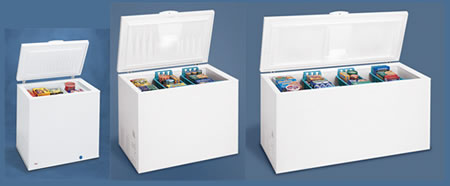
Now that we have a home that we plan to stay in for a while, we are considering buying a chest freezer to place in the garage. Growing up, a lot of my friends with larger families had either a chest freezer or a second refrigerator in the house, and I’d rather not have another appliance inside the house. Also, I love the convenience of frozen foods and our current freezer is always packed. Is the worth the investment? Here is a quick cost/benefit analysis:

Costs

There is the obvious upfront cost of the freezer, monthly electricity costs to run it, hopefully minimal maintenance costs, and I suppose we’ll lose the space in the garage. Here is the rough breakdown for various sizes of chest freezers (Energy Star rated, name brand):

7 ft3: $210 + $25/year in electricity. Assuming 10-year life, that’s $3.83/month. For a 20-year life, that’s $2.96/month.

15 ft3: $410 + ~$38/year in electricity. 10-year life: $6.58/month. 20-year life: $4.88/month.

25 ft3: $710 + ~$52/year in electricity. 10-year life: $10.25/month. 20-year life: $7.29/month.

Potential Benefits

Less Eating Out
To be honest, I really just want to stock up on a large variety of frozen foods so that there is less of the daily question… “What am I going to cook for dinner?”. Too often, the answer ends up as “let’s get take-out”. I want staples like frozen chicken breasts and veggies, as well as having a few Trader Joe’s pizzas and burritos tucked away.

Ability To Stock Up During Sales
If there is a sale on something like frozen vegetables, now I can buy in bulk instead of waiting around for the next sales cycle. You can also freeze everything from bread to milk.

Storing Fresh Fruit
You can do some fun (and cheap) U-Pick at local farms during the summer and not have to eat it all at once. Blueberries, strawberries, peaches, yum. Home gardeners can do the same.

Less Shopping = Less Driving = Less Gas
I try to grocery shop in conjunction with commuting or other errands, but living in suburbia has still definitely increased my fuel usage.

Buying Half A Cow
Although I’ve never done so, it might be cool to buy a whole cow. I guess I’d need one of the bigger freezers for such an undertaking.

Cooking In Bulk
I have tried a few times to cook an entire week’s food ahead of time, but I’d often run out of freezer space. Also, this way one can make their own soups or stocks in large batches. My mom always used to freeze her homemade chicken stock into “pucks” using old margarine tubs.

In addition, there are also the make-your-own-takeout places like Dream Dinners and Super Suppers, which I have never tried before because I never had that kind of freezer space.

I would imagine that I should be able to make up the $5-$10 a month in costs, especially if I can cut down on the dining out. Everyone I know with a chest freezer likes it. Anyone out there disagree?

Finding Local and Affordable Items On My Bucket List

As a successful early retiree points out, sometimes it may not be simply money keeping you from accomplishing your dreams:

Retirement forces you to stop thinking that it is your job that holds you back. For most people the depressing truth is that they aren’t that organized, disciplined, or motivated.

Many people have a list of 101 Things To Do Before I Die, also more recently known as a Bucket List. Much of my list includes travel, but I wanted to narrow it down to things that I could work on over weekends and cost less than $500. I should be able to accomplish these things without achieving financial independence.

Get Certified to Scuba Dive: $300
My sister recently got certified to scuba dive. The cost was between $300 and $400. This includes classroom materials (book/DVD), equipment rental, two pool sessions, and two ocean dives. You must supply your mask, snorkel, fins, and boots. Now, the trip to the Great Barrier Reef is gonna cost me…

Skydiving: $200
There is usually a skydiving place near most metro areas, although for obvious reasons it tends to be a drive. It costs around $200 for a single tandem-jump, and an additional $100 for a video of the jump (another person has to jump and film you). You pretty much just show up, watch a short video, and go for it. I’ve actually done this one already (photo credit, not me). I must say, if you are so inclined, it is quite a memorable experience. Remembering the feeling makes me want to do the rest of these items!

Fly an Airplane: $75+
Chances are you have a non-commercial airfield near you as well. Just look up “flying lessons + your city”, and many places will offer an introductory lesson for $50 to $100. During the lesson, the pilot will let you “fly” the airplane for a bit. Of course, if you have a pilot friend, they could take you up as well for free. My wife got to do this recently, it sounded awesome.

Learn a Foreign Language: Free to $$$
I would imagine the cheapest way to learn a language would probably be to check out some language books and tapes from your local library. After that, you’ll need to find some native speakers to practice conversing with and correct your pronunciation. I remember while in college you could setup lunches with international students. You have lunch together, and might spend 30 minutes speaking Spanish only, and then 30 minutes speaking English with them. For more money, you can always get a more refined computer-based course or go to an official language school.

Finish a Marathon: Free to $$$
The idea of running a marathon has always been appealing to me due to the sheer simplicity and purity of the accomplishment. There are many free online resources on how to train for your first marathon. I have tried none of them. 😉 The time needed to train would vary widely based on your current abilities. I bet I’d need at least 6 months. As for costs, I’ve been told to eventually buy a proper pair of running shoes, which you only use for running.

Brown Bag Lunch Idea: Simple Chinese Chicken Salad

There was some interest how to keep food costs down, so here’s another brown bag lunch idea that I use. Previously I did my Simple Custom Sandwich Edition, which probably could have been cheaper but I tried to price things at retail.

This time it’s Simple Chinese Chicken Salad, a recipe stolen from my sister. Prices are still from retail grocery store, frugal shoppers should be able to beat these prices easily. Salads from lunch joints are really expensive for some reason, at least $6.

Ingredients and Costs

$0.53 for 1/3 head of romaine at $1.60/head
$0.83 for 1/3 lb of frozen chicken breast at $2.50/lb
$0.40 for 1/3 can of mandarin oranges at $1.19/can
$0.10 for handful of crunchy noodles at $1.29/can
$0.35 for sesame ginger salad dressing at $3.50/bottle
———————-
$2.11 total for each salad

* Optional: Chopped green onion, or bit of slivered almonds. Minimal additional cost, I chop up an entire green onion and keep it in the freezer to sprinkle on stuff.

** You could probably save more money by making your own salad dressing (sample recipe).

Recipe (if you can even call it that)

  1. Rinse and cut up lettuce. One head usually makes 3 lunches.
  2. Cook the chicken however you like (boil, grill, saute) and season with salt and pepper. Rip or chop chicken into small bite-size pieces.
  3. Drain can or mandarin orange wedges (or unhealthily drink the syrup like I do), separating into 3 portions as well.
  4. Put all these dry ingredients into reusable plastic container. Keep chow mein noodles separate to preserve crunchiness. Keep salad dressing into smaller container, or keep in fridge at work.

In one session, you have made 3 Chinese chicken salads that cost ~$2 each, ready to eat and bring for lunch or eat as any other meal. You can either spread it across Mon-Wed-Fri, or if you live with a spouse/partner, it’ll be gone in no time. I put a lot of chicken in there, it prevents me from getting hungry too soon. If you need more calories, use larger portions or add some carbs with bread or toasted bagel.

I forgot to add my crunchy noodles when taking pictures this time, but here it is:

How Much Do We Spend? Breakdown of Current Expenses

I understand that revealing our net worth is not enough to fully explain our entire financial picture. That is by design; I like keeping the picture fuzzy. Blogs are very hard to keep anonymous, and I’ve been doing this since 2004. This is why I continue not to share our respective salaries, occupations, employers, and geographical location. Besides, I am not here to be better than you, or the next dude. Anyone out there could earn more than me, save more than me, or spend less than me. I’m only trying to track our progress, and to consistently try to make our situation a little bit better each day.

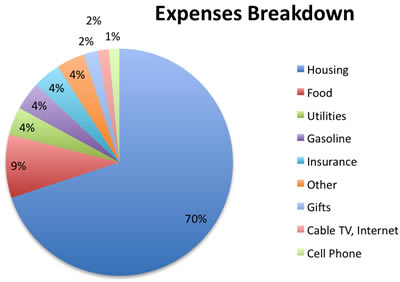
But I’ll give in a little bit. I think tracking expenditures is a good idea for everyone, so I might as well share what I have discovered. Besides, I’ve already revealed that our goal for an Emergency Fund is 6 months of expenses, or $30,000. That means my wife and I spend $5,000 a month? How? Here’s the lovely pie chart:

Housing: We spend $3,500 a month housing, 70% of our total monthly expenses. (Note that this is not the same as 70% of income!) This includes principal, interest, taxes, and insurance (PITI). Yes, it is obscenely high. The median price of a home in our area is over $500,000, so don’t go thinking we live in a multi-acre 5,000 square foot estate. At the same time, incomes here are also a lot higher, especially in certain fields. So there is a give and take.

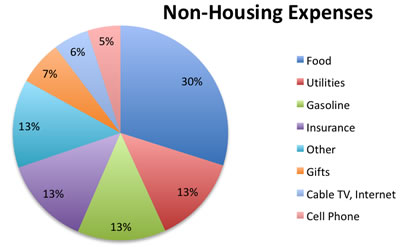
Given that this one area skews the graph so much, I made another graph of all non-housing expenses:

Food: $450/month includes both groceries and dining out. This is where the “fat” is in our spending, and we know it. We love food and do our best to “consciously spend” and enjoy every dollar put into this pleasure. I’m okay with making many simple foods at home, but I still go out when I want to eat freshly baked naan, perfectly seasoned pad thai, authentic pizza, or hand-wrapped tamales.

Insurance: $200/month includes two cars and umbrella liability insurance policies. Our deductibles are $1,000 to keep costs low, but our liability limits are high ($250,000/$500,000) due to the requirements of the umbrella policy.

Utilities: $200/month includes electric, gas, sewer, and water. Gasoline: $200/month. Cable TV + Internet: $80/month. Cell Phones: $75/month for two lines.

Gifts: $100/month. This might be somewhat unique to us, but given our big family events like birthdays, weddings, graduations, usually end up costing us $100 per month.

Other: $200/month usually covers the other smaller categories including clothing, entertainment, and pet expenses.

That ends up with the total being $5,005 per month. $3,500 to housing, $1,505 to everything else. Health insurance is provided by our employers. Non-monthly expenses like home improvement projects, travel, charity, car purchases/depreciation, or medical procedures are not included.

One Way To Track Your Progress Towards Financial Independence

Another more conventional definition of financial freedom is when you have “passive” income that covers your expenses so that you no longer have to work. Usually, this comes from paper investments like stocks, bonds, or annuities. In the book Your Money or Your Life, the authors outline a somewhat unique way to track your progress towards financial independence (FI).

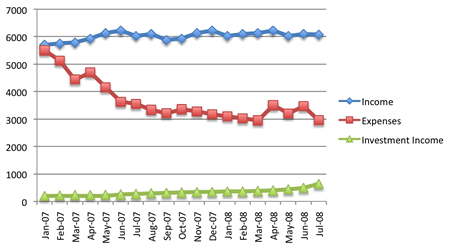
First, you should go out and buy a huge wall-sized piece of graph paper and put it up somewhere you’ll see every day. Create a chart with the horizontal axis being time, and the vertical axis being money. Each month, you should record the following items:

  1. Your monthly income
  2. Your total monthly expenses
  3. Estimated investment income

Here is a sample of what it might look like:

Line 1 – Graphing Your Income Each Month
While many personal finance articles focus on spending less, the book does a good job of reminding us that income matters and we can always do something to increase it. It also tells us that the path towards a happier life and a career you enjoy of also tends to increase your income. The book summarizes this with the following:

“Increase your income by valuing the life energy you invest in your job, exchanging it for the highest pay consistent with your health and integrity.”

Line 2 – Graphing Your Expenses Each Month
Note that we are not making a budget here. A budget often seems to suggest a goal of “I will spend this much”. Instead, here you are first making an assessment of your situation from last month. You then attempt a few (or several) changes, and re-assess again a month later. This continual feedback should ideally help you see what is working and what’s not.

For those dealing with debt, the Expenses line might even be higher than your Income line at first. This should provide a nice incentive to get to the first “crossover point” where you at least earn what you spend. Gradually, we can shave off those lower priority expenditures as we keep seeing that gap between income and expenses grow wider and wider.

Line 3 – Graphing Your Expected Income From Investments
Here, the simple formula given for finding the income you can derive from your investments is this:

savings x interest rate / 12 = monthly investment income

The suggested investment here is to use is that of the 30-year U.S. Treasury Bond, currently yielding somewhere around 4.5%. This means if you bought $100,000 of these bonds with your savings, you would earn $375 reliably every month for 30 years without risking your principal. Other people might use dividend payments from stocks, or use a historically-safe withdrawal rate.

Either way, the big goal is to make this third line meet up with the expenses line. As time goes on this line will hopefully curve up exponentially, providing inspiration to reach this “crossover point”. The idea of working for only a finite period of time can be very motivating.

Given that this book was written in 1992, I am going to guess that doing this using a spreadsheet program like Excel is also acceptable. While a physical chart may work better for some people and provide a more constant and tangible reminder, I think perhaps making the chart your Desktop wallpaper might serve a similar purpose. (Or you could create blog about it…)

This is a pretty cool idea. Perhaps I should stop tracking net worth and simply do this? For us, as mentioned before, once our mortgage is paid off the expense line should drop dramatically. Separating out the non-housing expenses into a separate line might help me focus better.

DIY Installation of Floating Engineered Hardwood Flooring

I’m happy to say that our hardwood floors are fully installed! The bulk of the credit has to go to my father-in-law, who while he has never installed any hardwood flooring before, provided the peripheral knowledge and common sense that is need in doing such home projects. My wife and I basically served as unskilled day laborers. 🙂 If you’re looking to install your own wood flooring, you might want check out my previous post on picking out what type of flooring to buy and how to install it. We had a concrete subfloor, and we chose to float an engineered hardwood flooring over it. This might not be the best choice for everyone.

Prepping the Concrete Floors
The first part of installation is to make sure you have a relatively level subfloor. A rough rule of thumb is that you want to see no gaps thicker than 1/8″ of space if you lay down a 5 ft-long straight piece of wood like a 2×4 flat on the ground. (Or 1/4″ every 10 feet.) This part is important in order to avoid squeaks and squishy spots, and lazy installers (both hired and DIY) will simply lay over anything remotely flat. If you do demand proper prep and your floor isn’t flat, this can add to installation costs when contracting it out (and therefore savings if you do it yourself).

We were hoping preparation would just mean scraping excess carpet glue or drywall mud off of the subfloor. But we found that we actually had a good-sized area which was not flat at all. We tried using a hand grinder at first, but in the end we rented what they called a concrete planer in order to grind it down flat. It is a beast and we ended up with over 30 pounds of concrete dust everywhere. We had put up tarps, but it still got everywhere. This would have been horrible if we were already living in the house, luckily we weren’t. I think it cost about $250 to rent for a day.

Laying Underlayment
Next step was to lay down a thin blue foam underlayment on top of the concrete. The underlayment is designed as a moisture barrier between the wood and the concrete, reduces sound, and also adjust for the remaining minor irregularities in the subfloor. We just taped it down with duct tape. Some newer flooring products actually have this already on the bottom of the flooring.
Connecting The Pieces Together
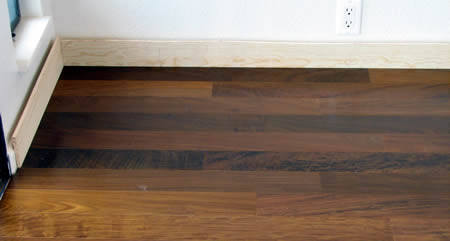
Our flooring was tongue-in-groove, with glue applied in the grooves. Some other types allow you to simply click together, but we found this was mainly for laminate flooring. We put in spacers at the walls, as the floating floor has to be allowed to contract and expand with the seasons. Trim is added later to hide the gaps. You’ll need some sort of table or chop saw to cut the pieces to fit when you reach the other wall and at corners.

Trim and Moldings
Finally to make everything look nice, you’ll need to install moldings at walls, doorways, and transitions to other floor types. You’ll also have to cover up all the nail holes with putty so they don’t show. This all takes a lot of patience to do well, which can be tough when you’re tired of installing wood and you just want to be done already.

Final Verdict and Parting Advice…
We are very happy with the final product. I think anybody who is reasonably comfortable with tools and has the proper patience can perform this activity, the only question is if you actually want to. Either using up a week of vacation or giving up all your weekends for a month isn’t always fun, although I did learn a lot and lost some weight in the process. Oh, and there’s always the several thousand dollars in installation costs that we saved.

We do have some squishiness in the floor when walking on it, but it is not very prominent and we don’t mind. Of course it wouldn’t be there at all if we decided to do a glue-down floor, but I think it was still worth it to float given the time saved and the ability to easily fix any mistakes as we went.

As for parting advice… buy good knee pads! My father-in-law is old school and tough, and didn’t ever wear knee pads the entire time, so I figured I didn’t need them either. On the second day of installation, I started seeing red spots all over the underlayment. Did someone spill ketchup? Nope, my knees had blistered and were bleeding all over the place… Good knee pads are worth every penny. In general, it is worth it to buy the proper, quality tools for the job. If you’re doing this is as a weekend warrior type of activity, it takes a lot of determination to finish everything, so there’s no need to make things harder on yourself.

Hypermiling: Optimize Your Driving For 30%+ Higher Fuel Economy

In my post on hedging gas prices, reader J.P. introduced a concept that I had never heard of before – hypermiling. Essentially, there are a group of people out there so serious about improving their fuel economy that they are swapping data and tricks in order to wring every last MPG out of their cars. Users proudly post pictures taken of their fuel economy meters. Imagine, treating high fuel economy as a competitive sport!

Although many hypermilers manage to wring out over 100 miles per gallon out of their hybrid cars, many of these concepts can be applied to non-hybrids as well. It is very intriguing to see the many different behaviors that they describe. The following are taken from this thorough article on CleanMPG.com as well as the Wikipedia entry on hypermiling.

Basic Tips
First up, here are some of the more conventional tips that you might have read about elsewhere. Most of them follow common sense; if you make your engine work harder, it burns more gas.

  • Do not use quick accelerations or brake heavily.
  • Do not drive at higher speeds.
  • Combine trips to reduce driving with a cold engine and on frequent short trips.
  • Remove excess weight and/or cargo racks. Do not tow unless absolutely necessary.
  • Minimize running mechanical and electrical accessories (e.g. air conditioning).
  • Avoid driving on hilly or mountainous terrain if possible.
  • Do not use 4-wheel drive if it is not needed.

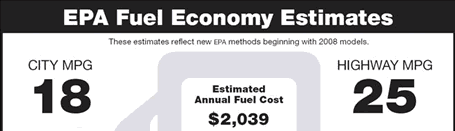
In practice, this means driving very differently that you might now. You want to accelerate your emptied car as slowly as possible, and continue to drive as slowly as possible once you go past about 30 mph, especially on freeways. You want to be aware so that the second you may need to stop or can coast, you can take your foot off the gas pedal immediately. Don’t use air conditioning, do use cruise control. Track your mpg with a mileage log to measure any improvements. (Most people do not ever achieve the given EPA fuel economy ratings for their vehicle.)

Advanced Tactics
Here we get into some more extreme behavior. Note that not all hypermilers engage in these activities, these are simply the ones that push the envelope. Some may be considered dangerous, or even illegal in certain areas.

  • Use an real-time fuel economy meter. If you don’t have a hybrid with a built-in meter, get yourself something like the ScanGuage II.
  • Inflate tires to much higher pressures. Higher tire pressures -> Lower rolling resistance -> better fuel economy. They recommend not just inflating to the psi recommended by your car, but the maximum sidewall rating allowed by your tire manufacturer. Some members even take advantage of the “factor of safety” that engineers use and pump it up to 25% over the max rating. 50+ psi is not unheard of.
  • Switch to a special motor oil. Using low kinematic viscosity oil helps improve mpg.
  • Forced Autostop: Turn off engine whenever possible. If you’re slowly stopping to a red light or just coasting, turn off your combustion engine completely (“force” it to “stop”). Keep the engine off while idle, and only start it up when you’re ready to go again. This reduces losses due to running the engine at idle.
  • Pulse and Glide. This consists of driving using alternating periods of accelerating (“pulse”) and coasting (“glide”), and then repeating the process. It is most efficient if you turn off the engine and coast in neutral while coasting.
  • Draft behind big rigs or large vehicles. Take advantage of the turbulent air behind a big rig on the freeway by driving as close as you feel comfortable behind it. The resulting lower air drag means you need less gas.

The Financial Payoff
Although many hypermilers have other motivations like less fuel-dependence, better environment, or simply competitiveness – another obvious benefit is in fuel cost savings. Reports indicate that improving your fuel economy by 30-40% is definitely possible without using all of the advanced tactics. If you went from say a combined city/highway 22 mpg based on your previous habits to 30 mpg (a 36% increase), and you drove 12,000 miles per year with gas at $3.70/gallon, this would save you $538 over a year. Worth it? Your decision.

Personally, I like learning about people who take anything to the extreme, that way I can just pick and choose what I want to implement in my own life. I think I’ll go check my tire pressure tomorrow…

How To Hedge Against Rising Gas and Oil Prices?

Everybody’s talking about gas prices… they’ve reached another high, everybody wants a hybrid… so why not explore how an individual can try to limit their exposure to gas prices?

How much more are you really paying?
Yes, $50 for a fill-up hits some sort of mental trigger, but sometimes I wonder if people really have calculated exactly how much more they are paying. According to AAA, the current national average is $3.70/gal, while a year ago it was $3.05. If your car gets 20 miles per gallon, you drive 12,000 miles per year, paying 65 cents more per gallon equates to an extra $390 per year. (If you got a stimulus check, this means a lot of it might have already been spent…)

Now, for many families who are walking a financial tightrope, such a hard-to-avoid increase is just a another step closer to the edge. But for the Wii-playing, Starbucks-drinking crowd, is an extra $32/month really worth making a fuss over? I mean, some of these folks are the same ones whose eyes glaze over when I describe some of the extra things I do for money outside of a regular workday.

Hedging Against Future Increases
Now, someone could always play with oil futures contracts like the airlines do, but that’s a bit complicated for the average person. However, if we are afraid that gas prices will rise even further but are comfortable paying the current price, it would make sense to try and buy a bunch of gas at today’s prices and lock-in that rate. A while ago there was a company called the FuelBank that tried to make this a reality, but it appears to have gone nowhere.

Buying the Oil ETF USO
Another way that you can effectively buy at today’s prices is to buy shares of the United States Oil ETF, symbol USO, from your favorite online stock broker. This idea was initially explored in this SeekingAlpha article back when it debuted in 2006. Unlike other commodities ETFs or investing in an energy company like Chevron or Exxon, the objective of this ETF is specifically to keep it’s net asset value (NAV) at the price of crude oil. (Specifically, the spot price of West Texas Intermediate light, sweet crude oil delivered to Cushing, Okla., minus expenses.)

Now, USO hasn’t done the best job of tracking crude oil prices exactly on a day-to-day basis, but it seems to get the general trend right if you hold an extended period of time. From 5/7/07 to 5/6/08, crude oil went from $61.48 to $121.82 a barrel, an increase of 98%. (source) For the same date range, USO went from $48.06 to $93.38 a share, up 94%. (source)

In order to counteract the theoretical $390 from the example above back, you could have bought 9 shares of USO for a total upfront cost of $390 a year ago, which would be worth $408 more today. So in theory, the average driver could put aside something like $1,000 and buy 10 shares of USO to hedge against rising gas prices. Even just one share would dampen the effects somewhat.

The Catches
Unleaded gas prices only went up 21% in the same time period that crude oil went up nearly 100%. So the ratio between crude oil price and unleaded gasoline doesn’t seem to be a constant. Also, if gas prices fall then your savings at the pump will likely also be negated by a drop in USO’s share price. Also, you could account for the lost potential of any money put aside for this if you had invested it elsewhere.

I don’t personally plan on doing this, but it is an idea that could work if you were really sensitive to higher gas prices and/or buy a lot of gas. Another alternative is a site like HedgeStreet, though I haven’t looked too deeply into it.