Free eBook Downloads From Wowio, Plus Refer 10 Friends For A Free iPod Shuffle

Wowio is a website that lets you download eBooks from their library for free. They are in Adobe Acrobat format, so don’t need any special software to read them. There’s also no annoying DRM, so you can move them between computers and PDAs with ease.

What’s the catch? Well, the titles are limited, so you’re not going to get the current New York Times bestseller. But they do have a wide selection, from classics to comic books (I mean, graphic novels!). Here are the titles I downloaded today (you get five each day):

  • Avant-Guide Las Vegas: Insiders Guide for Urban Adventurers (Travel Guide)
  • Critique 01: The Magazine of Graphic Design Thinking
  • Guerrilla Data Analysis Using Microsoft Excel
  • The Science of Getting Rich (supposedly inspired The Secret)
  • Slaughter-House Five by Kurt Vonnegut

Basically, check it out, and if nothing catches your eye, don’t join. Can’t beat free. I think they also make money by putting ads in the books, but they must be spaced pretty far apart. I’m about 50 pages into Slaughter-House Five and haven’t seen one yet.

To join, you must verify your identity. It’s relatively painless, you only need one of the following:

  • A non-anonymous e-mail address (no yahoo, hotmail, or gmail). A work or school e-mail should work fine, and they also accepted my @mymoneyblog.com e-mail.
  • Credit card – will not be charged
  • Scan of ID (Driver’s License or Student ID) – I’d probably avoid this. At least with the credit card you have built-in fraud protection.
  • Friends and Family code – Each new member can “vouch” for 3 others who don’t want to or can’t do one of the above.

Free iPod Shuffle

Right now, they are also having a promotion that if you refer 10 of your friends, they will send you a free iPod shuffle. This is actually a pretty easy deal, as it’s absolutely free to join and you don’t even need a credit card number. When you sign up, at the end they will ask you for the e-mail of the person who referred you.

Please don’t use my e-mail, I already have enough referrals. Below is a script that will return a random e-mail that you should use as your referrer in order help a fellow reader out. Then, I will ask them who used their e-mails as a referral, so you’ll have a chance to be listed.

I’ll make it an image scramble it to avoid spam, but you can also let me know if you don’t want me to put your e-mail up. Thanks!

Family Emergency / Bereavement Airfares: Worth A Try

I recently learned that if you have to fly on short notice due to a medical emergency or a funeral, there is something called a “bereavement fare” or “compassion fare”. The rules differ between all the airlines, but basically if you qualify you get around 50% off the highest non-restricted airfare available. You’ll need to call each airline directly for details. These full fares can be extremely high, and even at half-off still way more than what you would get at a site like Expedia.com. The main benefit to these fares is that you can usually change your arrival and departure dates much more easily and without penalty fees. Here is a good article at SmarterLiving that goes into more detail about bereavement fares.

First, we went browsing online. Usually when you sort the results by price it looks something like this: $300, $315, $340, $410, …

But given our short notice, it went like this: $300, $800, $900, …

I called to get a price quote for a bereavement fare and the price was about double the lowest online fare. Luckily, the flight schedule that was available for the lower price was something we could work around. If that flight schedule was sold out, we would have gone for the bereavement fare.

Another idea to try is that you can try to use your frequent flier miles, and if you qualify under their bereavement fare rules (and there is a frequent flier seat available) they may waive the 14-day advance booking requirement. In the end, it’s a good thing to know that these alternatives exist, especially due to the added flexibility. But it’s quite likely that you’ll be able to do better on your own.

Confessions Of A Car Salesman: Beware Of The Four Square!

The Consumerist has a very enlightening article from a former used car salesman about the tricks that he used on customers, and how to recognize them. It’s a long article that contains a lot of common sense advice, but I found the carefully planned psychological tactics that they employ the most intriguing. Distraction, confusion, manipulation…

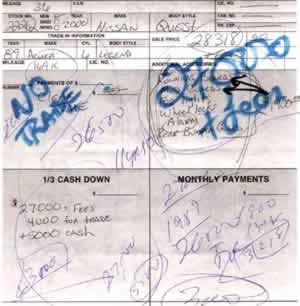
At the heart of it all is the “4-square,” a sheet of paper divided into four boxes: your trade value, the purchase price, down payment, and monthly payment. This is supposed to help you and the dealership come to an agreement, but as you’ll see, it’s really more akin to three-card monte dealer’s deck of cards. Many, but not all, dealerships use this tool.

4square, image credit: Consumerist.com

I’ve only shopped for a car by myself once, right after I got offered my first job. My experience was exactly as described by this article. They broke out the 4-square form, started high, tried to wear me down, showed me how good of a deal they were giving me as compared to the original price, all of it. Even down to the part where they made me sign the “X” to signify that if the price was right, that I would buy today.

I ended up talking about a used Toyota 4Runner that caught my eye, and somehow the price went from $21,000 down to $16,000 after 45 minutes of me saying “I don’t know, I need to think about it”. (What I was really thinking was – let me use your computer so I can look up the Blue Book value and see how badly you’re trying to screw me.) The whole sleaze factor turned me off so much I just stuck with my trusty old Nissan – which I still have today.

Also, if you haven’t read it before, check out this (also very long) expose as an undercover car salesman by a writer at Edmunds.com.

I do have a confession to make though – I have caught a few episodes of King of Cars late at night and it was pretty entertaining!

Have You Checked Out Your Local Public Library Recently?

library books, image credit: mountsaintvincent.eduAs a kid, I went to the library weekly, grabbing new books and getting yelled at for misplacing overdue ones. Even now, I remember feverishly looking for the next book in the Boxcar Children series, or re-reading How To Eat Fried Worms for the 86th time. Then I went for about ten years without public library card. I guess my recreational reading activity dropped due to school, work, and good ole’ cable TV. For a while I just bought every book I wanted from Amazon (mainly with gift certificates from various online offers). But over the past year I have again become a regular library visitor.

First of all, the selection is great. In addition to books, a lot of popular music albums and DVDs are available. Recently, I’ve gotten the newest Snow Patrol album and a full season of the Sopranos. Other features which may be in your area are Library2Go, which offers audiobooks that you can listen to on your mp3 player, and NetLibrary, which offers e-books that you can download to your computer or PDA.

My favorite feature is the internet-based hold system. I go online, pick out all the books I want, and make a few clicks. I get to see exactly how many people are ahead of me, and when the book is ready, it’s shipped directly to my local branch (only a few blocks away) and I get an e-mail saying it’s waiting for me. Renewing online is just as easy. I love it.

So don’t miss out on this great resource. I still buy a lot of books, but I can browse and explore so much more content this way. Also, this means there’s no good reason why you can’t read some of the best investment books out there. Check one out this weekend!

My $300 Cup Of Coffee

I spilled coffee on my Dell Inspiron 4150 laptop today. It made a sad sort of grunt, and shut itself off… apparently forever. I’ve used compressed air and dried it all day, all to no avail. This was actually my largest impulse buy ever, at about $1,200. I’m very sad, this laptop has served me well for four years, and was my sole computer for a long time. Of course I bought the three-year warranty, which was never used. I don’t know if it covers spills anyways.
Now I’m considering my options:

  • Pay someone to fix it. Bringing it into a repair shop would probably cost $50 just for them to touch it… Then I’d have to pay for parts.
  • Fix it myself. Motherboards (if that is even what is broken) cost about $100 online. Probably not. Could it be another cheaper part? I don’t know enough to figure it out.
  • Sell it as-is on eBay. After looking on eBay, I see that my model would still sell at a pretty good price if it worked – about $300 before shipping. This broken one without a hard drive actually sold for $225. I can probably get any critical information off the hard drive myself and sell that too.
  • Sell the parts individually on eBay. There are all kinds of separate parts on that I could sell separately – hard drive (wiped first), monitor, keyboard, touchpad, memory, AC adapter, dvd/cd drive, recovery CDs? I don’t know if it would worth the hassle of dealing with possible returns as I can’t really test the items anymore.

Any suggestions? I’m probably going to take this chance to upgrade to a new laptop, given that you can get a basic one for under $500 these days.

Are You A “Maestro Of Money Management”?

A friend of mine sent me this link, and I think he was trying to mock me! 😉 It’s an article from the Wall Street Journal entitled Nickel-and-Diming Your Way To Riches, if That’s Your Thing Here’s an excerpt:

I thought I was fairly deft at handling money. But that was before I met the maestros of money management.

We’re talking here about the legions of Americans who manipulate their monthly cash flow like chess masters, along the way snagging frequent-flier miles, cash rewards and interest income.

Am I such a maestro? Are you? Let’s see:

Maestro Activity #1: Maximizing Bank Interest

Consider Dan Goldzband, a cost accountant in San Diego. He has his paycheck deposited directly into a high-yield savings account, where the money sits until he transfers it to his checking account to pay bills. His reward: $35 to $85 in interest each month.

“My checking-account balance rarely exceeds $100,” Mr. Goldzband says. “If it does for more than a couple of days, I am doing something wrong. Of course, only a compulsive like me could make this work. But the general idea, less rigorously applied, would still work for many people.”

Well, my checking account usually hovers around $500-$2,000, because we often have to write paper checks for weddings/graduations/baby showers/birthdays/donations. It’s not writing the checks that’s the problem, it’s that we can never tell when people are actually going to deposit them. Shrug. I also have one free overdraft per year on my Washington Mutual free checking account (review) as a backup anyhow.

But someone is exaggerating… At $35 a month in a 5% APY account, that is suggesting that he would otherwise have $8,000 sitting around earning 0%. ($85 would be $20,000+!) I doubt he needs that much for everyday cashflow. I would bet a good chunk of that is considered his emergency fund or other cushion. Not putting that away into a high-yield saving account would just be silly. The author agrees:

Meanwhile, if your checking account is on the plump side, keep enough there to avoid triggering fees and move the rest into a high-yield savings account or a money-market fund. If you shift $5,000 into an account paying 5%, you will pick up $250 in interest over the next 12 months.

Maestro Activity #2: Credit Card Arbitrage

Don’t have much money in your savings account? No problem. Maestros will borrow from credit cards with 0% introductory rates and then use the money to earn a little interest, often stashing the cash at EmigrantDirect, HSBC Direct or one of the other banks with high-yield online savings accounts.

Okay, I’m definitely guilty of this. I even got so many questions about it that I wrote a detailed, step-by-step Guide On How To Make Money From 0% APR Balance Transfers. Don’t miss the introduction though – this is definitely not for everybody.

Maestro Activity #3: Using Credit Cards But Paying In Full To Reap Rewards

When the maestros aren’t gaming those 0% offers, they’re hunting for the credit cards with the best rewards. Thanks to this strategy, Mr. Bilker says he hasn’t paid to take his family to the movies for two years. He’s also got $500 in convenience-store gift cards, and he garnered a $1,700 discount by charging $17,000 in kitchen remodeling expenses.

For many cardholders, the prize is frequent-flier miles. Bob Smith, a retiree in rural Michigan, has 30 credit cards. He charges everything, from groceries to utility bills, to whichever card is currently paying the highest reward. He figures he and his wife have collected more than 100,000 frequent-flier miles over the past year.

Yes, yes, I do this too. Here are the three cards that I keep in my wallet. The article even admits this may be worth the effort on a smaller scale:

Forget shuffling back and forth between your checking account, your savings account and the latest, greatest credit-card offer. Instead, go for the easy money. Pile your expenses onto a good rewards card and be sure to pay off the balance every month. Let’s say you charge $1,000 a month to a credit card that earns frequent-flier miles. That should give you enough points every two years to get a domestic round-trip ticket worth perhaps $400 — and maybe two or three tickets if the card pays double miles and gives you a sign-up bonus.

Maestro Activity #4: Keep Your Investment Expenses Minimal

Most important, focus first on your portfolio rather than your monthly cash flow. Suppose you revamp your $300,000 mutual-fund portfolio, cutting your annual fund expenses by half a percentage point. That would save you $1,500 a year — without the ongoing hassles that come with juggling credit cards and bank accounts.

Sure, that would be great, except my mutual fund portfolio expenses are already under 0.30% annually. 😛

Nickel and Diming, Huh, Punk?
Actually, I pretty much agree with the premise of the article. As I’ve said before, the time I spent talking about a subject is not directly proportional to how important I think it is. Mentally, I divide them into the big things that help guarantee I’ll reach my goals, and also the small things that will make those goals arrive earlier. Besides, it’s fun to have a profitable hobby. (My other hobbies aren’t cheap!)

Going To Vegas? Play The Games With The Best Odds!

I’m going to Vegas! I haven’t been in several years, so I wanted to brush on my gambling knowledge. Of course we all know that the vast majority of games have what is called a “House Edge”, which means that over the long run the casino will be profitable. But not all games and bets are created equal. Since I love numbers, I decided to compile some ways to achieve the best odds in a casino. This way, you’ll increase your chances of winning the short term, or at least extend the time between ATM visits 🙂

Odds Explained
A 95% expected return, or a House Edge of 5%, is the same as saying that on each bet you are expected only to receive 95 cents out of every dollar you bet. This does not mean if you walk up the table with a $100 bankroll, you will leave out with $95. You will most likely bet a lot more than $100 since you will win many hands as well. If you play 50 hands per hour, after 4 hours at $5 each that’s $1000 in bets. With a 5% House Edge, on average you would have lost $50. The more hands you play, the more you are expected to lose. This is why good blackjack dealers deal so fast.

So besides playing inherently slower games or simply playing less, here are a few ways to get the best odds:

Bets Requiring No Skill
This includes scenarios where the best odds are achieved when you simply make the same move every time. (Actually, the best odds here are achieved by not gambling at all…)

1.36% House Edge

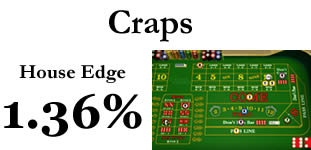
Although the table is very cluttered, the best bet is actually very simple. Just put your money on the Don’t Pass/Don’t Come line and the House Edge is a mere 1.36%. You won’t be very popular, however, as you are betting on the roller to “crap out”. Since this is such a social game, it may be worth it to bet on the Pass/Come line instead – the House Edge is only slightly worse at 1.41%.

1.06% House Edge

Although Baccarat has the reputation of being a “high-class” game, the ideal betting is remains straightforward. If you bet on the banker every time, the House Edge is a mere 1.06%.

Bets Requiring Some Skill
The main skill you need here is memorization. For each situation, there is always a single correlating “correct” move.

0.60% House Edge

If you memorize Basic Strategy, the house edge in a normal six-deck shoe is about 0.6%. Keep in mind that the strategy changes slightly with all the small variations between blackjack games. Read up on how the rules on when you can split, double down, surrender, and more affect the odds. Never buy insurance. You can even practice learning online.

Positive House Edge

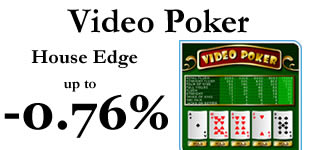
If you’re going to stare at a computer screen alone, you should play video poker. Unlike slot machines, you can actually figure out your odds of winning based on the payout schedule which must be displayed on each machine. If you find a “full play” machine and memorize the correct moves for each combination of cards, you can theoretically achieve a negative House Edge of up to -0.76%. Keep in mind this takes into account getting the Royal Flush, which pays 800 to 1. However, if you practice a bit, you can whittle the House Edge down to less than 0.5%. (I don’t know of any free sites that help teach you Video Poker, do you?)

Bets Requiring Significant Skill
If you are willing to put in the required of time and effort, poker may be a good idea. You are competing directly with other people, with the casino making their money by taking a small percentage of each pot. Tournaments can be a fun way to minimize your losses.

Another practice that can gain you a slight advantage over the house is Blackjack with card-counting. This takes into account that a blackjack deck has a “memory” – that is, what cards have been shown will affect the probabilities of what cards will be shown. Not only do you have to be mentally sharp and pay continuous attention to every single card shown, you have to do it all without letting the casino know you are doing it, as they’ll kick you out. Card counting typically gives the player an advantage of 0.5 to 1.5% over the house.

Of course, Vegas isn’t all about the odds. I personally like Craps (not just pass), Blackjack (no counting), and the sportsbook the best. Provide your own Vegas tips below!

References: Wikipedia – Baccarat, Craps, Blackjack, Video Poker

Are We Saving Too Much For Retirement?

piggy bankOne contrarian article deserves another. This one, courtesy of the New York Times is titled “Save Less and Still Retire With Enough”. The main premise is that contrary to popular opinion, most of us are actually doing just fine money-wise. All this talk of impending consumerism-drive doom? It’s a big scam by the investment companies, who have a vested interested in us keeping big balances in our brokerage accounts.

The more realistic amount could be as little as half the typical recommendation made by Fidelity, Vanguard or any number of other financial institutions. For a middle-income couple, that could mean trading $400,000 in retirement money for about $3,000 a year more during prime working years to spend on education or home improvement. ?For a middle-class household, that?s a lot of money,? said Laurence J. Kotlikoff, a Boston University economics professor, who is on the forefront of this research into spending and savings, and is selling his own retirement calculator.

You can read more of Mr. Kotlikoff’s research here. Here is an excerpt from one paper:

TIAA-CREF is recommending a retirement ?salary replacement? target equal to 80 percent of annual labor earnings. For our stylized household [couple earning $125,000 with two kids], this equals $100,000… This is 78.0 percent higher than the appropriate target!

In other words, his “appropriate” target replacement salary is actually only about 45% of their previous income, or $56,000, for a couple earning $125,000 a year. This is due to a number of factors which aren’t explained in detail, but factor in that their house should be paid off and the kids will be gone during retirement. However, I saw no mention of the increased costs from health insurance and other medical costs that increase with age. He also expects the their investments to earn 9% a year (6% real, 3% inflation), which is a bit optimistic to me.

In the end, of course some people are saving too much. I mean, if you’re eating Cup o’ Ramen ten times a week and checking your million-dollar bank balance on the free computers at the public library, sure, maybe you need to loosen up a bit. I’ve never met any of these people, have you? There’s no way that they outnumber the ones that are saving too little.

And how do we even know what will be too much or too little? Every retirement calculator is simply trying to predict the future. Note the huge “we are not liable if this is wrong” disclaimers. I’ve read a lot of articles that also support the fact that the stock market will only earn about 6% annually in the future, and similar ones that say that the long-term expected returns of stocks will be the same as bonds. Japan’s stock market has been in the dumps for more than decade.

A possible personal solution?
I’m trying to come up with what I call the Core Lifestyle, which essentially includes everything that I would personally really want out of life – things like a job that I value, a small house in a specific area, a skiing season pass, and an international trip every year. The idea that this should require a certain amount of money, for example $100,000 a year. (Yes, I am aware that this is a lot of money. I’m also living in a big West Coast city…) My feeling is that after a certain point, any extra spending just ends up on “stuff” like nice cars, gadgets, brand name clothes, and bigger houses that really won’t improve my quality of life.

Anything above that threshold goes into investments. This is opposite of some plans which suggest socking away a specific percentage of your gross income each year. Then, as our wealth builds, whenever it is that we have enough to cut back on working, we will! It could be 39, 45, or 52. There would be no “squandering of youth”. We’ll live well now, and then we’ll live even better after that. Sounds easy, doesn’t it? We’ll see how it goes 😛

Do you feel like you’re depriving yourself now to save for retirement? If your retirement planner told you that you could save less, would you do it?

Pet Food Recall Involving Many Popular Brands

If you’re a pet owner and buy canned or “wet” food, you should read about the Menu Foods recall after reports of kidney failure and deaths. According to this CNN/AP article, Menu Foods makes pet foods for all these companies from just two factories:

Iams; Eukanuba; America’s Choice; Preferred Pets; Authority; Award; Best Choice; Big Bet; Big Red; Bloom; Bruiser; Cadillac; Companion; Demoulas Market Basket; Fine Feline Cat; Shep Dog; Food Lion; Giant Companion; Great Choice; Hannaford; Hill Country Fare; Hy-Vee; Key Food; Laura Lynn; Loving Meals; Main Choice; Mixables; Nutriplan; Nutro Max; Nutro Natural Choice; Nutro; Ol’Roy; Paws; Pet Essentials; Pet Pride; President’s Choice; Price Chopper; Priority; Publix; Roche Bros; Save-A-Lot; Schnucks; Springsfield Pride; Sprout; Stater Bros; Total Pet; My True Friend; Western Family; White Rose; Winn Dixie and Your Pet.

This reminds me of my list of acceptable and unacceptable generic products. So much stuff is made at the same facility, it’s hard to figure out if you are actually getting better product by buying a brand name like Iams or Eukanuba. While the ingredients may be different, I would bet many of them are very, very similar. In this case, the recalled products were all made using the same wheat gluten.

While there are lots of good choices out there, we choose to buy Natural Balance dry food for our dog.

Buy Your Glasses Online For $28 at EyeGlassDirect

Here’s an interesting entrepreneurial story from this month’s SmartMoney magazine. Imagine that you work at LensCrafters making eyeglasses. You see the extremely large profit margins. You go home, buy the same equipment, and install it in your condo. You train some technicians to do most of the work. You call it EyeGlassDirect.com and start selling basic glasses with frame for $28. All while still working at LensCrafters!

I’ve been wearing glasses for over a decade, and I’ve never even thought about buying them online. The store seems to be legit, it has a 30-day unconditional exchange policy and a relatively clean Better Business Bureau report. The glasses include add-ons like UV and anti-scratch coatings that sometimes cost extra.

$28 seems like a great price for those without insurance or just looking for a basic set of glasses. I’ve always felt LensCrafters was mainly for those that had vision insurance. My current insurance only covers either contacts or glasses, so I choose to pay out-of-pocket for glasses every couple of years (and add it to my flexible spending account). I have high-index lenses, so I’ll have to dig up my old Costco receipt to see if I should try these guys next time. Anyone use them before?

Added: You can find reviews for this and other online shops at GlassyEyes. I hate it when magazines mention bloggers but don’t give out their websites.

Buying A Home In The San Francisco Bay Area On $75,000 A Year

Besides shopping at Whole Foods or Trader Joes, it seems like one of the major hobbies of young professionals in cities like Los Angeles or San Francisco is to complain that we can’t afford a house given our mere $50,000-$100,000 salary. It’s true. Housing is pricey. But every time I hear this lament, I think of the e-mail I got from a single woman who made it happen on $75,000 per year in the Bay Area. How did she do it?

She saved for a few years, and made it a priority. Sure, rent is high, but there is still a lot of fat in a $75,000 salary. By far, the easiest way to save money is to get a roommate. Your rent goes down by at least a third, utilities are cut in half, and if you get along you can save a lot in food. Even if you live by yourself, I would say that saving $10,000 a year should be possible, even on top of saving 10% towards retirement. If you think I’m insane, I would definitely take a look at your definitions of “needs” and “wants”.

She got realistic. If you grew up in the suburbs, you’ll may feel like living in anything but a 2,000 square foot ranch home is just not acceptable for a hard-working educated person like yourself. Nope. Homes like that cost $1 million here. First step, downgrade your size requirements. Her sights moved down to townhouses, and then to condos or even studios.

She got even more realistic. Still too pricey in the trendy areas. Time to give up? No, time to downgrade your location requirements. The East Bay is filled with workers that commute to either to San Francisco or San Jose every morning. She finally found a nice $300,000 1-Bedroom condo in the East Bay for which she paid $30,000 down. Since it was near public transportation, her total commute is a reasonable (for the area) 45 minutes door-to-door.

She’s got almost $100,000 in equity now. Fast forward to today, and her $300,000 condo is worth more than $350,000. Add in her down payment and the small bit of her mortgage payments that goes toward principal, and she’s got a good chunk of equity built up. If her career (and boyfriend) keeps moving in the right direction, her next property just might be that 2,000 square foot ranch home in the suburbs…

It won’t happen overnight, but from her I know that the now seemingly bizarre idea of saving for 3-5 years for a down payment really does work. There is light at the end of the tunnel. At least these days people are less likely to think “dude, I have to buy now or I’ll be forever priced out of the market”. You can save without pressure under the guise of waiting the market out… with me! 🙂

Prevent Cell Phone Overages With WatchMyCell

Constantly checking up on how many cell phone minutes you have left? The Windows application WatchMyCell logs into your online account page for you and tracks how many minutes you have left. It will even send you an text message or e-mail whenever you’ve reached your chosen threshold. Currently supports Cingular, Verizon, T-mobile, and Sprint/Nextel. They claim that no personal information is stored on their server, and all information sent to your cell phone provider is sent over 1024 bit encryption (also addressed here).

The only time I’ve gone over cell phone minutes was during my wedding, and it was way over. Link via LifeHacker.