Vanguard ETF & Mutual Fund Fee Cuts (February 2026)

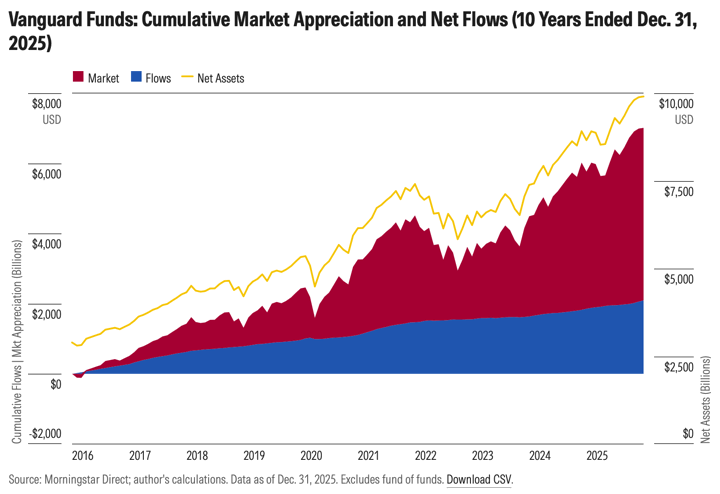
Vanguard just announced a new round of expense ratio drops spanning 53 funds (roughly 25% of them), totaling close to $250 million in fee reductions in 2026. See their press release and full list of changes. This comes almost exactly a year after their February 2025 cuts which spanned 87 funds with an estimated $350 in fee reductions that year.

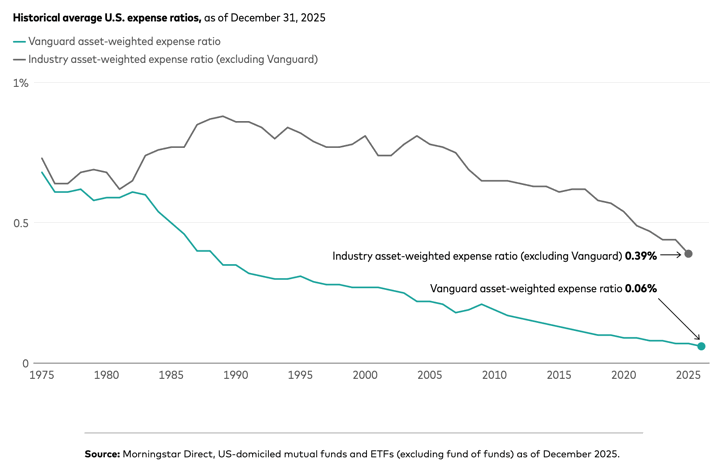
Over the past two years, Vanguard has reduced fees on most of its fund lineup totaling nearly $600 million in savings for investors—Vanguard’s largest-ever two-year combined cost reduction. Vanguard’s product lineup across all asset classes and styles now has an average expense ratio of 0.06%, reinforcing the firm’s longstanding cost leadership position. These consistently low costs help investors keep more of their returns, contributing to stronger long-term performance.

Additional media coverage at the Wall Street Journal (gift article) and Morningstar.

At this point, most of their expense ratios are so low on their big funds that most individual investors won’t notice much of a difference. The largest index funds VTI, VXUS, BND are unchanged. Target Retirement funds are also unchanged. However, I do believe it is an important indicator that Vanguard is still lowering costs as their assets under management continue to grow.

As an individual investor, it’s also important to remember that costs matter and those costs directly affect performance. Jack Bogle was right in his past skepticism of ETFs in that over time, the group has grown to include a lot of complex, expensive options. While the overall, asset-weighted average expense ratio for ETFs has declined over time, the average fee of newly launched ETFs has actually increased. Be wary of all those new, fancy ETFs that make attractive promises like limited downside and extremely high dividend income. This “Boomer candy” almost always comes with a higher expense ratio, and I am willing to bet it will also end up with lower long-term returns. New tricks, same old story.

Personally, I note that the Vanguard 0–3 Month Treasury Bill ETF (VBIL) lowered its expense ratio from 0.07% to 0.06%. My current go-to is iShares 0-3 Month Treasury Bond ETF (SGOV), which is at 0.09%.

The 30-day median bid/ask spread on VBIL is now 0.01% of market price, meaning its liquidity is now basically on the same level as SGOV (also at 0.01%). I will probably start using VBIL instead of SGOV for the times when I want a short-term cash equivalent in a brokerage account. 0.03% is a small difference, but I gotta keep incentivizing those lower costs. Long live the Vanguard Effect!

Fidelity Money Market Funds: Claim Your State Income Tax Exemption (Updated 2026)

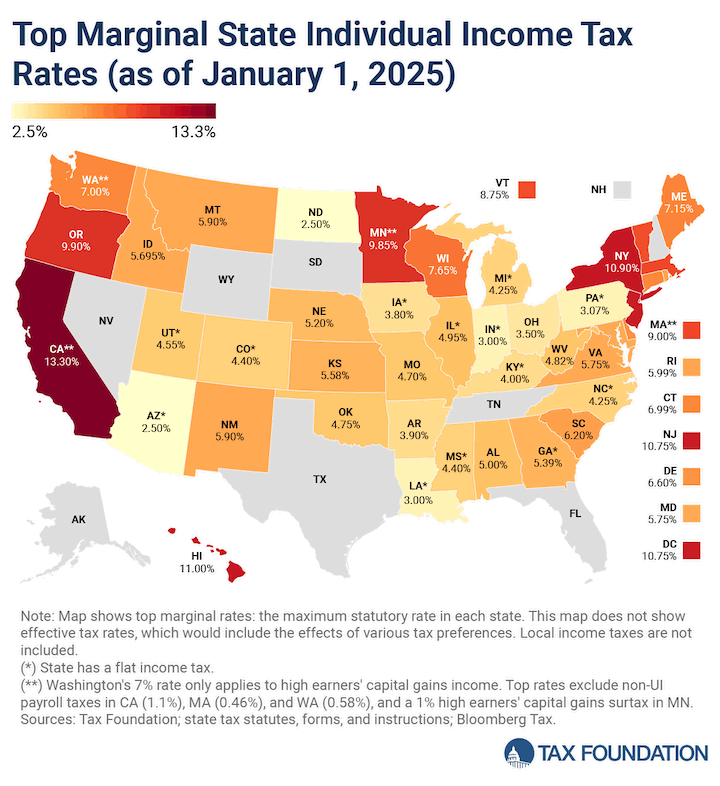
Updated for 2026. As the brokerage 1099 forms for the 2025 Tax Year are coming out, here is a quick reminder for those subject to state and/or local income taxes. If you earned interest from a money market fund, a significant portion of this interest may have come from “US Government Obligations” like Treasury bills and bonds, which are generally exempt from state and local income taxes. However, in order to claim this exemption, you’ll likely have to manually enter it on your tax return after digging up a few extra details.

(Note: California, Connecticut, and New York exempt dividend income only when the mutual fund has met certain minimum investments in U.S. government securities. They require that 50% of a mutual fund’s assets at each quarter-end within the tax year consist of U.S. government obligations.)

Fidelity has released 2025 Percentage of Income from U.S. Government Securities [pdf]. Here are the results for the most popular core Fidelity money market funds:

  • Fidelity® Treasury Only Money Market Fund (FDLXX, CUSIP 31617H300) – 98.67%.
  • Fidelity® Government Money Market Fund (SPAXX, CUSIP 31617H102) – 50.90%. *Did not meet the minimum investment in U.S. Government securities required to exempt the distribution from tax in California, Connecticut, and New York.
  • Fidelity® Government Cash Reserves (FDRXX, CUSIP 316067107) – 52.17%. *Did not meet the minimum investment in U.S. Government securities required to exempt the distribution from tax in California, Connecticut, and New York.
  • Fidelity® Treasury Money Market Fund* (FZFXX, CUSIP 316341304) – 61.52%. *Did not meet the minimum investment in U.S. Government securities required to exempt the distribution from tax in California, Connecticut, and New York.

It is disappointing that SPAXX as a default cash sweep did not meet the requirements to exempt any of their interest from state income tax in California, Connecticut, and New York. They must have missed the 50% minimum cut-off in one of the four quarters of 2025.

This is why I mostly own FDLXX as my “pseudo-core” money market fund via automated recurring purchases. For more information on this “hack”, see my post Fidelity Treasury Only Money Market (FDLXX) as Fidelity Core Position Workaround.

To find the portion of Fidelity dividends that may be exempt from your state income tax, multiply the amount of “ordinary dividends” reported in Box 1a of your Form 1099-DIV by the percentage listed in the PDF. For example, if you earned $1,000 in total interest from Fidelity Treasury Only Money Market Fund (FDLXX) in 2025, then $986.70 could possibly be exempt from state and local income taxes. If your marginal state income tax rate was 10% that would be a ~$99 tax savings for every $1,000 in total interest earned.

On a net after-tax basis, folks with a ~10% state income tax rate will likely find that FDLXX earns more interest than the default core holdings of SPAXX/FZFXX, even though the gross yield of SPAXX/FZFXX is higher than that of FDLXX.

To obtain these tax savings, you’ll have to manually adjust your state/local income tax return. I don’t believe that TurboTax, H&R Block, and other tax software will do this automatically for you, as they won’t have the required information on their own. (I’m also not sure if they ask about it in their interview process.) If you use an accountant, you should also double-check to make sure they use this information. Here is some information on how to enter this into a previous version of TurboTax:

  • When you are entering the 1099-DIV Box 1a, 1b, and 2a – click the “My form has info in other boxes (this is uncommon)” checkbox.
  • Next, click on the option “A portion of these dividends is U.S. Government interest.”
  • On the next screen enter the Government interest amount. This will be subtracted from your state return.

Standard disclosure: Check with your state or local tax office or with your tax advisor to determine whether your state allows you to exclude some or all of the income you earn from mutual funds that invest in U.S. government obligations.

[Image credit – Tax Foundation]

Estimate Your Personal Rate of Return (Quick Calculator)

Fixed for 2026. I initially wrote this calculator in 2007. Hey, at least you know it wasn’t AI! Some of you may be wondering how well your specific portfolio performed last year (or over any specific period of time). Let’s say you started the year with $10,000 and put in another $5,000 through 10 different deposits spaced throughout the year, and ended up with $16,000. What was your rate of return? Your main goal is simply to separate the effect of new deposits (or withdrawals) and your actual return from investments.

Figuring out your exact personal rate of return requires you to know the exact dates of all your deposits and withdrawals, along with a financial calculator or spreadsheet program with an IRR function (example here). However, for a quick and simple estimate of your returns, try this calculator instead:

Initial Balance: $
Total Deposits: $
Total Withdrawals: $
Final Balance: $
Time period:   year(s)
Your estimated annualized rate of return:   %

Instructions

  1. Get your initial balance. This is probably from your brokerage statements. Try January of last year.
  2. Tally up any deposits or withdrawals. For example, let’s say you know you put $3,000 in your Roth IRA and also 5% of your $40,000 salary into a 401(k). That would be $3,000 + $2,000 = $5,000. That’s it, you don’t need to worry about looking up the specific dates and amounts.
  3. Get your final balance. Your December statement is probably available already.
  4. Find the time elapsed (in years) between your initial and final balances.
  5. Hit Calculate. An estimate of your annualized return is instantly given.

How Accurate Is This Estimate?
The calculator assumes that the inflows and outflows are spread evenly around the middle of the year. I originally saw this method in the book The Four Pillars of Investing (review). However, unless the deposits and withdrawals are very large as compared to the initial balance, the estimates are actually pretty good.

For example, let’s say that you start with $100,000 on 1/1/2025, and end up with $120,000 on 1/1/2026. If you had net deposits of $10,000 during the year, the calculator above would estimate your return at 9.52%. If the $10,000 was actually deposited all at once on one of these specific days, you would get the following exact returns:

Deposit Date Exact Return
1/1/2025 (very first day) 9.1%
6/04/2025 (middle of the year) 9.5%
1/1/2026 (very last day) 10%
Estimate 9.5%


Also check out the rest of my Tools and Calculators.

Callan Periodic Table of Investment Returns 2025 Year-End Update

Callan Associates updates a “periodic table” annually with the relative performance of 9 major asset classes over the last 20 years. Above is the most recent snapshot of 2006-2025, which you can find on their website Callan.com. The best performing asset class is listed at the top, and it sorts downward until you have the worst performing asset. I find it easiest to focus on a specific Asset Class (Color) and then visually noting how its relative performance bounces around.

The Callan Periodic Table of Investment Returns conveys the strong case for diversification across asset classes (stocks vs. bonds), capitalizations (large vs. small), and equity markets (U.S. vs. global ex-U.S.). The Table highlights the uncertainty inherent in all capital markets. Rankings change every year. Also noteworthy is the difference between absolute and relative performance, as returns for the top-performing asset class span a wide range over the past 20 years.

Top 10 Largest US Companies 1985 vs. 1995 vs. 2005 vs. 2015 vs. 2025 (The Haystack Keeps Changing)

The late Jack Bogle was often credited with the saying: “Don’t look for the needle in the haystack. Just buy the haystack.” If you look at the entire “haystack” of the overall market as hundreds and thousands of individual companies, over time there are a lot of losers and a few big winners, or “needles”.

In addition, I’d also add the saying that “The haystack is always changing.” Check out the table above of the top 10 largest US companies in different decades, updated as of 12/31/25 as collected by JP Morgan Asset Management (this is a useful resource that is updated every quarter).

Notice that all the 1985 Top 10 companies are marked as green. There are fewer and fewer left in the top 10 after each decade that passes, and there are none in 2025. Most likely, by the time 2045 or 2065 rolls around – when you might be retired! – the Top 10 will include companies that don’t even exist today.

Investing in a simple market-cap index fund will always be criticized as “dumb” or “overweight this” or “underweight that”. I think weighing by the company value is a perfectly fine system for the patient, long-term investor. In the end, things shakes themselves out. If you buy the entire investable US stock market, or even extend this to the entire investable world stock market, you can be sure that you own all the eventual winners.

I enjoy not having to worry about things in the long term. If I feel like doing some active trading, I can, but I can also go weeks without checking a single stock ticker if I’m not in the mood.

MMB Portfolio Dividend & Interest Income – 2025 Year End Update

Here’s my 2025 Year-End income update as a companion post to my 2025 Year-End asset allocation & performance update. Even though I don’t focus on high-dividend stocks or covered-call strategies – I still track the income from my portfolio as an alternative metric to price performance. The total income goes up much more gradually and consistently than the number shown on brokerage statements, which helps encourage consistent investing. Here’s a related quote from Jack Bogle (source):

The true investor will do better if he forgets about the stock market and pays attention to his dividend returns and to the operating results of his companies. – Jack Bogle

Stock dividends are a portion of profits that businesses have decided to distribute directly to shareholders, as opposed to reinvesting into their business, paying back debt, or buying back shares. They have explicitly decided that they don’t need this money to improve their business, and that it would be better to distribute it to shareholders. The dividends may suffer some short-term drops, but over the long run they have grown faster than inflation.

Here is the historical growth of the S&P 500 total dividend, which tracks roughly the largest 500 stocks in the US, updated as of 2025 Q4 (via Yardeni Research):

Tracking the income from my portfolio. Three of the primary income “trees” that produce income “fruit” in my portfolio are Vanguard Total US Stock ETF (VTI), Vanguard Total International Stock ETF (VXUS), and Vanguard Real Estate Index ETF (VNQ).

In the US, the dividend culture is somewhat conservative in that shareholders expect dividends to be stable and only go up. Thus the starting yield is lower, but grows more steadily with smaller cuts during hard times. Companies do buybacks as well, often because they are easier to discontinue. Here is an updated chart of the trailing 12-month (ttm) dividend per share over the last 15 years paid by the Vanguard Total US Stock ETF (VTI) via WallStNumbers.com.

European corporate culture tends to encourage paying out a higher (sometimes even fixed) percentage of earnings as dividends, but that also means the dividends move up and down with earnings. The starting yield is currently higher but may not grow as reliably. Here is an updated chart of the trailing 12-month (ttm) dividend per share over the last 15 years paid by the Vanguard Total International Stock ETF (VXUS).

In the case of Real Estate Investment Trusts (REITs), they are legally required to distribute at least 90 percent of their taxable income to shareholders as dividends. Historically, about half of the total return from REITs is from this dividend income. Here is an updated chart of the trailing 12-month (ttm) dividend per share over the last 15 years paid by the Vanguard Real Estate Index ETF (VNQ).

The dividend yield (dividends divided by price) also serve as a rough valuation metric. When stock prices drop, this percentage metric usually goes up – which makes me feel better in a bear market. When stock prices go up, this percentage metric usually goes down, which keeps me from getting too euphoric during a bull market.

Finally, the last income component of my portfolio comes from interest from bonds and cash. Vanguard Short-Term Treasury ETF (VGSH) and Schwab US TIPS ETF (SCHP) are example holdings, with the actual amount varying with the prevailing interest rates, the real rates on TIPS, and the current rate of inflation.

Dividend and interest income yield. To estimate the income from my portfolio, I use the weighted “TTM” or “12-Month Yield” from Morningstar (checked 1/4/26), which is the sum of the trailing 12 months of interest and dividend payments divided by the last month’s ending share price (NAV) plus any capital gains distributed (usually zero for index funds) over the same period. My TTM portfolio yield is now roughly 2.66%.

In dividend investing circles, there is a metric called yield on cost, which is calculated by dividing the current dividend by the original purchase price. In other words, while my portfolio yield today is 2.53%, that is because the current market price is also a lot higher. Due to increasing dividends on average over time, my yield-on-cost based on my portfolio value from 10 years ago is over 5%.

What about the 4% rule? For big-picture purposes, I support the simple 4% or 3% rule of thumb, which equates to a target of accumulating roughly 25 to 33 times your annual expenses. I would lean towards a 3% withdrawal rate if you want to retire young (closer to age 50) and a 4% withdrawal rate if retiring at a more traditional age (closer to 65). It’s just a quick and dirty target to get you started, not a number sent down from the heavens!

During the accumulation stage, your time is better spent focusing on earning potential via better career moves, improving your skillset, networking, and/or looking for asymmetrical (unlimited upside, limited downside) entrepreneurial opportunities where you have an ownership interest.

Our dividends and interest income are not automatically reinvested. They are simply another “paycheck”. As with our other variable paychecks, we can choose to either spend it or invest it again to compound things more quickly. You could use this money to cut back working hours, pursue a different career path, start a new business, take a sabbatical, perform charity or volunteer work, and so on. You don’t have to wait until you hit a magic number. Our life path has been very different because of this philosophy. FIRE is Life!

Best Interest Rates Survey: Bank Accounts, Treasury Bills, Money Markets, ETFs – January 2026

Here’s my monthly survey of the best interest rates on cash as of January 2026, roughly sorted from shortest to longest maturities. Banks and brokerages love taking advantage of idle cash, and you can often earn more money while keeping the same level of safety by moving to another FDIC-insured bank or NCUA-insured credit union. Check out my Ultimate Rate-Chaser Calculator to see how much extra interest you could earn from switching. Rates listed are available to everyone nationwide. Rates checked as of 1/11/26.

TL;DR: Savings account interest rates have dropped slightly overall, moving with the Fed rate cut. You can still get 4.6% if you accept some hoops/restrictions, but most are under 4% now. Short-term T-Bill rates have fallen, now ~3.6%. Top 5-year CD rates are ~4% APY, while 5-year Treasury rate is ~3.7%.

High-yield savings accounts*
Since the huge megabanks still pay essentially zero interest, everyone should at least have a separate, no-fee online savings account to piggy-back onto your existing checking account. The interest rates on savings accounts can drop at any time, so I list the top rates as well as competitive rates from banks with a history of competitive rates and solid user experience. Some banks will bait you with a temporary top rate and then lower the rates in the hopes that you are too lazy to leave.

  • The top saving rate at the moment: Pibank at 4.60% APY (no min), but they have some weird restrictions; like you can only use wire/Plaid to deposit and wire transfers to withdraw funds?! OnPath FCU is at 4.40% APY with $25,000 minimum balance. CIT Platinum Savings is now at 3.75% APY with $5,000+ balance and is offering an up to $300 deposit bonus which increases your effective APY for a while. There are many banks in between.
  • SoFi Bank is at 3.30% APY + up to 4.00% APY for 6 months + $325 new account bonus with qualifying direct deposit. You must maintain a direct deposit of any amount (even $1) each month for the higher ongoing APY. SoFi has historically competitive rates and full banking features.
  • Here is a limited survey of high-yield savings accounts. They aren’t the top rates, but a group that have historically kept it relatively competitive such that I like to track their history. This month they start at 3.30% APY on up.

Short-term guaranteed rates (1 year and under)
A common question is what to do with a big pile of cash that you’re waiting to deploy shortly (plan to buy a house soon, just sold your house, just sold your business, legal settlement, inheritance). My usual advice is to keep things simple and take your time. If not a savings account, then put it in a flexible short-term CD under the FDIC limits until you have a plan.

  • No Penalty CDs offer a fixed interest rate that can never go down, but you can still take out your money (once) without any fees if you want to use it elsewhere. Marcus has a 13-month No Penalty CD at 3.95% APY ($500 minimum deposit). Farmer’s Insurance FCU has a 9-month No Penalty CD at 4.00% APY ($1,000 minimum deposit). USALLIANCE Financial CU has a 11-month No Penalty CD at 3.90% APY ($500 minimum deposit). CIT Bank has a 11-month No Penalty CD at 3.75% APY ($1,000 minimum deposit).
  • Genisys CU has a 13-month certificate at 4.16% APY ($500 min). Early withdrawal penalty is a clearly-disclosed 90 days of interest (many places hide this info now). Anyone can join this credit union via partner organization Arthritis Foundation or Paint Creek Center for the Arts (one-time $5 fee).

Money market mutual funds
Many brokerage firms that pay out very little interest on their default cash sweep funds (and keep the difference for themselves). Note: Money market mutual funds are highly-regulated, but ultimately not FDIC-insured, so I would still stick with highly reputable firms.

  • Vanguard Federal Money Market Fund (VMFXX) is the default sweep option for Vanguard brokerage accounts, which has a 7-day SEC yield of 3.64% (changes daily, but also works out to a compound yield of 3.70%, which is better for comparing against APY). Odds are this is much higher than your own broker’s default cash sweep interest rate.
  • Vanguard Treasury Money Market Fund (VUSXX) is an alternative money market fund which you must manually purchase, but the interest will be mostly (100% for 2024 tax year) exempt from state and local income taxes because it comes from qualifying US government obligations. Current 7-day SEC yield of 3.66% (compound yield of 3.72%).

Treasury Bills and Ultra-short Treasury ETFs
Another option is to buy individual Treasury bills which come in a variety of maturities from 4-weeks to 52-weeks and are fully backed by the US government. You can also invest in ETFs that hold a rotating basket of short-term Treasury Bills for you, while charging a small management fee for doing so. T-bill interest is exempt from state and local income taxes, which can make a significant difference in your effective yield.

  • You can build your own T-Bill ladder at TreasuryDirect.gov or via a brokerage account with a bond desk like Vanguard and Fidelity. Here are the current Treasury Bill rates. As of 1/9/26, a new 4-week T-Bill had the equivalent of 3.62% annualized interest and a 52-week T-Bill had the equivalent of 3.51% annualized interest.
  • The iShares 0-3 Month Treasury Bond ETF (SGOV) has a 3.70% 30-day SEC yield (0.09% expense ratio) and effective duration of 0.10 years. SPDR Bloomberg Barclays 1-3 Month T-Bill ETF (BIL) has a 3.59% 30-day SEC yield (0.136% expense ratio) and effective duration of 0.15 years. The new Vanguard 0-3 Month Treasury Bill ETF (VBIL) has a 3.72% 30-day SEC yield (0.07% expense ratio) and effective duration of 0.10 years.

US Savings Bonds
Series I Savings Bonds offer rates that are linked to inflation and backed by the US government. You must hold them for at least a year. If you redeem them within 5 years there is a penalty of the last 3 months of interest. The annual purchase limit for electronic I bonds is $10,000 per Social Security Number, available online at TreasuryDirect.gov.

  • “I Bonds” bought between November 2025 and April 2026 will earn a 4.03% rate for the first six months. The rate of the subsequent 6-month period will be based on inflation again. More on Savings Bonds here.
  • In mid-April 2026, the CPI will be announced and you will have a short period where you will have a very close estimate of the rate for the next 12 months. I will post another update at that time.

Rewards checking accounts
These unique checking accounts pay above-average interest rates, but with unique risks. You have to jump through certain hoops which usually involve 10+ debit card purchases each cycle, a certain number of ACH/direct deposits, and/or a certain number of logins per month. If you make a mistake (or they judge that you did) you risk earning zero interest for that month. Some folks don’t mind the extra work and attention required, while others would rather not bother. Rates can also drop suddenly, leaving a “bait-and-switch” feeling.

  • La Capitol Federal Credit Union pays 6.50% APY (increased) on up to $10,000 if you make 15 debit card purchases of at least $5 each per statement cycle. Anyone can join this credit union via partner organization, Louisiana Association for Personal Financial Achievement ($20).
  • OnPath Federal Credit Union (my review) pays 6.00% APY on up to $10,000 if you make 15 debit card purchases, opt into online statements, and login to online or mobile banking once per statement cycle. Anyone can join this credit union via $5 membership fee to join partner organization. You can also get a $150 Visa Reward card when you open a new account and make qualifying transactions.
  • Genisys Credit Union pays 6.75% APY on up to $7,500 if you make 10 debit card purchases of $5+ each per statement cycle, and opt into online statements. Anyone can join this credit union via $5 membership fee to join partner organization.
  • Oklahoma Central Credit Union pays 6.00% APY on up to $10,000 if you make 15 debit card purchases (non-ATM) per statement cycle. Anyone can join this credit union if they are “affiliated with another credit union”.
  • First Southern Bank pays 5.50% APY on up to $25,000 if you make at least 15 debit card purchases, 1 ACH credit or payment transaction, and enroll in online statements.
  • Credit Union of New Jersey pays 6.00% APY on up to $25,000 if you make 12 debit card purchases, opt into online statements, and make at least 1 direct deposit, online bill payment, or automatic payment (ACH) per statement cycle. Anyone can join this credit union via $5 membership fee to join partner organization.
  • Andrews Federal Credit Union pays 5.25% APY (decreased) on up to $25,000 if you make 15 debit card purchases, opt into online statements, and make at least 1 direct deposit or ACH transaction per statement cycle. Anyone can join this credit union via partner organization.
  • Capitol Credit Union pays 6.00% APY on up to $15,000 if you make 12 debit card purchases, opt into online statements, and make at least 1 direct deposit or ACH transaction per statement cycle. Anyone can join this credit union via partner organization ($5 to Wild Basin Wilderness).
  • Find a locally-restricted rewards checking account at DepositAccounts.

Certificates of deposit (greater than 1 year)
CDs offer higher rates, but come with an early withdrawal penalty. By finding a bank CD with a reasonable early withdrawal penalty, you can enjoy higher rates but maintain access in a true emergency. Alternatively, consider building a CD ladder of different maturity lengths (ex. 1/2/3/4/5-years) such that you have access to part of the ladder each year, but your blended interest rate is higher than a savings account. When one CD matures, use that money to buy another 5-year CD to keep the ladder going. Some CDs also offer “add-ons” where you can deposit more funds if rates drop.

  • ClearPath FCU has a limited-time 5-year “Flex” certificate at 4.25% APY ($5,000 minimum of new money), which has a unique feature of having no penalty after 12 months (must withdraw it all; partial withdrawals are subject to penalties). Available as regular or IRA. Anyone can join this credit union via partner organization ($5.00 donation to Clear Giving Charitable Association). Hat tip to Deposit Quest.
  • United Fidelity Bank has a 5-year certificate at 4.15% APY ($1,000 minimum), 4-year at 4.10% APY, 3-year at 4.10% APY, 2-year at 4.15% APY, and 1.5-year at 4.05% APY. Early withdrawal penalties are not disclosed clearly online.
  • Mountain America Credit Union (MACU) has a 5-year certificate at 4.00% APY ($500 minimum), 4-year at 4.00% APY, 3-year at 4.05% APY, 2-year at 4.20% APY, and 1-year at 3.80% APY. Early withdrawal penalty for the 4-year and 5-year is 365 days of interest. Anyone can join this credit union via partner organization American Consumer Council (use promo code “consumer” when joining).
  • You can buy certificates of deposit via the bond desks of Vanguard and Fidelity. You may need an account to see the rates. These “brokered CDs” offer FDIC insurance and easy laddering, but they don’t come with predictable early withdrawal penalties. Right now, I see a 5-year non-callable brokered CD at 3.75% APY (callable: no, call protection: yes). Be warned that both Vanguard and Fidelity will list higher rates from callable CDs, which importantly means they can (and will!) call back your CD if rates drop significantly later.

Longer-term Instruments
I’d use these with caution due to increased interest rate risk (tbh, I don’t use them at all), but I still track them to see the rest of the current yield curve.

  • Willing to lock up your money for 10 years? You can buy long-term certificates of deposit via the bond desks of Vanguard and Fidelity. These “brokered CDs” offer FDIC insurance, but they don’t come with predictable early withdrawal penalties. You might find something that pays more than your other brokerage cash and Treasury options. Right now, I see a 10-year CDs at 3.65% (non-callable) vs. 4.15% for a 10-year Treasury. Watch out for higher rates from callable CDs where they can call your CD back if interest rates drop.

All rates were checked as of 1/11/26.

* I no longer recommend fintech companies due to the possibility of significant loss due to poor recordkeeping and the lack of government protection in such scenarios. The point of cash is absolute safety of principal.

Photo by Giorgio Trovato on Unsplash
MMB Portfolio Asset Allocation & Performance – 2025 Year End Update

Here is my 2025 Year-End portfolio update that includes all our combined 401k/403b/IRAs and taxable brokerage accounts but excludes our house and small side portfolio of self-directed investments. Following the concept of skin in the game, the following is not a recommendation, but a sharing of our actual, imperfect DIY portfolio.

“Never ask anyone for their opinion, forecast, or recommendation. Just ask them what they have in their portfolio.” – Nassim Taleb

How I Track My Portfolio
Here’s how I track my portfolio across multiple brokers and account types:

  • The Empower Personal Dashboard real-time portfolio tracking tools (free) automatically logs into my different accounts, adds up my various balances, tracks my performance, and calculates my overall asset allocation daily. Formerly known as Personal Capital.
  • Once a quarter, I also update my manual Google Spreadsheet (free to copy, instructions) because it helps me calculate how much I need in each asset class to rebalance back towards my target asset allocation. I also create a new sheet each quarter, so I have a personal archive of my portfolio dating back many years.

2025 Year-End Asset Allocation and YTD Performance
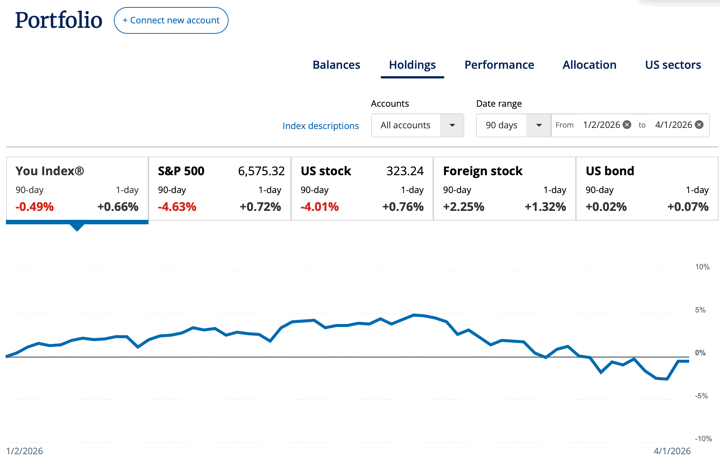
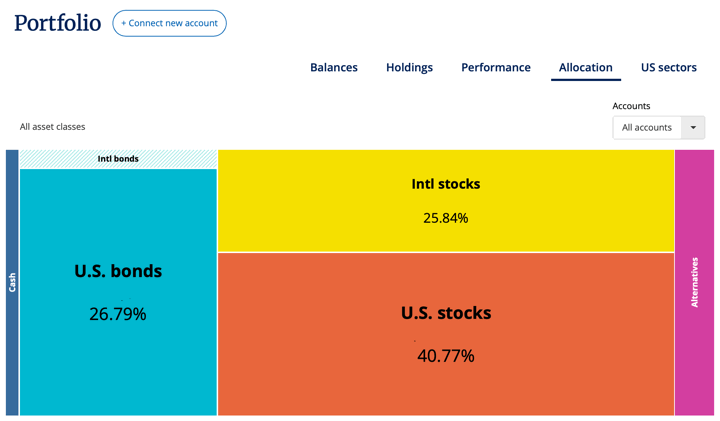
Here are updated performance and asset allocation charts, per the “Holdings” and “Allocation” tabs of my Empower Personal Dashboard.

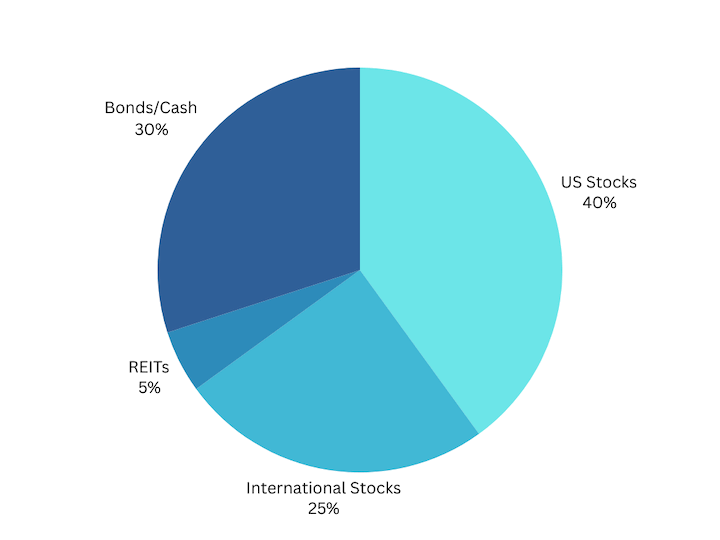
The major components of my portfolio are broad index ETFs. I do mix it up a bit around the edges, but not very much. Here is a model version of my target asset allocation with sample ETF holdings for each asset class.

  • 35% US Total Market (VTI)
  • 5% US Small-Cap Value (AVUV)
  • 20% International Total Market (VXUS)
  • 5% International Small-Cap Value (AVDV)
  • 5% US Real Estate (REIT) (VNQ)
  • 20% US “Regular” Treasury Bonds and/or FDIC-insured deposits (VGSH)
  • 10% US Treasury Inflation-Protected Bonds (SCHP)

Big picture, it is 70% businesses and 30% very safe bonds/cash:

By paying minimal costs including management fees, transaction spreads, and tax drag, I am trying to essentially guarantee myself above-average net performance over time.

I do not spend a lot of time backtesting various model portfolios. You’ll usually find that whatever model portfolio is popular at the moment just happens to hold the asset class that has been the hottest recently.

The portfolio that you can hold onto through the tough times is the best one for you. I’ve been pretty much holding this same portfolio for 20 years. Check out these ancient posts from 2004 and 2005. Every asset class will eventually have a low period, and you must have strong faith during these periods to earn those historically high returns. You have to keep owning and buying more stocks through the stock market crashes. You have to maintain and even buy more rental properties during a housing crunch, etc. A good sign is that if prices drop, you’ll want to buy more of that asset instead of less. I don’t have strong faith in the long-term results of commodities, gold, or bitcoin – so I don’t own them.

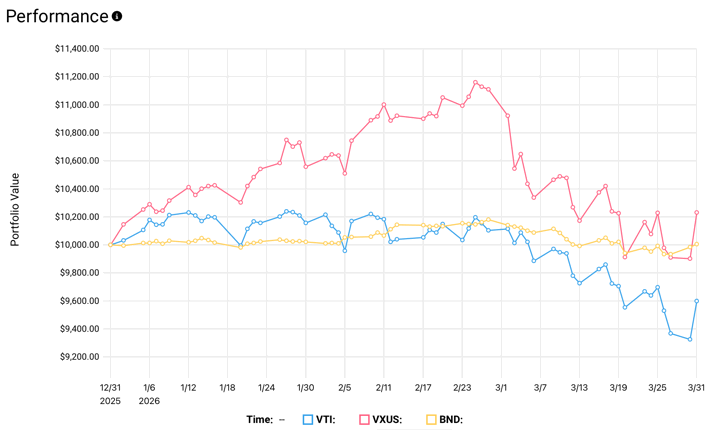
Performance details. Here’s an updated YTD Growth of $10,000 chart courtesy of Testfolio for some of the major ETFs that shows the difference in performance in the broad indexes:

Nearly everything went up in 2025. I doubt 2026 will be boring. I’ll share about more about the income aspect in a separate post.

Webull ACAT Transfer Bonus: 3% to 4% of Assets ($2k/100k Minimum)

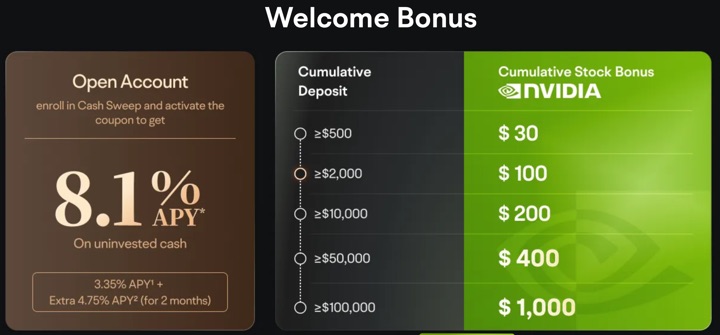
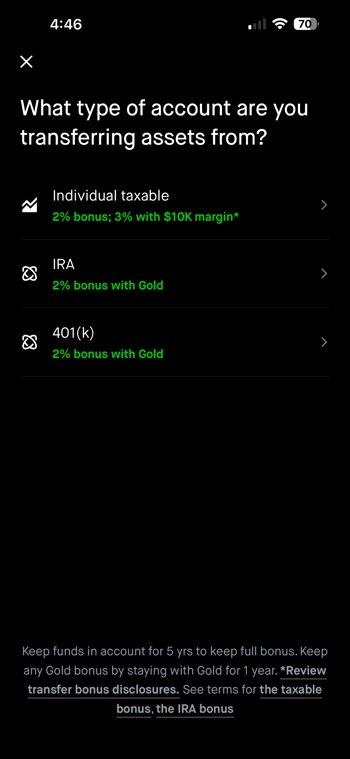
Updated with new offer. The Webull brokerage app is offering an updated ACAT Transfer bonus of up to 4% of assets transferred plus up to $100 in outgoing fee reimbursements on your first transfer of at least $2,000. This specific offer ends March 31, 2026. This is for individual taxable brokerage accounts. Joint, Crypto, and IRA accounts are excluded.

You must transfer at least $100,000 in assets to get a 4% match, with a minimum hold of 5 years to get the full payout (they break it up into installments with the last one being paid March 2031). Max funding is $2,000,000. You must transfer at least $2,000 in assets to get a 3% match, also with a minimum hold of 5 years. 4% is a very high bonus, but it is a long hold period. Be sure to read all the terms and conditions.

2025 Year-End Review: Asset Class & Target Date Fund Returns

2025 saw positive returns for every broad asset class that I track. Per Morningstar, here are the total annual returns (includes price appreciation and dividends/interest) for select asset classes as benchmarked by popular ETFs after market close 12/31/25.

I didn’t include Bitcoin or any other crypto because I don’t track them as a long-term asset, only own small amounts temporarily, and would not advise my family to own it. However, I do acknowledge that it went down slightly this year.

Meanwhile, Gold went up by a lot this year, which indicates to me that Gold and Bitcoin have some very different characteristics. Very few developed countries are buying large amounts of Bitcoin to store in their central bank vaults.

The “set and forget” Vanguard Target Retirement 2055 fund (VFFVX), currently consisting of roughly 90% diversified stocks and 10% bonds, was up 21.4% in 2025.

Commentary. 2024 yet again shows that you want to stay in the game. There are always going to be reasons to be afraid: because US stocks continue to have historically high valuations, because you’re worried about an AI bubble, or worried that AI will instead take your job…

Here are your cumulative returns through the end of 2025 if you had been a steady investor in the Vanguard Target Retirement 2055 for many years despite the many, many problems of the world:

(These work great inside 401ks and IRAs. I’d avoid buying Target Retirement mutual funds in a taxable account.)

I feel the need to promote slow compounding over all the short-term madness around us. Sports gambling. Risky options trading. Crypto joke coins. Buy Now Pay Later. I tell my kids that it’s perfectly okay to avoid some stuff completely. You don’t need to try it to know it’s a bad idea.

The Central Struggle of Investing: Repeatedly Choosing Easy but Boring

Michael Burry, of “Big Short” fame, recently shut down his hedge fund and started a Substack with an educational goal. I enjoy following his musings because he’s not afraid to say what he thinks, even if I often don’t agree (or have any idea what he’s obliquely referring to). He recently posted a “foundational” article that is supposed to show his thinking process, with a familiar beginning:

For those that do not trust anything analog, since 1990, there have been over 750 replacements in the S&P 500 Index. Google’s Gemini 3 Pro swears by it. Claude Max agrees.

Gemini 3 Pro and Claude Max further propose that 45% of the top 20 names in the 1999 NASDAQ 100 ended up bankrupt or acquired after a >75% loss. This checks out, my conference room says.

Capital is always fighting to be recycled.

Thusly, you now carry the knowledge that most investors are best off in an index – and have no need to invest in individual stocks.

If one is rather young and has 50-70 years left, then one absolutely should be almost entirely invested in common stock indices, preferably the S&P 500 or the Nasdaq 100 or both. Live life, touch grass, achieve real things, automatically reinvest dividends, and let the compounding of the Index Gods do the work. Maybe not this very day, but over time, this is the way for most.

Of course, some of us just do…not…want…easy.

For them, well, their God gave them GameStop.

He then goes very deep into how he analyzed GameStop and through skill and smarts, of course made some nice returns on the trade.

This is the central humblebrag of professional investors. *You* should index, but here’s what *I* do instead.

This also relates to the central struggle for all individual investors. If you are a motivated person who studies investing with an honest and open mind, you realize that you probably shouldn’t really be actively trading. But if you are a motivated person who studies investing, you probably think you are in the tiny minority that can make money reliably with actively trading. Smart enough to turn off “easy” mode.

The other problem with “easy” is that it is usuually boring and often slow. Meanwhile, your Robinhood app or equivalent will happily sell you:

  • Crypto, including memecoins that have zero utility.
  • Gambling, err “Prediction markets” on this weekend’s NFL game.
  • “Dividend” ETFs with a crazy 12% yield that some think will last forever.
  • Aggressive options that can lose all your money within days.
  • “Boomer candy” ETFs that promise stock-like upside with zero downside.
  • Index “Plus”. Index with extra ketchup. Index minus the ketchup. Just 25 basis points extra!

I spend a lot of my own time doing just this – reading such interesting ideas across various corners of the investing world but repeatedly convincing myself to pick “easy”. Doing nothing, over and over again.

Fidelity Tax-Loss Harvesting Tool: Help Identify Capital Loss Opportunities

Fidelity has a number of useful Tools & Calculators, most of which are open to everyone to use. However, their Tax-Loss Harvesting Tool (login required) is meant for Fidelity taxable brokerage customers, as it is based on your personal data and shows the size of your expected capital gains this year, while also helping you identify capital losses that you can “harvest” if you wanted.

You’ll need to provide your marginal tax rates (make an estimate with current brackets here). The tool can even help you place the (market) order to sell those shares with just a couple clicks.

This Fidelity article How to reduce investment taxes contains a lot of details on the practice of tax-loss harvesting:

An investment loss can be used for 2 different things:

– The losses can be used to offset investment gains.
– Remaining losses can offset $3,000 of income on a tax return in one year. (For married individuals filing separately, the deduction is $1,500.)

[…] There are 2 types of gains and losses: short-term and long-term.

– Short-term capital gains and losses are those realized from the sale of investments that you have owned for one year or less.
– Long-term capital gains and losses are realized after selling investments held longer than one year.
The key difference between short- and long-term gains is the rate at which they are taxed.

Short-term capital gains are taxed at your marginal tax rate as ordinary income. The top marginal federal tax rate on ordinary income is 37%.

Wash sale warning: The tool can’t cross-reference all your other non-Fidelity trades, and also doesn’t even account for your Fidelity trades within tax-deferred accounts. If a wash sale occurs, your loss will be disallowed. Here’s the warning provided:

Wash sale warning: Estimated savings based on tax-loss harvesting assumes that you will not have a wash sale that would defer your tax loss.

If you sell shares at a loss and you purchase additional shares of the same or a substantially identical security (in the same or a different account) within the 61-day period that begins 30 days before and ends 30 days after the trade date of the sale, the purchase may result in a wash sale. If a wash sale occurs, the loss from the transaction will be “disallowed” for tax purposes, and the amount of the loss will be added to the cost basis of your shares in the same security. Fidelity adjusts cost basis information related to shares in the same security when a wash sale occurs within an account as the result of an identical security purchase.

You must check your own records across all of your Fidelity and non-Fidelity accounts to ensure that you are correctly accounting for losses related to any wash sales.

ETFs are often the easiest way to harvest a tax loss. Even if you buy-and-hold ETFs, consider ETF tax-loss harvesting (my post from 2008?!) as you can harvest the loss from the sale of an ETF, and then immediately buy a similar but not “substantially identical” ETF without triggering a wash sale. This has become common industry practice. There’s a Fidelity article on this too.

When evaluating your ETFs against the wash-sale rule, compare the issuer, index, and underlying holdings between the two ETFs being swapped. The more dissimilar these are, the more likely it is that you won’t trigger a wash sale.

Even Vanguard does ETF tax-loss harvesting in their advisory services using “surrogate ETFs”.

Surrogate funds are the ETFs (exchange?traded funds) Vanguard Personal Advisor uses toreplace investments sold to harvest losses. They are Vanguard ETFs® with similar asset and sub?asset allocations to the funds we’re replacing.

There may not be as many opportunities to harvest a tax loss this year since most things are up (a good thing!), but something to keep in mind down the road.

The usual disclaimer: I do not provide legal or tax advice. The information herein is general and educational in nature and should not be considered legal or tax advice.