
A satoshi, or “sat” for short, is the smallest unit of the cryptocurrency bitcoin. “Stacking Sats” is a popular term for gradually accumulating bitcoin by purchasing small amounts of bitcoin at a time. (100 million sats = 1 bitcoin.) The idea is that you should be excited about adding any amount to your stack, focusing on that forward progress instead of the current market price.
If only it would be as trendy for folks to “stack VOO” or “stack VTI”. A low-cost S&P 500 or US Total Market index ETF is a tax-efficient way to build up your ownership of a share of excellent American businesses. Unfortunately, there is always something shinier next to this vanilla product. Factor ETFs, themed ETFs, sector ETFs, and so on. John Rekenthaler of Morningstar has an interesting series of articles comparing the long-term returns of various alternatives to Vanguard index funds. See Vanguard’s Other Index-Fund Invention.
Even way back in 1992, Vanguard started offering “Value” and “Growth” index funds, essentially splitting the US stock market into two halves based on price/book ratios. Essentially, these were the first variation on the plain S&P 500 index fund. You might think one was better than other. (Most academics would have guessed Value would win.) So what happened over the next 20 years? Not very much! (Plus Growth won slightly.)

Of course, I would not be surprised at all to see Value squeak out a slight win over Growth after another 10 or 20 years. One is always going to be winning slightly, but take a step back and you can argue they are effectively tied. Why not just own the S&P 500 index fund and get the average?
(Quick reminder: The Rule of 72 says that 10% annualized means your money will double every 7.2 years. That means $10,000 will have doubled three times in about 21 years. $10k doubled to $20k, then doubled to $40k, then doubled to $80k!)
What if you rebalanced regularly between Value and Growth? If you rebalanced between the two funds every single month, your annual return would have increased by 0.10%. If you rebalanced between the two funds only once every 5 years, your annual return would have increased by 0.28%. But really, who rebalances only once every 5 years? In view, these numbers are still low enough to be in the noise range, and the extra return is not dependable.
What if you bought a low-cost actively-managed fund from Vanguard instead? Due much to Vanguard’s extremely low costs on their active funds, some actively-managed funds did do better, but others did worse. If you chose to buy the funds with the highest trailing returns, or the best Sharpe ratios, or the most popular funds (most assets), all that Ivy League brainpower and decades of investing experience would have still lagged behind a simple index fund portfolio. Only with the power to see the future would you have picked the index-beating funds.

As the saying goes, don’t let the pursuit of perfect be the enemy of the good. As someone sitting on a relatively big pile of VTI after 15+ years of stacking it share by share, I am certainly relieved that I didn’t get too distracted by all of the other shiny objects out there. Instead of remembering your highest portfolio value ever from your monthly statement, remember the number of shares of VTI or VOO that you own. Every $200 saved = 1 share of VTI. But in the end, as long as you get excited about stacking something of high-quality with long-term productive value, you’ll likely end up in a good place.
 Here’s my monthly roundup of the best interest rates on cash as of June 2022, roughly sorted from shortest to longest maturities. We all need some safe assets for cash reserves or portfolio stability, and there are often lesser-known opportunities available to individual investors. Check out my
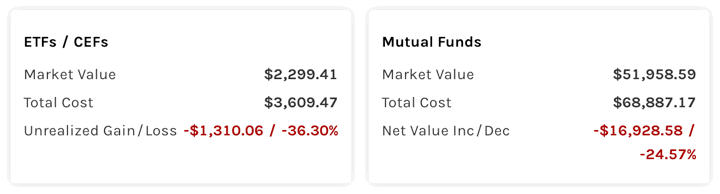
  Inside various financial forums, I am seeing the “anyone else worried?” 😓 posts as most portfolios are down double-digits. For a retiree with a $1 million portfolio, seeing $100,000 or $200,000 of value evaporate is understandably stressful. However, much of this is because you are comparing to your portfolio’s all-time high, or high-water mark, which is a relatively arbitrary number. Just because at one moment in time, there were a few willing buyers of your assets for a given price doesn’t mean you should anchor yourself to that number.




 While listening to the
 Updated May 2022. Vanguard regularly announces expense ratio cuts to their mutual funds and ETFs. This post serves to keep track of these updates, as Vanguard usually removes the press releases after a certain amount of time. Most changes will be minor, it is always good to see continuing progress.


 Inflation (and thus I Bonds) 🚀🚀🚀! Savings I Bonds are a unique, low-risk investment backed by the US Treasury that pay out a variable interest rate linked to inflation. With a holding period from 12 months to 30 years, you could own them as an alternative to bank certificates of deposit (they are liquid after 12 months) or bonds in your portfolio.
  This is a bit of an “inside baseball” topic appealing only to serious DIY investors, but I found this FT article about
  The Best Credit Card Bonus Offers – 2026
 Big List of Free Stocks from Brokerage Apps
 Best Interest Rates on Cash - 2026
 Free Credit Scores x 3 + Free Credit Monitoring
 Best No Fee 0% APR Balance Transfer Offers
 Little-Known Cellular Data Plans That Can Save Big Money
 How To Haggle Your Cable or Direct TV Bill
 Big List of Free Consumer Data Reports (Credit, Rent, Work)