Best Interest Rates Survey: Bank Accounts, Treasury Bills, Money Markets, ETFs – October 2025

Here’s my monthly survey of the best interest rates on cash as of October 2025, roughly sorted from shortest to longest maturities. Banks and brokerages love taking advantage of our idle cash, and you can often earning more money while keeping the same level of safety by moving to another FDIC-insured bank or NCUA-insured credit union. Check out my Ultimate Rate-Chaser Calculator to see how much extra interest you could earn from switching. Rates listed are available to everyone nationwide. Rates checked as of 10/13/2025.

TL;DR: Savings account interest rates have dropped slightly overall. You can get 4.6% and 4.5% APY if you accept some hoops/restrictions. Short-term T-Bill rates have fallen slightly, now ~4.1%. Top 5-year CD rates are ~4.3% APY, while 5-year Treasury rate is ~3.6%.

High-yield savings accounts*
Since the huge megabanks still pay essentially no interest, everyone should at least have a separate, no-fee online savings account to piggy-back onto your existing checking account. The interest rates on savings accounts can drop at any time, so I list the top rates as well as competitive rates from banks with a history of competitive rates and solid user experience. Some banks will bait you with a temporary top rate and then lower the rates in the hopes that you are too lazy to leave.

  • The top saving rate at the moment: Pibank at 4.60% APY (no min), but they have some weird restrictions; like you can only use wire/Plaid to deposit and wire transfers to withdraw funds?! Presidential Bank has a 4.50% APY savings account that requires an Advantage Checking account. You’ll have to decide if the hoops are worth it. CIT Platinum Savings is now at 3.85% APY with $5,000+ balance and is offering an up to $300 deposit bonus which increases your effective APY for a while. There are many banks in between.
  • SoFi Bank is at 3.80% APY + up to 4.50% APY for 6 months + $325 new account bonus with qualifying direct deposit. You must maintain a direct deposit of any amount (even $1) each month for the higher APY. SoFi has historically competitive rates and full banking features.
  • Here is a limited survey of high-yield savings accounts. They aren’t the top rates, but a group that have historically kept it relatively competitive such that I like to track their history. I call this the “okay/good” zone of 3.40%+.

Short-term guaranteed rates (1 year and under)
A common question is what to do with a big pile of cash that you’re waiting to deploy shortly (plan to buy a house soon, just sold your house, just sold your business, legal settlement, inheritance). My usual advice is to keep things simple and take your time. If not a savings account, then put it in a flexible short-term CD under the FDIC limits until you have a plan.

  • No Penalty CDs offer a fixed interest rate that can never go down, but you can still take out your money (once) without any fees if you want to use it elsewhere. Marcus has a 13-month No Penalty CD at 3.95% APY ($500 minimum deposit). Farmer’s Insurance FCU has a 9-month No Penalty CD at 4.00% APY ($1,000 minimum deposit). USA USALLIANCE Financial CU has a 11-month No Penalty CD at 3.90% APY ($500 minimum deposit).
  • Abound Credit Union has a 10-month certificate at 4.30% APY ($500 min). Early withdrawal penalty is 90 days of interest. Anyone can join this credit union via $10 membership fee to join partner organization.

Money market mutual funds
Many brokerage firms that pay out very little interest on their default cash sweep funds (and keep the difference for themselves). Note: Money market mutual funds are highly-regulated, but ultimately not FDIC-insured, so I would still stick with highly reputable firms.

  • Vanguard Federal Money Market Fund (VMFXX) is the default sweep option for Vanguard brokerage accounts, which has a 7-day SEC yield of 4.04% (changes daily, but also works out to a compound yield of 4.12%, which is better for comparing against APY). Odds are this is much higher than your own broker’s default cash sweep interest rate.
  • Vanguard Treasury Money Market Fund (VUSXX) is an alternative money market fund which you must manually purchase, but the interest will be mostly (100% for 2024 tax year) exempt from state and local income taxes because it comes from qualifying US government obligations. Current 7-day SEC yield of 4.04% (compound yield of 4.12%).

Treasury Bills and Ultra-short Treasury ETFs
Another option is to buy individual Treasury bills which come in a variety of maturities from 4-weeks to 52-weeks and are fully backed by the US government. You can also invest in ETFs that hold a rotating basket of short-term Treasury Bills for you, while charging a small management fee for doing so. T-bill interest is exempt from state and local income taxes, which can make a significant difference in your effective yield.

  • You can build your own T-Bill ladder at TreasuryDirect.gov or via a brokerage account with a bond desk like Vanguard and Fidelity. Here are the current Treasury Bill rates. As of 10/10/25, a new 4-week T-Bill had the equivalent of 4.09% annualized interest and a 52-week T-Bill had the equivalent of 3.61% annualized interest.
  • The iShares 0-3 Month Treasury Bond ETF (SGOV) has a 4.12% 30-day SEC yield (0.09% expense ratio) and effective duration of 0.10 years. SPDR Bloomberg Barclays 1-3 Month T-Bill ETF (BIL) has a 4.02% 30-day SEC yield (0.136% expense ratio) and effective duration of 0.15 years. The new Vanguard 0-3 Month Treasury Bill ETF (VBIL) has a 4.12% 30-day SEC yield (0.07% expense ratio) and effective duration of 0.10 years.

US Savings Bonds
Series I Savings Bonds offer rates that are linked to inflation and backed by the US government. You must hold them for at least a year. If you redeem them within 5 years there is a penalty of the last 3 months of interest. The annual purchase limit for electronic I bonds is $10,000 per Social Security Number, available online at TreasuryDirect.gov.

  • “I Bonds” bought between May 2025 and October 2025 will earn a 3.98% rate for the first six months. The rate of the subsequent 6-month period will be based on inflation again. More on Savings Bonds here.
  • In mid-October 2025, the CPI will be announced and you will have a short period where you will have a very close estimate of the rate for the next 12 months. I will post another update at that time.

Rewards checking accounts
These unique checking accounts pay above-average interest rates, but with unique risks. You have to jump through certain hoops which usually involve 10+ debit card purchases each cycle, a certain number of ACH/direct deposits, and/or a certain number of logins per month. If you make a mistake (or they judge that you did) you risk earning zero interest for that month. Some folks don’t mind the extra work and attention required, while others would rather not bother. Rates can also drop suddenly, leaving a “bait-and-switch” feeling.

  • OnPath Federal Credit Union (my review) pays 7.00% APY on up to $10,000 if you make 15 debit card purchases, opt into online statements, and login to online or mobile banking once per statement cycle. Anyone can join this credit union via $5 membership fee to join partner organization. You can also get a $150 Visa Reward card when you open a new account and make qualifying transactions.
  • Genisys Credit Union pays 6.75% APY on up to $7,500 if you make 10 debit card purchases of $5+ each per statement cycle, and opt into online statements. Anyone can join this credit union via $5 membership fee to join partner organization.
  • Oklahoma Central Credit Union pays 6.00% APY on up to $10,000 if you make 15 debit card purchases (non-ATM) per statement cycle. Anyone can join this credit union if they are “affiliated with another credit union”.
  • La Capitol Federal Credit Union pays 5.75% APY on up to $10,000 if you make 15 debit card purchases of at least $5 each per statement cycle. Anyone can join this credit union via partner organization, Louisiana Association for Personal Financial Achievement ($20).
  • First Southern Bank pays 5.50% APY on up to $25,000 if you make at least 15 debit card purchases, 1 ACH credit or payment transaction, and enroll in online statements.
  • Credit Union of New Jersey pays 6.00% APY on up to $25,000 if you make 12 debit card purchases, opt into online statements, and make at least 1 direct deposit, online bill payment, or automatic payment (ACH) per statement cycle. Anyone can join this credit union via $5 membership fee to join partner organization.
  • Andrews Federal Credit Union pays 5.50% APY (down from 6%) on up to $25,000 if you make 15 debit card purchases, opt into online statements, and make at least 1 direct deposit or ACH transaction per statement cycle. Anyone can join this credit union via partner organization.
  • Find a locally-restricted rewards checking account at DepositAccounts.

Certificates of deposit (greater than 1 year)
CDs offer higher rates, but come with an early withdrawal penalty. By finding a bank CD with a reasonable early withdrawal penalty, you can enjoy higher rates but maintain access in a true emergency. Alternatively, consider building a CD ladder of different maturity lengths (ex. 1/2/3/4/5-years) such that you have access to part of the ladder each year, but your blended interest rate is higher than a savings account. When one CD matures, use that money to buy another 5-year CD to keep the ladder going. Some CDs also offer “add-ons” where you can deposit more funds if rates drop.

  • United Fidelity Bank has a 5-year certificate at 4.30% APY ($1,000 minimum), 4-year at 4.25% APY, 3-year at 4.20% APY, 2-year at 4.20% APY, and 1.5-year at 4.25% APY. Early withdrawal penalties are not disclosed clearly online.
  • Mountain America Credit Union (MACU) has a 5-year certificate at 4.00% APY ($500 minimum), 4-year at 4.00% APY, 3-year at 4.00% APY, 2-year at 4.25% APY, and 1-year at 4.00% APY. Early withdrawal penalty for the 4-year and 5-year is 365 days of interest. Anyone can join this credit union via partner organization American Consumer Council for a one-time $5 fee (or try promo code “consumer”).
  • Lafayette Federal Credit Union (LFCU) has a 5-year certificate at 3.97% APY ($500 minimum), 4-year at 3.97% APY, 3-year at 3.97% APY, 2-year at 4.02% APY, and 1-year at 4.02% APY. Slightly higher rates with jumbo $100,000+ balances. Note that the early withdrawal penalty for the 5-year is a relatively large 600 days of interest. Anyone nationwide can join LFCU by joining the Home Ownership Financial Literacy Council (HOFLC) for a one-time $10 fee.
  • You can buy certificates of deposit via the bond desks of Vanguard and Fidelity. You may need an account to see the rates. These “brokered CDs” offer FDIC insurance and easy laddering, but they don’t come with predictable early withdrawal penalties. Right now, I see a 5-year non-callable brokered CD at 3.75% APY (callable: no, call protection: yes). Be warned that both Vanguard and Fidelity will list higher rates from callable CDs, which importantly means they can (and will!) call back your CD if rates drop significantly later.

Longer-term Instruments
I’d use these with caution due to increased interest rate risk (tbh, I don’t use them at all), but I still track them to see the rest of the current yield curve.

  • Willing to lock up your money for 10 years? You can buy long-term certificates of deposit via the bond desks of Vanguard and Fidelity. These “brokered CDs” offer FDIC insurance, but they don’t come with predictable early withdrawal penalties. You might find something that pays more than your other brokerage cash and Treasury options. Right now, I see a 10-year CDs at [n/a] (non-callable) vs. 4.05% for a 10-year Treasury. Watch out for higher rates from callable CDs where they can call your CD back if interest rates drop.

All rates were checked as of 10/13/25.

* I no longer recommend fintech companies due to the possibility of significant loss due to poor recordkeeping and the lack of government protection in such scenarios. The point of cash is absolute safety of principal.

Photo by Giorgio Trovato on Unsplash

MMB Portfolio Dividend & Interest Income – October 2025 Q3 Update

Here’s my 2025 Q3 income update as a companion post to my 2025 Q3 asset allocation & performance update. Even though I don’t focus on high-dividend stocks or covered-call income strategies – I still track the income from my portfolio as an alternative metric to price performance. The total income goes up much more gradually and consistently than the number shown on brokerage statements, which helps encourage consistent investing. Here’s a related quote from Jack Bogle (source):

The true investor will do better if he forgets about the stock market and pays attention to his dividend returns and to the operating results of his companies. – Jack Bogle

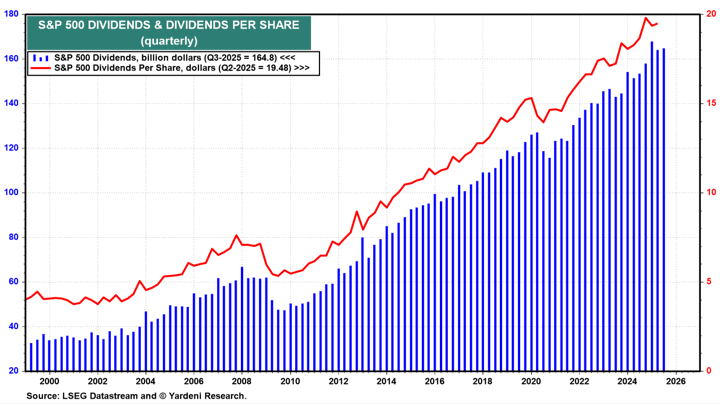
Stock dividends are a portion of profits that businesses have decided to distribute directly to shareholders, as opposed to reinvesting into their business, paying back debt, or buying back shares. They have explicitly decided that they don’t need this money to improve their business, and that it would be better to distribute it to shareholders. The dividends may suffer some short-term drops, but over the long run they have grown faster than inflation.

Here is the historical growth of the S&P 500 total dividend, which tracks roughly the largest 500 stocks in the US, updated as of 2025 Q3 (via Yardeni Research):

Tracking the income from my portfolio. Three of the primary income “trees” that produce income “fruit” in my portfolio are Vanguard Total US Stock ETF (VTI), Vanguard Total International Stock ETF (VXUS), and Vanguard Real Estate Index ETF (VNQ).

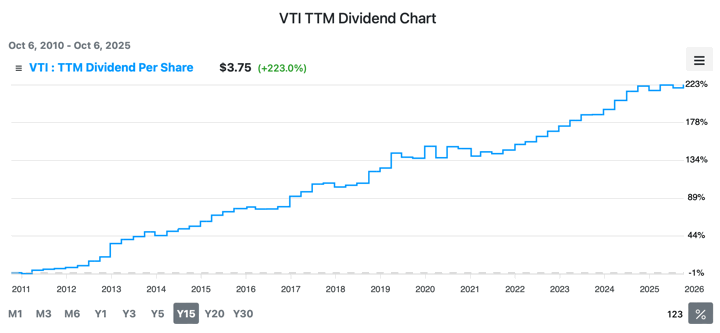
In the US, the dividend culture is somewhat conservative in that shareholders expect dividends to be stable and only go up. Thus the starting yield is lower, but grows more steadily with smaller cuts during hard times. Companies do buybacks as well, often because they are easier to discontinue. Here is an updated chart of the trailing 12-month (ttm) dividend per share over the last 15 years paid by the Vanguard Total US Stock ETF (VTI) via WallStNumbers.com.

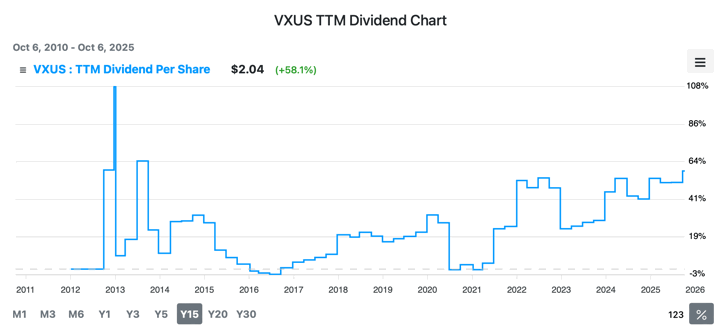
European corporate culture tends to encourage paying out a higher (sometimes even fixed) percentage of earnings as dividends, but that also means the dividends move up and down with earnings. The starting yield is currently higher but may not grow as reliably. Here is an updated chart of the trailing 12-month (ttm) dividend per share over the last 15 years paid by the Vanguard Total International Stock ETF (VXUS).

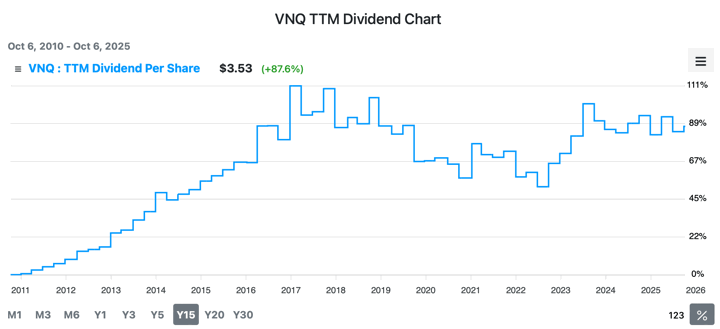
In the case of Real Estate Investment Trusts (REITs), they are legally required to distribute at least 90 percent of their taxable income to shareholders as dividends. Historically, about half of the total return from REITs is from this dividend income. Here is an updated chart of the trailing 12-month (ttm) dividend per share over the last 15 years paid by the Vanguard Real Estate Index ETF (VNQ).

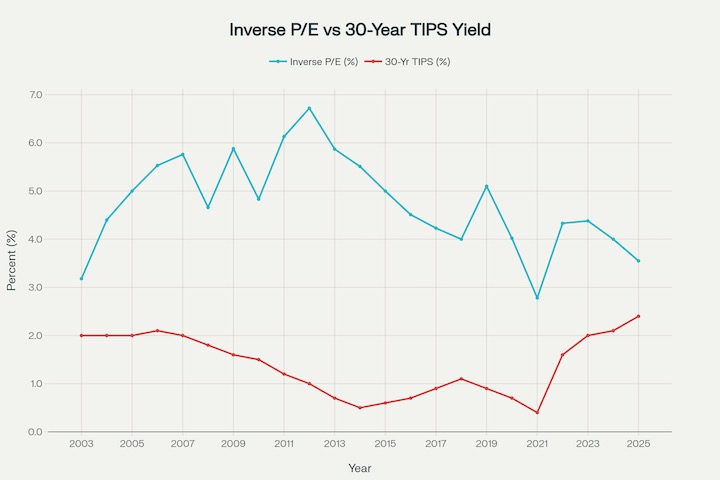
The dividend yield (dividends divided by price) also serve as a rough valuation metric. When stock prices drop, this percentage metric usually goes up – which makes me feel better in a bear market. When stock prices go up, this percentage metric usually goes down, which keeps me from getting too euphoric during a bull market.

Finally, the last income component of my portfolio comes from interest from bonds and cash. Vanguard Short-Term Treasury ETF (VGSH) and Schwab US TIPS ETF (SCHP) are example holdings, with the actual amount varying with the prevailing interest rates, the real rates on TIPS, and the current rate of inflation.

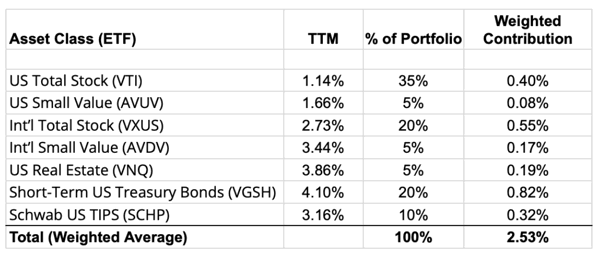
Dividend and interest income yield. To estimate the income from my portfolio, I use the weighted “TTM” or “12-Month Yield” from Morningstar (checked 10/6/24), which is the sum of the trailing 12 months of interest and dividend payments divided by the last month’s ending share price (NAV) plus any capital gains distributed (usually zero for index funds) over the same period. My TTM portfolio yield is now roughly 2.53%.

In dividend investing circles, there is a metric called yield on cost, which is calculated by dividing the current dividend by the original purchase price. In other words, while my portfolio yield today is 2.53%, that is because the current market price is also a lot higher. My yield based on my portfolio value from 10 years ago (October 2015) is over 5%.

What about the 4% rule? For big-picture purposes, I support the simple 4% or 3% rule of thumb, which equates to a target of accumulating roughly 25 to 33 times your annual expenses. I would lean towards a 3% withdrawal rate if you want to retire young (closer to age 50) and a 4% withdrawal rate if retiring at a more traditional age (closer to 65). I don’t enjoy debating this number. It’s just a quick and dirty target to get you started, not a number sent down from the heavens!

During the accumulation stage, your time is better spent focusing on earning potential via better career moves, improving your skillset, networking, and/or looking for asymmetrical (unlimited upside, limited downside) entrepreneurial opportunities where you have an ownership interest.

Our dividends and interest income are not automatically reinvested. They are simply another “paycheck”. As with our other variable paychecks, we can choose to either spend it or invest it again to compound things more quickly. You could use this money to cut back working hours, pursue a different career path, start a new business, take a sabbatical, perform charity or volunteer work, and so on. You don’t have to wait until you hit a magic number. Our life path has been very different because of this philosophy. FIRE is Life!

Kraken Crypto/Brokerage: Up to 2% Deposit Bonus w/ 12-Month Hold

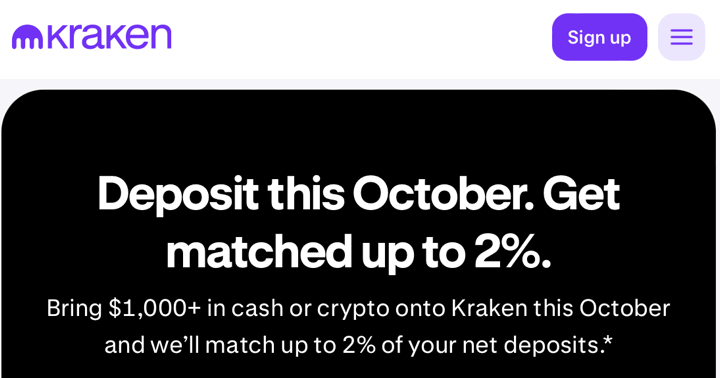
Kraken is offering up to a 2% deposit bonus in October for any customer that deposits $1,000+ in cash or crypto during October. The deposit bonus will vary from 1% to 2% depending on total deposits across all customers, with the strange rule that when $500 million in total aggregate deposits are made and the full 2% deposit is triggered, the entire promo ends immediately, so you need to have participated by then. The bonus will then be paid within 14 days after the promo ends, in their USDG stablecoin.

Net deposits are calculated by total cash and crypto deposited, minus withdrawals during the promotion period. Your deposits earn a 1% match rate, which can boost up to 2% based on community progress. The final rate is set based on the total community net deposit value at the end of the promo (Oct 31 or when $500M is reached).

You must keep your net deposits at Kraken through November 1st, 2026. You can trade your deposit, and market fluctuations are okay as long as you don’t withdraw any funds. Full terms here.

Kraken is best known as a crypto exchange, but as of early 2025 they now offer US stock trading under Kraken Securities through a partnership with Alpaca (press release). The terms say that you can trade your deposits, so technically I don’t see why you couldn’t move your cash to Kraken, buy a T-Bill ETF like SGOV or VBIL (current SEC yields ~4.11% and 4.12%), and basically earn up to an additional 2% APY on your cash for a year.

A 2% deposit bonus for a 12-month hold is a pretty good deal. For me, the main catch is that you have to trust the US regulatory agencies that manage SIPC insurance in case Kraken Securities fails during the next year. ETFs held in an SIPC brokerage account are definitely better than an uninsured crypto account, but I just worry it could be messy, so I’d probably size my risk (deposit amount) accordingly.

If you haven’t already, you should also grab Kraken’s $75 new crypto account bonus and 30 days of free money spins, where I earned almost $20 in random crypto like DOGE and PEPE:

MMB Portfolio Asset Allocation & Performance – 2025 Q3 Update

Here is my 2025 3rd Quarter portfolio update that includes all our combined 401k/403b/IRAs and taxable brokerage accounts but excludes our house and small side portfolio of self-directed investments. Following the concept of skin in the game, the following is not a recommendation, but a sharing of our actual, imperfect DIY portfolio.

“Never ask anyone for their opinion, forecast, or recommendation. Just ask them what they have in their portfolio.” – Nassim Taleb

How I Track My Portfolio
Here’s how I track my portfolio across multiple brokers and account types:

  • The Empower Personal Dashboard real-time portfolio tracking tools (free) automatically logs into my different accounts, adds up my various balances, tracks my performance, and calculates my overall asset allocation daily. Formerly known as Personal Capital.
  • Once a quarter, I also update my manual Google Spreadsheet (free to copy, instructions) because it helps me calculate how much I need in each asset class to rebalance back towards my target asset allocation. I also create a new sheet each quarter, so I have a personal archive of my portfolio dating back many years.

2025 Q3 Asset Allocation and YTD Performance
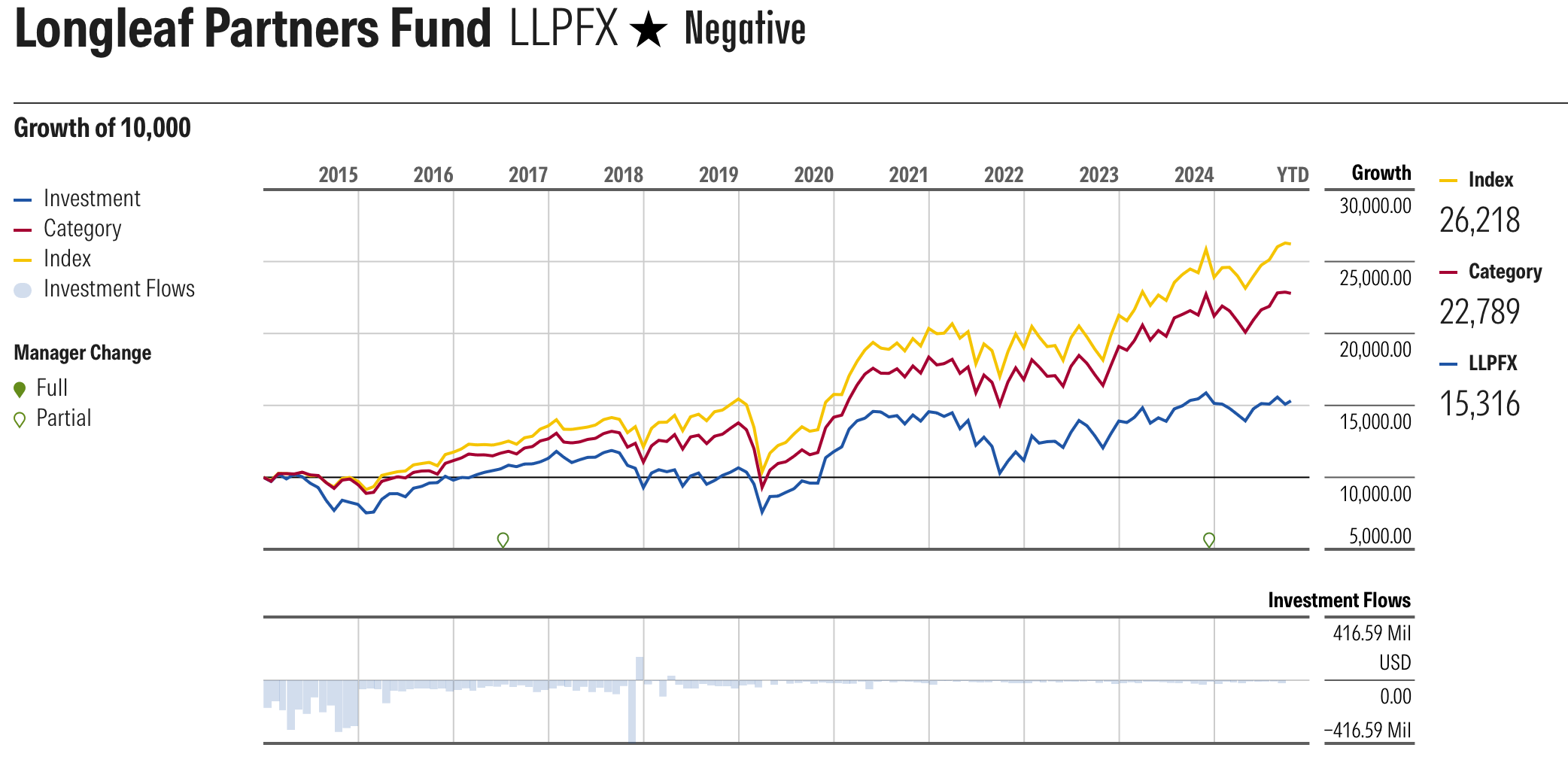
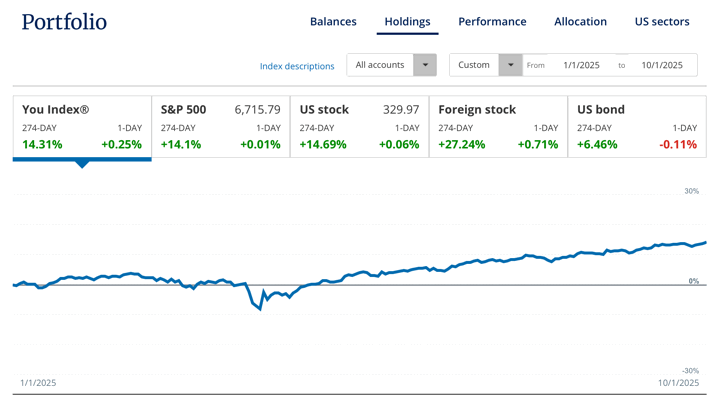
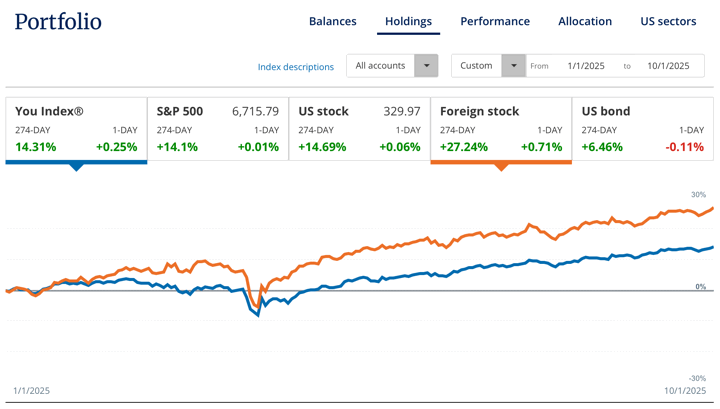
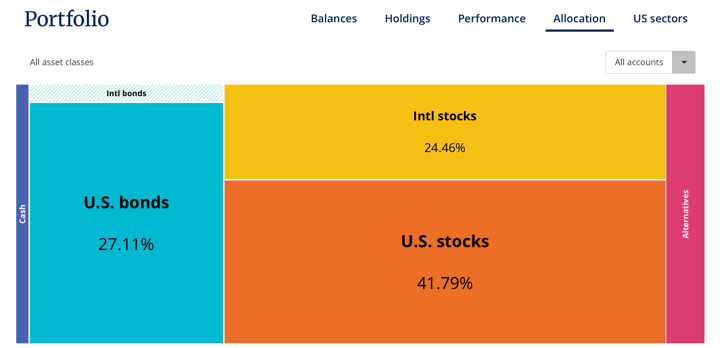
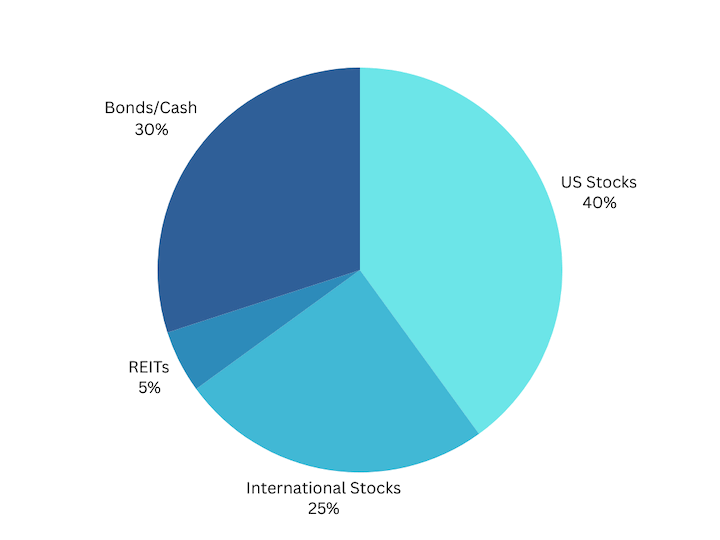
Here and at the top of this post are updated performance and asset allocation charts, per the “Holdings” and “Allocation” tabs of my Empower Personal Dashboard.

The major components of my portfolio are broad index ETFs. I do mix it up a bit around the edges, but not very much. Here is a model version of my target asset allocation with sample ETF holdings for each asset class.

  • 35% US Total Market (VTI)
  • 5% US Small-Cap Value (AVUV)
  • 20% International Total Market (VXUS)
  • 5% International Small-Cap Value (AVDV)
  • 5% US Real Estate (REIT) (VNQ)
  • 20% US “Regular” Treasury Bonds and/or FDIC-insured deposits (VGSH)
  • 10% US Treasury Inflation-Protected Bonds (SCHP)

Big picture, it is 70% businesses and 30% very safe bonds/cash:

By paying minimal costs including management fees, transaction spreads, and tax drag, I am trying to essentially guarantee myself above-average net performance over time.

I do not spend a lot of time backtesting various model portfolios. You’ll usually find that whatever model portfolio is popular at the moment just happens to hold the asset class that has been the hottest recently.

The portfolio that you can hold onto through the tough times is the best one for you. I’ve been pretty much holding this same portfolio for 20 years. Check out these ancient posts from 2004 and 2005. Every asset class will eventually have a low period, and you must have strong faith during these periods to earn those historically high returns. You have to keep owning and buying more stocks through the stock market crashes. You have to maintain and even buy more rental properties during a housing crunch, etc. A good sign is that if prices drop, you’ll want to buy more of that asset instead of less. I don’t have strong faith in the long-term results of commodities, gold, or bitcoin – so I don’t own them.

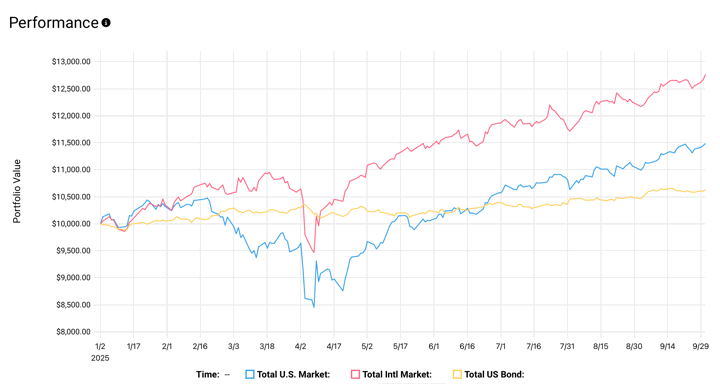
Performance details. According to Empower, the S&P 500 keeps reaching toward all-time highs (+14% YTD) and foreign stocks continued their relative outperformance this year (+27% YTD). I wonder how long this will last?

Here’s an updated YTD Growth of $10,000 chart courtesy of Testfolio for some of the major ETFs that shows the difference in performance in the broad indexes:

My portfolio is getting a bit too stock-heavy (a good sign overall I suppose) so I am reinvesting excess income and dividends into bonds. I will stay invested for sure, but will rebalance around the edges. I’ll share about more about the income aspect in a separate post.

What Belongs in Your Portfolio? Six Criteria for Asset Class Selection

Elm Wealth has a new article on asset classes that introduces their six criteria for whether to include it inside their client portfolios. I found how they explicitly outlined this structure very useful. Here are the six criteria:

  • Low cost
  • Expectation of risk premium
  • Ability to systematically estimate expected return
  • Non-zero-sum
  • Liquid
  • Tax-efficient

Here is a partial excerpt of selected asset classes, outlining how each one performed under each individual criteria. Find the full chart with all of the asset classes in their article.

Here are the asset classes that passed all six criteria.

Risk Assets

  • Broad US Public Market Equities
  • Broad Non-US Public Market Equities
  • Public Market REITS

Safe Assets

  • US Treasury Bills
  • Treasury Inflation-Protected Securities (TIPS)
  • US Treasury and investment grade nominal bonds (small allocation)
  • High grade municipal bonds (small allocation in taxable)

This pretty much matches my portfolio. I know this list is incredible “boring”, and they don’t include any of the trendy ones right now – private equity, aggressive covered call options, crypto, etc. Sometimes, I am also pulled by the desire to seem skilled and sophisticated. But I think it’s an important message that these readily-available asset classes are all you need to achieve financial independence.

Remember, these are the same authors of the book titled “Missing Billionaires”. Permanent capital loss is the real danger! Relentless and reliable compounding wins.

Kraken Brokerage: 2% ACAT Transfer Bonus on Stocks & ETFs

Kraken is best known as a crypto exchange, but as of early 2025 they now offer US stock trading under Kraken Securities through a partnership with Alpaca (press release). They’ve got that VC money and an IPO coming up, so you know that means a high cash burn rate to show high growth! I already saw that with their $75 new crypto account bonus and 30 days of free money spins, where I earned almost $20 in random crypto like DOGE and PEPE:

Until 9/30, Kraken is also offering a 2% ACAT transfer bonus, paid in USDG stablecoin with no cap and 1-year minimum hold period. That’s a pretty solid bonus, with the main concerns being that Kraken is a crypto-first company and there may be some headaches even with SIPC insurance and all that. I’m thinking of moving my US Bank SGOV assets over since they nuked my Smartly 4% card, but I’m a little wary of this brand new brokerage that seems to have been put together by duct tape. In any case, here are the promo highlights.

  • 2% bonus on ACAT transfers of stocks/ETFs. No cap. Offer expires 9/30/25. 1-year minimum hold period after 10/1/25.
  • The terms indicate you must be Kraken+ subscriber (costs $5 a month or $50 a year) when the bonus is calculated after 1 year, but I’m not sure if they will want you to be a subscriber for the entire year hold period. The language states “Kraken+ subscribers are eligible for a 2% bonus.”, so to be safe I’d probably keep it the entire time.
  • Bonus is paid in USDG in , which is Kraken’s dollar stablecoin. If you don’t want to be paid in crypto, it looks like you can sell it to trade, but you can’t withdraw it from the platform until the year is done. I’m not sure how this works in terms of 1099s at the end of the year.
  • Kraken Securities will reimburse you for any outbound ACAT fees from your originating broker.

Here’s how I would approach this bonus:

  • If I didn’t have a Kraken crypto account yet, I’d open one first and grab this $75 referral bonus.
  • For the next 30 days, I’d set a reminder and make sure I open my app and do my daily spin for all 30 days and see if I get a luck $1,000 payout, but probably closer to $15-$30 total.
  • In the meantime, I’d sign-up for the 30-day free trial of Kraken+ to sell whatever crypto I didn’t want to keep with much lower transaction fees as a Kraken+ subscriber. This would also prep me for this ACAT bonus.
  • I would then quickly transfer whatever I wanted for the this bonus by 9/30. Even if it was just safe SGOV or other T-Bill ETFs, I’d still be getting 2% on top. If I moved $50,000, 2% would be $1,000. Kraken would get nice shiny numbers for their IPO decks. I’d hold for 1 year, making sure I still had Kraken+ on 10/1/26 and then move it to the next bonus.
  • Most importantly, I would avoid speculating money on crypto. 2% is a solid guaranteed bonus on top of existing buy and hold assets, but you can easily lose 2% on crypto in a single day and then some!

Here are important excerpts from the fine print:

What is this promotion?
A limited-time incentive offering for eligible U.S. users, providing up to a 2% bonus for qualified transfers of stocks/ETFs into Kraken Securities via ACATS. Kraken+ subscribers are eligible for a 2% bonus. Non Kraken+ users will receive a 1% bonus.

Who is eligible?
U.S. residents only, excluding New York and Maine. Users must be fully verified and approved to trade equities. Users must have opened and been approved for a Kraken Securities account.

What do I receive if my ACAT qualifies?
You receive up to a 2% bonus (2% for Kraken+ users, 1% for non-Kraken+ users) in USDG based on the value of stocks and ETFs you transfer into Kraken Securities via ACATS during the promo window. The value of the transferred assets is determined at the time the qualified ACAT transfer is successfully completed. The bonus is credited after the promotion period ends and placed on hold for one year (usable for trading but not withdrawable until the hold is lifted).

When does the hold period end and how is the hold lifted?
At the end of the one year holding period, which starts on October 1st 2025, the bonus will become eligible for withdrawal provided that the client’s total net transfers into eligible equities remain equal to or greater than the initial value upon which the bonus was calculated.

Is there a maximum reward amount I can receive?
No.

In what currency will the bonus be paid?
Global Dollar (USDG)

Does Kraken reimburse the sender ACATS fees?
Yes. Kraken Securities will reimburse you for any outbound ACAT fees your sending broker may charge you. This reimbursement is not dependent on this promotion and does not have a minimum value requirement to be eligible for reimbursement.

Best Interest Rates Survey: Bank Accounts, Treasury Bills, Money Markets, ETFs – September 2025

Here’s my monthly survey of the best interest rates on cash as of September 2025, roughly sorted from shortest to longest maturities. Banks and brokerages love taking advantage of our idle cash, and you can often earning more money while keeping the same level of safety by moving to another FDIC-insured bank or NCUA-insured credit union. Check out my Ultimate Rate-Chaser Calculator to see how much extra interest you could earn from switching. Rates listed are available to everyone nationwide. Rates checked as of 9/9/2025.

TL;DR: Savings account interest rates are mostly stable (maybe a tiny bit lower on average) with one at 4.8% APY but most struggling to stay above 4.00% APY. Short-term T-Bill rates have fallen slightly, now ~4.2%. Top 5-year CD rates are ~4.25% APY, while 5-year Treasury rate is ~3.6%.

High-yield savings accounts*
Since the huge megabanks still pay essentially no interest, everyone should at least have a separate, no-fee online savings account to piggy-back onto your existing checking account. The interest rates on savings accounts can drop at any time, so I list the top rates as well as competitive rates from banks with a history of competitive rates and solid user experience. Some banks will bait you with a temporary top rate and then lower the rates in the hopes that you are too lazy to leave.

  • The top saving rate at the moment: HUSTL Financial at 4.80% APY (no min), a division of Vantage West Credit Union, member NCUA (and thus not a fintech). No direct experience with this one; was recently lowered from 5%. The “good/excellent” savings rate zone appears to be roughly 4% and above. CIT Platinum Savings is now at 4.00% APY with $5,000+ balance. There are many banks in between.
  • SoFi Bank is at 3.80% APY + up to 4.50% APY for 6 months + $325 new account bonus with qualifying direct deposit. You must maintain a direct deposit of any amount (even $1) each month for the higher APY. SoFi has historically competitive rates and full banking features.
  • Here is a limited survey of high-yield savings accounts. They aren’t the top rates, but a group that have historically kept it relatively competitive such that I like to track their history. I call this the “okay/good” zone of 3.50%+.

Short-term guaranteed rates (1 year and under)
A common question is what to do with a big pile of cash that you’re waiting to deploy shortly (plan to buy a house soon, just sold your house, just sold your business, legal settlement, inheritance). My usual advice is to keep things simple and take your time. If not a savings account, then put it in a flexible short-term CD under the FDIC limits until you have a plan.

  • No Penalty CDs offer a fixed interest rate that can never go down, but you can still take out your money (once) without any fees if you want to use it elsewhere. Marcus has a 13-month No Penalty CD at 4.15% APY ($500 minimum deposit). Farmer’s Insurance FCU has a 9-month No Penalty CD at 4.25% APY ($1,000 minimum deposit). USA USALLIANCE Financial CU has a 11-month No Penalty CD at 4.20% APY ($500 minimum deposit).
  • Eagle Bank has a 12-month certificate at 4.40% APY ($1,000 min). Early withdrawal penalty is 90 days of interest.

Money market mutual funds
Many brokerage firms that pay out very little interest on their default cash sweep funds (and keep the difference for themselves). Note: Money market mutual funds are highly-regulated, but ultimately not FDIC-insured, so I would still stick with highly reputable firms.

  • Vanguard Federal Money Market Fund (VMFXX) is the default sweep option for Vanguard brokerage accounts, which has an SEC yield of 4.20% (changes daily, but also works out to a compound yield of 4.28%, which is better for comparing against APY). Odds are this is much higher than your own broker’s default cash sweep interest rate.
  • Vanguard Treasury Money Market Fund (VUSXX) is an alternative money market fund which you must manually purchase, but the interest will be mostly (100% for 2024 tax year) exempt from state and local income taxes because it comes from qualifying US government obligations. Current SEC yield of 4.20% (compound yield of 4.28%).

Treasury Bills and Ultra-short Treasury ETFs
Another option is to buy individual Treasury bills which come in a variety of maturities from 4-weeks to 52-weeks and are fully backed by the US government. You can also invest in ETFs that hold a rotating basket of short-term Treasury Bills for you, while charging a small management fee for doing so. T-bill interest is exempt from state and local income taxes, which can make a significant difference in your effective yield.

  • You can build your own T-Bill ladder at TreasuryDirect.gov or via a brokerage account with a bond desk like Vanguard and Fidelity. Here are the current Treasury Bill rates. As of 9/9/25, a new 4-week T-Bill had the equivalent of 4.16% annualized interest and a 52-week T-Bill had the equivalent of 3.68% annualized interest.
  • The iShares 0-3 Month Treasury Bond ETF (SGOV) has a 4.21% SEC yield (0.09% expense ratio) and effective duration of 0.10 years. SPDR Bloomberg Barclays 1-3 Month T-Bill ETF (BIL) has a 4.14% SEC yield (0.136% expense ratio) and effective duration of 0.15 years. The new Vanguard 0-3 Month Treasury Bill ETF (VBIL) has a 4.21% SEC yield (0.07% expense ratio) and effective duration of 0.10 years.

US Savings Bonds
Series I Savings Bonds offer rates that are linked to inflation and backed by the US government. You must hold them for at least a year. If you redeem them within 5 years there is a penalty of the last 3 months of interest. The annual purchase limit for electronic I bonds is $10,000 per Social Security Number, available online at TreasuryDirect.gov.

  • “I Bonds” bought between May 2025 and October 2025 will earn a 3.98% rate for the first six months. The rate of the subsequent 6-month period will be based on inflation again. More on Savings Bonds here.
  • In mid-October 2025, the CPI will be announced and you will have a short period where you will have a very close estimate of the rate for the next 12 months. I will post another update at that time.

Rewards checking accounts
These unique checking accounts pay above-average interest rates, but with unique risks. You have to jump through certain hoops which usually involve 10+ debit card purchases each cycle, a certain number of ACH/direct deposits, and/or a certain number of logins per month. If you make a mistake (or they judge that you did) you risk earning zero interest for that month. Some folks don’t mind the extra work and attention required, while others would rather not bother. Rates can also drop suddenly, leaving a “bait-and-switch” feeling.

  • OnPath Federal Credit Union (my review) pays 7.00% APY on up to $10,000 if you make 15 debit card purchases, opt into online statements, and login to online or mobile banking once per statement cycle. Anyone can join this credit union via $5 membership fee to join partner organization. You can also get a $150 Visa Reward card when you open a new account and make qualifying transactions.
  • Genisys Credit Union pays 6.75% APY on up to $7,500 if you make 10 debit card purchases of $5+ each per statement cycle, and opt into online statements. Anyone can join this credit union via $5 membership fee to join partner organization.
  • NEW: Oklahoma Central Credit Union pays 6.00% APY on up to $10,000 if you make 15 debit card purchases (non-ATM) per statement cycle. Anyone can join this credit union if they are “affiliated with another credit union”.
  • La Capitol Federal Credit Union pays 5.75% APY on up to $10,000 if you make 15 debit card purchases of at least $5 each per statement cycle. Anyone can join this credit union via partner organization, Louisiana Association for Personal Financial Achievement ($20).
  • First Southern Bank pays 5.50% APY on up to $25,000 if you make at least 15 debit card purchases, 1 ACH credit or payment transaction, and enroll in online statements.
  • Credit Union of New Jersey pays 6.00% APY on up to $25,000 if you make 12 debit card purchases, opt into online statements, and make at least 1 direct deposit, online bill payment, or automatic payment (ACH) per statement cycle. Anyone can join this credit union via $5 membership fee to join partner organization.
  • Andrews Federal Credit Union pays 5.50% APY (down from 6%) on up to $25,000 if you make 15 debit card purchases, opt into online statements, and make at least 1 direct deposit or ACH transaction per statement cycle. Anyone can join this credit union via partner organization.
  • Find a locally-restricted rewards checking account at DepositAccounts.

Certificates of deposit (greater than 1 year)
CDs offer higher rates, but come with an early withdrawal penalty. By finding a bank CD with a reasonable early withdrawal penalty, you can enjoy higher rates but maintain access in a true emergency. Alternatively, consider building a CD ladder of different maturity lengths (ex. 1/2/3/4/5-years) such that you have access to part of the ladder each year, but your blended interest rate is higher than a savings account. When one CD matures, use that money to buy another 5-year CD to keep the ladder going. Some CDs also offer “add-ons” where you can deposit more funds if rates drop.

  • Mountain America Credit Union (MACU) has a 5-year certificate at 4.25% APY ($500 minimum), 4-year at 4.20% APY, 3-year at 4.15% APY, 2-year at 4.00% APY, and 1-year at 4.15% APY. Early withdrawal penalty for the 4-year and 5-year is 365 days of interest. Anyone can join this credit union via partner organization American Consumer Council for a one-time $5 fee (or try promo code “consumer”).
  • Lafayette Federal Credit Union (LFCU) has a 5/4/3/2/1-year certificates at 4.28% APY ($500 min). Slightly higher rates with jumbo $100,000+ balances. Note that the early withdrawal penalty for the 5-year is a relatively large 600 days of interest. Anyone nationwide can join LFCU by joining the Home Ownership Financial Literacy Council (HOFLC) for a one-time $10 fee.
  • You can buy certificates of deposit via the bond desks of Vanguard and Fidelity. You may need an account to see the rates. These “brokered CDs” offer FDIC insurance and easy laddering, but they don’t come with predictable early withdrawal penalties. Right now, I see a 5-year non-callable brokered CD at 3.70% APY (callable: no, call protection: yes). Be warned that both Vanguard and Fidelity will list higher rates from callable CDs, which importantly means they can (and will!) call back your CD if rates drop significantly later.

Longer-term Instruments
I’d use these with caution due to increased interest rate risk (tbh, I don’t use them at all), but I still track them to see the rest of the current yield curve.

  • Willing to lock up your money for 10 years? You can buy long-term certificates of deposit via the bond desks of Vanguard and Fidelity. These “brokered CDs” offer FDIC insurance, but they don’t come with predictable early withdrawal penalties. You might find something that pays more than your other brokerage cash and Treasury options. Right now, I see a 10-year CDs at [n/a] (non-callable) vs. 4.08% for a 10-year Treasury. Watch out for higher rates from callable CDs where they can call your CD back if interest rates drop.

All rates were checked as of 9/9/25.

* I no longer recommend fintech companies due to the possibility of significant loss due to poor recordkeeping and the lack of government protection in such scenarios. (Ex. Evergreen Wealth at 5% APY is a fintech.)

Photo by insung yoon on Unsplash
401(k) Match Done, Now What? A Retirement Account Priority List

You’ve maxed your company 401(k) match. Now what? Where exactly should you direct your savings? Christine Benz has a short but useful Morningstar article called A Hierarchy for Retirement Savings. The structure reminds me a bit of the Personal Finance Flowchart from Reddit.

The best part of the article is that they explain the exceptions, or at least reasons for de-prioritization, in a clear and concise manner. These exceptions may be uncommon, but they are important to know. I recommend reading the entire article, but here are some quick notes.

  • 401(k) up to the match. Exception: You may not have a match.
  • IRA up to the limit (plus Spousal IRA). Exception: Your 401(k) may be so awesome it’s good enough. 401ks also have better asset protection.
  • 401(k) up to the “normal” limit. Exception: In some limited cases near retirement, the benefits don’t outweigh the restrictions.
  • Health Savings Account (HSA) up to the limit. Exception: You may not be eligible for an HSA.
  • Additional after-tax 401(k) contributions to the “full” deductible limit, if allowed. (AKA “Mega Backdoor Roth”). Exception: Your plan may not offer additional after-tax contributions (only about 1/4 do), or your plan is otherwise extra bad.
  • Taxable brokerage account. The default if nothing else is better.

Photo by Jon Tyson on Unsplash
Coin Flip Challenge: The Importance of Bet Sizing and Surviving Volatility

In the book Missing Billionaires, Victor Haghani and James White argue that through the power of compound interest, there should be many more billionaires around – simply through time, even with modest investment performance. The reason why there are “missing” billionaires is not because they didn’t find the optimal asset allocation, it’s due to making poor risk decisions and/or excessive spending (and then taking big risks to keep the fun times rolling).

For example, one simple way that you can lose money even with the odds in your favor is poor bet sizing. The authors created the Elm Wealth Coin Flip Challenge in order to teach this interactively. In the game, the coin is altered such that you know it will come up heads 60% of the time, and tails 40% of the time. If you know anything about gambling in the real world, you’ll know this is a huge advantage! Dramatic movies about card counting and the MIT Blackjack team involves edges of only ~1%.

You get $25 to wager, and you can bet any amount you have. Can you build your stack up to thousands of dollars? Try for yourself, first with just your intuition. You’ll soon discover that it’s harder than it looks! Too little a bet, and the needle doesn’t really move much even on the good swings. Too big a bet, and you can’t survive the bad swings. It’s quite easy to dwindle quickly down to zero. After that, as Warren Buffett has stated, “Anything times zero is zero.”

Nowadays, we all have a 24/7 casino lurking in our pockets. With ads constantly telling us we can get rich with crypto, stock options, and sports betting, I think it’s very critical to teach ourselves and our kids about these concepts like odds and betting. Warren Buffett once bought and installed slot machines in his own house, to teach his kids about the one-armed bandits. Investing done right with proper risk management is a positive-sum game with excellent odds for the investor. Crypto speculation, aggressive use of stock options, and sport betting are only excellent for the “house” and I fear will create a generation of missing wealth. The next wave of volatility will come soon enough.

Lower Expense Ratios (Still) Predict Higher Performance

The reason that low-cost index funds continue to grow in popularity each year is simple – they make you more money! If Wall Street could figure out how to make you more money reliably with their sheer skill and then charge you for a little sliver of that skill, then of course they’d prefer to do that. Passive funds took their market share as a result of merit, not marketing. Chart above via Yahoo Finance.

Jeffrey Ptak of Morningstar continues to share the most recent evidence that costs matter. In this Morningstar article, he shares a chart (see above) of “Average Forward Net Excess Return” sorted by fee grouping over 5-year rolling periods.

What I found buttresses Russ’ original findings and subsequent research he’s done on the topic: Expenses excelled at predicting funds’ performance. To illustrate, here are funds’ forward average excess net returns (versus their average peer) over all rolling five-year periods between Jan. 1, 2005, and Dec. 31, 2024, sorted by fee grouping.

In his personal Substack, Ptak shares a similar chart over different time periods of 1-year to 15-years.

The relationship is very clear. Sure, there are a few outliers (although hardly any consistent outliers over time), but as a whole, you absolutely do not “get what you pay for” with fund and ETF expense ratios. On the whole, the more you pay in expenses, the worse the performance you get in return.

Vanguard Letter: Choose an Automated Cost Basis Method (MinTax Warning)

Vanguard has been sending out letters to clients with SpecID as their default cost basis tracking method. This letter has caused a lot of confusion. My understanding is that they will no longer let you use SpecID for automated sell transactions, and so you will need to pick a different default cost basis method. Here are possible examples of automated sell transactions:

  • Automatic Withdrawal Plan (AWP), automatically redeems shares from your Vanguard fund account and transfers the funds to your bank account on a regular, recurring basis. Per Vanguard, this service is “ideal for IRA shareholders who are age 59½ or older and want to draw income from their IRAs”. But I’m assuming this works on taxable accounts as well.
  • Vanguard’s free automatic RMD service, which takes out exactly the amount of required minimum distribution each year.
  • Vanguard Digital Advisor and Personal Advisor, which manages and may sell shares to rebalance your portfolio for you.

This change makes intuitive sense as how would Vanguard know which tax lots you want to specify if it’s an automated sale? How did they even do it in the past? I am guessing you have to tell them within a certain window of time.

However, for manual sell transactions, you can still use SpecID and specify exactly which tax lot you want to sell. I don’t have any automated systems set up, so I am not concerned about this change. I will note that Vanguard now only allows SpecID on market orders, and not limit orders. I don’t really understand why this is the case (as long as you don’t have multiple limit orders outstanding), but it is what it is.

Here is the full text of the letter:

Action needed: Choose an automated cost basis method

Dear Vanguard Investor:

We noticed you’ve selected specific identification (SpecID) as your preferred cost basis method for certain holdings in your account. While you’ll still be able to use SpecID for individual transactions, we’re updating our preferred cost basis settings to include these automated methods only:

• FIFO (first in, first out)
• MinTax (minimum tax)
• HIFO (highest in, first out)

This change will take effect in August 2025. If you don’t select one of the automated methods as your preferred cost basis method by then, we’ll automatically set your default to FIFO. You can update your preferred method anytime by logging in to your account at vanguard.com or by contacting Vanguard. This update won’t affect any pending transactions.

Why are we making this change?
SpecID requires you to manually identify specific lots for each sale or transfer, which makes it incompatible with automation. In some cases, such as automatic distributions, IRS rules may default your trade to FIFO if SpecID instructions aren’t provided by the settlement date, which could potentially result in unfavorable tax consequences.

By switching to an automated method, you’ll still have the flexibility to use SpecID at the time of a transaction, while also benefiting from having additional automated options beyond FIFO.

To leam more about cost basis methods and your available options, please visit vanguard.com.

What’s changing on the website?
Your online experience will remain the same. You’ll continue to select your preferred cost basis method on vanguard.com. You can still choose SpeciD when placing a trade or requesting a transfer by updating the cost basis instructions at the time of the transaction using our website or app.

If you don’t update your default from SpeciD to an automated method, we’ll set it to FIFO per IRS rules. Open orders won’t be affected.

If you do have automated sales, which option should you choose? As Vanguard states, each method has its own sets of pro and cons. First, I think it is very important to understand that the “MinTax” algorithm does not guarantee that you end up with the minimum tax owed! It’s a very crude algorithm with the following priorities:

Our system prioritizes your tax savings by selecting to sell securities in the order listed below:

Short-term capital loss from largest to smallest.
Long-term capital loss from largest to smallest.
Short-term zero gain or loss.
Long-term zero gain or loss.
Long-term capital gain from smallest to largest.
Short-term capital gain from the smallest to largest.

This means that MinTax will choose to trigger a $1,000,000 long-term capital gain before a $1 short-term capital gain, simply because the tax *rate* (percentage) is the same or lower on the long-term capital gain. Meanwhile, the absolute tax incurred may be very different – see this real-life example that created a large unwanted tax bill. Mentally, I think of the name as “MinTaxRATE” and not “MinTax”.

Some folks may want to consider the HIFO (Highest In, First Out) method as it minimizes the total capital gains amount, but doesn’t take into account short or long-term holding periods. But again, every situation is different. If you don’t tell Vanguard anything, then FIFO (First in, First Out) is the default, which may create some large capital gains since they will be selling your oldest tax lots. I’d pick MinTax over FIFO.

I will probably choose HIFO, just as the backup setting with no plans to actually use it. I personally don’t like automated selling systems and prefer SpecID as I have complete control as to how many gains I want. For example, sometimes you have some tax brackets to fill, and you may actually want more capital gains in a certain year. Perhaps you have a lot of carryover losses and want to offset them.

Best Interest Rates Survey: Bank Accounts, Treasury Bills, Money Markets, ETFs – August 2025

Here’s my monthly survey of the best interest rates on cash as of August 2025, roughly sorted from shortest to longest maturities. Banks and brokerages love taking advantage of our idle cash, and you can often earning more money while keeping the same level of safety by moving to another FDIC-insured bank or NCUA-insured credit union. Check out my Ultimate Rate-Chaser Calculator to see how much extra interest you could earn from switching. Rates listed are available to everyone nationwide. Rates checked as of 8/10/2025.

TL;DR: Savings account interest rates are mostly stable (maybe a tiny bit lower on average) with one at 5% APY but most struggling to stay above 4.00% APY. Short-term T-Bill rates at around 4.3%. Top 5-year CD rates are ~4.25% APY, while 5-year Treasury rate is ~3.8%.

High-yield savings accounts*
Since the huge megabanks still pay essentially no interest, everyone should at least have a separate, no-fee online savings account to piggy-back onto your existing checking account. The interest rates on savings accounts can drop at any time, so I list the top rates as well as competitive rates from banks with a history of competitive rates and solid user experience. Some banks will bait you with a temporary top rate and then lower the rates in the hopes that you are too lazy to leave.

  • The top saving rate at the moment: HUSTL Financial at 5.00% APY (no min), a division of Vantage West Credit Union, member NCUA (and thus not a fintech). No direct experience with this one; wonder how long it will last? The “good/excellent” savings rate zone appears to be roughly 4% and above. CIT Platinum Savings is now at 4.00% APY with $5,000+ balance. There are many banks in between.
  • SoFi Bank is at 3.80% APY + up to $325 new account bonus with direct deposit. You must maintain a direct deposit of any amount (even $1) each month for the higher APY. SoFi has historically competitive rates and full banking features. See details at $25 + $300 SoFi Money new account and deposit bonus.
  • Here is a limited survey of high-yield savings accounts. They aren’t the top rates, but a group that have historically kept it relatively competitive such that I like to track their history. I’d call this the “okay/good” zone of 3.50%+.

Short-term guaranteed rates (1 year and under)
A common question is what to do with a big pile of cash that you’re waiting to deploy shortly (plan to buy a house soon, just sold your house, just sold your business, legal settlement, inheritance). My usual advice is to keep things simple and take your time. If not a savings account, then put it in a flexible short-term CD under the FDIC limits until you have a plan.

  • No Penalty CDs offer a fixed interest rate that can never go down, but you can still take out your money (once) without any fees if you want to use it elsewhere. Marcus has a 13-month No Penalty CD at 4.15% APY ($500 minimum deposit). Farmer’s Insurance FCU has a 9-month No Penalty CD at 4.25% APY ($1,000 minimum deposit). USA USALLIANCE Financial CU has a 11-month No Penalty CD at 4.20% APY ($500 minimum deposit).
  • Eagle Bank has a 12-month certificate at 4.40% APY ($1,000 min). Early withdrawal penalty is 90 days of interest.

Money market mutual funds
Many brokerage firms that pay out very little interest on their default cash sweep funds (and keep the difference for themselves). Note: Money market mutual funds are highly-regulated, but ultimately not FDIC-insured, so I would still stick with highly reputable firms.

  • Vanguard Federal Money Market Fund (VMFXX) is the default sweep option for Vanguard brokerage accounts, which has an SEC yield of 4.22% (changes daily, but also works out to a compound yield of 4.30%, which is better for comparing against APY). Odds are this is much higher than your own broker’s default cash sweep interest rate.
  • Vanguard Treasury Money Market Fund (VUSXX) is an alternative money market fund which you must manually purchase, but the interest will be mostly (100% for 2024 tax year) exempt from state and local income taxes because it comes from qualifying US government obligations. Current SEC yield of 4.24% (compound yield of 4.32%).

Treasury Bills and Ultra-short Treasury ETFs
Another option is to buy individual Treasury bills which come in a variety of maturities from 4-weeks to 52-weeks and are fully backed by the US government. You can also invest in ETFs that hold a rotating basket of short-term Treasury Bills for you, while charging a small management fee for doing so. T-bill interest is exempt from state and local income taxes, which can make a significant difference in your effective yield.

  • You can build your own T-Bill ladder at TreasuryDirect.gov or via a brokerage account with a bond desk like Vanguard and Fidelity. Here are the current Treasury Bill rates. As of 8/8/25, a new 4-week T-Bill had the equivalent of 4.36% annualized interest and a 52-week T-Bill had the equivalent of 3.92% annualized interest.
  • The iShares 0-3 Month Treasury Bond ETF (SGOV) has a 4.24% SEC yield (0.09% expense ratio) and effective duration of 0.10 years. SPDR Bloomberg Barclays 1-3 Month T-Bill ETF (BIL) has a 4.16% SEC yield (0.136% expense ratio) and effective duration of 0.15 years. The new Vanguard 0-3 Month Treasury Bill ETF (VBIL) has a 4.21% SEC yield (0.07% expense ratio) and effective duration of 0.10 years.

US Savings Bonds
Series I Savings Bonds offer rates that are linked to inflation and backed by the US government. You must hold them for at least a year. If you redeem them within 5 years there is a penalty of the last 3 months of interest. The annual purchase limit for electronic I bonds is $10,000 per Social Security Number, available online at TreasuryDirect.gov.

  • “I Bonds” bought between May 2025 and October 2025 will earn a 3.98% rate for the first six months. The rate of the subsequent 6-month period will be based on inflation again. More on Savings Bonds here.
  • In mid-October 2025, the CPI will be announced and you will have a short period where you will have a very close estimate of the rate for the next 12 months. I will post another update at that time.

Rewards checking accounts
These unique checking accounts pay above-average interest rates, but with unique risks. You have to jump through certain hoops which usually involve 10+ debit card purchases each cycle, a certain number of ACH/direct deposits, and/or a certain number of logins per month. If you make a mistake (or they judge that you did) you risk earning zero interest for that month. Some folks don’t mind the extra work and attention required, while others would rather not bother. Rates can also drop suddenly, leaving a “bait-and-switch” feeling.

  • OnPath Federal Credit Union (my review) pays 7.00% APY on up to $10,000 if you make 15 debit card purchases, opt into online statements, and login to online or mobile banking once per statement cycle. Anyone can join this credit union via $5 membership fee to join partner organization. You can also get a $100 Visa Reward card when you open a new account and make qualifying transactions.
  • Genisys Credit Union pays 6.75% APY on up to $7,500 if you make 10 debit card purchases of $5+ each per statement cycle, and opt into online statements. Anyone can join this credit union via $5 membership fee to join partner organization.
  • La Capitol Federal Credit Union pays 5.75% APY on up to $10,000 if you make 15 debit card purchases of at least $5 each per statement cycle. Anyone can join this credit union via partner organization, Louisiana Association for Personal Financial Achievement ($20).
  • First Southern Bank pays 5.50% APY on up to $25,000 if you make at least 15 debit card purchases, 1 ACH credit or payment transaction, and enroll in online statements.
  • Credit Union of New Jersey pays 6.00% APY on up to $25,000 if you make 12 debit card purchases, opt into online statements, and make at least 1 direct deposit, online bill payment, or automatic payment (ACH) per statement cycle. Anyone can join this credit union via $5 membership fee to join partner organization.
  • Andrews Federal Credit Union pays 5.50% APY (down from 6%) on up to $25,000 if you make 15 debit card purchases, opt into online statements, and make at least 1 direct deposit or ACH transaction per statement cycle. Anyone can join this credit union via partner organization.
  • Find a locally-restricted rewards checking account at DepositAccounts.

Certificates of deposit (greater than 1 year)
CDs offer higher rates, but come with an early withdrawal penalty. By finding a bank CD with a reasonable early withdrawal penalty, you can enjoy higher rates but maintain access in a true emergency. Alternatively, consider building a CD ladder of different maturity lengths (ex. 1/2/3/4/5-years) such that you have access to part of the ladder each year, but your blended interest rate is higher than a savings account. When one CD matures, use that money to buy another 5-year CD to keep the ladder going. Some CDs also offer “add-ons” where you can deposit more funds if rates drop.

  • Mountain America Credit Union (MACU) has a 5-year certificate at 4.25% APY ($500 minimum), 4-year at 4.20% APY, 3-year at 4.15% APY, 2-year at 4.00% APY, and 1-year at 4.15% APY. Early withdrawal penalty for the 4-year and 5-year is 365 days of interest. Anyone can join this credit union via partner organization American Consumer Council for a one-time $5 fee (or try promo code “consumer”).
  • Lafayette Federal Credit Union (LFCU) has a 5/4/3/2/1-year certificates at 4.28% APY ($500 min). Slightly higher rates with jumbo $100,000+ balances. Note that the early withdrawal penalty for the 5-year is a relatively large 600 days of interest. Anyone nationwide can join LFCU by joining the Home Ownership Financial Literacy Council (HOFLC) for a one-time $10 fee.
  • You can buy certificates of deposit via the bond desks of Vanguard and Fidelity. You may need an account to see the rates. These “brokered CDs” offer FDIC insurance and easy laddering, but they don’t come with predictable early withdrawal penalties. Right now, I see a 5-year non-callable brokered CD at 3.95% APY (callable: no, call protection: yes). Be warned that both Vanguard and Fidelity will list higher rates from callable CDs, which importantly means they can (and will!) call back your CD if rates drop significantly later.

Longer-term Instruments
I’d use these with caution due to increased interest rate risk (tbh, I don’t use them at all), but I still track them to see the rest of the current yield curve.

  • Willing to lock up your money for 10 years? You can buy long-term certificates of deposit via the bond desks of Vanguard and Fidelity. These “brokered CDs” offer FDIC insurance, but they don’t come with predictable early withdrawal penalties. You might find something that pays more than your other brokerage cash and Treasury options. Right now, I see a 10-year CDs at 3.85% (non-callable) vs. 4.27% for a 10-year Treasury. Watch out for higher rates from callable CDs where they can call your CD back if interest rates drop.

All rates were checked as of 8/10/25.

* I no longer recommend fintech companies due to the possibility of loss due to poor recordkeeping and lack of government regulation. (Ex. Evergreen Wealth at 5% APY is a fintech.)

Photo by insung yoon on Unsplash