TIAA Traditional and Lifetime Income Annuities Now Available to Public via IRA

TIAA-CREF recently announced that they are allowing the public to invest in their fixed and income annuities inside a Traditional or Roth IRA (via Bogleheads). This includes their most well-known TIAA Traditional Annuity, which has traditionally been only available to those working in nonprofit colleges, universities, hospitals (TIAA stands for Teachers Insurance and Annuity Association of America).

This was a Father’s Day coincidence, as what they suggest is very similar to what I helped set up for my father. As a long-time educator, the bulk of his retirement savings was accumulated using the TIAA Traditional annuity through both employer and employee contributions. After considering many factors, I advised him to annuitize a portion of it upon retirement for guaranteed lifetime income. The rest of the portfolio was stock and bond mutual funds.

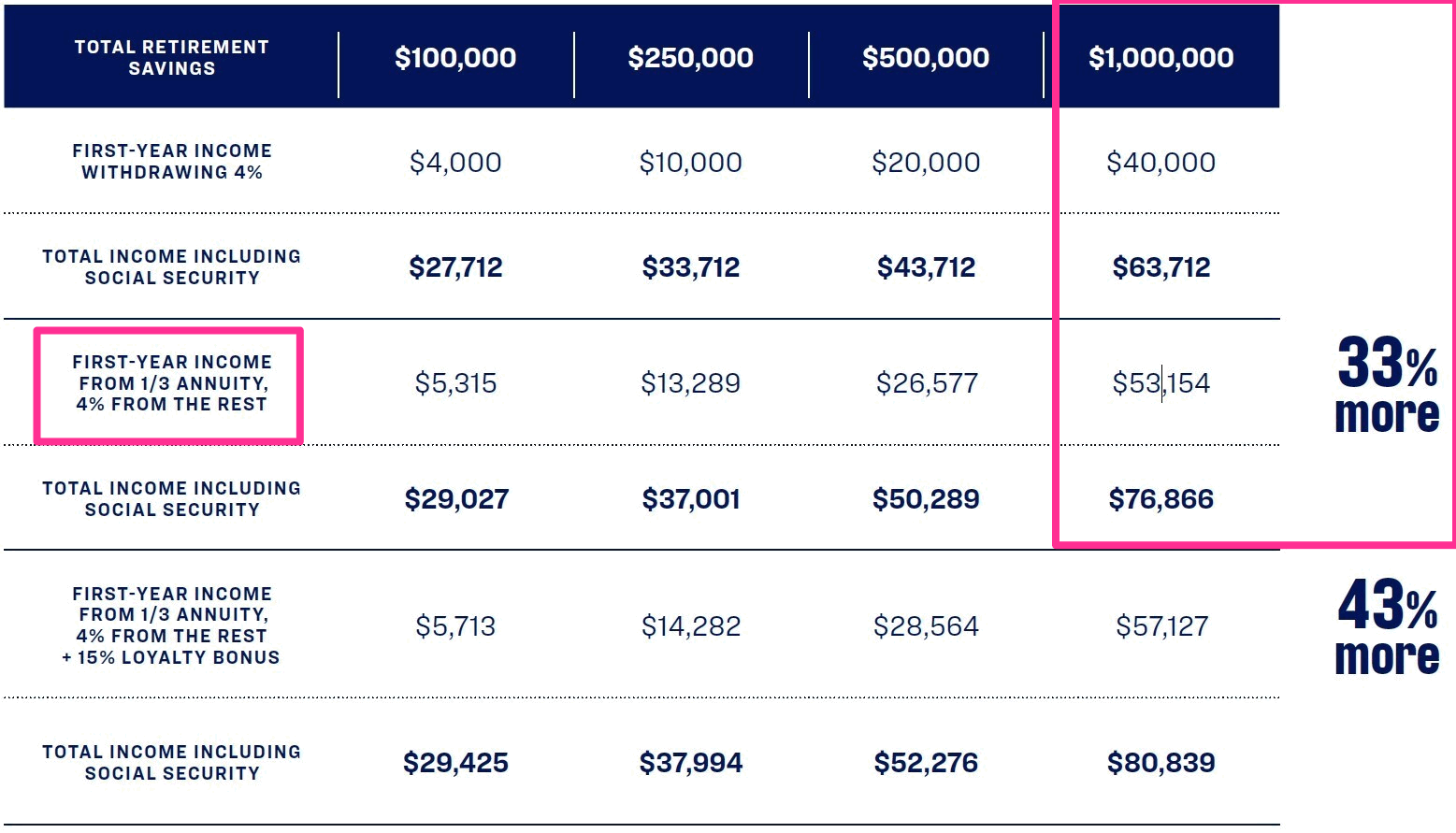
In the example that TIAA provides, they annuitize 1/3rd of the total available portfolio, and the rest is spent down using the popular “4% withdrawal rule”. Their claim is that “annuitizing a portion of your savings with TIAA Traditional offers between 33% and 43% more income than a 4% withdrawal strategy.”

Looking at the fine print, they state:

Calculation uses the TIAA Traditional “new money” income rate for a single life annuity with a 10-year guarantee period at age 67 using TIAA’s standard payment method beginning income on March 1, 2025 (7.9462%).

So a 67yo person taking a single-life income annuity with a 10-year guarantee, which pays out 8% of principal every year. So if you annuitized $1,000,000, you would get roughly $80,000 a year in annual income, guaranteed, every year until death (with minimum 10 years of payments, or $800,000). 8% is double (100% more) what you’d get out from the “4% rule”, so if you annuitize 1/3rd if your portfolio, it would boost the first-year income by 33%. Math works out.

Here are some additional details I would emphasize:

  • With the income annuity used, the 8% withdrawal rate won’t ever go up or adjust with inflation. It’s a fixed payout every year, so the real inflation-adjusted value will decrease over time. After 15 years or 30 years, the payout from $1M would still be $80,000.
  • The “4% rule” taken from perhaps a 60% stock/40% bond portfolio is designed to be raised with inflation each year. After 15 years, the $40,000 a year from $1M would be $62,000 with 3% average inflation and $72,000 a year with 4% average inflation. After 30 years, the $40,000 a year from $1M would be $97,000 with 3% average inflation and $130,000 a year with 4% average inflation.
  • At death, the TIAA annuity would have zero value (assuming past the 10-year guarantee). Your 60/40 portfolio may have a lot (or a little, or nothing) left over.
  • The TIAA annuity is a guaranteed only by the claims-paying ability of TIAA. TIAA is usually one of the absolute top-rated insurance companies in terms of safety, but it doesn’t print its own money.

Overall, I felt that the trade-offs were worth it for my parents. They are financially conservative folks. Their annuitized income was lower because they took a joint-life annuity with my mother, but when added on top of their combined Social Security, their guaranteed monthly paycheck in retirement was large enough to cover all of their basic monthly expenses. Unless there was a big one-time expense, they would not have to take a single penny out of the rest of their investment portfolio.

I knew the value of the TIAA income would decrease over time due to inflation, but some studies have shown that retiree expenses also tend to trend downward over time. Social Security will still go up with inflation, and so should their investment portfolio over the long run.

TIAA Traditional as an accumulation vehicle. My dad was already with TIAA Traditional for decades before I started helping him with his finances, and while I am thankful for the financial stability of TIAA-CREF, I don’t know that I would pick the TIAA Traditional Annuity if I was starting out today. As a fixed annuity, there is a guaranteed minimum interest rate and then they credit extra if their underlying investments do well. The value thus is always increasing steadily and never goes down, which some people may like. Even a “safe” bond fund can have a negative year, as we saw recently.

Based on the numbers that I have seen, the long-term average return of TIAA Traditional will probably be very close to that of a low-cost Total US Bond Fund like BND. So it’s like a bond fund with smoothed returns. But this also means the long-term average return of TIAA Traditional will likely not be as high as if you held a Target Retirement Fund with stocks/bonds. Thus, I could see TIAA Traditional as a partial substitution for the bond portion of your portfolio, especially if you plan on annuitizing it upon retirement and can thus earn some of that vague “loyalty bonus”. THAT is the main advantage of TIAA – the ability to earn an excellent annuitization income rate from a very solid company.

(You can view the current TIAA Traditional interest rates here. Note that there are multiple different rate classes, and since the IRA class is fully liquid, it tends to offer one of the lower rates.)

For my parents, I am quite happy with the results of annuitizing a portion of your retirement portfolio. It depends on your own goals, but a fixed base monthly paycheck in retirement offers great peace of mind. I personally enjoy the fact that they stress much less about market swings. If TIAA continues to offer competitive income payout rates along with their top-tier safety rating, I will definitely keep this option in mind for myself.

Self-Paced CFP: Insurance Planning Highlights and Self-Paced Study Experiences

Finally… I passed the “Insurance Planning” course for my University of Georgia Self-Paced CFP class. That’s only #2 out of the 7 topics, but here are a few quick observations so far:

  • After trying a couple of times… 😅 I was not able to pass the course exams without studying the course materials first. You need 80% correct to pass, and I’d be in the 60% to 80% range without any studying.
  • I’ve been able to pass the exams after only reading the online course slides and review questions. I haven’t opened the textbooks once (as shown in pristine condition above!), even though I spent extra for the physical textbooks (as opposed to electronic-only).
  • As a personal finance geek, I did know a lot of the material beforehand, but there are definitely new bits that I’m learning here and there. The material is dry, but it covers a lot of topics.
  • Like many other professional certification exams, much of passing means studying specifically for the test. The questions aren’t necessarily weighted by what’s commonly used in financial planning practice, but by what is easiest to test in a multiple-choice format. That means memorizing formulas that require a financial calculator, “none of the above”, “all of the above”-type questions, and minor differences in definitions. I now understand why even after completing this educational course requirement, most CFP applicants sign up for another ~$1,000 “cram course” that just drills you on sample test questions.

Back to Insurance Planning. I got stuck on this course for while as it is a very wide topic with some rather dull topics, so here is a high-level overview of what was covered.

Three main categories of “Pure Risk” for individuals and families:

  • Personal
  • Property
  • Liability

Principles and Purpose of Insurance

  • Types of risk (pure vs. speculative)
  • Methods of managing risk (avoidance, reduction, retention, transfer)

Property and Casualty Insurance

  • Homeowners and renters insurance
  • Auto insurance
  • Liability and umbrella policies
  • Business-related coverage

Life Insurance

  • Types (term, whole, universal, variable)
  • Suitability and needs analysis
  • Policy selection, riders, beneficiary designations

Health Insurance and Disability Insurance

  • Health plans (PPO, HMO, HDHP, etc.)
  • Medicare and Medicaid
  • Social Security
  • Disability coverage (short-term, long-term, own vs. any occupation)
  • Long-Term Care Insurance

Employee and Group Benefits

  • Group life, health, and disability plans
  • COBRA and continuation coverage
  • Cafeteria and flexible spending accounts

Annuities

  • Types (fixed, variable, immediate, deferred)
  • Payout options and guarantees
  • Tax treatment and suitability

Role of a financial planner.

  • Coverage level determination
  • Help clients identify coverage gaps or excesses.
  • Refer clients to qualified Property & Casualty (P&C) agents.
  • Evaluate insurance as part of a broader financial plan.
  • Review and update over time

For example, for personal liability insurance you would ask about:

  • Personal Auto Policy (PAP): For motor vehicle-related liabilities.
  • Homeowners Policy: Covers bodily injury/property damage to others.
  • Comprehensive Personal Liability (CPL) Policy: Standalone liability coverage.
  • Umbrella Policy: Broad, high-limit policy supplementing existing coverages.

You may not need all of them individually, but some combination of these should work together to make sure there no holes. It’s also possible that you may have duplicate coverage or otherwise too much insurance.

A lot of financial advice focuses on “offense”: maximizing income, minimizing expenses, and optimizing investments. But “defense” is just as important, as it includes protecting from loss of future income and loss of existing assets.

Best Interest Rates Survey: Savings Accounts, Treasuries, CDs, Money Markets, ETFs – June 2025

Here’s my monthly survey of the best interest rates on cash as of June 2025, roughly sorted from shortest to longest maturities. Banks and brokerages love taking advantage of our idle cash, and you can often earning more money while keeping the same level of safety by moving to another FDIC-insured bank or NCUA-insured credit union. Check out my Ultimate Rate-Chaser Calculator to see how much extra interest you could earn from switching. Rates listed are available to everyone nationwide. Rates checked as of 6/4/2025.

TL;DR: Savings account interest rates are mostly stable overall, topping out around 4.60% APY. Short-term T-Bill rates at around 4.3%. Top 5-year CD rates are ~4.25% APY, while 5-year Treasury rate is ~4%.

High-yield savings accounts*
Since the huge megabanks still pay essentially no interest, everyone should at least have a separate, no-fee online savings account to piggy-back onto your existing checking account. The interest rates on savings accounts can drop at any time, so I list the top rates as well as competitive rates from banks with a history of competitive rates and solid user experience. Some banks will bait you with a temporary top rate and then lower the rates in the hopes that you are too lazy to leave.

  • The top saving rate at the moment: Elevault at 4.60% APY (no min), which appears to be an app-only subsidiary of Southern Bancorp, member FDIC (and thus not a fintech). The “good/excellent” savings rate zone appears to be roughly 4% and above. CIT Platinum Savings is now at 4.10% APY with $5,000+ balance. There are many banks in between.
  • There are also now a lot of savings accounts with higher rates but also added hoops. Examples: Roger.bank at 4.65% APY (no min), but does require an additional companion checking account. Axos One Savings at 4.66% APY (no min), but requires an Axos One Checking with direct deposit of $1,500+ and minimum balance of $1,500.
  • SoFi Bank is at 3.80% APY + up to $325 new account bonus with direct deposit. You must maintain a direct deposit of any amount (even $1) each month for the higher APY. SoFi has historically competitive rates and full banking features. See details at $25 + $300 SoFi Money new account and deposit bonus.
  • Here is a limited survey of high-yield savings accounts. They aren’t the top rates, but a group that have historically kept it relatively competitive such that I like to track their history. I’d call this the “okay/good” zone of 3.50%+.

Short-term guaranteed rates (1 year and under)
A common question is what to do with a big pile of cash that you’re waiting to deploy shortly (plan to buy a house soon, just sold your house, just sold your business, legal settlement, inheritance). My usual advice is to keep things simple and take your time. If not a savings account, then put it in a flexible short-term CD under the FDIC limits until you have a plan.

  • No Penalty CDs offer a fixed interest rate that can never go down, but you can still take out your money (once) without any fees if you want to use it elsewhere. Marcus has a 7-month No Penalty CD at 4.00% APY ($500 minimum deposit) and 13-month at 3.90% APY. Farmer’s Insurance FCU has 9-month No Penalty CD at 4.25% APY ($1,000 minimum deposit). Kinecta FCU has 9-month Liquid CD at 4.25% APY ($10,000 minimum) that allows for daily penalty-free withdrawals of up to 50% of the start of day balance. Consider opening multiple CDs in smaller increments for more flexibility.
  • Eagle Bank has a 12-month certificate special at 4.55% APY ($1,000 min). Early withdrawal penalty is 90 days of interest.

Money market mutual funds
Many brokerage firms that pay out very little interest on their default cash sweep funds (and keep the difference for themselves). Note: Money market mutual funds are highly-regulated, but ultimately not FDIC-insured, so I would still stick with highly reputable firms.

  • Vanguard Federal Money Market Fund (VMFXX) is the default sweep option for Vanguard brokerage accounts, which has an SEC yield of 4.23% (changes daily, but also works out to a compound yield of 4.31%, which is better for comparing against APY). Odds are this is much higher than your own broker’s default cash sweep interest rate.
  • Vanguard Treasury Money Market Fund (VUSXX) is an alternative money market fund which you must manually purchase, but the interest will be mostly (100% for 2024 tax year) exempt from state and local income taxes because it comes from qualifying US government obligations. Current SEC yield of 4.23% (compound yield of 4.31%).

Treasury Bills and Ultra-short Treasury ETFs
Another option is to buy individual Treasury bills which come in a variety of maturities from 4-weeks to 52-weeks and are fully backed by the US government. You can also invest in ETFs that hold a rotating basket of short-term Treasury Bills for you, while charging a small management fee for doing so. T-bill interest is exempt from state and local income taxes, which can make a significant difference in your effective yield.

  • You can build your own T-Bill ladder at TreasuryDirect.gov or via a brokerage account with a bond desk like Vanguard and Fidelity. Here are the current Treasury Bill rates. As of 6/4/25, a new 4-week T-Bill had the equivalent of 4.28% annualized interest and a 52-week T-Bill had the equivalent of 4.08% annualized interest.
  • The iShares 0-3 Month Treasury Bond ETF (SGOV) has a 4.17% SEC yield (0.09% expense ratio) and effective duration of 0.10 years. SPDR Bloomberg Barclays 1-3 Month T-Bill ETF (BIL) has a 4.13% SEC yield (0.136% expense ratio) and effective duration of 0.15 years. The new Vanguard 0-3 Month Treasury Bill ETF (VBIL) has a 4.19% SEC yield (0.07% expense ratio) and effective duration of 0.10 years.

US Savings Bonds
Series I Savings Bonds offer rates that are linked to inflation and backed by the US government. You must hold them for at least a year. If you redeem them within 5 years there is a penalty of the last 3 months of interest. The annual purchase limit for electronic I bonds is $10,000 per Social Security Number, available online at TreasuryDirect.gov.

  • “I Bonds” bought between May 2025 and October 2025 will earn a 3.98% rate for the first six months. The rate of the subsequent 6-month period will be based on inflation again. More on Savings Bonds here.
  • In mid-October 2025, the CPI will be announced and you will have a short period where you will have a very close estimate of the rate for the next 12 months. I will post another update at that time.

Rewards checking accounts
These unique checking accounts pay above-average interest rates, but with unique risks. You have to jump through certain hoops which usually involve 10+ debit card purchases each cycle, a certain number of ACH/direct deposits, and/or a certain number of logins per month. If you make a mistake (or they judge that you did) you risk earning zero interest for that month. Some folks don’t mind the extra work and attention required, while others would rather not bother. Rates can also drop suddenly, leaving a “bait-and-switch” feeling.

  • OnPath Federal Credit Union (my review) pays 7.00% APY on up to $10,000 if you make 15 debit card purchases, opt into online statements, and login to online or mobile banking once per statement cycle. Anyone can join this credit union via $5 membership fee to join partner organization. You can also get a $100 Visa Reward card when you open a new account and make qualifying transactions.
  • Genisys Credit Union pays 6.75% APY on up to $7,500 if you make 10 debit card purchases of $5+ each per statement cycle, and opt into online statements. Anyone can join this credit union via $5 membership fee to join partner organization.
  • La Capitol Federal Credit Union pays 5.75% APY on up to $10,000 if you make 15 debit card purchases of at least $5 each per statement cycle. Anyone can join this credit union via partner organization, Louisiana Association for Personal Financial Achievement ($20).
  • First Southern Bank pays 5.50% APY on up to $25,000 if you make at least 15 debit card purchases, 1 ACH credit or payment transaction, and enroll in online statements.
  • Credit Union of New Jersey pays 6.00% APY on up to $25,000 if you make 12 debit card purchases, opt into online statements, and make at least 1 direct deposit, online bill payment, or automatic payment (ACH) per statement cycle. Anyone can join this credit union via $5 membership fee to join partner organization.
  • Andrews Federal Credit Union pays 5.50% APY (down from 6%) on up to $25,000 if you make 15 debit card purchases, opt into online statements, and make at least 1 direct deposit or ACH transaction per statement cycle. Anyone can join this credit union via partner organization.
  • Find a locally-restricted rewards checking account at DepositAccounts.

Certificates of deposit (greater than 1 year)
CDs offer higher rates, but come with an early withdrawal penalty. By finding a bank CD with a reasonable early withdrawal penalty, you can enjoy higher rates but maintain access in a true emergency. Alternatively, consider building a CD ladder of different maturity lengths (ex. 1/2/3/4/5-years) such that you have access to part of the ladder each year, but your blended interest rate is higher than a savings account. When one CD matures, use that money to buy another 5-year CD to keep the ladder going. Some CDs also offer “add-ons” where you can deposit more funds if rates drop.

  • Mountain America Credit Union (MACU) has a 5-year certificate at 4.25% APY ($500 minimum), 4-year at 4.20% APY, 3-year at 4.15% APY, 2-year at 4.00% APY, and 1-year at 4.20% APY. Early withdrawal penalty for the 4-year and 5-year is 365 days of interest. Anyone can join this credit union via partner organization American Consumer Council for a one-time $5 fee (or try promo code “consumer”).
  • Lafayette Federal Credit Union (LFCU) has a 5/4/3/2/1-year certificates at 4.28% APY ($500 min). Slightly higher rates with jumbo $100,000+ balances. Note that the early withdrawal penalty for the 5-year is a relatively large 600 days of interest. Anyone nationwide can join LFCU by joining the Home Ownership Financial Literacy Council (HOFLC) for a one-time $10 fee.
  • You can buy certificates of deposit via the bond desks of Vanguard and Fidelity. You may need an account to see the rates. These “brokered CDs” offer FDIC insurance and easy laddering, but they don’t come with predictable early withdrawal penalties. Right now, I see a 5-year non-callable brokered CD at 4.30% APY (callable: no, call protection: yes). Be warned that both Vanguard and Fidelity will list higher rates from callable CDs, which importantly means they can (and will!) call back your CD if rates drop significantly later.

Longer-term Instruments
I’d use these with caution due to increased interest rate risk (tbh, I don’t use them at all), but I still track them to see the rest of the current yield curve.

  • Willing to lock up your money for 10 years? You can buy long-term certificates of deposit via the bond desks of Vanguard and Fidelity. These “brokered CDs” offer FDIC insurance, but they don’t come with predictable early withdrawal penalties. You might find something that pays more than your other brokerage cash and Treasury options. Right now, I see a 10-year CDs at [none listed] (non-callable) vs. 4.35% for a 10-year Treasury. Watch out for higher rates from callable CDs where they can call your CD back if interest rates drop.

All rates were checked as of 6/4/25.

* I no longer recommend fintech companies due to the possibility of loss due to poor recordkeeping and lack of government regulation. (Ex. Evergreen Wealth at 5% APY is a fintech.)

Photo by insung yoon on Unsplash
Merrill Edge + BofA Preferred Rewards = Up to $1,000 ACAT Transfer Bonus, Improved Credit Card Rewards

Updated May 2025. Merrill Edge is the self-directed brokerage arm formed after Bank of America and Merrill Lynch merged together. They are currently offering an increased cash bonus of up to $1,000 for moving “new money” or assets over to them from another brokerage firm. The offer code is 1000PR. Offer valid for both new and existing IRAs and taxable brokerage accounts (they call them Cash Management Accounts).

Here’s an overview along with my personal experience as I’ve had an account with them for a few years now.

Cash bonus. If you are holding shares of stock, ETFs, or mutual funds elsewhere, you can simply perform an “in-kind” ACAT transfer over to Merrill Edge. Your 100 shares of AAPL will remain 100 shares of AAPL, so you don’t have to worry about price changes, lost dividends, or tax consequences. Any cost basis should transfer over as well. Make a qualifying transfer and/or deposit to your new account within 45 days and maintain your balance for at least 90 days. The fine print version:

  1. You must enroll by entering the offer code in the online application during account opening or by providing it when speaking with a Merrill Financial Solutions Advisor at 877.657.3847.
  2. Fund your account with at least $20,000 in qualifying net new assets within 45 days of account opening. Assets transferred from other accounts at MLPF&S, Bank of America Private Bank, or 401(k) accounts administered by MLPF&S do not count towards qualifying net new assets.
  3. You must be enrolled in Preferred Rewards as of 90 days from meeting the funding criteria described in Step 2.
  4. After 90 days from meeting the funding criteria described in Step 2, your cash reward will be determined by the qualifying net new assets in your account (irrespective of any losses or gains due to trading or market volatility) as follows:
  • $100 bonus with $20,000+ in new assets
  • $200 bonus with $50,000+ in new assets
  • $400 bonus with $100,000+ in new assets
  • $1,000 bonus with $250,000 or more in new assets

Customers not enrolled in Preferred Rewards as of 90 days after funding will receive the following cash reward: qualifying net new assets of $20,000 to $49,999 receive $100; for $50,000-$99,999, receive $150; for $100,000-$249,999, receive $250; for $250,000 or more, receive $600.

Note that Preferred Rewards tiers usually requires a while to reach, unless you satisfy their “fast track” requirements:

You can enroll, and maintain your membership, in the Bank of America Preferred Rewards® program if you have an active, eligible personal checking account with Bank of America® and maintain the balance required for one of the balance tiers. The balance tiers are $20,000 for the Gold tier, $50,000 for the Platinum tier, $100,000 for the Platinum Honors tier, and $1,000,000 for the Diamond Honors tier. Balances include your combined, qualifying Bank of America deposit accounts (such as checking, savings, certificate of deposit) and/or your Merrill investment accounts (such as Cash Management Accounts, 529 Plans). You can satisfy the combined balance requirement for enrollment with either:

– a three-month combined average daily balance in your qualifying deposit and investment accounts, or
– a current combined balance, provided that you enroll at the time you open your first eligible personal checking account and satisfy the balance requirement at the end of at least one day within 30 days of opening that account.

After I did a similar bonus a couple years ago with a partial transfer (just enough to satisfy one of the tiers), a Merrill Edge rep contacted me and offered me a custom bonus to move even more assets over. (The bonus ratios were about the same, but higher limits.) Therefore, if you are considering this and happen to have more than $250,000 to transfer over, you may want to give them a call and see if they can offer even more money.

(Additional Outgoing ACAT Fee Reimbursement: Merrill Edge will also reimburse you any outgoing ACAT transfer fee or final closure fees that your old broker may charge you. You will need to contact Merrill directly and then send them a copy of your final statement with the fee shown.)

You can even transfer in Admiral Shares of Vanguard mutual funds – they won’t let you buy any additional shares, but you can only hold or sell them. You can, however, buy more shares of the corresponding Vanguard ETF if you wish. (Alternatively, you should consider having Vanguard convert your Admiral share into ETFs on a one-time basis that will preserve your original cost basis. After you have ETFs, you can move those over to Merrill Edge and trade them as you wish.)

The features for the account itself seem like most other online brokerages. Unlimited commission-free online stock, ETF and options trades (+ $0.65 per-contract fee). You can trade ETFs, fixed income, mutual funds, and options.

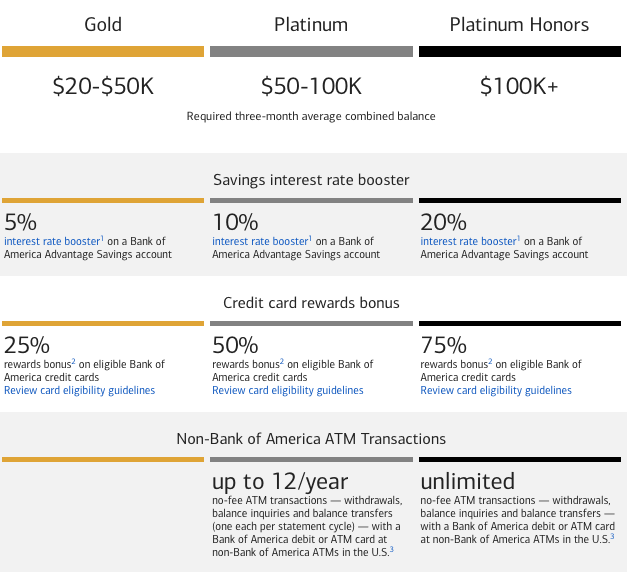
Preferred Rewards bonus. The Preferred Rewards program is designed to rewards clients with multiple account and higher assets located at Bank of America banking, Merrill Edge online brokerage, and Merrill Lynch investment accounts. Here is a partial table taken from their comparison chart (click to enlarge):

BofA checking accounts. With Gold status ($20k in assets) and above, you’ll get the monthly maintenance fee on up to 4 checking or savings accounts waived. That means you no longer have to worry about a minimum balance or maintaining direct deposit, depending on your account type. You’ll also get waived ATM fees at non-BofA ATMs at Platinum and above (12/year at $50k assets, unlimited at $100k). Free cashier’s checks.

Credit card rewards. With the Preferred Rewards boost, you can get up to 2.6% cash back on all your purchases with the Bank of America Unlimited Cash Rewards card, or 2.6% towards travel and no foreign transaction fees with the Bank of America Travel Rewards Card. You can also get 5.2% cash back on the first $2,500 in combined grocery/wholesale club/gas purchases each quarter with the Bank of America Customized Cash Rewards Card.

My personal experience. In terms of Merrill Edge, I’ve had an account with them for several years now and my lightning review is that they have a “okay/good” user interface and solidly “good” customer service (i.e. real, informed humans available 24/7 on the phone, not email-only customer service that takes hours to days like Robinhood). I am not an active trader and only make about 10-15 trades a year, but have been quite satisfied with the account. I can also move money instantly between my Merrill Edge and Bank of America checking accounts, making it relatively easy to sweep out idle cash into an external savings account, as their default cash sweep pays nearly zero interest. Don’t leave too much cash there!

The biggest financial benefit to this BofA/Merrill Edge combo with Preferred Rewards has probably been the 75% boost to their credit card rewards, allowing me to get a flat 2.625% cash back on virtually all my daily purchases. The second biggest benefit has probably been this cash bonus, and the third is the waived checking and ATM fees.

The ongoing credit card rewards would be the main reason to do this deposit offer, as the bonus percentages alone aren’t that high. For example, a $400 bonus on a $100,000 transfer amount is only 0.4%. Other brokerage transfer bonuses can be 1%, even 2%, and up.

Bottom line. Merrill Edge is currently offering up to $1,000 if you move over new assets to their self-directed brokerage. This can simply be mutual fund or ETFs shares currently being held elsewhere. When you keep enough assets across Bank of America and Merrill Edge, their Preferred Rewards program can offer ongoing perks like waived bank account fees and boosted credit card rewards.

More Details on Warren Buffett Stepping Back

I’m not sure how many of you follow Warren Buffett and Berkshire Hathaway closely, but here are a couple of significant updates as a follow-up to the 2025 Annual Shareholder Meeting where he announced that he was stepping down as CEO at the end of 2025:

As he will no longer be CEO, I am assuming this means that he will also not write anything in the annual Letter to Shareholders, which means that his public interactions will be severely limited to whatever few interviews he grants, if any. The end of an era.

Big List of 529 College Savings Plan Promotions: 529 Day 5/29 2025

College savings plans that are looking to grow assets tend to have promotions on May 29th, aka “529 Day”. I started gathering up these bonuses from various plans even before having kids, and eventually consolidated them into one single plan. The bonus amounts tend to be pretty modest, and transfers do involve extra legwork, so getting more than one is mostly for the highly-motivated.

Here’s a list of bonuses that include guaranteed amounts; I’m less interested in drawings. I’m listing the state, but you do not have to be a resident of that state to open a 529 account there. You can have multiple 529s from different states, and often you can usually get the bonus once for each child/beneficiary. However, you may need to be a resident to qualify for a specific bonus, or there may be an age restriction on the beneficiary, etc.

  • CaliforniaCA Scholarshare. Open a ScholarShare 529 account between May 20 and May 31, 2025, and receive a $50 bonus. Use promo code 529Day25.
  • FloridaFlorida Prepaid 529. Open a Florida 529 Savings Plan by June 30, 2025, and get $50 added to your account.
  • GeorgiaPath2College 529. Open a Georgia Path2College 529 account between May 20 and May 31, 2025, and receive a $50 bonus! Use promo code 529Day25.
  • KansasLearning Quest 529. Nothing on their site yet, but might be one coming closer to 5/29.
  • MichiganMichigan Education Trust. Purchase a new MET from 5/29/25 to 6/1/25 and get a $50 bonus. A minimum $250 contribution during online enrollment is required, use coupon code 529DAY during enrollment to qualify.
  • MinnesotaMN Saves 529. Open a Minnesota 529 College Savings Plan account between May 20 and May 31, 2025, and receive a $50 bonus! Use promo code 529Day25.
  • NebraskaNEST 529. Nothing on their site yet, but might be one coming closer to 5/29.
  • PennsylvaniaPA 529. There is only a drawing, but wanted to note that all PA children born after January 1, 2019, have a $100 investment available for them in a Keystone Scholars account. You must activate to claim.
  • UtahUtah My529. To be eligible to receive a $25 matching contribution from my529, open an account for a beneficiary who is new to my529 and contribute $25 or more to the new account between May 1 and May 31, 2025. Use the code 529DAY25 during the account setup process. my529 will match the $25 contribution on or around June 16, 2025. Account owners must be Utah residents. The beneficiary does not need to be a Utah resident.
  • VirginiaNEST 529. For one day only, open a new Invest529 account on May 29th and use the gift code 529DAY2025 to receive a bonus initial contribution of $25.

529 plans can now pay for K-12 tuition, apprenticeships, and other educational expenses beyond college tuition and room/board. You can even pay to up to $10,000 of student loans (including your own). Check your own state rules to ensure they enable this option, though. Finally, opening a plan and making any contribution also starts the 15-year clock on potential future 529-to-Roth IRA rollovers.

Most 529 plans also now have convenient contribution links to share with friends and family. Please let me know if you find others.

Sources: NY Times, CollegeSaving.org, specific state websites.

Photo credit: Modified from Pawel Czerwinski on Unsplash

Check the Cost Basis Tracking in Your Brokerage Account

When you sell your shares of stocks/ETFs/mutual funds in a taxable brokerage account, your broker will also record the specific shares and the original value at purchase (cost basis) at which you bought them. Even if you don’t expect to sell your shares very often, it can still be important how you set the cost basis tracking option inside your brokerage account.

Allan Roth has a useful ETF.com article about why your choice of cost basis tracking could possibly make a difference of thousands of dollars or more. Here’s his real-world example:

Not too long ago, a very seasoned and knowledgeable investor shared a story of a mistake he recently made. He meant to buy 300 shares of the Vanguard Total Stock Market ETF (VTI) but mistakenly punched an extra zero and bought 3,000 instead.

He quickly realized his mistake and sold the 2,700 shares he accidentally bought. The ETF was only up slightly, and he used the Minimum Tax (MinTax) cost basis method on Vanguard’s brokerage platform. He was shocked to learn he just realized a long-term capital gain of about $150,000. […] Because the recently purchased lot of VTI had a tiny short-term gain, it was last in the prioritization of sales and his prior lots with large long-term gains were sold.

Are your current settings still the default? For example, at Vanguard, the default cost basis method appears to be:

  • Average cost (AvgCost) as the default cost basis method for mutual funds at Vanguard.
  • First-in, first-out (FIFO) as the default cost basis method for all investments other than mutual funds.

You can usually change this setting. Here’s what I see as my available options at Vanguard:

At Fidelity, the default cost basis method appears to be First-in, first-out (FIFO) as well for brokerage accounts. Here’s what I see as my available options at Fidelity:

Roth suggests that the best practice is to manually choose specific tax lots. In my experience, using the SpecID setting at Vanguard will force you to choose the “specific shares” that you want to sell when you enter the order. This has come in handy for me, forcing me to think about the tax consequences before I submit. Roth also shares a recent change that Vanguard only allows market orders (no limit orders) on SpecID sales. He decides that it is more important to get the tax basis right than the small added safety of a limit order. I would agree.

At Fidelity, when you sell the shares, on the order ticket there is either a “Sell Specific” action option, or after “Sell” you can click on a small link to “Specify shares”. Unfortunately, I don’t see an option that forces you to manually pick a specific tax lot. Fidelity does a good job of presenting the tax lots clearly on your Positions screen, but you’ll still have to remember on your own when the time comes.

However, if you do forget but remember quickly afterward, I found these instructions to reassign the tax lots before settlement:

Follow these steps to specify tax lots AFTER a trade is placed but before settlement:

– Log into Fidelity.com and Select “Accounts & Trade,” then choose “Account Positions”
– Navigate to the “Closed Positions” link above the “Symbol” column
– Click on “Select Action” next to the appropriate account and choose “Reassign Lots”

Most major brokerage firms should have a similar option, although some of the new ones may not. For example, Robinhood only added their Tax Lots feature in December 2024, more than a decade after starting out. Yet even they admit the potential benefits:

Tax Lots allow customers to choose specific assets to sell—whether it’s the ones held long term, the ones with the lowest or highest cost basis, or the ones that might have experienced the greatest loss. This gives customers the ability to make more informed decisions and manage their tax bill.

In any case, I used this as a timely reminder to be double-check all of your current brokerage account settings.

US Bank Self-Directed Brokerage: Enabling Automatic Dividend Reinvestment

For those that are newer members of the US Bank checking/savings/credit card/brokerage ecosystem, most likely for the up to 4% cash back rewards from their Smartly credit card (current terms for new applicants are poor, but the grandfathered terms are still excellent), you may choose to park some assets in their self-directed brokerage arm in order to meet the (grandfathered) qualification requirements. I personally did, and it has been working out fine.

Notably, as with many brokerage firms, US Bank pays rather pathetic rates on idle cash (0.23% APY as of 5/15/25). The cash sweep that we forget about is a reliable profit source for them. I tend to forget, everyone tends to forget.

Thus, when I need to move assets to a new brokerage, my two preferred options are my holdings of Berkshire Hathaway (BRKB) because they don’t pay out any dividends at all and iShares 0-3 Month Treasury Bond ETF (SGOV) because it pays a competitive yield from T-Bills (that’s also exempt from state/local taxes). The final touch is to set up automatic dividend reinvestment on the shares to avoid losing interest on idle cash sweep. This way, each month the interest paid out is automatically reinvested into more shares of SGOV at the current market price.

Earning a ~5% return from SGOV over the last year was much better (20X better!) than earning ~0.25%.

For US Bank brokerage, there is no online option available to set this up. You must call them on the phone and request it manually. The phone number for US Bank Wealth Management Brokerage Services is 800-888-4700. There were no sales-related hassles and it only took about 5 minutes. Worth the effort. Now I don’t have to worry about making manually trades or manually transferring out the idle cash every month.

Best Interest Rates Survey: Savings Accounts, Treasuries, CDs, Money Markets, ETFs – May 2025

Here’s my monthly survey of the best interest rates on cash as of May 2025, roughly sorted from shortest to longest maturities. Banks love taking advantage of our idle cash, and you can often earning more money while keeping the same level of safety by moving to another FDIC-insured bank or NCUA-insured credit union. Check out my Ultimate Rate-Chaser Calculator to see how much extra interest you could earn from switching. Rates listed are available to everyone nationwide. Rates checked as of 5/14/2025.

TL;DR: Savings account interest rates are stable overall. Short-term T-Bill rates at around 4.3%. Top 5-year CD rates are ~4.25% APY, while 5-year Treasury rate is ~4.15%.

High-yield savings accounts*
Since the huge megabanks still pay essentially no interest, everyone should at least have a separate, no-fee online savings account to piggy-back onto your existing checking account. The interest rates on savings accounts can drop at any time, so I list the top rates as well as competitive rates from banks with a history of competitive rates and solid user experience. Some banks will bait you with a temporary top rate and then lower the rates in the hopes that you are too lazy to leave.

  • The top saving rate at the moment: Axos One Savings at 4.66% APY (no min). Roger.bank is right behind at 4.65% APY (no min), but does require an additional companion checking account. OnPath FCU has a new account paying 5.00% APY but requires $25,000 min and has some ACH withdrawal hoops. CIT Platinum Savings is now at 4.10% APY with $5,000+ balance, but also has a $225/$300 deposit bonus you can stack on top. There are many banks in between.
  • SoFi Bank is at 3.80% APY + up to $325 new account bonus with direct deposit. You must maintain a direct deposit of any amount (even $1) each month for the higher APY. SoFi has historically competitive rates and full banking features. See details at $25 + $300 SoFi Money new account and deposit bonus.
  • Here is a limited survey of high-yield savings accounts. They aren’t the top rates, but a group that have historically kept it relatively competitive such that I like to track their history.

Short-term guaranteed rates (1 year and under)
A common question is what to do with a big pile of cash that you’re waiting to deploy shortly (plan to buy a house soon, just sold your house, just sold your business, legal settlement, inheritance). My usual advice is to keep things simple and take your time. If not a savings account, then put it in a flexible short-term CD under the FDIC limits until you have a plan.

  • No Penalty CDs offer a fixed interest rate that can never go down, but you can still take out your money (once) without any fees if you want to use it elsewhere. Marcus has a 7-month No Penalty CD at 4.00% APY ($500 minimum deposit) and 13-month at 3.90% APY. Farmer’s Insurance FCU has 9-month No Penalty CD at 4.25% APY ($1,000 minimum deposit). Kinecta FCU has 9-month Liquid CD at 4.25% APY ($10,000 minimum) that allows for daily penalty-free withdrawals of up to 50% of the start of day balance. Consider opening multiple CDs in smaller increments for more flexibility.
  • Security State Bank has a 12-month certificate special at 4.65% APY ($25,000 min). Early withdrawal penalty is 180 days of interest.

Money market mutual funds
Many brokerage firms that pay out very little interest on their default cash sweep funds (and keep the difference for themselves). Note: Money market mutual funds are highly-regulated, but ultimately not FDIC-insured, so I would still stick with highly reputable firms.

  • Vanguard Federal Money Market Fund (VMFXX) is the default sweep option for Vanguard brokerage accounts, which has an SEC yield of 4.20% (changes daily, but also works out to a compound yield of 4.28%, which is better for comparing against APY). Odds are this is much higher than your own broker’s default cash sweep interest rate.
  • Vanguard Treasury Money Market Fund (VUSXX) is an alternative money market fund which you must manually purchase, but the interest will be mostly (100% for 2024 tax year) exempt from state and local income taxes because it comes from qualifying US government obligations. Current SEC yield of 4.23% (compound yield of 4.31%).

Treasury Bills and Ultra-short Treasury ETFs
Another option is to buy individual Treasury bills which come in a variety of maturities from 4-weeks to 52-weeks and are fully backed by the US government. You can also invest in ETFs that hold a rotating basket of short-term Treasury Bills for you, while charging a small management fee for doing so. T-bill interest is exempt from state and local income taxes, which can make a significant difference in your effective yield.

  • You can build your own T-Bill ladder at TreasuryDirect.gov or via a brokerage account with a bond desk like Vanguard and Fidelity. Here are the current Treasury Bill rates. As of 5/14/25, a new 4-week T-Bill had the equivalent of 4.32% annualized interest and a 52-week T-Bill had the equivalent of 4.14% annualized interest.
  • The iShares 0-3 Month Treasury Bond ETF (SGOV) has a 4.17% SEC yield (0.09% expense ratio) and effective duration of 0.10 years. SPDR Bloomberg Barclays 1-3 Month T-Bill ETF (BIL) has a 4.13% SEC yield (0.136% expense ratio) and effective duration of 0.15 years. The new Vanguard 0-3 Month Treasury Bill ETF (VBIL) has a 4.20% SEC yield (0.07% expense ratio) and effective duration of 0.10 years.

US Savings Bonds
Series I Savings Bonds offer rates that are linked to inflation and backed by the US government. You must hold them for at least a year. If you redeem them within 5 years there is a penalty of the last 3 months of interest. The annual purchase limit for electronic I bonds is $10,000 per Social Security Number, available online at TreasuryDirect.gov.

  • “I Bonds” bought between May 2025 and October 2025 will earn a 3.98% rate for the first six months. The rate of the subsequent 6-month period will be based on inflation again. More on Savings Bonds here.
  • In mid-October 2025, the CPI will be announced and you will have a short period where you will have a very close estimate of the rate for the next 12 months. I will post another update at that time.

Rewards checking accounts
These unique checking accounts pay above-average interest rates, but with unique risks. You have to jump through certain hoops which usually involve 10+ debit card purchases each cycle, a certain number of ACH/direct deposits, and/or a certain number of logins per month. If you make a mistake (or they judge that you did) you risk earning zero interest for that month. Some folks don’t mind the extra work and attention required, while others would rather not bother. Rates can also drop suddenly, leaving a “bait-and-switch” feeling.

  • OnPath Federal Credit Union (my review) pays 7.00% APY on up to $10,000 if you make 15 debit card purchases, opt into online statements, and login to online or mobile banking once per statement cycle. Anyone can join this credit union via $5 membership fee to join partner organization. You can also get a $100 Visa Reward card when you open a new account and make qualifying transactions.
  • Genisys Credit Union pays 6.75% APY on up to $7,500 if you make 10 debit card purchases of $5+ each per statement cycle, and opt into online statements. Anyone can join this credit union via $5 membership fee to join partner organization.
  • La Capitol Federal Credit Union pays 5.75% APY on up to $10,000 if you make 15 debit card purchases of at least $5 each per statement cycle. Anyone can join this credit union via partner organization, Louisiana Association for Personal Financial Achievement ($20).
  • First Southern Bank pays 5.50% APY on up to $25,000 if you make at least 15 debit card purchases, 1 ACH credit or payment transaction, and enroll in online statements.
  • Credit Union of New Jersey pays 6.00% APY on up to $25,000 if you make 12 debit card purchases, opt into online statements, and make at least 1 direct deposit, online bill payment, or automatic payment (ACH) per statement cycle. Anyone can join this credit union via $5 membership fee to join partner organization.
  • Andrews Federal Credit Union pays 5.50% APY (down from 6%) on up to $25,000 if you make 15 debit card purchases, opt into online statements, and make at least 1 direct deposit or ACH transaction per statement cycle. Anyone can join this credit union via partner organization.
  • Find a locally-restricted rewards checking account at DepositAccounts.

Certificates of deposit (greater than 1 year)
CDs offer higher rates, but come with an early withdrawal penalty. By finding a bank CD with a reasonable early withdrawal penalty, you can enjoy higher rates but maintain access in a true emergency. Alternatively, consider building a CD ladder of different maturity lengths (ex. 1/2/3/4/5-years) such that you have access to part of the ladder each year, but your blended interest rate is higher than a savings account. When one CD matures, use that money to buy another 5-year CD to keep the ladder going. Some CDs also offer “add-ons” where you can deposit more funds if rates drop.

  • Mountain America Credit Union (MACU) has a 5-year certificate at 4.25% APY ($500 minimum), 4-year at 4.20% APY, 3-year at 4.15% APY, 2-year at 4.00% APY, and 1-year at 4.20% APY. Early withdrawal penalty for the 4-year and 5-year is 365 days of interest. Anyone can join this credit union via partner organization American Consumer Council for a one-time $5 fee (or try promo code “consumer”).
  • Lafayette Federal Credit Union (LFCU) has a 5/4/3/2/1-year certificates at 4.28% APY ($500 min). Slightly higher rates with jumbo $100,000+ balances. Note that the early withdrawal penalty for the 5-year is a relatively large 600 days of interest. Anyone nationwide can join LFCU by joining the Home Ownership Financial Literacy Council (HOFLC) for a one-time $10 fee.
  • You can buy certificates of deposit via the bond desks of Vanguard and Fidelity. You may need an account to see the rates. These “brokered CDs” offer FDIC insurance and easy laddering, but they don’t come with predictable early withdrawal penalties. Right now, I see a 5-year non-callable brokered CD at 4.20% APY (callable: no, call protection: yes). Be warned that both Vanguard and Fidelity will list higher rates from callable CDs, which importantly means they can (and will!) call back your CD if rates drop significantly later.

Longer-term Instruments
I’d use these with caution due to increased interest rate risk (tbh, I don’t use them at all), but I still track them to see the rest of the current yield curve.

  • Willing to lock up your money for 10 years? You can buy long-term certificates of deposit via the bond desks of Vanguard and Fidelity. These “brokered CDs” offer FDIC insurance, but they don’t come with predictable early withdrawal penalties. You might find something that pays more than your other brokerage cash and Treasury options. Right now, I see a 10-year CDs at 4.05% (non-callable) vs. 4.53% for a 10-year Treasury. Watch out for higher rates from callable CDs where they can call your CD back if interest rates drop.

All rates were checked as of 5/14/25.

* I no longer recommend fintech companies due to the possibility of loss due to poor recordkeeping and lack of government regulation. (Ex. Evergreen Wealth at 5% APY is a fintech.)

Photo by insung yoon on Unsplash
2025 Berkshire Hathaway Annual Shareholder Meeting Video, Transcript, and Notes

The 2025 Berkshire Hathaway Annual Shareholder Meeting occurred on May 3rd, 2025, and you’ve probably already heard the big news: Warren Buffett will step down as the CEO at the end of the year, to be replaced by Greg Abel (recent Fortune profile). He will remain Chairman of the Board. This is a big deal, but I view it more as a step change. This will allow Abel to directly manage all of their wholly-owned subsidiary companies with full authority, while still having Buffett around to make big deals in the event of a market crisis opportunity. I doubt Buffett’s day-to-day routine will change drastically.

In any case, I still enjoyed watching and listening to the entire Q&A session with Warren Buffett, Greg Abel, and Ajit Jain. The absence of Charlie Munger was still noticeable.

CNBC again has the broadcast rights. You can find the full 6+ hour live re-broadcast on CNBC YouTube and they have also uploaded most of it to the CNBC Buffett Archives site. Their official transcript is not yet available, but you can find a helpful transcript from Steady Compounding or listen to the audio podcast version here. Personally, I like to listen to the audio in the car once, and then read through the transcript for the second round.

Here are a few personal takeaways and notes.

Nothing new regarding the cash pile. They only swing when it’s a fat pitch. They remain disciplined and remain patient and opportunistic. From Greg Abel:

Looking at our balance sheet, as Warren commented, we will have a fortress of a balance sheet. I thought Sue Decker, our lead director, said it well yesterday. We’ve got a significant amount of cash right now, but it’s an enormous asset to have that and that will continue to be a philosophy. When we can deploy it, we’ll deploy it well. We recognize it as a strategic asset that allows us to weather difficult times and not be dependent on anybody.

From Buffett:

We don’t think it’s improper for passive investors to make a few simple investments and sit with them for life. But we’ve made the decision to be in the business, so we think we can do a little better by behaving in a very irregular manner.

To young workers: find people you respect and really want to work for. Don’t worry about the salary as much.

You really want to work at something you enjoy. I’ve had five bosses in life and I liked every one of them – they were all interesting. I still decided that I’d rather work for myself than anybody else. But if you find people that are wonderful to work with, that’s the place to go. I’ve told my kids basically that you don’t get lucky like I did when I found what interested me at seven or eight years of age. It could have taken a lot longer, but you want to find what you love.

Alternatively, find a good teacher or mentor in an area you are passionate about:

People that teach, in general, love having a young student who’s actually really interested in the subject, and they’ll spend extra time with you. I ran into that. I had Graham and Dodd at Columbia. Dave Dodd treated me like a son basically. But I was interested in what they were saying and they found it kind of entertaining that I was so interested, so I would look around at what really fascinates you. I wouldn’t try and be somebody else.

On crypto and trying to get rich quick without creating any value. Much of crypto is based on the Greater Fool theory.

If very stupid things are happening around you, you do not want to participate. If people are making more money because they’re borrowing money or participating in securities that are pieces of junk but they hope to find a bigger sucker later on, you have to forget that. That’ll bite you at some point. The basic game is so good, and you’ve been so lucky to be born now.

A temporary 15% drop in the stock market is nothing.

If it had gone up 15% instead of down 15%, people would take that with remarkable grace. But if it makes a difference to you whether your stocks are down 15% or not, you need to get a somewhat different investment philosophy because the world is not going to adapt to you. You’re going to have to adapt to the world.

You will see a period in the next 20 years that will be a “hair curler” compared to anything you’ve seen before. That just happens periodically. The world makes big mistakes, and surprises happen in dramatic ways. The more sophisticated the system gets, the more the surprises can come out of left field.

Meanwhile, paying 1% annually constantly every year for investment management fees is a lot.

Incidentally, if all of you were paying 1% for investment management fees at Berkshire last year, you would have paid $8 billion for managing, and you really wouldn’t have had to do it. Investment management is a very good game because other people put up the capital and you charge them for the capital whether they do well or not, and then you charge them a lot more if they do well. It’s a well-designed business for the people who practice it – and who can blame them? That is capitalism.

Most of the time, nobody has much of an edge.

Charlie always pointed out that we made most of our money out of about eight or nine ideas over 50 years. We talked about it every day and read every report and did everything else. But if you think you can get an idea a day from listening to your broker or reading financial information, forget it. Every now and then you get extraordinary opportunities, and most of the time you don’t have much of an edge.

Overall, listening to this session as a Berkshire shareholder reminds me that the company retains a long-term mindset, thinking in decades and not quarters. A lot of companies say things like they think for the long-term, they put shareholder interests first, but their actions don’t match.

I am thankful for these reminders of how things should be done. Of course, it’s sad that things are changing, and Buffett’s increasing age does remind me of my own. I can’t believe how long he’s been at this. Carpe Diem.

Past BRK meetings:

Savings I Bonds May 2025: 1.10% Fixed Rate, 2.88% Inflation Rate (3.98% Total for First 6 Months)

Update: Savings I Bonds bought from May 1, 2025 through October 31, 2025 will have a fixed rate of 1.10% and inflation rate of 2.88%, for a total composite rate of 3.98% for the first 6 months. Compare the total rate with the current short-term Treasury yields (1-year @ ~3.9%), and compare the fixed rate with the short-term TIPS real yields (5-year @ ~1.5%).

Every existing I Bond will earn this inflation rate of ~2.88% eventually for 6 months; you will need to add your own fixed rate that was set based the initial purchase month. See you again in mid-October for the next early prediction for November 2025.

Original post from 4/11/25:

Savings I Bonds are a unique, low-risk investment backed by the US Treasury that pay out a variable interest rate linked to inflation. With a holding period from 12 months to 30 years, you could own them as an alternative to bank certificates of deposit (they are liquid after 12 months) or bonds in your portfolio.

New inflation numbers were just announced at BLS.gov, which allows us to make an early prediction of the May 2025 savings bond rates a couple of weeks before the official announcement on the 1st. This also allows the opportunity to know exactly what an April 2025 savings bond purchase will yield over the next 12 months, instead of just 6 months. You can then compare this against a May 2025 purchase.

New inflation rate prediction. September 2024 CPI-U was 315.301. May 2025 CPI-U was 319.799, for a semi-annual inflation rate of 1.43%. Using the official composite rate formula:

Composite rate formula: [Fixed rate + (2 x semiannual inflation rate) + (fixed rate x semiannual inflation rate)]

This results in the variable component of interest rate for the next 6 month cycle being ~2.86 to 2.88%, depending on the fixed rate.

Tips on purchase and redemption. You can’t redeem until after 12 months of ownership, and any redemptions within 5 years incur an interest penalty of the last 3 months of interest. A simple “trick” with I-Bonds is that if you buy at the end of the month, you’ll still get all the interest for the entire month – same as if you bought it in the beginning of the month. It’s best to give yourself a few business days of buffer time. If you miss the cutoff, your effective purchase date will be bumped into the next month. (You should always sell at the very beginning of the month.)

Buying in April 2025. If you buy before the end of April, the fixed rate portion of I-Bonds will be 1.20%. You will be guaranteed a total interest rate of 1.20 + 1.91 = 3.11% for the next 6 months. For the 6 months after that, the total rate will be 1.20 + 2.88 = 4.08%.

Buying in May 2025. If you buy in May 2025, you will get ~2.88% plus a newly-set fixed rate for the first 6 months. The new fixed rate is officially unknown, but is loosely linked to the real yield of short-term TIPS with some reductions. In the previous 10 days, 5-year TIPS real rates have ranged from 1.25% to 1.72%. That’s a nearly 50 basis point swing! If I had to guess, I’d put a new fixed rate somewhere between 1.0 to 1.3%, for a total rate of about 4%. Every six months after your purchase, your rate will adjust to your fixed rate (set at purchase) plus a variable rate based on inflation.

If you have an existing I-Bond, the rates reset every 6 months depending on your specific purchase month. Everyone will eventually get this variable rate. Your bond rate = your specific fixed rate (based on purchase month, look it up here) + variable rate (total bond rate has a minimum floor of 0%).

Buy now or wait? Between those two options, I’m actually not sure. In the short-term, the rates are no better than T-bills. If you are a long-term holder, you might grab the 1.2% fixed rate “bird in the hand”. But the inflation rate will be higher in May by nearly a whole 1%, and so I’d personally just wait and see what happens in mid-October to buy my limit.

Also consider that 30-year TIPS rates on 4/10/25 were at 2.68%! If you really intend to hold for 30 years, that might be a better deal. I plan to fill out my TIPS ladder a bit more if the rates stay this high.

Unique features and considerations. I have a separate post on reasons to own Series I Savings Bonds, including inflation protection, tax deferral, exemption from state income taxes, and potential tax benefits if used toward qualified educational expenses.

The main drawback is hassle. You can only buy new savings bonds through TreasuryDirect.gov, which is limited in its customer service resources and features. But as there is no option for paper tax forms nor statements, so your heirs may never know they exist! If they do find it, it may take them several months to close out all the estate paperwork. If your password is compromised, they will not replace any lost or stolen savings bonds. The juice may not be worth the squeeze when you can own individual Treasury bonds or TIPS within any full-service brokerage account.

Annual purchase limits. The annual purchase limit is now $10,000 in online I-bonds per Social Security Number. For a couple, that’s $20,000 per year. As of 2024. you can only buy online at TreasuryDirect.gov, after making sure you’re okay with their security protocols and user-friendliness. (No more tax refund savings bonds.) Technically, the purchase limits are per Social Security Number or Employer Identification Number. For those looking for another way to expand their purchasing power, that means you can also buy for a child, grandchild, LLC, or a trust.

Bottom line. Savings I bonds are a unique, low-risk investment that are linked to inflation and only available to individual investors. You can now only purchase them online at TreasuryDirect.gov. For more background, see the rest of my posts on savings bonds.

[Image: 1942 US Savings Bond poster – source]

Best Interest Rates Survey: Savings Accounts, Treasuries, CDs, ETFs – April 2025

Here’s my monthly survey of the best interest rates on cash as of April, roughly sorted from shortest to longest maturities. Banks love taking advantage of our idle cash, and you can often earning more money while keeping the same level of safety by moving to another FDIC-insured bank or NCUA-insured credit union. Check out my Ultimate Rate-Chaser Calculator to see how much extra interest you could earn from switching. Rates listed are available to everyone nationwide. Rates checked as of 4/20/2025.

TL;DR: Short-term savings accounts dropped again slightly overall. Short-term T-Bill rates at around 4.3%. Top 5-year CD rates are ~4.25% APY, while 5-year Treasury rate is ~4%.

High-yield savings accounts*
Since the huge megabanks still pay essentially no interest, everyone should at least have a separate, no-fee online savings account to piggy-back onto your existing checking account. The interest rates on savings accounts can drop at any time, so I list the top rates as well as competitive rates from banks with a history of competitive rates and solid user experience. Some banks will bait you with a temporary top rate and then lower the rates in the hopes that you are too lazy to leave.

  • The top saving rate at the moment: Roger.bank is at 4.65% APY (no min), but does require an additional companion checking account. OnPath FCU has a new account paying 5.00% APY but requires $25,000 min. CIT Platinum Savings is now at 4.10% APY with $5,000+ balance, but also has a $225/$300 deposit bonus you can stack on top. There are many banks in between.
  • SoFi Bank is at 3.80% APY + up to $325 new account bonus with direct deposit. You must maintain a direct deposit of any amount (even $1) each month for the higher APY. SoFi has historically competitive rates and full banking features. See details at $25 + $300 SoFi Money new account and deposit bonus.
  • Here is a limited survey of high-yield savings accounts. They aren’t the top rates, but a group that have historically kept it relatively competitive such that I like to track their history.

Short-term guaranteed rates (1 year and under)
A common question is what to do with a big pile of cash that you’re waiting to deploy shortly (plan to buy a house soon, just sold your house, just sold your business, legal settlement, inheritance). My usual advice is to keep things simple and take your time. If not a savings account, then put it in a flexible short-term CD under the FDIC limits until you have a plan.

  • No Penalty CDs offer a fixed interest rate that can never go down, but you can still take out your money (once) without any fees if you want to use it elsewhere. Marcus has a 13mo No Penalty CD at 4.00% APY ($500 minimum deposit). Farmer’s Insurance FCU has 9-month No Penalty CD at 4.25% APY ($1,000 minimum deposit). Kinecta FCU has 9-month Liquid CD at 4.25% APY ($10,000 minimum) that allows for daily penalty-free withdrawals of up to 50% of the start of day balance. Consider opening multiple CDs in smaller increments for more flexibility.
  • Security State Bank has a 12-month certificate special at 4.65% APY ($25,000 min). Early withdrawal penalty is 180 days of interest.

Money market mutual funds
Many brokerage firms that pay out very little interest on their default cash sweep funds (and keep the difference for themselves). Note: Money market mutual funds are highly-regulated, but ultimately not FDIC-insured, so I would still stick with highly reputable firms.

  • Vanguard Federal Money Market Fund (VMFXX) is the default sweep option for Vanguard brokerage accounts, which has an SEC yield of 4.22% (changes daily, but also works out to a compound yield of 4.30%, which is better for comparing against APY). Odds are this is much higher than your own broker’s default cash sweep interest rate.
  • Vanguard Treasury Money Market Fund (VUSXX) is an alternative money market fund which you must manually purchase, but the interest will be mostly (100% for 2024 tax year) exempt from state and local income taxes because it comes from qualifying US government obligations. Current SEC yield of 4.23% (compound yield of 4.31%).

Treasury Bills and Ultra-short Treasury ETFs
Another option is to buy individual Treasury bills which come in a variety of maturities from 4-weeks to 52-weeks and are fully backed by the US government. You can also invest in ETFs that hold a rotating basket of short-term Treasury Bills for you, while charging a small management fee for doing so. T-bill interest is exempt from state and local income taxes, which can make a significant difference in your effective yield.

  • You can build your own T-Bill ladder at TreasuryDirect.gov or via a brokerage account with a bond desk like Vanguard and Fidelity. Here are the current Treasury Bill rates. As of 4/17/25, a new 4-week T-Bill had the equivalent of 4.32% annualized interest and a 52-week T-Bill had the equivalent of 3.99% annualized interest.
  • The iShares 0-3 Month Treasury Bond ETF (SGOV) has a 4.18% SEC yield (0.09% expense ratio) and effective duration of 0.09 years. SPDR Bloomberg Barclays 1-3 Month T-Bill ETF (BIL) has a 4.13% SEC yield (0.136% expense ratio) and effective duration of 0.15 years. The Vanguard 0-3 Month Treasury Bill ETF (VBIL) hasn’t been around long enough to generate an SEC yield (0.07% expense ratio).

US Savings Bonds
Series I Savings Bonds offer rates that are linked to inflation and backed by the US government. You must hold them for at least a year. If you redeem them within 5 years there is a penalty of the last 3 months of interest. The annual purchase limit for electronic I bonds is $10,000 per Social Security Number, available online at TreasuryDirect.gov.

  • “I Bonds” bought between November 2024 and April 2025 will earn a 3.11% rate for the first six months. The rate of the subsequent 6-month period will be based on inflation again. More on Savings Bonds here.
  • In mid-April 2025, the CPI will be announced and you will have a short period where you will have a very close estimate of the rate for the next 12 months. Read all the details about your options here.

Rewards checking accounts
These unique checking accounts pay above-average interest rates, but with unique risks. You have to jump through certain hoops which usually involve 10+ debit card purchases each cycle, a certain number of ACH/direct deposits, and/or a certain number of logins per month. If you make a mistake (or they judge that you did) you risk earning zero interest for that month. Some folks don’t mind the extra work and attention required, while others would rather not bother. Rates can also drop suddenly, leaving a “bait-and-switch” feeling.

  • OnPath Federal Credit Union (my review) pays 7.00% APY on up to $10,000 if you make 15 debit card purchases, opt into online statements, and login to online or mobile banking once per statement cycle. Anyone can join this credit union via $5 membership fee to join partner organization. You can also get a $100 Visa Reward card when you open a new account and make qualifying transactions.
  • Genisys Credit Union pays 6.75% APY on up to $7,500 if you make 10 debit card purchases of $5+ each per statement cycle, and opt into online statements. Anyone can join this credit union via $5 membership fee to join partner organization.
  • La Capitol Federal Credit Union pays 5.75% APY on up to $10,000 if you make 15 debit card purchases of at least $5 each per statement cycle. Anyone can join this credit union via partner organization, Louisiana Association for Personal Financial Achievement ($20).
  • First Southern Bank pays 5.50% APY on up to $25,000 if you make at least 15 debit card purchases, 1 ACH credit or payment transaction, and enroll in online statements.
  • Credit Union of New Jersey pays 6.00% APY on up to $25,000 if you make 12 debit card purchases, opt into online statements, and make at least 1 direct deposit, online bill payment, or automatic payment (ACH) per statement cycle. Anyone can join this credit union via $5 membership fee to join partner organization.
  • Andrews Federal Credit Union pays 5.50% APY (down from 6%) on up to $25,000 if you make 15 debit card purchases, opt into online statements, and make at least 1 direct deposit or ACH transaction per statement cycle. Anyone can join this credit union via partner organization.
  • Find a locally-restricted rewards checking account at DepositAccounts.

Certificates of deposit (greater than 1 year)
CDs offer higher rates, but come with an early withdrawal penalty. By finding a bank CD with a reasonable early withdrawal penalty, you can enjoy higher rates but maintain access in a true emergency. Alternatively, consider building a CD ladder of different maturity lengths (ex. 1/2/3/4/5-years) such that you have access to part of the ladder each year, but your blended interest rate is higher than a savings account. When one CD matures, use that money to buy another 5-year CD to keep the ladder going. Some CDs also offer “add-ons” where you can deposit more funds if rates drop.

  • KS State Bank has a 5-year certificate at 4.15% APY ($500 minimum), 4-year at 4.15% APY, 3-year at 4.15% APY, 2-year at 4.20% APY, and 1-year at 4.25% APY. $500 minimum. The early withdrawal penalty (EWP) for the 5-year is a huge 540 days of interest.
  • Mountain America Credit Union (MACU) has a 5-year certificate at 4.25% APY ($500 minimum), 4-year at 4.25% APY, 3-year at 4.25% APY, 2-year at 3.95% APY, and 1-year at 4.25% APY. Early withdrawal penalty for the 4-year and 5-year is 365 days of interest. Anyone can join this credit union via partner organization American Consumer Council for a one-time $5 fee (or try promo code “consumer”).
  • Lafayette Federal Credit Union (LFCU) has a 5/4/3/2/1-year certificates at 4.28% APY ($500 min). Slightly higher rates with jumbo $100,000+ balances. Note that the early withdrawal penalty for the 5-year is a relatively large 600 days of interest. Anyone nationwide can join LFCU by joining the Home Ownership Financial Literacy Council (HOFLC) for a one-time $10 fee.
  • You can buy certificates of deposit via the bond desks of Vanguard and Fidelity. You may need an account to see the rates. These “brokered CDs” offer FDIC insurance and easy laddering, but they don’t come with predictable early withdrawal penalties. Right now, I see a 5-year non-callable brokered CD at 4.00% APY (callable: no, call protection: yes). Be warned that both Vanguard and Fidelity will list higher rates from callable CDs, which importantly means they can call back your CD if rates drop later. (Issuers have indeed started calling some of their old 5%+ CDs during 2024.)

Longer-term Instruments
I’d use these with caution due to increased interest rate risk (tbh, I don’t use them at all), but I still track them to see the rest of the current yield curve.

  • Willing to lock up your money for 10 years? You can buy long-term certificates of deposit via the bond desks of Vanguard and Fidelity. These “brokered CDs” offer FDIC insurance, but they don’t come with predictable early withdrawal penalties. You might find something that pays more than your other brokerage cash and Treasury options. Right now, I see a 10-year CDs at [n/a] (non-callable) vs. 4.34% for a 10-year Treasury. Watch out for higher rates from callable CDs where they can call your CD back if interest rates drop.

All rates were checked as of 4/20/25.

* I no longer recommend fintech companies due to the possibility of loss due to poor recordkeeping and lack of government regulation. (Ex. Evergreen Wealth at 5% APY is a fintech.)

Photo by insung yoon on Unsplash