
Okay, so you probably aren’t reading a book titled Warren Buffett’s Ground Rules: Words of Wisdom from the Partnership Letters of the World’s Greatest Investor if you are perfectly happy owning solely index funds forever. While the shared concepts with low-cost, passive investing still apply, here are things to consider if you want to do some of your own picking and choosing between individual stocks and bonds.
Given how much energy an 86-year-old Buffett seems to have, it must have been very interesting to invest with him as a hungry young man. On the other hand, reading through the partnership letters also shows how mature he was in his late 20s and early 30s.
Be honest with yourself. Pick a yardstick ahead of time. You need to pick a proper benchmark against which to measure your performance, not just having positive or negative years. Back in 1966, it was the Dow over the last 3 years. Note that it wasn’t just an index, but also a timeframe of at least 3-5 years.
If you’re going to invest a portion of your portfolio on your own, always keep track of your performance. You need to be honest about your results and whether they beat the rest of your portfolio, or even a simple target-date fund.
Investing modest amounts is an advantage. Use it. Warren Buffett had a lot more flexibility with a smaller asset base. There are many deals out there that on a percentage basis are attractive, but if you have to deploy billions, it won’t even move the needle. For example, there might a 12-month CD that earns you 8% APY, but only on $10,000. If you only have $20,000 to invest, putting a big chunk of your portfolio in a risk-free 8% would be much smarter than stocks over the next year. However, if you have $100 million to invest, such a deal would be a rounding error. Some other transactions like odd-lot tenders are also ideal for smaller investors.
Worry about risk and return, not about the name of the product. It doesn’t matter if it’s a laundromat, rental unit, shares of a public company, or bonds. When Buffett was winding down his partnership, municipal bonds were yielding 6.5% on a tax-free basis. In his mind, it was a better investment to buy the municipal bonds rather than stocks given the near-term prospects. So that’s what he recommended.
Ignore the crowd. Think rationally and independently. If you’re going to “beat the market”, then you have to think differently than the market. You’re looking for some area where the market price is much lower than the intrinsic value. By definition, that means a lot of people will be disagreeing with your opinion.
Develop your best ideas, and then bet big on it. Buffett is not a big fan of owning 100+ stocks in the name of diversification. If you have your 5-10 best ideas, why also invest in the other 90 that are worse? If you’re going to actively manage your portfolio, you must have the conviction to bet big on your opinions.
Self-confidence is required, as you will have periods of bad performance. For me, keeping my conviction during times of underperformance is the primary reason most of my portfolio is indexed. Here a stat from the book credited to Joel Greenblatt: Of the top 25% of managers who had outperformed the market over the decade: 97% spent at least 3 years in the bottom half of performance and 47% spent at least 3 years in the bottom 10%.
If you are hiring an outside manager, look at integrity first. Buffett on the types of managers he seeks for Berkshire:
We look for three things: intelligence, energy, and integrity. If they don’t have the latter, then you should hope they don’t have the first two either. If someone doesn’t have integrity, then you want them to be dumb and lazy.
As a side example, here is how Buffett organized his own fee structure for the partnership. If the fund did not accumulate anything past a 6% annual gain every year, he would not take any fees at all. Above the 6% annual rate, he would take 25% of gains as his fee. While some hedge funds also employ a “high water mark” system, they usually still have some form of flat fee that they take, no matter way. If Buffett didn’t reach his 6%, he got nothing. In addition, he had nearly all his own net worth in the partnership as well. He “ate his own cooking”.
 Vanguard recently celebrated the
  When Jack Bogle grants an interview, I sit down and take notes in case he drops something significant. Here is a link to his

 Some folks don’t like it when I write about investments that aren’t low-cost index funds. The thing is, when I find something intriguing, I like to dig deeper and then keep a record my findings. That way I can look back later and see how things turned out and compare with my opinions at the time. Just because I write about something doesn’t mean I recommend it, you have to read the entire post.

 While the number of real estate crowdfunding sites keeps growing, most marketplaces still require you to be an accredited investor with high income and/or net worth requirements. However, options for non-accredited investors should improve shortly due to the expanded
  We’ve all heard that you should keep an emergency fund in case of unexpected expenses or unemployment. But what if you don’t have the cash? Personal finance author Jonathan Clements presents a mathematical argument for using your 401(k) as an emergency fund in his recent article
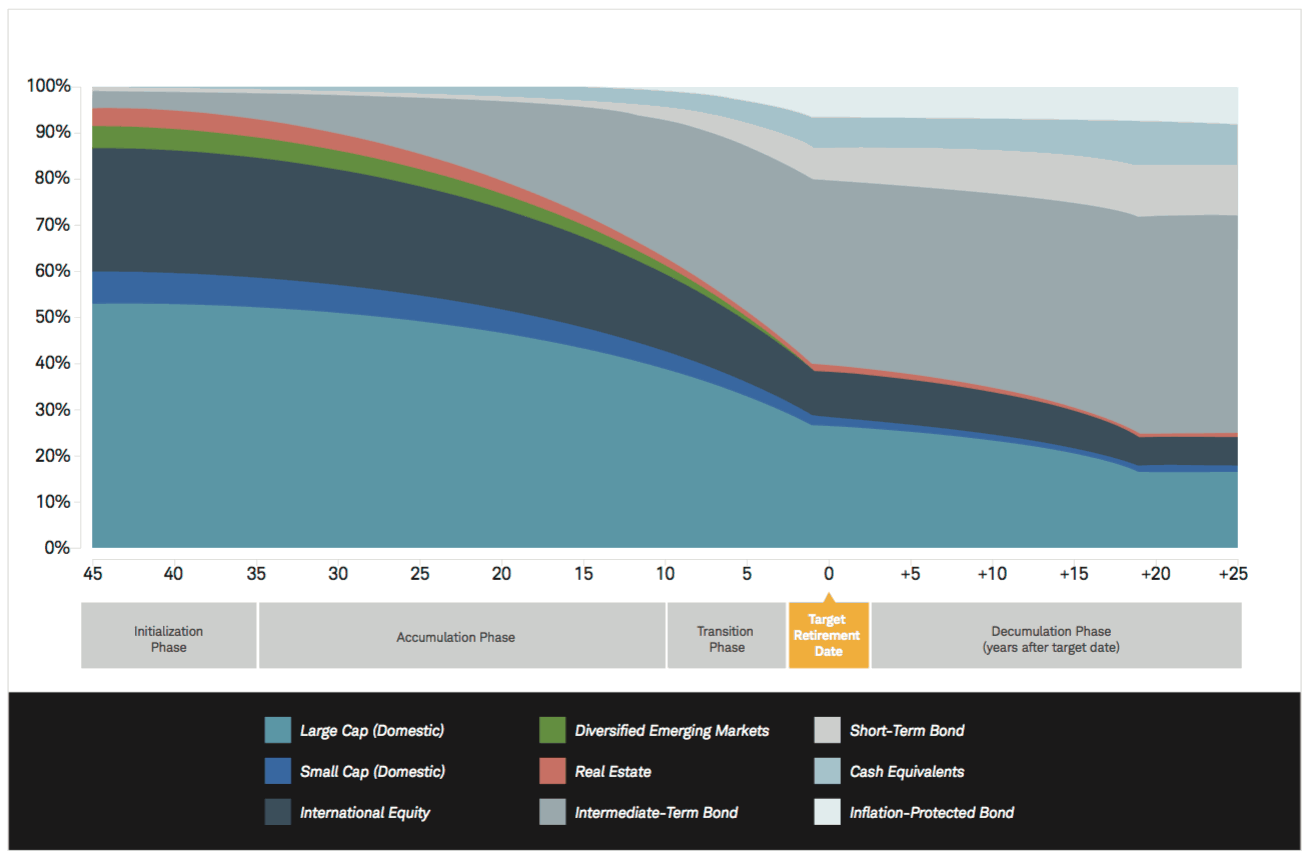
  The following chart taken from

 Here’s a


 I like the idea of living off dividend and interest income. Who doesn’t? The problem is that you can’t just buy stocks with the absolute highest dividend yields and junk bonds with the highest interest rates without giving up something in return. There are many bad investments lurking out there for desperate retirees looking only at income. My goal is to generate portfolio income that will keep up with inflation.
 The Best Credit Card Bonus Offers – 2026
 Big List of Free Stocks from Brokerage Apps
 Best Interest Rates on Cash - 2026
 Free Credit Scores x 3 + Free Credit Monitoring
 Best No Fee 0% APR Balance Transfer Offers
 Little-Known Cellular Data Plans That Can Save Big Money
 How To Haggle Your Cable or Direct TV Bill
 Big List of Free Consumer Data Reports (Credit, Rent, Work)