Real Estate Crowdfunding Experiment #3: Apartment 6-Plex in Wisconsin with RealtyShares

rs_okeefe1

Here are details of my 3rd real estate crowdfunding investment, a $2,000 loan for a 6-unit apartment complex in Milwaukee, Wisconsin. This follows my $5,000 Patch of Land loan in a single-family house in California, and a $2,000 Fundrise Income eREIT investment into their diversified basket of commercial properties. Here are the quick stats:

  • Site: RealtyShares
  • Property: 6-unit, 6,490 sf multifamily in Milwaukee, WI.
  • Interest rate: 9% APR, paid monthly.
  • Amount invested: $2,000.
  • Term: 12 months, with 6-month extension option.
  • Total loan amount is $168,000. Purchase price is $220,000 (LTC 76%). Estimated after-repair value is $260,000. Broker Opinion of Value is $238,000.
  • Loan is secured by the property, in the first position. Also have personal guarantee from borrower.
  • Stated goal is to rehab, stabilize, and then either sell or refinance.

Property details. I chose this property because it is different from my other past “experiments”. I have never lived in or visited Milwaukee, Wisconsin. Where I live, parking spaces have sold for more than this apartment complex. As a result, I have never invested in an apartment complex. Also, reading through the other properties in the developer’s portfolio, I suspect the goal is to eventually refinance and then keep these as cashflow rentals. All units are 2 bed/1 bath, currently fully rented for ~$600 a month each. I don’t know the net operating income numbers, but this place earns roughly $43,000 in gross annual rents with a purchase price of $220,000. Annual property taxes are $3,000 a year. Even if half of the rent is spent on expenses, that is still a cap rate of 10%.

realtyshareslogoExperience so far. At least for this investment, it was not “pre-funded” by RealtyShares before the “crowd-funding” takes over. That means you have to wait until they secure enough committed money before the deal can go forward.

My timeline… I committed to this loan in December 2015 and $2,000 was debited from my Ally bank account on 12/29/15. However, the funding goal was not reached until 1/13, during which I earned no interest during this two-week period. I was then told the following:

We are writing to inform you that we have received all investor funds as of today, January 13, 2016, for the 135 E Keefe Avenue investment. You should expect to receive your first monthly payment by February 15th and this will cover the period from 1/13/16 to 2/10/16.

My first monthly interest payment did not arrive until another two weeks later on 3/3. My subsequent interest payments were posted on schedule on 3/17, 4/18, and 5/15. Due to the fact that there was no pre-funding to get the ball started early, there was essentially 3 month period between the time where they first took my money and I received my first interest check. Other than the interest payments, I have received no property updates since January, although I don’t necessarily expect any at this point.

As I’ve said before, this is an experiment, not necessarily a recommendation. I am learning that although I do like loans backed by hard assets, you do need a lot of patience with these sort of investments.

Some account screenshots:

rs_okeefe2

rs_1605earnings1

rs_1605earnings2

Grantham GMO Q1 2016 Quarterly Letter Highlights

gmo2016q1_3

Here are my notes and takeaways from the GMO Quarterly Letter for Q1 2016, released May 10th, 2016. I always pick up something educational when reading these letters (previous editions may require free registration.) I already discussed their Q1 2016 Asset Class Forecasts with the previous Q4 2015 letter, but in the future I’ll try to align the same quarterly information into one post.

GMO investment philosophy is that asset prices will eventually mean-revert back to their historical valuation levels. However, “eventually” can mean prices moving in the opposite way for a very long time periods. Right now is one of those periods:

It’s no secret that the last half decade has been a rough one for value-based asset allocation. With central bankers pushing interest rates down to unimagined lows, ongoing disappointment from the emerging markets that have looked cheaper than the rest of the world, and the continuing outperformance from the U.S. stock market and growth stocks generally…

Of course, such deviations are exactly the source of potential excess returns for such value investors. GMO still believes in long-term value-based asset allocation.

A quick primer on how future returns work for bonds. Excerpt:

It is universally understood (I hope) that a 10-year Treasury note yielding 1.84% held for 10 years will give a return pretty close to 1.84%. It is not quite so widely known that the rate of return of a dynamic portfolio of such bonds – a “constant maturity strategy” – is also pretty well fixed for certain time horizons.

To take the Barclays U.S. Aggregate Bond index (Agg) as an example of a dynamic portfolio, with a duration of a little over five years and a current yield of 2.17%, the range of possible returns over the next seven years is not very wide. We are not guaranteed to get 2.17%, but the return if the yield were to gradually drop to zero over that period would be about 2.9% per year, and if the yield were to gradually double, it would be about 1.5% per year. No matter what happens to yields over the next seven years, returns are going to be something pretty close to 2.17% on the Agg.

Wrong prediction on oil prices. In 2005, Grantham made a rough 10-year prediction that rising oil prices were not in a bubble, but instead actually a “paradigm shift” where oil prices would stay high permanently. He also predicted that we would start to run out of other finite resources, resulting in higher commodities prices. As it turns out, we saw that oil prices have crashed along with other commodities. Grantham outlines again why he made the prediction, what he got wrong, and of course goes ahead and makes another set of predictions:

– Oil stocks should do well over the next five years, perhaps regaining much of their losses. But, after 5 years, prospects are more questionable, and, beyond 10 years, much worse.

– Mineral resource stocks are unlikely to regain their losses, but from current very low prices they will probably outperform based on historical parallels following similar major crashes.

– Farmland is likely to outperform most other assets. It is still my first choice for long- term investing.

– Forestry should perform above aggregate portfolio averages and be less volatile than equities.

Why should we listen to this new forecast when his last one was wrong? It all goes back to the first point of the letter. These are all long-term calls based on history and a bit of common sense. Grantham is telling you to buy exposure into finite resources – oil, minerals, farmland, and timber. Sooner or later, if you have something that everyone needs like oil and is also selling at historically very low prices, prices are going to go back up eventually.

The problem is “eventually” could be this year, or it could be another 10 years or more.

High US housing prices are more worrying than high US stock market prices. Housing prices are certainly bouncing back…

gmo2016q1_2

…the threshold for a bubble level for the U.S. market is about 2300 on the S&P 500, about 10% above current levels…

… Thus, unlikely as it may sound, in 12 to 24 months U.S. house prices – much more dangerous than inflated stock prices in my opinion – might beat the U.S. equity market in the race to cause the next financial crisis.

Climate change warning.

Let me just make the point here that those who still think climate problems are off topic and not a major economic and financial issue are dead wrong. Dealing with the increasing damage from climate extremes and, just as important, the growing economic potential in activities to overcome it will increasingly dominate entrepreneurial efforts in future decades. As investors we should try to be prepared for this.

You read this letter for Grantham’s opinions, and you definitely get them. Personally, I don’t see anything that would change my boring portfolio. If anything, I would make sure to have some international exposure to emerging markets stocks as they have low historical valuations and are also correlated with commodities.

Research Affiliates 10-Year Asset Class Forecast, Q1 2016

crystal_ball_hp

Research Affiliates, an asset-management firm founded by Rob Arnott, also offers long-term forecasts across a variety of asset classes via their Expected Returns tool. Here is a paper explaining their equities methodology [pdf]. I would like to note down some of these predictions, in the hopes of coming back later and seeing how they turned out. I’ve already been around over 10 years, what’s another 10? 🙂

Here is what they have as of April 30, 2016 (click to enlarge):

ra_2016april1

ra_2016april2

Overall, their conclusions suggest that we should have very modest expectation for US stocks and US bonds, while some international diversification can help boost expected returns. More specifically:

  • Future 10-year average returns for US Stocks are expected to be very small on an inflation-adjusted basis (between roughly 0%-1%). US equities are highly-valued based on historical values.
  • Broad US (Core) Bonds, Long-term US Treasuries, Short-Term Treasuries, and TIPS are all expected to have low forward returns (between roughly 0%-1%). Their low current yields offer little other alternative prediction.
  • Relatively bright spots, at least returns-wise, include Emerging Markets stocks, Developed International (EAFA) stocks, and Emerging Markets bonds (both local and non-local currency).

Distribution of Lifetime Returns for Individual US Stocks, 1989-2015

overunderachievers

Have an individual stock idea brewing the in the back of your mind? Perhaps the recent LendingClub drama has you itching to buy a few shares of LC at under $5 a share? Above is an interesting chart that shows the distribution of total returns for individual stocks when compared to the S&P 500 index (1989-2015). It was created by Longboard Asset Management, found via Abnormal Returns.

We analyzed 14,455 active stocks between 1989 and 2015, identifying the best performing stocks on both an annualized return and total return basis. Looking at total returns of individual stocks, 1,120 stocks (7.7% of all active stocks) outperformed the S&P 500 Index by at least 500% during their lifetimes. Likewise, 976 stocks (6.8% of all active stocks) lagged the S&P 500 by at least 500%. The remaining 12,404 stocks performed above, at or below the same level as the S&P 500.

I felt that this chart shows you the psychological risks of investing in individual stocks. I’ve been dipping my toes back into individual stock investing with a very small portion of my portfolio. My general idea is to invest in some high-quality, dividend-earning stocks and thus being able to earn those dividends without paying the expense ratio of an ETF. I’d also avoid some tax-efficiency issues if I am able to hold them for very long periods as opposed to a dividend ETF that keeps changing the components of their underlying index. Here’s one of my inspirations. In other words: Buy good stocks, hold them forever.

But as the chart above shows, some of your picks will do great, and some will do horribly. Some people will tell you about their “ten-baggers” and neglect to mention the losers, while the final math will show you lagging the index. As active investors, Longboard concludes that you should focus on avoiding the underperforming assets. But I’d be wary of being so careful about avoiding losers that they miss out on the winners. (The winners often look like losers at some point… can you say Apple?)

Even if you just plan on make a few trades here and here, individual stock investing is a mental sport that takes self-discipline and a calm rationality. Very few people have the characteristics needed, even when managing their own money with no management fee drag. Charlie Munger has his own take, but also admits that only a small percentage can add value:

I think a select few – a small percentage of the investment managers – can deliver value added. But I don’t think brilliance alone is enough to do it. I think that you have to have a little of this discipline of calling your shots and loading up – if you want to maximize your chances of becoming one who provides above average real returns for clients over the long pull.

[…] I think it’s hard to provide a lot of value added to the investment management client, but it’s not impossible.

LendingClub Drama: Should Investor-Lenders Be Scared of Bankruptcy?

lcdrama_quote2
As an early adopter and IPO participant of LendingClub, I was disappointed to read about their recent happenings. The major financial media outlets have been covering it closely, with summary-style articles from the NYT here and WSJ here. This is my condensed understanding of the situation.

  • On Monday, May 9th, LendingClub abruptly announced in a “by the way” manner that their celebrity CEO Renaud Laplanche had resigned. (His only other alternative was to be fired.) Three other high-level executives were also fired.
  • LendingClub improperly sold $22 million of loans to an institutional investor that did not meet the investor’s standards. The origination dates were changed some loans in order to make the loan meet the investor’s specifications. Other loans had other features of their disclosures altered and/or misrepresented. LendingClub later bought the loans back for full price.
  • LendingClub as a company decided that it was good idea to invest in outside investment funds that own… LendingClub notes. Can you say conflict of interest? Will the fund get better access to loans? LendingClub was supposed to be the middleman, so why are they quietly taking on risk as the lender?
  • For one of these funds that LendingClub invested in, then-CEO Laplanche had a personal stake which he did not disclose. Director John Mack also had a personal stake, which apparently was disclosed. So now LendingClub as company is investing in outside funds that invest in LendingClub notes and are (shhh) partially owned by their CEOs and Directors?
  • On Tuesday, May 17th, an SEC filing disclosed that LendingClub received a grand jury subpoena from the U.S. Department of Justice (DOJ), which indicates they will be subject to additional investigations as well as potential lawsuits in the future.

When LendingClub started out a peer-to-peer lender, the grand idea was that the spread that banks got between taking deposits and making loans would be made thinner, with the difference going to individuals, NOT Wall Street. Individual borrowers got loans at lower rates. Individual lenders got paid higher interest. An illustration from their own materials:

lcdrama_spread

In opinion, LendingClub then became too aggressive in their chase to stay on top as the “industry leader”. The majority of their notes are now sold to large, institutional investors, not individuals. But this also means risk if the big investors decide to stop buying their big chunks of loans. In turn, they loosened their standards and became willing to take on additional risk by essentially buying their own loans if demand drops. You can decide if it was coincidence that they started fudging dates and other “little stuff” to keep things going.

Finally, another way that LendingClub was aggressive is that they pursued a way to allow them to sell notes in all 50 states called a “blue sky exemption”. However, by doing it this way, they could not create a “bankruptcy remote vehicle” where individual note-holders were protected in case of a LendingClub bankruptcy. This is another way where the individual investor is not their #1 concern. Here’s the official statement from the LendingClub website (emphasis mine):

When you invest in a Note, you are investing in an obligation of Lending Club. Borrowers make payments on their loans to Lending Club, and in turn, Lending Club distributes payments to investors in the Notes net of fees. If Lending Club were to go out of business, investors may not receive the full amount of payments due and to become due on the Note, or such payments may be delayed as bankruptcy or other proceedings make their way through the courts.

We have taken steps to ensure continuity to protect investors and borrowers if Lending Club were to go out of business. For example, we have executed a backup and successor servicing agreement with Portfolio Financial Servicing Company (“PFSC”). Under this agreement, PFSC stands ready to service borrower loans.

Following five business days’ prior written notice from us or from the indenture trustee for the Notes, PFSC will begin servicing the loans. If the underlying loans are determined to be part of Lending Club’s bankruptcy estate, PFSC may not be able to make payments on the Notes. If our agreement with PFSC were to be terminated, we would seek to replace PFSC with another backup servicer.

Here’s another take by Kaddhim Shubber in a FT article.

The short answer is that yes, there is a chance that if LendingClub files bankruptcy that investors individual notes may lose their principal and/or interest if other creditors claim priority over those assets. The question is determining the probability of this happening.

Why an acquisition is much more likely than bankruptcy. If I am reading their recent filings correctly, LendingClub has over $800 million in cash along with little company debt (other than the notes created to be sold to outside investors). Their company value dropped to as low as $1.5 billion this week, which means the company itself could technically be bought for $700 million. (Less than a year ago, the company was worth over $5 billion.) A mega financial institution like Wells Fargo or J.P. Morgan Chase could easily buy the entire company (and keep servicing the notes) if the value dropped further. I believe the LC platform still has real value, but if trust erodes further then it may need the backing of a bigger name. Then we’d be full-circle, the former peer-to-peer lender now owned by Wall Street. I’m not saying such an acquisition is likely, but instead something that would happen well before bankruptcy.

At the same time, unlikely is not zero. I would not put any more than 5% of my net worth into LC notes. I had great hope for LendingClub, but also never put more than a few percent of my net worth into LC notes. Here is my post on liquidating my LendingClub notes on the secondary market. I have no position in LC stock either, as I sold my shares immediately after the LendingClub IPO. I’m just watching this one from the sidelines.

Jeremy Grantham GMO 7-Year Asset Class Forecast, Q1 2016

forecastcloud

I tend to ignore most market predictions, especially the short-term ones. However, I do keep up with a few longer-term forecasts which seem to offer the best combinations of historical data, logic, and common sense. I definitely don’t assume they are correct, but like learning from their arguments. By saving them here, hopefully I can look back later to see how they end up and learn even more. One of these is the GMO Quarterly letters by Jeremy Grantham and their GMO 7-Year Return Forecasts (free registration may be required).

Here is the most recent GMO 7-Year Asset Class Forecast, as of March 31, 2016:

gmo2016q1_trim

They just released a newer one, but here are my notes on the the previous GMO Quarterly Letter, Q4 2015:

  • They are starting to like high-yield corporate bonds again. “At current spreads, high yield seems to be no worse than fair value and probably better than that, even if we assume (as we do) that we are entering a fourth default cycle. In today’s environment, that makes it one of the best available risk assets for investors.” – Ben Inker.
  • Two areas where the U.S. has “documentable advantages”… 1. Americans are more entrepreneurial and willing to take risks. 2. US and Canada are relatively well-positioned to face future climate and food production challenges due to our natural resources (water, arable land, fossil fuels).
  • The low commodities prices right now will have underestimated positive effects on our economy, but they won’t last forever.
  • “As always, though, prudent investors should ignore historical niceties like these and invest according to GMO’s rather depressing 7-year forecast. The U.S. equity market, although not in bubble territory, is very overpriced (+50% to 60%) and the outlook for fixed income is dismal.” – Jeremy Grantham.
  • “At current asset prices no pension fund requirements can be met. Thus, we should welcome a major market break that will leave us with more reasonable investment growth potential for the longer term, but I suspect that we will have to wait patiently for such a major decline.” – Jeremy Grantham.

My personal opinions and takeaways:

  • Their forecast is certainly depressing. Keep in mind the numbers are inflated-adjusted “real” returns. I am more optimistic long-term, but it is best to be prepared.
  • Enjoy any benefit of low oil prices while they last. Put aside some savings from lower gas and heating oil prices, if you can.
  • Keep your equities diversified internationally. Certainly don’t give up on US stocks but don’t be 100% US either.
  • Even though GMO likes high-yield corporate bonds right now, it is a timing game that I choose not play. I am staying in short- to intermediate-term, high-quality bonds.

Berkshire Hathaway 2015 Annual Letter by Warren Buffett (Live Webcast Reminder)

brkletters2014

Reminder: BRK Annual Meeting Live Webcast starts Saturday, April 30th at 10am Eastern. Always wanted to attend the Berkshire Hathaway Shareholder Meeting? This year, anyone can watch the Buffett and Munger Q&A session live without flying to Omaha, Nebraska. I don’t know if it will be available for later repeated viewing.

Charlie and I have finally decided to enter the 21st Century. Our annual meeting this year will be webcast worldwide in its entirety. To view the meeting, simply go to https://finance.yahoo.com/brklivestream at 9 a.m. Central Daylight Time on Saturday, April 30th. The Yahoo! webcast will begin with a half hour of interviews with managers, directors and shareholders. Then, at 9:30, Charlie and I will commence answering questions.

Rest of original post:

Berkshire Hathaway (BRK) released their 2015 Letter to Shareholders [pdf] over the weekend. As always, the letter is written in a straightforward and approachable fashion. Even if you aren’t interested in BRK stock at all, reading the letter can be educational for individual investors of any experience level.

I’m sure many people smarter than me will offer their responses to this letter, but here are my notes.

Berkshire share value. As usual, the letter addresses the different ways to value BRK shares. First, there is the market value, as seen on any BRK stock quote. Second, there is the book value, which is an accounting term defined as total assets minus intangible assets and liabilities. Third, there is the intrinsic value, which is what Buffett believes is the true value. Buffett has repeatedly stated that BRK will buy back shares if the market value drops to 120% of book value.

Over time, this asymmetrical accounting treatment (with which we agree) necessarily widens the gap between intrinsic value and book value. Today, the large – and growing – unrecorded gains at our “winners” make it clear that Berkshire’s intrinsic value far exceeds its book value. That’s why we would be delighted to repurchase our shares should they sell as low as 120% of book value. At that level, purchases would instantly and meaningfully increase per-share intrinsic value for Berkshire’s continuing shareholders.

This suggests that Buffett believes BRK is worth signficantly more than 1.20x book value. As I write this, the BRK stock is roughly 1.3x book, and it has dropped as low as 1.25x book in January 2016. As a (tiny) shareholder, I also use this as a rough measure of whether the company is under- or over-valued (or out-of-fashion vs. in-fashion). My holdings are mostly meant as a future educational tool for my children. I don’t know how BRK will perform as compared to the S&P 500, but it is great example of a money-making machine.

Individual stock holdings. As BRK has moved from mostly holding parts of public companies to holding entire private companies, there is less for the individual stock picker to sift through. For example, you and I can no longer buy shares of Precision Castparts or BNSF Railroad directly. He is still confident in his “Big Four” investments of American Express, Coca-Cola, IBM and Wells Fargo:

These four investees possess excellent businesses and are run by managers who are both talented and shareholder-oriented. Their returns on tangible equity range from excellent to staggering. At Berkshire, we much prefer owning a non-controlling but substantial portion of a wonderful company to owning 100% of a so-so business. It’s better to have a partial interest in the Hope Diamond than to own all of a rhinestone.

Even though the outlooks for AmEx and IBM is not as positive as they were few years ago, Buffett must still view them also as reliable money-making machines. Reading through this and older letters are a great way to learn about important concepts like earnings growth, dividend payouts, and share buybacks.

Optimism. A good portion of the letter was devoted to optimism about the American economy.

It’s an election year, and candidates can’t stop speaking about our country’s problems (which, of course, only they can solve). As a result of this negative drumbeat, many Americans now believe that their children will not live as well as they themselves do.

That view is dead wrong: The babies being born in America today are the luckiest crop in history.

Indeed, most of today’s children are doing well. All families in my upper middle-class neighborhood regularly enjoy a living standard better than that achieved by John D. Rockefeller Sr. at the time of my birth. His unparalleled fortune couldn’t buy what we now take for granted, whether the field is – to name just a few – transportation, entertainment, communication or medical services. Rockefeller certainly had power and fame; he could not, however, live as well as my neighbors now do.

Shareholder letters from 1977 to 2015 are available free to all on the Berkshire Hathaway website. You can also purchase all of the Shareholder letters from 1965 to 2014 for only $2.99 in Amazon Kindle format. Three bucks is a very reasonable price to have an official copy forever stored in electronic format. (Updated paperback will be re-stocked in mid-April for about $20. Don’t overpay for a stale physical copy.)

The 2014 Annual Letter discussed the power of owning shares of productive businesses (and not just bonds). The 2013 Annual Letter included Buffett’s Simple Investment Advice to Wife After His Death.

Real Estate Crowdfunding Experiment #1: Patch of Land Final Update

pol_final3

pol_final0My first investment into real estate crowdfunding has completed. In April 2015, I invested $5,000 into a fix-and-flip loan at the site Patch of Land. There are more details in my initial update, but here’s a quick recap of the loan details:

  • Single-family home in West Sacramento, California
  • Loan secured by property, in the first position. Backed by personal guarantee from borrower.
  • 6-month expected term (roughly April 15th to October 15th). Fix-and-flip.
  • Loan-to-value is 75% per independent 3rd-party appraisal.
  • 11% APR interest, paid monthly.
  • $5,000 invested.

Here are the initial and final numbers on the property itself:

  • Developer Purchase Price: $155,000
  • Estimated Remodel Costs: $55,000
  • Developer Contribution $31,000 + closing costs + origination fee
  • Developer Loan Request: $179,000
  • Independent 3rd-party After-Repair-Value: $238,000
  • LTV based on Independent ARV: 75%
  • Developer estimated selling price: $275,000 to $300,000
  • Actual selling price: $300,000

pol_final2

Here are the final numbers for my partial investment:

  • 4/20/15 – $5,000 invested.
  • Proceeded to collect $45.83 of interest on the 15th of every month (pro-rated on partial months).
  • 9/23/15. Loan extension granted.
  • Kept collecting $45.83 of interest on the 15th of every month (pro-rated on partial months).
  • 3/15/16. Notified that house in under contract for $300,000.
  • 3/30/16. Loan was paid in full.

The loan term was supposed to be for 6-months (one of the main reasons I chose it) but the process took longer than expected and the total loan period ended up being nearly 12 months. My total interest payments were $517.91. I also received an additional $75 fee for the loan extension. I thus received a total of $5592.91 over 346 days, for an annualized return of 12.5%. Without the extra $75 penalty fee, my interest payments would be right at the promised 11% APR.

Takeaways from the process:

  • Be patient but decisive when selecting your investment. You should be comfortable with the local market situation as well as the numbers like loan-to-value ratio. You should know what you want, ignore anything that doesn’t fit your criteria, and act quickly when you see something that does. This is really the only part of the process where you have control, so use it wisely.
  • Understand the contract. Just because there is a “6-month expected term” doesn’t mean you’ll get your money back in 6 months. You should read the terms carefully to see what options are available to the borrower if they can’t make that date. Is an extension automatically granted? Is there an increased interest rate? How long does the extension last?
  • Liquidity and more patience. One of the defining features of this type of investment is that it is highly illiquid. If I buy a mutual fund, I can sell the entire thing and get fair market value as cash in my bank account in a few business days. With an investment like this, the borrower could pay it back early, take their sweet time, or even default entirely and they’d have to liquidate the home before I get my principal back. That could take another several months. You should not need this money any time soon.
  • Low-maintenance. The good part of having no control is that you don’t have to do anything. I just sat back and had the interest automatically swept to my bank account each month. I received a simply 1099-INT for the interest earned through this loan, and it was quite easy to deal with at tax time.
  • Updates. I did not receive constant updates on this loan, but I think the updates were adequate. I was given a couple of photos on the remodel progress and updates on loan extension, house listing, house listing changes, and house being under contract. You do not have any two-way contact with the developer.

I will admit that I was nervous for a little bit on this house. I could track the house listing on real estate sites like Zillow and I questioned some of the cosmetic choices that the developer made, including painting the house an gunmetal-grey stucco. I also questioned the high listing price of $325,000, which I thought they’d never get and would scare off potential buyers. It all ended well as the house was repainted into a neutral beige and the developer agreed to sell at a good price.

Will I invest again? Well, I can’t help but be satisfied with my 12%+ annualized return, but things could also have dragged out a lot longer. I will probably invest again, but at a different real estate site, if only to see how they might handle things differently. I’m in it to make money, but I’m also in it to learn as this is my “experimental money” fund (even Burton Malkiel and Jack Bogle have such accounts).

Account screenshot:

pol_final1

Higher Savings Rate vs. Higher Risk Portfolio

An article on the Vanguard Advisors Blog discussed the trade-offs involved in adjusting an investor’s savings rate and the risk level of their portfolio – Investor success: Measured in dollars, not (per)cents.

A portfolio’s value can grow through both capital contributions and return on capital, but only capital contributions can grow wealth reliably. Saving is our contribution to our own investment success and, importantly, unlike the investment returns we seek, its benefits are both more certain and within our control.

The chart below shows projected outcomes based on savings rate (4% or 6%) and portfolio risk level (conservative, moderate, or aggressive). You can see visually that the combination of 6% savings rate and moderate risk (50% stocks/50% bonds) has both a higher average outcome and fewer poor outcomes than the combination of 4% savings rate and aggressive risk (80% stocks/20% bonds)

nuance

Part of this should be expected – you’re saving 50% more in dollars when going from a 4% to 6% savings rate. But on an absolute level, perhaps that amount of dollars is something you can swing.

Vanguard did a similar study called Penny saved, Penny earned back in 2011 that compared three levers: savings rate, portfolio asset allocation, and also starting to save earlier. Take the following baseline scenario:

  • Investor begins working at 25, but starts saving at age 35.
  • 12% savings rate
  • Moderate asset allocation (50% stocks and 50% bonds)
  • Salary starts at $30,000 but increases with age

Now, here are three ways in which a worker could increase their final savings balance at retirement (age 65).

  • Option #1. Invest more aggressively with an asset allocation of 80% stocks and 20% bonds, while keeping your 12% savings rate and starting age of 35.
  • Option #2. Raise your savings rate to 15%, while keeping your starting age of 35 and 50/50 asset allocation.
  • Option #3. Start saving at age 25 instead of 35. while keeping your 12% savings rate and and 50/50 asset allocation.

Which single option do you think has the most impact? The results are based the median balance found after running Monte Carlo computer simulations based on 10,000 possible future scenarios for each option.

Scenario Median Balance at age 65 % Increase vs. Baseline
Baseline $474,461
Option #1
(Aggressive asset allocation)
$577,133 22%
Option #2
(Raise savings rate)
$593,077 25%
Option #3
(Start saving earlier)
$718,437 51%


Between the three “levers” you could pull, starting to save earlier wins by a significant margin, which is an important truth but minus a time machine today is the earliest we can start saving more. After that, a higher savings rate is a more reliable path to improving your odds for success. Investing with significantly more risk performs somewhat similarly on a median basis, but actual results will vary the most widely.

I suppose my version of this is that an investor should keep working hard to maximize their savings rate, but only work hard to find a “good” asset allocation once and then let it be. My definition of “good” asset allocation is one that considers your financial needs, your knowledge, and as a result is something that you can keep forever. Don’t look for the “perfect” asset allocation, as these can only be known after the fact and are constantly changing. Too often, they are based on data mining and recent performance. Look at any asset allocation with growing popularity, and the asset classes that make it hot have probably done well in the past decade. You can quote “long-term” numbers from long periods like 1970 to 2015, but these numbers are still strongly influenced by recent past performance.

Early Retirement Portfolio Income Update, April 2016

dividendmono225I like the idea of living off dividend and interest income. Who doesn’t? The problem is that you can’t just buy stocks with the absolute highest dividend yields and junk bonds with the highest interest rates without giving up something in return. There are many bad investments lurking out there for desperate retirees looking only at income. My goal is to generate reliable portfolio income by not reaching too far for yield.

A quick and dirty way to see how much income (dividends and interest) your portfolio is generating is to take the “TTM Yield” or “12 Mo. Yield” from Morningstar quote pages. Trailing 12 Month Yield is the sum of a fund’s total trailing 12-month interest and dividend payments divided by the last month’s ending share price (NAV) plus any capital gains distributed over the same period. SEC yield is another alternative, but I like TTM because it is based on actual distributions (SEC vs. TTM yield article).

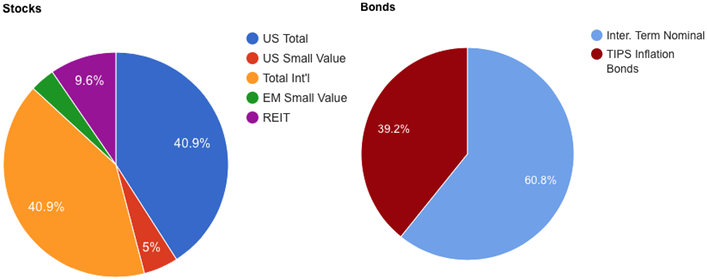
Below is a close approximation of my most recent portfolio update. I have changed my asset allocation slightly to 60% stocks and 40% bonds because I believe that will be my permanent allocation upon early retirement.

Asset Class / Fund % of Portfolio Trailing 12-Month Yield (Taken 4/14/16) Yield Contribution
US Total Stock
Vanguard Total Stock Market Fund (VTI, VTSAX)
24% 1.94% 0.46%
US Small Value
WisdomTree SmallCap Dividend ETF (DES)
3% 2.80% 0.09%
International Total Stock
Vanguard Total International Stock Market Fund (VXUS, VTIAX)
24% 2.82% 0.66%
Emerging Markets Small Value
WisdomTree Emerging Markets SmallCap Dividend ETF (DGS)
3% 3.03% 0.10%
US Real Estate
Vanguard REIT Index Fund (VNQ, VGSLX)
6% 4.21% 0.24%
Intermediate-Term High Quality Bonds
Vanguard Intermediate-Term Tax-Exempt Fund (VWIUX)
20% 2.90% 0.60%
Inflation-Linked Treasury Bonds
Vanguard Inflation-Protected Securities Fund (VAIPX)
20% 0.82% 0.26%
Totals 100% 2.31%


The total weighted 12-month yield was 2.31%. This means that if I had a $1,000,000 portfolio balance today, it would have generated $23,100 in interest and dividends over the last 12 months. Now, that is significantly lower than the 4% withdrawal rate often quoted for 65-year-old retirees with 30-year spending horizons, and is even lower than the 3% withdrawal rate that I have previously used as a rough benchmark. I’ll note that the muni bond interest in my portfolio is exempt from federal income taxes.

Given the volatility of stock returns, the associated sequence of returns risk, and current high valuations, I still like the income yield measuring stick. I feel that the income yield number does a rough job of compensating for market valuations (valuations go up probably means dividend yield go down) as well as interest rates (low interest rates now, probably low bond returns in future). With 60% stocks, I am hoping that the overall income will keep up with inflation and that I will never have to “touch the principal”. Over the last 15 years or so, the annual growth rate of the S&P 500 dividend averaged about 5%.

As noted previously, a simple benchmark for this portfolio is Vanguard LifeStrategy Moderate Growth Fund (VSMGX) which is an all-in-one fund that is also 60% stocks and 40% bonds. That fund has a trailing 12-month yield of 2.12%. Taken 4/14/2016.

So how am I doing? Staying invested throughout the last 10 years has been good to me. Using the 2.31% income yield, the combination of ongoing savings and recent market gains have us at 88% of the way to matching our annual household spending target. Consider that if all your portfolio did was keep up with inflation each year (0% real returns), you could still spend 2% a year for 50 years. From that perspective, a 2% spending rate seems like a conservative number, even with the many current predictions of modest future returns.

Early Retirement Portfolio Asset Allocation Update, April 2016

portpiegenericIt has been a while, so here is a 2016 First Quarter update on my investment portfolio holdings. This includes tax-deferred accounts like 401ks, IRAs, and taxable brokerage holdings, but excludes things like our primary home and cash reserves (emergency fund). The purpose of this portfolio is to create enough income to cover household expenses.

Target Asset Allocation

aa_updated2015

I try to pick asset classes that will provide long-term returns above inflation, distribute income via dividends and interest, and finally offer some historical tendencies to balance each other out. I don’t hold commodities futures or gold as they don’t provide any income and I don’t believe they’ll outpace inflation significantly. In addition, I have doubt that I would hold them through an extended period of underperformance (i.e. don’t buy what you don’t can’t stick with).

Our current target ratio is 70% stocks and 30% bonds within our investment strategy of buy, hold, and rebalance. With a self-directed portfolio of low-cost funds and low turnover, we minimize management fees, commissions, and tax drag.

Actual Asset Allocation and Holdings

1604_portpie

Stock Holdings
Vanguard Total Stock Market Fund (VTI, VTSMX, VTSAX)
Vanguard Total International Stock Market Fund (VXUS, VGTSX, VTIAX)
WisdomTree SmallCap Dividend ETF (DES)
WisdomTree Emerging Markets SmallCap Dividend ETF (DGS)
Vanguard REIT Index Fund (VNQ, VGSIX, VGSLX)

Bond Holdings
Vanguard Limited-Term Tax-Exempt Fund (VMLTX, VMLUX)
Vanguard Intermediate-Term Tax-Exempt Fund (VWITX, VWIUX)
Vanguard High-Yield Tax-Exempt Fund (VWAHX, VWALX)
Vanguard Inflation-Protected Securities Fund (VIPSX, VAIPX)
iShares Barclays TIPS Bond ETF (TIP)
Individual TIPS securities
U.S. Savings Bonds (Series I)

Commentary
In terms of the big picture, very little has changed. I did not accomplish my plan of relocating my holdings of WisdomTree SmallCap Dividend ETF (DES) and WisdomTree Emerging Markets SmallCap Dividend ETF (DGS) into tax-deferred accounts. I pretty much left them where they have been, inside a taxable brokerage account. I am currently leaning towards simply selling them completely and making my overall portfolio more simple. I would just have Total US, Total International, and US REITs for stocks. I would technically still hold a “small value tilt” on my holding in my kid’s 529 college saving plan asset allocation.

As for bonds, I’m still somewhat underweight in TIPS mostly due to lack of tax-deferred space as I really don’t want to hold them in a taxable account. (I noticed that shares of TIP are actually up 4% this year, less than 4 months in). My taxable bonds are split roughly evenly between the three Vanguard muni funds. The average duration across all of them is roughly 4-5 years.

A simple benchmark for my portfolio is 50% Vanguard LifeStrategy Growth Fund (VASGX) and 50% Vanguard LifeStrategy Moderate Growth Fund (VSMGX), one is 60/40 and one is 80/20 so it also works out to 70% stocks and 30% bonds. That benchmark would have a total return of -0.87% for 2015 and +1.42% YTD (as of 3/31/16).

I like tracking my dividend and interest income more than overall market movements. In a separate post, I will update the amount of income that I am deriving from this portfolio along with how that compares to my expenses.
Under Armour, Nike, and Owning The Haystack

haystacknikeIf you’re a basketball fan, you may have read this ESPN article about how Under Armour beat out Nike to get an endorsement deal for Stephen Curry. As one of the hottest athletes in the world, this single deal could shift billions of dollars towards Under Armour, especially if the Warriors win 73 games and defend their NBA championship. All for a company that just starting making shoes 10 years ago.

Under Armour (UA) is currently worth about $10 billion (at a very high P/E ratio), just 10% of Nike (NKE) at roughly $100 billion. What will things look like in another 10 or 20 years? Will they maintain their momentum? Athletic apparel is a huge and growing industry, but fashion moves quickly and I am only getting older! Under Armour didn’t even exist when I was begging my parents for Nike Air Jordans in high school.

I see myself as an investor in these companies through the Vanguard Total Stock Market Index Fund. I know that as a market-cap weighted fund, the amount of each stock held is directly proportional to the total market value of the company. Right now, I own roughly 10 shares of Nike stock to every 1 share of Under Armour stock. If the current trends continue, I could one day be owning 10 shares of UA stock for every share of NKE. All without having to pay attention to trends, comb through any financial statements, or trade a single share of stock.

In the future, I will own shares of the company selling whatever kinds of clothing and shoes all the kids covet, be it Nike or Under Armour or something being sketched right now in a garage somewhere. (My own athletic wear logos are dependent on what is on sale under $10 at Ross…) I’ve repeated this well-known quote from Vanguard founder Jack Bogle before:

Don’t look for the needle in the haystack. Buy the entire haystack.

In the end, I sleep better at night because I know that I will own the haystack. I will own all the winners in relative amounts. In exchange, I will give up the opportunity to earn a very high return from betting on the top winner, I will give up the risk of picking the losers, and I won’t have to pay anyone to pick them for me.