Howard Marks is famous among many investors for his Client Memos as the chairman and cofounder of Oaktree Capital Management. He even weaved many of the older ones into a book, which I read and reviewed. I now try to read every one that comes out. Here’s the most recent client memo dated November 26th, 2013 [pdf]. Below are a few selected excerpts. First, a quick lesson on risk aversion:
Risk aversion is the essential element in sane markets. People are supposed to prefer safety over uncertainty, all other things being equal. When investors are sufficiently risk averse, they’ll (a) approach risky investments with caution and skepticism, (b) perform thorough due diligence, incorporating conservative assumptions, and (c) demand healthy incremental return as compensation for accepting incremental risk. This sort of behavior makes the market a relatively safe place.
In short, it’s my belief that when investors take on added risks – whether because of increased optimism or because they’re coerced to do so (as now) – they often forget to apply the caution they should. That’s bad for them. But if we’re not cognizant of the implications, it can also be bad for the rest of us.
What about now? Marks does see an increase in risk tolerance recently. But how bad is it?
 How time flies. Almost exactly 5 years ago on November 21st, 2008, I was sitting alone in yet another hotel on a business trip in a city that I can’t even remember. CNN was on TV as I wrote the following in a blog post with the title
  Speaking of holding municipal bonds, I’ve been catching up on the troubles in Detroit and Puerto Rico. Last month, there was a flurry of articles warning about mutual funds with high exposure to Puerto Rico bonds, as they were yielding over 9% and trading at 60 cents on the dollar. Most junk corporate bonds don’t yield that much! Yet, they still clung to investment-grade status from the major ratings agencies because if they went any lower, the bonds would crash as many mutual funds would be then forced by their mandates to sell the bonds. Don’t you love ratings agencies?
 I would characterize my personal portfolio as 85% passive, 15% active, and 100% low-cost. Why is part of my portfolio managed by people trying to generate “alpha”? Aren’t I supposed to say that index funds are always better? Author and money manager Rick Ferri has a good post about When Active Funds Makes Sense, even he is a well-known index fund advocate.
  After posting
 Investment research firm Morningstar rates 529 plans in their annual “529 College Savings Plans Research Paper and Industry Survey”. They recently announced their
 Fidelity Investments recently made a 40% reduction on the management fees for their direct-sold 529 Index Portfolios, with total expense ratios now ranging from 0.19-0.29%, down from 0.25-0.35%. Fidelity runs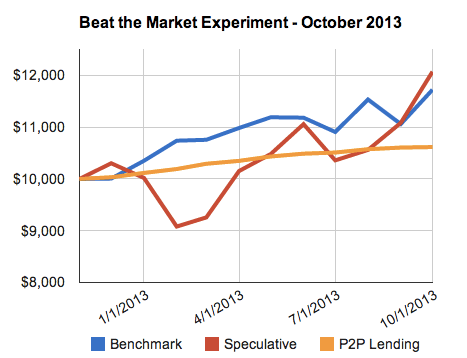

 The Best Credit Card Bonus Offers – 2026
 Big List of Free Stocks from Brokerage Apps
 Best Interest Rates on Cash - 2026
 Free Credit Scores x 3 + Free Credit Monitoring
 Best No Fee 0% APR Balance Transfer Offers
 Little-Known Cellular Data Plans That Can Save Big Money
 How To Haggle Your Cable or Direct TV Bill
 Big List of Free Consumer Data Reports (Credit, Rent, Work)