Investment Portfolio Update: Asset Allocation & Fund Holdings – July 2011

This an update for my investment portfolio, including 401(k) plans, IRAs, and taxable brokerage holdings. There have been only a few small changes since my last portfolio update. As always, this is our own personal portfolio and may not necessarily be completely applicable to anyone else.

Asset Allocation – Target vs. Actual

I separate the stock and bond portions for clarity. My target asset allocation remains the same:

Here is my actual stock allocation, where it shows that I am slightly overweight US Total and will need do some light rebalancing.

My actual bonds allocation is not really worth making a chart for… the target is 50%/50% and I have 47% short-term nominal bonds and 53% inflation-protected bonds.

Stocks vs. Bonds Ratio

[Read more…]

Don’t Let 401(k) Auto-Enrollment Decide Your Contribution Rate For You

The Wall Street Journal has a rather surprising article 401(k) Law Suppresses Saving for Retirement regarding a recent law that allowed employers to automatically enroll their employees into their 401(k) retirement plans. The goal was to encourage saving and make contributing a certain percentage rate the default option for workers, after which they could change the contribution rate to whatever they wanted (even zero). Before now, the default option was usually little more than passing out a brochure.

Auto-enrollment seemed like it was working. More workers than before were using 401(k) plans. The problem was, the default percentage rate for most plans was about 3%. It turns out that for some people that 3% is actually less than the 5-10% than people might have chosen on their own if started from zero. As a result, the study showed that 40% of workers ended up actually saving less after auto-enrollment began. Talk about unintended consequences!


Source: WSJ (Click to enlarge)

Possible reasons include inertia (aka laziness), but I suspect that if a company sets it at a certain percentage, then there can be a subconscious belief that such a number is the “recommended” or “approved” contribution rate. In reality, that 3% appears to be chosen simply to be low enough as to avoid workers opting-out immediately. In other words, much lower than what would be required to fund a proper retirement.

The study noted was done by the Employee Benefit Research Institute, which actually wrote a rebuttal article that focused on the fact that auto-enrollment is increasing the savings rate for many people, especially those with lower incomes. The problem is not with auto-enrollment itself, but more with tinkering with the default contribution rate. Another potential tool is an “auto-escalation” feature that increases employee savings rates by a set amount each year, say 1%, to encourage more savings over time.

When it comes down to it, the study pretty much reaffirms the original conclusion that started auto-enrollment in the first place. Lots of people are too busy, forgetful, uneducated, or scared to make the proper financial decisions for themselves. Don’t rely on your employer to decide how much to save for retirement.

Everyone has a different situation, but if you don’t have a pension or other significant retirement assets, your overall savings rate is probably going to have to be more than 10% if you expect to replace most of your income upon retirement. The tax advantage of traditional and Roth 401ks is very significant over time. Finally, if you have an employer match available, don’t say no to free money!

Debt, Debt, and More Debt

After seeing this household debt bubble chart, I’ve been especially sensitive to news about consumer debt. Here are some recent stats from across the spectrum:

Mortgages
According to real estate data firm CoreLogic, 22.7% of US homes with a mortgage had negative equity in the first quarter of 2011, meaning the outstanding mortgage amount was greater than the value of the property. That’s 10.9 million of them, and another 2.4 million had equity of 5% or less, which means with any further drops they’ll be in danger as well.

Nevada was the state with the biggest share of homes underwater, at 63% of all mortgaged properties, followed by Arizona (50%), Florida (46%), Michigan (36%), and California (31%). Goodness.

Home Equity Loans
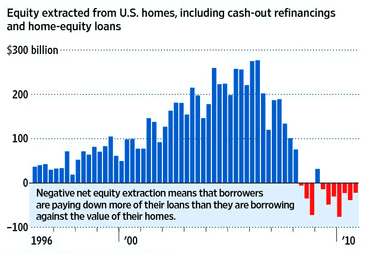
The same report also found that a hefty 38% of borrowers who took cash out of their residences using home-equity loans are underwater. By contrast, only 18% of borrowers who don’t have these loans were underwater. Check out all the home equity extracted up until 2008, which is slowly being paid back now.

Is there some good data about what all this money bought?

401(k) Loans
Human-resources consulting group AON Hewitt reports that nearly 30% of 401(k) participants currently have a loan outstanding, the highest in recent history. On a purely interest-rate level, these loans can actually be a pretty good deal. (Don’t listen to the double-taxation myth perpetuated by Suze Orman and others.) However, you have the potential penalty of losing the preciouis tax-deferred benefit plus a 10% penalty if you don’t pay it back in time (and if you lose your job, it’s due even sooner). Still, having nearly a third of all people dipping into their retirement money can’t be a good thing.

Sources: ConsumerAffairs, LA Times, WSJ, SmartMoney

Vanguard Lower Minimum Investment On Target Retirement Funds to $1,000

Effective May 11st, Vanguard has lowered the minimum initial investment on their Target Retirement Funds to $1,000, down from $3,000. Thank goodness, as this avoids having everyone pointing out that the Vanguard STAR fund was the only one with a minimum of $1,000. But seriously, I think this is a smart and overdue move by Vanguard, as it allows investors with limited funds to start out investing in a low-cost, diversified investment that adjusts with age. I put my own mother’s Rollover IRA in a Target Retirement Fund a couple years ago, and I sleep well at night.

(See previous post on the Vanguard Target Date Retirement Funds Glide Path to see how the asset allocation changes over time. I kept my mom’s target date close to their default recommendation, as my dad’s retirement accounts are on the conservative side.)

What if you have less than $1,000? There are plenty of “how to invest with just $100” posts out there, and if I look back I’ve probably done one myself. However, my new advice is this: Don’t bother. Instead, focus your energy on investing in yourself, by either learning about investing in general or improving your career and business skills. Put what you have safely in the bank, now once you have $1,000, then stick it in a Target Retirement Fund via a tax-advantaged IRA.

House Value Update Q2 2011: Mortage Loan Payoff Calculations

As part of tracking our financial status, I regularly check in to see how long it will take to pay off our home mortgage. Buying versus renting is a very personal decision, but we ended up buying our house three and a half years ago and still plan on staying in it for the foreseeable future. I see it as an inflation hedge (our mortgage payments won’t go up) and paying it off quickly as an integral part of our early retirement plan (lower expenses means smaller portfolio needed).

We obtained a 30-year, fixed rate mortgage. Our current interest rate is 4.75%, after two rate modifications, which were basically low-cost refinances through our original lender that didn’t need additional appraisals, etc. This way, we were able to advantage of dropping interest rates over the last few years.

Home Value Estimate
Good comps are still the best way to estimate your home value. Recently, a house very similar to ours was sold through a short sale by Bank of America for 92% of our original purchase price. The house is the same model with basically the same floorplan, original construction year, and is about 10 houses down from us on the same street. The main difference was that it was in worse condition in terms of interior updates and deferred maintenance. We feel this puts a pretty good floor on the current value of our house, although I like to subtract another 6% due to broker costs if we really did sell. This gives us a current value of 86% of our original purchase price. Definitely not great, but it could be worse, and we aren’t underwater.

You can also try internet valuation tools such as Zillow, Cyberhomes, Coldwell Banker, and Bank of America (old version). After using them for a year, I found them to be interesting but imprecise tools.

Remaining Mortgage Balance
On top of our normal mortgage payments, we’ve been making sporadic additional payments directly towards principal. Our current mortgage balance is 66% of the original purchase price, 77% of the value estimate above, and 82% of the original loan value (we put 20% down).

We’ve had the mortgage for 3.5 years, but we can calculate “how far” we’re actually into our mortgage by comparing the remaining balance and the remaining principal on a regular 30-year amortization. You can get this amortization table from many online mortgage calculators. Currently, we are at the same remaining balance as if we were 9 years into a normal 30-year amortization. This means if we just pay the “minimum” mortgage payment amount based on a 30-year paydown from here on out, we’ll have 21 years left until the loan is paid in full. Not bad, already cut over 5 years off the end. 🙂

Several months ago, we set up a regular additional principal payment of 25% of the normal 30-year payment (i.e. $500 on a $2,000 payment). This automation makes our monthly budgeting easier. According to this mortgage payoff calculator, this puts us on track to pay off the loan in only 15 years (another 6 years early). Ideally, if all goes well I would like to shave this down into the 10-year range.

Looking back, it would have saved me some interest to simply go with a 15-year mortgage initially. However, the 30-year option gave me more flexibility with lower payments back then and even now, so I don’t regret the decision all that much. I do recommend people using a 15-year mortgage to determine if you can “afford” a house to my friends now, because a 30-year mortgage just seems so long.

How Often Should I Rebalance My Investment Portfolio? Updated

Here’s a slightly updated and revised version of an older post I had on rebalancing a portfolio to maintain a target asset allocation.

What is Rebalancing?
Let say you examine your risk tolerance and decide to invest in a mixture of 70% stocks and 30% bonds. As the years go by, your portfolio will drift one way or another. You may drop down to 60% stocks or rise up to 90% stocks. The act of rebalancing involves selling or buying shares in order to return to your initial stock/bond ratio of 70%/30%.

Why Rebalance?
Rebalancing is a way to maintain the risk to expected-reward ratio that you have chosen for your investments. In the example above, doing nothing may leave you with a 90% stock/10% bond portfolio, which is much more aggressive than your initial 70%/30% stock/bond mix.

In addition, rebalancing also forces you to buy temporarily under-performing assets and sell over-performing assets (buy low, sell high). This is the exact opposite behavior of what is shown by many investors, which is to buy in when something is hot and over-performing, only to sell when the same investment becomes out of style (buy high, sell low).

However, in taxable accounts, rebalancing will create capital gains/losses and therefore tax consequences. In some brokerage accounts, rebalancing will incur commission costs or trading fees. This is why, if possible, it is a good idea to redirect any new investment deposits in order to try and maintain your target ratios.

How Often Should I Rebalance?
[Read more…]

The Problem With A Retirement Based On The Stock Market

As far as retirement calculators go, the new one over at the Scottrade Knowledge Center is pretty nice. It does the whole Monte Carlo thing, running theoretical scenarios based on historical data. There are fancy interactive sliders that let you input your current portfolio balances, annual contributions, and your future expenses. The result is a pretty chart:

But the same problem always occurs whenever retirements depend heavily on market returns. If future returns are on the low side of history, I could end up broke* and eating dog food by age 90. If future market returns are high, then I could die with $10 million in the bank. What the heck do I need with that much money at age 90?

One way to avoid this is to have a very conservative portfolio of safe and short-term bonds (or TIPS). This has the slight inconvenient problem of requiring a very high savings rate. (Or lottery winnings, a large inheritance, or other windfall.)

Now, it would be nice to have a way to share the risk with others out over longer periods of time. Give up some of the potential upside, in return for some downside protection. This usually involves an insurance company (annuities) or the government (Social Security). Which do you want to trust with a big chunk of your hard-earned money? It’s a tough call. 🙂

* This isn’t technically true. I’m sure in reality, if my portfolio was doing so poorly, I would adjust my spending however I could. But I would have to decrease my standard of living.

What Is A “Safe” Savings Rate? How About 16.62%

The term “Safe Withdrawal Rate” (SWR) usually refers to the amount of your portfolio that you can withdraw each year in retirement safely without running out of money. The “4% rule” is often used, which says that if you want $40,000 inflation-adjusted every year safely , you need $1 million as your target.

Reader Dave thoughtfully sent me an interesting Financial Advisor magazine article about an upcoming academic paper by Dr. Wade Pfau that takes a look at this from another angle. What if you wanted to figure out a “Safe Savings Rate”?

Let’s say you save for 30 years, and then retire (spend) for 30 years. The traditional SWR only depends on the 30-year period when you are saving reach that target number. Instead, what if you looked at the entire 60 year period together. This ends up smoothing things out, because periods of high return are often followed by periods of low return, and vice versa.

Here are the baseline assumptions. The goal is to withdraw 50% of current salary, inflation-adjusted, during retirement. You maintain a constant asset allocation of 60% stocks and 40% bonds (T-Bills). Results are in the chart below. The blue line is the saving rate according to the 4% rule, and the black line is based on the new 60-year test period using actual investment returns.

Based on market data since 1871, a savings rate of 16.62% would have worked every time. As you can see the black line is also much more consistent over time. Can everyone manage that? Maybe not, but few people are satisfying the 4% rule as well.

The given scenario is not one-size-fits-all, but it would be interesting if this research was expanded into some sort of retirement calculator. For example, all other things held the same, if you saved for 40 years, the safe saving rate drops to 8.77%. If you saved for only 20 years, the safe saving rate rises to over 30%. I’ll have to wait for the published paper to see what happens if you go a bit riskier into say 80% stocks/20% bonds, or if it accounts for changing allocations over time.

Update: Here is a link to the working paper [PDF].

Creating Lifetime Income via AARP Immediate Annuity

While perusing through old magazines in the dentists office, I came across an ad for annuity with the usual headline “Get a monthly income check GUARANTEED for life”. I took a picture of the ad, the payout rates are below:

The specific product is a fixed immediate annuity where you pay them a lump sum and received regular monthly payments until you die. It is called the AARP Lifetime Income Program (guaranteed by New York Life and only endorsed by the AARP). There are two options to protect you in case of an early death – either a “cash refund” or “20-year guarantee” feature:

  • “Cash Refund”: if you die before your total payments equal your annuity purchase price, your beneficiary will be paid the difference.
  • “20 Year Guarantee”: if you die before 20 years has passed, your beneficiary will receive the remaining monthly payments during the 20-year guarantee period.

DIY Early Retirement Pension?

Since my wife and I don’t have any pensions to look forward to, one way to create our own pension is to buy a fixed immediate annuity. I used their quote calculator to see what I could get right now if I was 50 years old and with the 20-year minimum payout.

So with a lump sum of $100,000, I could get $445 a month for life. That works out to a 5.34% payout rate.

The “guarantee” for annuities are only good as long as the issuing insurance company stays in business, but many states have a guaranty association that provides an additional backstop. For example, in Florida the total annuity cash surrender protection per owner per member company is $100,000, and the maximum aggregate benefit for all insurance lines is $300,000. I am not a lawyer, but from what I read that means I can buy three $100,000 annuity policies from three different insurance companies, and have it all backed by the state if any or all of those insurers goes bust.

That means if we were both 50 years old right now (which we aren’t), both my wife and I could put $300,000 across different insurers and both get about $1,300 a month in lifetime that is about as safe as one can make it. Together, that’s a cap of $2,600 a month. I don’t want to annuitize our entire portfolio, but I imagine that it would relieve a lot of my stress if our basic needs could be met with a monthly annuity payment that doesn’t depend on the performance of the stock market.

Now, these numbers above do not adjust for inflation, and so will buy less and less goods each year. This is important, especially if I am going to be buying so early at age 50. Inflation-adjusted annuities are available but the payouts are significantly lower and I feel the competition is not as good. One alternative is to start small and ladder additional annuities as you age.

There are many of these types of annuities available out there. I’m not recommending this one in particular, I was just using it as a handy example for some rough number calculations. A good comparison site is ImmediateAnnuities.com.

Net Worth & Goals Update – March 2011

Net Worth Chart 2011

Oh alright, here’s another net worth update. My last snapshot was about 9 months ago. I know people like the voyeurism, but hopefully my commentary will also provide some helpful insights as to achieving our goals.

Credit Card Debt
I used to take money from credit cards at 0% APR and place it into online savings accounts, bank CDs, or savings bonds that earned 4-5% interest (yes I know, much less recently), keeping the difference as profit while taking minimal risk. (Minimal in regards that the risk was only dependent on my behavior and not outside factors.) However, given the current lack of great no fee 0% APR balance transfer offers, I am currently not playing this “game”.

Most credit cards don’t require you to pay the charges built up during a monthly cycle until after a grace period of about 14 days. This theoretically provides enough time for you to receive your statement in the mail and send back a check. As this is simply a snapshot of my finances, my credit card debt consists of just these charges. I don’t carry any balances or pay any interest charges.

Retirement and Brokerage accounts
Since my last update, the broad stock indexes have risen significantly, about 25% including dividends according to Vanguard Total World Stock Index ETF (VT) that I use as a general benchmark. Although these high valuations make me nervous, I am still a believer in stocks for the (very) long run and rebalancing your asset allocation regularly. Don’t buy high and sell low.

Here is our target asset allocation. Being heavy in stocks, our portfolio bounced back significantly as well.

Our total retirement portfolio is about $360k or on an estimated after-tax basis, $318,000. At a theoretical 4% withdrawal rate, this would provide $1,060 per month in retirement income, which brings me to 42% of my long-term goal of generating $2,500 per month. These are all really rough numbers, but helpful to measure progress and visualize living off your portfolio.

Cash Savings and Emergency Funds
We are happy to hold a year’s worth of expenses (conservatively estimated at $60,000) in our emergency fund. According to my emergency fund poll, many of you readers also have substantial savings set aside, with most having at least 4 months of expenses. Very nice.

Recently I wrote about how I maximize interest in my emergency fund, including the specific banks and institutions I use.

Home Equity
I would like my house paid off in 15-20 years at most, so I’ve been putting some extra money towards the mortgage. Note that this is only after maxing out both our 401k plans, fully funding IRAs every year, and creating a one-year emergency fund. I’d like our mortgage pay-down progress to parallel our portfolio growth so that both are ready for at least partial retirement in about 10 years.

So there you have it. Mrs. MMB and I both earned a six-figure salary again last year, which combined is in the top 5% of households. We try to save a lot of it while it stays this way. 🙂 The future is hard to see, but we’re getting there a lot faster than we thought we could.

Dilbert and Bogart On “F#(& You” Money

Trying to think of a good name for your retirement fund? Here’s a funny Dilbert comic about a colorful option:

dilscott

In fact, the origins of the term “F— You Money” can be traced to actor Humphrey Bogart. The following quote is attributed to him:

The only good reason to have money is this: so that you can tell any SOB in the world to go to hell.

There is also this story from some biographical accounts of his early years:

Long before he was Hollywood’s most famous tough guy, Bogart began his acting career on the stage. After serving in the United States Navy during WWI, he got his start playing a handful of very juvenile roles in drawing-room and country-house comedies. In 1920, he scored a leading roll in the comedy “Cradle Snatchers” and received a bevy of positive notices. It was during this time that he was said to have kept $100 dollars in his dresser drawer at all times, calling it his “F” you money. Instead of taking a part he didn’t want, he could just say “F” you.

I looked it up and $100 in 1920 was about $1,000 in today’s dollars.

I like Bogart’s definition better. He basically says “I’ve now got the financial independence to be picky in how I spend my time.” You don’t need a million bucks. Even a smaller sum of money tucked away can make a big difference in your mood and outlook on life. The first $25,000 I saved up freed me up to pursue my real passions and make the next $250,000.

Stable Value Fund 2011 Interest Rate Announced

If you have a 401(k), 403(b), or similar retirement plan, you may have an investment option called a stable value fund. Sometimes it goes by a different name like Guaranteed Pooled Fund, but they are always marked as a conservative investment. The pitch is basically the higher interest rate of longer-term bonds, with the relatively liquidity and stable principal value of a money market fund. I explored the risks and rewards of stable value funds before and currently hold them as part of my bond allocation.

My specific stable value fund is run by Transamerica Financial Life Insurance Company (TFLIC) and offered an interest rate of 3.5% for all of 2010, which was much higher interest than any other similar bond investment was going to pay me. Then they told me that until February 28th, 2011, the interest rate would be 3.0%. Finally, I just received a letter that told me that the interest rate from March 1st to December 31st, 2011 would be lowered to 1.8%.

So, should I stay or should I go? Interest rates continued to drop in 2010, so I did expect them to lower their rate.

Online savings accounts like Capital One Consumer Bank are paying around a low 0.75% APY, and I have no access to something like that in my 401k. They recently announced a self-directed option through Schwab, although I need to find more details about how much transaction costs would be. The Vanguard Short-Term Treasury Fund (VFISX) is currently yielding only 0.66%. Taking a look at current Treasury yields shows the 2-year at 0.78% and the 5-year at 2.30%.

So the interest rate itself is still pretty competitive relative to other “safe’ investment options. My other bond alternative inside the account is the huge PIMCO Total Return fund (PTTRX) with a 3.12% yield and 4.8 year duration, which did pretty well for me when I had it but I worry about asset bloat with $240 billion is assets, manager risk, and interest rate risk.

In the absence of any significantly better options, it looks like I’m staying put.