Better Inflation Chart with CPI Component Breakdown

In my last post, reader Greg shared a better chart that illustrates the components of the Consumer Price Index, which is supposedly to track what the average consumer spends and thus is used to gauge inflation. Definitely worth archiving for later.

Source: New York Times. Click to visit. It’s interactive, so you can zoom in and out to see all the little details.

Minimizing Your Personal Inflation Rate

Inflation. Deflation. Hyperinflation. It’s all people seem to talk about these days. I’m always reading that you should always consider your investment returns after inflation. But what is inflation? Most of the time, they are talking about the Consumer Price Index for Urban Consumers (CPI-U) published monthly by the Bureau of Labor Statistics. This is based on the price of a theoretical basket of goods. Here are the components of the CPI, made into a nice pie chart by dshort.com from this recent BLS CPI report.

However, common sense tells us that we do not all share the same inflation rate. A long-distance trucker will be much more sensitive to the price of gas than a couple living in Manhattan. A grandmother who has owned her home since 1940 and doesn’t plan on moving doesn’t notice if rents are rising 3% or 6% a year. The CPI could have very little correlation to your personal inflation rate.

In addition, it’s possible to manage our own personal inflation rates by changing our behavior or making some upfront investments. Let’s take a look at the largest components of the CPI.

Housing (42%)
This category includes the cost of rent (or owner’s equivalent cost) as well as utilities like gas and electricity. The most obvious way to deal with inflation is to own a house, either directly or via mortgage. With a 30-year fixed mortgage, your monthly payment is going to stay the same, and your total housing payment is only going to vary a bit as your insurance and property taxes go up. My neighbor used to have a mortgage of $300 a month.

As for utilities, a solution I plan to install is solar photovoltaic (PV)panels. In most states, you can sell back the electricity you generate with solar panels throughout the day, so that it cancels out your entire electricity bill. With a large enough system, you will never have a power bill again. Here is a helpful PDF consumer’s guide on solar systems from the Department of Energy.

The large upfront cost can be defrayed with federal and state tax credits, and the panels come with (about) a 25-year warranty. Other parts, like the inverter, come with a 10-year warranty. If you have the space you could also install a windmill, or contract electricity from other sources.

If you live in an especially hot/cold climate and much of your expense is cooling/heating, a very important area is insulation.

Transportation (17%)
This category includes the cost of vehicles, public transportation, and fuel. I plan on owning all my cars for at 10 years each, so even though it will catch up to me eventually, the annualized cost should remain reasonable. Avoiding the hit of depreciation during the early years, either buy buying used or holding for a long time, is important.

As for fuel, again I plan on using my solar panels to create electricity for my plug-in electric vehicle. Range is currently an issue, but as battery technology improves, I expect that it will be feasible for most households to own at least one electric vehicle.

Food & Beverages (15%)
This category includes food at home, dining out, and also alcohol. Why not grow some of your own food? We are starting to dabble in square-foot gardening, which involves planting small, efficient gardens that use minimal water, pesticides, and labor. Dining out is one of those expenses that is almost all for pleasure and convenience, so if it becomes hurtful then we’ll cut back. I’ve already been cutting back on the alcohol for waistline reasons.

Education & Communication (6%)
I’m not sure why these two are lumped together, but I really don’t see communication costs rising very much in the future. It would appear that data transfer is only going to get faster and cheaper. On the other hand, education costs continue to skyrocket. (Okay, now I see why they are together… sneaky) Even though this is only 6% of the CPI, if you have kids then tuition prices are likely a huge concern. If you don’t have kids (and are done with school), then you don’t care at all.

There are still some limited opportunities for prepaid college tuition out there, which are worth exploring if you accept the penalties for not following their restrictions. An example is the Florida Prepaid college plan.

Any other ideas for controlling your personal inflation rate?

Target Retirement Funds Increasing International Exposure

The January 2010 issue of SmartMoney magazine had a nice little article Target-Date Funds Retool — Again about how those all-in-one Target Retirement funds that nearly all 401k plans have now are almost all increasing the percentage of stocks that are international. They all say this not performance-chasing, but at the very least it’s sentiment-chasing. People just aren’t all that confident in an predominantly-US portfolio anymore. I like the quote “Were you wrong before, or are you wrong now?”.

In any case, the online version left out my favorite part of the handy graphic, so I scanned it in here:

Vanguard announced back in October that it was also following the herd and increasing international exposure for its funds, and a quick look on the Vanguard Target 2025 fund shows the international holding at 20.8% as of 12/31/10. Seems like they are rolling out the change gradually.

I’m always on the fence on these funds. If having one fund keeps people from jumping from one fund to another, these funds can be a net positive. I like simplicity. But you have to watch out for high costs because that will eat away at your return. On the other hand, you can construct your own retirement portfolio out of just a few funds now, and not have to watch these guys follow each other around. Even the Vanguard Target 2025 fund only has 3 funds inside of it.

What Is Your Portfolio’s Current Asset Allocation?

If you haven’t been keeping close track of it, your portfolio’s asset allocation may have shifted significantly over the past year. Your relative mix of assets like stocks, bonds, or real estate has a great impact on the volatility and expected future return of your portfolio.

Morningstar has a bunch of helpful tools for managing your investment portfolio, but many of them require a paid membership. However, one handy trick is that anyone can use many of these premium features for free at the T. Rowe Price website by signing up for a free account with nothing but an e-mail address.

Portfolio Manager
This tool lets you enter all your portfolio holdings, which it then stores for you and allows you to track it with automatically updated prices. You can either track all your future transactions as you go, or just input your updated holdings every few months like I do.

Portfolio X-Ray
Once you enter your holdings, simply look for the Portfolio X-Ray tab and you’ll have a complete breakdown of the true asset allocation of your overall portfolio. Does your “small cap” fund really own a bunch of mid-caps and large-cap funds? X-Ray will reveal your true exposure to stock style (i.e. Small/Mid/Large, Growth/Blend/Value), geographical regions (i.e. Japan, US) , stock sectors (i.e. Telecom, Energy), average expense ratio, and more.

If you’d rather have a quick peek without needing to register at all – but also without the ability to save your portfolio – try the Morningstar Instant X-Ray tool.

If you already have a target asset allocation in mind, now might be a good time to to rebalance your assets back towards that target. Rebalancing is a way to maintain the risk/reward balance that you have chosen for your investments, and also forces you to buy temporarily under-performing assets and sell over-performing assets (buy low, sell high). If you are looking for a bit more guidance, here are my favorite posts on investing.

2010 Year-End Financial Goal Progress Update

As 2010 draws to a close and the champagne is all gone, here’s an update on the status of our personal financial goals. I’ve been on the fence for a while about whether to continue our detailed net worth updates, and I’ve decided to reclaim some privacy and stop doing them in the previous format. Instead, I’d like to keep tracking our progress but in a opaque manner where I think everyone can still calculate their own and compare with us if desired. I’m not sure exactly how to do this, but here is a rough outline.

Credit Card & Consumer Debt

I think the first part of any healthy financial status should be to outline and pay off any consumer loans. We do use credit cards, but we pay our balances in full each month. We don’t have any auto loans or other forms of consumer debt.

I used to take money from credit cards at 0% APR and place it into online savings accounts, bank CDs, or savings bonds that earned 4-5% interest, and keeping the difference as profit while taking minimal risk. (By this I meant that the risk was dependent on my own actions.) I could have also used such 0% loans instead of other debt like student loans. However, given the current lack of great no fee 0% APR balance transfer offers, I am currently not playing this “game”.

Retirement Portfolio

As far as financial freedom goes, there are a number of ways to fund your living expenses without working. Pensions, Social Security, stocks, bonds, real estate, and so on. For us, I have boiled down “financial freedom” to be two things:

Part 1: Accumulate 25 times annual (non-housing) expenses

Part 2: Own my house / Pay off mortgage

I think it’s important to note that these two parts don’t necessarily have a number attached to them. Minimizing expenses are just as important as increasing portfolio size, as well as minimizing the amount of house that you “need”. More detail can be found in this post entitled A Quick & Dirty Plan To Reach Financial Freedom.

For Part 1, the basic idea is to assume that a portfolio can return 4% annually with adjustments for inflation. So if you have $1,000,000, that would create $40,000 a year. The exact implementation of this is more complicated, as there are several ways to help avoid portfolio depletion like annuities and adjusting your withdrawals during market downturns. Most folks won’t need a million dollars, though, if they have already paid off their house. For example, if your non-housing expense are only $1,000 per month, then you’d only need 12 x 25 = $300,000.

Back in July I was 33% of the way to reaching this goal. We are now 40% of the way. At this pace, we could finish Part 1 in less than 10 years, but we will likely scale back our income when we have kids. We’ll have to keep a close eye on those expenses as well.

Housing & Mortgage

Owning a house isn’t for everyone, but I think that if you are geographically stable, it can be a great way to become financially independent. Once you pay off the house, then your housing “expense” is mostly taken care of. (There is still maintenance and property taxes.)

We have owned our house for about 3 years now, having taken out a 30-year fixed rate mortgage initially with a 20% downpayment. Since I want to retire before I’m 50, I need to speed things up. Over the past year, we have made additional payments toward principal, as well as lowered the interest rate to 4.75%. These prepayments have been irregular lump-sum amounts, although I agree an automated plan is easier to maintain. The outstanding loan principal is now 67% of the purchase price. If we were to continue the original minimum-required payments, our home would be now be paid off in 21 years. This is good, as we can support that payment on one income.

Free PDF of Unveiling the Retirement Myth by Jim Otar

I’m still recovering from holidays, but I did see today that retirement specialist Jim Otar has made his book Unveiling The Retirement Myth available in PDF format for free until January 9, 2011. Here is the direct download link (expired).

I haven’t read it, but from I can gather it seems targeted at those DIY investors who are carefully planning the withdrawal phase of retirement, and not for beginners. For example, the summary teaser talks about “non-Gaussian optimum asset allocations”. 🙂 Hey, sounds like great weekend reading to me. Learn more about the material at his site RetirementOptimizer.com. In any case, it’s free and the book retails for $50, so why not download it. I’m now wanting an iPad to read all these free eBooks out there…

Thanks to TheFinanceBuff for the tip.

The Perils of Pursuing Financial Freedom

The following is a guest post from Kent Thune, who is a Certified Financial Planner(R) and the author of The Financial Philosopher, where he urges readers to place *meaning before money and purpose before planning*.

altext

What is freedom? What is financial freedom? Is there a difference? Is the freedom that money apparently purchases worth the sacrifices we make to reach this freedom? Can the pursuit of financial freedom paradoxically reduce one’s actual freedom? Can freedom be bought? If not, then what does this say about the pursuit of financial freedom?

The Tail Wagging the Dog

“Life is about life and not the result of life.” ~ Johann Wolfgang Von Goethe

Financial goals are destinations; they’re not life. If you believe that life is about the journey and not the destination, it’s contradictory to believe that life now must be sacrificed for a life bought by money later.

If retirement, for example, is accomplished only upon (or in unison with) the accomplishment of financial freedom what is the purpose of life now? Are you enslaving yourself now for a perceived freedom years or even decades away?

The blind pursuit of financial freedom is often closer to slavery than it is to liberation. The ultimate example of the metaphorical tail wagging the dog is an individual who creates a financial plan and then shapes their life and behaviors to accomplish the plan; whereas the healthy individual will clarify life (non-financial) goals first, and use money as a tool to reach those goals second. The pursuit of financial freedom can actually be liberating if it is not a blind pursuit—if it is a pursuit consciously defined by the individual.

[Read more…]

Vanguard Target Retirement Funds Changes: Increased International Exposure

A lot of people own Vanguard Target Retirement 20XX Funds, and I just noticed that Vanguard made an announcement that they will be making some changes:

  • The international equity weighting will be increased to 30% of the overall stock portion fund, up from about 20%.
  • Three of the funds (European Stock Index, Pacific Stock Index, and Emerging Markets Stock Index) will be replaced by a single fund, Vanguard Total International Stock Index Fund.
  • The Total International Stock Index Fund itself is making some changes. Its benchmark index will switch to the MSCI All Country World ex USA Investable Market Index, which differs from the previous index by adding exposure to Canada and Israel, as well as adding a ~13% allocation to small-cap companies.

All of these changes sound good to me, even if it is another example of Vanguard following the herd. The very first target retirement funds had no exposure to Emerging Markets. Emerging got hot, and then Vanguard added to their funds. Investors have been increasing their international exposure as well recently, and 20% was less than their competitors like Fidelity and starting to look old-fashioned. (Perhaps this is another move away from the philosophies of founder Jack Bogle.)

This also means most Target funds will consist of just three funds:

  • Vanguard Total Stock Market Index Fund
  • Vanguard Total International Stock Index Fund
  • Vanguard Total Bond Market II Index Fund

The stated reasons are for increased simplification and diversification (and a little less volatility perhaps), and not for any increase in expected future returns. Here’s a Q&A from Morningstar with Vanguard CIO Gus Sauter about the topic.

I still like this series of all-in-one funds for those people who like the idea of auto-pilot and have all their retirement savings in tax-deferred accounts like 401ks and IRAs. They are simple, reduce your stock exposure gradually over time, keep costs low, and rebalance regularly for you. You can also adjust your risk level by choosing a different target year.

I held the Vanguard Target Retirement 2045 (VTIVX) for a while. After selling it, I’ve found it very easy to let my asset allocation shift.

However, if you have both taxable and tax-deferred investment accounts, splitting up your bonds and stocks for optimal tax-efficiency can help you increase your after-tax returns.

ING Your Number: Retirement Calculator Assumptions and Factors

I was watching TV this weekend and kept seeing commercials about ING’s Your Number, which is an online calculator that supposedly helps you plan for retirement by telling you how much you need to save. Here’s one of them if you haven’t heard of them before:

After trying it out and finding out my 7-digit number, I wanted to see what was “under the hood”. Monte carlo simulations? Spits out random number to mess with your head? Maybe my Google-Fu is weak, but I couldn’t find anything except this Your Number worksheet [PDF] from ING dated 2009. The final numbers don’t match up, but it does provide some insight into how the current calculator works. Using this information and trying lots of permutations, I tried to backtrack how each question affects the final output.

Factors and Assumptions

Current age. This factor appears to be used solely to calculate how many years you have left until retirement. Since the ING Your Number is the amount of money you need at the time of retirement, it increases every year with inflation. This is an important fact to note, as needing $1 million today would be the same as needing $2 million 30 years from now due to inflation alone. (Inflation is assumed to be roughly 3% annually.)

Marital status. The calculator says “We’re not trying to pry into your personal life, but whether or not your married has an impact on your number.” Nosy or not, it actually doesn’t seem to matter. I tried all kinds of inputs, but I couldn’t find any that changed based on being married or not. Let me know if I missed something here.

Current household income. At first glance, you’d think your current household income wouldn’t affect Your Number necessarily, since it later on asks for the actual income required during retirement. I noticed that making slight changes in your current income doesn’t affect Your Number at all. However, large changes do – it appears that this number is used to estimate future social security benefits. If your current income is really low, then your future benefits will also be low, which increases Your Number.

Age at retirement. This factor is used twice – once along with your current age to find how long you have until retirement, and again with your death age to find years in retirement. The more years you plan to spend in retirement, the greater Your Number will need to be in order to maintain a margin of safety.

Annual income required during retirement. A recommended amount is 80% of your pre-retirement income, but I hate that rule-of-thumb. Instead, this is probably the hardest part of the calculator because it requires the most personal and in-depth thought. Is your house paid off and are you going to stay in it? How much of your current income goes towards work expenses? What activities do you plan to do in retirement?

Provide income through what age? As noted above, this “death age” is used to calculate the amount of years you’ll spend in retirement. I kind of wish they just assumed 100 or something for this, it seems a bit morbid to guess when you’ll die.

In the end, Your Number is essentially your annual retirement income multiplied by a factor ranging from 5 to 30, depending on how long your retirement horizon is. It could have just told people to multiply by 25 and be just as accurate (or inaccurate) . As you might expect with any calculator that tries to help plan your retirement by asking five questions, Your Number is mostly a marketing gimmick designed to connect you with ING-affiliated financial advisors and insurance salesmen. That doesn’t mean you still don’t want to try it, though, right? 🙂

What’s yours?

2010 Q3 Investment Portfolio Update – Fund Holdings

I’ve already posted my target asset allocation, now here’s my actual portfolio holdings. Again, these are my own choices, governed by the size of my tax-advantaged accounts like IRAs/403b/401ks, the brokerage firms that I use, and my preference of passive management and low fees. Even with the explosion of new blogs, I still don’t see very many people sharing their actual holdings. I hope that if I share, then others will share as well. 🙂

Tax-Efficient Placement

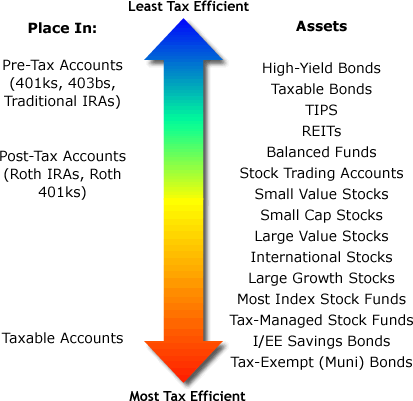
One big change for me over the last two years is that I now run out of room in my IRAs and 401ks each year and now have money sitting in taxable accounts. Since each asset class is taxed differently, where you put your assets can make a big difference in your net return. As a result, I’ve moved some things around. Here’s a handy graphic taken from a post about tax-efficient fund placement:

Chart of Relative Tax Efficiency of Assets

Stocks

US Total Market
I used to own Vanguard Total Stock Market Index Fund (VTSMX) but recently converted that to the ETF share version Vanguard Total Stock Market ETF (VTI) due to the lower 0.07% annual expense ratio. This fund tracks the MSCI US Broad Market Index, and typically holds the largest 1,200–1,300 stocks (covering nearly 95% of the index’s total market capitalization) and a representative sample of the remaining stocks. It currently holds 3,391 different companies. All for $7 a year for each $10,000 hold.

In my 401k, since I have limited options, I hold a mix of 75% Diversified Stock Index Institutional Fund (DISFX) which is basically a S&P 500 fund and 25% Fidelity Spartan Extended Market Index Fund (FSEMX) as it tracks the entire market minus the S&P 500. Together, the track the overall US market very well, at only a slightly higher cost of a weighted 0.25%.

US Small Cap Value
Here, I still hold the Vanguard Small-Cap Value Index Fund (VISVX). I could convert to the Vanguard Small-Cap Value ETF (VBR) with identical holdings and a lower expense ratio of 0.14% vs. 0.28%, but since it is only 5% of my portfolio I haven’t yet. In addition, there are good arguments for alternative ETFs such as iShares Russell 2000 Value Index ETF (IWN) or iShares S&P SmallCap 600 Value Index ETF (IJS). They each track slightly different indices and thus hold different stocks. Something to analyze deeper at a later time.

REIT
I still hold the Vanguard REIT Index Fund (VGSIX) as opposed to the Vanguard REIT ETF (VNQ). Both track the MSCI® US REIT Index. I hold this inside my IRA, so I’d rather just have full investment rather than worry about partial shares and such.

International / Total World excluding US
I used to hold Fidelity Spartan International Index Fund (FSIIX) but now hold the Vanguard FTSE All-World ex-US ETF (VEU) which tracks the FTSE All-World ex US Index and holds 2,239 stocks from around the world. There is the equivalent Vanguard FTSE All-World ex-US Index Fund (VFWIX) but since this is a bigger holding for me, the cheaper expense ratio makes a difference.

Emerging Markets
I converted to the Vanguard Emerging Markets ETF (VWO) from the Vanguard Emerging Markets Stock Index Fund (VEIEX). Even though my overall investment here is low, VEIEX has both a 0.25% redemption fee, and a 0.50% purchase fee, which is just too annoying to stay there. Another option would have been the iShares MSCI Emerging Markets Index (EEM), but it is both more expensive and has had more tracking issues. Here’s a EEM vs. VWO comparison post.

Bonds

Short-Term High Quality Bonds
I used to own the Vanguard Short-Term Treasury Fund Investor Shares (VFISX) but it now only yields 0.41% with an average duration of 2.2 years. If you had an IRA at certain banks, you could buy a CD earning 2-3% over the same time horizon. It would be just as safe. There would be less liquidity, but I’m not really concerned about that. The CD would be even better because you can’t lose what you put in.

I’ve actually gone ahead an put this portion of my portfolio in a stable value fund inside my 401k. I explored the risks and rewards of stable value funds, and while they are not of the utmost safety, the worst-case scenario is on the same order of the worst-case scenario of many short-term bond funds. My stable value fund is earning 3.5% for all of 2010.

I’ve also been looking at municipal bond funds such as the Vanguard Limited-Term Tax-Exempt Fund (VMLTX) and Vanguard Intermediate-Term Tax-Exempt Fund (VWITX) since they are mostly rated AA and above with interest being federally tax-exempt. If I lived in California and had a big bond allocation, I’d still consider a partial holding in the Vanguard California Intermediate-Term Tax-Exempt Fund (VCAIX) since the interest is higher and is exempt from both federal and CA income tax. I wrote about VCAIX in late 2009 when the yield was 3.49%. It’s done quite well since then, although California’s still got major issues to work out. If I lived in New York, I’d consider the same for NY funds.

Inflation-Protected Bonds (TIPS)
Here, the only thing to buy is either individual TIPS bonds or a mutual fund/ETF holding TIPS bonds. Usually buying individual bonds is risky because you aren’t spreading the default risk across hundreds of issuers, but in this case every single bond is just as safe and backed by the US government.

I have my Self-Employed 401k at Fidelity, which allows me to buy individual TIPS with no commission (just bid/ask spread). I bought some longer-term TIPS with real yields of 2-3%, and they’ve been doing well since real yields have dropped since. In addition, I hold shares of the iShares Barclays TIPS Bond ETF (TIP) because I can trade iShares ETFs commission-free at Fidelity.

The Vanguard Inflation-Protected Securities Fund Investor Shares (VIPSX) was also considered, along with new TIPS ETFs that have different maturities such as the PIMCO 15+ Year U.S. TIPS Index ETF (LTPZ).

Target Asset Allocation for Investment Portfolio

Asset allocation (AA) is an important part of portfolio design, and I like pinning down a target asset allocation for personal reference. This helps keep me focused as my portfolio shifts over time and makes it easy to re-balance back. For some educational posts on this topic, please refer to my asset allocation starter guide.

Below is my updated target asset allocation. Here is my target asset allocation from 2008. It’s not dramatically different, but I’ll try to explain the slight changes below. This is just my own AA, and I think everyone should develop their own based on their own beliefs and learning. If you just copy someone else’s without thinking, when things go awry you won’t have the foundation to stick to your guns. I have been strongly influenced by the writings of Jack Bogle, William Bernstein, David Swensen, Rick Ferri, and Larry Swedroe.

Stocks

I separate things out first into stocks and bonds, and then later it’s easy to go 60% stocks/40% bonds and so on. Here’s my stocks-only breakdown:

  • I now do a 50/50 split between US and International stocks. In general, I would like to mimic the overall world investment landscape. On a market cap basis, the US stock market is now about 45% of the world, while everyone else takes up 55%. 50/50 is just simpler, with a slight tilt towards domestic stocks.
  • I consider REITs a separate real estate asset class. I used to put Real Estate under US stocks since I only held US Real Estate Investment Trusts (REITs), but in the future I would be open to investing in foreign real estate as property laws improve and investing costs drop.
  • On the US side, I add some extra small-cap value companies. Historically, adding stocks of smaller companies with value characteristics (as opposed to growth) has improved the returns of portfolios while lowering volatility. There is debate amongst portfolio theories as to why this happened and if it will continue.

    If you buy a “total market” mutual fund or ETF, you’ll already own many of these types of companies (although many will not be held due to their small size relative to the big mega-corporations). I feel this adds a bit of diversification.

  • On the international side, I add a little extra exposure to emerging markets. You may be surprised to know that “emerging” countries like China, Brazil, Korea, India, Russia, and Taiwan already make up 26% of the world’s markets when you remove the US. These are countries that have a greater potential for growth, but also lots of ups and downs. I add a little bit more than market weight for these as well.

Bonds

I try to keep things simple for bonds, partially due to the fact that they are currently a smaller portion of my portfolio.

  • I like a 50/50 split between inflation-linked bonds and nominal bonds. Inflation-protected bonds provide a yield that is guaranteed to be a certain level above inflation. Nominal bonds pay a stated rate that is not adjusted for inflation. I like to balance the benefits of both.
  • Instead of only short-term US Treasuries for nominal bonds, I added some flexibility. I used to invest only in short-term US treasuries, as they provided the best buffer in my portfolio as they were of the highest quality and had a low sensitivity to interest rate fluctuations. Both TIPS and nominal Treasuries did great during the 2009 crash and the subsequent flight-to-quality, but now the yield on Treasuries is just too low in my opinion. There are trillions of dollars from countries and huge institutions around the world that are tucking their money away under the safe Treasury mattress. By venturing into other places they won’t with my tiny portfolio, I feel I can stay relatively safe yet increase my yield significantly. Possibilities include bank CDs, stable value funds, and high-quality municipal bonds.

Want more examples? Here are 8 model portfolios from respected sources, an updated Swensen portfolio, one from PIMCO’s El-Erian, and Ferri’s personal portfolio. Have fun!

Portfolio Manager Rick Ferri Shares Personal Portfolio and Asset Allocation

In a recent post on the NY Times Bucks blog, portfolio manager and author Richard Ferri shared his own personal portfolio. As a proponent of low-cost, passive investing, it was not surprising to see mostly index funds in his portfolio, but it was interesting to see that his overall asset allocation is 80% stocks and 20% bonds. He is quick to note that he does have a pension and defined-benefit plans which balance out his overall financial picture. Wouldn’t you like to know what all those financial advisors out there actually own?

Asset Allocation

Here is his asset allocation broken down into stocks and bonds separately using pretty pie charts:

Stocks

Bonds

Here’s the overall 80/20 breakdown with ticker symbols (based on this Bogleheads post):

34% Vanguard Total Stock Market ETF (VTI)
10% S&P SmallCap 600 Value Index Fund (IJS)
5% Ultra-Small Company Market (BRSIX)
8% Vanguard REIT ETF (VNQ)

6.5% Vanguard Pacific ETF (VPL)
6.5% Vanguard European ETF (VGK)
5% DFA International Small Cap Value
5% DFA Emerging Markets Core
—- [alternative: Vanguard Emerging Markets ETF (VWO)]

12% Vanguard Total Bond Market Index Fund Investor Shares (VBMFX)
4% Vanguard Inflation-Protected Securities Fund Investor Shares (VIPSX)
4% Vanguard High-Yield Corporate Fund Investor Shares (VWEHX)

Reading his book All About Asset Allocation was very helpful in creating my own portfolio. (Also see Model Portfolio #3 taken from that book.) I haven’t been updating my own own portfolio asset allocation as diligently as I should, although I have been keeping track of it. Here’s the last snapshot I took:

Pie Chart of Investment Portfolio

I’ve had some asset allocation drift for sure, although I have been countering this by rebalancing with new funds. I really need an update…

Emergency Funds

It’s also interesting to note that he keeps an emergency fund of two years’ living expenses, and that he uses the Vanguard Short-Term Bond (BSV) with a current SEC yield of 1.08%. Very simple and almost no-maintenance.

I prefer using a mix of high interest savings accounts and longer-term CDs/rewards-type checking accounts. I figure that index fund investors get so excited by saving 10 basis points (0.10%) on mutual fund, but with a bit of work you could beat a short-term bond fund by 100 basis points (1%) with what I would call less risk.

Bond funds still have risk to principal, meaning you may have to sell for less than you bought in for, while FDIC-insured bank accounts do not. Money market funds are currently averaging less than 0.10% yield.