Stable Value Funds – Exploring Risks and Rewards

The last time I wrote about stable value funds was in late 2008, both before the 2009 crash and a time when most of my 401k was in stocks. This time around, as I was trying to figure out how to rebalance my larger portfolio in a tax-efficient manner, I took another look at this asset class found almost exclusively in defined-contribution plans like 401ks. According to the Stable Value Investment Association (SVIA), approximately 15 to 20 percent of 401(k) assets are in stable value funds.

What are Stable Value Funds?

Generally, stable value funds are a bunch of bonds which have a insurance “wrapper” around them which protects it from interest rate volatility. The intended result is a product that pays the higher interest rates of intermediate-term bonds, with the liquidity and stable day-to-day price of a money market fund. Think “cash but pays higher interest”. A chart from the SVIA [pdf] illustrates:

The Attraction

Here’s my current situation. The stable value fund in my 401k has a guaranteed net interest rate in 2010 of 3.50%. The low-cost Vanguard Intermediate-Term Bond Index Fund Investor Shares (VBIIX) currently yields 3.17%, but will have a moderate amount of price volatility, especially if interest rates rise. The Vanguard Prime Money Market Fund (VMMXX) currently yields 0.11% with its high-quality, ultra-short-term holdings and Vanguard backing.

I could get the stability of money market fund, with an interest rate more than 3% higher! (All yields are net of fees.)

The Risks

Higher interest rates with no price volatility? Free lunch? Not quite. First of all, any guarantee is only as good as the entity doing the guarantee. Check the safety ratings of the insurer of your fund. Mine is Transamerica Financial Life Insurance Co. (TFLIC):

Not the greatest, but not bad. In addition, there are actually several ways an insurer can get “out” of the contract. From the SVIA FAQ:

Are there instances when book value or contract value does not apply?
There are a few, limited instances when participants do not get book value from a stable value fund. These limited instances are typically contractually defined. One such instance typically not covered is security defaults or downgrades. In order to protect the integrity of the stable value fund, most contracts incorporate investment guidelines establishing minimum credit quality requirements for the underlying securities. These contracts have established mechanisms to address downgraded or defaulted securities that fall outside the contractual guidelines.

Corporate-initiated events, which are employer-driven events such as an early retirement program, layoff, or bankruptcy, are also typically not covered. Corporate-initiated events generally cause withdrawals in masse from a stable value fund. These withdrawals can negatively impact investors and plans that choose to remain in the fund.

First up, if the underlying securities turn out to be utter crap via a default or credit downgrade, then the insurance doesn’t apply? Wait, the insurer gets to choose the securities in the first place? Sometimes smells here. In fact, this happened in 2009 to the insurer State Street, although they decided to step in to make investors whole in order to preserve their reputation. Via this CBS Moneywatch article:

In December 2008 and January 2009, State Street elected to provide support – a total of $610 million – to the bond portfolio in stable value funds the company managed. State Street was not contractually obligated to do this. As the company’s 8-K filing (a report filed with the SEC to notify investors of any events that could be of importance to shareholders) stated, “liquidity and pricing issues in the fixed income markets” so affected the accounts that the wrappers “considered terminating their financial guarantees.” State Street’s action to bolster its portfolios kept the wrappers in place.

Finally, there is the “corporate-initiated event” of a huge layoff or bankruptcy. At the end of 2008, Lehman Brothers infamously went bankrupt, which left their stable value fund managed by Invesco with a negative return of 1.7 percent in December and an annual return for 2008 of 2 percent. In April 2009, a stable value fund for Chrysler employees only paid out 89 cents on the dollar, a drop of 11% due to the company’s troubles.

As you can see, there is a lot of things that can invalidate the guarantee. So, the next step is to understand the holdings, which in the event of a liquidation can help you imagine your worst-case scenario. You should be be able to see at least an overall breakdown of the assets, and a market-to-book-value ratio must be disclosed at least once a year. This will show any discrepancies between what the insurer says is worth $1 and what the market says. My TFLIC stable value fund’s market-to-book ratio was 101.30% as of March 31s, 2010 and here is their holdings summary:

Bottom Line

In good times, the stable value fund has a pretty easy job of maintaining an image of price stability and paying out the stated interest rate. However, when the poo hits the fan there are a lot of ways the insurance wrapper can be worth less than a bubble gum wrapper. The only real good news is that you are still left with some intermediate-term, investment-grade bonds. Even with the upheaval of 2009, the worst example I could find was a drop of 11%. Even Lehman Brothers investors ended up with a overall positive return for the year. These losses are not insignificant, but something the order of the drop in other similar bond funds during that time. The key is to understand the risks that you are taking, which oftentimes people don’t (including me).

As for my personal investments, after doing my bit of due diligence, I am going to put a small percentage (less than 5%) of my total assets in my stable value fund, given the limited alternatives in my 401k. I am willing to take the risk of a small loss in order to earn 3.50% for all of 2010 in this current interest rate environment.

Undo a Roth IRA Conversion For Profit – Tips & Tricks

Did you know that if you do a Traditional to Roth IRA conversion, that you can undo it? This “do-over” process is called recharacterization, and can come in very handy if the value of your investments drop significantly after your conversion since you owe income taxes based on the value of the IRA at the time of conversion. With the recent market volatility, this may apply to many investors as it did previously in 2008/2009.

Take the example below, from a 2009 CNN Money article but still applicable. Let’s say you had a Traditional IRA valued $150,000 at conversion, which later on drops to $100,000. At the end of the year, you’d have to pay taxes on $150k of income and also be stuck with the lower account value. By performing an “undo” and “redo” the conversion, you could pay income taxes on only $100,000 of income instead of $150,000 – a savings of $14,000 at the 28% tax rate. (Find your 2010 tax bracket.)

There are some ground rules, however. The IRS says you can perform a recharacterization until October 15th of the year following the year you converted. So if you converted in April 2010, you have until October 15, 2011. If you want to re-convert, you have to wait either 30 days after the recharacterization or until the tax year after the conversion year, whichever is later. Again, if you converted in April 2010, you’d have to wait until January 1st, 2011 to reconvert. If you wait too long in between, it is possible your account value might be even higher than before. Still, something I’ll be keeping an eye on.

(You must still meet the Roth conversion eligibility rules, previously based upon your modified adjusted gross income. In 2010, there are no income limits. In 2011 and beyond, there currently are no income limits either, but it is unknown if this will remain the case. Also, only for 2010 conversions are you allowed to split the income over 2011 and 2012, which can lower your overall tax bill based on tax brackets.)

More Advanced: Multiple Roth IRAs

How can you set yourself up to best take advantage of this “redo” opportunity? I recently read in a sample issue of Kiplinger’s Retirement Report that you should split your Traditional-to-Roth conversion into multiple IRAs for each asset class you own.

For example, you might split a $200,000 IRA into $100k of stocks and $100k of bonds. If the stocks go down to $80k while the bonds go up to $120k, just to a “redo” on the stock IRA and leave the bonds IRA alone. Assuming the values stay the same upon re-conversion, that would save you income taxes on $20,000 ($5,600 at a 28% tax rate) as compared to not splitting up the IRA since if you just converted it a single IRA, the total value remained $200,000 ($80k+$120k). Tricky!

Traditional to Roth IRA Conversion at Vanguard

So, you’ve done your research, read the articles, crunched the numbers, and you want to convert your Traditional IRA held at Vanguard into a Roth IRA. But, how do you actually do it at Vanguard.com? There is no explicit “Convert” button or link to run this conversion. After some fumbling around, I managed to figure it out. But why not just share it here in mind-numbing detail and hopefully save folks some time.

You’ll need to have both a Traditional and Roth IRA set up at Vanguard first (mutual fund only). If you don’t have the Roth yet, click on the “Open an Account” link on the black bar on the top of every page and open an account first. Be sure to indicate that the funds you’ll use to open the new account are “At Vanguard”.

After you already have both a Vanguard Traditional IRA and a Vanguard Roth IRA:

  1. Log in to your account online. Click on “My Portfolio” so that you can view all your accounts.
  2. Under your Traditional IRA section, click on “Buy & Sell”.
  3. Next, click on “Exchange” on any of your funds.
  4. Now, you can choose to Exchange from all your Traditional IRA funds, to funds in your Roth IRA. You may need to add a new fund.
  5. For the exchange amount, if you are doing a complete conversion, chose All. You may be asked to verify and accept any redemption fees.
  6. You’ll also need to choose your tax withholding options. In order to maximize my balances in these tax-deferred accounts, I chose not to withhold and to pay the taxes separately myself later from a taxable account. Also, I can spread the taxes due for a 2010 conversion over two years.
  7. At the end of the next available business day, your mutual funds will be exchanged into your Roth at their net asset values. Your Traditional IRA will still show up with zero balances, which you can hide from displaying.
  8. Your conversion is complete! Keep your transaction confirmations for tax time.

Keep on reading below for some of the warnings and notifications that you’ll encounter during the conversion process.

A conversion is a taxable event. Generally, you’ll owe taxes on the amount you convert from your traditional, SEP-, or rollover IRA into a Roth IRA.

When you convert to a Roth IRA, you may elect to withhold Federal and certain state taxes. You can get the most benefit from the conversion if you don’t have taxes withheld and instead pay taxes from a separate nonretirement account. Keep in mind that the money withheld for taxes isn’t part of the conversion, and, if you’re under age 59½, you may have to pay a 10% federal penalty tax on it. You also can’t “recharacterize”, or restore to a traditional IRA, the amount you withhold. If you choose not to withhold, you may need to make estimated tax payments to avoid an underpayment penalty.

We encourage you to consult a tax advisor about your individual situation. For 2010 conversions only, you have the option of postponing the tax due and paying it off over two years. If you choose this option, taxable income from the conversion gets split evenly between 2011 and 2012. Alternatively, you can choose to pay all the conversion income in 2010.

Moving money out of a retirement account is a distribution, and all or a portion of your distribution may be subject to federal or state tax. You can elect to have either no federal income taxes withheld from your Vanguard IRA® distribution or a percentage between 10 and 100. If you don’t elect to have income taxes withheld from your IRA distribution, you’ll remain liable for income taxes. Tax penalties may also apply if your estimated income tax payments or income tax withholdings are insufficient under federal or state rules.

Is Generic Financial Advice Helpful or Hurtful?

Good financial advice is hard to come by. There are so many variables, such that you have to find the balance between providing enough information, and making things digestible enough that peoples’ eyes don’t glaze over.

Check out this advice column found in the newsletter that comes in my 401k statement each month. Can you spot what’s missing?

There is no mention of what investment vehicle you should be sticking your money in, or even how much they estimate your future returns to be. Is it 100% stocks? 50% stocks/50% bonds? Orange juice futures? 6% returns? 12% returns? Who knows. Is this pre-tax or post-tax? Is it all in tax-sheltered accounts? Is my annual income supposed to rise as sharply as the chart seems to imply? I selfishly hope so!

Yet, I feel like this is what a large percentage of workers want to read. One impossibly simple chart that defines your retirement needs. So someone gives it to them. Maybe it gives them a general idea of where to start. But is a vague, possibly wrong answer better than guessing? I feel another poll coming on…

Is Such "One-Size-Fits-All" Financial Advice Helpful?

View Results

Loading ... Loading ...

Net Worth & Goals Update – July 2010

Net Worth Chart 2010

Time for another net worth update… last one was back in April.

Credit Card Debt
I used to take money from credit cards at 0% APR and place it into online savings accounts, bank CDs, or savings bonds that earned 4-5% interest (much less recently), keeping the difference as profit while taking minimal risk. (Minimal in regards that the risk was under my control.) However, given the current lack of great no fee 0% APR balance transfer offers, I am currently not playing this “game”.

Most credit cards don’t require you to pay the charges built up during a monthly cycle until after a grace period of about 14 days. This theoretically provides enough time for you to receive your statement in the mail and send back a check. As this is simply a real-time snapshot of my finances, my credit card debt consists of just these charges.

Retirement and Brokerage accounts
We recently converted our Traditional IRA balances to Roth IRAs, as the income restrictions were lifted this year. The choice to convert was rather simple for us, as we had non-deductible contributions that will now be able to be withdrawn tax-free. (We still owe taxes on very modest gains.)

Our total retirement portfolio is now $289,277 or on an estimated after-tax basis, $249,976. At a theoretical 4% withdrawal rate, this would provide $833 per month in after-tax retirement income, which brings me to 33% of my long-term goal of generating $2,500 per month.

Cash Savings and Emergency Funds
We are now a bit below a year’s worth of expenses (conservatively estimated at $60,000) in our emergency fund. This is after withholding some money for paying taxes on the Roth IRA conversion above, and also for undisclosed, one-time recent expenses. It’d be fun to say that we picked up a convertible or something, but the reality is much less exciting. 😛

Our cash savings is mostly kept in a combination of a rewards checking account (with debit card usage requirements), a SmartyPig account at 2.15% APY currently, or in a 5-year CD from Ally Bank, which despite the long term still provides a very competitive yield even if you withdraw early before the 5 years is up. (See here for more details.)

Home Value
I am still not using any internet home valuation tools to track home value. After using them for a year and finding them unreliable, I am back to maintaining a conservative estimate and focusing on mortgage payoff. If we get some positive cashflow after retirement savings, I do want to pay it down faster.

Total Stock Returns = Fundamental + Speculative Returns

Another theory of predicting future stock market returns states that there are three main components to long-term stock market performance. Amongst many others, I learned this from authors and investors Jack Bogle and William Bernstein.

Part 1: Dividend Yield
If your stock distributes 2% in dividends each year, then you will have a 2% contribution towards of return. This is what dividend investors love to see coming in each quarter, and is relatively easy to track for a large group of companies. Here it is over time for the S&P 500, courtesy of Multpl.com:

Part 2: Earnings Growth
If earnings stay constant, then all other things equal, one would expect the share price of your company to stay constant as well. If the earnings grow by 5% every year, then your share price will grow by 5% per year. Thus, earnings growth rate is a vital component of total return.

If your portfolio was all of the stocks traded in the United States, like that of a broad-based index fund, this would create a connection between the growth rate of the nation’s Gross Domestic Product and the earnings growth rates of all US companies. In other words, the fundamental return is based on GDP growth. In turn, the GDP growth rate is connected to population growth and productivity per person.

These two parts added to together are coined the fundamental return:

Fundamental Return = Earnings Growth + Dividend Yield

Some bad news: Now, from 1950-2000, fundamental returns were 10%: 4% dividend yield and a 6% earnings growth rate. These days, the S&P 500 has a dividend yield of only about 2%. Earnings growth rate estimates are subject to debate, but they hover around 5-6%.

Part 3: Changes in P/E Ratio
The price-to-earnings (P/E) ratio is the price per share divided by earnings per share. In other words, it is how much investors are willing to pay for each unit of earnings. If they are willing to pay 20 times annual earnings, the share price of the stock will be twice as high as if they only paid 10 times earnings. This part is denoted the speculative return, as it has changed throughout history. Here it is again for the S&P 500:

In 1950, the P/E ratio was less than 10. As of right now in mid-2010, it is 20. It is very unlikely that this more than doubling of price-per-share will happen again, with the historical average being around 15. (During the dot-com bubble, the P/E ratio was over 40. In 2008, it was over 25.) This will lead to a zero, and quite possible negative, future speculative return!

Summary

When predicting future returns, you have to look at all the sources of those expected returns. Fundamental return is still a solid reason why stock prices will go up on the long-term, especially if you are not investing only in one country or economy. Some people call it a belief in capitalism, that economic growth will continue and GDP will continue to increase. I simply believe in the passion and motivation of all the people out there, from Sweden to China to Brazil. However, there is good evidence that you might not be getting 10% historical returns due to P/E ratio contraction.

In a recent column, Larry Swedroe shares that the forecasts that he has read are predicting a 5% total annual growth in earnings and 2% dividends for a total return of 7% (similar to above). Inflation is predicted at 2.5%. However, he points out the current minimal-risk return is pretty low as well, so you need consider the big picture:

The bottom line is that while the expected nominal return to stocks is lower than the historical return, so is the expected return to Treasury bonds. You should decide if the expected risk premium for stocks is sufficient given your unique ability, willingness and need to take risk.

Portfolio Solutions 30-Year Stock/Bond Market Forecast

Every year, the low-fee investment advisor Portfolio Solutions, LLC founded by Rick Ferri provides a 30-year market forecast based on their analysis of several factors. In their own words:

Each year, we analyzed the primary drivers of asset class long-term returns including risk as measured by implied volatility, expected earnings growth based on expected long-term GDP, market implied inflation based on the spread between long-term Treasury Bonds and TIPS, and current cash payouts from interest and dividends on bond and stock indexes. These factors plus others are used in a valuation model to create an estimate for risk premiums over the next 30 years. In a sense, we believe these expected returns reflect what the market is estimating will be a fair payment for each asset class over T-bills over the long-term.

You can view all the asset classes on their site, but I have included some of the major ones below for preservation and reference. Another set of estimates to throw into the mix.

Thirty-Year Return Estimates, Assuming 3% Inflation

Asset Classes

Real Return

With 3% Inflation

Risk*

Government-Backed Fixed Income

Intermediate-term U.S. Treasury notes

1.5

4.5

5.0

Long-term U.S. Treasury bonds

2.0

5.0

5.5

Corporate and Emerging Market Fixed Income

Intermediate-term high-grade corporate (AAA-BBB)

2.3

5.3

5.5

Foreign government bonds (unhedged)

2.5

5.5

7.0

U.S. Common Equity and REITs

U.S. large-cap stocks

5.0

8.0

15.0

U.S. small-cap stocks

6.0

9.0

20.0

REITs (real estate investment trusts)

5.0

8.0

15.0

International Equity (unhedged)

Developed countries

5.0

8.0

17.0

Developed countries small company

6.0

9.0

22.0

All emerging markets including frontier countries

8.0

11.0

27.0

*The estimate of risk is the estimated standard deviation of annual returns.

Future Stock Market Returns: Price-Earnings Ratios as a Long-Term Predictive Tool

As part of gathering the data needed to go beyond net worth, I’ve shown ways to track find your personal savings rate by tracking your current spending with your current after-tax income. For now, I’m skipping ahead to estimating your portfolio’s long-term investment returns.

There are a lot of ways to estimate future stock returns. You’ve probably heard of the P/E ratio, which is usually the price divided by last year’s earnings. This is one measure of “value”. Here is a plot of historical values of the inflation-adjusted S&P 500 index, along with its annual earnings (source).

Historical Price & Earnings Separately
Historical P/E Ratio

As you can see, there is a lot of volatility in P/E ratio. The “P/E 10” ratio is the share price divided by the average earnings over the last 10 years. By taking a long-term average, you smooth out the noise and bumps.

Professor Robert Shiller of Yale University, which provided the above data as well, spoke about the usefulness of this ratio in his book Irrational Exuberance, and provided the data for the following chart. The x-axis shows the real “P/E 10” of the S&P Composite Stock Price Index (inflation adjusted price divided by the prior 10-year mean of inflation-adjusted earnings). The y-axis shows the geometric average real annual return of the same index, reinvesting dividends, and selling 20 years later.

Price-Earnings Ratios as a Predictor of Twenty-Year Returns

You can definitely see the relationship that a higher P/E10 usually leads to a lower future return. However, there is still a great deal of scatter for any given P/E10 ratio.

What about today? As of June 2, 2010 the P/E10 is 19.99 with the S&P 500 index at around 1,098. Historical average is about 15. Back in March 2009 when everything was looking bleak, the P/E10 was 13.32. (P/E10 is also referred to as Cyclically Adjusted Price Earnings (CAPE) ratio.)

The Early Retirement Planning Insights website provides a calculator that forecasts future returns based on the current value of P/E 10, again using historical returns. I’m not sure exactly how they did all the regression. Here’s their return forecast for a P/E 10 ratio of 20.

Future Returns Prediction (P/E10 = 20)

For a 20-year forecast, it shows an average outlook of 4% returns, on a real (after-inflation) basis. Of course, the range indicates that the actual returns could look much worse. As the time-horizon lengthens, the range gets smaller due to the phenomenon of reversion to the mean. Kind of scary to look 60 years ahead!

Warnings

To me, this stuff is useful as a general Big Picture planning tool, not as a short-term trading tool. These are just predictions based on the past, which is often the best we can do, but still far from perfect. Many people use P/E10 as a tool for market timing, shifting their asset allocation as it rises and falls. Shiller himself states that his plot above:

confirms that long-term investors—investors who commit their money to an investment for ten full years—did do well when prices were low relative to earnings at the beginning of the ten years. Long-term investors would be well advised, individually, to lower their exposure to the stock market when it is high, as it has been recently, and get into the market when it is low.

That may be true, but market timing systems can really test an investor’s faith when they seem to be wrong for a long period of time. On a personal basis, I’d probably limit any asset allocation moves – if any – to if the P/E10 ratio moved to an extreme, for example dropped below 10 or above 25.

Calculating Our Personal Savings Rate

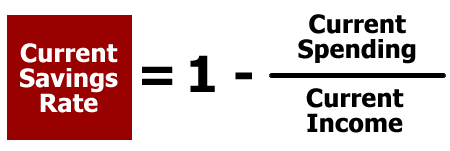
Do you know what your household’s savings rate is? Most of us probably have a rough guess, but I wanted to use some more reliable data. Here’s the definition again for my purposes:

Current Spending

There are plenty of ways of tracking your expenditures, as anyone who has tried to follow a monthly budget has found out:

  • Handwritten expense lists
  • Excel or other spreadsheets
  • Online budgeting tools
  • PDA/Smartphone input tools
  • Automated account aggregation tools

I’ve tried various methods to track my expenses manually, but never had the commitment to follow through for more than a month or two at a time. I track all of my numerous financial accounts using account aggregation site Yodlee, but since August 2009 I have linked my primary checking accounts and the few often-used credit cards at the similar-but-nicer Mint.com.

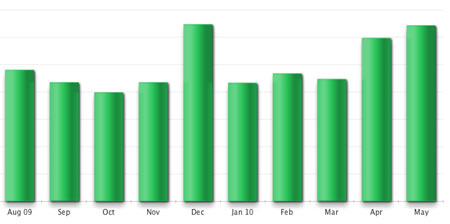
It took a lot of manually categorizing individual transactions, but now it takes less than 10 minutes every couple of weeks at Mint to correct the few new stores I visit (mostly small restaurants). This means I almost have an entire year of spending data from August 2009 to May 2010:

As you can see, there was a general trend, but a few months had major spikes. December had holiday gifts, some travel, and end-of-year charitable giving. In April, we bought a new high-efficiency washer/dryer and had some home electrical-repair bills. In May, we bought our plane tickets and hotel accommodations for a trip to Peru. The lesson here is that there are always going to be these spikes, and it’s best to be prepared and account for them. Our actual average spending ended up being higher than I would have guessed. The monthly fluctuations ranged from 20% below average in October to 30% above average in December.

Current Income

We are a dual-income couple with no kids currently. Our “big-picture budget” is to be able to live off the lesser of our two incomes. We each make relatively good money, so we have been lucky to be able to do this for a few years now. On a practical basis, we do this by having one primary joint checking account in which we only direct deposit that one paycheck. All bills are paid out of this account. This way it psychologically easier to “live within the means” of that single paycheck as the balance goes up and down.

Current Savings Rate

I don’t reveal actual income numbers, so it’s easier to share the savings rate. I am using after-tax income because I feel it is more applicable. According to the above data, on average we spend 84% of the single after-tax paycheck each year, giving us a saving rate of 16%. This is helpful to know we have a buffer if one of us were to lose our jobs. (We also max out the pre-tax 401k plan employee contributions at our jobs, so the single paycheck is already reduce a bit.) When both of our incomes are included, our saving rate is over 60%.

You may consider this low or high, but in terms of early retirement for most people you’ll need to put away a lot more than the 10 to 15% recommended by some experts. I like the idea of both spending a year’s worth of income and saving a year’s worth of income, although this will not be realistic for everyone.

National Personal Savings Rate Definitions: NIPA vs. FoFA

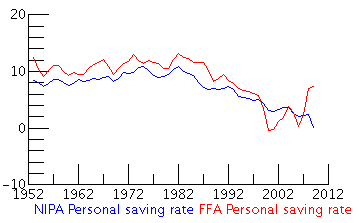
In looking up some stats for personal savings rates, I found that the Bureau of Economic Analysis (BEA) provides a chart of two separate calculations that track the personal savings rates of US taxpayers:

  1. The National Income and Product Accounts (NIPAs) method, and
  2. The Flow of Funds Accounts (FFAs) method

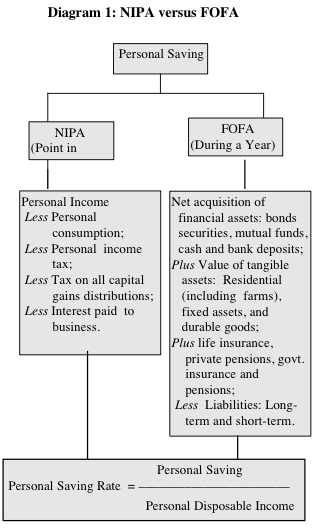
You may find either of these quoted in mainstream media articles whenever there is a big shift or one goes negative temporarily. Both methods have been criticized for the accuracy, in which I won’t go into detail here. The main differences between the NIPA and FoFA methods are outlined in this chart from the AARP paper [pdf] “The Declining Personal Saving Rate: Is There Cause for Alarm?”:

A few things to note:

  • When I read “disposable income”, I normally think of what’s left over after paying for food and shelter. In this case, disposable income is just personal income minus “personal contributions to social insurance and personal taxes”.
  • Both NIPA and FoFA exclude capital gains on investments, which some say contributes to a “wealth effect” where people will spend more because they feel richer due to growth of investments. (not as much recently…)
  • From the chart, FoFA includes the purchase of new assets and investments as personal savings. NIPA includes employee 401(k) and pension contributions as wage income.
  • FoFA treats the purchase of consumer durables (cars, major appliances) as a form of savings, while NIPA treats it as consumption.
  • NIPA says that paying your mortgage (owner-occupied housing) is savings as imputed rent, while FoFA counts your added home equity as an asset, but your mortgage payment as a liability.

Confused yet? Well, I hope at least you came away with something. The AARP paper goes on to explore various theories for the long-term decline of the personal savings rate. If you’re looking for more, here’s another paper that explores the differences.

Beyond Net Worth: Tracking Financial Progress Better

For a while now, I’ve been thinking about a better way to publicly track my progress towards financial freedom and also allow easier comparisons between readers. I’m sure some people would miss the net worth updates, but I have reached the point where our net worth fluctuates mainly with stock market valuations and not due to actual improvements to income or savings rates.

First, I started to brainstorm the required data needed for such tracking, each of which I can address in a future post. Once we collect these numbers, I can then put out some numbers and ratios that could be better indicators than plain net worth. Heck, a portfolio of a million dollars is nothing if you plan on spending $100k a year, but if you only spend $40k a year and have a small pension, you could be all set.

  1. Current Monthly Income (After-Tax)
    How much money are you taking in right now? For those with variable paychecks, it would probably be best to average this out over the trailing 12-months or 6-months.
  2. Current Monthly Spending Rate
    How much are you spending? This should also be averaged out over at least 6 months, in order to capture all those irregular bills like my semi-annual car insurance bill, as well as those unexpected expenses that always pop up. For example, in the last few months alone we have had an $1,000 electrician bill and a $500 auto repair tab.
  3. Current Portfolio Size
    How big is your current investment nest egg? If you include your house, then you’ll need to include the cost of renting in your future spending.
  4. Future Spending Rate
    What is your “burn rate” going to be in retirement or semi-retirement? Many online calculators simply assume this is 85% to 100% of your current monthly spending. This can be too generic. For example, in less than 20 years, I plan to have my house paid off. My mortgage is more than 50% of my current expenses! Other items like health insurance premiums will be harder to predict.
  5. Investment Return
    There are many smart folks making educated guesses about future market returns based on both looking backwards and forward. Based on your chosen asset allocation, one can at least attempt a rough estimate of future after-inflation returns. We can’t rely on these numbers, but it’s a good beginning.
  6. Safe Withdrawal Rate / Retirement Income Rate
    How will you create your income during retirement? If it’s going to be from selling stocks or bonds, you’ll have to decide on how much is okay to withdraw each year so that you don’t run out. Will you draw a fixed percentage each year? Adjust annually for inflation? Adjust annually for market returns?

    What if you are planning to live off dividends or bond income? What if these fluctuate? If you have a pension or annuity, how will this fixed income change how you draw down other assets?

Potential Indicators

A simple example would be calculating your personal savings rate, which would be independent of market fluctuations for most people:

Multiply by 100 for a percentage. Hopefully this isn’t negative! Another good ratio might be your portfolio multiplier factor, which tracks how big your portfolio is relative to your planned future spending.

Depending on who you talk to, a Portfolio Size Factor of 25 to 35 might be desirable if you are withdrawing money from a portfolio of 60% stocks and 40% bonds. Adjustments should be made for pre-tax vs. post-tax accounts.

I could post these and other monthly indicators each month, instead of net worth. What do you think? Any other numbers that I’m missing?

Tracking Inflation: Consumer Price Index Explained – Infographic

The U.S. government tracks inflation in many ways, and one popular way is the Consumer Price Index (CPI). This index is then used to adjust everything from income tax brackets to Roth IRA contributions limits to pension payouts to the return on inflation-linked bonds (TIPS). There are then sub-indices for different groups and regions.

Each month, the Bureau of Labor Statistics gathers 84,000 prices in about 200 categories — like gasoline, bananas, dresses and garbage collection — to form the Consumer Price Index, one measure of inflation. […] The categories are weighted according to an estimate of what the average American spends, as shown below.

The NY Times put together a nice interactive infographic that helps explain the ingredients of the CPI and their relative importance:

You can hover your mouse, and zoom in/out as you like. Does it match your personal spending and inflation rates? Probably not, so it’s good to note the differences. For instance, actual housing prices are not included in the CPI, but instead “owner’s equivalent rent” (24% of CPI) is tracked which is defined as what homeowner’s would pay to rent their home. And once I get my mortgage paid off, I’ll be more worried about other things like health insurance (only 6% of CPI).

Link via the Betterment Blog (Betterment review upcoming).