Should I Contribute To A Non-Deductible IRA, Part 2: Better Than Regular Taxable Account?

Continued from Part 1: Future Roth IRA Rollover. Now we’ll consider what happens if we don’t convert to a Roth.

To recap, an non-deductible IRA everything is the same as a Traditional IRA except that the initial contribution is not tax-deductible. This means that it grows tax free, but all earnings (dividends + capital gains) are taxed as ordinary income upon withdrawal. The original contribution isn’t taxed again.

This is in contrast to regular taxable account, where you can defer taxes on capital gains until you sell. Currently, if you hold stocks or bonds for at least a year before selling, you’ll be taxed at the long-term capital gains (LTCG) rate of 15% or less. Qualified dividends are taxed when received, but are also currently taxed 15% or less. Non-qualified dividends such as from bonds or REITs are taxed as ordinary income.

So which one’s better? I decided to run a few sample scenarios to find out. Here is the IRA scenario spreadsheet I used, which you can play with as well. I’ll be assuming that current tax rules stay the same when you withdraw, which is almost guaranteed not to be the case, but hopefully we’ll get something out of it.

Assumptions
Initial Balance: $4,000 after-tax
Ordinary income tax rate: 25%
Dividend tax rate: 15%
Time Horizon: Lump-sum withdrawal after 30 years

Scenario #1: Buy-and-Hold With Stock Index Funds
Let’s say you invest in an S&P 500 index fund, with very low turnover. You buy and hold until withdrawal. Total annual return is 8%, with 2% being in dividends each year. With a non-deductible IRA, it keeps growing as gets taxed at the end. After 30 years, you’ll end up with $31,188.

With a taxable account, you’ll get taxed 15% on those dividends every year, but the rest is accumulated as long-term capital gains. Upon selling it and paying 15% on those gains, you end up with $32,834. Taxable wins by $1,646 (5%).

If you lower the ordinary tax rate to 15%, then the non-deductible IRA wins by $1,979 ($34,813 vs. $32,834). If you raise your ordinary tax rate to 30%, then the taxable account wins loses by $3459 ($29,375 vs. $32,834). In general, taxable wins out when your tax rate at withdrawal is about 21%.

altext

Scenario #2: Active Trading With Stocks or Stock Funds
Now if you have lots of buying and selling in your portfolio, then you’ll be subject to short-term capital gains every year. Here, if you assume 100% turnover (holding stocks for just under a year) and you still earn 8% annually, taxable will never win regardless of ordinary tax rates. Even at 9% return in taxable vs. 8% return in IRA. The yearly drag of taxes kills your returns, so you should probably seek the shelter of a IRA if you plan on investing in moderate-to-high turnover funds.

Scenario #3: Buy-and-Hold With Bonds or REIT Funds
Holding a bond fund or REIT (real estate) fund is actually similar to Scenario #2, because most of the earnings from bonds and REITs are due to their interest yield or dividend distributions, and those are taxed at the higher ordinary income rates.

Let’s say you have an REIT fund that also gains 8% annually, and 100% of it’s gains are in the form of unqualified dividends. (REITs have a historical average yield of about 6-8%)

At 25% income tax rates, the taxable account just can’t keep up with an final value of $22,974 vs. $31,188 from the non-deductible IRA. That’s a 35% increase in value by going with the IRA. As income tax rate rises, the IRA’s advantage increases. A similar result occurs for bonds, although the difference is smaller due to lower expected returns.

altext

Liquidity or Early Withdrawal Concerns
A significant advantage of taxable accounts is that you can choose to access, or not access, the funds at any time. With an IRA, with a few exceptions you have to wait until age 59.5 to make a withdrawal without penalties. In addition, you’ll be required to make minimum distributions starting at age 70.5 even if you don’t need to. Some early retirees or those that want to leave a legacy might want to just stick with a taxable account.

Summary
Again, all of these are based on guesses as to what future tax laws will be, but for now my very general summary is:

  • IRAs have less liquidity and more restrictions in general. So if the expected net returns are equal, I’d pick the taxable account.
  • For low-turnover stock portfolios and index funds, the non-deductible IRA might lose out to a taxable account, but not by all that much. As your trading frequency increases, the taxable account gets less and less attractive. On the flip side, a tax-managed mutual fund might make things sway back in favor of the taxable.
  • If you plan on holding any significant amount of REITs, bonds, or other tax-inefficient investments, then a non-deductible IRA can have significant tax advantages over holding them in a taxable account.

Since I do have holdings of bonds and REITs in my portfolio and need all the tax-deferred space I can get, it looks like I’ll be contributing to a non-deductible IRA before the April 15th deadline.

Should I Contribute To A Non-Deductible IRA? Part 1: Future Roth IRA Rollover

As we’ve seen, after you reach a certain income, both Roth IRAs and tax-deductible contributions to Traditional IRAs are no longer available. After you max out your 401(k) or 403(b) plan at $15,500 per year, you start running out of tax-advantaged accounts quickly. One option is to contribute to a Traditional IRA anyways, even though the contribution will not be tax-deductible. Everything else is the same: your money will still grow tax-free, and withdrawals will be taxed at your ordinary income tax rate. You can sock away $4,000 for 2007 and $5,000 for 2008. So should you do it? I have less than three weeks before I need to decide!

There appear to be two primary ways to answer this question:

  1. Future Roth Rollover. In 2010, there will no longer be any income restrictions for Traditional-to-Roth IRA rollovers. Could this mean Roth IRAs for everyone?
  2. Compare Returns vs. Taxable Account. If you either can’t or don’t wish to convert to a Roth, will your performance at least be better than a regular taxable account?

Future Roth IRA Rollover

According to current laws, in 2010 the income restriction for Traditional-to-Roth IRA rollover will disappear. Since you’ve already paid taxes on your non-deductible IRA contributions, you will only have to pay income tax on the earning portion when you rollover. This can be seen as effectively allowing you a way to contribute to a Roth IRA down the road. Now, instead of having to pay ordinary taxes upon withdrawal, I don’t have to pay any taxes! I even avoid required minimum distributions.

Catch #1: The Law May Change
I have seen no indication that this Roth “back door” was intentional. Some people see this as simply an oversight that a busy (or lazy) Congress simply hasn’t gotten around to changing… yet. For example, the current low 15% long-term capital gains rate is also scheduled to go up in 2011. Others think that the lure of tax revenue now gained through Roth conversions might be appealing and they’ll let it stay. Now I’ve waited until the last minute to make my decision and it’s almost mid-2008, and nothing has changed, so maybe it’ll happen…

Catch #2: Mixing Deductible and Non-Deductible Contributions
Let’s say you have $10,000 in a Traditional IRA, $4,000 of which was a non-deductible contribution, and $6,000 of which was deductible contributions and earnings within the IRA. If you wanted to convert $4,000 of it over to a Roth IRA, you can’t simply pick out the non-deductible contribution. The $4,000 would be pro-rated to be 40% non-taxable and 60% taxable, in the same proportions as your total IRA.
The only way to convert all of your non-deductible contributions would be to convert everything together, which might not be ideal.

One way around this is to first roll over your deductible IRA money into another qualified retirement plan like your 401(k) if they allow such transfers (and you like your investment options). Then make your non-deductible IRA contribution. That way, the deductible and non-deductible parts can be separated. I don’t have any deductible IRA funds, but I think I could rollover into my Solo 401(k) if desired.

Catch #3: More Paperwork
If you make non-deductible contributions, conversions, or withdrawals you must document them each year using with IRS Form 8606. It’s probably a good idea to simply file the form every year so that you don’t end up forgetting and having to pay extra taxes later.

In general, I think the Roth conversion option is great if it’s available, but I am still not convinced it will still be around in 2010. So I’d better make sure that’s a non-deductible IRA is still a decent deal even without that option. To be continued in Part 2…

2008 Roth/Traditional IRA Phase-Out Limits For High Income Earners

For those people with increasing incomes, you may be wondering when either Roth IRAs and tax-deductible contributions to Traditional IRAs start being taken away from you. Here are the phase-out numbers for the 2008 tax year:

Roth IRA Phase-Out Limits
Once you reach the bottom of these phase-out ranges for your modified adjusted gross income (MAGI), your contribution limit of $5,000 starts getting reduced. At the top of the range, you can no longer contribute at all.

Tax Filing Status Phase-Out Range
Married filing jointly or qualifying widow(er) $159,000 to $169,000
Single, head of household $101,000 to $116,000
Married filing separately (and you lived with your spouse at any time during the year) $0 to $10,000

Traditional IRA Deductibility Phase-Out Limits
Once you reach the bottom of these phase-out ranges, your full deduction starts getting reduced. At the top of the range, you can no longer deduct taxes on any contributions at all. This table assumes that both you and your spouse are covered by an employer retirement plan.

Tax Filing Status Phase-Out Range
Married filing jointly or qualifying widow(er) $83,000 to $103,000
Single or head of household $52,000 to $62,000
Married filing separately $0 to $10,000

If you are single and are not covered by an employer retirement plan, or you’re married filing jointly and neither of you have a employer retirement plan, then there are no income limits for deductibility. If one spouse has a plan and the other does not, then the phase out range is $156,000 to $166,000.

Reference: See IRS Pub 590 for way too many details.

Test Driving The Financial Life You Want

Now that we have a fixed monthly mortgage payment for the foreseeable future, we are looking ahead to our true mid-term goal of living on one income. Specifically, we’d like to live on two half-incomes when we have children. We live in one of the most expensive areas in the country. Can we do it?

Both of our incomes are somewhat comparable, so our plan is to actually pretend that only one of us is working, deposit that person’s paycheck into a checking account, and work only from that checking account. The mortgage note, utilities, food, gas, all expenses will be deducted from that account. A reasonable percentage (15%? 20%?) for retirement will still be taken out. I have no idea what a child will cost, but maybe we’ll take out an extra $500 a month for food and diapers as well? The second person’s income will still be dealt with, but just separately.

This way, we will get as close as we can to simulating living on one income. If the checking account starts to shrink too fast, we’ll have to think of ways to cut expenses further. I think this is an interesting idea that could be applied to anyone who wants to stretch into a new financial goal. You may think you can do it, but failure might be costly.

  1. Buying a new home. Can you afford a mortgage payment that is significantly higher than your rent? You should be sure, otherwise you might be joining the million other people in foreclosure.
  2. Kickstarting your retirement contributions. Maybe you’re afraid of putting too much in a 401(k) or IRA and not being able to take it out. Why not just use savings account and stick your imagined contributions in there for a while? That way you won’t have to deal with penalties.
  3. Increasing your debt payments. Some people are afraid to pay off too much debt in case they need the money for later. An emergency fund would help solve this, but also the “pretend” debt account might be a good temporary solution.
  4. Going back to school, switching careers, etc. Again basically the same idea – how will you react to living on less income?

March 2008 Financial Status / Net Worth Update

Net Worth Chart March 2008

“Good” Credit Card Debt
If you’re a new reader, you may have some concerns about my high levels of credit card debt. I’m actually taking money from 0% APR balance transfer offers and instead of spending it, I am placing it in high-yield savings accounts that actually earn me 4% interest or more, and keeping the difference as profit! :D Along with other deals that I blog about, this helps me earn extra side income of thousands of dollars a year. Recently I put together a series of step-by-step posts on how I do this. Please check it out first if you have any questions. This is why, although I have the ability to pay the balances off, I choose not to.

Cash Savings, Home Purchase
If my posting has been a bit light lately, it has been because I’ve been bogged down by a combination of illness, travel, and the home-buying process. Also, I didn’t want to do it in real-time because there were some snags along the way… but we’ve finally closed!! I have lots of house-related posts coming about mortgages, inspections, and so on… but first here are a few details that will help explain this net worth update.

Purchase price $600,000
Down payment (20%) $120,000
Discount points paid (1%) $6,000
Buyer’s agent rebate (1.5%) $9,000
Closing Costs ~$3,000 (rest paid by lender)

Our purchase price of $600,000 was more than the $500,000 we estimated we wanted to spend a couple years ago, but we are now in a 4-bedroom single-family home that we can see ourselves living in forever. In addition, we didn’t stretch too far as we can handle the mortgage payment on either one of our incomes.

We believe we got a good deal even though the short-term market looks bad, and the house has tons of potential. We’re even going to rent out a room to a relative. Our home appraisal actually came in at $640,000 – we’ve been told an appraisal coming in higher than purchase price doesn’t happen very much in this scared housing market. Using this value would actually leave our home equity at $160,000 instead of just the down payment of $120,000. However, I’m just going to be conservative and leave it at $120,000 for now.

As you can see, our 50% buyer’s agent rebate helped offset our closing costs and the points on the loan. Of course, mentally we are using the $9,000 rebate towards all the home improvement projects we have brewing. 😉 Finally, adding back in the $5,000 earnest deposit that I had marked as spent last month makes the numbers look a lot better than they really were.

Emergency Fund?
Our net cash balances have taken a big hit to less than $10,000, and that makes me nervous given that our monthly expenses just shot up drastically. Our foreseeable mid-term goal will definitely need to be to build up a proper emergency fund, which we’ve never officially had since we basically treated our downpayment funds as such. Visiting Brazil and Australia will have to be placed on the backburners for now…

Retirement and Brokerage accounts
February is the fourth month is a row that our IRAs and 401k/403bs have dropped by 3%. We may need to start setting up some regular monthly investments in order to help force ourselves to keep investing.

It’s been a wild month! You can see our previous net worth updates here.

Rollover IRAs: Good Idea In General, But What About A Small 401k?

If you leave your job and have a 401k or 403b left behind, the common advice is to roll it over into a Rollover IRA. There are several benefits to doing so, but here are the biggies:

  1. You maintain the tax-deferred status of the investment. For a traditional 401k, you would still be subject to ordinary income tax upon withdrawal, but along the way it would continue to grow tax-free. If you took the money as a lump sum, you would be subject to both taxes and penalties right away (with specific exceptions).
  2. Increased flexibility in investments. Most 401k plans have relatively limited investment choices, but you can open up an IRA at a variety of places. You can the invest in individual stocks, different mutual funds, bonds, ETFs, annuities, or even just a bank certificate of deposit.
  3. Save money by paying less fees. Along the same vein, many 401ks contain mutual funds with relatively high expense ratios compared to what is available on the open market. Many would recommend switching to low-cost index funds.
  4. You can consolidate accounts. You can combine the Rollover IRA with your other IRAs of the same time (Roth or Traditional Pre-Tax). One less thing to manage.
  5. Estate Planning perks.With an IRA, you have the ability to create a “Stretch IRA”, where your child can inherit and IRA and have the distributions “stretched out” across their longer life expectancy. This allows for more time to tax-free growth.

But many of these perks get overshadowed when you have a small 401k balance. My wife has an old 401k with only $2,000 in it at Fidelity. She gets to choose from a variety of Fidelity funds, including their Spartan index funds with 0.10% expense ratios, all with no minimum investment requirements. In addition, I don’t believe she is being charged any sort of administrative fees. We haven’t rolled it over to an IRA because:

  • Lonely IRA. We have no Traditional-type IRAs to merge it with at this time. We’d just be left with a $2,000 IRA.
  • Flexibility? If we moved it to Vanguard with the rest of our IRAs, we would not meet the $3,000 minimum for most of the funds. The only fund we could buy would be the Vanguard STAR fund.
  • No money to be saved? At most brokers, paying a commission for every trade on only $2,000 would really eat into the balance. We could move it to Zecco, which has free trades but also a $30 annual IRA fee. We can do better staying put, although if our existing investment choices were worse, finding a low-cost brokerage and switching to buying ETFs might be an option.
  • Itty-bitty estate. Again for small balances, this isn’t much of a factor in my opinion. No kids, anyhow :)

We could also move it to her new 403b, but it also has less-than-ideal investment choices. For now, it seems like the best move is really to stay put at Fidelity until there is a better opportunity. However, I would agree that our situation is a relatively rare case.

Interim Asset Allocation: Existing Accounts, Fund Choices, and Implementation

Okay, so I’ve decided upon an asset allocation plan. Now for my least favorite part – juggling and cramming all those asset classes into several different accounts. First, I’ll list my existing accounts, their estimated current balances, and my flexibility in investment options.

Account Type Est. Value Fund Choices
Roth IRA #1 $46,000 Vanguard funds w/ no transaction fee (NTF)
Roth IRA #2 $13,000 All Vanguard funds
Traditional 401k #1 $23,000 All Fidelity funds+ ETFs w/ $20 commission
Traditional 403b #2 $14,500 Limited low-cost fund choices (S&P 500 index fund, DODGX)
Traditional 401k #3 (old job) $2,000 Select Fidelity funds
Total Value $98,500

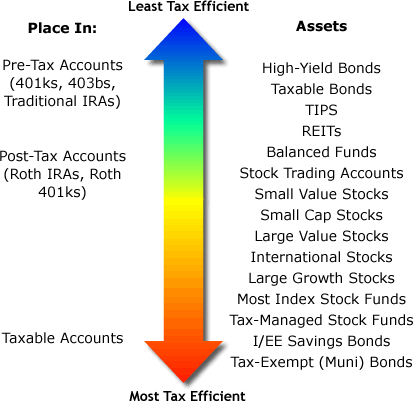
So I’ve got 7 asset classes to fit in 5 accounts. Below is a chart that shows the major asset classes sorted by tax efficiency:

Chart of Relative Tax Efficiency of Assets
(See my post on Tax Efficient Mutual Fund Placement For Maximum Return for sources and more information.)

Next, I combine my chosen 86% stocks/14% bonds with my asset allocation to find the breakdown below:

Asset Class Percentage of Total Portfolio Est. Value
Short-Term Treasury Bonds 7% $7,000
TIPS 7% $7,000
Real Estate 8.6% $8,500
US Small Value 8.6% $8,500
Emerging Markets 8.6% $8,500
International Large 25.8% $25,500
US Large 34.4% $34,000
Totals 100% $99,000

For example, with 40% of all stocks as US Large, I get 40% x 86% = 34.4% US Large over my entire portfolio. You might notice that I also sorted them in the tax-efficient order given above.

But in this case, I also need to consider the availability of low-cost index funds as well as placement, especially since all my money is already in tax-deferred accounts. My Roth IRAs are all with Vanguard with a wide variety of index choices, but my Traditional 401ks are limited to a few select index funds. After spending some time with a pencil, paper, and good eraser, here is the compromise I have worked out:

Roth IRA #1
$7,000 Vanguard Short-Term Treasury Fund (VFISX)
$3,000 Vanguard REIT Index Fund (VGSIX)
$8,500 Vanguard Small-Cap Value Index Fund (VISVX)
$8,500 Vanguard Emerging Markets Stock Index Fund (VEIEX)
$19,000 Vanguard Total Stock Market Index Fund (VTSMX)

Roth IRA #2
$7,000 Vanguard Inflation-Protected Securities Fund (VIPSX)
$6,000 Vanguard REIT Index Fund (VGSIX)

Traditional 401k #1
$23,000 Fidelity Spartan International Index Fund (FSIIX)

Traditional 403b #2
$14,500 Diversified [S&P 500 Index] Fund (DISFX)

Traditional 401k #3 (old job)
$1,000 Fidelity Spartan Total Market Index Fund (FSTMX)
$1,000 Fidelity Spartan International Index Fund (FSIIX)

On additional reason for this particular set up is to accommodate future growth. As the year progresses, I can continue to buy more shares of the largest asset classes (FSIIX and DISFX) in our 401ks. To retain the target asset allocation if things get out of whack, I can sell VTSMX in my Roth IRA and buy other funds as needed, with only a $3,000 minimum for most funds. I avoid any other low-balance fees at Vanguard by choosing electronic delivery of statements. In the future, I may switch my IRAs to an brokerage account to simply buy ETFs, but I don’t think that is necessary quite yet. I like the current simplicity and good service.

(By the way, I have such large Roth IRA balances because I did a Traditional-to-Roth conversion while our tax brackets were lower than they are now.)

Interim Asset Allocation: History, Decision, and Changes

Over the last year or so, I’ve learned a lot of new things about investing and asset allocation. At the same time, I know that changing your asset allocation too frequently is often a response to recent market activity (aka performance chasing, or market timing). In addition, I’m a highly analytical person and I love for things to have a correct answer to 5 significant figures before committing… which is pretty much impossible here. But at some point I know I just need to take action if I truly believe it is an improvement.

Previous Asset Allocation
In April 2006, I moved from the all-in-one Vanguard Target Retirement 2045 Fund (VTIVX) to a portfolio with more asset classes in an attempt to better optimize risk/reward factors based on historical data. You can see the asset allocation breakdown here. This asset allocation is pretty much what I have right now, except that I added a Micro-Cap stock fund and we moved money into a 401k with limited investment options.

Interim Asset Allocation

altext

I’m still continuing my series on building my portfolio, so I won’t explain all my actions here, but here are some quick summaries:

  1. Stocks/bonds allocation. I am shifting to a age-based formula for my stocks percentage. Using 115 minus my age, I am at 86% stocks and 14% bonds.
  2. Domestic/international allocation. I am increasing my international allocation to better match the world market. It’s essentially 50/50 if you think REITs are a separate asset class.
  3. Small/Value/Emerging Markets. These sub-classes are riskier than their overall market, but have been shown to have diversification benefits. Even if they don’t in the future, I am okay with them simply being more risky along with higher returns. Essentially, I am taking the total markets, and increasing the portion of one additional asset class which I think has the highest diversification benefits. For example, Small Value is a subset of Total US market, and Emerging Markets is a subset of the Total International market.
  4. Real Estate. I’m still holding REITs, as they are a way to invest in commercial real estate, and have also been shown to provide diversification benefits. Will give more references later.
  5. Micro-Cap, International Value, and Large Value. I think all of these potentially good asset classes to hold, but I think they are of lesser overall importance than the others. So in an effort to simplify, I am dropping them as separate funds. I still continue to have exposure the asset classes within other funds.
  6. New Bonds Allocation. I’ve been meaning to this for a while. I’ve been holding an intermediate-term corporate bond fund because it used to have a lower expense ratio after various fees. Inflation-protected bonds are still pretty new, but I’ve been convinced of their utility. I’ve also been convinced that bond ratings agencies just aren’t that good at their jobs, so I’m sticking with the highest quality bonds (Treasuries). The book Unconventional Success was a big influence here.

I call this my interim asset allocation because while I’m very confident this new setup fits my needs and preferences better than my previous asset allocation, I know that I will continue to learn and read. But just like with football coaches, this interim asset allocation might just become my permanent one.

In addition to all the books that I have read (and am still reading), I’d also like to say thanks to the many smart and helpful folks over at the Diehards.org forums for all the indirect and direct help. (I post anonymously at both forums.) Even though they sometimes feed my tendency towards complexity, I love the wealth of information that is available.

Rebuilding My Investment Portfolio: Index Of Posts So Far

I am a proponent and investor in low-cost, passive-managed mutual funds, but even within that philosophy there can be a dizzying array of choices. Although this has been taking a lot longer than I had hoped, but here is an updated compilation of posts about my thought process when re-building my portfolio.

Section 1: Simplified Theoretical Stuff

  1. Disclaimer and General Philosophy
  2. Consider Simply Buying The Entire Market
  3. Efficient Frontier and Modern Portfolio Theory

Section 2: Choosing An Asset Allocation

  1. Deciding On The Stocks/Bonds Ratio
  2. Deciding On The Domestic/International Ratio
  3. Considering The Diversification Benefits Of Small and Value Stocks
  4. Equity Asset Allocation: Comparison of 8 Model Portfolios

Investment Portfolio: 2007 Year-End Holdings And Performance Update

12/07 Portfolio Breakdown
 
Retirement Portfolio
Fund $ %
FSTMX – Total Stock Market (~Large) $24,006 23%
DISFX – S&P 500 Index Fund (Large) $7,437 7%
VIVAX – Vanguard Value Index (Lg Value) $13,782 13%
DODGX – Dodge & Cox (Lg Value) $13,782 5%
VISVX – V. Small-Cap Value Index $12,725 12%
VGSIX – V. REIT Index $7,637 7%
VTRIX – V. International Value $8,851 13%
VEIEX – V. Emerging Markets Stock Index $10,622 10%
VFICX – V. Int-Term Investment-Grade Bond $8,037 8%
PTRAX – PIMCO Total Return (Interm. Bond) $2,393 2%
Cash (to be invested) $3,000 3%
Total $105,323

Recent Transactions
In the last quarter of the year, we ended up putting in the maximum $15,500 salary deferral in both of our 401k/403b’s. I had already put in $12,500 already in my Solo 401k, so I sent in a last-minute check for $3,000. For my wife’s 401k, it was done in big salary deferrals in October, November, and December. We were lucky that the company allows almost 100% salary deferrals.

Summary and Performance
My last portfolio update was back in September, but I figured with the end of 2007 it was definitely time for an update. It was a late decision to go ahead and contribute a lot to our tax-deferred accounts and taking away a bit from our cash hoard, so I was more concerned with getting them in on time than what I was actually investing in. Lots of changes to come soon, so I’m just posting a snapshot of what we have for now.

I did go back and track the cash inflows, and calculated our time-weighted rate of return, which ended up being 2.49% annualized for 2007. For a very rough comparison, the S&P 500 via Vanguard 500 (VFINX) returned 6.13% YTD. Part of this low performance was just due to timing, as the latter half of 2007 was a lot worse than the 1st half, and that was when we invested a lot more money. (Remember, this is the exact performance of our money, not just the averaged returns of all the funds we hold.) In 2006, our portfolio return was calculated at 24.9%. How did you do in 2007?

What If You Had To Live Solely Off Of Social Security?

A lot of us younger folks are so disillusioned by our government that we don’t expect Social Security to even be around when we turn 65 (or likely 75 by that time…). But the fact is that today millions of people rely on Social Security as their primary – if not sole – source of income. Taking into account that the average benefit is only $963 a month, that’s not very much.

AARP asked retirees who rely primarily upon Social Security how the manage financially, and reprinted a selection of the responses. I enjoyed reading them, as they gave me a glimpse of what obstacles they face, and it showed many different ways they deal with them. Being on a fixed income and having a limited ability to make more money due to disability or illness would be very frustrating to me. Here are some excerpts, which I have organized by the major spending categories:

Housing

We built our own house on a lake stick by stick, or we wouldn?t have a house on a lake. It took us two years. Our son helped with the framing, and my son-in-law did the painting, but my husband did a fantastic job, only contracting out the roofing. [..] We planned ahead and paid off our house before retirement.

We put our home into a reverse mortgage several years ago, and I will realize very little if I sell. I have no children within 130 miles but can’t afford to sell because of the dwindling equity.

[I] live in a Section 8 apartment. In this area, a one-bedroom apartment is $700 to $1,300 per month. I cannot afford this and was lucky to get on Section 8. I must share the apartment with two roommates.

The largest portion of your income will be taken up with rent, utilities, phone, and maybe an auto (I had to get rid of mine), so be certain to apply for government-subsidized housing as soon as possible, as there is likely to be a lengthy waiting list. I waited 3 years! Previously, my rent alone was higher than the current total expense for rent, utilities, and phone.

Healthcare

[…] Our biggest expenses are the cost of our HMO, our Medicare and our medications. My $511 monthly pension pays for that. Our medications, although prescribed by HMO doctors, weren?t on the HMO?s formulary, so the cost wasn?t covered. Since we don?t live too far from Canada, we used to buy our most expensive medications through a Canadian clinic. However, now they will no longer serve Americans, so we did what others do on limited incomes?we just quit taking our two most expensive medications.

[Read more…]

What Are We Saving For, Anyways? Our Life Goals and Retirement Plans

I’ve talked about this in bit and pieces under the Goals category, but I thought I should organize our life goals into one post. Hopefully, this will outline our priorities and shed some light on why we choose to do the things we do.

First, I’d like offer what I am afraid people think our life goals are:

Incorrect Goals

  1. Find the highest paying job possible. Work long hours, but tolerate it for the money.
  2. Live a very spartan lifestyle, with minimal luxuries and worrying about money constantly.
  3. At age 65, abruptly stop working so hard, finally relax and begin enjoying our life. Hopefully live long enough to enjoy this period.

In fact, that’s not what we want at all:

Actual Goal #1 – Finding A Job That Fits
If your going to spend almost 50% of every weekday doing something, shouldn’t you enjoy it? Sure, even great jobs have their challenges – bureaucracy, boring meetings, office politics, the occasional annoying co-worker. But finding a job where you don’t dread getting out of bed in the morning was a huge priority for me. It took a few different degree programs, a couple of resignations, some stressful interviews, and several rejections, but we are definitely making progress in finding work that is challenging, enjoyable, and reasonably well-compensated.

I would also add that having a simple lifestyle initially allowed us to take some risks in order to get where we are now.

Actual Goal #2 – Less Work, More Life
[Read more…]