Equity Asset Allocation: Comparison of 8 Model Portfolios

I’m still planning on reshaping my investments and continuing my choosing an asset allocation series, but Thanksgiving and work has thrown me off a bit.

To skip ahead a bit, here are several sample asset allocations from various sources for the equity (stock) side of your portfolio. I thought it would be helpful to see them all side by side and compare how different authorities might split things differently between domestic and international stocks, how they deviate from the “total” market indexes, and whether they choose to incorporate additional asset classes like real estate or commodities.

For more information about any specific portfolio and the source, just click on the pie chart.

altextaltext

altextaltext

[Read more…]

Will Retiring Early Help You Live Longer?

There are lots of reasons to retire early, but will it help you live longer as well? One study seems to suggest so, and is often cited in websites discussing early retirement. Dr. Sing Lin wrote a paper in 2002 called Optimum Strategies for Creativity and Longevity which studied the relationship between the age of retirement and the average of death for retirees of Boeing Aerospace. The results are startling:

altext

As the retirement age increases, the average age of death decreases almost linearly. The average person who worked until age 65 lived for only 18 months after retirement! In contrast, the person retiring at 50 lived for another 36 years.

There is some dispute as to the validity of this data, but I haven’t found anything solid either way. The author does make some very bold conclusions, though:
[Read more…]

Investment Gift Idea For Children: A Roth IRA?

A few very forward-thinking readers have asked me about ways to help their kids or other young folks by giving them a Roth IRA. This seems like an awesome idea to grab them some tax-sheltered action. I’ve thought about this in passing, but never really did the research into the technicalities of it. One good article on this subject is over at Fairmark called Roth IRAs for Minors. Combine this with official IRS publications and a few magazine articles about employing your children, and here’s what I found:

The Facts

  • There is no age requirement to open an IRA.
  • Many, but not all, IRA providers will allow you to setup an IRA account for minors.
  • The primary requirement is the child needs to have taxable earned income to make a contribution. So to make a $4,000 contribution, they would need $4,000 of income. Earned income means that dividend or interest payments don’t count.
  • An important difference between IRAs and 529s is that once the child reaches 18 or so, they get complete control over the money and can do whatever they want with it.

The Payoff
How much money are we talking about? Umm.. a lot! From the Kiplinger article:

Let’s assume you give your 15-year-old daughter $1,000 to fund a Roth IRA. If the money inside the account grows at an annual average rate of 8% — well below the long-term average return for stocks — that $1,000 will grow to about $47,000 over the 50 years it takes for today’s teen to reach retirement age. If you added another $1,000 a year until she turned 20 -? and never added another dime — that initial $5,000 investment would be worth nearly $250,000 by her 65th birthday. With a Roth IRA, the full amount will be tax-free when it’s withdrawn in retirement.

Now the question is how to obtain that taxable earned income?

Income From Non-Parental Employer
This is probably the most legitimate and straightforward way, also the hardest to get. Examples for small children might be acting or modeling from an agency not directly owned by the parents. For teens this could include money from tutoring, bagging groceries, or working at the movie theater. In addition, this income may be subject to payroll taxes like Medicare and Social Security Tax at 7.65%.

Income From Parents As Employer
Maybe you already run your own business, and could use the services of a child – web design? computer set-up or consulting? From the Fairmark article:
[Read more…]

Choosing An Asset Allocation, Step 3: Considering The Diversification Benefit Of Small and Value Stocks

So far we’ve looked into the stock/bond ratio and the domestic/international ratio. Instead of taking these total stock markets as whole, you can further subdivide them into “styles” or additional asset classes. Although these vary in specific definition, in the general layout is shown by the Morningstar style box shown to the top right.

Value vs. Growth Stocks
Value stocks are those that tend to trade at a lower price relative to objective measures like dividend yield, earnings, sales, or book value. For example, you could screen by low P/E ratio. To generalize, value stocks tend to have low growth prospects or are in unglamorous industries. On the other side are growth stocks, which have high relative valuations. Again to generalize, these companies tend to have big growth expectations like Google or Apple.

If you look across long periods of history, it actually turns out that value stocks outperform growth stocks as a whole. People use different ways to explain this phenomenon. One camp says that value stocks are riskier because they are more likely to fail due to poor prospects, so obviously they should have higher return. Others use a behavioral view, saying that since they are “boring” or “ugly” stocks then they tend to be undervalued by investors in general.

Either way, including value stocks as part of a portfolio has also historically provided a diversification benefit, as can be shown by this graph from the excellent book All About Asset Allocation:
[Read more…]

Choosing An Asset Allocation, Step 2: Deciding On The Domestic/International Ratio

I don’t know if this is the proper next step, but after deciding on a stock/bond ratio for myself, I want to think about the specific breakdown of stocks (equity). As mentioned when talking about investing in total markets, you could simply “own the world” using just two funds or ETFs and weighting them according to market capitalization – using one Total US fund and one All-World Except-US fund:

altext

If you use the ETFs, the total weighted expense ratio would be a mere 0.17% annually!

Concerns About Investing Abroad
However, according to various surveys the average US investor has much less than 55% of their equity portfolio in international stocks. Here are a few reasons that have been cited:

  • Country/political risk – This includes the possibility that the economy of certain countries could collapse due to war or other internal strife. Also many governments have less oversight and transparency than the US and other developed countries.
  • Currency risk – These days it seems like people want to hedge against a falling dollar, but only recently people were worried about a strengthening dollar affecting international investments. Either way, it does add an element of risk.
  • Added cost – Investing in international mutual funds usually cost more in management fees.
  • Existing exposure – Some statistics show that a very large chunk of revenue from US-based companies now come from outside our borders, so even without adding international companies we are already being exposed to many of the same effects. This also explains the recently increasing correlation between domestic and international stocks.
  • Performance-chasing – Recently international funds have been on a very good run. Some believe this is the main factor in increasing foreign exposures, as opposed to fundamental factors.

Historical Risk/Reward Relationship – Benefits of Diversification
On a very general level, the reason to invest in international stocks as it pertains to Modern Portfolio Theory is that you get a diversification benefit. Historically, international stocks in general have had higher average returns, but also higher risk (volatility). But due to low-ish correlation, mixing domestic and international stocks has resulted in less risk and greater return.
[Read more…]

Choosing An Asset Allocation, Step 1: Deciding On The Stocks/Bonds Ratio

Last time I did a really simplified overview of Modern Portfolio Theory. Much of the credit for this is due to a fellow name Harry Markowitz, who figured out that if you combine two assets with the same return that aren’t perfectly correlated, this diversification can result in reduced risk without reducing return. Even if you don’t combine two assets with the same return, combining two assets that have low correlations (don’t move together) will get you a better reward/risk ratio. Markowitz later won a Nobel Prize for his work in this area.

Stocks vs. Bonds
Studies have shown that somewhere between 77% and 94% of the variability in portfolio returns are determined by asset allocation. So our goal is to use asset classes with low correlation to get the best reward/risk ratio. One of the most popular examples of assets that have low correlation is stocks and bonds. Accordingly, adjusting your ratio between stocks and bonds is one of the most basic ways to adjust the amount of risk you wish to take in a portfolio.

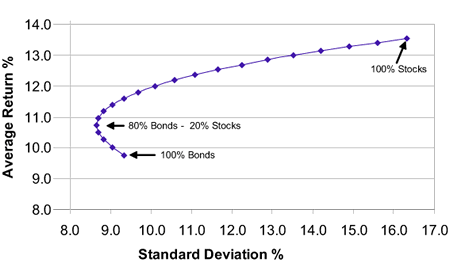
The chart below shows the risk/return trade-off between bonds and stocks for 1980-2004. The stock portfolio is represented by the S&P 500 index, while the bond portfolio contains 60% five-year Treasury notes and 40% long-term Treasury bonds. The portfolios range from 100% bonds, to 95% bonds/5% stocks, 90% bonds/10% stocks, all the way to 100% stocks. (via this AAII article)

altext

[Read more…]

Building My Portfolio: Efficient Frontier and Modern Portfolio Theory

Building upon the idea of investing in broad markets, next up is Modern Portfolio Theory. This is another advanced topic that entire careers can be built around, but here is my attempt to explain it in one quick digestible chunk.

Risk vs. Reward
As far as investing goes, the most basic component we have is cash. If we invest it in a Treasury bill from the government (as riskless as possible), then we will end up with a return after inflation of zero. You just keep up with inflation. No risk, no reward. In order to increase our reward we, must take on more risk. But it’s not a linear relationship. We want to find the mix of investments that offer the best mix of risk and reward. So again we turn to history and whip up some math. (I’ll go easy on the numbers here.)

Reward = Return
The idea of reward is usually represented by the historical average annual return of the investment. Sounds good to me.

Risk = Standard Deviation
The idea of risk has many possible definitions. Stocks are seen as riskier as bonds, because their prices have historically fluctuated much more wildly. For example, for domestic stocks, your best year would be +39% while your worst year would be -28%. In contrast, for a broad bond portfolio, your best year would have been +31% while your worst year would be -8%. (Source: Vanguard) A mathematical way to measure this volatility is standard deviation. The larger the standard deviation, the higher the risk.

Mix ‘Em Up
An asset class is a group of investments that exhibit similar characteristics. If we plot their historical returns vs. historical standard deviations, we might get something like this:

altext

One dot might be the S&P 500. Another dot might be 1-Year Treasury Bonds. Now, what if we starting mixing them up into in various ratios. Like taking 50% S&P 500, 25% US Small Cap, and 25% 5-Year Treasury Bonds. We’ll get a whole lot more dots, err… data points:
[Read more…]

Building My Portfolio: Disclaimer and General Philosophy

I am starting a new series of posts that describes how I will reconstruct my current investment portfolio from scratch, from general theory to the actual purchasing of specific mutual funds. Here I want to reiterate the point of this blog – This is how I am thinking of investing my money, not necessarily how I think you should do it. In other words, I don’t claim to be an expert, I just think sharing is fun and hopefully there will be a good debate and overall knowledge will be increased. You don’t really often get to see someone juggling a real portfolio across a multiple Roth IRAs, 403bs, 401k, and taxable accounts. It will also keep me organized and motivated as I’m been putting this off 🙂

General Philosophy
Here are some quick insights into how I approach investing. You’ve all read this ominous phrase before:

Past Performance Does Not Guarantee Future Results

Well, you know what? All we have is past performance. The important thing is to look back at all the data available, and try to extract useful information that has the greatest chance of persisting into the future. This won’t be easy, and there will be eternal debate as to how where we draw the line between “likely to persist” and “unlikely to persist”.

Based on this life expectancy chart, if I’m lucky I’ll have another 50 years of investing ahead of me. However, much of the data I read about in studies only dates back no further than 1975. Even the really far-reaching ones only date back to 1926. So I’m supposed to use at best 80 (and often only 25) years of data and extrapolate that out for another 50 years? That doesn’t seem like a huge mountain of evidence, especially considering events like World War II which had huge consequences and occurred only 50 years ago. Wouldn’t it be nice to have something like 800 years of investment data to make decisions upon?

As a result, I will try to keep my portfolio simple and stick to things that I believe are the most reliable, including supporting articles and data. Most of this will come from my readings of books and various studies.

Read more: Index of Posts On Building My Portfolio

What Percentage of My Income Should I Contribute To A 401k Plan?

Actually, a better question is what percentage of your income should you contribute to all types of retirement plans? But the 401(k) plan is one of those cases when you have to choose something to start out with, and many people just never get around to changing it again. Too much, and your cashflow will get tight and uncomfortable. Too little, and you’re not taking full advantage of the tax benefits.

Start With The Match
As everybody says, matching contributions from your employer will probably offer the best return-on-investment you’ll ever get. Most companies have a cap after which the match stops, and my guess is that most people contribute up to that cap and then forget about it. Certainly, this number provides a floor, but most of us will have to chip in some more to accumulate a happy nest egg. (I’ve never heard of a match above 6% of pay, although I’m sure some exist.)

Take Into Account Other Accounts Like Roth IRA
The reason people like Roth IRAs is that if you think your tax situation now will be about the same as in retirement, the Roth IRA has a lot of extra advantages like the ability to make early withdrawals for a variety of reasons, as well the ability to never make any withdrawals and leave it to your heirs still compounding away. However, if you have a Roth 401(k) the difference gets a lot slimmer, you may just go with which one offers you better investment choices. Either way, it’s good to consider the whole picture.

Mint.com allows you to compare different IRA accounts available online … if you want to see how your IRA stacks up against what’s available, you should check them out.

Taken all together, I would say 10% would be good place to start unless you have a pension or other sources of retirement income lined up. But that’s just me… what do you think?

Each 1% More Can Make A Big Difference
On top of that 10%, it’s interesting to see how much difference nudging it up another 1% can do. I used this Increase 401k Contribution Calculator from Wachovia and ran some numbers. Assuming you make $50,000 gross annually, you’re 35, you retire at 65, 8% annual return, and a 25% income tax bracket, here’s what happens if you increase your contribution percentage by 1% (unmatched):

altext
altext

Not too bad for giving up just $31 per month; if you’re younger the payoff is even better. (Almost good enough to bump up your contributions by 1% today?) Still, start taking enough $31s out and it’ll start to hurt.

Give Until It Hurts?
To find the nice balance, there are a couple of ways to do it:

  1. Analyze your finances, estimate a percentage, and just adjust from there. (More work.)
  2. Start at match %, and keep increasing the % until it starts to hurt.
  3. Start at a high amount (20%? 25%?), and keep decreasing it until your take-home pay is a manageable amount.

Each person probably has a different preference. But again, we go back to the real-life aspect – Will you remember to change your percentages later? Life gets busy, and each month you just keep forgetting and forgetting… In that case perhaps the third option is best, assuming you have some cushion to pay with.

Roth IRA Contribution vs. Emergency Fund Savings

altext

Earlier this week I explored how the performance of money invested in a 401(k) should compare to a regular brokerage account. This brought to mind a different debate:

If you had to choose between contributing $4,000 to a Roth IRA or keeping/putting it towards your Emergency Fund, which would should you choose? We’re assuming you don’t have the funds to do both. Many people put Emergency Fund near the top of their priority lists, just below taking advantage of any “free money” 401(k) match, but above all other retirement accounts. This is because you don’t want to have to dip into retirement accounts and face stiff penalties, or otherwise be faced with other forms of high interest debt like credit cards or personal loans if you need money urgently.

However, the annual $4,000 Roth IRA contribution limit is a “use it or lose it” proposition. You can’t put nothing in this year, and then $8,000 the next. Once April 15th rolls around, you’ve missed out on potential tax advantages that may extend several decades (even to your heirs). This may be mitigated somewhat if you also have a Roth 401(k) or other similar account available.

I used to be in the Emergency Fund First camp, but now I think I’ve changed my mind, mainly thanks to commenter Jbo. Here’s my reasoning. Let’s say you go ahead an contribute $4,000 to a Roth IRA but leave it invested in something safe like a money market fund. Many banks also allow you to open IRA accounts holding certificates of deposit. Now, there are basically two possible resulting scenarios after you do this:

You end up needing the money
No problem, you can always withdraw your Roth IRA contributions without any penalty. Just take out what you need (up to $4,000), and leave the rest in the account. Since it’s in a safe investment it won’t have decreased in value due to stock market volatility. You’ll still lose the tax advantages on any withdrawals, but you’d have missed out anyways.

You don’t need the money
More likely than not, you won’t need all the money, and hopefully within a year or so your emergency fund will be replenished from other sources. Now, you can start really taking advantage of the Roth IRA’s tax benefits and move to riskier investments.

Using the same assumptions as before, a $4,000 post-tax Roth IRA contribution would theoretically end up being worth $40,251 after 30 years. If the $4,000 was placed in a taxable account, you’d only end up with $32,834. Even if you assume inflation will run 3% a year, that’s still $3,000 more in today’s dollars that you made on your initial contribution of only $4,000 by putting it in a Roth.

Am I missing anything? It would seem like putting money in the Roth IRA is a pretty safe bet. The downside is very small, and the upside is very high. One key thing to remember is to keep the Roth IRA money in a safe investment while you are treating it as a emergency fund, as stocks have been known to drop as much as 40% in one year. You don’t want to be having to sell your stocks to get cash after that happens!

  • Make sure your current IRA is charging you as little in fees as possible.  Visit Mint.com and their IRA wizard for a quick look into the best discount brokers offering IRA’s.

How Much Better Is Your 401k Than A Regular Taxable Brokerage Account?

Everybody loves 401k plans for their tax advantages. But exactly how good are they, really? What if your 401k only offers limited, more expensive options than you can find from a regular brokerage account? I wanted to explore this using some estimated numbers, just to see how it works out. I know my assumptions won’t fit everyone, but people can adjust them to be closer to their own situation.

Assumptions

  1. Start with a $10,000 pre-tax contribution for each
  2. Both plans have the same imaginary investments for 30 years
  3. Annual return on those investments is 8%, broken down into 6% from capital gains, and 2% in qualified dividends. This is to approximate the amount of dividends currently being paid on stocks in general.
  4. 28% ordinary tax bracket both now and upon withdrawal in retirement
  5. 15% tax bracket for long-term capital gains and qualified dividends
  6. Any company matching is ignored, as everyone should contribute up to the match. 🙂

401k Calculations
The calculations for the final value of the 401(k) are relatively simple. You start with $10,000, it grows at 8% annually without any tax consequences for 30 years, and then upon withdrawal it is taxed at ordinary income tax rates. With our assumptions, the math would look like this:
[Read more…]

Fidelity Self-Employed 401k Account Review

I’ve mentioned several times I have a Self-Employed 401k account. It’s a somewhat unique thing, so here’s a little bit more about it.

What’s a Self-Employed 401(k) and who’s eligible?
A Self-Employed 401(k) is a tax-advantaged 401(k) retirement account that is available to self-employed individuals or business owners with no employees other than a spouse, including sole proprietors, partnerships, corporations, and S-corporations. It is also referred to as an Individual 401(k) or a Solo 401(k). You can even get them in Traditional or Roth versions.

For more details, see these other posts:

I chose a Solo 401k over other options like SEP-IRA due to the increased contribution limits for those with relatively low self-employed incomes. I ended up picking Fidelity Investments as my plan administrator, and here are my experiences after using it for the last year:

Application Process
It’s been a while, so I don’t have a rundown of dates or anything, but I remember the application being a bit long, but very straightforward. You can either print the forms out online, or have them mail you a nicely bound copy. I mailed it in, they set it up, and I had my own Solo 401k. No hassles.

Account Fees
There were no setup fees, no maintenance fees, no minimum balance requirements, no annual fees. I only thing I’ve ever paid is for the expense ratios in the mutual funds I bought. As you’ll see below, that’s barely added up to $20 so far!

[Read more…]