
The reason that low-cost index funds continue to grow in popularity each year is simple – they make you more money! If Wall Street could figure out how to make you more money reliably with their sheer skill and then charge you for a little sliver of that skill, then of course they’d prefer to do that. Passive funds took their market share as a result of merit, not marketing. Chart above via Yahoo Finance.
Jeffrey Ptak of Morningstar continues to share the most recent evidence that costs matter. In this Morningstar article, he shares a chart (see above) of “Average Forward Net Excess Return” sorted by fee grouping over 5-year rolling periods.
What I found buttresses Russ’ original findings and subsequent research he’s done on the topic: Expenses excelled at predicting funds’ performance. To illustrate, here are funds’ forward average excess net returns (versus their average peer) over all rolling five-year periods between Jan. 1, 2005, and Dec. 31, 2024, sorted by fee grouping.

In his personal Substack, Ptak shares a similar chart over different time periods of 1-year to 15-years.
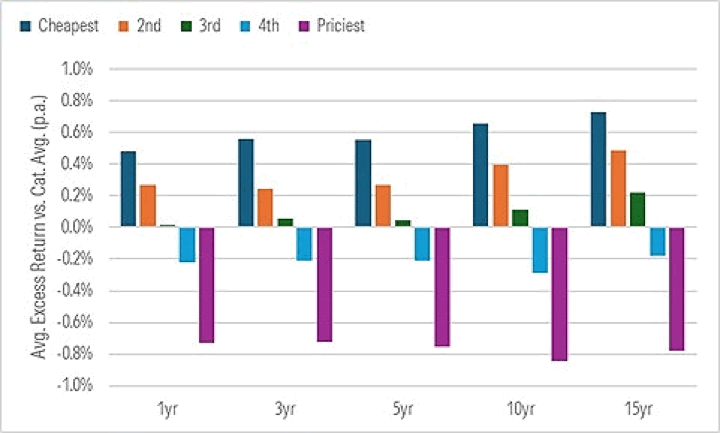
The relationship is very clear. Sure, there are a few outliers (although hardly any consistent outliers over time), but as a whole, you absolutely do not “get what you pay for” with fund and ETF expense ratios. On the whole, the more you pay in expenses, the worse the performance you get in return.
 The Best Credit Card Bonus Offers – 2026
 Big List of Free Stocks from Brokerage Apps
 Best Interest Rates on Cash - 2026
 Free Credit Scores x 3 + Free Credit Monitoring
 Best No Fee 0% APR Balance Transfer Offers
 Little-Known Cellular Data Plans That Can Save Big Money
 How To Haggle Your Cable or Direct TV Bill
 Big List of Free Consumer Data Reports (Credit, Rent, Work)
Jonathan,
Is this trend the same for bond funds? My dad just passed away and left my mom a portfolio of 74 different bond funds. I’m trying to figure out a strategy to reduce the number of funds. I started looking at the expense ratios but it’s not clear if the lowest cost funds are the best ones to sell.
I have been following you for many years. Thank you for all you do!
Renee
My understanding is that low fees are even more important for bond funds. The fees eat directly into your yield, most investment-grade bonds are priced are very efficiently, and bond returns are usually lower overall than stocks, so percentage-wise you are losing more of your return.
Thanks for reading! 😃
If they were only in your fathers name you would have a complete step up of basis in which case sell them all if you can and buy bnd. With that said, from my own experience, there are sadly no effective secondary markets for some bonds.