A market-capitalization weighted portfolio is one where assets are held in proportion to their total market value (share price * # of shares). For example, if you were to buy into the S&P 500 index (a cap-weighted index), right now you would be buying ~170 times more of Amazon (~$2 Trillion value) as Best Buy ($13 Billion value). But as the share value of each company changes, you wouldn’t have to do anything to maintain market-cap weighting.
What if you wanted to weigh your entire portfolio based on values of all the investable assets in the world? This chart from WisdomTree’s 2/26 update breaks it down for you (found via Weekly Chartstorm).
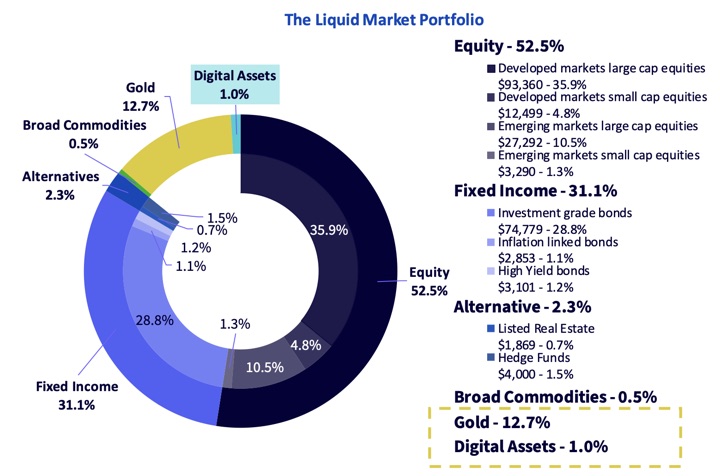
Roughly, you’re looking at 50% equities, 30% debt (fixed income/bonds), 12.7% of gold (!), and 1% in digital assets. The gold number surprised me. These values are credited to Bloomberg and Wisdomtree as of 2/2/26. Market cap values are in billions.
Let’s check some of those numbers. The chart estimates the total market value of all the equities in the world at ~$135 Trillion, which also roughly matches other sources. The chart estimates the total market value of all the gold in the world at ~$33 Trillion, which roughly matches other sources. That gives us a ratio of roughly 4:1 of stocks:gold.
However, I wrote in 2016 about the idea of Investing 1% Of Your Portfolio Into Gold, where another source said that the world market cap weighting for gold at that time was a tad under 1%. Looking closer, this number appears to be an estimate of the world’s total quantity of gold held for investment.
At first, I thought this was like how you can’t own every business in the world since many are privately-held, when we talk about equities we are actually talking about publicly-investable businesses. Okay, so it looks like roughly 50% of the gold above ground is used in jewelry and 15% for industrial purposes. But still, isn’t gold jewelry also considered an investment? How do you decide how much of gold is an investment asset by someone, and how much isn’t? Maybe a true global market-cap weighting of gold is not quite as high as in the chart of above, but still significantly higher than what I previously thought.
 The Best Credit Card Bonus Offers – 2026
 Big List of Free Stocks from Brokerage Apps
 Best Interest Rates on Cash - 2026
 Free Credit Scores x 3 + Free Credit Monitoring
 Best No Fee 0% APR Balance Transfer Offers
 Little-Known Cellular Data Plans That Can Save Big Money
 How To Haggle Your Cable or Direct TV Bill
 Big List of Free Consumer Data Reports (Credit, Rent, Work)
Gold has been on a lot of peoples minds as of late. The thesis by gold advocates is that the spending of western democracies and the resultant debt is “unsustainable,” In order for these governments to cope with the mountains of debt, they plan to use central banks to print money to buy this debt (expand the feds balance sheet). Which will result in money printing and inflation, or debasement of FIAT currencies and a loss of purchasing power for those who hold cash and negative returns on bonds. Which is exactly what the US treasury-federal did in the 40s to pay for the WWII debt. So there is history and precedence for this policy when debt to GDP ratio is as high as it is. Of course this theory/concern around US currency debasement has been around for 40 years and has yet to come true. So the real question is why should we believe this will happen now? Gold is a collectable (it only has value due to its scarcity and desirability) and goes up in value so long as someone will pay more for it than you. Anyway, Gold being a physical asset is seen as a hedge against dollar debasement. If you believe we are on the verge of another 40’s style bailout of the the federal government, then reducing your exposure to us $ is prudent. Now, I will also say as a collectible, gold is probably about as good as baseball cards, wine, art, silver, etc as a store of value. But if you have cash, you should consider converting some of it to gold/silver, instead of letting inflation eat away its value in CDs, bonds, and etc. I think that currency debasement is in the future, assuming we don’t cut spending and don’t stop printing money. In that future gold is a good insurance policy against excessive money printing. Of course we are also on the verge of the AI revolution and maybe a productivity boom, so we’ll outgrow our debts. Also possible, but everyone loves a good bear story, so gold thrives when people see the glass as half empty.
Absolutely absurd transaction fees (dealer cuts; taxed as collectables) limit gold as an investment. Gold works great in holding its value and in keeping medieval economies stable and unchanging…for centuries. A lump of shiny rock will remain a lump of shiny rock forever. Everyone accepts that gold delivers an inflation match over the long term.
Paper money is designed to deflate and prod economic action. Consider the return of technology investments for the last 150 years or so. Start with steel, trains, automobiles, electricity, aluminum, films, audio recording, radio, TV, “Plastics,” the Internet, smartphones, and AI. Consider those who rode dividend stocks that paid cash to live on instead of sitting in a safe as a rock.
Those who rode the mainstream investing train and switched tracks with the times made infinitely more profit than gold hoarders. Yes, a tailored suit doesn’t cost $2 in paper money any more. Yes, bad governments try to inflate their way out of debt with Zimbabwe paper notes and the absurd “Trillion Dollar Coin” associated with Paul Krugman. Still, there’s always a responsible banker somewhere in the world.
Adapt. If a medieval economy happens to return you might trade your daily labor for gold. But you still can’t eat gold.
Totally agree that gold dealers charge absurd transaction fee’s (20% round trip), and buying physical gold form dealers for “investing” is not the way to go. That’s why people buy ETF’s that represent physical gold or buy into vaulting arrangements where transaction costs (under 1-2%) are minimized. Vaulting stores your gold for at a low rate. Vaulting provides additional benefits like a debit card to allow you to spend your gold conveniently in your currency of choice. This arranagment also is a tool for asset protection by locating your money outside of the united states safe from civil asset forfeiture, legal judgments, and government seizure. Basically if you make yourself lawsuit proof you don’t need to spend as much on insurance like umbrellas and liability..
The role possessing physical gold in your home is primarily for insurance. Where you may need a portable source of wealth that has no government counter party risk. I spent a lot of time listening to holocaust survivors as my mom made it her mission to have high school children hear their stories before they all died. One thing is clear having a portable source of wealth not tied to a government helps you to buy freedom and start a new life somewhere else. Not saying this is necessary, but having a plan B in life can be prudent when things don’t work as you planned.
I don’t disagree with your thesis that there are better “investments” than gold. Assets those that produce income, rents or production have always been a good investment. Commodities, due well as well. I would never argue one should put all of their money in precious metals. I never invested in gold except for the scenario above.
However, where gold has an argument is as a bonds/currency alternative. When a country debases its currency to pay its debt. This results in inflation and negative real returns on bonds. Yes, this happens Japan has done it, and the US has done it. This is not a theoretical risk, especially in highly indebted western democracies. In a high inflation, negative real interest rate environment gold is a better choice for risk reduction compared to the traditional safe havens of bonds. Currency debasement and negative bond returns is the risk that people are hedging with gold, this is the argument. But is now that time?
The goldbug story where gold will protect you from the apocalypse, and you’ll survive sitting in your cave with your pile of gold. Just isn’t likely.
The invention of FIAT currency actually began from gold IOUS. When people began using gold as currency they found it/. Gold coins are quite heavy and hard to carry around, so what people evolved into is leaving their gold at a gold dealer and the dealer would issue them an IOU. So people began to use those IOUs to pay for goods and services as it was easier than lugging gold around. Those IOUS developed into what we now know as bank notes.
Gold has no utility agreed. Its a collectable, its value is due to scarcity and desirability (just like wine, baseball cards, art, etc.) . You can’t eat (well the wine you can), those collectables either, but they are a tool for storing wealth. Thats the goal with gold, and its not the only way to do it. But it is the largest and most liquid of the collectables market that free’s you from the risk of having to have a 3rd party government involved in your transaction.
The key very simply. In an environment where the Federal reserve prints money to buy government bonds/debt. For the purpose of keeping bond rates low (easier repayment) with the side effect of high inflation due to money printing. Bond real yields can become negative, where inflation is higher than the bond yield. This is a tool central banks deploy to reduce indebtedness by inflating away the debt (inflation is a tax on the populous). In this scenario which the US has deployed in the 1940s and Japan in the 1990s, Bonds are not a safe haven asset, you loose value by keeping government bonds. Thats where gold maybe a better store of value as it can’t be debased / inflated like US dollars, and while it produces no yield, a 0% return is desirable over a negative return. This is the argument for the last 40 years, and maybe someday gold investors will be correct, the question is if/when?