American Airlines 40th Anniversary Prize Drawing: Free Miles

American Airlines has a new 40th anniversary promo game where you can earn some prizes like free AAdvantage miles or Admirals Club access (grand prize is 1 million miles). I signed-in, clicked around for under 5 minutes, and walked away with free 40 AA miles and an Avis rental car upgrade (not worth much).

You can keep playing every day until 5/3. My personal strategy would simply be to play until you get some free AA miles to reset your expiration date. AA miles currently expire after 18 months of inactivity.

Best Interest Rates on Cash – April 2021

Here’s my monthly roundup of the best interest rates on cash as of April 2021, roughly sorted from shortest to longest maturities. There are many lesser-known opportunities to improve your yield while keeping your principal “safe” (FDIC-insured or equivalent). Check out my Ultimate Rate-Chaser Calculator to see how much extra interest you’d earn by moving money between accounts. Rates listed are available to everyone nationwide. Rates checked as of 4/5/2021.

Fintech accounts
Available only to individual investors, fintech accounts oftentimes pay higher-than-market rates in order to achieve high short-term growth (often using venture capital). I define “fintech” as a software layer on top of a different bank’s FDIC insurance. Although I do use some of these after doing my own due diligence, read about the Beam app for potential pitfalls and best practices.

  • 3% APY on up to $100,000. The top rate is 3% APY for April through June 2021, and they have not indicated any upcoming rate drop. HM Bradley requires a recurring direct deposit every month and a savings rate of at least 20%. See my HM Bradley review.
  • 3% APY on 10% of direct deposits + 1% APY on $5,000. One Finance lets you earn 3% APY on “auto-save” deposits (up to 10% of your direct deposit, up to $1,000 per month). Separately, they also pay 1% APY on up to another $25,000 with direct deposit. New $50 bonus via referral. See my One Finance review.
  • 3% APY on up to $15,000. Porte requires a one-time direct deposit of $1,000+ to open a savings account. $50 bonus via referral. See my Porte review.
  • 2.15% APY on up to $5k/$30k. Limited-time offer of free membership to their higher balance tier for 6 months with direct deposit. See my OnJuno review.

High-yield savings accounts
While the huge megabanks pay essentially no interest, it’s easy to open a new “piggy-back” savings account and simply move some funds over from your existing checking account. The interest rates on savings accounts can drop at any time, so I list the top rates as well as competitive rates from banks with a history of competitive rates. Some banks will bait you with a temporary top rate and then lower the rates in the hopes that you are too lazy to leave.

  • 1.25% APY on up to $250k. ZYNLO is a division of PeoplesBank with its own FDIC certificate. It also offers 100% roundup matching on debit card purchases if you maintain a $3,000 balance. See my ZYNLO review.
  • T-Mobile Money is still at 1.00% APY with no minimum balance requirements. The main focus is on the 4% APY on your first $3,000 of balances as a qualifying T-mobile customer plus other hoops, but the lesser-known perk is the 1% APY for everyone. Thanks to the readers who helped me understand this. There are several other established high-yield savings accounts at closer to 0.50% APY.

Short-term guaranteed rates (1 year and under)
A common question is what to do with a big pile of cash that you’re waiting to deploy shortly (just sold your house, just sold your business, legal settlement, inheritance). My usual advice is to keep things simple and take your time. If not a savings account, then put it in a flexible short-term CD under the FDIC limits until you have a plan.

  • No Penalty CDs offer a fixed interest rate that can never go down, but you can still take out your money (once) without any fees if you want to use it elsewhere. Marcus has a 7-month No Penalty CD at 0.45% APY with a $500 minimum deposit. AARP members can get an 8-month CD at 0.55% APY. Ally Bank has a 11-month No Penalty CD at 0.50% APY for all balance tiers. CIT Bank has a 11-month No Penalty CD at 0.30% APY with a $1,000 minimum deposit. You may wish to open multiple CDs in smaller increments for more flexibility.
  • Lafayette Federal Credit Union has a 12-month CD at 0.80% APY ($500 min). Early withdrawal penalty is 6 months of interest. Anyone can join this credit union via partner organization ($10 one-time fee).

Money market mutual funds + Ultra-short bond ETFs
Normally, I would say to watch out for brokerage firms that pay out very little interest on their default cash sweep funds (and keep the difference for themselves). However, money market fund rates are very low across the board right now. Ultra-short bond funds are another possible alternative, but they are NOT FDIC-insured and may experience short-term losses in extreme cases. I personally don’t think the risk is worth the tiny yield at this time.

  • The default sweep option is the Vanguard Federal Money Market Fund which has an SEC yield of 0.01%. Vanguard Cash Reserves Federal Money Market Fund (formerly Prime Money Market) currently pays 0.01% SEC yield.
  • Vanguard Ultra-Short-Term Bond Fund currently pays 0.42% SEC yield ($3,000 min) and 0.52% SEC Yield ($50,000 min). The average duration is ~1 year, so your principal may vary a little bit.
  • The PIMCO Enhanced Short Maturity Active Bond ETF (MINT) has a 0.31% SEC yield and the iShares Short Maturity Bond ETF (NEAR) has a 0.45% SEC yield while holding a portfolio of investment-grade bonds with an average duration of ~6 months.

Treasury Bills and Ultra-short Treasury ETFs
Another option is to buy individual Treasury bills which come in a variety of maturities from 4-weeks to 52-weeks. You can also invest in ETFs that hold a rotating basket of short-term Treasury Bills for you, while charging a small management fee for doing so. T-bill interest is exempt from state and local income taxes. Right now, this section isn’t very interesting as T-Bills are yielding close to zero!

  • You can build your own T-Bill ladder at TreasuryDirect.gov or via a brokerage account with a bond desk like Vanguard and Fidelity. Here are the current Treasury Bill rates. As of 4/5/2021, a new 4-week T-Bill had the equivalent of 0.03% annualized interest and a 52-week T-Bill had the equivalent of 0.06% annualized interest.
  • The Goldman Sachs Access Treasury 0-1 Year ETF (GBIL) has a -0.01% SEC yield and the SPDR Bloomberg Barclays 1-3 Month T-Bill ETF (BIL) has a -0.10% (!) SEC yield. GBIL appears to have a slightly longer average maturity than BIL.

US Savings Bonds
Series I Savings Bonds offer rates that are linked to inflation and backed by the US government. You must hold them for at least a year. If you redeem them within 5 years there is a penalty of the last 3 months of interest. The annual purchase limit is $10,000 per Social Security Number, available online at TreasuryDirect.gov. You can also buy an additional $5,000 in paper I bonds using your tax refund with IRS Form 8888.

  • “I Bonds” bought between November 2020 and April 2021 will earn a 1.68% rate for the first six months. The rate of the subsequent 6-month period will be based on inflation again. More info here.
  • In mid-April 2021, the CPI will be announced and you will have a short period where you will have a very close estimate of the rate for the next 12 months. I will have another post up at that time.
  • See below about EE Bonds as a potential long-term bond alternative.

Prepaid Cards with Attached Savings Accounts
A small subset of prepaid debit cards have an “attached” FDIC-insured savings account with exceptionally high interest rates. The negatives are that balances are severely capped, and there are many fees that you must be careful to avoid (lest they eat up your interest). There is a long list of previous offers that have already disappeared with little notice. I don’t personally recommend nor use any of these anymore, as I feel the work required and risk of messing up exceeds any small potential benefit.

  • Mango Money pays 6% APY on up to $2,500, if you manage to jump through several hoops. Requirements include $1,500+ in “signature” purchases and a minimum balance of $25.00 at the end of the month.

Rewards checking accounts
These unique checking accounts pay above-average interest rates, but with unique risks. You have to jump through certain hoops which usually involve 10+ debit card purchases each cycle, a certain number of ACH/direct deposits, and a certain number of logins per month. If you make a mistake (or they judge that you did) you risk earning zero interest for that month. Some folks don’t mind the extra work and attention required, while others would rather not bother. Rates can also drop suddenly, leaving a “bait-and-switch” feeling.

  • The Bank of Denver pays 2.00% APY on up to $25,000 if you make 12 debit card purchases of $5+ each, receive only online statements, and make at least 1 ACH credit or debit transaction per statement cycle. The rate recently dropped. If you meet those qualifications, you can also link a Kasasa savings account that pays 1.00% APY on up to $50k. Thanks to reader Bill for the updated info.
  • Devon Bank has a Kasasa Checking paying 2.50% APY on up to $10,000, plus a Kasasa savings account paying 2.50% APY on up to $10,000 (and 0.85% APY on up to $50,000). You’ll need at least 12 debit transactions of $3+ and other requirements every month. The rate recently dropped.
  • Presidential Bank pays 2.25% APY on balances up to $25,000, if you maintain a $500+ direct deposit and at least 7 electronic withdrawals per month (ATM, POS, ACH and Billpay counts).
  • Evansville Teachers Federal Credit Union pays 3.30% APY on up to $20,000. You’ll need at least 15 debit transactions and other requirements every month.
  • Lake Michigan Credit Union pays 3.00% APY on up to $15,000. You’ll need at least 10 debit transactions and other requirements every month.
  • Find a locally-restricted rewards checking account at DepositAccounts.

Certificates of deposit (greater than 1 year)
CDs offer higher rates, but come with an early withdrawal penalty. By finding a bank CD with a reasonable early withdrawal penalty, you can enjoy higher rates but maintain access in a true emergency. Alternatively, consider building a CD ladder of different maturity lengths (ex. 1/2/3/4/5-years) such that you have access to part of the ladder each year, but your blended interest rate is higher than a savings account. When one CD matures, use that money to buy another 5-year CD to keep the ladder going. Some CDs also offer “add-ons” where you can deposit more funds if rates drop.

  • NASA Federal Credit Union has a special 49-month Share Certificate at 1.50% APY ($10,000 min). Early withdrawal penalty is 1 year of interest. Anyone can join this credit union by joining the National Space Society (free). Note that NASA FCU may perform a hard credit check as part of new member application.
  • Lafayette Federal Credit Union has a 5-year CD at 1.25% APY ($500 min). Early withdrawal penalty is 6 months of interest. Anyone can join this credit union via partner organization ($10 one-time fee).
  • You can buy certificates of deposit via the bond desks of Vanguard and Fidelity. You may need an account to see the rates. These “brokered CDs” offer FDIC insurance and easy laddering, but they don’t come with predictable early withdrawal penalties. Right now, I see a 5-year CD at 0.90% APY vs. 0.98% APY for a 5-year Treasury. Be wary of higher rates from callable CDs listed by Fidelity.

Longer-term Instruments
I’d use these with caution due to increased interest rate risk, but I still track them to see the rest of the current yield curve.

  • Willing to lock up your money for 10 years? You can buy long-term certificates of deposit via the bond desks of Vanguard and Fidelity. These “brokered CDs” offer FDIC insurance, but they don’t come with predictable early withdrawal penalties. You might find something that pays more than your other brokerage cash and Treasury options. Right now, I see a 10-year CD at 1.80% APY vs. 1.70% APY for a 10-year Treasury. Watch out for higher rates from callable CDs from Fidelity.
  • How about two decades? Series EE Savings Bonds are not indexed to inflation, but they have a unique guarantee that the value will double in value in 20 years, which equals a guaranteed return of 3.5% a year. However, if you don’t hold for that long, you’ll be stuck with the normal rate which is quite low (currently 0.10%). I view this as a huge early withdrawal penalty. But if holding for 20 years isn’t an issue, it can also serve as a hedge against prolonged deflation during that time. Purchase limit is $10,000 each calendar year for each Social Security Number. As of 4/5/2021, the 20-year Treasury Bond rate was 2.28%.

All rates were checked as of 4/5/2021.

Uber Eats Promo Code: 50% Off Pickup Order

If you use Uber Eats, enter the promo code TRYNOW50 for 50% off your next pickup order (max discount $15). Look under “Account” and then “Promotions” to enter the code. This worked for me, even though it didn’t show up on its own. Mine says it will expire April 16th, 2021.

If you haven’t signed up for Uber Eats yet, you can first use my referral link to get $20 off your first order of $25+. Or simply apply this promo code at checkout: eats-ubermymoneyblog. Thanks if you use it!

High-Yield Crypto Accounts: 6% Interest in Bitcoin or 9% Interest on Stablecoin

This WSJ article is the first mainstream financial article that I’ve seen discuss the high interest rates paid on Bitcoin and stablecoin (cryptocurrency backed by a “stable” asset like the US dollar). I am (again) not a cryptocurrency expert, but it does seem appropriate to educate and warn other curious investors about the risks. Here’s my take:

  • The price of Bitcoin can vary a lot. It probably went up or down by a hundred dollars in the time you took to read this sentence.
  • Stablecoin prices tend to vary less because they promise to be backed by a stable asset. USDT (Tether) and USDC (USD Coin) are both currently trading exactly at US$1.00, so it appears that the market believes this claim. However, US dollar stablecoins are not affiliated with the US government or any central bank.
  • Brokers/exchanges where you can buy and sell these cryptocurrencies are not backed by government insurance. They are businesses – some will end up worth billions, some will get bought by a bigger competitor, and some will probably fail (likely because they were hacked). Even though they might be called “savings” or “interest” accounts, no cryptocurrency is held in an FDIC-insured bank, or even an SIPC-insured brokerage account. They will promise to keep your crypto safe and pay interest, but it is possible they may not live up to their end of the deal, AKA “counterparty risk”. Not every exchange is equal.
  • This potential risk is a big reason that they have to pay you 6% annual interest in your Bitcoin and/or 9% annual interest in your USDC stablecoin. They are lending out your assets and earning even more interest, because traditional banks won’t do so.
  • The result is two separate risks – the risk of the price of crypto itself, and counterparty risk of the place holding your crypto.

In the end, I agree with this part of the article (even with the mocking tone):

If you’re a risk-taker who relishes the ride when an asset soars and can laugh off the losses when it crashes, then maybe you should consider letting a broker borrow your cryptocurrency at a generous rate.

After all, if you aren’t troubled by the extraordinary volatility of virtual money, you might as well earn some interest on it.

I did buy some crypto a few years ago as a purely speculative investment and to promote my own learning. We are talking less than 1% of net worth, but it has become a 5-figure amount. I was very skeptical at first, but now I am partial to the theory that either BTC is worth zero, or it will eventually be worth at least on par with the market cap of gold (roughly $200,000). I accept that both scenarios are possible.

I bought Bitcoin using the Voyager app ($25 bonus, publicly-traded with $3 Billion market cap) and also opened an account with BlockFi ($250 bonus, just completed $350m Series D at $3B valuation). Both of these companies are worth well over a billion dollars and gone though various rounds of funding, which isn’t bulletproof but it means that smarter people than me have vetted their security protocols and business practices.

BlockFi pays me 6% interest on up to 2 BTC (8.6% on USDC) and Voyager pays 6.25% interest on BTC (9% on USDC). I reinvest the interest so that I own a little bit more BTC each month. However, I fully accept that I am getting paid this interest and getting the convenience of buying BTC with a few taps in exchange for the potential risk that they will go bust while losing all my BTC. There are other options like hardware wallets, but I am don’t want the inconvenience or to worry about forgetting my bitcoin passwords for my relatively small investment.

Bottom line. Sorry, you can’t earn a 9% “safe” interest rate on your cryptocurrency, even if it is a US-dollar backed stablecoin. At a minimum, you still have counterparty risk. This is a business lending out your assets, charging interest, and giving you a cut. They can go bust, and not all exchanges are the same. Perform your own due diligence when picking a broker/exchange to buy from. I picked what I think are among the safest, but it’s still risky.

Even though the interest rates are quite low, I keep my “safe” cash in FDIC-insured bank accounts and similar.

TD Double Up Card: 2% Cash Back on All Purchases (TD Bank Deposit Account Required)

The TD Double Up card is a new cashback rewards credit card from TD Bank which earns up to 2% flat cash back on all eligible purchases without worrying about the merchant or category.

  • 1% cash back on purchases + 1% cash back when you redeem into an eligible TD Bank Deposit Account.
  • New customer bonus: $75 cash back via statement credit after $500 in purchases within the first 90 days.
  • 0% introductory APR on balance transfers for first 15 billing cycles.
  • No annual fee.

At first, I though this was not-so-subtle copycat of the Citi Double Cash card, which offers 1% on purchases + 1% when you pay Citi back for those purchases (which you should each month to avoid carrying a balance). Citi does not required any other accounts with them. Here, the restriction to earn that extra 1% back is that you must be an active holder of a TB Bank checking or savings account. TD Bank only offers accounts to customers in select states:

Connecticut, Delaware, Florida, Maine, Maryland, Massachusetts, New Hampshire, New Jersey, New York, North Carolina, Pennsylvania, Rhode Island, South Carolina, Texas, Vermont, Virginia, Washington, D.C.

Bottom line. If you are a TD Bank customer, the TD Double Up card is another welcome option for a simple flat 2% cash back credit card with no annual fee. Everyone should have a 2% cash back card in their purse/wallets, even if they have other cards with higher cashback in specific categories. If you don’t bank with TD Bank or have a Fidelity account, check out the Citi Double Cash card.

Free Krispy Kreme Donut Every Day in 2021 w/ Vaccine Card

Krispy Kreme is giving away a free Original Glazed doughnut if you show them your COVID-19 vaccination card. This is valid once a day, every day for the rest of 2021! Valid in-store or drive-thru in participating US locations. No purchase required. No, they won’t take a picture of your card.

You don’t need to eat a doughnut every day, but it’s a nice gesture and this means you can just pop in whenever you feel like it. If you happen to stop in on a Monday starting 3/29, you can get a free donut and a medium brewed coffee for free, no purchase required. Monday Coffee offer does not require any vaccination card and expires 5/24/21.

ZYNLO Bank Review: 1.25% APY (No Longer Available To New Signups), 100% Match on Roundups

Update: As of 4/8/21, the ZYNLO website now lists their money market as “no longer available”, although the rate is still 1.25% APY if you opened it in time. The savings account pays 0.80% APY and still includes the roundups. There is a new “Tomorrow Savings” account that only pays 0.40% APY, so I’m not sure why anyone would pick that one.

ZYNLO Bank is another new “digital-first” bank, backed by the FDIC insurance of PeoplesBank in Massachusetts. Along with the common features of no monthly fees and Allpoint ATM network access, ZYNLO differentiates itself from the banking app crowd in a few different ways.

0.80% to 1.25% APY. Their main page advertises 0.80% APY on their Money Market account, which is already a competitive rate, but if you enter the promo code BANK (should auto-populate at this promo link) at account opening, they promise a higher promo rate of 1.25% APY on up to $250,000. Looks like promo code NERD gives the same result. Unfortunately, there is no rate guarantee as to how long either rate will last.

100% match on Roundups. When you purchase something with the ZYNLO debit card from their checking account (ex. $4.44), they will round up the transaction to the nearest dollar (ex. $5), deposit that amount (ex. 56 cents) into your savings account, and also match that amount (ex. another 56 cents). Their Savings Account (not the same as Money Market) offers a 100% match on “roundups” during their first 100 days. After that, you must maintain an average daily balance of $3,000 to continue to receive a 100% match. Otherwise, you only get a 25% match. The savings account pays negligible interest.

Let’s say you make 20 debit card purchase per month. If your purchase amounts are random over time, you will average a roundup of 50 cents per transaction. At a 100% match, that works out to $10 a month in matches per month (plus $10 of your own money being put aside in savings for you). 40 debit transaction per month = $20 a month at 100% roundup, and so on. If you make a lot of debit card purchases, it might be worth keeping a $3,000 balance to keep that 100% match.

Note that they don’t accept applications from a few states:

Who can use ZYNLO?
Any U.S. citizen 18 or older with a valid Taxpayer Identification Number. We can open accounts for people throughout the United States with the exception of CA, CT, MA, & NY.

My take. The money market promo rate may be attractive to those with very high balances as it applies to balances up to $250,000. The roundup matching might be attractive for people that make a lot of purchases on their debit cards. The negative is that there is no rate guarantee period and thus the slightly higher promo rate may not be high to guarantee a solid return over what might be a short period of time, given the other bank options near 3% APY available.

Hat tip to DepositAccounts.

Free Practical Course To Improve Your Happiness from Yale University

Want to take a free online class together with me (and 3.3 million other people)? The NYT had a nice profile of the free online course The Science of Well-Being offered by Yale University on Coursera. (It was the most popular class ever taught at Yale.) I’d heard about this class before and have even taken other courses at Coursera, but I had the mistaken impression that it was more of a lecture series. In reality, the course requires weekly practice to help you “rewire” and permanently change your behavior based on psychology research.

In this course you will engage in a series of challenges designed to increase your own happiness and build more productive habits. As preparation for these tasks, Professor Laurie Santos reveals misconceptions about happiness, annoying features of the mind that lead us to think the way we do, and the research that can help us change. You will ultimately be prepared to successfully incorporate a specific wellness activity into your life.

I’m not sure how often the course runs, but I’m enrolled in the one that starts today, March 17th, 2021. I’m guessing they’ll keep enrollment open for a little while longer at least. Here’s my first message after enrolling, which gives you a better idea of what to expect:

Congratulations on taking part in this journey! Over the next several weeks, we’ll explore what new results in psychological science teach us about how to be happier, how to feel less stressed, and how to flourish more. We’ll then have a chance to put these scientific findings into practice by building the sorts of habits that will allow us to live a happier and more fulfilling life.

Each week you will have requirements (graded quizzes) and “rewirements” (weekly practices aimed at rewiring your habits to boost mood and overall well-being). The final project asks you to practice a scientifically validated wellness behavior for four weeks and write about the experience.

Even though the course is completely free (skip the $49 certificate), it is one of those “you get out what you put in” situations. The course runs for 10 weeks and is estimated to require a consistent commitment of 1-2 hours per week. In a given week, you might track your sleep patterns, keep a gratitude journal, perform random acts of kindness, or try to meditate regularly.

You take an initial happiness assessment (answer a bunch of questions) in the beginning and another one at the end of the course. In this way, you have a way of measuring of whether taking these new actions has changed your well-being. Even a small improvement in happiness has to be a pretty valuable thing, no? I mean, think of how often we try to gain a little bit of joy through buying a new object (home, car, phone, shoes, meal).

The creator and professor of this course, Dr. Laurie Santos, also has a podcast called The Happiness Lab. Another popular online course with broad application is Learning How to Learn: Powerful mental tools to help you master tough subjects.

Neighborhood Nosh Review: Up to 10% Back at Participating Restaurants

Neighborhood Nosh (formerly iDine) is a promotional service allows you to earn cash back when you dine at participating restaurants and pay with your linked credit card. You may already be familiar with using Rewards Network to earn airline and hotel points, but this is a rebrand of their standalone program which offers cash back in the form of an American Express gift card. Here is the standard structure:

  • Sign up for a free account and provide your credit/debt card numbers. (I believe they only ask for the 16 digits. They won’t charge anything on it.)
  • If you use that linked card to pay for a meal at a participating restaurant (dine-in, takeout, or direct delivery), you will automatically earn cash back rewards on the entire amount including tip.
  • No membership cards, no coupons, no apps. You don’t do anything that announces that you are seeking a discount.
  • Earn either 5% or 10% back.

Usually, you earn 5% back until you reach $750 in spending with in the calendar year. After that, you start earning 10% cash back.

New and existing member promo. Right now, existing members get 10% back until 4/4/21. If you sign up as a new member by 7/31, link a card, and pay with that card within the first 30 days, and opt-in to their marketing emails, you’ll also earn 10% cash back right away.

Existing iDine member rewards will also automatically be transferred to Neighborhood Nosh.

Cash out details. It appears they will mail you a physical AmEx gift card once you reach a rewards balance of $20.

After a member reaches $20 in accumulated restaurant rewards from Neighborhood Nosh, an American Express® Reward Card will be mailed the following month with all available rewards. Rewards in an amount less than $20 are subject to expiration if no dining activity occurs within one year from the date the rewards were originally earned.

My take. I like the fact that you don’t have to do change your existing eating habits to earn extra rewards. I could simply link the card that I put most dining purchases on (for example the Chase Sapphire Preferred 2X or Chase Sapphire Reserve 3X points or the American Express Gold 4x points) and then promptly forget about it for the most part. If the restaurant I visit happens to be part of the program, then I get some free rewards as a nice surprise.

I do look through their list of participating restaurants when I want some miles activity for a specific airline to avoid the expiration of points. Each of your credit cards can only be linked to one type of Rewards Network account. I usually have 5-7 different credit cards linked to 5-7 different programs, so I can pick up points from a specific program as needed with a single targeted purchase. You have to plan ahead a little bit, as the points can take a while to post.

Now, if you eat at a participating Rewards Network restaurants regularly, then the 10% cash back from Neighborhood Nosh could really add up. Could be worth a look.

American Rescue Plan Act of 2021: New 3rd Stimulus Chart, Child-Related Tax Credits, COBRA, Dependent Care FSA Limits

The American Rescue Plan Act of 2021 became effective March 11th, 2021 and there is a lot to unpack in the $1.9 trillion economic stimulus bill. Besides the headline $1,400 stimulus checks, there are many other items that could be worth over a thousand dollars each – expanded child and childcare tax credits, subsidized ACA/COBRA health insurance premiums, and increased pre-tax contributions to Dependent Care FSAs. After reading the NY Times, Tax Foundation, Wikipedia, and Kitces round-ups, here again are my minimalist highlights so that you can research further if it applies to your situation.
3rd Stimulus checks / Recovery rebates.

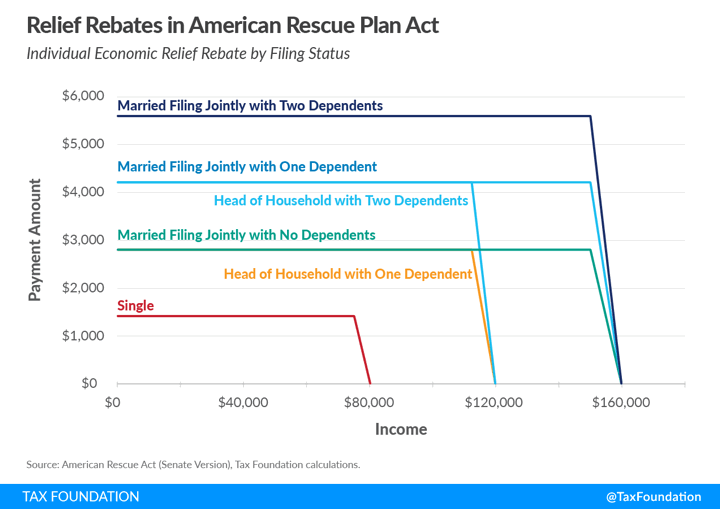
  • $1,400 for each eligible recipient. This includes $1,400 for each child and adult dependent, including college students claimed as dependents.
  • Income phase-out starts at AGI of $75,000 Single, $112,500 Head of Household, and $150,000 Married Filing Joint. Fully phased out at $80k/120k/160k. Qualify using your 2019 or 2020 income (once filed), or even 2021.
  • Track status at IRS Get My Payment tool.

Unemployment benefits.

  • Previous changes extended (including expanded eligibility) for additional 25 weeks, until 9/6. $300 weekly supplement also extended until 9/6.
  • For 2020, the first $10,200 of UI benefits are now tax-free if your income is under $150,000.

Expanded Child Tax Credit.

  • For 2021, it increases to up to $3,000 per child ($3,600 for ages 5 and under). The age limit for qualifying children also rises to 17, from 16. Previously, the max credit was $2,000 per child (and was only $1,000 as recently as 2017).
  • Now fully refundable.
  • Income phase-outs start at MAGI of $150,000 for married filing joint ($75,000 single).

Expanded Child and Dependent Care Tax Credit.

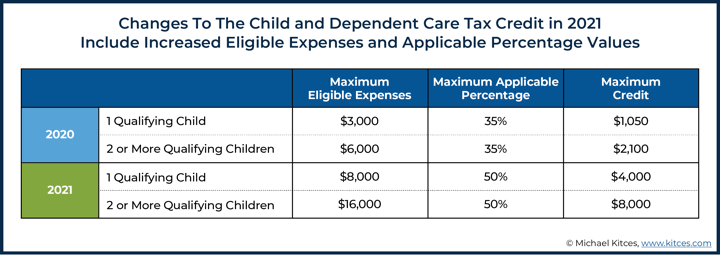
  • For 2021, now worth up to $4,000 for one qualifying individual or $8,000 for two or more. More expenses are eligible, at a higher percentage. The net increase in value could be worth up to $5,900 (see chart below).
  • Now fully refundable.
  • Qualifying children are under the age of 13 for the entire year.

Dependent Care Flexible Spending Accounts.

  • For 2021, you can now contribute $10,500 (married filing joint) into a Dependent Care FSA instead of the normal $5,000 (married filing joint). Single filers can contribute up to $5,250, up from $2,500.
  • Employers must choose to allow this option. Bug your HR department and hopefully they’ll make the change before it’s too late.

Student loans.

  • For student loan debt forgiven between 1/1/2021 and 12/31/2025, the forgiven amount will no longer be considered as taxable income.
  • No actual student loan debt is being forgiven as part of this bill, but it may be wise to prepare for the possibility in the near future. (I might not consider paying down any student loan amounts under $10,000, especially while they are in deferral.)

COBRA Health Insurance.

  • If you lost your job involuntarily (or had job hours cut and thus lost coverage), the government will pay for your entire COBRA health insurance premium from 4/1 through 9/30. This could add up to several thousand dollars.

Health insurance bought from ACA exchanges.

There will always be debate about details of this bill, but that is theoretical while my goal is to be actionable. The goal here is to help taxpayers be proactive and make sure they get any benefits and aid for which they qualify.

Lesser-Known Cheap Basic Prepaid Cell Phone Plans on Every Network – Starting Under $10 a Month

(Updated 2021. T-Mobile absorbed Sprint, so no more Sprint MVNOs. Tello is now a T-Mobile MVNO, but is still quite affordable. Ting Mobile has new flexible plans that work well for occasional data users, and you can now choose from either the T-Mobile or Verizon network.)

You can get unlimited talk and unlimited texts for $10 a month or less on every major network. That’s less than my bare landline used to cost. The major networks sell wholesale minutes to lesser-known MVNOs (Mobile Network Virtual Operators), which they in turn sell at a significant discount to individuals. Below are the best options by network below (Verizon, AT&T, T-Mobile) along with an alternative. I sort by network because that usually makes it easier to Bring Your Own Device (BYOD), though every MVNO will have a form where you can check compatibility via identification number (IMEI or MEID). Here are the cheapest plans with unlimited talk & text and 5G/LTE high-speed data.

Disclosure: This post includes affiliate links where available. If you make a purchase through the links below, I may be compensated.

T-Mobile NetworkT-Mobile Network Color: Hot Pink

  • Unlimited Talk & Text. Tello Mobile also has an unlimited talk, text, and no data for $8 a month. You need to choose a custom plan to find this option. Upgrade to 1 GB of data at only $10 per month. New user promo: Get 50% off their first 3 months.
  • Unlimited Talk & Text + Flexible Data. Ting Mobile has an unlimited talk and text for $10 a month plus pay-for-what-you-use data for $5 per GB of high-speed data. This may work best for those that want to always have access to data at a reasonable price, but no data during most months. Ting data can also be shared across multiple lines ($10 per line base). Ting now runs on both the T-Mobile and Verizon networks. For T-Mobile, you should be directed their “X1 SIM card”. New user promo: Bring over your own phone and get a free $25 service credit.
  • Higher price, but not MVNO. Alternatively, you can go directly with T-Mobile Connect and get unlimited talk and text with 2 GB data for $15 a month.

Note: I personally use Mint Mobile, which offers unlimited talk, text, and 4 GB data for $15 a month – see my Mint Mobile review for tips and details based on my experiences.

AT&T NetworkAT&T Network Color: Blue

  • Unlimited Talk & Text. Good2Go Mobile offers unlimited talk and text for $10 a month. Upgrade to 1 GB of data and pay $15 month. Buy the SIM card from Amazon for $5 and get $5 credit included.
  • 3 GB LTE data, more expensive. Alternatively, Red Pocket Mobile offers unlimited talk, text, and 3 GB data for $19 a month. After your LTE data runs out, you still get data included at slower 2G data speeds until your month resets. Be sure to choose the AT&T network (GSMA) when you sign up.

Verizon NetworkVerizon Network Color: Red

  • Unlimited Talk & Text + Flexible Data. Ting Mobile has an unlimited talk and text for $10 a month plus pay-for-what-you-use data for $5 per GB of high-speed data. This may work best for those that want to always have access to data at a reasonable price, but no data during most months. Ting data can also be shared across multiple lines ($10 per line base). Ting now runs on both the T-Mobile and Verizon networks. For Verizon, you should be directed their “V1 SIM card”. New user promo: Bring over your own phone and get a free $25 service credit.
  • I previously listed US Mobile, which also advertises unlimited talk and text for $10 a month, but they actually tack on a mandatory $2 month “access fee” on top of the usual taxes and fees. I don’t know of any other provider that does this, as it is basically a secret way to make the price really $12 a month.
  • 3 GB LTE data, more expensive. Alternatively, Red Pocket Mobile offers unlimited talk, text, and 3 GB data for $19 a month. After your LTE data runs out, you still get data included at slower 2G data speeds until your month resets. Be sure to choose the Verizon network (CDMA) when you sign up.

(Note: Now that Sprint has finally completed its merger with T-Mobile, some T-Mobile MVNOs can now access Sprint towers and some previous Sprint MVNOs are switching to T-Mobile MVNOs.)

Here are the cheapest plans with unlimited talk & text and 5G/LTE high-speed data.

PFS Buyers Club: US Mint Coin Purchase Opportunity ($100 + $200 Guaranteed Profit)

(Update: The 3/11 opportunity is no longer available. You can still sign up for an account and be alerted of the next opportunity roughly 48 hours prior. They seem to pop up every 3-6 months.)

The US Mint regularly releases limited-edition coins to collectors. The coin sets are often limited to one per customer. PFS Buyers Club is a website broker that recruits regular folks to buy their allotted coin set with a set markup amount, with the agreement that they will sell only to PFS Buyers Club. For example, you might pay $300 for a coin and they’ll agree to pay you $350 for it – a fixed profit of $50.

Note that the eventual value of the set may exceed that elsewhere – you may be able to get $400 for that coin on eBay, for example – but if you want to make that bet, don’t promise to sell to PFS Buyers Club. Just buy it on your own and try to sell it yourself. Keep in mind that eBay fees can be quite high, and you’ll be responsible for other costs like the proper shipping with adequate insurance. PFS Buyers Club will send you a prepaid mailing label (including insurance) and pay you via eCheck, paper check, or PayPal.

On Thursday March 11th (short notice, I know), there is a new guaranteed profit opportunity. The commission is larger than usual (up to $300 + credit card rewards), but so is the upfront cost (up to $6,500). I will be trying this out myself for the first time, especially as the high spending amount will also help me trigger some big credit card bonuses. PFS Buyers Club has a very solid reputation, but this way I can also write more honestly and in detail about the process.

The cost of the Four-Coin Set should be either $4,317.50 or $4,410.00 and the cost of the One Ounce Gold Eagle should be either $2,325.00 or $2,375.00. (The Mint will only be releasing the exact price for these products on Wednesday the 10th, and it will depend on the spot price of Gold over the next couple of days.)

Each item would need to be purchased as a separate Mint order, as such, each purchase will also have a $4.95 shipping charge. You will have each order shipped to your own house or office and then ship it to PFS Buyers Club with a prepaid shipping label that we will provide for you.

PFS will be offering a commission of $200.05 for each Four-Coin Set.

PFS will be offering a commission of $100.05 for each One Ounce Gold Eagle coin.

This is also a great opportunity to earn valuable points/miles on your credit cards, as well as meet any spending thresholds.

Spending $6,500 on your credit card would earn another $130 profit at 2% cash back. That’s a total of $430. You could do even better if satisfying a credit card sign-up bonus hurdle. Here is the 4-coin set and the 1-ounce coin.

If you want to jump on this, you can sign up to join PFS Buyers Club here. I’ll write a more detailed review afterward. If you use that link, I will receive a referral fee if you successfully sell your coin for a profit.