
What If You Had To Live Solely Off Of Social Security?

A lot of us younger folks are so disillusioned by our government that we don’t expect Social Security to even be around when we turn 65 (or likely 75 by that time…). But the fact is that today millions of people rely on Social Security as their primary – if not sole – source of income. Taking into account that the average benefit is only $963 a month, that’s not very much.

AARP asked retirees who rely primarily upon Social Security how the manage financially, and reprinted a selection of the responses. I enjoyed reading them, as they gave me a glimpse of what obstacles they face, and it showed many different ways they deal with them. Being on a fixed income and having a limited ability to make more money due to disability or illness would be very frustrating to me. Here are some excerpts, which I have organized by the major spending categories:

Housing

We built our own house on a lake stick by stick, or we wouldn?t have a house on a lake. It took us two years. Our son helped with the framing, and my son-in-law did the painting, but my husband did a fantastic job, only contracting out the roofing. [..] We planned ahead and paid off our house before retirement.

We put our home into a reverse mortgage several years ago, and I will realize very little if I sell. I have no children within 130 miles but can’t afford to sell because of the dwindling equity.

[I] live in a Section 8 apartment. In this area, a one-bedroom apartment is $700 to $1,300 per month. I cannot afford this and was lucky to get on Section 8. I must share the apartment with two roommates.

The largest portion of your income will be taken up with rent, utilities, phone, and maybe an auto (I had to get rid of mine), so be certain to apply for government-subsidized housing as soon as possible, as there is likely to be a lengthy waiting list. I waited 3 years! Previously, my rent alone was higher than the current total expense for rent, utilities, and phone.

Healthcare

[…] Our biggest expenses are the cost of our HMO, our Medicare and our medications. My $511 monthly pension pays for that. Our medications, although prescribed by HMO doctors, weren?t on the HMO?s formulary, so the cost wasn?t covered. Since we don?t live too far from Canada, we used to buy our most expensive medications through a Canadian clinic. However, now they will no longer serve Americans, so we did what others do on limited incomes?we just quit taking our two most expensive medications.
[Read more…]

U-Haul vs. Penske Moving Truck Rentals: Share Your Story

altext

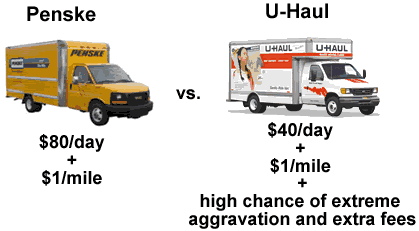
I’m helping a relative move this weekend, and I am trying to convince her not to go with the cheap choice (U-Haul), but pay $40 more for a Penske rental for her local move. This is mainly based on overwhelming anecdotal evidence (from me, my friends, and tons of people online) that U-Haul is just a logistical disaster and Penske is run at least competently, if not well. There’s nothing in this for me, except that I don’t want to deal with all the potential headaches that seem to happen with U-Hauls.

Details of my pleadings:

  1. I have used U-Haul once. The truck was a disaster – underpowered, dirty, and literally about to fall apart. It was not there when I wanted to pick it up, but I got another one. (Which probably screwed over the next person… see below)
  2. I have used Penske once. It was a brand-new truck with 200 miles on it, and they told me that Penske only uses their trucks for a few years and then sells them. (You may have seen lots of big yellow trucks with the Penske logo painted over, many of which look in great shape, as I have.) It was picked up, used, and dropped off with no billing surprises or funky fees.
  3. Multiple friends have used U-Haul, and most of them have some sort of horror story. In one, a tire blew in Montana on their trailer. They had to wait until the next day for a new one, but weren’t reimbursed for the extra required hotel room.
  4. U-Haul doesn’t actually do reservations, they are more like “yeah, we’ll see on that day. We might have just double-booked. If so, you might need to drive a couple hours to somewhere else or wait until tomorrow.” Avoiding that scenario by itself is worth $40 to me.
  5. Besides my personal experience above, U-Haul trucks have been shown to be unsafe and poorly maintained per this LA Times investigation – “Many trucks have high mileage, and The Times found safety checks were often overdue. Customers describe breakdowns and accidents.” Like perhaps, bald tires?

Am I overreacting? The Penske does “cost double”, but with the mileage I think it’ll be more like $130 vs. $90. If you’ve used U-Haul or Penske before, please share your experiences. Good or bad, I want it to be fair. But I’m betting it’s going to be lopsided…

Bodega: Cheap Eats and Social Commentary For 25 Cents

Do you think the $1 menu at McDonald’s is disgusting, or a godsend? Well, check out this funny yet sad video about cheap eats in the Bodegas of New York City, otherwise known as the corner convenience store. (There are a few expletives, but nothing extremely offensive.)

A humorous yet searing commentary about the choices confronting people who live in “the poorest urban county in the country.” Under the yellow awning of the Bronx Bodega, all the important food groups are represented. Join Dallas Penn of DallasPenn.com and Rafi Kam of OhWord.com as they illustrate the finer points of the Bodega Food Pyramid.

I like the Whole Foods comment. This stuff could be called “Empty Foods”. This reminds me of my breakdown of What 200 Calories Costs – The Economics of Obesity. If you’re poor, it can be tough to turn down pork rinds, snack cakes, ice cream sandwiches, and sugar water for just 25 cents apiece. You could get 1,000 calories that would fill your stomach quickly and easily for a buck. Can you really justify spending more than that if you don’t have to?

Sure, you could get a side salad at McDonald’s for $1, but that provides a mere 20 calories. Even with the low-fat Italian dressing, that’s another 60 calories for a total of 80 calories. That’s not going to satisfy you.

Is there just not enough demand for nutritious, cheap, and convenient foods? Or is it just too expensive to manufacture?

Get Out Of Your Sprint Cellphone Contract Without A Penalty

One good way to get out of your cell phone contract without paying the fat penalty is to wait for them to change your contract terms. I believe by law if they change your contract, you can either accept or cancel within 30 days without any fees.

The Consumerist reports that Sprint is adding some new charges as of January 1st, 2008. I don’t remember seeing this change on my Sprint bill, but many users on the SprintUsers forum have reported success canceling their contracts without fees, and one posted this as part of a conversation with a Sprint representative.

Sprints current policy as read by account services: “On Jan. 1st 2008 Sprint customers who have been affected by the fees, [consumer and IL customers], will have their ETF waived if they wish to terminate their contract. There will be no post-dating of cancellation where the ETF will be waived as only customers affected by the new surcharges will be eligible.”

If you want out of your Sprint contract, or just want to get some fresh new-contract deals, it may be worth a call. Even if you just jump ship to the Sprint SERO plan. 🙂

As for other carriers, I just ran across this “roaming hack” which supposedly lets you cancel with any wireless provider by placing a ton of calls while roaming. The idea is that you will make yourself and unprofitable customer that way, and they’ll just “fire” you. Not sure if it works though.

What Are We Saving For, Anyways? Our Life Goals and Retirement Plans

I’ve talked about this in bit and pieces under the Goals category, but I thought I should organize our life goals into one post. Hopefully, this will outline our priorities and shed some light on why we choose to do the things we do.

First, I’d like offer what I am afraid people think our life goals are:

Incorrect Goals

  1. Find the highest paying job possible. Work long hours, but tolerate it for the money.
  2. Live a very spartan lifestyle, with minimal luxuries and worrying about money constantly.
  3. At age 65, abruptly stop working so hard, finally relax and begin enjoying our life. Hopefully live long enough to enjoy this period.

In fact, that’s not what we want at all:

Actual Goal #1 – Finding A Job That Fits
If your going to spend almost 50% of every weekday doing something, shouldn’t you enjoy it? Sure, even great jobs have their challenges – bureaucracy, boring meetings, office politics, the occasional annoying co-worker. But finding a job where you don’t dread getting out of bed in the morning was a huge priority for me. It took a few different degree programs, a couple of resignations, some stressful interviews, and several rejections, but we are definitely making progress in finding work that is challenging, enjoyable, and reasonably well-compensated.

I would also add that having a simple lifestyle initially allowed us to take some risks in order to get where we are now.

Actual Goal #2 – Less Work, More Life
[Read more…]

Take Pride In Being Financially Different!

Recently, I ran across an article called the 5 Steps to Early Retirement. Written by a couple who retired at 38, here are they are:

  1. Track your spending.
  2. Save a lot.
  3. Invest wisely.
  4. Put peer pressure into perspective.
  5. Keep your eye on the prize.

At first glance, these steps may seem obvious and common sense. However, I would say there is a lot of hidden wisdom in the 4th step, in which they explain:

Social pressure to spend can be subtle and pervasive, and it can divert you from your commitment to retire early. Marketing specialists tell you that if you only buy this new product, car, house, or membership, your lifestyle will improve. It’s reasonably easy to tune out that marketing message, but you have to handle your friends with a little more tact. Trying to match the spending of our peer group is a surefire way to derail financial goals. Decide now that you don’t have to keep up with their consumption to fit into the crowd. The choice is yours — not theirs.

In other words, if you want to be different from everyone else – have more savings, retire earlier, whatever – then you have to act differently from everyone else. Here’s a quick anecdote. A friend of my wife recently told her:

“You make good money, you should stop buying your dresses from Target… Check out my new Louis Vuitton purse!”

The same friend later in the same week said:

“How the *%& do you have $100,000 (20% down) saved up already for a house?”

She didn’t make any connection between the two events. 😉 I’m not saying everyone should buy dresses from Target, but I do think everyone should pick their battles and be proud of them. Maybe it’s not leasing that shiny SUV or brown-bagging the lunch more often. Maybe I’m weird, but I love it when people judge me by my outward appearance. One day, perhaps that same friend will say:

“What!? You’re only 48 and you’re retiring?”

Considerations For Going Cell Phone Only

I mentioned that our family has been living with only a cell-phone for about half a year now. Here are some of the concerns that we had, and how we got over them.

Our Current Setup
We have two individual Sprint SERO plans that give us each 500 anytime minutes, unlimited nights & weekends starting at 7pm, and unlimited mobile-to-mobile. All for $30/ month each + taxes. No overages at all. I just checked, and the plan looks still to be available using the savings@sprintemi.com e-mail address.

How much do you really need another line?
When we lost our VoIP service with SunRocket, we just tried to live without it, and realized it was fine. I even bought a MagicJack VoIP gadget for $40 to try it out, but stopped using it after only a week or so. We thought we might go over our 500 anytime minutes per month, but since my wife and I mostly call each other a lot, the free mobile-to-mobile works great.

Voice Quality and Comfort
I’m surprised by how many people’s cell phones don’t work in their own house. That would drive me crazy! I used to think cell phone calls were just too fuzzy to use all the time, but either I have gotten used to it or the quality is just better now. As for comfort and avoiding too much excess radiation from the phone, a wired headset is key. I got a wireless Bluetooth headset as a gift, but I always forgot to charge it and it kept falling off my ear.
[Read more…]

Check Your Used Cell Phone Minutes For AT&T, Verizon, T-Mobile, and Sprint

Since the Sunrocket demise in July, we have been living with just a cell phone – no landline or VoIP – and it’s actually worked out pretty well. I like the simplicity. We haven’t had any overage problems, but I did tend to check a lot in the beginning to make sure. Here are some easy ways to to check your remaining minutes for several cell phone providers:

AT&T (Cingular)
Dial *MIN# (*646#)
AT&T Firefox plugin (might currently be broken)

Verizon
Dial #MIN (#646)
Verizon Firefox plugin

T-Mobile
Dial #MIN# (#646#) or dial 611 + say “minutes”
T-Mobile Firefox plugin

Sprint Nextel
Dial *4 or dial *2 + say “minutes used”
Sprint Firefox plugin (not currently working for me)

Then there is the Windows desktop application WatchMyCell, which logs into your online account page for you and tracks how many minutes you have left. It will even send you an text message or e-mail whenever you’ve reached your chosen threshold.

Now, all of these automatic methods will require your username and password. Although I’ve done some digging and found nothing obvious, I can’t be sure none of them are doing anything shady. I would at least change your password to something unique to the site. Personally, I just program the number as a contact. Let me know if I missed anything.

Pet Peeve: Direct Marketing Based On Guilt Or Power

You’ve probably heard of “direct marketing” products – like Avon cosmetics, Cutco knives, or Amway health supplements. At the most basic level, I don’t mind any of these companies. If you have the desire to sell directly to individuals and work purely on commission, that’s fine with me. You do what you gotta do.

What I don’t like about many of these companies is that they promote selling to your “natural market”, aka – your friends and family. Even big corporations like financial planning company Ameriprise promote this. To me, this is the same as converting your friendship and love into money. I mean really, if you weren’t you’d simply go out and sell the product to complete strangers like everyone else. The only reason you’re selling to your buddies is because you know it gives you a better chance of making money.

What really bugs me is when someone abuses their social or professional influence in this way. Let’s say your boss’s son wants to sell you Cutco knives to “help pay for college”. Or your boss’s wife invites you to an Avon party and won’t take no for an answer. That’s an abuse of power in my opinion, as there is the unsaid possibility that if you don’t buy anything you may see negative consequences in the workplace.

So, I ask you, kind reader – How does one get out of this situation if they are really pushy? There are only so many times you can say “Sorry, I’m busy that day.” Do you just suck it up and buy the cheapest thing in the catalog? I’m leaning that way, the moral high ground is just not worth it (ugh… office politics). Is there some really clever way to get the point across?

Is It Time To Get Rid Of My Old Car?

I like the idea of driving old cars into the ground, but sooner or later there must be a tipping point where the cost of upkeep outweighs the slow depreciation. I just can’t tell if it’s time yet. You always see a lot of used cars with ads like “Runs great. New tires, new radiator, new brakes, new…” and you think to yourself “If all that stuff is new and it runs fine, then why are they selling it?” My theory is that the tipping point has been reached.

Here are the stats on my car. It’s a 1995 Nissan, so it’s almost 13 years old now. 93,000 miles, and I’ve had it since 2000. It’s actually run almost perfectly for the first half-decade of ownership. But in the past couple of years, I have had to replace the starter, the alternator, and one of the motors for one of my power windows. Just last week, the other window motor stopped working. I don’t want to spend another $300-$400 to fix it, so I’m just going to screw it into place with the help of my father-in-law. (The original title of this post was “I have duct tape on my car – Time to dump it?”) The brake pads are pretty worn, one of the boots of the CV joint has a hole in it and the mechanic recommended replacing the whole joint ($$$).

Should I starting considering dumping this trusty car and look for another one that will give me another 5-8 years of smooth running? Maybe I’m being biased by my interest in a $5,000 fun car… Perhaps it is more economical to keep patching it up?

(The picture shown is of a ’83 Nissan, which provides a view of what I could be driving in another 12 years… Check out that sweet body kit 🙂 )

Rejected For Laser Eye Surgery: My Money-Saving Plan Foiled

My eyes are bad, they have been for a while. So bad, it turns out, that I can’t have laser eye surgery. No LASIK, no PRK, no Custom LASIK, no acronyms at all! Anyways, this has foiled my possible money-savings plans, but I thought I’d share them anyways.

  1. Decide if I want laser eye surgery by November.
  2. Max out my Flexible Spending Account (FSA) during Open Enrollment in December. (Say, $3,000.)
  3. Get the procedure done in January.
  4. Get my $3,000 back from the FSA afterwards in January.
  5. (Travel to less-developed countries in 2008 without worrying about being blind without my glasses…) 🙁

By timing it this way, I not only get the tax benefit of paying for my procedure with pre-tax money (saving 28% or whatever your tax bracket is), but I also effectively get a 0% interest payment plan for 12 months with no credit check. This is because for all the FSA plans I have worked with, you can get the full reimbursement upfront, but you still only fund the FSA via equal amounts from your paycheck.

Mental Accounting: Is A Dollar Always A Dollar?

In economics, there is a concept called fungibility. A good is fungible if one example of the good is indistinguishable from another example of the same good. A common example is money. A dollar is a dollar, no matter where it came from, where it is located, or what you plan on buying with it. And so it should be treated as such… supposedly. The problem is humans do something called mental accounting, which violates this principle and leads to often-confusing decisions.

A popular example happens while gambling. Let’s say you go to Vegas. You hate the slots, but mindlessly drop a quarter into a slot machine while waiting for a friend and win $300 on your first pull. Are you more less likely to keep gambling? Most people are likely to keep on playing as long as they are playing with “house money”. Once they lose that $300, they’ll stop. But really, that quick $300 is no different than if you had to work 10 hours of overtime to get it. Why do people spend money more easily if it came without much effort? “Easy come, easy go”?

An academic paper by Dr. Thaler titled “Mental Accounting Matters” [pdf] explores this concept further and tries to categorize the types of mental accounting that we do. It was a very intriguing read; here are just a few examples:

Relative Value
Consider these two hypothetical scenarios:

  1. You are at Best Buy buying a new TV. It costs $860 there, but another store 15 minutes away has the same model for $850. Do you bother driving to the other store to get the savings?
  2. You are at Office Max buying a calculator. It cost $20 there, but another store 15 minutes away has it for half-off ($10). Do you drive to the other store now?

If presented separately, significantly more people will go out of their way for the calculator than the TV. But both involve saving $10 with the same action. The only difference is that $10 is only ~1% of $860, but is 50% of $20.

The same thing happens at the movie theater. A medium drink costs $4, a large costs $4.50, and a Super Jumbo drink costs $4.75. You might as well go for the $4.75 drink, right?

Advance Purchases
Here’s a quiz from another study:
[Read more…]