Framework For Thinking Through Personal Finance

(Warning: The following post is very stream-of-consciousness and written on very little sleep.)

While doodling today (I doodle a lot) I started thinking about money and how it such an overwhelming issue at times. I read so much advice from so many different directions, my head starts to spin. I ended up drawing this:

altext

Basically, the idea is that if you want more money, you should focus in on one of these three areas:

Spend Less
Either through buying less goods and services, or by finding a lower price for the same goods and services, one can spend less money each month. Much of this is psychological, as most of what we buy are “wants” and not “needs”. Long-time habits and deeply ingrained notions may need to be broken. Priorities need to be consciously decided. However, there comes a point where it is simply not possible to spend any less.

Invest Better
With the money that is saved, one would want to make it grow as much as possible. Here, I am focusing more on passive investments like stocks, mutual funds, bonds, or gold. There are many competing theories as to whether skill is a factor in picking stocks. Personally, I believe that the markets are mainly efficient, and that “beating the market” is exceedingly unlikely. All that can be done is to maximize your risk/reward ratio. Therefore, there is also a maximum value on how “well” we can invest.

Earn More
This is done via work, either through being an employee, or starting your own business and becoming the employer. Ways to advance in your career include more education, better interpersonal skills, or otherwise achieving positive results and getting promoted. Other more individual ventures include real estate investing, building a business with employees, or creative works that produce “passive income”. These come with additional risk of losing money, but also offer added upside.

Priorities and Diminishing Returns
I feel that the first two, Spending Less, and Investing Better, should be the first to be addressed. If very little attention has been paid to these two areas, a lot of progress can be made. Of course, it can probably be a lifelong process to make sure these things continue to be taken care of. Lots of energy can be spent trying to optimize both (!). However, at some point, I think there will be diminishing returns. When you start considering about whether you should flush the toilet every time you use it in order to save water, perhaps it’s time to focus on other things. 😀 Similarly, there is only so much I can make from maximizing bank interest and picking a optimum asset allocation. Of course, if you reach a happy place already, you don’t even need to Earn More.

In a way, I think Spending Less and Investing Better are appropriately located at the base of the triangle. After building a good foundation, you can start taking some risks in the Earning More area. I think for most people this is the hardest part. It can be very hard to increase one’s salary if they feel they are stuck in their current career. Maybe they are comfortable already. Taking classes, switching jobs, it can be very stressful. On the other hand, it is also the one with limitless boundaries.

I know I already discuss these things on a daily basis, but I think it can also be good to methodically examine one’s progress in each of these areas every so often.

Have You Noticed How Much Free Online TV There Is?

I’m probably way behind the times, but I’m impressed by how many full episodes of TV shows are free online now. I had completely missed the first episode of the new season of Beauty and the Geek (a horrible show that I’m ashamed to admit I watch, but I do 😛 ), but then today I just stumbled upon it online. Sure there are commercials, but I can just switch windows and surf websites until they pass. Not all shows are available, but a lot of the ones I hear about most are:

CW – Beauty and the Geek, Gossip Girl
ABC – Grey’s Anatomy, Desperate Housewives, Lost
CBS – CSI, Survivor
NBC – Heroes, My Name Is Earl
TLC/Discovery/Animal Planet – LA Ink, Dirty Jobs

Getting Defensive About Spending Habits

Here’s a mild little rant to end the work week. It’s about people judging other’s spending habits. Let’s start off with those who think there are some who save too much. Take this comment received by MyTwoDollars:

You always talk about saving money and making sacrifices, don?t you ever spend any money? Don?t you have stuff you want or things you want to do? What good is money if you don?t spend it?

As it turns out, David likes to travel on vacation and eat organic food. Or this one found by The Simple Dollar:

What?s the point in making money if you?re going to live your life like a miserable miser. All this money that you?re ?saving?, what do you do with it? Take it to the grave?

Seriously, I can’t name a single blogger that is a “miserable miser”. Not even close. Does anybody out there really even know any bona fide miser at all? The only people I know that are miserable are the people who spent more than they had, and are now digging out of consumer debt. They’re stressed. My friends who are frugal – they all seem pretty happy!

I have my own theory about why people attack other people’s choices. It’s because they get defensive about their own spending habits. They take advice such as “How brown-bagging your lunch saves you money” and read it internally as “You dined out for lunch today? Ha! What a waste of money. What a stupid, uninformed decision.”

But at the same time, at the other end of the spectrum, sometimes the culture of anti-consumerism goes too far as well. For example, I often think twice about writing about some toy I want to buy, or the international trips I want to take, because inevitably there will be the comment asking “Why are you buying that crap if you’re trying to save money?”. Perhaps they take my writing to say “Why don’t you spend money on travel? What, are you too cheap to widen your horizons?”

I think what I mean to say is – Don’t misinterpret words to be at one of these extremes unless it really says that. Be comfortable in your own “financial skin”. As long as you are making your desired progress towards your financial goals, why feel guilty about how you spend any excess income. If you’re not, perhaps some changes are indeed in order.

What Is The Best Fun-But-Cheap Used Car Under $5000?

Recently, I have been toying more seriously with the idea of selling one of our used cars to buy another cheap one with a manual transmission. I’ll be honest, it’s entirely for entertainment purposes. I want to get better at driving a stick, and I also want to have fun with it before, well, we have kids and need to buy something more practical 😉

I’m looking for something under $5,000, and I expect to sell it again in about 3 years. I live in an area with nice weather, and I don’t drive very much otherwise so rock-bottom fuel economy isn’t critical. Repair costs are a concern. Here are a few models that I’m considering:

1989-1995 Toyota Pickup
Estimated cost: $2,000

Pros: Reliable model. Cheap. Truck bed could be useful for home improvement projects.

Cons: Not as fun, 4-cylinder version is a bit weak.

1987-1995 YJ Jeep Wrangler
Estimated cost: $4,000-5,000

Pros: Fun, Sunshine, Can maybe take it off-road occasionally.

Cons: Reliability ratings aren’t great. High theft rate.

1989?1997 Mazda Miata Convertible
Estimated cost: $4,000-5,000

Pros: Fun, Sunshine, Nimble, Easy to park. Pretty reliable.

Cons: Might feel small for my body frame. Not sure about crash safety.

Images from their respective Wikipedia pages.

Wall Street Journal, New York Times Becoming Totally Free?

You may have noticed that the Wall Street Journal website is free right now not free anymore. Rupert Murdoch wants to switch from a subscription-based site to an advertising-based model, and I am totally for it! It was always a pain to have articles publicly available for a limited only, or never at all. So visit WSJ.com today, drive up their visitor count during this little experiment, and help make it free forever 🙂

In related news, the New York Times is also going completely free, getting rid of the paid portion of its site called TimesSelect. You could still get it free with an .edu address so I was subscribed to it, but it’s nice that know that now I can still get it once my school e-mail dies off. In addition, the newspaper is also giving free access to all its old articles from 1987 to present. Nice!

Some people are skeptical that the shift away from paid content is a good idea, but I think it was inevitable due to competition. I mean, I wouldn’t have visited or linked to either the LA Times or Chicago Tribune just now if they weren’t free.

Our Wedding: What We Spent, Who Paid For It, and How It Went

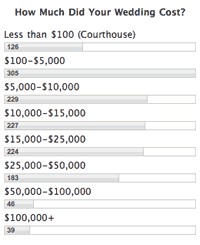
First, even though it could have been executed better, to the right are the results of my informal wedding cost survey. While there was a big spread, over 30% of people said they spent less than $5,000 on their weddings. Impressive! The median value was near $10,000.

Now, a few people asked me what we spent on our wedding. I’m sure more people were wondering, but weren’t so bold. 😉 I’ve actually avoided talking about this topic for a variety of reasons, the main one being that I don’t think I have anything especially helpful to offer on this front! However, I’m sharing all kinds of money stuff already, so why not throw it out there and see what happens…

Weddings Are Very Personal
Weddings are tricky. They involve the expectations, cultures, and traditions of two families, who might have completely different ideas of what a wedding “should” be. This is on top of what the media perpetuates as standard, in everything from wedding magazines to movies. As such, I try to refrain from forming opinions on what people should or should not do for their weddings. Everyone needs to find their own balance between wants and costs.

What We Spent
[Read more…]

Free Nights of Theater In October and November

In an effort to attract new audiences, a large group of America’s not-for-profit theaters are organizing a Free Night of Theater clustered around October 18th, 2007 in various locations nationwide:

In 2007 the Free Night program will be presented in Atlanta, Austin, Boise, Cincinnati, Cleveland, the state of Connecticut, Indianapolis, Kansas City, Lexington, Los Angeles, the state of New Jersey, the state of North Carolina, Oregon (in Ashland and Eugene), Philadelphia, Sacramento, San Diego, San Francisco, Seattle/Greater Puget Sound, South Carolina, Charleston, several states represented by Southeastern Theatre Conference, Washington D.C. and the state of Wisconsin.

Despite the somewhat confusing wording, it’s not necessarily confined to 10/18, but depending on the area may include multiple plays from different groups. For example, last year in the San Francisco Bay Area over 8,300 tickets were given away to 151 performances from 110 local companies, including “many of the region?s leading theatre producers, such as American Conservatory Theater, Berkeley Repertory Theatre, San Jose Repertory Theatre, TheatreWorks, Magic Theatre and California Shakespeare Theater, along with a host of smaller companies.”

It sounds like quite an event, and a good opportunity to get out and see something new. Check out the website for additional information and how to book tickets, as it is first-come, first-serve. Via Punny Money.

This Is Why I Hate Rebates…

altext

Wonder why you haven’t received your rebate? It might be because they just threw it away. Above are 1,300 unopened rebate forms that were dug out of a dumpster by a San Jose Mercury reporter (need a login?). Here is an excerpt:

I know that Shu Wong of San Jose hasn’t received the $3.50 mail-in rebate for a Vastech computer networking USB hub purchased at a Fry’s Electronics in May. Richard Louie of Austin, Olivia Sattaypiwat of Saratoga and Buu Duong of San Jose haven’t received their rebates, either.

I know this because they told me so, and because I am staring at more than 1,300 rebate requests sent to Vastech on Bonaventura Drive in San Jose. The envelopes were tossed – unopened – into a garbage dumpster near Vastech. I have two boxes of envelopes that were thrown out without being processed. In all of my years of reporting, I have never encountered such outrageous behavior against consumers.

Grrr. Did you know that rebate processing companies compete with each other based on their rebate rejection percentages? It’s part of their marketing materials… essentially “We reject more than the other guys, so go with us!” Makes you feel warm and fuzzy, no? Via the Consumerist.

Getting Out Of A Cell Phone Contract By Giving It Away

Want out of your 2-year contract early? Already tried the conventional methods of smooth-talking or catching them changing your contract? The next step may be to simply give it away.

At least that’s what the author of this Wall Street Journal article How to Dump a Cellphone Contract did. Apparently most carriers allow you to transfer your contract to another person, as long as they pass a credit check. To find a potential taker, the options range from sites that charge $20 like CellTradeUSA and CellSwapper, to the free sites Craigslist and FreeCycle. Thanks to KG for the tip.

It’s not quite as easy as it sounds… you will likely have to offer to either swap contracts or include your phone as an incentive. You’ll also lose your phone number. The author threw in her phone, a bunch of accessories, and $50 cash, which I guess is understandable as her contract had over a year left on it.

The winner? FreeCycle. In one day! I don’t know if they just got lucky, but it would seem prudent to use the free sites first. The pay sites entice you by dangling a bunch of communications from potential swappers, but you can’t get their info without paying.

This is what I’m wondering – if you already fulfilled your contract, wouldn’t that potentially be worth some money? Another user could simply hop on and go month-to-month. They wouldn’t get a discounted phone, but it’d be cheaper than most prepaid plans. Maybe I should have tried selling mine before jumping ship to Sprint SERO

How Much Did You Spend On Your Wedding?

A friend of mine wants to know. This survey is anonymous, so tell the truth! 🙂

{democracy:6}

I will follow up with a more detailed post next week. For the curious, various studies report the average cost of weddings in the US to be about $30,000, while the median is around $15,000. Those crazy celebrity weddings must throw off the averages, especially since everyone seems to get married three times each.

MagicJack VoIP Review: Equipment + 1 Year of Phone Service For Only $40?

Since my SunRocket service went bankrupt, I’ve been living with just a cell phone. It’s actually been fine so far, but I’m just not ready to give up on traditional phones just yet. I like having multiple headsets around the house and not having to worry about minutes (all those hold times for customer reps add up). My initial idea was to get a real phone number with Skype (~$60+/year) and getting a $50 D-Link USB Phone adapter that replicates a phone jack, but the reviews were hit and miss.

Then I ran across something similar by a start-up called MagicJack. It only cost $40 and includes one year of unlimited incoming/outgoing calls with free long distance. You can also call to the US from international locations, but you can’t call to international countries at all. At first, I was skeptical, but then a reader e-mailed me last week and said it works great. I figured, for $40, why not try it out? There’s even a 30-day return policy. Here are my experiences:

Ordering and Shipping
I found a coupon code ‘SUNROCKET’ that knocked off the $3.95 shipping, so I spent $39.95 total. I received prompt order and shipping confirmations via e-mail, and it arrived just 4 days later. It was shipped in a small padded envelope via First Class mail for $1.81 – very economical! See below for a picture of the unopened product.

First Impressions and Installation
This thing really is tiny! It’s the size of a Zippo lighter. One end is USB (and thoughtfully comes with a 1 ft. USB extension cord), and the other end is a phone jack. It only supports Windows XP and Vista, so Mac folks are out of luck for now.

When I first plugged it in, nothing happened. The 1-page manual said “Take it out, and try another USB port.” I did that, and a small blue light on the MajicJack turned on, and it started to self-install on my computer. No CDs required. It proceed to make sure my firewall was configured correctly, and then asked me some personal address info for 911 service and also to pick my phone number.

A catch is revealed! Here, I was disappointed to discover that you can only get phone number in selected area codes of selected states. Currently they are CO, DC, MD, MI, MN, NV, TN, VA, and WA (see screenshot below). Supposedly they are still adding more states and as they come along you can do a one-time switch to a new number. This should be more clearly listed on the website. 🙁 (e911 still works based on the address you supply.)

One partial workaround is to combine a GrandCentral number with this service. Grandcentral has a lot more area codes, but also doesn’t cover the entire country.

Still, in about 5 minutes I had a phone number assigned to me and was all set up. I plugged in my phone and amazingly enough, there was a dial tone. I called out… worked fine. I called in… and my phone rang. Nice! The voice quality was okay, not awesome and not awful, but that may be because I was doing this all via a wireless broadband connection. You can even switch it to work via computer headset, a la Skype.

Of course, there are negatives. You will need the computer to be on whenever you want your phone to work, so that may be annoying to some people. I also found that when I do reboot my computer, sometimes it takes a few tries to get it to start working again. You get voicemails sent to your e-mail address as .wav files, but there aren’t all of the different forwarding options and different rings that you might have gotten with SunRocket or other VoIP providers. I was also really hoping that my fax machine would work with MagicJack, but I haven’t had any successful transmissions yet.

Here’s another MagicJack review at DSLReports.

More Pictures

altext altext altext

Summary

Pros
» Cheap! $40 a year for unlimited domestic calling!
» Simple setup
» …Did I mention it was cheap?
Cons
» Limited number availabilty
» Must keep computer on at all times
» Faxing may not work
» Long-term viability is questionable
» Few bells and whistles

MagicJack essentially makes any traditional phone a USB plug-n-play phone. If you are willing to deal with the issues inherent in VoIP phones, this is a compelling product. If I had a local telephone number, this would be a slam dunk. It’s cheap enough that I’m willing to wait it out.

Another big issue is whether this sort of business model is sustainable. I mean, right now they are selling additional years of service for only $20! Can you smell another SunRocket meltdown? Do you really care if you break even after only two months? 🙂

Running On A Gilded Hamster Wheel

The New York Time recently published an article In Silicon Valley, Millionaires Who Don?t Feel Rich about people who have big savings and big salaries, but still keep working crazy hours:

Mr. Kremen estimated his net worth at $10 million. That puts him firmly in the top half of 1 percent among Americans, according to wealth data from the Federal Reserve, but barely in the top echelons in affluent towns like Palo Alto, Menlo Park and Atherton. So he logs 60- to 80-hour workweeks because, he said, he does not think he has nearly enough money to ease up.

?You?re nobody here at $10 million,? Mr. Kremen said earnestly over a glass of pinot noir at an upscale wine bar here.

Working inside a start-up has always been invigorating, she says. But she and her husband, 62, who also works, have concluded that she must stick with it if they are to continue to live the life they enjoy here. Recently the couple hammered out an agreement: Ms. Baranski will work at least five more years for the sake of their bottom line.

?People around here, if they have 2 or 3 million dollars, they don?t feel secure,? said David W. Hettig, an estate planner based in Menlo Park who has advised Silicon Valley?s wealthy for two decades.

The easy response, and my initial one as well, is “boo-fricken-hoo, cry me a river”. But it kept sticking my mind for some reason. Will I be like this? These people are obviously intelligent, but perhaps these people are stuck in their own little hamster wheel, albeit perhaps a nice Land Rover version. Work, spend, work, spend. When looking at the rich people around me, sometimes I think that the people who get to be millionaires at a young age are the same people who just need to keep working. More, more, more. I can only hope that I will know the meaning of “enough”.

Perhaps I should buy this USB hamster wheel, which spins when you type. Seems like a perfect daily reminder 🙂

altext altext