Reasons To Own Series I Savings Bonds

sb_posterSeries I Savings Bonds (aka “I Bonds”) are a unique investment sold directly to individuals by the US Treasury that pay out a variable interest rate linked to inflation. This post collects general reasons to own these savings bonds without going into the internal details of how they work. Please also see my related post Reasons To Own TIPS, Treasury Inflation-Protected Securities.

Backed by the US government and will never decrease in nominal value. If you buy an I Bond for $1,000, you’ll never get less than $1,000 back. Sometimes it’s nice to know that something will only go up in numerical value.

Pays interest that is the sum of a fixed rate and an inflation-linked rate. The fixed rate is set at purchase. The inflation-linked rate is reset every 6 months based on a preset formula tracking the CPI-U (Consumer Price Index for All Urban Consumers). This is unique and would come in helpful in times of unexpectedly higher inflation. I write about the upcoming I bond rate changes every 6 months as well.

Sold directly by US Treasury with no fees. You must either buy them directly online at TreasuryDirect.gov or via paper bonds via tax return. There are no purchase fees or annual maintenance fees.

Interest from I-Bonds are exempt from state and/or local income taxes. Same as with US Treasury bonds and TIPS.

Federal income tax on interest is not due until redemption. This means that you can defer paying taxes on accrued interest for up to 30 years. You don’t owe taxes until you cash out. This also means that you can time your eventual withdrawal during a year where you have the lowest tax rate (i.e. when your income drops after retirement).

Possible tax-free interest when used for qualified educational expenses. If you meet all the requirements, you can even avoid federal income taxes completely when paying qualified higher education expenses at an eligible institution. These include income phase-out limits.More information at this TreasuryDirect page. You can even contribute your proceeds to a 529 plan or Coverdell Educational Savings Account. Here are some tips from Finaid.org.

Series EE and I US Savings Bonds issued after December 31, 1989 may be redeemed tax-free in order to contribute the proceeds to a section 529 plan or Coverdell Education Savings Account. (To take advantage of this, file IRS Form 8815 to claim an exclusion for the interest after rolling the proceeds of these US Savings Bonds into a section 529 college savings plan or Coverdell Education Savings account. Write “529 College Savings Plan” or “Coverdell Education Savings Account” in the answer to 1(b), where it asks for the name of the educational institution. The specific citation in the tax code for this guidance is IRC Section 135(c)((2)(C).)

Reasons for NOT owning I Bonds.

  • There are purchase limits for I Bonds of $10,000 per person per year in electronic format. You can also buy an additional $5,000 in paper bonds per year using your tax refund with IRS Form 8888. If you have children, you may be able to buy additional savings bonds by using a minor’s Social Security Number.
  • The fixed rate has been low in recent years. Here, the inflation-linking may help you get an interest rate slightly above inflation, but after taxes, your net return may still lag inflation. For example if the fixed rate was zero and inflation was 2%, you would probably get less than a 2% return after taxes.
  • As with interest earned from bank accounts and taxable bonds, interest is eventually taxed at ordinary income rates. Long-term capital gains and dividends from stocks are usually taxed at lower rate.
  • You can’t redeem your savings bonds at all during the first 12 months. I believe there is a small exception if you can show yourself to be affected by an official natural disaster.
  • If you redeem within the first 5 years, you will be subject to an early redemption penalty of your last 3 months of interest.
  • TIPS are analyzed more deeply by financial professionals, and have not been found to lie on the “efficient frontier” curve. Thus, it is also unlikely that I bonds will optimal in that way.
  • You may not want to open and track a separate Treasury Direct account just to hold your I Bonds.
  • If you lose your online login and password to TreasuryDirect.gov and someone jumps through all the hoops necessary to steal your electronic I bonds, then the US Treasury will not reimburse you. If you lose paper bonds, there is a replacement policy.

TIPS vs. I Bonds.
Both have interest that both linked to inflation and is exempt from state/local taxes. You should compare the fixed rate from I Bonds with the current real rate in the TIPS market. Things that might make I Bonds more attractive than TIPS include the tax-deferral ability and the ability to avoid taxes when spent on qualified educational expenses. Things that might makes TIPS more attractive are the intra-day liquidity at all times and the ability to buy unlimited amounts via your choice of broker.

I own both TIPS and I Bonds in my personal portfolio. Inflation-protected bonds are part of my chosen asset allocation, and I prefer to use a lot of my tax-deferred account space for REITs. Series I Bonds allow me to own inflation-linked bonds in effectively a tax-deferred manner. I may also be able to use the interest tax-free for educational expenses as I have three young kids with 12-16 years to go before college.

Ally Invest Commission-Free ETF List Review (+ New Account Cash Bonus)

Ally Invest (formerly TradeKing) has rolled out their own commission-free ETF list to augment their $4.95 trades and no account minimums. As an existing customer, they sent a short e-mail with the following paragraph:

We’re excited to announce that you can now trade some of our most popular ETFs commission free. We made sure to handpick a variety of funds that may fit your investment style, whatever that may be. They’re a great way to diversify and another way we strive to be a better ally.

You can view the complete list of 100+ ETFs here. I see three major categories:

  • WisdomTree “Smart Beta” ETFs (all of them)
  • iShares Sector and ESG ETFs
  • 6 iShares Core ETFs

Low-cost index ETFs. Here are their lowest-cost ETFs across the major asset classes. There are enough iShares Core ETFs to build a simple, low-cost portfolio with no commissions. I might have wished to see IEMG instead of ESGE or some more bond options, but otherwise these are not bad for portfolio building blocks.

  • iShares Core S&P Total U.S. Stock Market ETF (ITOT) 0.03% ER
  • iShares Core MSCI International Developed Markets ETF (IDEV) 0.05% ER
  • iShares MSCI EM ESG Optimized (ESGE) 0.25% ER
  • iShares Core U.S. REIT ETF (USRT) 0.08% ER
  • iShares Core 1-5 Year USD Bond ETF (ISTB) 0.06% ER
  • iShares Core 10+ Year USD Bond ETF (ILTB) 0.06% ER
  • iShares Core 5-10 Year USD Bond ETF (IMTB) 0.06% ER
  • iShares National Muni Bond ETF (MUB) 0.07% ER

This list is certainly not as “all-inclusive” as compared to the just-announced Firstrade free trades program but it is still a positive move, especially for those that already have an Ally Invest account and don’t want to move assets. You may also have an Ally bank account and want to keep things together.

Commission-free ETF rules. There is a minimum holding period of 30 calendar days for commission-free ETFs, otherwise you will be charged a short-term trading fee of $9.90. This is equal to their normal trade commissions ($4.95 buy + $4.95 sell = $9.90). Commission-free ETFs will also not be margin-eligible for 30 days from the purchase date.

New account bonuses of $50 to $3,500. Ally Invest is still running their new account promotions of up to $3,500 cash bonus + 90 days of free trades. Here’s the chart, the bonuses start at a $10,000 transfer or deposit.

Up to $150 transfer fee credit. If you’re already trading somewhere else, Ally Invest will reimburse up to $150 in ACAT transfer fees if you make a one-time transfer of $2,500 or more.

These promotions are stackable, so for example if you had $25,000 at E*Trade, you could move your existing holdings over (without having to sell anything) and get a $200 bonus while also having Ally Invest cover the transfer fee. You’d then have 90 days of commission-free trades to sell and buy as you wish.

Finally, I noticed that Ally Invest has a new “Select” tier where you get cheaper $3.95 trades and $0.50 options contracts when you maintain an average balance of $100,000 (or average 30 trades per month) for the past rolling 3 months.

Bottom line. Ally Invest has added a commission-free ETF list, which includes a few popular low-cost iShares Core ETFs, several iShares Sector/ESG ETFs, and every single WisdomTree ETF (“Smart Beta”). This is a continuing trend amongst online brokers. Ally Invest also has new account cash bonuses from $50 to $3,500.

How Did GMO Asset Return Forecasts Actually Turn Out? 2011-2018

I’ve read Jeremy Grantham’s quarterly letters and the GMO 7-Year Asset Class Return Forecasts for over 8 years. (Anyone can sign up at GMO.com for free.) Grantham gained successively more fame after avoiding the Japanese bubble, the Dot-com bubble, and the Financial Crisis. Given the recent talk about record bull markets, let’s take a look back and see how accurate the most recently applicable GMO predictions turned out to be.

Let’s compare the GMO 7-year return forecast with reality, in this case actual returns from January 1st, 2011 to January 1st, 2018. Below is the forecast chart as of December 30, 2010. I looked up the closest ETF or mutual fund that I would have invested in for each asset class, and then found the total return via Morningstar or ETF Replay for 1/1/2011 to 1/1/2018. According to BLS.gov and SmartAsset, the total inflation during that same period was 1.6% to 1.7 annualized. I added the actual 7-year real returns onto the old prediction chart below.

(The blurred-out asset classes are basically special investments that GMO was selling to their institutional clients that the Average Jane could not have easily bought via ETF or mutual funds. Since they didn’t make their position clear in the beginning, it’s hard to judge the subsequent results.)

Some quick and simple observations:

  • US Large-Cap and US Small-Cap stocks did a lot better than forecasted. Compounded over the full 7 years, the difference was on the order of doubling your money vs. making nearly nothing.
  • International Developed Large-Cap and International Small-Cap stocks also did significantly better than forecasted.
  • Emerging Market stocks did significantly worse than expected.
  • Bonds did about as expected across the board.

Reading the commentary is always illuminating and helps me better understand their forecasts. Grantham has addressed these results here and there, but basically he still thinks a reversion to the mean will happen eventually. Here’s a quote from one of his recent quarterly letters:

“Relative to what we were thinking [in 2010], emerging equities have done surprisingly badly, and the U.S. equity market has done surprisingly well,” said Grantham. “Was that the luck of the draw, which has no bearing on future returns? Was it a temporary phenomenon that will soon reverse? Or does it tell us something important about emerging being a value trap and/or the U.S. being extraordinary that we need to take into account in our forecasting of the future?”

The short answer to these questions is that while emerging markets “deserved” some of their bad luck over the last several years and the outperformance of the U.S. has made some sense, we do not believe that emerging is a value trap, nor do we believe that the U.S. has proved itself particularly extraordinary.

Here’s GMO’s most recent forecast as of July 31st, 2018:

I understand the fundamentals behind these numbers, but I can’t help but think that if you keep calling for a drop long enough, it’ll happen eventually. There’s a reason why market timing is hard and why it’s called a “risk premium”. You never know exactly when the drops will come. All you might really be able to say is that a drop is more likely now than when people were worried in 2014, 2015, 2016, 2017… The rubber band is stretched, but it’s been stretching for a while and it could still stretch even longer.

Bottom line. Forward-looking stock return forecasts can be off. By a lot. Most of them rely on a reversion to historical average valuations, which doesn’t always happen in a timely fashion (who knows, maybe not ever all the way back?). Forward-looking bond return forecasts are made differently, and more likely to be kept within a tighter range. I sitll believe in simple diversification between stocks and high-quality bonds.

Mental Stress Test For a Severe Recession and Stock Market Crash

After my last quarterly portfolio update, I rebalanced back to my target asset allocation this week. I sold some US stocks and went from 70% stocks/30% bonds back to 67% stocks/33% bonds. (I bought a little Emerging Market stocks as well.) In preparation for living off my portfolio, I also recently increased my separate “emergency fund” to two years of household expenses.

This is all part of my normal investment plan, but current prices do show a market valuation that is pretty darn optimistic. If we get Vanguard’s expected asset class returns along with their projected inflation of a bit under 2% annualized, I’d be actually be fine with that.

Of course, the real fear is something much worse – a severe recession and extended bear market. I like to imagine this ahead of time and give myself a mental “stress test”. This is more about imagining your future behavioral responses than running fancy computer simulations.

A simple version of such a crash scenario is to imagine the following:

  1. Your stock holdings drop by half over a short period.
  2. Your bond holdings have zero total return for the same period.

Below again is a chart including multiple 50% drops.

risefall_720b

In addition, here is a JP Morgan AM slide that shows that sharp intra-year drops are much more common than you might think from just looking back at annual returns:

My personal portfolio is basically 33% US Stocks, 33% International Stocks, and 33% Bonds (33/33/33). In the crash scenario above, my portfolio balance would drop by 1/3rd and my new asset allocation would be 50% stocks and 50% bonds.

Based on past experience, I will probably find it difficult to keep buying stocks as they keep dropping. However, I will probably find it tolerable to hold on without selling. This might be a hoarder thing, although I actually don’t do that much with physical stuff.

How long could I hold out in a crash scenario? I think in term of “years of expenses”. First, I have my two years of expenses in cash. My withdrawal rate is 3%, so if I didn’t want to touch my stock holdings, I could withdraw funds out of my bond holdings alone and still have another 11 years of expenses (33% divided by 3). This would be my form of “rebalancing”. Instead of selling bonds and buying stocks, I’d just gradually sell bonds and buy food. 😉

In addition, my stock holdings would still distribute dividends. Right now the dividend yield is about 2%, but maybe in a severe recession the total dividend also drops to half of the original amount. Taking the cash, bonds, and depressed stock dividends together, I could go about 17 years without selling a single share of stock.

Hopefully, stocks will rebound well before 17 years pass. People like to point out that to get back to even after a 50% drop, you’d have to have a 100% rise. True. But look at the chart above again… 100%+ rises happen more frequently than 50% drops. It’s easy to forget how crazy the swings can be in both ways. Staying out of the market at the wrong time hurts too.

There are other options that are less fun and harder to count on. I could spend less money. Cutting back might come more easily when everyone else is cutting back as well. I could get more work. It might be harder to find a job in a severe recession, but even a lower-paying job would help.

Bottom line. This is my rambling stress test as someone planning to live off their portfolio for another 40+ years. Hopefully, you’ve gone through something similar that fits your situation. If you’ve got a good steady job, maybe it’s most important to ignore the noise and ABC (Always Be Contributing). Some retirees put 5 years of expenses into cash or bank CDs so they “know” that they can last 5 years without having to take money out of a depleted portfolio. If that sounds like a good idea, I’d do it sooner rather than later. There are many bank CDs earning around 3% APY right now.

Chase You Invest: 100 Free Stock Trades Details and Comparison

Chase just announced a new free stock trade program as part of a new online brokerage arm called You Invest. This means another megabank is moving more heavily into “relationship banking” where they hope you will keep your bank accounts, credit cards, brokerage accounts, and mortgage all at the same place. This is pretty significant as JP Morgan Chase is the largest US bank in terms of both market value and total customers (over 60 million).

According to CNBC, here are the offer details:

  • 100 free trades per year for the first year. Launches next week. Free trades must be done online or via app. Anyone can open a You Invest Trade account with no minimum balance requirement. You can fund with a Chase account or another external bank account.
  • After the first year, 100 free trades per year ongoing for those with $15,000+ in combined balances (Premier level). Assuming this matches up with their Premier banking rules, which I believe it should, the $15,000 includes both bank deposits and investment balances.
  • Unlimited free trades per year ongoing for Private Banking clients. The article says this typically requires at least $100,000 in combined balances. However, their Private Banking page says the requirement is $250,000. I suspect that the $100,000 combined limit means that (upcoming) Chase Sapphire Banking clients will qualify for unlimited trades.
  • In January 2019, Chase plans to launch a You Invest Portfolios service which is more of a robo-advisor that helps manage your portfolio for a fee.
  • If you exceed the free trade allotment, additional trades are $2.95 each.

Combining with other Chase products. In terms of credit cards, Chase has done well with their Chase Sapphire Preferred and Chase Sapphire Reserve cards. However, they currently don’t offer any bonus features if you have a bank or brokerage relationship. In terms of banking, Chase is also expected to launch a Sapphire Banking tier at the $100,000 total asset level. Chase also lets you qualify for their Premier Plus banking product via a Chase first mortgage with automatic payments.

The competition. Bank of America currently offers 30 free trades per month at their Platinum Preferred Rewards tier ($50,000 in total bank/investment assets) and 100 free trades/month at their Platinum Honors tier ($100,000 in total bank/investment assets). Bank of America offers a 50% bonus (Platinum) and 75% bonus (Platinum Honors) on eligible BofA Rewards credit cards. I moved over some assets to Merrill Edge specifically to qualify for the free trades and this bonus. So it worked on me for BofA, and it might work for Chase if they sweeten the pot enough.

Wells Fargo does not currently offer any free trades to banking customers with big balances, closing their program to new sign-ups in 2013. Citibank has been offering more bonuses on both their banking and credit cards, for example with the new Citi ThankYou Premier card.

Vanguard has just rolled out its free ETF trade program covering nearly all ETFs that they don’t think are too risky (leveraged and inverse ETFs). Fidelity also recently cut a lot of fees and minimums as well, some of which apply to their banking products. Vanguard, Fidelity, and Schwab all have commission-free trades on select low-cost index ETFs, on top of which they have been adding more banking features.

The Robinhood app offers unlimited free trades, free options trading, and a web interface now. A Chase executive threw some shade at them with the quote “There are customers out there who may not want to trust their credentials or their money to an app of the month”. Hah!

Reasons To Own TIPS, Treasury Inflation-Protected Securities

When it comes to constructing a portfolio, I used to think it was all about numbers and optimization. When you pick an asset class based on historical data, that assumes you hold through both the good times and the really bad times. It has helped me to keep gathering nuggets of knowledge over time to maintain my faith during those really bad times.

I’d like to start a series of posts to document why I own each specific asset class. Somebody asked me about TIPS the other day, so I’ll start with them. I’m not an investing professional, just a semi-retired DIY investor who wants to keep on learning and would like to share with other like-minded folks. I won’t get into the tiny details, mostly a lot of charts, links, and higher-level ramblings.

Treasury Inflation-Protected Securities (TIPS) are bonds issued by the US government that pay interest which is linked to inflation. Inflation is measured by the Consumer Price Index (CPI). In terms of a useful all-around primer, this Morningstar (M*) article 20 Years In, Have TIPS Delivered? covers a lot of the bases. For more nuts-and-bolts mechanics, see this older Vanguard paper Investing in Treasury Inflation Protected Securities. According to M*, TIPS currently make up about 9% of the overall Treasury market.

Here are my reasons for owning Treasury Inflation-Protected Securities (TIPS):

TIPS are backed by the US Government, just like the more common “vanilla” US Treasury bonds. With bonds, I prefer to stay on the safer end of the spectrum. Bonds are debt, and I don’t want to worry about if I get paid back. Buying US Treasury bonds is the lowest amount of credit risk possible.

TIPS provide a “real” inflation rate at purchase, which means it is guaranteed to provide a set return above inflation (before taxes) until maturity. Very few bonds are structured in this manner. In simplified terms, if the real interest rate is 2% and inflation is 3%, then the total interest paid will be 5%. Working backwards from that, you get the concept of breakeven inflation rate, or the expected inflation by the market (via M*):

The introduction of TIPS brought with it a market-determined observable real rate of interest, which is what the yield on a TIPS is. If you subtract the TIPS yield from the comparable-maturity nominal Treasury yield, you get the market’s inflation expectation over the period until maturity of these two bonds. This is called “breakeven inflation,” because it is the level of inflation at which returns for the nominal and inflation-indexed bonds should break even.

Here’s how the expected inflation and actual inflation compared for 5-year periods since 2003. For the most part, they have been pretty close:

TIPS thus provides insurance against *unexpected* inflation. TIPS are often described as an inflation hedge, but it’s more of a hedge against unexpected inflation. All bonds are already priced with inflation in mind. If everyone thinks inflation will be high, then bonds across the board will be priced to pay out more interest to counter that.

The reason why you don’t hear much about TIPS in the media is that over the last several years, there hasn’t been any unexpected inflation. If you bought fire insurance on your house, and your house hasn’t burned down yet, are you going to stop buying the fire insurance?

TIPS also provides a certain amount of protection in case of severe deflation. TIPS are guaranteed to return par at maturity, meaning they have floor value even in a case of severe deflation. This asymmetry helps make TIPS attractive relative to Treasuries, as best explained by this EconompicData post:

Thus, assuming a view that an inflationary and deflationary scenario are equally likely, the unlimited potential outperformance of TIPS vs. Treasuries in an inflationary environment and limited upside of Treasuries vs. TIPS in a deflation environment would sway an investor towards TIPS.

If inflation meets the market expectations, then TIPS and Treasuries will have the same return. If actual inflation is higher than the (expected) breakeven inflation rate, then TIPS will pay more than the regular Treasury bond. If actual inflation is less than the (expected) breakeven inflation rate, then TIPS will pay less than the regular Treasury bond. Here’s a simple graphic from AAII:

Here’s a 2008-2018 Morningstar chart comparing the growth of $10,000 between the Vanguard Intermediate Treasury Fund (VFITX) and the Vanguard Inflation-Protected Securities Fund (VIPSX). You can see while there is definitely a difference – sometimes one leads, sometimes the other – but over the last 10 years the net return has been very similar. Again, inflation has not been much higher (or a lot lower) than expected.

Do you think future inflation will be higher than the current expected number? Here’s the 5-year breakeven inflation rate for the last couple of years. Via WSJ Daily Shot.

If I had to bet, I would bet that the future inflation number will be higher than 2% then less than 2%. However, most likely they will return around the same amount. So this is not a huge risky bet. In terms of the big picture, it’s a relatively wimpy bet. I currently hold about 1/3rd of my portfolio asset allocation in bonds, and about 1/3rd of those bonds are invested in TIPS. That means about 11% of my total portfolio is in TIPS. If the real yields on TIPS were to go back higher to historical levels, I would go back up to 50% of bonds in TIPS.

Here are some reasons for NOT owning Treasury Inflation-Protected Securities (TIPS).

  • TIPS are not part of the efficient frontier. If you run an mean-variance blah-blah-blah optimizer, you won’t find TIPS on the ideal risk/return curve.
  • TIPS have a low historical correlation with stocks, but not as low as regular Treasuries – regular Treasuries are a better bet to go up when the stock markets crash.
  • TIPS have only been around for 20 years. You might argue that they have not been tested in severe high-inflation environment.
  • As with nominal Treasuries, the interest is taxable as ordinary income rates, not the lower dividend or long-term capital gains rates as with stock dividends. You’ll have to pay taxes on this interest every year – it can’t be deferred like if you buy a stock and hold it for a long time. If you buy individual TIPS, you’ll also have to pay income taxes on the inflation adjustment without actually getting the interest until maturity. This is called “phantom income” but can be avoided if you buy TIPS via an ETF or mutual fund. TIPS are thus generally recommended to be kept in tax-sheltered accounts. (TIPS interest is exempt from state and local taxes, however.)
  • Some people worry that the government will fudge the CPI numbers if high unexpected inflation really becomes a problem.

Vanguard 10-Year Expected Asset Class Returns (2018)

I was surprised to read the NY Times article Vanguard Warns of Worsening Odds for the Economy and Markets. Everything is written very carefully using odds so that there is no “prediction” that could be called “wrong” later on, but at the same time if there is a future recession, they will appear to have been “right”. I didn’t know that Vanguard did these sort of economic predictions or that they were deemed so noteworthy.

As the chart below reminds us, all bull markets must eventually come to an end:

risefall_720b

The question is, what is the point? What is actionable about this? You could view this article as encouraging market timing (sell stocks now!), or it could be a prudent reminder to rebalance and assess your risk exposure (sell a little stock now? maybe?). The latter is always a good idea, so let’s be generous and call it that. I wonder what Jack Bogle thinks. I mean, the title of his upcoming book about the history of Vanguard is Stay the Course.

For posterity, I wanted to record their expected 10-year (annualized) returns for the following asset classes (as of mid-2018):

  • US Stocks 3.9%
  • International Stocks 6.5%
  • US Total Bond (Corporate + Government) 3.3%
  • International Bonds 2.9%
  • Commodities 5.9%
  • US Treasury Bonds 3%
  • Cash 2.9%

These are nominal numbers. In another economic outlook article, Vanguard projects inflation to run slightly under 2% annualized.

Are You Quietly Losing Money via Your Brokerage Cash Sweep Account?

A recent WSJ article by Jason Zweig calls attention to one of the hidden ways that brokerage firms make money from you. As interest rates rise, they go out and earn the highest market rates while giving you a lot less on your idle cash. The difference adds up to big profits.

Brokerage accounts used to make you buy a money market fund with a high expense ratio. These days, they use a “bank sweep” account. They advertise the FDIC insurance, but hide the fact that they often own the bank and are skimming millions in interest:

In a bank sweep, your brokerage automatically rakes together and deposits your spare cash in one or more banks. Banks hand the brokerage a hefty fee, and the brokerage hands you some crumbs. For any given investor, a few dollars from dividends or interest income don’t amount to much. Rolled together with idle cash from thousands of other investors, they can add up to millions.

Morgan Stanley. Ameriprise. E-Trade. If you dig through Schwab’s disclosure, you’ll see them state that “In setting interest rates, the affiliated banks may seek to pay as low a rate as possible”. Nice.

Default options often prey on your inattention and laziness. Here are some ways to avoid the low interest rates of the bank sweep accounts.

  • Explore all your sweep options. Some places give you multiple alternatives for your cash sweep. For example, Fidelity has Fidelity Government Money Market Fund (SPAXX), Fidelity Treasury Fund (FZFXX), and FCASH. The two funds have SEC yields over 1.5% right now, while FCASH earns only 0.25% on balances under $100,000.
  • Keep your cash accounts empty automatically. You can set up automatic dividend reinvestment, or perhaps an automatic deposit of dividends into a high yield savings account. That should keep most of your interest and dividends from piling up as cash.
  • Manually reinvest often or transfer to alternative funds. Keep an eye on your cash balance, and invest it as soon as possible into stocks, bonds, or a higher-yielding money market fund alternative. Some accounts offer a text alert if you balance exceeds a certain amount like $1,000.
  • Move your assets to another firm. Vanguard still has a decent sweep option (VMMXX, see below). Fidelity still has two decent money market sweep options as well (SPAXX and FZFXX).

Vanguard isn’t incentivized to play these interest-skimming games. Vanguard’s only sweep account nowadays is the Vanguard Federal Money Market fund due to new regulations (read more here). Vanguard used to have better options as the default account, but at least the Vanguard Federal Money Market fund still earns a decent SEC yield of 1.87% (as of 8/8/18). If you want, you can still move money manually into the Vanguard Prime Money Market fund, Vanguard Municipal Money Market funds, and the Vanguard Treasury Money Market fund which may do better on an after-tax basis.

On the flip side, if you are individual stock investor, this is why higher interest rates are good for brokerage firms like Schwab. If you believe in the future of low-cost index funds, Fidelity and Vanguard are not publicly-traded, but you can become a shareholder in Schwab. Heck, Schwab has even set up their “free” robo-advisor to profit from higher interest rates due to a sizable cash allocation. (I do not hold Schwab stock at the time of this writing, but it is on my watchlist.)

Bottom line. Check the interest rate on your brokerage sweep account – It might be a lot lower than you think. Consider taking action.

How Did Total Bond and Treasury Bond Funds Perform During the Largest Stock Market Drawdowns?

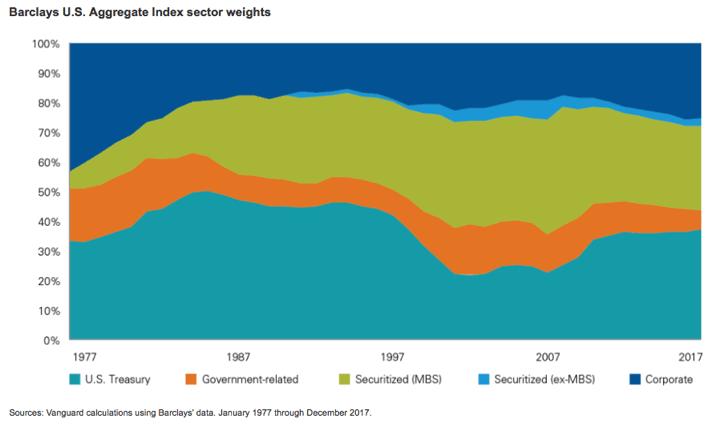
If you own bond mutual funds or ETFs, the most popular benchmark is the Bloomberg Barclays Aggregate Bond Index (AGG), which basically tracks all U.S. taxable investment-grade bonds, including US Treasury government bonds, investment-grade corporates, mortgage-backed bonds, and other asset-backed securities. The largest bond fund in the world is the Vanguard Total Bond Market Index Fund (VBMFX/VBTLX/BND), which tracks a slight variation of this index – the Bloomberg Barclays U.S. Aggregate Float Adjusted Bond Index.

In an Advisor Perspectives article, Eric Hickman compares the “Total US Bond” index (AGG) to a Treasury Bond-only index and finds that the overall returns are very similar for both, but Treasury bonds perform better during a market drop. Thus, he concludes that Treasury Bonds Are the Only Bonds You Need.

I wanted to save this chart that lists the returns of both AGG and Treasury bonds during the 10 largest S&P 500 drawdowns since 1976. He points out that 8 out of 10 times (and during all top 6 drawdowns), Treasury bonds outperformed the AGG index.

My personal takeaway was that both Total US and Treasury-Only did pretty well. Right now, AGG has ~42% in US Treasuries and 22% in US government mortgage-backed bonds. If you were a professional advisor or a really detailed DIY investor, then yes, there is an argument for Treasuries only. (Because they are all equally creditworthy, you could even build your own ladder of Treasury bonds with zero expense ratio.) But if you hold a “Total US Bond” fund inside your 401k or target retirement fund, I would still be satisfied that it has historically served its purpose as the safer “ballast” of your portfolio. Overall, I would definitely focus more on keeping your expense ratios low, as the numbers above don’t account for the deduction of fund expenses.

Fidelity Investments: Zero Expense Ratio Index Funds, Zero Account Fees

Fidelity Investments announced a bunch of “zero”-themed price and fee cuts across nearly all of their products:

  • Zero expense ratio mutual funds (two new Fidelity ZERO Index Funds)
  • Zero account minimums, zero account fees, zero domestic money movement fees
  • Zero investment minimums on Fidelity retail and advisor mutual funds and 529 plans
  • Lower expense ratios on many existing Fidelity index mutual funds

Fidelity ZERO Total Market Index Fund and (FZROX) and Fidelity ZERO International Index Fund (FZILX). These have zero expense ratio. Not nearly zero like 0.03%, but 0.00%. This was made possible partially because Fidelity is “self-indexing” and not paying any licensing fees to a 3rd party provider like the S&P 500.

  • Fidelity ZERO Total Market Index Fund and (FZROX) tracks the total US stock market, and is supposed to be comparable to the Vanguard Total Stock Market Index Fund (VTSMX) and the Schwab Total Stock Market Index Fund (SWTSX).
  • Fidelity ZERO International Index Fund (FZILX) tracks the total international stock market including foreign developed and emerging stocks. It’s supposed to compare with the Vanguard FTSE All- World, Ex-U.S. Index Fund (VFWIX) and Schwab International Index Fund (SWISX). I like that FZILX includes emerging markets. VFWIX does too, but SWISX does not include emerging markets.

More info on Fidelity index funds.

Zero minimums, zero account fees, domestic money movement fees. There is now no minimum amount required to open an account, buy a mutual fund, or maintain any account at Fidelity. Some of the account fees are nice to see gone as I have been dinged by them from other brokerages. For example: account transfer out fee, IRA closure fee, domestic bank wire fee.

Zero investment minimums. If you want to put $5 in a mutual fund, now you can. They want to get rid of all barriers to entry.

Notably, their trade commissions are holding steady at $4.95 a trade. They still have $0 commissions on select iShares and Fidelity ETFs.

Access to lowest-price share class. Although it didn’t fit neatly into their “zero” theme, another big move was that now all investors will get the lowest priced share class available. In the past, if you only put in $5,000 you might pay one price, and if you had $1,000,000 then you’d get a lower price. Vanguard still does this with their Investor and Admiral share classes. Now, everyone will get the lowest price regardless. Fidelity says the average asset-weighted annual expense across Fidelity’s stock and bond index funds will decrease by 35%, with expense ratios as low as 0.015%.

Bottom line. Fidelity just announced a big round of price cuts that basically shout “We’re cheap too!!” They added two new index funds with zero expense ratios, and they got rid of nearly all their account fees and minimum investments. This comes after Vanguard’s “all ETFs trade free with us” announcement and Schwab’s streak of “we have cheap ETFs” TV commercials.

Are You Worried About Investing at an All-Time Market High?

Maybe folks are worried about the yield curve, maybe it’s the political drama, or maybe they just feel it in their bones – I’ve been getting more questions about if I think now is still a good time to invest.

Well, here are some articles that may help you feel better:

What if You Only Invested at Market Peaks? by Ben Carlson. What if you were so unlucky as to invest only at the following market peaks (and suffering the subsequent drops)? As long as you kept on saving your money (putting it in cash when not at a market peak), and not selling at all, you would have actually done fine.

Meet Bob.
Bob is the world’s worst market timer.
What follows is Bob’s tale of terrible timing of his stock purchases.

Should You Invest (Or Wait) When The Stock Market Is At An All-Time-High? at Engaging-Data.com. Here is another interesting interactive tool that lets you pick any subsequent time period and see how the distribution of future returns compared if you invested at an all-time high (ATH) during that period. The market tends to spend a lot of time near all-time highs.

The key takeaway is that in the past several generations of investing, the market has done well and most of the time, the market is within 5% of its ATH. If you waited for a large dip to invest, you could be waiting for a long time and you would have missed out on a large amount of the gains.

Finally, here’s an older post to consider: The Only Two States of Your Portfolio: Happy All-Time High or Sad Drawdown.

Zero to $1 Million in 14 Years: Maxing Out 401k and IRAs from 2004-2017

Like many others, I had a vague goal of $1 million net worth in my 20s. It’s easy to find a theoretical path a million. For example, $750 per month earning 8% returns for 30 years with get you there. Doing the actual earning, saving and investing is the hard part. It gets even harder during a bear market when your money feels like it is burning up in flames.

On the list of “Things I Would Tell My Younger Self”, I would include “Be patient and keep saving. You’ll get there.” Or by changing up the phrase “Always Be Closing” popularized in Glengarry Glen Ross – “Always Be Contributing” (ABC). One of the major benefits of writing this blog was keeping my focus on this path.

This is how a real couple could have gone from zero to $1 million from 2004 to 2017. My spouse and I both had our first full year of full-time jobs in 2004. From 2004 to 2017, we contributed the maximum allowable limit to both of our 401k and IRAs each year. The contribution limits rose gradually over the years. (Company match is not included here.) We invested our money in low-cost index Vanguard funds – mostly stocks with a little bonds – which can be closely approximated by the Vanguard Target Retirement 2045 fund (ticker VTIVX). This fund had its share of ups and downs with the market. It crashed a lot in 2008 and 2009. It went back up a lot afterward. We just kept contributing and buying each year.

Using Morningstar tools, I found the final amount today if the limit was invested on January 1st of each year. For example, if both of us invested $16,000 in Vanguard Target Retirement 2045 at the beginning of 2004 ($13k + $3k), that investment would now be worth $104,144 as of June 30, 2018. And so on for each subsequent year. As you can see, if you add all the years up, you would reach over $500,000 for an individual and over $1,000,000 for a couple:

These numbers won’t be the same across other time periods, but they do represent a real-world experience. I’ve done a variation of this before in What If You Invested $10,000 Every Year For the Last 10 Years? 2008-2017 Edition.

According to Vanguard, 13% of their plan participants maxed out their 401k plans in 2017. 58% of participants had their entire account balance invested in a single target-date fund or similar managed allocation.

Bottom line. A real couple that started saving as 26-year-olds in 2004 and maxing out both their 401k and IRA plans each year could have reached $1 million by age 40 in 2018. All with a simple Vanguard Target Retirement index fund. This requires a lot of steady saving, but the important part is that it required no special investment skill. You didn’t need to recognize bubbles. You didn’t need to time bottoms. You didn’t need a fancy asset allocation, estimate future cashflows, understand price/book ratios, or even rebalance. Always be contributing.