 It might be a little painful, but it may be worthwhile to check on your pre-tax IRAs during this dip. If you have been thinking of converting your “Traditional” IRAs over to Roth IRAs, your shrunken gains will lead to a smaller tax bill now, while your (hopefully) future gains from this point onward will be tax-free after 5 years and age 59.5.
Roth IRAs have a few unique benefits like a lack of minimum required distributions, but the primary consideration regarding conversions is still whether you think your tax rate will be lower today or when you withdraw. This is outlined in greater detail in the WSJ article A Strategy for Taking Advantage of the Market Meltdown (paywall?). One interesting suggestion is to convert just enough money from a traditional IRA to make full use of your current income-tax bracket. Here are the 2020 IRS marginal tax brackets (source) – remember the left column is adjusted gross income so it comes after subtracting the standard deduction of $12,400 (single) and $24,800 (joint).

Depending on your income situation for 2020, you might have a good amount of room to convert and pay a 10%, 12%, or 22% rate. For example, a married couple could make up to $105,050 in gross income (before the standard deduction) and still be in the 12% bracket. You get the most tax-deferred benefit if you can pay for your tax bill with external funds as opposed to the IRA balance itself.
Backdoor Roth IRAs. In case you aren’t already aware, you can make a “backdoor” Roth IRA contribution even if you exceed the standard income limits on Roth IRA contributions. This is primarily because there are no longer any income limitations on Roth IRA conversions. There are some finer points that experts debate, but the general idea is that you first contribute to a non-deductible traditional IRA and then quickly convert that to a Roth IRA (ideally with no gains and thus tax owed). One catch is that if you already have other deductible pre-tax IRA balances, then these would mix together and you’d have to pay tax on a pro-rated basis.
Given the recent stock market drop, if you made non-deductible IRA contributions in the past few years, but your “Backdoor Roth” was complicated by also having some other pre-tax IRA balances mixed in (say, from a 401k rollover), then this might be a chance to convert everything over to a Roth IRA with much smaller tax consequences.
 If you are living paycheck-to-paycheck, by definition you aren’t saving and buying any assets. The folks who do have assets, those assets keep growing and compounding away. Left alone, that gap just widens relentlessly. Meanwhile, building up assets from nothing can feel agonizingly slow in the beginning.

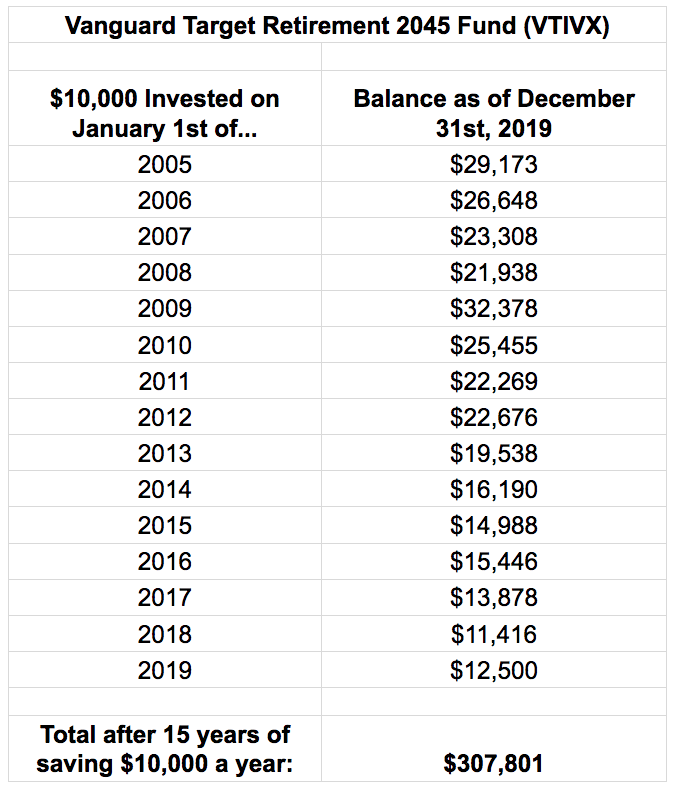
 The last 10 years of stock market returns have been pretty remarkable. If you invested $100,000 in the S&P 500 in the year 2000 and held it though the dot-com crash and financial crisis, you would be closing in on $300,000 today. However, if you retired in 2000 with a portfolio invested in the S&P 500 and used a 4% withdrawal rate (increasing each year by 3% for inflation), your nest egg would less than $50,000 and on a path to zero!
 Now that you’re done reading articles about




 I use a Solo 401k plan because it lets you contribute the most tax-deferred money for a modest amount of self-employed income. At the end of each year, I can more clearly estimate my total income for 2019 and thus my maximum contribution limits. There are several online calculators out there (try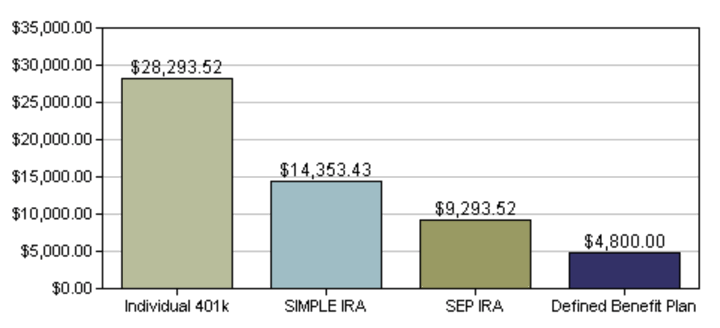






 The Best Credit Card Bonus Offers – 2026
 Big List of Free Stocks from Brokerage Apps
 Best Interest Rates on Cash - 2026
 Free Credit Scores x 3 + Free Credit Monitoring
 Best No Fee 0% APR Balance Transfer Offers
 Little-Known Cellular Data Plans That Can Save Big Money
 How To Haggle Your Cable or Direct TV Bill
 Big List of Free Consumer Data Reports (Credit, Rent, Work)