How to Retire Happy, Wild, and Free (Book Notes)

retirehappy

After finishing the book How to Retire Happy, Wild, and Free by Ernie Zelinski, I am surprised at how unique it is. After all these years, this may be the first book I’ve read that directly explores the non-financial aspects of retirement. There are no historical rates of return, compound interest charts, or income strategies. Consider:

  • How will you create meaning in your life?
  • What activities will you keep your mind and body in top shape?
  • Who will you spend your time with?
  • What kind of environment do you want to surround yourself?

I’ve already written about two interesting points inside: Listing 10 activities you’d like to do in retirement, and the differences between a retirement activity and a job. Here are the rest of my book notes.

On going back to some form of paid work after official retirement:

A research study released in 2001 by Cornell University psychologists found that, particularly for men, employment after official retirement is beneficial for their psychological wellbeing. Those who retire from their primary career, but then find some sort of other work, are the happiest and suffer the least depression. Surprisingly, the researchers didn’t find much difference for women who go back to work after retiring versus those who don’t. No reasons were given for this important difference between the sexes.

On separating yourself from your job:

Many professionals miss their personal career space and some have been known to rent office space after they have retired to maintain their routine and sense of importance. They’ll tell their friends “Call me at the office,” just so they have a place to go.

For most of us, who we are, is based on what we do. If we become too dependent on this mind-set and our job ends, we lose our sense of identity. So before, or soon after retirement, we need to redefine who we are in a positive and meaningful way. Recycle yourself.

To help with this separation, try listing your five best traits that have nothing to do with work. Here are some possible examples:

ambitious
well-organized
hard-working
creative
kind
passionate
generous
joyful
loving
spontaneous
connected to others
good sense of humor
peaceful
inner happiness
spiritual

On figuring out how to spend your time instead of work. Ask yourself these questions:

  • What gift do I give naturally to others?
  • What gift do I most enjoy giving to others?
  • What gift have I most often given to others?

Some people don’t need any help in this area. They are ready to sail around the world, then bike around the world in reverse, and so on.

However, many others do need some help creating a fulfilling retirement. This book can help. Perhaps you keep on working because you can’t imagine retirement, or you have already retired but find yourself in a funk. The initial “I’m finally freeeeeeeee!!” has worn off. You might even be a little depressed from the social isolation or lack of structure in your life. This book can help.

Personal Capital Review: Automatically Track Net Worth and Portfolio Asset Allocation

Personal Capital is free financial website and app that links all of your accounts to track your spending via bank and credit cards, investments, and net worth. You provide your login information, and they pull in the information for you automatically so you don’t have to type in your passwords every day on 7 different websites. Personal Capital’s strength is in investments, including portfolio tracking, performance benchmarking, and asset allocation analysis.

Net worth. You can add your home value, mortgage, checking/savings accounts, CDs, credit cards, brokerage, 401(k), and even stock options to build your customized Net Worth chart. You can also add investments manually if you’d prefer. I have a habit of accumulating bank and credit union accounts, so I find account aggregation quite helpful.

Cash flow. The Cash Flow section tracks your income and expenses by pulling in data from your bank accounts and credit cards. This chart compares where you are this month against the same time last month. If you hate budgeting, you may find it easier to view a real-time snapshot of your spending behavior. Their expense categorization tool is pretty accurate, and if it isn’t you can change it manually. However, it isn’t quite as advanced as Mint.com, where you for example you can make a rule to always classify “Time Warner Cable” as “Utilities” and not “Online Services”.

Portfolio. This is where Personal Capital is better than many competing services, by analyzing my overall asset allocation, holdings, and performance relative to benchmarks. If you’re like me, you have investments spread across multiple custodians. I now have investments at Vanguard, Fidelity (401k), Schwab, TransAmerica (401k), and Merrill Edge. It’s nice to be able to see everything together in one picture. They can also analyze your retirement accounts fees to see if you are quietly getting charged too much.

For comparison, Mint did not allow manual input of investments and it did not break down my asset allocation correctly based on my linked accounts. In fact, all it shows is a big orange pie chart with “99.9% Not Sure” and “0.00 Other”.

Personal Capital considers the major asset classes to be US stocks, International stocks, US Bonds, International Bonds, and Cash. The “Alternatives” classification includes Real Estate, Gold, Energy, and Commodities.

If you have one bank account, one credit card, and a 401(k), you may not need this type of account aggregation service. Life tends to get messy though, and this helps me maintain a high-level “big picture” view of things.

Security. As with most similar services, Personal Capital claims bank-level, military-grade security like AES 256-bit encryption. The background account data retrieval is run by Envestnet/Yodlee, which partners with other major financial institutions like Bank of America, Vanguard, and Morgan Stanley. Before you can access your account on any new device, you’ll receive an automated phone call, email, or SMS asking to confirm your identity. Their smartphone apps are compatible with Touch ID/Face ID on Apple and mobile PINs on Android devices.

In terms of the big picture, my opinion is that by making it more convenient, I am able to keep a closer eye on all my account and thus actually make myself less likely to be affected by a security issue.

How is this free? How does Personal Capital make money? Notice the lack of ads. Personal Capital makes money via an optional paid financial advisory service, and they are using this as a way to introduce themselves. (People who sign up for portfolio trackers tend to have money to manage…) They are a hybrid advisor, combining their online tools with real human access. Their management fees are 0.89% annually for the first $1 million, with slightly lowered pricing as you go past $1 million in assets. As an SEC-registered RIA fiduciary that now manages over $7 billion, I think this improves their credibility as a company built to handle sensitive information.

Note that if you give them your phone number, they will call you to offer a free financial consultation. If you answer the phone or e-mail them that you don’t want to be contacted anymore, they will honor that request. Or you could ask them your hardest financial question and see how they respond. However, if you simply ignore the phone calls, they will keep calling. Now, you can keep using the portfolio software for free no matter what happens. But, if you aren’t interested, I would highly recommend simply being upfront with them. A simple “no thank you” and you’re good.

If you’re upfront with them, they’ll be upfront with you. I’m still a DIY guy when it comes to my money, and they have been happy to keep monitoring my accounts for free, without any additional phone calls over the last 5 years.

Bottom line. It’s not what you make, it’s what you keep that counts. The free financial dashboard software from Personal Capital helps you track your net worth, cash flow, and investments. I recommend it for tracking stock and mutual fund investments spread across different accounts. I’d link your accounts on the desktop site, but interact daily through their Android/iPhone/iPad apps for optimal convenience (log in with Touch ID or mobile-only PIN).

Motivation: Take Advantage Of Being 29, 39, 49, or 59 Years Old

40greatI’m turning 40 years old this summer. This number has always been a psychological marker for me. I’ve always wanted to be financially secure and have started a family by age 40. According to this Atlantic article by Daniel Pink*, I’m far from the only one. Consider marathons:
Four people in four different professions living in four different parts of the world, all united by the common quest to run 26.2 miles. But something else links these runners and legions of other first-time marathoners. Red Hong Yi ran her first marathon when she was 29 years old. Jeremy Medding ran his when he was 39. Cindy Bishop ran her first marathon at age 49, Andy Morozovsky at age 59.

All four of them were what the social psychologists Adam Alter and Hal Hershfield call “nine-enders,” people in the last year of a life decade. They each pushed themselves to do something at ages 29, 39, 49, and 59 that they didn’t do, didn’t even consider, at ages 28, 38, 48, and 58—and didn’t do again when they turned 30, 40, 50, or 60.

The article contains several other insights that definitely applied to me. According to Alter and Hershfield:

“People are more apt to evaluate their lives as a chronological decade ends than they are at other times,” Alter and Hershfield explain. “Nine-enders are particularly preoccupied with aging and meaningfulness, which is linked to a rise in behaviors that suggest a search for or crisis of meaning.”

According to psychologist Clark Hull:

At the beginning of a pursuit, we’re generally more motivated by how far we’ve progressed; at the end, we’re generally more energized by trying to close the small gap that remains.

You could tell yourself that being 29 is no different than being 28 or 30, or you can just use this behavioral quirk to reach your goals. I’ve been working on “closing the gap” in terms of getting all my financial affairs in order. Here are all the things that I’ve been working on as a 39-year-old:

  • Created a system to simulate a monthly “paycheck” so that things run smoothly and the bill gets paid even if I am not around to micromanage things (like I usually do). Dividends and interest flow to the emergency fund/cash buffer (savings account), which then automatically transfers a set amount each month to our day-to-day checking account.
  • Beefed up our cash buffer. As part of the above-mentioned system, I increased our cash hoard to two years of expenses in FDIC-insured savings accounts and CDs. The idea is that this buffer “bucket” feeds the checking account, but also gets replenished by income and interest from our portfolio. As larger upfront expenses like a home repair or used car purchase comes up, the buffer can take a hit. The dividends come in quarterly spurts. The buffer allows us to handle shocks without disruption.
  • Re-examined term life insurance. We are currently 10 years into a 30-year term policy with a level premium. We technically don’t need to replace any lost income anymore, so we considered canceling this policy. However, we decided that if something were to happen to one of us, we would still need to pay someone to replace childcare duties for three children. I don’t know how other single parents do it, but I know that I’d need help!
  • Moved some missing assets into revocable living trusts for estate planning purposes. When we created this trust, we were mostly concerned about having a plan in place to take care of the children in case something happened to both of us. After you create a trust, you must manually move/retitle all your various brokerage accounts into it, and the paperwork can be a pain.
  • Consolidated accounts. I still have a penchant for collecting new financial accounts, but I’ve also closed a bunch this year. Our grandparents used to hide money in jars around the house. I like to buy shares of Berkshire (BRK) and put them in brokerage accounts (often involving a bonus, and BRK gives off no dividends to worry about at tax time). I started over a decade ago with Sharebuilder (now Capital One Investing) and most recently got $5 worth from Stash.
  • Bought a used 2015 Toyota minivan so that we have a reliable family vehicle for the next 10 years. I love sliding doors. I hate the inconvenience of a car breakdown.
  • Started and put some money into a 529 plan for each kid. The amount isn’t enough to cover four years of college, we’ll just have to see how much it can grow as compared to tuition. I read somewhere that you should plan to save 1/3rd, fund 1/3rd from annual income, and leave the last 1/3rd for scholarships, grants, or student loans.

Everything on this list was being putting off because it was unpleasant. Most either dealt with the prospect of early death/severe disability, or annoying paperwork. The prospect of turning 40 got me over the hump. Next decade: Marathon at age 49?

* The article is actually an excerpt from his new book When: The Scientific Secrets of Perfect Timing.

Why Pursue Financial Freedom: Fulfilling Retirement Activity vs. Ideal Job

retirehappy

How to Retire Happy, Wild, and Free by Ernie Zelinski continues to offer smart observations on retirement. For example, when people are working, their idea of leisure is often passive: watching TV, listening to music, shopping, or eating at restaurants. However, in retirement, they need to replace all the intangibles besides money that working provided.

The Academy of Leisure Sciences has 8 criteria for finding a good leisure activity in retirement:

  1. You have a genuine interest in it.
  2. It is challenging.
  3. There is some sense of accomplishment associated with completing only a portion of it.
  4. It has many aspects to it so that it doesn’t become boring.
  5. It helps you develop some skill.
  6. You can get so immersed in it that you lose the sense of time.
  7. It provides you with a sense of self-development.
  8. It doesn’t cost too much.

Did you know even know the Academy of Leisure Sciences existed? Another new tidbit from this book.

My observation is that these are also same characteristics of a good job. Think of your own job and read it again:

  1. You have a genuine interest in it.
  2. It is challenging.
  3. There is some sense of accomplishment associated with completing only a portion of it.
  4. It has many aspects to it so that it doesn’t become boring.
  5. It helps you develop some skill.
  6. You can get so immersed in it that you lose the sense of time.
  7. It provides you with a sense of self-development.
  8. It pays enough to support your lifestyle.

Of course, this brings you to why saving up money to reach financial freedom is a worthy pursuit. The list of things that satisfies the top 8 leisure criteria should be pretty long. It might take a few tries to find something that fits, but you could play any sport, learn to cook, speak a new language, and so on.

However, adding the criteria that it has to pay you makes the list much shorter, perhaps non-existent. Compare picking up cycling for personal enjoyment vs. getting paid as a professional cyclist. Learning how to smoke some decent backyard BBQ vs. getting paid as a professional caterer. Start to speak a new language vs. becoming an (adequately-paid) French teacher. I’m sure some lucky people out there really do have a perfect job where they are getting paid for something that they would “do for free”. However, most of us don’t, so that’s where financial freedom comes in to remove that money requirement.

Non-Financial Retirement Planning: List 10 Retired Activities

retirehappyEver notice that every book on “How to Retire” is really just about how to accumulate a big pile of money? I’m currently in the middle of How to Retire Happy, Wild, and Free by Ernie Zelinski, which contains absolutely nothing about mutual funds, real estate, or safe withdrawal rates. Instead, it deals with the non-financial aspects of retirement. What does that mean? Well, many retirees spend at least some time being quite unhappy. They haven’t solved the other retirement problems:

  • How will you create meaning for yourself?
  • What activities will you keep your mind and body in top shape?
  • Who will you spend your time with?
  • Where is the best environment to live?

A recommended exercise is to write down the 10 favorite interests and activities that you would like to pursue in retirement. At the same time, write down how much time you are presently spending on these activities. If you are not spending any time pursuing these activities before retirement, the experts say that you are unlikely that you will spend much time on these activities after you quit work. Many people are surprised when their retirement is completely different from they imagined. They may become bored, aimless, lonely, and/or depressed. A surprisingly large number go back to work!

You need to develop activities as part of your retirement planning, BEFORE you retire. Here’s my list of favorite activities, along with time currently spent.

  1. Time with kids. Chasing bugs and jumping in muddy puddles. Learning new things with them. (Almost enough)
  2. Cooking at home. Becoming a better cook. Know what I’m eating. (4-6 hours a week)
  3. Time with spouse. Enjoying their company. (Not nearly enough)
  4. Play tennis. Social interaction and physical exercise. (3-6 hours a week)
  5. Keep learning about investing and finance. (Enough)
  6. Entertain friends at house. Cook for them. Socialize. (Very little)
  7. Read books. (2-3 hours a week? A little each day)
  8. Build an off-grid shed. Power from solar PV. Tinker with batteries and wind turbines for fun. Water catchment. Composting toilets? (None)
  9. Raise fish and/or chickens. I like to read about chicken tractors and backyard fish farms. (None)
  10. Travel. So much left to see out there. (Few weeks a year)

Right now, most of our non-work time is spent on toddler childcare, so many of these activities are being neglected. This list is a good reminder that I need to work harder on maintaining good relationships my wife, family, and friends. Once all the kids are in pre/school, we’ll see if I actually get around to the rest. Maybe the experts are right and I’ll never build that self-sustaining tilapia farm…

Reader Question: Tracking Asset Allocation Across Multiple Investment Accounts

portpie_blank200Here’s a reader question regarding my most recent portfolio asset allocation update. It has been edited for clarity and to remove personal details by request:

Thank you for posting the quarterly finance updates. I would like to do something similar to track the returns by asset class but unfortunately, I have my funds across multiple accounts. Some of my funds are in Roth, Rollover IRA and a 401k from current employer. My wife has her funds in similar retirement accounts. How do I consolidate all my investment funds to get a holistic view and correct asset allocation? Also, how do I get Vanguard funds when my 401k options are limited?

First of all, everything may look neater in my updates, but I also have my funds spread across multiple accounts. My wife and I have funds spread across Roth IRA, Traditional IRA (at least temporarily), 401k/403b, Self-Employed 401(k), taxable brokerage accounts, savings bonds, and bank CDs.

Here are the details on how I do my quarterly update.

1803_pc2b

  1. I pull up my custom Google Spreadsheet and make a fresh duplicate of the most recent worksheet. I change the label to a brief datestamp so the labels aren’t too wide. “17.12” indicates December 2017, “1803” indicates March 2018, and so on. I keep all my old snapshots as tabs. This is handy because I can go back and remember what my portfolio looked like back in March 2009, for example.
  2. I log into each individual account one-by-one directly at the provider website. I could use an aggregator, but I do this just to make sure my addresses/passwords are correct in my trusty password manager and everything looks right. No new sub-accounts, no errors, new secure messages, etc. I pull up my holdings and type in the balances manually into the proper asset class cell. The spreadsheet adds them up.
  3. For most of my funds, the asset class is readily available. For example, I know that the Vanguard Emerging Markets Stock Index fund is going under “Emerging Markets”. If you aren’t sure or if the fund includes multiple asset classes (Target Retirement fund, LifeCycle fund, etc), you can either use a service like Personal Capital (free registration required) for a quick-and-easy analysis or Morningstar X-Ray (free TRP registration required) for a manual-but-deeper analysis.
  4. For the most part, the spreadsheet does the rest. The pie charts automatically update to show me my overall holistic breakdown. It shows me how far off I am from my target values, both in terms of percentage and dollar amounts.

trackaa1

When your 401k options are limited, here’s how I would pick the best choice available. I would start by narrowing it down to the cheapest index funds available. Look at all the expense ratios. These days, at least one should be under 0.30%. You can verify using the ticker symbol on Morningstar. For example, for a while my best 401k option was a proprietary S&P 500 index fund. So I bought that, and adjusted my holdings elsewhere. Later on, they added Vanguard Total International Stock index fund and a Schwab brokerage window. There are probably 10-15 other funds on the menu that I have no interest in owning. A Target fund might be the most reasonable choice. Remember to roll your 401k over to an IRA when you switch employers.

My Money Blog Portfolio Asset Allocation, March 2018

portpie_blank200

Here is a First Quarter 2018 update for my primary investment portfolio. These are my real-world holdings, not a recommendation. It includes tax-deferred 401k/403b/IRAs and taxable brokerage accounts and excludes our primary home, cash reserves, and a few side investments. The goal of this portfolio is to create enough income to cover our regular household expenses. As of 2018, we have started the phase of “early retirement” where we are spending some of the dividends and interest from this portfolio.

Actual Asset Allocation and Holdings

I use both Personal Capital and a custom Google Spreadsheet to track my investment holdings. The Personal Capital financial tracking app (free, my review) automatically logs into my accounts, tracks my balances, calculates my performance, and gives me a rough asset allocation. I still use my custom Rebalancing Spreadsheet (free, instructions) because it tells me where and how much I need to direct new money to rebalance back towards my target asset allocation.

Here is my portfolio performance for the year and rough asset allocation (real estate is under alternatives), according to Personal Capital:

1803_pc1b

1803_pc2b

Here is my more specific asset allocation, according to my custom spreadsheet:

1803_spread1

Stock Holdings
Vanguard Total Stock Market Fund (VTI, VTSMX, VTSAX)
Vanguard Total International Stock Market Fund (VXUS, VGTSX, VTIAX)
WisdomTree SmallCap Dividend ETF (DES)
WisdomTree Emerging Markets SmallCap Dividend ETF (DGS)
Vanguard Small Value ETF (VBR)
Vanguard Emerging Markets ETF (VWO)
Vanguard REIT Index Fund (VNQ, VGSIX, VGSLX)

Bond Holdings
Vanguard Limited-Term Tax-Exempt Fund (VMLTX, VMLUX)
Vanguard Intermediate-Term Tax-Exempt Fund (VWITX, VWIUX)
Vanguard High-Yield Tax-Exempt Fund (VWAHX, VWALX)
Vanguard Inflation-Protected Securities Fund (VIPSX, VAIPX)
iShares Barclays TIPS Bond ETF (TIP)
Individual TIPS securities
U.S. Savings Bonds (Series I)

Target Asset Allocation. Our overall goal is to include asset classes that will provide long-term returns above inflation, distribute income via dividends and interest, and finally offer some historical tendencies to balance each other out. I personally believe that US Small Value and Emerging Market will have higher future long-term returns (along with some higher volatility) than US Large/Total and International Large/Total, although I could be wrong. I don’t hold commodities futures or gold (or bitcoin) as they don’t provide any income and I don’t believe they’ll outpace inflation significantly. I also try to imagine each asset class doing poorly for a long time, and only hold the ones where I think I can maintain faith.

Stocks Breakdown

  • 38% US Total Market
  • 7% US Small-Cap Value
  • 38% International Total Market
  • 7% Emerging Markets
  • 10% US Real Estate (REIT)

Bonds Breakdown

  • 50% High-quality, Intermediate-Term Bonds
  • 50% US Treasury Inflation-Protected Bonds

I have settled into a long-term target ratio is 67% stocks and 33% bonds (2:1 ratio) within our investment strategy of buy, hold, and rebalance. With a self-managed, simple portfolio of low-cost funds, we minimize management fees, commissions, and income taxes.

Real-world asset allocation details. For both simplicity and cost reasons, I am no longer buying DES/DGS and will be phasing them out whenever there are tax-loss harvesting opportunities. New money is going into the more “vanilla” Vanguard versions: Vanguard Small Value ETF (VBR) and Vanguard Emerging Markets ETF (VWO).

I’m still a bit underweight in TIPS and REITs mostly due to limited tax-deferred space as I don’t want to hold them in a taxable account. My taxable muni bonds are split roughly evenly between the three Vanguard muni funds with an average duration of 4.5 years. I have been seriously thinking of going back to US Treasuries due to changes in relative interest rates and our marginal income tax rate.

My stock/bond split is currently at 69% stocks/31% bonds. I continue to invest new money on a monthly basis in order to maintain the target ratios. Once a quarter, I also reinvest any accumulated dividends and interest that we did not spend. I don’t use automatic dividend reinvestment. First of all, we spend some of our dividends now. In addition, I can usually avoid creating any taxable transactions unless markets are really volatile.

Performance and commentary. According to Personal Capital, my portfolio has basically broken even so far in 2018 (-0.70% YTD). I see that during the same period the S&P 500 has lost 0.63% (excludes dividends) and the US Aggregate bond index has actually lost 1.55%.

An alternative benchmark for my portfolio is 50% Vanguard LifeStrategy Growth Fund (VASGX) and 50% Vanguard LifeStrategy Moderate Growth Fund (VSMGX), one is 60/40 and one is 80/20 so it also works out to 70% stocks and 30% bonds. That benchmark would have a total return of -0.98% YTD (as of 4/9/18).

In a separate post, I’ll share about more about the income aspect.

Graphic: The Fall of Pensions, The “Rise” of 401ks and IRAs

pension401kIRA

Above is a historical chart of US household retirement assets that helps visualize the shift from mostly pensions to mostly a combination of defined contribution plans (401k, 403b, etc) and IRAs. Pension share has gone from nearly 80% of total assets in the 1980s to about 40% today. The blips upwards in 2001 and 2009 are more a function of stock market drops than anything else. I find it interesting that annuity use is not increasing at all, i.e. people are not creating more “DIY pensions”. Found via WSJ Daily Shot.

Below is a graphic of the percentage of households who have any retirement plan at all, grouped by income percentile. This means it counts any family with one person with any retirement plan of any type with any amount saved. Via Bloomberg article about state-mandated Roth IRAs.

ira_bloomberg

My big-picture concern is – What happens when those who started jobs in the 1980s and 1990s retire in the 2030s and 2040s with no pensions? As shown above, the majority of the lowest-income workers have no retirement plan at all. If you include the highest-paid workers, the average 401(k) at retirement age is currently about $100,000. In contrast, I ran an annuity quote and a pension that pays $50,000 a year inflation-adjusted is roughly the equivalent of having $1,000,000 saved in a 401(k).

More individuals are finding themselves in charge of their own retirement every day, whether they like it or not. This is a very serious responsibility. Warren Buffett has a plaque in his office with the following saying on it:

A fool and his money are soon invited everywhere.

Lots of money floating around means lots of “helpers” will pop up. Big banks. Start-up smartphone apps. Even Overstock.com now wants to help you with investing. Read the Gotrocks parable and beware high-fee helpers.

NYT Financial Tuneup Day 4: Retirement

nyt_ftuDay 4 of the NY Times 7-Day Financial Tuneup is about retirement. (Sign up for your own personalized tune-up here.) This assumes you are eligible for a 401(k) or similar retirement plan. The key action point is bumping up your retirement contribution rate by 1% and perhaps adjusting your asset allocation if necessary. Here’s a simple chart showing you why:

nyt_tuneup_ret1

If you’re making $50,000 annually and contributing 5 percent of your salary to your retirement account, assuming an annual return of 6 percent and a 3 percent annual salary increase, in 25 years, you will have about $198,000 in your retirement account. If you start to increase that percentage by 1 percentage point annually however, you will have over $550,000 in that same account in 25 years. By increasing the amount you save by 1 percentage point each year, you’ll save an extra $354,940 for retirement.

Increase Your Savings

  • Log into your retirement savings account. (Baby steps…)
  • Increase the amount of money taken out of your paycheck by 1 percentage point annually. Also check to see if you are taking full advantage of any company match.
  • Make it automatic. If you have the option, set it to automatically escalate in the future.

Rebalance Your Account

  • Log into your retirement savings account.
  • Determine how you should rebalance your account. What is your target asset allocation? Here’s mine but it’s probably more complicated than most people need. Consider a target-date fund, especially if it is a low-cost, passive version. Fidelity, Vanguard, and Schwab all have solid versions. I put my own mom in the Vanguard one.
  • Make it automatic. If you have the option, set it to automatically escalate in the future. My provider calls it “Auto-Increase”.
  • Rebalance your account. Basically, make sure your portfolio is still what you want it to be, as it may have shifted over time. You only need to do this once or twice a year, or you can set “bands” to rebalance when things get too out of whack.

Action, action, action. This move won’t make you save enough for retirement by itself, but it’s something tangible. If you are really going for financial freedom, you should use this as a platform to do even more. We have our 401k savings rate already set at 60% (max allowed by one provider) since we are working part-time (“semi-retired” sounds better!) with a lower income but still want get as close to the annual 401k limits as possible.

Financial Tuneup Recap (still in progress)

Study: Working Longer vs. Saving More

savebuttonbankHere’s a working paper titled The Power of Working Longer by Gila Bronshtein, Jason Scott, John B. Shoven, Sita N. Slavov which compares the effect of working longer (delaying your retirement date) and increasing your savings rate while working.

The basic result is that delaying retirement by 3-6 months has the same impact on the retirement standard of living as saving an additional one-percentage point of labor earnings for 30 years. The relative power of saving more is even lower if the decision to increase saving is made later in the work life. For instance, increasing retirement saving by one percentage point ten years before retirement has the same impact on the sustainable retirement standard of living as working a single month longer.

Update: I read the full paper and here’s my view. For most households earning less than $100,000 a year with average savings rates, Social Security changes matter more than returns on investment portfolio. What really matters is delaying Social Security and getting the resulting higher monthly income for life. For most people, that’s the same as working longer as they can’t just wait around without a paycheck.

If you are close to retirement, chances are that working longer is the best practical solution to improving your financial outlook. Working longer means your portfolio grows a bit more hopefully, your Social Security check gets bigger, and your retirement length gets shorter (annuities pay more).

However, if you are young, it is quite easy to tell yourself today that you’ll simply work a bit longer far in the future. When the time comes, you may not be given the option of working longer either due to job loss or disability. If you take this too far, you could just tell yourself that you’ll simply work until you die and you won’t have to save anything at all.

You can pay $5 for the full paper, or you may be able to get free access if you have a .edu or .gov e-mail address.

Free Social Security Calculator Tool: Estimate Your Benefits

socialsecuritycardThere are some (mostly young) skeptics, but Social Security should remain a major pillar of your future retirement income. For over 60% of current retirees aged 65+, Social Security makes up the majority of their income. Therefore, it may be worth spending some extra time figuring out how it works.
First, you should sign up for a mySocialSecurity account at SSA.gov. For many people, this is the only way to view your current benefit eligibility as they are phasing out those annual green paper statements. You will find some interesting information including eligible earnings history. (For example, I earned $1,814 in the summer after high school.) Also, if you claim your account first, it prevents an potential identity thief from opening an account in your name and stealing your benefits.

Second, you can check out this unofficial Social Security helper tool to test out different scenarios. Created by an Google engineer named Greg Grothaus in his spare time, the site takes your earnings history and uses Javascript to analyze it within your browser. No data is submitted over the internet. Found via The Finance Buff.

Here are some scenarios you might test out:

  • What happens to my benefit if I earn additional wages for several more years? What if I stop working forever?
  • How does my benefit change as my total earnings grow during my lifetime?
  • What happens if I choose to take my benefits early? What if I delay and take them late?

You might not know that your eventual benefit is based on your top 35 annual indexed earnings values. Indexed earnings are simply the payroll wages you earned in a year multiplied by a number that adjusts for wage growth. I personally don’t even have 35 working years yet, so every additional year I work will be in my “Top35” and increase my future payout. Here are some charts based on my earnings history:

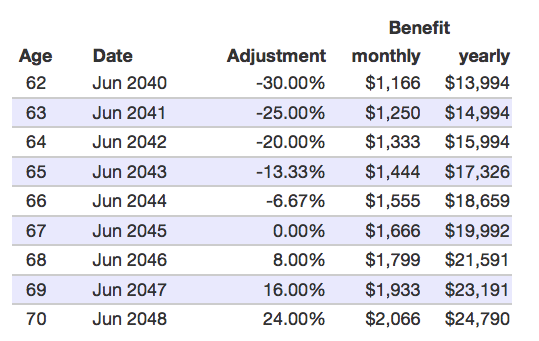
If I stop working immediately and then start taking benefits at my “normal” retirement age of 67 years, I will earn $1,666 per month ($19,992 per year). If I start taking money at age 62, I will earned a reduced $1,166 per month ($13,994 per year). Here’s the full chart:

sstool1

If I keep working for another 20 years at $50,000 per year, then my age 67 benefit will increase to $2,328 per month ($27,936 per year). If I start taking money at age 62, I will earned a reduced $1,630 per month ($19,555 per year). Here’s the updated full chart:

sstool2

Working/waiting an extra year may increase your payout enough to change your lifestyle significantly. An extra $100 per month may not seem that much, but that’s an extra $1,200 each year for the rest of your life that increases with inflation. If you don’t have adequate income from other sources, that could cover your medication copays for the year. It could be the difference between staying home and doing a video chat vs. flying and playing with your grandkids in person each year.

If you are on the early retirement track, that inserts a bunch of zeros in your “Top 35”. With this calculator, you can see how much that actually changes your eventual payout. Even if I continued to work another 25 years at $100,000 per year, my annual benefit at age 67 would be about $33,000 per year.

As a reminder, both SSA.gov and this tool only show you what your benefit will be under current law. Social Security isn’t a savings plan – current retirees are being paid from money taken from current workers. This means that changing demographics will require some sort of modification by 2035. From the Chief Actuary of the Social Security Administration:

Currently, the Social Security Board of Trustees projects program cost to rise by 2035 so that taxes will be enough to pay for only 75 percent of scheduled benefits. This increase in cost results from population aging, not because we are living longer, but because birth rates dropped from three to two children per woman. Importantly, this shortfall is basically stable after 2035; adjustments to taxes or benefits that offset the effects of the lower birth rate may restore solvency for the Social Security program on a sustainable basis for the foreseeable future.

401k Millionaire By Age 45: How Was It Possible?

millWith the ongoing bull stock market, more people are reaching $1,000,000 balances in their 401k every day. However, a more extreme claim is that someone reached this mark at age 45 with total employee contributions of only $300,000. Is that really possible? Let’s take a look at what would need to fall into place for that to happen…

Consistently high contributions from salary. If you divide $300,000 by a theoretical 25 years of savings, that works out to $12,000 per year. That is within 401k historical contribution limits, but even with 25 working years, that means nearly maxing out your 401k contributions every single year. (Employer company matches don’t count and can push you above that limit.) According to Redditor Subject_Beef, s/he indeed saved regularly in 1995 with contributions close to the max most years. Consider that only about 10% of participants max out their 401ks each year, and most of those people were over the age of 45.

401kmill

High investment gains. Next, you must have the growth of $300,000 to $1,000,000, which would require a high stock allocation, avoidance of a prolonged bear market, and not panicking during market losses. Even with a lump-sum invested 25 years ago, going from $300k to $1000k would require a compound annual growth rate of 6.2%. However, with a 401(k), you have to do this through regular contributions and dollar-cost-averaging over time. Therefore, the actual growth rate would have to be significantly higher than that. By my rough calculations, the average would have to have been around 9% annually. The current asset allocation was shown to be roughly 37% S&P 500 Index fund, 33% US Small Cap Stock Index fund, and 30% International Stock Index fund. The annualized return of the S&P 500 has been about 10% over the last 23 years, so the numbers are quite possible.

No IRA rollovers. Finally, you’d need a steady career as most people who change companies either cash out or roll their 401(k) funds into an IRA with more flexibility. It is possible to do repeated 401k-to-401k rollovers, which is apparently the case here. I can’t think of too many compelling reasons to do so besides enabling the Backdoor Roth IRA. This is also why I don’t think tracking aggregate 401k balances is a good way to measure savings or wealth. People move funds out of 401ks into IRAs all the time.

Altogether, I believe this story and the numbers do check out. However, this is not a common occurrence given the factors above that have to align. The poster does mention a significant employer match that would have help increase the effective contributions above $300,000 and make it a bit more realistic for an average worker. In any case, becoming a 401(k) millionaire by age 45 is an impressive accomplishment.