Backdoor Roth IRA: Now Officially Supported by Congressional Intent?

rothheartIn 2010, the tax laws were changed to eliminate the income limits on conversions from Traditional IRAs to Roth IRAs. Since Roth IRAs still have income limits on direct contributions, this opened up a “backdoor” where high-income individuals could first contribute to a non-deductible Traditional IRA and then immediately convert to a Roth IRA. If there were no capital gains upon conversion, there would be no taxes due. Thus, the term “Backdoor Roth IRA”.

Some financial experts fretted about the legality of this move due to something called the step transaction doctrine. Some financial advisors instructed people to take special steps to help ensure the legitimacy of their Roth IRA conversions. You also have to be careful if you have other Traditional IRA accounts that you are not rolling over (“IRA aggregation rule”).

Even with all this discussion, there was never any official acknowledgement of this tax move. In past years, there were explicit budget proposals that would have curbed this option. Some argued that this talk itself was implicit acknowledgement that it was legal. Confused yet?

Apparently, the official acknowledgment finally came with the new tax law when they stopped allowing Roth IRA recharacterizations (undos). According to this Forbes article Congress Blesses Roth IRAs For Everyone, Even The Well Paid, a conference committee report by Congress included the following footnotes. Thanks to reader Abel for the tip.

268 Although an individual with AGI exceeding certain limits is not permitted to make a contribution directly to a Roth IRA, the individual can make a contribution to a traditional IRA and convert the traditional IRA to a Roth IRA, as discussed below.

269 Although an individual with AGI exceeding certain limits is not permitted to make a contribution directly to a Roth IRA, the individual can make a contribution to a traditional IRA and convert the traditional IRA to a Roth IRA.

276 The provision does not preclude an individual from making a contribution to a traditional IRA and converting the traditional IRA to a Roth IRA. Rather, the provision would preclude the individual from later unwinding the conversion through a recharacterization.

277 In addition, an individual may still make a contribution to a traditional IRA and convert the traditional IRA to a Roth IRA, but the provision precludes the individual from later unwinding the conversion through a recharacterization.

Do these footnotes end all speculation? Ed Slott seems to think that this indicates “intent” by Congress, and he is a respected tax source. The same conclusion is also drawn by Natalie Choate in this Morningstar article.

Both my wife and I have made non-deductible Traditional IRA contributions every year since 2010. I think if it was really an “unintended loophole”, they would have closed it by now (as with Social Security benefits). I am not a tax professional, I’m just a guy who wishes we didn’t need experts to interpret every little thing. If there were any people who needed additional convincing, perhaps this will give them the confidence to proceed.

Charlie Munger’s Life as a Financial Independence Blueprint

blueprintCharles Munger is probably best known as the Vice Chairman of Berkshire Hathaway and partner of Warren Buffett. The University of Michigan Ross School of Business recently shared a hour-long talk with Munger on YouTube (embedded below). Munger has plenty of mentions on this site already, but my main takeaway from this talk was a more nuanced overview of his early years and how he personally achieved financial independence before really getting involved with Warren Buffett.

Here is a summary of my notes from the talk:

  • He was not born poor, but he was also not born into exceptional wealth. Munger wanted to go to Stanford for undergrad, but his father encouraged him to go to the University of Michigan as it was still an excellent school but more affordable. He ended up dropping out after only one year in 1943 to serve in the US Army Air Corps.
  • Military service, then law school. After World War II, he took college courses with the GI Bill and eventually went to Harvard Law School (getting accepted even though he never earned an undergraduate degree).
  • Successful law career. He practiced as a successful real estate lawyer until he achieved about $300,000 in assets. This was 10 years of living expenses for his family at the time (he now had a wife and multiple kids). At this point, he started doing real estate development at the same time. When this took off, he stopped practicing law.
  • Successful real estate development. When he achieved about $3 to $4 million in assets, he also wound down his real estate development firm. He was now “financially independent” but still mostly anonymous.
  • At this point, he decided to become a “full-time capitalist”. This last stage is what led him to his current status as a billionaire philanthropist. Along with his work with Warren Buffett and Berkshire Hathaway, he was also the chairman of Wesco Financial, which also grew to be a conglomerate of different wholly-owned businesses along with a carefully-run stock portfolio. Wesco Financial eventually became a wholly-owned subsidiary of Berkshire Hathaway.

Using Charlie Munger’s life as a blueprint, here’s a pathway towards financial independence.

  • Work hard, get an education, develop a valuable skill. Munger didn’t start Facebook from his dorm room or trade penny stocks in high school. He served in the military, earned a law degree, and went to work everyday for years. At this point, work means exchanging your time for money, but hopefully at a good hourly rate.
  • Use that work career and save up 10x living expenses. Munger called himself a “cautious little squirrel” saving up a pile of nuts. He dutifully saved his salary while supporting a family and kids (and some other personal family drama that a luckier person wouldn’t have to deal with). I don’t think you’ll need 10x if you don’t have a family to support.
  • To accelerate wealth accumulation, you can now take some more risk and start some sort of business. You need something that scales, something that’s not paid per hour. Munger did real estate development. If you look at people who got wealthy quickly, nearly all of them are business owners of some type.
  • At some point, your investments will enough money to support your living expenses. This is financial independence. It doesn’t matter what you do during the day, as you earn enough money while you’re sleeping. However, many people choose to continue doing one of the paths above: (1) employee-based career, (2) active business management, or (3) actively managing their investments.

Bottom line. Charlie Munger offers up great words of wisdom in this talk. He reminds us that our choice in marriage is much more important than our choice in career. He reminds us that just showing up every day and plugging away will yield great dividends over time. He reminds us that easy wealth without work is not a good thing for society. (He also says to give Bitcoin a wide berth.)

However, you can also learn a lot by noting and observing his actions. Munger was not a huge risk-taker. He grew his wealth in steps and never exposed his family to possible ruin. He worked hard for a long time and only became extraordinarily rich and famous later in his life. He primarily wanted to be independent “and just overshot”.

What If You Invested $10,000 Every Year For the Last 10 Years? 2008-2017 Edition

keepcalmInstead of just looking at one year of returns, here’s an annual exercise that helps you look at the bigger picture. You may know the 10-year historical return of the S&P 500, but most of us didn’t just invest a big lump sum of money a decade ago, and most of us don’t just invest in the S&P 500.
Investment benchmark. There are many possible choices for an investment benchmark, but I chose the Vanguard Target Retirement 2045 Fund. This all-in-one fund is low-cost, highly-diversified, and available in many employer retirement plans as well open to anyone with an IRA. In the early accumulation phase, this fund is 90% stocks (both US and international) and 10% bonds (investment-grade domestic and international). I think it’s a solid default choice where you could easily do worse over the long run.

Investment amount. For the last decade, the maximum allowable contribution to a Traditional or Roth IRA has been roughly $5,000 per person. That means a couple could put away at least $10,000 a year in tax-advantaged accounts. If you have a household income of $67,000, then $10,000 is right at the 15% savings rate mark.

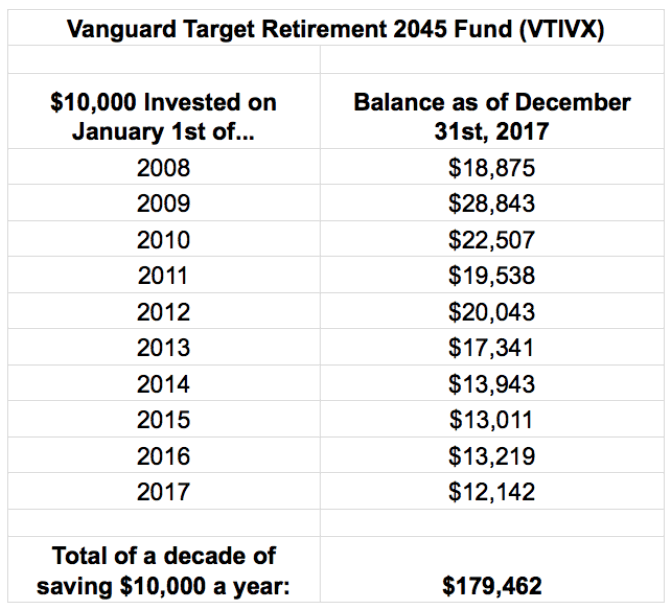
A decade of real-world savings. To create a simple-yet-realistic scenario, what would have happened if you put $10,000 a year into the Vanguard Target Retirement 2045 Fund, every year, for the past 10 years. You’d have put in $100,000 over time, but in more manageable increments. With the handy tools at Morningstar and a quick Google spreadsheet, we get this:

2008-2017x10k

For every $10,000 you put in annually over the last 10 years, you would have a ~$80,000 investment gain on top of the $100,000 in contributions. For example, if you were a couple that both maxed out their 401k and IRAs at roughly $20k each or $40k total per year, that would leave you with a gain of roughly $360,000 over the last decade (and a total balance of $760,000).

Some of that money was invested right before the crash in 2008/2009, and some has only been in the market for a few years. $10,000 invested in the beginning of 2008 would have dropped down to $5,500 in value before the rebounding. Not every year will turn out to be as good as this year, but taking it all together provides a more balanced picture.

Earn money, save a big chunk of it, and then invest it in your choice of productive assets. Keep calm and repeat. The investment side of our path to financial freedom can be mostly explained by such behavior. (Add in maxing out a 401(k) each year as well if you can.) Something as accessible and boring as the Vanguard Target Retirement Fund can make you rich. You don’t need a secret trading strategy or exclusive hedge fund manager.

My Money Blog Portfolio Asset Allocation, 2017 Year-End Update

portpie_blank200

Here is a year-end update on my investment portfolio holdings for 2017. This is my last-minute checkup in case I need to rebalance to make another other tax-related moves. This includes tax-deferred 401k/403b/IRAs and taxable brokerage holdings, but excludes things like our primary home, cash reserves, and a few other side investments. The goal of this portfolio is to create enough income to cover our regular household expenses.

Actual Asset Allocation and Holdings

I use both Personal Capital and a custom Google Spreadsheet to track my investment holdings. The Personal Capital financial tracking app (my review, join free here) automatically logs into my accounts, tracks my balances, calculates my performance, and gives me a rough asset allocation. I still use my custom Rebalancing Spreadsheet (instructions, download free here) in order to see exactly where I need to direct new investments to rebalance back towards my target asset allocation.

Here is my portfolio performance for the year and rough asset allocation (real estate is under alternatives), according to Personal Capital:

1712_pc1

1712_pc2c

Here is my more specific asset allocation, according to my custom spreadsheet:

1712_portpie

Stock Holdings
Vanguard Total Stock Market Fund (VTI, VTSMX, VTSAX)
Vanguard Total International Stock Market Fund (VXUS, VGTSX, VTIAX)
WisdomTree SmallCap Dividend ETF (DES)
WisdomTree Emerging Markets SmallCap Dividend ETF (DGS)
Vanguard Small Value ETF (VBR)
Vanguard Emerging Markets ETF (VWO)
Vanguard REIT Index Fund (VNQ, VGSIX, VGSLX)

Bond Holdings
Vanguard Limited-Term Tax-Exempt Fund (VMLTX, VMLUX)
Vanguard Intermediate-Term Tax-Exempt Fund (VWITX, VWIUX)
Vanguard High-Yield Tax-Exempt Fund (VWAHX, VWALX)
Vanguard Inflation-Protected Securities Fund (VIPSX, VAIPX)
iShares Barclays TIPS Bond ETF (TIP)
Individual TIPS securities
U.S. Savings Bonds (Series I)

Target Asset Allocation. Our overall goal is to include asset classes that will provide long-term returns above inflation, distribute income via dividends and interest, and finally offer some historical tendencies to balance each other out. I don’t hold commodities futures or gold (or bitcoin) as they don’t provide any income and I don’t believe they’ll outpace inflation significantly. I also try to imagine each asset class doing poorly for a long time, and only hold the ones where I think I can maintain faith.

Stocks Breakdown

  • 38% US Total Market
  • 7% US Small-Cap Value
  • 38% International Total Market
  • 7% Emerging Markets
  • 10% US Real Estate (REIT)

Bonds Breakdown

  • 50% High-quality, Intermediate-Term Bonds
  • 50% US Treasury Inflation-Protected Bonds

I have settled into a long-term target ratio is 67% stocks and 33% bonds (2:1 ratio) within our investment strategy of buy, hold, and rebalance. With a self-managed, simple portfolio of low-cost funds, we minimize management fees, commissions, and income taxes.

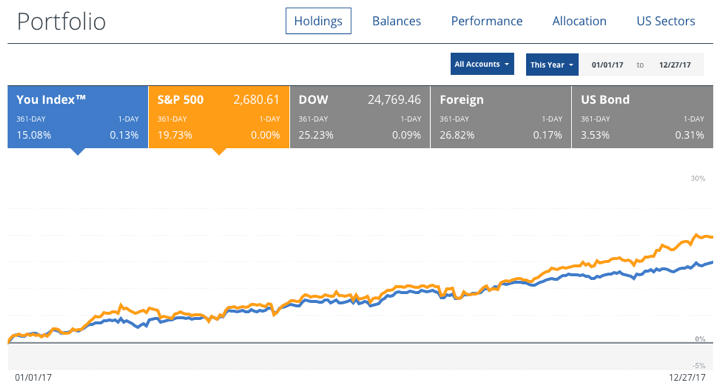
Performance, details, and commentary. According to Personal Capital, my portfolio has gained 15.08% overall in 2017 (with a few days left to go). In the same time period, the S&P 500 has gained 19.73% (excludes dividends) and the US Aggregate bond index has gained 3.53%. For the first time in a while, my sizable allocation to developed international and emerging markets stocks has boosted my overall return.

My stock/bond split is currently at 70% stocks/30% bonds due to the continued stock bull market. I continue to invest new money on a monthly basis in order to maintain the target ratios. Once a quarter, I also reinvest any accumulated dividends and interest. I don’t use automatic dividend reinvestment. This way, I can usually avoid creating any taxable transactions unless markets are really volatile.

For both simplicity and cost reasons, I am no longer buying DES/DGS and will be phasing them out whenever there are tax-loss harvesting opportunities. New money is going into the more “vanilla” Vanguard versions: Vanguard Small Value ETF (VBR) and Vanguard Emerging Markets ETF (VWO).

I’m still somewhat underweight in TIPS and REITs mostly due to limited tax-deferred space as I don’t want to hold them in a taxable account. My taxable muni bonds are split roughly evenly between the three Vanguard muni funds with an average duration of 4.5 years. I may start switching back to US Treasuries if my income tax rate changes signficantly.

Is Taking All Your Money Out of the Stock Market Ever A Good Idea?

timemoneylogoIf you enjoy financial success stories from people with modest incomes, check out the Time Money article I Took All My Money Out of the Stock Market and It Feels Amazing. Yes, the title is a bit clickbaity, but it’s still worth a read.

Rosalind Warren combined her personal savings with a modest inheritance, invested it in low-cost index funds, and left it alone for a long time. These are exactly the three things that the prudent DIY investor is supposed to do. (She even used Vanguard index funds. Future spokesperson?)

Here’s how $10,000 invested in the mentioned Vanguard Balanced Index Fund would have done since its 1992 inception (via Morningstar):

vbinx

The frugal librarian is now age 62 with a paid-off house, no debt, and a “high six-figure” nest egg. However, she differs from the prototypical retiree in that she recently sold off all her stocks:

I once figured out exactly how much money I would need to live on — not lavishly, but comfortably — for the rest of my life. I promised myself that once I had that amount, I would actually do just that — take my money out of the market and live on it for the rest of my life.

Last week, I reached that goal.

I’m 62. I’ve spent decades caring about the market. I counted on it to make me enough money so that I’d be able to cash in my chips and walk away when I hit retirement age.

And so it did.

And now? It’s time for this librarian to declare victory and get the hell out.

Having zero stock holdings is not something that would usually be recommended by professional financial planners. Most would recommend at least some small allocation to stocks. But you know what? If you read the entire article, Warren shows that she has done her research and appears to understand the angles. She’s not stuffing the money in a mattress. She’s not panicking or predicting a crash. She’s shown that she can control her spending.

Her portfolio now consists of U.S. Treasuries, Treasury Inflation-Protected Securities (or TIPS bonds), and laddered CDs. First, this shows she knows that the biggest danger of not having any stocks is inflation. Second, it also shows she has the financial knowledge to counter that risk. If she’s holding TIPS and laddering CDs with the top rates, her money should at least keep up with inflation (although she admits it won’t grow much past that).

Even if her portfolio only manages to barely keep up with inflation and she lives another 33 years to age 95, simple math shows that she can still theoretically take out 3% a year (100% divided by 33). I don’t know exactly what “high six-figures” means, but $800,000 times 3% = $24,000 per year. There is the possibility that she might need more money than that, but there’s also the possibility that stocks perform even worse than her bonds/CD portfolio. She’s also still working and not taking withdrawals yet.

I don’t see any problem with not holding any stocks in this specific situation. Rosalind Warren has a steady job she intends to keep working at, the ability to defer Social Security until age 70 (maxing out her lifetime inflation-linked benefit), no debt, a paid-off house, and another $20,000 to $30,000 a year she can withdraw in the future. Equally important, not having to pay attention to market fluctuations gives her peace of mind. What do you think?

Vanguard Interactive Ad: $1 Million Is Closer Than You Think

vg_1mil

Vanguard has a new full-page interactive ad in the NY Times online with the heading $1 Million Is Closer Than You Think. This is one of those expensive ads that I feel ambivalent about as a investor-owner of Vanguard. I’d rather they rely on word-of-mouth (like from yours truly) and focus more on the customer experience. Will the slick design attract new money and lower expense ratios? At least it promotes the types of things that I support:

  • Save more. Increase your regular contributions. Track your overall saving rate.
  • Keep costs low. Watch your management fees and other costs affecting your portfolio.
  • Stay the course. Don’t react to the market and chase what’s hot.

Early Retirement Income Update 2017 Q3: Do I Have Enough Yet?

dividendmono225

How do you know when you portfolio is enough to retire on? You have to figure out a withdrawal strategy first. This is a tricky question and full of worries about running out of money. You could take out a fixed amount (i.e. $50,000 a year). You could take out a fixed percentage (i.e. 4% a year). You can adjust for inflation. You can implement upper or lower guardrails.

Personally, I appreciate the behavioral reasons why living off income while keeping your ownership stake is desirable. The analogy I fall back on is owning a rental property. If you are reliably getting rent checks that increase with inflation, you can sit back calmly and ignore what the house might sell for on the open market.

I’ve also come to feel that dividend yield can be a quick-and-dirty way to adjust your withdrawal rate for valuation. For example, if the price of S&P 500 index goes up while the dividend payout stays the same, then wouldn’t it be prudent to simply spend the same amount? Check out the historical S&P 500 dividend yield via Multpl. Focus the last 20 years – the yield was highest in the 2008 crash and lowest in the 2000 tech bubble.

sp500dy_1710

Now check out the absolute dividend amount (inflation-adjusted), also via Multpl:

sp500d_1710

Note that if you only buy “high-yield” stocks and “high-yield” bonds, that actually increases the chance that those yields will drop sooner or later. I am trying to reach some sort of balance where I spend the income on a “total return” portfolio.

Even the venerable Jack Bogle advocated something similar in his early books in investing. He suggested owning the Vanguard Value Index fund and spending only the dividends as way to fund retirement.

One simple way to see how much income (dividends and interest) your portfolio is generating is to take the “TTM Yield” or “12 Mo. Yield” from Morningstar (linked below). Trailing 12 Month Yield is the sum of a fund’s total trailing 12-month interest and dividend payments divided by the last month’s ending share price (NAV) plus any capital gains distributed over the same period. SEC yield is another alternative, but I like TTM because it is based on actual distributions (SEC vs. TTM yield article).

Below is a very close approximation of my most recent portfolio update. My current target asset allocation is 66% stocks and 34% bonds, and intend that to be my permanent allocation upon early retirement.

Asset Class / Fund % of Portfolio Trailing 12-Month Yield (Taken 10/23/17) Yield Contribution
US Total Stock
Vanguard Total Stock Market Fund (VTI, VTSAX)
25% 1.85% 0.46%
US Small Value
Vanguard Small-Cap Value ETF (VBR)
5% 1.81% 0.09%
International Total Stock
Vanguard Total International Stock Market Fund (VXUS, VTIAX)
25% 2.57% 0.64%
Emerging Markets
Vanguard Emerging Markets ETF (VWO)
5% 2.34% 0.12%
US Real Estate
Vanguard REIT Index Fund (VNQ, VGSLX)
6% 3.90% 0.23%
Intermediate-Term High Quality Bonds
Vanguard Intermediate-Term Tax-Exempt Fund (VWIUX)
17% 2.81% 0.48%
Inflation-Linked Treasury Bonds
Vanguard Inflation-Protected Securities Fund (VAIPX)
17% 2.99% 0.51%
Totals 100% 2.53%


If I had a $1,000,000 portfolio balance today, a 2.5% yield means that it would have generated $25,000 in interest and dividends over the last 12 months. (The muni bond interest in my portfolio is exempt from federal income taxes.) Some comparison numbers (taken 10/23/2017):

  • Vanguard LifeStrategy Moderate Growth Fund (VSMGX) is a low-cost, passive 60/40 fund that has a trailing 12-month yield of 2.06%.
  • Vanguard Wellington Fund is a low-cost active 65/35 fund that has a trailing 12-month yield of 2.48%.

These income yield numbers are significantly lower than the 4% withdrawal rate often quoted for 65-year-old retirees with 30-year spending horizons, and is even lower than the 3% withdrawal rate that I usually use as a rough benchmark. If I use 3%, my theoretical income would cover my projected annual expenses. If I used the actual numbers above, I am close but still short. Most people won’t want to use this number because it is a very small number. However, I like it for the following reasons:

  • Tracking dividends and interest income is less volatile and stressful than tracking market prices.
  • Dividend yields adjust roughly for stock market valuations (if prices are high, dividend yield is probably down).
  • Bond yields adjust roughly for interest rates (low interest rates now, probably low bond returns in future).
  • With 2/3rds of my portfolio in stocks, I have confidence that over time the income will increase with inflation.

I will admit that planning on spending only 2% is most likely too conservative. Consider that if all your portfolio did was keep up with inflation each year (0% real returns), you could still spend 2% a year for 50 years. But as an aspiring early retiree with hopefully 40+ years ahead of me, I like that this method adapts to the volatility of stock returns and the associated sequence of returns risk.

Early Retirement Portfolio Asset Allocation, 2017 Third Quarter Update

portpie_blank200

Here is an update on my investment portfolio holdings after the third quarter 2017. This includes tax-deferred 401k/403b/IRAs and taxable brokerage holdings, but excludes things like our primary home, cash reserves, and a few other side investments. The purpose of this portfolio is to create enough income to cover our regular household expenses.

Target Asset Allocation. The overall goal is to include asset classes that will provide long-term returns above inflation, distribute income via dividends and interest, and finally offer some historical tendencies to balance each other out. I don’t hold commodities futures or gold as they don’t provide any income and I don’t believe they’ll outpace inflation significantly. I also try to imagine each asset class doing poorly for a long time, and only hold the ones where I think I can maintain faith.

Stocks Breakdown

  • 38% US Total Market
  • 7% US Small-Cap Value
  • 38% International Total Market
  • 7% Emerging Markets
  • 10% US Real Estate (REIT)

Bonds Breakdown

  • 50% High-quality, Intermediate-Term Bonds
  • 50% US Treasury Inflation-Protected Bonds

I have settled into a long-term target ratio is 67% stocks and 33% bonds (2:1 ratio) within our investment strategy of buy, hold, and rebalance. With a self-managed, simple portfolio of low-cost funds, we minimize management fees, commissions, and income taxes.

Actual Asset Allocation and Holdings

aa_portpie_1710

Stock Holdings
Vanguard Total Stock Market Fund (VTI, VTSMX, VTSAX)
Vanguard Total International Stock Market Fund (VXUS, VGTSX, VTIAX)
WisdomTree SmallCap Dividend ETF (DES)
WisdomTree Emerging Markets SmallCap Dividend ETF (DGS)
Vanguard Small Value ETF (VBR)
Vanguard Emerging Markets ETF (VWO)
Vanguard REIT Index Fund (VNQ, VGSIX, VGSLX)

Bond Holdings
Vanguard Limited-Term Tax-Exempt Fund (VMLTX, VMLUX)
Vanguard Intermediate-Term Tax-Exempt Fund (VWITX, VWIUX)
Vanguard High-Yield Tax-Exempt Fund (VWAHX, VWALX)
Vanguard Inflation-Protected Securities Fund (VIPSX, VAIPX)
iShares Barclays TIPS Bond ETF (TIP)
Individual TIPS securities
U.S. Savings Bonds (Series I)

Performance and commentary. According to Personal Capital, which aggregates all of my investment holdings across different accounts, my portfolio has gained 7.41% over the last 6 months since my last update. In the same time period, the S&P 500 has gained 9.21% (excluding dividends) and the US Aggregate bond index has gained 1.34%.

pcport_1710

Things are currently at 69% stocks/31% bonds. For the most part, I continue to invest new money on a monthly basis in order to try and maintain the target ratios. Once a quarter, I also reinvest any accumulated dividends and interest. I don’t use automatic dividend reinvestment. This way, I can usually avoid creating any taxable transactions unless markets are really volatile.

For both simplicity and cost reasons, I am no longer buying DES/DGS and will be phasing them out whenever there are tax-loss harvesting opportunities. New money is going into the more “vanilla” Vanguard versions: Vanguard Small Value ETF (VBR) and Vanguard Emerging Markets ETF (VWO).

I’m still somewhat underweight in TIPS and REITs mostly due to limited tax-deferred space as I don’t want to hold them in a taxable account. My taxable muni bonds are split roughly evenly between the three Vanguard muni funds with an average duration of 4.5 years. I may start switching back to US Treasuries if my income tax rate changes signficantly.

In a separate post, I will track dividend and interest income.

Social Security Provides Majority of Retirement Income for Most Americans

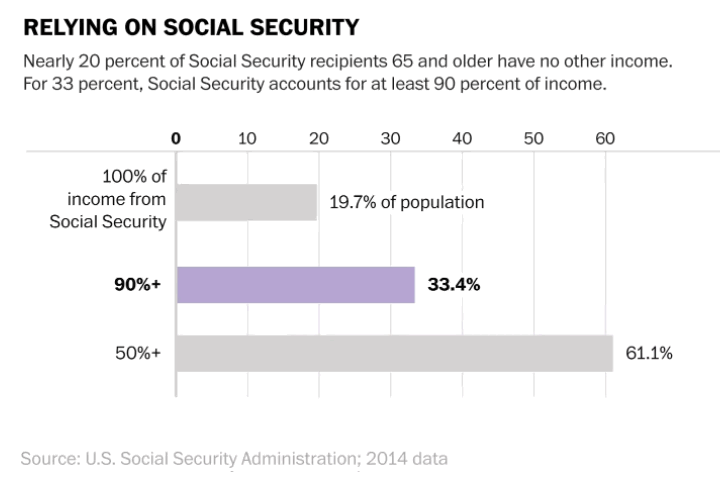
The Washington Post has a rather depressing article on The New Reality of Old Age in America, which includes the following chart about Social Security:

ss_percent

For 1/3rd of recipients age 65+, Social Security represents 90% or more of all their income. For 61% of recipients age 65+, Social Security represents at least half of all their income. In other words, Social Security is the cornerstone of retirement for the majority of Americans. Not a company pension. Not IRAs or 401k withdrawals.

Many articles like to explain how waiting until age 70 (the latest possible) to start withdrawals is mathematically the best move, but in reality the most common withdrawal age is 62 (the earliest possible). You only get about 75% of the monthly benefit at age 62 as compared to waiting until “full” retirement age (66 for current new retirees), but you get the money sooner.

Young people like to say things like “I don’t plan on Social Security being around when I retire”. (I probably said something like this too when I was in my 20s.) I have since talked to people whose sole income is Social Security. Nowadays, I don’t see how it could go away.

Health Insurance Premiums: Average Annual Cost $19,000 Family, $6,000 Individual

healthThe Wall Street Journal recently published (paywall?) a chart showing how the average cost of employer-provided health coverage for a family has changed from 1999-2017. The total average annual cost was $18,764 for a family and $6,690 for an individual in 2017. The data source is an annual poll of employers performed by the nonprofit Kaiser Family Foundation along with the Health Research & Educational Trust, a nonprofit affiliated with the American Hospital Association.

wsj_health

In very rough terms: a single adult is ~$500 per month ($6,000 per year), and a family is about $20,000 a year. These numbers agree overall with the preliminary health insurance quotes that I have gotten for my own family.

In addition to the rising premiums, the average annual deductible is now over $1,200 for a single worker.

The implications for an prospective early retirees are obvious. How are you going to cover this huge expense? Here’s a quick brainstorm of options. Spoiler alert: There is no easy fix.

  1. Use an Affordable Care Act (ACA) plan and get a subsidy if your income is low enough to qualify. Do a lot of reading, then hope it doesn’t change?
  2. Plan ahead with a job that offers health insurance benefits in early retirement (don’t have to be a certain age). You’ll probably have to hunker down with the same employer for a number of years.
  3. Save enough money (or create enough income) to pay for health insurance premiums. Try a managed-care system like Kaiser for a low-cost HMO plan.
  4. Find a part-time job that you both enjoy and offers health benefits.
  5. Run a part-time side business that earns enough profit to cover health insurance costs. Look for potential group discounts or tax breaks that are available as a business instead of a consumer.
  6. Now and later, look for a high-deductible health plan (HDHP) and fund a Health Savings Account (HSA) due to the tax advantages.
  7. Join a direct primary care arrangement or health care sharing ministry that is exempt from ACA.
  8. Extend your current employer coverage for up to 18 months through COBRA (check cost).
  9. Move to a foreign country with reasonable and transparent cash pricing.

Am I missing anything? Right now, we have #4. My family’s future plan is a mix of #1, 3, and 5. However, #5 could push us over the income limits for #1.

Absolute vs. Relative Standard of Living: What is Enough?

univ_brk

I’m currently reading University of Berkshire Hathaway: 30 Years of Lessons Learned from Warren Buffett & Charlie Munger at the Annual Shareholders Meeting by Daniel Pecaut and Corey Wrenn. As opposed to a rehash of the BRK shareholder letters, it contains highlights from listening to Warren Buffett and Charlie Munger live during the shareholder meetings in Omaha, Nebraska from 1986-2015. (The equivalent of a live Beyonce or Springsteen concert for investing geeks.)

I’ve always appreciated that Buffett and Munger are very rational and practical people, and one theme that I picked up from this book was the concept of absolute vs. relative standard of living.

What is enough? You’ve probably heard some variant of the phrase “live like a college student” when talking about how to save money. I certainly used this tactic successfully for many years, and Buffett explains why it makes sense:

Buffett contended that the average college student has the same standard of living as he does. Same food. No important difference in clothes, cars, TVs. After you have enough for daily life, all that matters is your health and those you love. Likewise in work, what really matters is that you enjoy it and the people with which you work. Munger concluded humorously, “What good is health? You can’t buy money with it.”

Ask yourself: Does this make me healthier? Does this let me spend more time with the people I love? Does it give me valuable knowledge? Think about how a large portion of the luxury world exists without actually improving your quality of life: luxury cars, designer clothing, fancy purses, fancy watches.

Stop comparing yourself to others. Buffett reminds us that envy is the worst among the seven deadly sins. You feel miserable with no upside at all. (The rest are gluttony, greed, lust, sloth, wrath, and pride.)

If someone else is getting rich, so what? Someone else will always be doing better. He asserted that the notion that an investor or investment manager should be “required” to beat everyone else is nonsense. The real key is to know what you really want to avoid and give those things a wide berth (such as a bad marriage, an early death, and so on). Do this and life will go much better, he advised.

I think this concept is under-appreciated in the investment world. You manage to lose a little less money than a benchmark and you still “win”? Think about the people who have quietly gotten rich with rental properties. They don’t worry about benchmarks, they just make sure the rent checks come in and the building is maintained. When they can, they buy another property. Over the long run, it works out just fine. You could do something similar by regularly buying a Vanguard Target Retirement Fund, Vanguard Balanced Fund, or even Vanguard Wellington Fund.

Money vs. Quality of Life. Make no doubt about it, Buffett enjoys having a lot of money. I imagine he treats it like a video game with dollars instead of points. However, he separates money and quality of life. That’s what has let him decide to give almost all of it away to charity. He’s donated over $27 billion already, with a total amount that could be over $100 billion (depending on the future value of Berkshire stock):

Buffett added that as far as he’s concerned, he hasn’t given up anything. He hasn’t changed his life. He couldn’t eat any better or sleep any better, so he really hasn’t given up anything. Someone giving up a trip to Disneyland to make a donation is the one making a real sacrifice.

These simple quotes can provide a basic outline for early retirement. First, try your best to stop comparing yourself to others, as that’s a game you’ll never win. Besides, if you act and spend like everyone else, then you’ll be working as long as everyone else. Next, decide what kind of daily lifestyle is “enough”. Does that require spending $30k a year? $50k a year? $80k a year? Now work to save 25 times that amount. $30k a year = $750,000. $50k a year = $1.25 million. (You might want to revisit the “enough” question after doing this multiplication…) That’s a nice rough number. Now work on the income side of the equation while keeping your spending side in check. In the meantime, enjoy your awesome quality of life. Appreciate the good stuff like nourishing food, hot showers, comfortable beds, nature, air conditioning, friends, and family.

Tough Times for Conservative Income Investors

JP Morgan Asset Management recently released the Q3 2017 update to their Guide to the Markets, which is another of those resources worth bookmarking for future updates. Some folks put a lot of time and energy into it, and it contains a lot of interesting charts and graphs. Here’s just one that caught my eye.

I consider myself a relatively conservative income-oriented investor, and this chart shows why it’s been a tough several years to be that type of investor. For much of the last 30+ years, you could have put your hard-earned money in an FDIC-insured certificate of deposit and enjoyed a guaranteed return above inflation. This isn’t even when shopping around for the top rates, just taking the average bank CD rates.

saverincome

Nowadays, you’re just trying to keep the bleeding to a minimum, jumping at the chance to grab a 3% APY long-term CD that might just keep up with inflation.

This also partially explains why the stock market keeps going up and up. Which would you rather have?

  • FDIC-insured cash savings that gives you $1 in annual interest per $100 invested, or a
  • S&P 500 ETF with a 4% earnings yield and 2% dividend yield? In other words, a basket of companies that for every $100 invested earns $4 a year in profit and out of that gives you $2 a year in cash dividends?

I really can’t complain as my overall portfolio of stocks, bonds, and bank CDs has more than doubled in the past several years. Yet, I also share that vague feeling of uneasiness with many other investors.